Dynamical invariants for group automorphisms
MILES, Richard <http://orcid.org/0000-0002-9805-1628>, STAINES, Matthew
and WARD, Thomas
Available from Sheffield Hallam University Research Archive (SHURA) at:
http://shura.shu.ac.uk/17221/
This document is the author deposited version. You are advised to consult the
publisher's version if you wish to cite from it.
Published version
MILES, Richard, STAINES, Matthew and WARD, Thomas (2015). Dynamical
invariants for group automorphisms. In: BHATTACHARYA, Siddhartha, DAS, Tarun,
GHOSH, Anish and SHAH, Riddhi, (eds.) Recent trends in ergodic theory and
dynamical systems : international conference in honor of S.G. Dani's 65th birthday,
December 26-29, 2012, Vadodara, India. Contemporary Mathematics (631).
American Mathematical Society, 231-258.
Copyright and re-use policy
See http://shura.shu.ac.uk/information.html
Sheffield Hallam University Research Archive
RICHARD MILES, MATTHEW STAINES, AND THOMAS WARD
Abstract. We discuss some of the issues that arise in attempts to classify automorphisms of compact abelian groups from a dynamical point of view. In the particular case of automorphisms of one-dimensional solenoids, a complete description is given and the problem of determining the range of certain in-variants of topological conjugacy is discussed. Several new results and old and new open problems are described.
1. Introduction
Automorphisms and rotations of compact abelian metric groups provide the simplest examples of dynamical systems, and their special structure makes them amenable to detailed analysis. In particular, their strong homogeneity properties allow global invariants (notably the topological entropy) to be calculated locally.
Here we wish to discuss the problem of classifying compact group automorphisms viewed as dynamical systems in the most naive sense. Denote byG the space of all pairs (G, T), where T is an automorphism of a compact metric abelian group G, and let∼denote a dynamically meaningful notion of equivalence between two such systems. Then the problem we wish to discuss has three facets:
• Classification: can the quotient spaceG/∼be described?
• Range: for some invariantπof such systems, what is
{π(G, T)|(G, T)∈ G}?
• Fibre: for a given value f of some invariant or collection of invariants π, what can be said about
{(G, T)∈ G |π(G, T) =f}?
We will describe some of the issues that arise in formulating these questions, re-calling in particular some of the well-known difficulties in the classification problem both from an ergodic theory and a set theory point of view. For the range problem we will describe some recent work and present some new arguments concerned with orbit growth in particular. Many but not all of the problems identified here are well-known.
The same questions make sense for group actions. Given a countable group Γ, there is an associated spaceGΓ comprising all pairs (G, T), whereT : Γ→Aut(G) is a representation of Γ by automorphisms of the compact metric abelian groupG. While our emphasis is not on any setting beyondG=Z, one or two examples will be given to indicate where the theory has new features for other group actions.
2010Mathematics Subject Classification. Primary 37C35; Secondary 37P35, 11J72.
Key words and phrases. topological entropy, zeta function, group automorphism, Mertens’ theorem, one-solenoid, Lehmer’s problem, Mertens’ theorem, orbit Dirichlet series, Bernoulli shift, Ornstein theory.
An element (G, T)∈ G(by assumption) carries a rotation-invariant metric giving the topology, aσ-algebra BG of Borel sets, and a probability measure (Haar
mea-sure)mGpreserved byT. The most natural notion of equivalence between (G1, T1) and (G2, T2) in Gis a commutative diagram
G1
T1
−−−−→ G1
φ
y yφ
G2 −−−−→
T2
G2 where the equivariant mapφis required to be:
• a continuous isomorphism of groups, giving the equivalence of algebraic isomorphism;
• a homeomorphism, giving the equivalence oftopological conjugacy; or
• an almost-everywhere defined isomorphism between the measure spaces (G1,BG1, mG1)
and
(G2,BG2, mG2),
giving the equivalence ofmeasurable isomorphism.
Clearly algebraic isomorphism implies topological conjugacy. Entropy arguments show that topological conjugacy implies measurable isomorphism. An easy conse-quence of the type of constructions discussed later — and an instance of the type of question one might ask about the structure ofG/∼— is that each measurable isomorphism equivalence class splits into uncountably many topological conjugacy classes. We have not included the equivalence relation that is in some ways the most natural in dynamics (finitary isomorphism, essentially measurable isomorphism by a map that is continuous off an invariant null set) because there is little that can be said about it beyond those examples where it is almost self-evident how to construct such a map.
We will also be interested in various invariants for (G, T)∈ G. The most signifi-cant of these is the entropy,
h(T) = lim
εց0nlim→∞− 1
nlogmG
n\−1
j=0
T−jBε(0)
(1.1)
whereBε(0) denotes an open metric ball around the identity ofG. A manifestation of the homogeneity of the dynamics of group automorphisms is that this quantity coincides with the topological entropy and with the measure-theoretic entropy with respect to Haar measure (see Bowen [12] or [17]), and is therefore an invariant of any of the notions of equivalence above.
Topological conjugacy also preserves closed orbits and periodic points. This combinatorial data is all contained in the dynamical zeta function
ζT(z) = expX
n>1
FT(n)
n z
n, (1.2)
whereFT(n) =|{g∈G|Tng=g}|, with radius of convergence
1/lim sup
n→∞
Definition 1. For elements (G, T),(G′, T′)∈ G write (G, T)∼h(G′, T′)
ifh(T) =h(T′), and
(G, T)∼ζ (G′, T′)
ifζT(z) =ζT′(z) as formal power series.
The primary growth rate measures are
p(T) = lim
n→∞ 1
nlogFT(n)
if this exists, and
πT(X) = X
n6X
OT(n),
where OT(n) denotes the number of closed orbits of lengthn. As we will see, for
many (in several precise senses, most) examples the limit definingpwill not exist, and a more averaged measure of orbit growth comes from the dynamical Mertens’ theorem, giving asymptotics for the quantity
MT(N) = X
n6N
OT(n)
eh(T)n =
X
n6N
X
d|n
µ(n/d)FT(d)
neh(T)n ,
where the expression on the right is simply obtained by M¨obius inversion, as
FT(n) =X
d|n
dOT(n).
In general, for an action T of a countable group Γ, the periodic point data for the action is a map from the space of finite-index subgroups of Γ to N∪ {∞}, associating to each subgroupL <Γ the cardinality of the set ofL-periodic points
FT(L) ={x∈X|Tℓx=xfor allℓ∈L}. (1.3)
There is an extension of the dynamical zeta function to the setting ofZd-actions
due to Lind [40], but it does not carry all the periodic point data unless d = 1. Some of the questions considered here have been studied for full-shift actions of nilpotent groups in [46], and for specific examples ofZ2-actions by automorphisms of compact connected groups in [47].
Several of the questions we will discuss involve adopting a point of view on what is a natural family of dynamical systems, and what is a dynamically meaningful no-tion of equivalence. In this context it is reasonable to restrict attenno-tion to ergodic group automorphisms throughout, and in some cases the more interesting ques-tions arise if we also insist that the group be connected. From this point of view the natural starting point is to study automorphisms of one-dimensional solenoids, and much of what we will discuss will be concerned with these. A remarkable consequence of the work of Markus and Meyer is that all of these seemingly ex-otic one-dimensional solenoids appear generically in Hamiltonian flows on compact symplectic manifolds of sufficiently high dimension [43] (we thank Alex Clark for pointing this out). Thus, despite the seemingly strange phenomena and arithmetic questions that arise here, the dynamical systems discussed here arise naturally in smooth dynamical situations. Another reason to restrict much of our attention to one-dimensional solenoids is cowardice. In one natural direction of extension, the
with algebraic number fields or function fields of positive characteristic (see [15] for the details), and the arithmetic questions that arise become more intricate but are in principle amenable to the same methods in those settings. Another natural direc-tion is to simply replace ‘one’ byd>2, and study automorphisms ofd-dimensional solenoids. In this complete generality the difficulties are more formidable, and this is discussed further at the end of Section 5.1.
The assumption of ergodicity is a mild requirement and avoids degeneracies – automorphisms of compact abelian groups cannot be non-ergodic in dynamically in-teresting ways. Ergodicity guarantees (completely) positive entropy, and the struc-ture of compact group automorphisms with zero entropy has been described by Seethoff [56].
2. Algebraic isomorphism
Deciding if (G1, T1) and (G2, T2) are algebraically isomorphic is not a dynamical question at all. The equivalence implies that φ : G1 → G2 is an isomorphism of groups, so we are asking if the groups are isomorphic to a single group G, and then if the two elements T1 and φ−1T2φ are conjugate as elements of the group Aut(G) of continuous automorphisms of G. If the systems are expansive (or satisfy the descending chain condition) and connected, then the problem of determining conjugacy in the automorphism group is algorithmically decidable by a result of Grunewald and Segal [22] (see Kitchens and Schmidt [28, Sec. 6]). In general this cannot be expected: if the group is infinite-dimensional then elements of the automorphism group in general correspond to matrices of infinite rank.
Example 2. Toral automorphisms are conjugate if the corresponding matrices have the same characteristic polynomial and share an additional number-theoretic in-variant related to ideal classes in the splitting field of the characteristic polynomial (see Latimer and Macduffee [32] for the details). This additional invariant is already visible even on the 2-torus. For example, if
A=
3 10 1 3
, B=
3 5 2 3
then it is easy to check that ifQ∈M2(Z) hasQA=BQwe have 5detQ.
A flavour of the sort of examples that will arise in this setting is given by the next problem.
Problem 1. Given a monic polynomialχ∈Z[x] of degreed, describe the combina-torial properties of the following poset. At the bottom leveln= 0 there is a vertex for each of the finitely many algebraic conjugacy classes of the set
Mχ ={A∈GLd(Z)|det(tId−A) =χ(t)},
which may be enumerated using data from the ideal class groups of the splitting fields of the various irreducible factors ofχusing [32]. At leveln>1 there is a vertex for each of the conjugacy classes of the elements of Mχ over the ringZ[p1j :j6n] where p1, p2, . . . are the rational primes in their natural order. The edges reflect conjugacy classes merging in the larger group at each level, and the top of the poset has a vertex for each conjugacy class of the setMχin GLd(Q), which are described
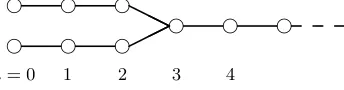
For example, Problem 1 is readily solved for Example 2 as follows. The poly-nomialχ(x) =x2−6x−1 is irreducible over Qwith splitting field Q(√10), with ideal class group isomorphic to Z/2Z. The representative matrices in Example 2 are not conjugate over Z[12] and Z[16], but become conjugate over Z[301], resulting in the diagram in Figure 1.
❢
❢ ❢
❢ ❢
❢
❢ ❢ ❢
❍❍❍ ✟✟✟
1 2 3 4
[image:6.612.222.394.190.235.2]n= 0
Figure 1. Conjugacy for the characteristic polynomialx2−6x−1.
3. Topological conjugacy
As we will see, for connected groups this notion of equivalence collapses to alge-braic isomorphism. In fact there is a rigidity phenomenon at work, which means that in many situations not only does the existence of a topological conjugacy force there to be an algebraic isomorphism, it is required to be algebraic itself.
Theorem 3(Adler and Palais [2]). IfT :Td→TdandS :G→Gare topologically conjugate ergodic automorphisms via a homeomorphismφfromTdtoG, thenG∼=
Tdand the mapφis itself an automorphism ofTd composed with rotation by a fixed point ofS.
This extends in several ways to other connected finite-dimensional groups, and to other group and semi-group actions (see Clark and Fokkink [16] and Bhattacharya and the third author [10]). Notice that the phenomena is not universal, and in particular requires the topological entropy to be finite. The next example shows that in infinite entropy situations there is no topological rigidity.
Example 4. If θ : T → T is any homeomorphism, then the map Θ : TZ → TZ
defined by (Θ ((xn)n∈Z))k=θ(xk) for allk∈Zis a topological conjugacy between
the left shift onTZ and itself.
Example 5. In contrast to the topological rigidity in Theorem 3 (as pointed out by Kitchens and Schmidt [28]) topological conjugacy on zero-dimensional groups preserves very little of the algebraic structure.
(1) A finite abelian group G has an associated shift automorphism (GZ, σG)
where (σ((xn)))k = xk+1 for all k ∈ Z. Clearly (GZ, σG) will be topo-logically conjugate to (HZ, σH) if and only if
|G| = |H|. Thus no part of the internal structure of the group alphabet is preserved by topological conjugacy.
(2) Kitchens [29] proves that ifGis zero-dimensional andTis expansive, mean-ing that there is an open neighbourhoodU of the identity with
\
n∈Z
T−nU ={e},
conjugacy is also addressed but not completely solved. It is shown that for any given entropy there are only finitely many equivalence classes for si-multaneous algebraic isomorphism and algebraic conjugacy. If the entropy is logpfor some primepthen it is shown that there is only one equivalence class, namely that containing (FZ
p,shift).
(3) For other group actions entirely new rigidity phenomena appear. Given a finite abelian group G, we may define an action σG of Z2 on the compact group
XG={x= (xn,m)∈GZ2 |xn,m+xn+1,m=xn,m+1 for alln, m∈Z} by shifting. R¨ottger [53], extending a partial result in [67], shows that the periodic point data in the sense of (1.3) for the system determines the structure ofG, and so in particular if (XG, σG) is topologically conjugate to (XH, σH) thenG∼=H.
(4) For the case G=Z/2Zin the setting ofXG as in (3), the only homeomor-phisms XG → XG commuting with the action of σG are elements of the action itself by [64].
Problem 2 (Kitchens [29]). Classify expansive ergodic automorphisms of compact abelian zero-dimensional groups up to simultaneous algebraic isomorphism and topological conjugacy.
Example 5(3) is associated in a natural way to the polynomial
1 +u1−u2∈Z[u±11, u±21]
since the condition defining the elements ofXGmay be thought of as requiring that the element ofGZ2 is annihilated by 1 +u
1−u2, with u1 corresponding to a shift in the first coordinate andu2 to a shift in the second coordinate.
Problem 3. Associate to a polynomialf ∈Z[u1±1, u±21] and a finite abelian groupG the shift actionσG,f on the space XG,f of elements ofGZ2 annihilated byf. Does
the periodic point data forσG,f determine the structure ofG?
4. Measurable isomorphism
This is an opaque equivalence relation, because as measure spaces any two in-finite compact metric abelian groups are isomorphic. A consequence of the homo-geneity mentioned above is that the entropy h(T) is an invariant of measurable isomorphism. A much deeper fact is that there is an abstract model as an indepen-dent iindepen-dentically distributed stochastic process for any ergodic group automorphism. These independent identically distributed processes – Bernoulli shifts – in turn are classified up to measurable isomorphism by their entropy (see Theorem 8 below).
Example 6. Example 5 gave some instances of topological rigidity for actions of larger groups. There is a remarkable theory of rigidity for measurable isomorphism of algebraicZdactions, and we refer to the survey of Schmidt [55] and the references
therein for this.
Theorem 7. Let (G, T) ∈ G be an ergodic compact group automorphism. Then there is a probability vector(p1, p2, . . .)defining a measureµponNwith the property
entropy Pn∈Npnlogpn of σ with respect to this measure. If h(T) < ∞ then we may assume thatpk = 0for all but finitely manyk, or equivalently we may replace the alphabetN with a finite set.
This was proved by Katznelson [27] in the case G=Td, and shown in general
by Lind [38] and independently by Miles and Thomas [44] and Aoki [4], using abstract characterizations of the property of being measurably isomorphic to a Bernoulli shift developed by Ornstein [50]. It means that an ergodic compact group automorphism is measurably indistinguishable from an abstract independent identically distributed stochastic process. Notice that the space AZ for a finite
alphabetAis a compact metric space in a natural way, so the question of whether or not the measurable isomorphism in Theorem 7 may be chosen to be finitary – continuous off a null set – in the case of finite entropy arises. Little is known in general, but Smorodinsky (unpublished) pointed out that a necessary condition is exponential recurrence – for a given non-empty open set O, the Haar measure of the set of points first returning to O after n iterations of the automorphism decays exponentially inn. Lind [39] showed that any ergodic group automorphism is exponentially recurrent, so all that is known is that this particular property does not preclude the possibility that ergodic group automorphisms are finitarily isomorphic to Bernoulli shifts. Rudolph has given a characterization of the property of being finitarily isomorphic to a Bernoulli shift [54].
Problem4. Determine when an ergodic group automorphism is finitarily isomorphic to a Bernoulli shift.
Theorem 8(Ornstein [49]). Bernoulli shifts with the same entropy are measurably isomorphic.
Theorems 7 and 8 together mean that the space G/∼ for the equivalence of measurable isomorphism embeds into R>0. There is a representative Bernoulli shift for each measurable isomorphism class of compact group automorphisms – but is there a compact group automorphism for each Bernoulli shift? Equivalently, is there a compact group automorphism for each possible entropy?
In order to describe what is known about this problem, letf ∈Z[x] be a polyno-mial with integer coefficients, with factorizationf(z) =Qdi=1(z−λi) overC. Then thelogarithmic Mahler measure off is the quantity
m(f) =
Z 1 0
log|f(e2πis)|ds= X |λi|>1
log|λi|=
d
X
i=1
log+|λi|.
Thus Kronecker’s lemma is the statement thatm(f) = 0 if and only iff is a product of cyclotomic polynomials. Lehmer [35] raised the question of whether there could be small positive values of the Mahler measure. He found the smallest value known to date, corresponding to the polynomial
f(x) =x10+x9−x7−x6−x5−x4−x3+x+ 1 with Mahler measure approximately log 1.176. Write
L= inf{m(f)|m(f)>0}.
and this led to a complete description of the range of possible values. These relate to the dynamics of group automorphisms in several ways.
Theorem 9 (Lind [37]). The infinite torus T∞ has ergodic automorphisms with
finite entropy if and only if L= 0.
An expansive automorphism is guaranteed to have finite entropy, but unfor-tunately Hastings [24] shows that no automorphisms of the infinite torus can be expansive.
Theorem 10 (Lind [38]). The set of possible entropies of ergodic automorphisms of compact groups is(0,∞] ifL= 0, and is the countable set
{m(f)|f ∈Z[x], m(f)>0}
if L >0.
This means that the cardinality of the quotient space G/∼ is uncountable or countable depending on the solution to Lehmer’s problem. This is now a problem of some antiquity, and means that we do not know if group automorphisms are spe-cial or not when viewed as measure-preserving transformations among the systems measurably isomorphic to Bernoulli shifts.
Problem 5 (Lehmer [35]). Determine ifL= inf{m(f)|m(f)>0}>0.
We refer to Boyd [13] for an overview of Lehmer’s problem. Expressed in dy-namical systems, Theorem 10 may be used to express the same question as follows.
Problem 6 (Lind [38]). Determine if it is possible to construct a compact group automorphism whose entropy is not of the formm(f) for somef ∈Z[x].
Attempting to describe the fibres (that is, the equivalence classes) for measurable isomorphism requires answering an already difficult problem in number theory, the
inverse Mahler measure problem.
Problem 7. Givenf ∈Z[x], characterize the set{g∈Z[x]|m(g) =m(f)}.
We refer to Boyd [14] for an overview of this problem, and to Staines [58] for recent work and references.
To conclude this section, it is worth noting that for other group actions the same entropy range problem, that is, the problem of determining the set
{h(T)|(G, T)∈ GΓ} ⊂R, (4.1) can turn out to be considerably simpler than providing an answer to Lehmer’s problem corresponding to the case Γ =Z. For example, Bj¨orklund and Miles [11, Th. 4.1] show that if Γ is any countably infinite amenable group with arbitrarily large finite normal subgroups, then the entropy range (4.1) is [0,∞]. In contrast, for Γ =Zd, the entropy range problem again reduces to Lehmer’s problem by [36].
Further discussion of the entropy range problem for group actions may be found in [11].
5. One-solenoids and subgroups of the rationals
5.1. Subgroups of the rationals. Subgroups of Q are readily classified (see Baer [6], or Beaumont and Zuckerman [8] for a modern account). Let H 6 Q
be an additive subgroup, andx∈H\ {0}. WriteP={2,3,5,7, . . .} for the set of rational primes. For each primep∈P, thep-height ofxis
kp(x) = sup{n∈N|pny=xhas a solutiony∈H} ∈N∪ {∞}
and thecharacteristic ofxis the sequence
k(x) = (kp(x))p∈P∈(N∪ {∞}) N
.
Two sequences (ap),(bp)∈(N∪ {∞})Nbelong to the same typeifa(p) =b(p) for all but finitely manyp, and for anypwitha(p)6=b(p), botha(p) and b(p) are finite. Notice that ifx, y∈H\ {0}thenk(x) andk(y) belong to the same type, allowing us to define thetype ofH,k(H), to be the type of any non-zero element ofH.
On the other hand, given any sequence (kp)p∈P with kp ∈ N∪ {∞}, we may
define
H((kp)p∈P) ={ab ∈Q|a, b∈Z,gcd(a, b) = 1,ordp(b)6kp for allp∈P},
an additive subgroup ofQ.
Theorem 11 (Baer [6]). Any subgroup of Q is of the formH((kp)p∈P) for some sequence (kp) ∈ (N∪ {∞})N. Two subgroups of Q are isomorphic if and only if they are of the same type.
Clearly the only self-homomorphisms of H = H((kp)) are the maps x 7→ a bx
with gcd(a, b) = 1 andkp(H) =∞for any primepdividingb. This gives a descrip-tion of all continuous automorphisms of one-solenoids: (G, T)∈ G hasGconnected with topological dimension 1 if and only ifGis dual to a groupH((kp)p∈P) andT
is dual to a map x7→ a
bxwith gcd(a, b) = 1 and with kp = ∞ for any prime p
dividingaorb. WritingS(H) for the set of primespwithkp(H) =∞, Theorem 11 shows in particular thatG∼=G′ implies thatS(Gb) =S(Gb′).
Example 12. Some of the diversity of subgroups may be seen in the following ex-amples.
(1) H((∞)p∈P) =Q.
(2) H((0)p∈P) =Z.
(3) H((∞,∞,0,0, . . .)) =Z[1 6].
(4) H((0,1,1,1,1, . . .)) is the subgroup of rationals with odd square-free de-nominator.
(5) For a set S ⊂Pof primes, there is an associated subgroup ofS-integers
RS ={x∈Q| |x|p61 for all p /∈ S}=Z[1p :p∈ S] =H((kp)p∈P)
wherekp=∞ifp∈S and 0 otherwise.
(6) Let ω= (ωj)∈ {H, T}N be the outcome of an infinitely repeated fair coin
toss, and let
kpj =
(
∞ ifj=H;
0 ifj=T.
Solenoids of higher topological dimension, dual to subgroups ofQdwithdgreater
than 1, present peculiar difficulties unless there are additional assumptions. A solenoid that carries an expansive automorphism has a prescribed structure (Law-ton [33], [34]; see also Kitchens and Schmidt [28, Sec. 5] for this result in the context of a more general treatment of finiteness conditions on group automor-phisms) rendering it amenable to analysis; solenoids dual to rings of S-integers in number fields also have a prescribed structure, and this is used by Chothi et al.
to study orbit growth in these systems [15], [19] and [20]. Around the same time as Baer’s classification of subgroups of Q, Kurosh [31] and Malcev [42] described systems of complete invariants for subgroups ofQd, but determining when the
in-variants correspond to isomorphic groups is intractable for d >1. The difficulties encountered here now have a precise formulation in terms of descriptive set theory, and Thomas [61] proves the remarkable result that the classification problem for subgroups ofQn+1is strictly more difficult than the same problem forQn forn>1
(we refer to the survey by Thomas [62] for an overview of these results).
5.2. Fixed points and entropy on one-solenoids. There are several routes to a formula for FT(n) ifT is an automorphism of a one-solenoid: a group-theoretic
argument due to England and Smith [18], a general valuation-theoretic approach due to Miles [45] which is independent of the characteristic and the topological dimension, and in the S-integer case an adelic argument due to Chothi, Everest
et al.[15]. Here we adapt the adelic approach of Weil [70] to cover all subgroups, because this geometrical approach also evaluates the entropy (the harmonic analysis used here is not strictly adelic, but closer to the constructions in Tate’s thesis [60], reproduced as [59]). For completeness we explain in Lemma 14 the basic idea from [15, Lem. 5.1], and refer to Hewitt and Ross [26] for background on the duality theory between discrete abelian groups and compact abelian groups.
The dual of a one-solenoid may be identified with a subgroup ofQ, and we now describe such a group using a direct limit of fractional ideals over a ring ofS-integers (see Example 12(5)) based on the concept of types introduced in the previous section. LetRS be a ring ofS-integers. A set of rational primesP disjoint fromS corresponds to a set of non-zero prime ideals ofRS. Letk= (kp)p∈Pbe a sequence of positive integers and define a submodule of theRS-moduleQbyH =PQcQRS, where cQ =Qp∈Qp−kp and Q runs over all finite subsets of P. The groupH is isomorphic toRS if and only ifP is finite, otherwise H may be expressed using a direct limit inj limi→∞Hi ofRS-modules, where
Hi=p(1)−kp(1)· · · · ·p(i)−kp(i)R
S,
andp(1), p(2), . . . is an enumeration ofP. By Theorem 11, for any given type we may choose a representative subgroupH =H((kp)p∈P) and note that the set
S(H) ={p∈P|kp=∞}
is independent of the choice of representative. We set
P(H) ={p∈P|0< kp<∞}
and
and use this data as above to obtain anRS(H)-module having the same type asH. Any other choice of representative subgroup produces an isomorphicRS(H)-module. This description now gives us a canonical way to view a one-solenoid.
Since there is a short exact sequence of discrete groups
{0} −→Z−→RS(H)−→
X
p∈S(H)
Z[1p]/Z−→ {0},
and the dual group of Z[1p]/Z is isomorphic to the ring ofp-adic integersZp, via
duality, there is a short exact sequence of compact groups
{0} −→ Y
p∈S(H)
Zp−→R\S(H)−→T−→ {0}. (5.1)
Therefore,R\S(H)is a central extension ofTby a cocycle
w:T×T−→ Y
p∈S(H)
Zp, (5.2)
and a simple explicit calculation along the lines of [63] shows that we may take
w(s, t) =−⌊s+t⌋((1,1, . . .)).
Furthermore, there is an explicit geometrical description of the solenoidR\S(H) as follows.
Lemma 13. The diagonal mapδ:x7→(x, x, . . .)embedsRS(H) as a discrete and
co-compact subgroup of the restricted directed product
AS(H)=
(x∞,(xp))∈R× Y
p∈S(H)
Qp|xp∈Zp for all but finitely manyp
,
which is a locally compact topological group. The set
F = [0,1)× Y p∈S(H)
Zp
is a fundamental domain forδ(RS(H))in AS(H), and
\
RS(H)∼=AS(H)/δ(RS(H)).
Proof. This is a special case of the construction introduced in [60]. See also [52] for
an accessible account.
Recall that a subgroup Γ< X in a locally compact topological group is called a
uniform latticeif Γ is discrete and the quotient spaceX/Γ is compact in the quotient topology, and a measurable setF ⊂X is afundamental domain for Γ if it contains exactly one representative of each coset of Γ. Themodule of a homomorphism
A:X→X
Lemma 14. LetΓbe a uniform lattice in a locally compact abelian groupX, letF be a fundamental domain forΓ, and letmdenote the Haar measure onX normalized to have m(F) = 1. Let Ae : X → X be a continuous surjective homomorphism with Ae(Γ)⊂Γ, and let A:X/Γ →X/Γ be the induced map. If kerA is discrete, then
modX(Ae) =|kerA|=m(AFe ).
Proof. ChooseF so that it contains an open neighborhoodU of the identity inX
(this is possible since Γ is discrete inX). SinceX/Γ is compact, kerAis finite and so there is a disjoint union A−1V =V
1⊔ · · · ⊔V|kerA| if V is a sufficiently small
neighbourhood of the identity in X/Γ, with each Vi an open neighbourhood of a point in the fibreA−1(0
X/Γ). SinceA is measure–preserving,
m A−1V=m(V).
IfU andV are sufficiently small, then the quotient mapx7→x+ Γ is a homeomor-phism betweenU andV, and so
mAUe =m(AV) =|kerA|m(V) =|kerA|m(U) ;
furthermore, sinceU(0X)⊂F, m(AFe ) =|kerA|. Example 15. A simple situation to which Lemma 14 may be applied is endomor-phisms of the torus.
(1) Taking Γ = Z < X = R, Ae(x) = bx for some b ∈ Z\ {0}, and m to be Lebesgue measure withm(F = [0,1)) = 1, we see that
|ker(x7→bx (mod 1))|=|b|.
In particular, it follows that if T : R/Z → R/Z is the map x 7→ ax for someain Z\ {0,±1} thenFT(n) =|an−1|and so
ζT(z) = 1−z 1−az
ifa >0, and
ζT(z) = exp
X
n>1
|a|n
n z n+X
n>1 1
nz n
−2X
n>1 1 2nz
2n
= 1 +z 1− |a|z
ifa <0.
(2) As seen above, some care is needed in dealing with the distinction between the expressions |an−1| and |a|n−1: for an automorphism T of the d
-torusG=Tddefined by an integer matrixAT ∈GL
d(Z) the same argument
gives the formula
FT(n) =|det(AnT−I)|,
anda priori an argument is needed to show thatζT(z) is a rational func-tion of z because of the absolute value. This is discussed in Smale [57, Prop. 4.15], and an elementary algorithmic way to compute the zeta func-tion in integer arithmetic is given by Baake, Lau and Paskunas [5].
Proposition 16. If T :Hb →Hb is an automorphism of a one-solenoid dual to the map x7→rxonH 6Q, then
FT(n) =|rn−1| × Y
p∈S(H)
|rn−1|p.
Proof. Since x 7→ rx is an automorphism of H, p ∈ S(H) whenever |r|p 6= 1.
Lemmas 13 and 14 show that ifT′ is the automorphism dual tox7→rxonA S(H), then
FT′(n) = modA
S(H)(x7→rx) =|r
n
−1| × Y
p∈S(H)
|rn−1|p.
The set of points of periodnis dual to the groupH/(rn−1)H, and multiplication
bypkp for anyp∈ P(H) remains non-invertible in the direct limitH, so
H/(rn−1)H∼=RS(H)/(rn−1)RS(H)
for eachn>1, showing the proposition.
The geometric viewpoint using adeles also allows the entropy to be computed easily using (1.1); this calculation is originally due to Abramov [1]. Write
log+(t) = max{0,logt}
fort >0.
Proposition 17 (Abramov’s formula). If T : Hb → Hb is an automorphism of a one-solenoid dual to the mapx7→rxon H6Q, then
h(T) = X
p∈P∪{∞}
log+|r|p= log max{|a|,|b|}
wherer=ab withgcd(a, b) = 1.
Proof. This formula is explained under the assumption that H = RS(H) by the following argument. First, the calculation (1.1) may be performed in the covering spaceAS(H)because the quotient map
AS(H)→R\S(H)
is a local isometry (we refer to [17, Prop. 4.7] for the details of this general lifting principle). Secondly, a small metric ball around 0 in the covering spaceAS(H)takes the form
(−ε, ε)× Y p∈S(H)
pnpZp,
and the actionfTrof multiplication byr−1on each of the coordinatesRorQ
pgives n\−1
j=0
Tr−j(−ε, ε) =
(
(−ε, ε) if|r|61; (−ε|r|−(n−1), ε|r|−(n−1)) if|r|>1, on the quasi-factorR, and
n\−1
j=0
T−j
r pnpZp=
(
pnpZ
p if|r|p61;
|r|−p(n−1)pnpZp if|r|>1,
In the general case an argument is needed to ensure that the entropy is not changed by passing fromRS(H)to the direct limitH, and we refer to [41, Prop. 3.1]
for the details.
5.3. Equivalence relations for one-solenoids. We now consider how the equiv-alence relations from Definition 1 behave for the subspace G1 ⊂ G consisting of pairs (G, T) where T : G → G is an automorphism of a one-solenoid. Thus we may assume that G is dual to a group H = H((kp)), and T = Ta/b is dual to the map x 7→ a
bx with gcd(a, b) = 1 on H, with the property that any primep
dividingabhaskp=∞.
Example 18. It is clear that the entropy and the zeta function do not together determine an element ofG1.
(1) We have (Zd[12], T2)∼ζ (Zd[12], T1/2) and (Zd[12], T2)∼h(Zd[12], T1/2).
(2) By varying the group instead of the map, much larger joint equivalence classes may be found. As pointed out by Miles [45], a consequence of Proposition 16 and Proposition 17 is that the set
n
(G, T)∈ G1|ζT(z) = 11−−2zz, h(T) = log 2
o
is uncountable. To see this, let{Sλ}λ∈Λ be an uncountable set of infinite subsets of P, all containing 2, with the property that |Sλ △Sν|=|N| for allλ6=ν. Associate to eachSλ the subgroupHλ=H((k(pλ))) where
kp(λ)=
0 ifp /∈Sλ,
1 ifp∈Sλ\ {2},
∞ ifp= 2.
Then the automorphism dual tox7→2xonHλhas zeta function 1−z
1−2z, and
by Theorem 11 these are all algebraically, and hence topologically, distinct systems.
Lemma 19. If (G, T)∼ζ (G′, T′)thenS(G) =S(G′).
Proof. Assume that (G, T)∈ G1 with T =Ta/b and Gdual toH((kp)). We claim that
{p∈P|pFT(n) for somen>1}={p∈P|p /∈ S(G) andp6ab}. (5.3) Since by hypothesisT is an automorphism, we have
pab =⇒ p∈ S(G)
so (5.3) gives the lemma. To see (5.3), notice that by Proposition 16 no prime inS(G) can divide anyFT(n), and any primep /∈ S(G) will divideap−1−bp−1and
so will divide someFT(n).
Problem 8. The case of endomorphisms is slightly different, because for exam-ple (bZ, T2) ∼ζ (Zd[12], T2) ∼ζ (Zd[12], T1/2). Formulate a version of Lemma 19 for endomorphisms of one-solenoids.
Proposition 20. On the spaceG1,
(1) ∼h has uncountable equivalence classes;
(2) ∼ζ has countable equivalence classes;
(3) the joint relation∼h and∼ζ has finite equivalence classes.
Proof. The pair (Z[[1
ab], Ta/b) has entropy log max{|a|,|b|}, and by Abramov’s
for-mula for any subset S ⊂ P\ {p| pab} of primes the pair (R\S[ab1], Ta/b) has the same entropy, showing (1).
By Lemma 19, the ∼ζ equivalence class determines the set of primes of infinite
height, and so the only parameter that can change is the rational a
b defining the
mapTa/b, and there are only countably many of these. For (3), notice that if (G2, Ta/b) has entropyhthen
max{|a|,|b|}6exph,
so there are only finitely many choices for the rationalrdefining the mapTr with a given entropy. Lemma 19 shows that there is no further choice for a fixed zeta
function.
Example 21. Some of the diversity possible in Proposition 20 is illustrated via simple examples.
(1) For any r∈Q\ {0,±1}the system (Qb, Tr) has zeta function 1
1−z, showing
that the∼ζ equivalence class may be infinite.
(2) The∼ζ equivalence class may be infinite in a less degenerate way. LetGbe
the group dual to Z(3), the subgroup obtained by inverting all the primes except 3. Then Proposition 16 shows that
FT
r(n) =|r
n−1|−1 3 by the product formula
Y
p∈P∪{∞}
|t|p=|t|×
Y
p∈P:|t|p6=1
|t|p= 1 (5.4)
for allt∈Q\ {0}. It follows that (G, T2)∼ζ (G, Tr) ifr= ab where (a, b)
is of the form
9k+3m
2 + 2, 9k−3m
2 + 1
or
9k+3m
2 + 4, 9k−3m
2 + 2
for integers m, kof the same parity chosen witha, b coprime and positive, or of the form
9k+3m+5 2 ,
9k−3m+1 2
or
9k+3m+7 2 ,
9k−3m+5 2
for integersm, kof opposite parity chosen with a, bcoprime and positive. (3) The ∼ζ equivalence class may be finite. For example, if (G, T) ∈ G1
has zeta function 1−z
1−2z, then we claim that (G, T) can only be (Zd[
automorphism, the only prime dividingabis 2, so ab is±2k for somek∈Z
and we may use Proposition 16 to calculate
ζT(z) =
( 1−z
1−2kz ifT =T2k; 1+z
1−2kz ifT =T−2k.
The constraints seen in Example 21(3) hold more generally for systems with the property that|S(Gb)|is finite.
Proposition 22. Let (G1, Tr),(G2, Ts)∈ G1 have|S(Gc1)|<∞and (G1, Tr)∼ζ (G2, Ts).
Thenr=sor r=s−1.
Proof. First notice that S(Gc2) = S(Gc1) by Lemma 19. Denote this common set of primes by S. Write r = a1
b1, s =
a2
b2 with gcd(ai, bi) = 1 and ai > 0 for i =
1,2. Since ζTr =ζTr−1 andζTs =ζT
−1
s , without loss of generality we may assume that ai > |bi| for i = 1,2. Then, using Proposition 16 (see [15, Th 6.1] for the details), it follows that
loga1= lim
n→∞ 1
nlogFTr(n) and loga2= lim
n→∞ 1
nlogFTs(n), so thata1=a2. Leta=a1=a2,
Ti={p∈ S | |a|p <|bi|p}andTi′ ={p∈ S | |a|p>|bi|p},
fori = 1,2. Notice that since gcd(a, bi) = 1,|bi|p = 1 for allp∈ Ti, and |a|p = 1
for allp∈ T′
i,i= 1,2. Hence
Y
p∈Ti∪T′
i a bi n −1 p = Y
p∈T′
i a bi n −1 p = Y
p∈T′
i
|bi|−pn =|bi|n, (5.5)
where the last equality follows by the Artin product formula, as |bi|p = 1 for
allp∈P\ T′
i.
For eachp∈ S \(Ti∪Ti′),|bai|p= 1, that is,
a
bi is a unit in the valuation ringZ(p). Let mi(p) denote the multiplicative order of a
bi in the residue field Z(p)/(p), and note that ifmi(p)6n, then|(a
bi)
n−1|
p= 1. Therefore, whenevernis coprime to
m= Y
i=1,2
Y
p∈S\(Ti∪T′
i)
mi(p),
for bothi= 1 and i= 2 we have
Y
p∈S\(Ti∪T′
i) a bi n −1 p
= 1. (5.6)
Substituting (5.5) and (5.6) into the formula given by Proposition 16 yields
FT
r(n) =|a
n
−bn1|and FTs(n) =|a
n
−bn2|,
whenever gcd(n, m) = 1. Sincea >0 anda >|b1|, it follows thatb1=±b2.
Corollary 23. The∼ζ equivalence class of(G, Ta/b)in the subset ofG1 withS(Gb)
finite has cardinality 2ω(a) + 2ω(b), where as usual ω(k) denotes the number of
6. Counting closed orbits
The most transparent combinatorial invariant of topological conjugacy is the count of periodic orbits, which may be captured using generating functions like the dynamical zeta function. For a class of ergodic group automorphisms with polyno-mially bounded growth in the number of closed orbits, a more natural generating function is given by the orbit Dirichlet series [20]. A consequence of the structure theorem for expansive automorphisms of connected groups due to Lawton [34] is the following.
Theorem 24 (Lawton [34]). IfT :G→Gis an ergodic expansive automorphism of a compact connected group, then ζT(z)is a rational function ofz.
It is clear that not every function can be a zeta function of a map – in particular the coefficients in (1.2) must be non-negative. In fact more is true, and it is shown in [51] that a function ζ(z) = expPn>1
an
nzn is the dynamical zeta function of
some map if and only if
06X
d|n µ n
d
ad≡0 (modn) (6.1)
for alln>1. A beautiful remark of Windsor is that the same condition is equivalent to being the dynamical zeta function of a C∞ diffeomorphism of the 2-torus [71]. Thus, for example,
e−z2
(1−2z)= exp
2z+z2+2 3 3z
3+24 4z
4+25 5 z
5+
· · ·
has non-negative coefficients but cannot be a dynamical zeta function of any map. England and Smyth [18] characterized in combinatorial terms the property of being the dynamical zeta function of an automorphism of a one-dimensional solenoid, and Moss [48] considered the more general question of when a function could be the dynamical zeta function of a group automorphism. Clearly the non-negativity and congruence condition in (6.1) is not sufficient, since the sequenceFT = (FT(n))n>1
for a group automorphism must be a divisibility sequence. Moss showed that adding this further condition is also not sufficient, even for linear recurrence sequences.
Lemma 25 (Moss [48]). The function f(z) = 1
(1−z)(1−z5) is the dynamical zeta
function of the permutation τ = (1)(23456) on the set {1,2,3,4,5,6}, which has the property that Fτ is a divisibility sequence, butf is not the zeta function of any
group automorphism.
Proof. The given permutationτ has
(Fτ) = (1,1,1,1,6,1,1,1,1,6, . . .),
which is a divisibility sequence satisfying the linear recurrence relation
un+5=un forn>1 with the initial conditions
u1=u2=u3=u4= 1, u5= 6.
ofGwithT5=I, the identity. If someg∈G\ {0}has orbit underT of cardinality less than 5, then there are integers 06m < n64 withTmx=Tnx, which implies
thatTn−mx=xand sox= 0 since|n−m|64. It follows that any non-identity
el-ement ofGhas an orbit of length 5 under the automorphismT, and so in particular every non-identity element ofGhas the same order, which is impossible.
England and Smyth [18] showed that
f(z) = expX
n>1
an nz
n
is the dynamical zeta function of a group automorphism dual to x 7→ mnx on a
one-solenoid if and only if
aknk−mk for allk>1 (6.2) and
gcdak,nℓa−ℓmℓ= 1 for allk6=ℓ. (6.3) They also gave an example (which does not seem to be correct) of a group automor-phism with irrational zeta function for an automorautomor-phism of a one-solenoid; there are now several ways to see that these must exist. In [65] it is shown that there are uncountably many distinct zeta functions of automorphisms dual to x 7→ 2x
on a one-solenoid (and hence most in cardinality are irrational functions); Everest, Stangoe and the third author [21, Lem. 4.1] showed that the map dual tox7→2x
onZ[1
6] has a natural boundary at|z|= 1
2. In order to relate the characterization from [18] to the S-integer constructions of Chothi, Everestet al. [15] outlined in Proposition 16, we show that they are equivalent.
Lemma 26. Given coprime integers m, n, a sequence (an) of positive integers satisfies (6.2) and (6.3) if and only if there is a subset of the primes S ⊂ P for which
ak=|nk−mk|Y p∈S
|nk−mk|
p (6.4)
for allk>1.
Proof. Clearly the existence of a setS ⊂Pwith (6.4) implies (6.2) and (6.3). Assume (6.2) and (6.3), let
S ={p∈P|pnℓ−mℓ
aℓ for someℓ>1}, and writebk =|nk−mk|Q
p∈S|nk−mk|p. If some prime powerpedivides someak,
then pe|nk −mk so by (6.3) pebk, and so akbk for all k > 1. If some prime
powerpedivides somebk, thenpenk−mk andp /∈ S and hencepeak. Thusbkak
for allk>1.
Theorem 27 (Miles [45]). If T : G → G is an ergodic automorphism of a finite-dimensional compact abelian group with finite entropy, then there exist global fieldsK1, . . . , Kn, sets of finite placesPi⊂P(Ki) and elementsξi ∈Ki, no one of
which is a root of unity fori= 1, . . . , n, such that
FT(k) =
n
Y
i=1
Y
v∈Pi
|ξki −1|−v1.
We now turn to another range problem, concerned with the growth in orbits. This may be thought of as a combinatorial analogue of Lehmer’s problem.
Theorem 28 (Ward [69]). For anyC∈[0,∞]there is a compact group automor-phism T :G→Gwith
1
nlogFT(n)−→C asn→ ∞.
Theorem 28 exploits known bounds for the appearance of primes in arithmetic progressions, and the proof works because the growth rate targeted is exponential (the caseC= 0 is trivial). The faster the growth rate sought, the easier the proof becomes (as may be seen in the proof of Theorem 29). Constructing compact group automorphisms with prescribed polynomial growth rates of periodic points is a far more delicate problem, and we refer to work of Haynes and White [25] for the current state of the problem.
6.1. Sets of primes and constructions in one-solenoids. The examples con-structed in Theorem 28 are not really satisfactory, since the groups used are zero-dimensional and (worse) the automorphisms are not ergodic. As a result it is natural to ask about the range of various invariants for ergodic automorphisms of connected groups. For rapid growth and a crude approximation, it is possible to exhibit growth in periodic orbits in a controlled way on connected groups, as illustrated in the next result (the proof of which we postpone briefly).
Theorem 29. Let θ= (θn)be a sequence of positive integers with n
logθn −→0
as n→ ∞. Then there is an automorphism T : X →X of a connected compact group with
logFT(n)
logθn −→1 asn→ ∞.
With more effort, taking advantage of known estimates for the size of the primi-tive part of linear recurrence sequence, it is likely that this result can be improved, but it is unlikely that any such approach will lead to an (unexpected) positive answer to the following.
Problem 9. Does Theorem 28 still hold if the compact groups are required to be connected?
work of the third author [66], [65], exposing in particular some of the Diophantine problems that arise.
Problem 10. Characterize the set
lim sup
n→∞ 1
nlogFT(n)|(G, T)∈ G andGis connected
of real numbers.
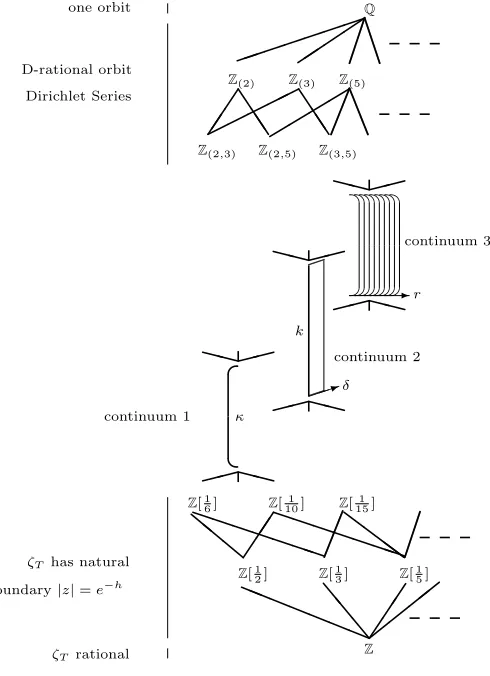
As we have seen in Proposition 16, orbit-growth questions on the space G1 es-sentially amount to questions about rational numbers and sets of primes. In this section we will give an overview of what is known in this setting specifically for the map dual to x7→ 2xon subrings of Q. Thus the systems are parameterised by subsets of P, and Figure 2 gives a guide to the results assembled here on the Hasse diagram of subsets of P, or equivalently of subrings of Q. In the diagram the standard notation for localization of rings is used for convenience, so for exam-pleZ[1
p |p6= 2,3] is writtenZ(2,3)and so on.
❳ ❳ ✘✘ ❳ ❳ ✘✘ ❳❳ ✘ ✘ ✞ ✝ ✘ ✘ ❳ ❳ ✆ ☎ ✆ ☎ ✆ ☎ ✆ ☎ ✆ ☎ ✆ ☎ ✆ ☎ ✆ ☎ ✆ ☎ ❛ ❛ ❛ ❛ ❛ ❛ ❛ ❡ ❡ ❡ ✡✡ ✡ ❧ ❧ ❧ ✡✡✡ PPP
[image:21.612.192.437.311.649.2]PPPP... ...
... ...
PPP
PPPP❩❩ ❩ ❩ ❳❳ ✘ ✘ ❳❳ ✘✘ ✏ ✏ ✏ ✏ ✏ ✏ ✏ ✑ ✑ ✑ ✑ ... ... ... ... ...... ...... ✡ ✡ ✡ ❏ ❏❏ ✟✟✟✟ ✟ ... ... ... ... ❏ ❏❏ ✧ ✧ ✧ ✧ ... ...... ... ... ... ... ... ★★ ★★ ... . . . . . . . . . . . . . . . . ✲ ✏✏✶
Z[1
2] Z[ 1
3] Z[ 1 5]
Z[1
6] Z[ 1 10] Z[
1 15]
Z Z(2,3) Z(2,5) Z(3,5)
Z(2) Z(3)
Q
Z(5)
ζT rational D-rational orbit one orbit
continuum 1
ζT has natural boundary|z|=e−h
Dirichlet Series continuum 2 continuum 3 δ k κ r
Figure 2. The Hasse diagram of subrings ofQ.
the endomorphismsx7→ax (or invert only those primes appearing ina) then the zeta functions arising are rational.
The first observation one can make about the lower part of Figure 2 (subrings of Q in which kp = ∞ for only finitely many primes p) concerns the exponen-tial growth rate of periodic points. If S ⊂ P has |S| < ∞, then there are con-stantsA, B >0 with
A nB 6
Y
p∈S
|an−bn|p61 (6.5)
for all n >1 (see [15, Th 6.1] for the details). A simple consequence of Proposi-tion (16) and the estimate (6.5) gives the construcProposi-tion needed for Theorem 29.
Proof of Theorem 29. Define a sequence (Sk) of sets of primes by
Sk ={p∈P|p2n−1 for somen < k} ∪ {2}.
Thus S1 ={2}, S2 ={2,3}, S3 ={2,3,7}, and so on, and let Tk : Xk →Xk be the automorphism dual tox7→2xonZ[1
p :p∈Sk]. By Proposition 16 and (6.5) it
follows thatFT
k(n) = 1 for n < kand limn→∞(1/n) logFTk(n) = log 2. It may be helpful to have in mind that the sequence of fixed point counts for these systems begins as follows:
FT1 = (1,3,7,15,31, . . .) FT
2 = (1,1,7,5,31, . . .)
FT
3 = (1,1,1,5,31, . . .)
FT
4 = (1,1,1,1,31, . . .),
and so on. We now inductively construct an infinite-dimensional solenoid X to-gether with an automorphismT as follows, starting at 2 for convenience.
At the first stage, letn2=⌈log3θ2⌉and let (X(2), T(2)) be then2-fold Cartesian product of copies of (X1, T1). By construction,
16 FT(2)(2)
θ2
63 =FT
1(2). (6.6)
At the next stage, let n3 =⌈log7θ3⌉ −m2 (and assume, as we may, that this is non-negative by amending the early terms of the sequenceθ), and let (X(3), T(3)) be the product of (X(2), T(2)) and then
3-fold Cartesian product of copies of (X2, T2), wherem2 is chosen to have
FT(3)(3)>θ3 and to minimize
FT(3)(3)−θ3.
By construction, we retain (6.6) but also have
16 FT(3)(3)
θ3
67 =FT
2(3).
We continue in this way, multiplying at the nth stage by a number of copies of (Xk, Tk) to approximate as well as possible the number of points of period n
sought, eventually producing an infinite product of one-dimensional solenoids T
with an automorphismT so that
16 FT(n)
θn 6FTn−1(n)62
Thus
16logFT(n)
logθn 61 + nlog 2
logθn,
giving the result by the growth-rate assumption onθ.
Example 30. The mapT dual to x7→2xonZ[1 6] has
ζT(z) = expX
n>1
|2n−1||2n−1|
3
n z
n.
The radius of convergence of ζT is 12 by (6.5), and a simple argument from [21, Lem. 4.1] shows that the series defining ζT(z) has a zero at all points of the form 12e2πij/3r
forj ∈Zandr>1, so|z|=12 is a natural boundary. The appearance of a natural boundary for the zeta function at 1
2 = exp(−h(T)) prevents an analysis of πT and MT using analytic methods. On the other hand,
the dense set of singular points on the circle|z|=1
2 form a discrete set inC3(the completion of the algebraic closure ofQ3), raising the following question.
Problem 11. For the map in Example 30 develop a notion of a dynamical zeta functionζT :C3→C3 in such a way that it has a meromorphic extension beyond its radius of convergence, and exploit this to give analytic or Tauberian proofs of statements like
MT(X) = 5
8logN+CT+ O(1/N).
There are several difficulties involved here, starting with the fact that the formal power series exp onQ3has radius of convergence 3−1/2<1; we refer to Koblitz [30] for the background needed to address this problem.
Problem 12. For a system in G1 for which the set of primes of infinite height is finite, show that if the zeta function is irrational, then it has natural boundary at e−h.
More generally, there is some reason to suspect a stronger result (see [9] for more on the methods involved here, and some partial results). In the disconnected case it is known that the zeta function is typically non-algebraic [68].
Problem 13 (Bell, Miles and Ward [9]). Is there a P´olya–Carlson dichotomy for zeta functions of automorphisms of compact groups? That is, is it true that such a zeta function is either rational or has a natural boundary at its circle of convergence?
Results of [19] give precise information about the systems at the lower end of Figure 2, and in the special case of one-solenoids they take the following form.
Theorem 31 (Everest, Miles, Stevens and Ward [19]). If T is an automorphism inG1with a finite set of primes of infinite height, then there are constantskT inQ
andCT >0 with
MT(n) =kTlogN+CT + O(1/N).
Example 32. IfT is the automorphism dual to x7→2xonZ[211] then
MT(N) =269
576logN+C+ O(1/N).
Problem 14. For systems inG1for which the set of primes of infinite height is finite, develop a notion of dynamical zeta function on the spaceQp:kp=∞Cpso that it has
a meromorphic extension beyond its radius of convergence, and exploit this to give an analytic proof of Theorem 31.
At the opposite extreme, the system corresponding to the subring Q has one closed orbit of length 1 by the product formula. If the set of primes of infinite height is co-finite, then the same basicp-adic estimate (6.5) shows that
FT(n)6nA (6.7)
for someA >0. This polynomial bound makes it natural to study the orbit growth using the orbit Dirichlet series
dT(s) =X
n>1
OT(n)
ns ,
and in [20] this is done for a large class of automorphisms of connected groups where (6.7) is guaranteed. At the level of generality adopted in [20], estimates for the growth ofπT(N) depend on the abscissa of convergence ofdT(s). However, ifT
is assumed to be an automorphism in G1, thendT(s) is found to have abscissa of
convergenceσ= 0 (see [20, Rmk. 3.7(1)]), and the following applies.
Theorem 33 (Everest, Miles, Stevens and Ward [20]). If T is an automorphism inG1with a co-finite set of primes of infinite height, then there is a finite setM ⊂N
for which dT(s)is a rational function of the variables {s−m|m∈M}, and there is a constant C >0 such that
πT(N) =C(logN)K+ O (logN)K−1, whereK is the order of the pole ats= 0.
The special structure of the orbit Dirichlet series arising in the co-finite case, which might be called Dirichlet rationality, raises the possibility of proving some or all of Theorem 33 using Tauberian methods. Unfortunately, as the next example shows, Theorem 33 does not seem to be provable using Tauberian methods for a reason related to the natural boundary phenomenon in Example 30: in all but the simplest of settings, the analytic behavior on the critical line is poor. The following example, which is an easy calculation using Proposition 16, is taken from Everest, Miles, Stevenset al.[20, Ex. 4.2].
Example 34. LetT :G→Gbe the automorphism dual to the mapx7→2xon the subringZ(3)∩Z(5)⊂Q. Then
dT(z) = 1− 1
2z+1 + 3 2z+1
1−3z1+1 − 1 2z+1 +
1 6z+1
1 1−3−z
+ 15 4z+1
1−3z1+1 −5z1+1 + 1 15z+1
1
(1−3−z)(1−5−z).
The obstacle to using Agmon’s Tauberian theorem [3] or even Perron’s Theo-rem [23, Th. 13] is illustrated in Example 34: not only does dT have infinitely
Problem 15. Develop a notion of orbit Dirichlet series with variables in the space
Q
p:kp=0Cp, and developp-adic versions of Tauberian theorems to find a meromor-phic extension of the orbit Dirichlet series arising in the setting of Theorem 33, and use this to give analytic proofs of Theorem 33(1) and (3).
Theorems 31 and 33 give some insight into the range of orbit-growth invariants across those groups with finite or co-finite set of primes of infinite height. Of course most elements of G1 fall into neither the co-finite nor the finite camp, and new phenomena appear in this large middle ground. Using delicate constructions of thin sets of primes, Baier, Jaidee, Stevenset al.[7] find several different continua of different orbit-growth invariants insideG1.
Theorem 35 (Baier, Jaidee, Stevens and Ward [7]). As illustrated in Figure 2, three different continua of orbit-growth rates exist in G1 as follows.
(1) For any κ∈(0,1) there is a system(G, T)∈ G1 with
MT(N)∼κlogN
(see Continuum 1).
(2) For any δ∈(0,1) andk >0 there is a system(G, T)∈ G1 with
MT(N)∼k(logN)δ
(see Continuum 2).
(3) For any r∈Nandk >0 there is a system(G, T)∈ G1 with
MT(N)∼k(log logN)r
(see Continuum 3).
Acknowledgements. We are grateful to Anthony Flatters for the calculation in Example 21(2), and to Alex Clark for pointing out the paper of Markus and Meyer [43].
References
[1] L. M. Abramov, ‘The entropy of an automorphism of a solenoidal group’,Teor. Veroyatnost. i Primenen 4(1959), 249–254.
[2] R. L. Adler and R. Palais, ‘Homeomorphic conjugacy of automorphisms on the torus’,Proc. Amer. Math. Soc.16(1965), 1222–1225.
[3] S. Agmon, ‘Complex variable Tauberians’,Trans. Amer. Math. Soc.74(1953), 444–481.
[4] N. Aoki, ‘A simple proof of the Bernoullicity of ergodic automorphisms on compact abelian groups’,Israel J. Math.38(1981), no. 3, 189–198.
[5] M. Baake, E. Lau, and V. Paskunas, ‘A note on the dynamical zeta function of general toral endomorphisms’,Monatsh. Math.161(2010), no. 1, 33–42.
[6] R. Baer, ‘Abelian groups without elements of finite order’,Duke Math. J. 3(1937), no. 1,
68–122.
[7] S. Baier, S. Jaidee, S. Stevens, and T. Ward, ‘Automorphisms with exotic orbit growth’,Acta Arithmetica158(2013), no. 2, 173–197.
[8] R. A. Beaumont and H. S. Zuckerman, ‘A characterization of the subgroups of the additive rationals’,Pacific J. Math.1(1951), 169–177.
[9] J. Bell, R. Miles, and T. Ward, ‘Towards a P´olya–Carlson dichotomy for algebraic dynamics’ (to appear).
[10] S. Bhattacharya and T. Ward, ‘Finite entropy characterizes topological rigidity on connected groups’,Ergodic Theory Dynam. Systems 25(2005), no. 2, 365–373.
[12] R. Bowen, ‘Entropy for group endomorphisms and homogeneous spaces’,Trans. Amer. Math. Soc.153(1971), 401–414.
[13] D. W. Boyd, ‘Speculations concerning the range of Mahler’s measure’,Canad. Math. Bull.
24(1981), no. 4, 453–469.
[14] D. W. Boyd, ‘Inverse problems for Mahler’s measure’, inDiophantine analysis (Kensington, 1985), inLondon Math. Soc. Lecture Note Ser.109, pp. 147–158 (Cambridge Univ. Press,
Cambridge, 1986).
[15] V. Chothi, G. Everest, and T. Ward, ‘S-integer dynamical systems: periodic points’,J. Reine Angew. Math.489(1997), 99–132.
[16] A. Clark and R. Fokkink, ‘Topological rigidity of semigroups of affine maps’,Dyn. Syst.22
(2007), no. 1, 3–10.
[17] M. Einsiedler, E. Lindenstrauss, and T. Ward, Entropy in dynamics (to appear). http://maths.dur.ac.uk/~tpcc68/entropy/welcome.html.
[18] J. W. England and R. L. Smith, ‘The zeta function of automorphisms of solenoid groups’,J. Math. Anal. Appl.39(1972), 112–121.
[19] G. Everest, R. Miles, S. Stevens, and T. Ward, ‘Orbit-counting in non-hyperbolic dynamical systems’,J. Reine Angew. Math.608(2007), 155–182.
[20] G. Everest, R. Miles, S. Stevens, and T. Ward, ‘Dirichlet series for finite combinatorial rank dynamics’,Trans. Amer. Math. Soc.362(2010), no. 1, 199–227.
[21] G. Everest, V. Stangoe, and T. Ward, ‘Orbit counting with an isometric direction’, in Al-gebraic and topological dynamics, inContemp. Math.385, pp. 293–302 (Amer. Math. Soc.,
Providence, RI, 2005).
[22] F. Grunewald and D. Segal, ‘Decision problems concerningS-arithmetic groups’,J. Symbolic Logic50(1985), no. 3, 743–772.
[23] G. H. Hardy and M. Riesz,The general theory of Dirichlet’s series, inCambridge Tracts in Mathematics and Mathematical Physics, No. 18 (Stechert-Hafner, Inc., New York, 1964). [24] H. M. Hastings, ‘On expansive homeomorphisms of the infinite torus’, inThe structure of
attractors in dynamical systems (Proc. Conf., North Dakota State Univ., Fargo, N.D., 1977), inLecture Notes in Math.668, pp. 142–149 (Springer, Berlin, 1978).
[25] A. Haynes and C. White, ‘Primes in arithmetic progressions in short intervals and growth rates for periodic points of group automorphisms’ (to appear).
[26] E. Hewitt and K. A. Ross, Abstract harmonic analysis. Vol. I, inGrundlehren der Math-ematischen Wissenschaften 115 (Springer-Verlag, Berlin, second ed., 1979). Structure of
topological groups, integration theory, group representations. [27] Y. Katznelson, ‘Ergodic automorphisms ofTn
are Bernoulli shifts’,Israel J. Math.10(1971),
186–195.
[28] B. Kitchens and K. Schmidt, ‘Automorphisms of compact groups’,Ergodic Theory Dynam. Systems9(1989), no. 4, 691–735.
[29] B. P. Kitchens, ‘Expansive dynamics on zero-dimensional groups’,Ergodic Theory Dynam. Systems7(1987), no. 2, 249–261.
[30] N. Koblitz,p-adic numbers,p-adic analysis, and zeta-functions, inGraduate Texts in Math-ematics 58(Springer-Verlag, New York, second ed., 1984).
[31] A. Kurosch, ‘Primitive torsionsfreie Abelsche Gruppen vom endlichen Range’,Ann. of Math. (2)38(1937), no. 1, 175–203.
[32] C. G. Latimer and C. C. MacDuffee, ‘A correspondence between classes of ideals and classes of matrices’,Ann. of Math. (2)34(1933), no. 2, 313–316.
[33] W. Lawton,Expansive Transformation Groups (Ph.D. thesis, Wesleyan University, 1972). [34] W. Lawton, ‘The structure of compact connected groups which admit an expansive
automor-phism’, inRecent advances in topological dynamics (Proc. Conf., Yale Univ., New Haven, Conn., 1972; in honor of Gustav Arnold Hedlund), pp. 182–196. Lecture Notes in Math., Vol. 318 (Springer, Berlin, 1973).
[35] D. H. Lehmer, ‘Factorization of certain cyclotomic functions’,Ann. of Math. (2)34(1933),
no. 3, 461–479.
[36] D. Lind, K. Schmidt, and T. Ward, ‘Mahler measure and entropy for commuting automor-phisms of compact groups’,Invent. Math.101(1990), no. 3, 593–629.
[37] D. A. Lind, ‘Ergodic automorphisms of the infinite torus are Bernoulli’,Israel J. Math.17