CHAMORRO-KOC, Marianella Ivonne and POPOVIC, Vesna
Available from Sheffield Hallam University Research Archive (SHURA) at:
http://shura.shu.ac.uk/480/
This document is the author deposited version. You are advised to consult the
publisher's version if you wish to cite from it.
Published version
CHAMORRO-KOC, Marianella Ivonne and POPOVIC, Vesna (2009). Context-of-use
and the design of user-product interactions: exploring causal relationships. In:
Undisciplined! Design Research Society Conference 2008, Sheffield Hallam
University, Sheffield, UK, 16-19 July 2008.
Copyright and re-use policy
Context-of-use and the design of user-product
interactions:
exploring causal relationships
Marianella Chamorro-Koc, School of Design, Faculty of Built Environment and Engineering, Queensland University of Technology, Australia.
Vesna Popovic, School of Design, Faculty of Built Environment and Engineering, Queensland University of Technology, Australia.
Abstract
Nine causal relationships that explain the cause and effect relationships between aspects of human experience, context-of-use and particular aspects of product usability have been previously identified in a study that focussed on investigating the aspects of human experience that influence people’s understanding of a product’s use. This paper reports on a work-in-progress – a pilot study experiment with practising designers - that aims to further explore these causal relationships and to investigate how they can be employed in the conceptualisation stage of a design task that emphasises product usability. Data collection includes sketches and annotations
produced during the design task, retrospective verbal reports of the designers’ interpretation of their initial design concepts, and opinions about the use of causal relationships during the design process. Indicative outcomes of the pilot study illustrate that awareness of causal relationships can assist designers in generating novel ways to enhance product usability.
Keywords
Context-Of-Use, Human Experience, User-Product Interaction, Product Usability, Product Design
In design research, issues of context-of-use have always been a component of the study of human experience. Research on experience and its relevance for the design of products has been widely explored from various perspectives (Sanders, 1999; Jordan, 2002; Kuniavski, 2003; Sleswijk Visser, Stappers, Van der Lugt and Sanders, 2005, Battarbee and Koskinen, 2005), but has mostly
centred on improving user experience through the development of more enjoyable user-product interactions (Sanders, 2002; Forlizzi and Ford, 2000; Overbekee, Djadjadiningrat, Hummels and Stephan, 2002; Sengers, 2003). However, research indicates that experience results from the user’s
product’s contextual information triggers users’ understanding of a product’s use.
The following section further explores these fundamental notions of context-of-use, human experience and the user-product interaction. The Background Study section then outlines the author’s earlier empirical study which investigated how people’s experience influences their understanding of product usability (Chamorro-Koc, 2007). Findings from that study identify nine causal relationships explaining the cause and effect relationships between human experience and people’s understanding of a product’s use and context-of-use; these are presented in the section Causal relationships. Applicability of these findings were verified in a design situation in which a design tool - Experience and Context Enquiry Design Tool (ECEDT) - was devised to present causal relationships in a manner accessible to designers. This tool was devised for trial purposes only (Chamorro-Koc, Popovic and Emmison, 2007) and it was acknowledged that causal relationships required further study in order to determine two key factors: the different ways in which these relationships relate to people’s knowledge of a product’s use and of their context-of-use; and the relevance of their application in the user-research stage of a design task (Chamorro-Koc, 2007).
Thus, the Current Study section of this paper reports on a work-in-progress, an empirical study that focuses on further exploring these nine causal
relationships, and which aims to understand (i) how causal relationships inform a design task and (ii) how designers perceive the relevance and applicability of the causal relationships in a design task. Indicative Outcomes section reports indicative outcomes of the study to date and includes an exemplar from the data collected.
It is expected that this study will deliver two types of results: (i) verification and/or identification of sub-relationships of causal relationships, and (ii) further exemplars of how causal relationships inform the design of user-product interaction. Additionally it will further and strengthen the theoretical
background of the ECEDT database which demonstrates the relevance of this knowledge and was trialed in the preceding study.
Context-of-use, human experience and the user-product
interaction
become productive interactions, are relevant to the design of interactive devices. Suchman’s studies introduced the term ‘situated action’, which establishes that human action is situated within culture, a particular context, experience and activity. Her concept of situated action has been applied in the field of Human Computer Interaction (HCI) and Design, serving as a platform for emerging concepts, and contributing to other human–machine interaction studies in which human experience has been related to context-of-use issues.
Design studies involving human experience as part of the design process considered that products of design engage people through their interaction in particular locations. This is stated in Plowman’s study (2002), which is
founded in an ethnographic approach to material culture. Plowman illustrates that people’s behavior, feelings, thoughts and understanding of things derive from their experience of everyday activities with everyday objects in a cultural location. He established the notion of ‘situatedness’, which explains that people’s experience with the multiple ways in which they integrate products (objects) designed through interaction, creates understanding about such products (2003, pp.30-31). In this sense, the context in which a product is used (situatedness) and experienced lies at the core of people’s knowledge.
The consideration of the user’s experience in the design of user-product interactions prompted an increasing interest in designing ‘beyond the object’ (Redstrom, 2006). This can be seen in the study of Overbekee et al. (2003), whose work on the design of user-product interaction stressed the importance of engaging the user in a fun and beautiful experience, as opposed to a technological or cognitive approach. Overbekee et al. pointed out that ease-of-use has been the focus for usability improvements in the design of products, but stressed that conveying contexts for experience and aesthetics of interaction in the design of products would contribute to an overall
experience.
This literature review shows that context has been considered an ingredient in human experience. It is related to culture as it projects people’s
understandings of the world, and it is related to the physical and social situations of a product’s use (Hall, 1976; Neulip, 2000). Previous studies show that the notion of experience has a connection with context issues because it takes place within particular situations, through which people’s experience of their interaction with product designs creates an understanding of the world (Frascara, 2002). Furthermore, these studies show that issues of usability have been connected to human experience as part of the studies of the user– product interaction (Maguire, 2001). The design the of user-product
interaction has taken account of several issues such as the study of human activity, the focus on user experience, and the design of contexts for
experience; however it has not identified how to use human experience issues to inform the design process and enhance the design of user-product
interactions.
Background study
human experience that are related to people’s understanding of aspects of product usability. As part of the outcomes, the study identified nine causal relationships describing the cause and effect relationships between human experience and aspects of product usability. In the study, the use of the term ‘product usability’ refers to users’ general understanding of the product (parts, functions, rationale of usage, use) and comprises users’ knowledge of a
product’s context-of-use. These findings were verified through their applicability to a design task (Chamorro-Koc et al., 2007). Three
recommendations emerged from these findings and aim to assist designers in enhancing the design of product usability by including the consideration of human experience as a component of design.
First, designing to enhance product usability requires that designers pay attention to the differences between their own concepts and the users’ concepts of a product’s use; designers must not only design from their own understanding and experience, but also consider the areas of human
experience that trigger the users’ understanding of product usability. Second, enhancing the design of product usability requires that designers pay
attention to the social aspects of a product’s use. Findings stress that the social context-of-use provides insightful information for the design of product usability. Whilst designers mostly refer to the physical environment in which a product is used, users relate more to the social environment of use.
Consequently, reference to diverse aspects or components of the social context-of-use should be included in the design of product usability to facilitate users’ understanding of a product’s use. These two
recommendations helped identify the aspects in which users’ and designers’ concepts of product usability are different. Such differences are grouped in four areas: (i) context-of-use, (ii) social context-of-use versus a product’s features, (iii) episodic knowledge and (iv) expert domain and lack of experience (Chamorro-Koc, 2007).
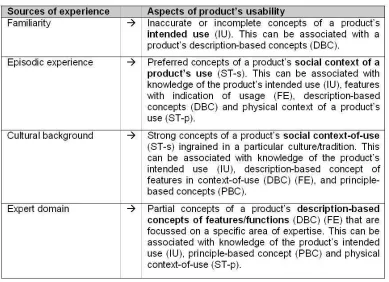
Finally, it was recommended that the design of product usability must investigate users’ familiarity with the product’s usability. This familiarity is related to the user’s expert domain and cultural background, the sources from which to uncover information about the users’ previous experience. Reference to this information should be included in the design of product use in order to assist the user’s understanding of product usage, and to prevent potential usability problems. Four specific aspects of human experience were identified; Table 1 describes them in connection to their influence on users’ understanding of aspects of product usability.
Table 1 shows four sources of experience that influence people’s
understanding of product usability. Each of these sources is connected in importance to a particular aspect of product usability. Highlighting each of these relationships can guide the design of particular usability aspects of a product’s design. For example, cultural background generates strong concepts of a product’s social context-of-use (ST-s) which is ingrained in a particular culture or tradition. The user’s cultural background can influence his or her understanding of a product’s usage and its context-of-use. It can also generate knowledge about the product’s intended use, a description of its features in the context-of-use, and principle-based concepts that explain the product’s functionalities. These findings support one of the premises of this study: that ‘human experience broadens or limits the user’s concepts of a product’s usability’.
Relationships presented in Table 1 can be employed in the early stages of the design process to inform designers about the areas of human experience that must be addressed to support particular aspects of the design of product usability. Consequently, designers can enhance users’ understanding of product usability by designing and incorporating ‘clues’ that appeal to particular areas of the intended users’ experience. The application of these relationships in a design task for verification of findings employed nine ‘causal relationships’ that are the basis of the relationships presented in Table 1. They identify the core relationships between users’ experience and their
Causal relationships
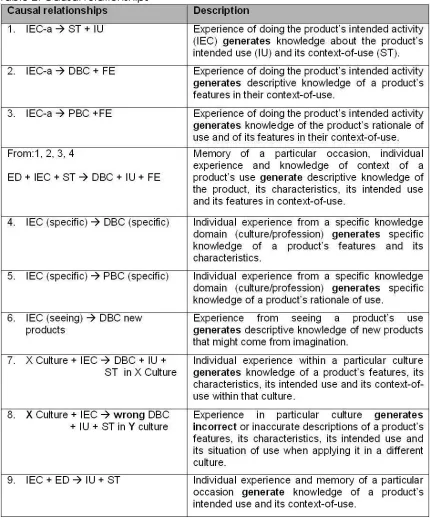
Nine causal relationships identified in the preceding study (Chamorro-Koc, 2007) explain the cause-and-effect relationships between experience, knowledge, and context-of-use. They explain how different types of
experience trigger people’s knowledge of a product’s use, intended use, and context-of-use, and how this influences their understanding of product
usability. Awareness and interpretation of these relationships can be
employed in a design process to enhance the design of product usability, as indicated in Table 2 below. For example, the causal relationship No 3 - [IEC-a
Table 2: Causal relationships
Figure 1: Components of a causal relationship
In this study, a design tool - Experience Context Enquiry Design Tool – ECEDT (Chamorro-Koc, 2007) - was devised as a research model to include and interpret the nine causal relationships in a way that informs designers about the aspects of human experience that must be addressed and to reconfirm the study findings. However, the study acknowledged that the nine causal relationships required further study in order to: find out the different ways in which these relationships relate to people’s knowledge of products’ use and of their context-of-use, and to explore the relevance of their application in the user-research stage of a design task (Chamorro-Koc, 2007).
The current study
The current empirical study seeks to address these issues. To this end, it employs a predefined design task that is presented to product designers for the application of the causal relationships and is being conducted in two stages: the first, the design stage; and the second, the retrospective verbal protocol and interview stage. Nine product designers are participating in the study, and each of them is assigned one of the nine causal relationships to explore in the design task.
Methodology
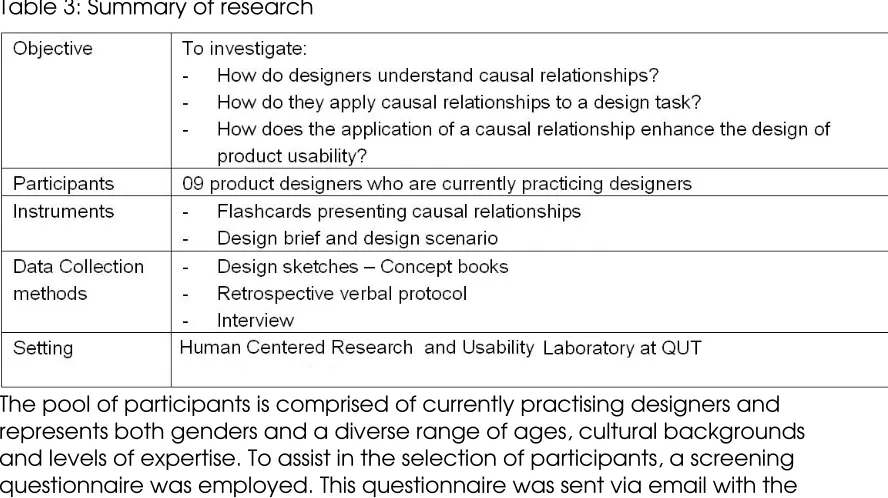
The following table summarises the research design of this study.
[image:9.595.121.565.505.754.2]Data collection is in two stages: design and interpretation. The design stage focuses on a design task in which each designer is asked to apply causal relationships in the resolution of a design task presented through a scenario and design brief. The interpretation stage focuses on retrospective verbal reports from participants to assist the interpretation and analysis of the design outcomes. Retrospective verbal reports take place in a laboratory
environment, so that responses can be video recorded to assist interpretation of visual data (sketches). There is no time limit for retrospective verbal reports.
The Experiment
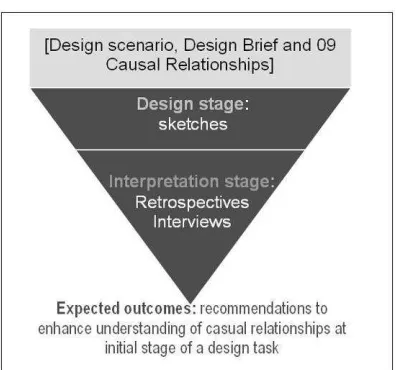
[image:10.595.121.323.237.422.2]The following figure synthesizes the experimental steps:
Figure 2: Experimental steps
A design scenario appropriate to the use of all nine causal relationships is presented to each of the participants. The design scenario aims to
contextualize and focus on the design problem in relation to usability aspects that need to be considered. A design brief outlining the design task is
provided. In this study the design task only comprises the initial
conceptualization stage of the design process. Causal relationships are
presented to the designers in the form of flashcards. Flashcards are employed in this experiment, to simplify the translation of the causal relationships into a visual form that designers can relate to. Designers are asked to consider the causal relationships and apply them during the design process. However, they are also asked to carry out the design task in the same way they would do in practice.
Design Stage: Sketches
Figure 3: Experiment instruction
Outcomes of this stage consist of sketches and annotations compiled and dated in a concept book. The design brief specifically asks designers to focus on usability aspects of the design. Therefore, the aim is to explore how
designers address product usability during concept generation. This is done through the study of design outcomes represented in visuals and annotations. It is expected that it would reveal how designers interpret the relationships between human experience, context-of-use and knowledge (causal relationship) in the design concept.
Interpretation Stage: Retrospective Verbal protocols
The interpretation stage focuses on understanding the participant’s design outcomes through their own interpretation. In order to allow participants to reflect on their designs, meetings for retrospective verbal protocol sessions are scheduled within one week from the time they have finished the design
project. This is supported by previous studies that found that the design thinking process is iterative (Schon and Wiggins, 1992) and that designers re-interpret the data every time they revisit it (Goldschmidt, 1991; Goel, 1995).
Retrospective verbal reports are employed to collect a description from the participants’ own perspective about the use of causal relationships in the design process represented in the sequence of sketches (Hannu and Pallab, 2000). The open ended interviews are conducted to ask the designers’ opinion on the usefulness and relevance of employing these causal
relationships to enhance design of product usability. They also focus on asking participants about any other issue arising from the initial observation of
sketches, and about any gaps or doubts arising from the retrospective report. The interpretation and analysis of visuals and verbal reports is assisted by ATLAS.ti and aims to identify references made to usability and experience issues in visuals and verbal reports (Chamorro-Koc, Popovic and Emmison, 2008).
The objective of the analysis is to respond to the research questions: (i) How do designers understand causal relationships? (ii) How do they apply this understanding to a design task? and (iii) How does the application of a causal
inform the design task about aspects of usability, and that they can be employed as a source of inspiration for more usable product designs. The following sections present one exemplar of the data collected to further describe these indicative outcomes.
[image:12.595.120.481.510.727.2]Figure 4 illustrates the design scenario and design brief presented to the designer (participant A), followed by the design outcomes and excerpts of verbal protocols supporting interpretation of initial outcomes.
Figure 4: Design scenario and design brief from pilot study
This design scenario and task was presented to participant A, a Chinese product design practitioner, who is temporarily living in Australia while undertaking his PhD studies. From the start, the designer highlighted that elderly people in China would not use blood pressure monitors by themselves, but would be assisted by family members with whom they live, or they would go to the nearby hospital for help. This situation contrasts with the social
context in countries such as Australia, in which elderly people are encouraged to live independently. In the case of the design of the blood pressure monitor, it seems that social context plays an important role in the experience that elderly users might have of this type of device. The following visuals show two
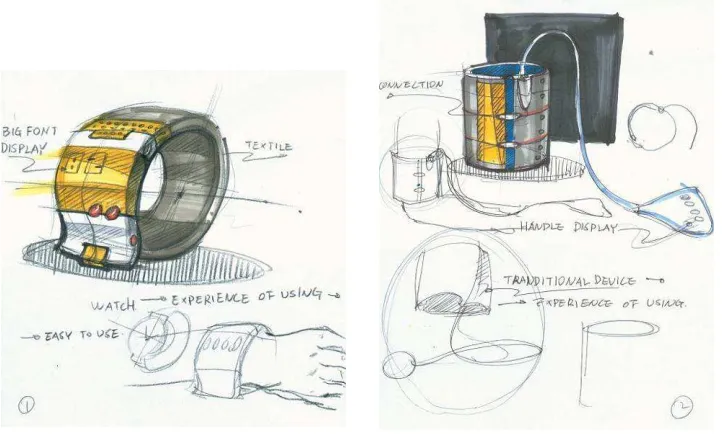
Figure 5: Design concept 1 (left), design concept 2 (right)
Figure 5 (left) shows the designer’s concept 1 of a blood pressure monitor. The visual shows that the blood pressure monitor has been transformed into a wrist band, which is composed of a soft section (annotation indicates this as
‘textile’), and a display section that uses large fonts. It illustrates a ‘clip’ to secure the wrist band and red operational buttons. Figure 5 (right) illustrates a blood pressure device that looks similar to the traditional one that is used around the arm: it has some connection points along one side and the air pump has been transformed into a handle display, as indicated by the annotations.
In the retrospective interview, the designer described his concept designs and the design process undertaken. The designer stated:
Figure 6: Excerpt from retrospective verbal report
For concept 1 he stated that he employed the causal relationship of
familiarity and experience with similar products on a particular occasion. This is the relationship: ED + IEC-a + ST -> DBC + IU + FE, which states that the memory of a particular occasion and experience in the context of a product’s use generates knowledge of the product, features, intended use and context-of-use (Table 2). He explained that elderly Chinese context-of-users are not familiar with technology but they are familiar with wrist watches as an object they can put on and wear. He also explained that, if they have to use a blood pressure monitor by themselves, then they would refer to their memory of having their blood pressure taken by the doctor. He used these ideas as inspiration to design something that resembles a wrist watch, so that users would know how to put this on. A large display is provided for ease of reading, and the use of soft material (or textile) follows the users’ familiarity with the textile material employed in the traditional blood pressure monitor used by doctors.
useful and can inspire innovative concept designs. He further explained that, in their current form, causal relationships ‘help raise knowledge points’ upon which he could build concept designs. However, the designer also pointed out that he is not sure if initial ideas would prove to be ‘usable’ by elderly users, as this requires investigating elderly users’ needs in more detail. The designer stated that perhaps the use of causal relationships could be an iterative tool during the design process, that ‘maybe after conducting further user research, the designer can go back to causal relationships to continue improving the
design concept’. These statements are consistent with those of the other two
participants. For example, participant B stated that ‘causal relationships were useful during his design process as a reminder of usability aspects to consider’
and inspired his design concepts. Also, he considered that ‘causal
relationships can be used at a later stage of the concept development, after initial design ideas have been explored; in that way they would further support the design process of addressing usability issues’.
The exemplars describe and provide further insights into the indicative outcomes stated at the beginning of this section. Regarding the research questions, these initial outcomes indicate that designers can relate to causal relationships and that they find it useful to inform their design process and enhance the design of product usability. In the case of the example
presented in this paper, excerpts from the retrospective verbal protocol show how the designer was able to connect the user experiences (of wearing wrist watches and having doctors take their blood pressure with the traditional device), with particular users’ knowledge of product use (how to put on a wrist watch, the use of textile as reference to the parts of the traditional blood pressure monitoring device). While causal relationships assisted designers to focus on usability aspects at a very early stage of the design process, the format in which causal relationships were presented to designers emerged as an issue to resolve for the main study. In this regard, one of the designers (during the interview section of experiment) claimed that: ‘still pictures used in flashcards do not help to convey the full context of the user experience in relation to the usability aspects that are being emphasized by the causal
relationship’. Overall, feedback received from designers about the causal
relationships presentation format indicates that the instrument employed (flashcards) must be reconsidered as this can have an important effect on the designers’ perceptions and understandings of the information conveyed.
Conclusions
This paper has presented a work-in-progress that focuses on further exploring a set of causal relationships that describe cause and effect relationships
between aspects of human experience and users’ knowledge of product use and context-of-use. Initial outcomes indicate that causal relationships are applicable and can help address the design of product usability at the
conceptual stage. Presenting the same design scenario and design task to all participants in the study, allows comparison of the different uses designers would make of causal relationships knowledge. Furthermore, interpretation and application of this knowledge has the potential to help to identify new emerging causal relationships. However, outcomes from the interview section indicate that designers’ understanding of causal relationships can be
to them. This aspect of the study was not considered in depth in the research design, and is currently being further explored before continuing with the experimental sessions of the study.
Overall, it is expected that this study will provide better understanding of the nine causal relationships and how they can be applied in a design task. This will support the further validation and development of the Experience and Context Enquiry Design Tool (ECEDT) conceptually developed in the
preceding study (outlined in the section Causal Relationships). More specifically, it will enhance the tool’s capabilities to assist designers in
addressing context-of-use issues and support user research at the initial design conceptualization stage.
References
Battarbee, K. & Koskinen, I. (2005). Co-experience: user experience as interaction. CoDesign, 1 (1), 5-18.
Chamorro-Koc, M. (2007). Experience, Context-of-Use and the Design of
Product Usability. Unpublished Doctoral Thesis, Queensland University of
Technology, Brisbane, Australia
Chamorro-Koc, M., Popovic, V. & Emmison, M. (2007). Experience, context-of-use and the design of the context-of-user-product interaction. In IASDR2007 Conference Proceedings Design Trends International Conference, [CD ROM], Hong Kong: Hong Kong Polytechnic University.
Chamorro-Koc, M., Popovic, V. & Emmison, M. (2008). Using visual representation of concepts to explore differences between users and
designers’ concepts of everyday products. Design Studies, 29 (2008) 142-159.
Frascara, J. (2002). Design and the Social Sciences: making connections.New York: Taylor & Francis
Forlizzi, J., & Ford, S. (2000). The building blocks of experience: an early
framework for interaction designers. In Proceedings of the 3rd conference on Designing interactive systems: Processes, practices, methods, and techniques
(pp. 419-423), New York: ACM.
Goel, V. (1995). Sketches of thought. Doctorate thesis, Massachusetts Institute of Technology, Cambridge, United States of America.
Goldschmidt, G. (1991). The dialectics of sketching. Creativity Research Journal 4 (2) 123-143
Kahmann, R.,Henze, L., 2002. Mapping the User-Product Relationship (in Product Design). In W. Green & P. Jordan (Eds), Pleasure with Products: Beyond Usability (pp. 297 – 306), New York: Taylor and Francis.
Maguire, M. (2001). Methods to support human-centered design. International
Journal of Human-Computer Studies, 55 (4) 587-634
Neulip, J. (2000). Intercultural communication: a contextual approach. Boston: Houghton Mifflin Co.
Overbeeke, K., Djadjadiningrat, T., Hummels T. & Stephan, W. (2002). Beauty in Usability: Forget Ease of Use! In W. Green & P. Jordan (Eds), Pleasure with Products: Beyond Usability (pp. 9-17). New York: Taylor and Francis.
Overbekee K., T. Djadjadiningrat, C. Hummels, Wensveen, S. & Frens J. (2003). Let’s make things engaging. In M. Blythe, K Overbekee, A MonK and P Wright (Eds), Funology: From Usability to Enjoyment. Dordrecth: Kluwer Academic Publishers.
Plowman, T. (2003). Ethnography and Critical Design Practice. In B. Laurel (Ed),
Design Research: Methods and Perspectives, (pp. 30-38). Cambridge: MIT
Press.
Redstrom, J. (2006). Towards user design? On the shift from object to user as the subject of design. Design Studies 27 (2006), 123-139
Sanders, E. (1999). Postdesign and Participatory Culture. In Useful and Critical:
The position of Research in Design Conference Proceedings. Tuusula.
Sanders, E. (2002). From user-centered to participatory design approaches. In J. Fracara (Ed), Design and the Social Sciences: Making Connections. New York: Taylor & Francis Ltd.
Schon, D. & Wiggins, G. (1992). Kinds of seeing and their function in designing.
Design Studies. 13 (2) 135-156.
Sengers, P. (2003). The Engineering of Experience. In M. Blythe, K. Overbekee, A. Monk, P. & Wright (Eds), Funology: From Usability to Enjoyment, London: Kluewer Academic Press.
Slesswijk Visser, F., Jan Stappers, P., Van der Lugt, R. & Sanders, E. (2005). Contextmapping: experiences from practice. CoDesign, 1 (2) 119-149.
Suchman, L. A. (2007). Human-machine reconfigurations: Plans and situated actions. New York: Cambridge University Press.
Rosch, E. (2002). Principles of Categorization. In D. Levitin (Ed) Foundations of
cognitive psychology: core readings (pp. 251-269), Cambridge: MIT Press.
Wilson, J. (2002). Communication artifacts: The design of objects and the object of design. In J. Frascara (Ed), Design and the Social Sciences: Making connections (pp.24-32), New York: Taylor & Francis.
Dr Marianella Chamorro-Koc
([email protected])Industrial Design from the Pontificia Universidad Catolica del Peru (Peru). As a Lecturer in Industrial Design she lectured and held the Discipline Coordination of the Industrial Design Area in the Faculty of Arts at the Pontificia Universidad Catolica del Peru (1997-2003).
Marianella Chamorro-Koc’s research interests are in the areas of product design, human-centred design, and product useability. Her PhD thesis connected the topics of experience, context of use and the design of product useability. She has been a recipient of a Faculty of BEE Scholarship (PhD degree) and a Fulbright Scholarship (M.A. degree); and she has been the Peruvian representative in ISO and participated as expert member in the initial development (2000-2003 )of the international standard ISO 20282 Ease of operation of everyday products.
Professor Vesna Popovic
([email protected])Vesna Popovic, PhD is a Professor in Industrial design at the Queensland University of Technology and she is founder of the Industrial Design
infrastructure in Brisbane, Queensland. She has worked as an industrial design and ergonomics consultant and was involved in international studies
conducted by ICSID (International Council of Societies of Industrial Design), UNDRO (United Nation Disaster Relief Organisation) and The League of Red Cross Societies. She was UNIDO Expert for Developing Countries. She has a number of realised designs and some of them received significant awards (19 Awards). She is the recipient of 6ADC Excellent Paper Award, 2003.
Vesna Popovic’s research interests are in the areas of: design (product design), interactivity and useability, research in design thinking and knowledge; human –centred design research. She has been the founder of the Human–Centred Design Research and Usability Laboratory at the Faculty of the Built
Environment and Engineering, QUT. Most of the research conducted has been published in refereed publications and conference proceedings.