Human-centric intelligent systems for
exploration and knowledge discovery
I. C. Parmee
DOI: 10.1039/b307211h
This speculative article discusses research and development relating to
computational intelligence (CI) technologies comprising powerful machine-based search and exploration techniques that can generate, extract, process and present high-quality information from complex, poorly understood biotechnology domains. The integration and capture of user experiential knowledge within such CI systems in order to support and stimulate knowledge discovery and increase scientific and technological understanding is of particular interest. The manner in which appropriate user interaction can overcome problems relating to poor problem representation within systems utilising evolutionary computation (EC), machine-learning and software agent technologies is investigated. The objective is the development of user-centric intelligent systems that support an improving knowledge-base founded upon gradual problem re-definition and reformulation. Such an approach can overcome initial lack of understanding and associated uncertainty.
Introduction
Uncertainty and poor problem definition are inherent features during early stages
of many problem-solving processes.
Immediate requirements for relevant information to improve understanding can be confounded by complex problem descriptions comprising many interacting variable parameters. Problem constraints and multiple objectives that defy com-plete quantitative representation and therefore require a degree of subjective user evaluation can further inhibit
mean-ingful progression. Indeed, problem
representation in the first instance may be merely based upon qualitative mental models arising from experiential knowl-edge, group discussion and slight empiric investigation. However, such representa-tions, coupled with user intuition, play a significant role in the identification of future direction and further investiga-tion. Initial concepts and hypotheses
based upon current understanding
require exploration in a breadth-first manner to generate relevant information that supports and enables meaningful progress.
Compound design perhaps presents a typical example where the chemist is faced with a problem of such magnitude in terms of the number of possible solutions that finding an appropriate
starting point upon which to base empiric study is a major task involving extensive experiential knowledge, skill and intuition. Although some computa-tional representations may be available to provide an indication of performance of, say, reagent combinations against specific criteria, a degree of uncertainty with regard to the fidelity of their output is generally inherent. Hence the need for human evaluation to eliminate poor reagent combinations that have survived
machine-based evaluation whilst
identifying high potential combinations for further empiric investigation. Due to the number of possible combinations across multiple reagent libraries some
form of computational search and
exploration capability is essential to identify potential high performance solu-tions for further evaluation by the
chemist.1Thus a machine/human
proce-dure could ensure that experimental effort is concentrated upon ‘best’
candi-dates thereby significantly reducing
design lead time. The above example is used in the paper to aid understanding of the proposed speculative approaches. Given the potential in the compound design domain it is apparent that the development of similar human/computer based search, exploration and classifica-tion capabilities would also be of sig-nificant benefit in other biotechnology
domains. The analysis of data sets from gene expression experiments to provide insights into gene activity under differing environmental conditions and the identification of gene regulatory networks is another area currently
receiv-ing attention.2
Problem redefinition and
reformulation
Generally, the development of
machine-based representations can support
exploration through the evaluation of identified combinations against criteria perceived to be relevant. Initial represen-tations may comprise simple rule sets coupled with basic statistical models generated from any available relevant data. Although the degree of user-confidence in the output of each criteria representation may vary considerably
such representations can provide
essential problem insight despite their apparent shortfalls. Seemingly high per-formance solutions identified in terms of quantitative criteria followed by qualita-tive human evaluation utilising experien-tial knowledge and intuition provides an indication of the viability of concepts and hypotheses and of the fidelity of the initial computational representations. An iterative user/machine-based exploratory process can commence where gradual
Downloaded on 23 August 2011
improvements in understanding
con-tribute to better representations, a
developing knowledge-base and the
eventual establishment of computational
models that support more rigorous
analysis. A highly interactive process thus emerges supporting the
develop-ment of representation through
knowledge discovery. Such a human/ machine-based development may run concurrently with, and be enhanced by, conventional empiric investigation and other forms of data/information gathering.
The above could be considered a general description of how we progress when faced with problems that initially seem beyond our perceived analytic capabilities. Using this description the following sections explore the
human-centric utilisation of evolutionary
computation, machine learning and
agent-based approaches integrated with enabling computational technologies to
significantly enhance this iterative,
knowledge discovery and representation development process. Particular areas requiring attention are:
Nthe development of meaningful
com-putational representations from
experi-ential knowledge, sparse data and
collective reasoning;
N non-linear search and exploration
processes that can negotiate the complex solution spaces described by such repre-sentations (where the solution space is described by all possible combinations of
variablese.g.reagent libraries);
N the capture of user experiential
knowledge and intuition during
re-definition of machine-based represen-tations and reformulation and subse-quent exploration of innovative solution spaces;
Ndevelopment of software agent-based
activities for information extraction,
processing and succinct presentation to the user resulting in a reduction in cognitive load.
The overall objective is the establish-ment of user-interactive computationally
intelligent search and exploration
environments that support rapid concept and hypothesis formulation, exploration and evaluation. Novel human-centred
problem-solving processes integrated
with such ‘virtual laboratories’ may lead
to innovation and scientific
break-through within an academic research
environment whilst supporting
competi-tive product development through
continuous knowledge discovery in an industrial context.
The author has been actively research-ing the development and integration of such user-centric CI systems primarily in the field of conceptual engineering
design3,4Recent involvement with
phar-maceutical and biotechnology design through close collaboration with Evotec
OAI, Milton Park, Abingdon, UK
(http://www.oai.co.uk/) indicates a very real potential for the integration of similar systems with these areas.
Search and exploration in
complex space
Concepts relating to multi-dimensional
(i.e. multi-variable) search and
explora-tion require descripexplora-tion to clarify
termi-nology. Asearch spacecomprises the set
of all possible solutions described by combinations of the problem’s
para-meters (e.g. reagents within selected
reagent libraries). Dimensionality of the
space relates to the number of variables
(e.g. reagent libraries) involved. The
size of the search space relates to the
dimensionality and the number of
values relating to each variable. For instance two reagent libraries each con-taining two hundred reagents would describe a search space of 40,000 possible
combinations. Adding a third reagent library comprising a further 200 reagents results in a space containing 8,000,000 possible combinations. This non-linear relationship creates very large search spaces even when considering relatively small numbers of variables. Such spaces
can be visualised as multi-dimensional
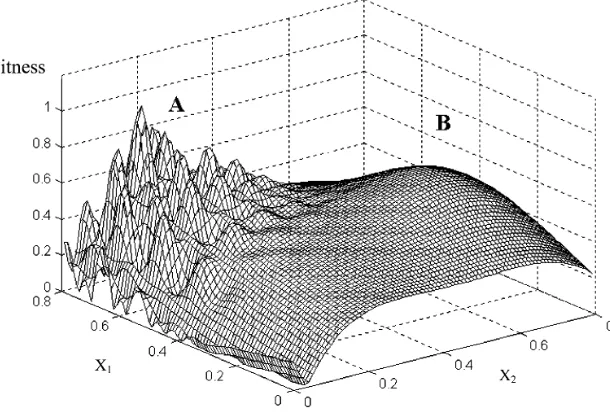
surfaces or landscapes. For instance, imagine a problem comprising two con-tinuous (real number) variables repre-sented along orthogonal horizontal axis with a vertical axis relating to the relative performance of combinations of these variables in terms of some criteria. A three-dimensional landscape representing all possible solutions at a given resolu-tion can then be plotted and visualised as shown in Fig. 1.
Obviously, a problem defined by larger numbers of variables rapidly
becomes impossible to visualize or
imagine in terms of the resulting high
dimensional landscape. The complexity
of this high-dimensional landscape is
significantly increased when integer
variables or when complex mixes of integer and continuous variables are involved in the problem description. In addition, the presence of local optima
representing best values relating to
the criteria under consideration
will create a multi-modal surface
(region A in Fig. 1) comprising peaks/ troughs upon which any form of search
Fig. 1 Search space/fitness landscape described by values of two continuous variable parameters (X1,X2) with solution performance indicated on the vertical axis. Regon A:
multi-modal characteristics. Region B: unimulti-modal characteristics.
Downloaded on 23 August 2011
[image:2.595.227.532.491.697.2]and optimization procedure may prema-turely converge. Region B is unimodal
i.e.only one peak is evident within the
region. This offers a far lesser challenge as a variety of gradient-based optimizers would rapidly converge upon the optimal point. The surface described by the
reagent combination example would
likely be extremely rugged with many local optima due to the random ordering of reagents within the reagent libraries.
Various constraints (e.g. maximum
allowable weight) will create infeasible regions of a surface and these regions may be convoluted and disjoint. Several quantitative criteria may be involved
(e.g. similarity, QSAR, docking etc.)
introducing varying degrees of conflict and creating landscapes with differing characteristics relating to a particular criteria. This introduces a requirement to search for common regions of these landscapes offering best compromise solutions.
Searching the two-dimensional land-scape in Fig. 1 presents little problem. Given existing computational capability a coarse exhaustive search of solutions would be possible. An increase in the number of variables and the inclusion of the additional complexities described above presents a far greater challenge. An exhaustive search becomes non-viable and the investigator has to rely upon sophisticated search, exploration and optimisation algorithms.
If the problem is well-defined in terms of variables, constraints and objectives that are quantifiable and of known relative importance then a range of search and optimisation techniques can be utilised that can handle the above complexities to a varying degree. Modern heuristic techniques involving popula-tions of trial solupopula-tions and stochastic
operators that promote search and
exploration and eventual convergence
are particularly well-suited to the
negotiation of such complex problem spaces. The term evolutionary
com-putation tends to cover techniques
such as these and perhaps the genetic
algorithm (GA)5 has become the best
known.
In most cases, however, high problem definition is characteristic of the latter stages of a problem-solving process. These final stages may represent the tip of the iceberg given the time and effort
involved in initial problem understand-ing, definition, formulation and repre-sentation. During early stages a high degree of assumption, particularly relat-ing to objective representation, generally provides a starting point for our investi-gations. An initial variable set may be selected with later addition or removal of variables as the sensitivity of the problem to various aspects becomes apparent. Constraints may be treated in the same way with the added option of softening them to allow exploration of non-feasible regions. Included objectives may change as significant payback becomes apparent through a re-ordering of objective pre-ferences. Some non-conflicting objectives may merge whilst difficulties relating to others may require serious re-thinking with regard to problem formulation. The initial problem space is therefore a moving feast rich in information which, when extracted and coupled with the
investigators’ experiential knowledge
and intuition supports significant pro-blem insight and subsequent propro-blem re-formulation. It is quite possible that final solutions will be identified from a space that bears little resemblance to the search space that provided a starting point for our investigations.
We are, perhaps, considering two problem search spaces:
(1) The machine-based quantitative space that is bounded and inflexible
when considered stand-alone (i.e. the
space defined by reagent libraries within a compound design situation). Search
and exploration algorithms utilizing
machine-based criteria representations to evaluate solutions can rapidly provide novel information from this space that aids problem understanding at a human level. Such understanding and subse-quent search space redefinition can remove the initial bounds.
(2) The investigators’ mental represen-tations of the problem. These representa-tions are only bounded by current
knowledge and understanding. The
development of this problem space relies upon external stimuli and human intui-tion and judgement at both a quantita-tive and qualitaquantita-tive level.
The indication from previous concep-tual design work in the engineering domain is that the appropriate melding of these two spaces will support a
holistic, knowledge-based approach
that can result in significant step changes to machine-based objective
representa-tion and in scientific/technological
understanding.
Problem reformulation
The concept of problem formulation and reformulation is well established within the engineering design research commu-nity especially when considering
innova-tive and creative design.6,7 This is
associated with the development of a designer’s understanding of a problem during the early investigative stages that may result in radical changes in problem representation. Another concept relates to the integration of knowledge from other sources through, say, analo-gical or metaphorical transfer from another problem area. This can be of significant benefit especially with regard
to the development of innovative
approaches. Also, much attention has been paid in the design research area to holistic aspects of the design process and the manner in which initial qualitative modelling of a problem domain even-tually translates into more definitive representations.
Many design research concepts map well onto generic problem-solving and decision-making processes where
com-plexity, high-dimensionality and the
inability of the user to concurrently cope with many dimensions of information (cognitive overload) obstructs progress and inhibits exploration. Computational intelligence techniques relevant to and developed within the design domain are now reaching a level of sophistication that allows them to be utilised to support a more holistic approach to
problem solving.8 Machine-based
exploratory systems can better handle the complexities of high-dimensional space ensuring that succinct specific information is available to the inves-tigator thus enabling a greater user-concentration upon the significance of emerging results.
Existing appropriate CI and
enabling technologies
Existing computational intelligence
technologies contribute in a piecewise manner to the development of
user-interactive CI systems that meld
Downloaded on 23 August 2011
machine-based problem processing and user problem solving. The flexibility of stochastic search and exploration pro-cesses provided by evolutionary
compu-tation (EC)9,10 means that complex
search spaces described by mathematical, statistical, boolean, neural network or fuzzy inference models can be efficiently and rapidly negotiated. This flexibility allows the integration of simple
rule-based models to provide initial
problem representation and the sub-sequent development and integration
of fuzzy, neural and/or statistical
models11,12 for the evaluation of
solutions as data and knowledge accu-mulates. Cluster-oriented genetic
algo-rithms13,14 can support information
extraction and multi-objective evolution-ary compuation approaches can handle multiple quantitative criteria. On-line user-centric criteria ranking capabilities
can be achieved via fuzzy preference
techniques.14,15The integration of
quali-tative criteria is implicitly supported during problem definition and re-formulation through the influence of user experiential knowledge. Software
Agent technologies17 can support
information extraction in terms of the identification of interesting solutions and support background processing of data and subsequent meaningful presentation of results to the user. Multi-agent systems can provide a machine-based negotiating capability that may assist in solution identification and selection,
qualitative objective satisfaction and
the processing of search direction
alternatives.18 A reduction in perceived
problem complexity through
machine-based processing of extracted data
and the subsequent presentation of
succinct information may thus relieve cognitive load upon the investigator. The processing of relatively mundane
tasks can be readily achieved via single
function agents thus allowing the user to concentrate more upon emerging aspects of interest. In the longer term
it is also possible that embedded
machine learning processes training
upon extracted information may enable some degree of autonomous agent-based activity.
The introduction of supporting and enabling technologies such as state-of-the-art data visualisation techniques and
high-performance computing (HPC)
would result in interactive CI search
and exploration systems where the
user becomes immersed within an
information-rich computing environment accepting and analysing output and introducing change. High-performance computing capabilities would be essential to achieve a seamless interface between
interactive processes. On-line
data-mining techniques11coupled with
agent-assisted data processing and visualisation would contribute greatly to the immer-sion concept. Overall integration with e-Science technology could lead to the establishment of Grid-based search and exploration capabilities widely available to the UK research community whilst also enabling remote access to very significant HPC resources and possibly
to diverse information sources that
enhance current knowledge of the pro-blem at hand.
The establishment of a seamless
user/machine-based information
genera-tion environment as described is
ambitious. However highly efficient
search across changing fitness landscapes
with varying objective preferences
and changing constraint conditions is achievable. It is also possible to spawn
concurrent/complementary local search
utilising appropriate algorithms.
Constraint-handling techniques can be introduced that allow exploration and information extraction relating to con-straint sensitivity. Search space sampling
techniques can be integrated with
exploration processes to rapidly generate concepts of problem complexity as land-scapes change. Statistical and CI-based modelling techniques are now available whereas the concurrent utilisation of differing model types to provide better
overall representation and increased
confidence is accepted practice in some areas.
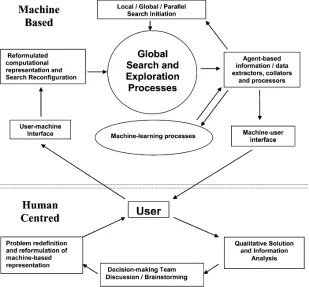
A possible configuration of the various system components and of user inter-activity is simply illustrated in Fig. 2.
The virtual laboratory
Taking all of the above into account the concept of a virtual laboratory begins to emerge. Imagine developing relatively basic machine-based criteria representa-tions from current data and constitutive theories associated with current under-standing and then being able to rapidly explore the multi-variate space described
Fig. 2 Simple illustration of a possible system configuration.
Downloaded on 23 August 2011
[image:4.595.225.534.428.715.2]by these representations using combina-tions of evolutionary algorithms and other local and global search techniques. As search progresses the system is extracting and accumulating information relating to complex characteristics of the problem domain whilst also discovering viable solutions. Solutions are initially identified that best satisfy objectives/ constraints seemingly relevant in terms of current understanding whilst back-ground processes extract information from areas of the problem space pre-viously visited and present this, in a succinct manner, on-screen to the user. The degree of difficulty of satisfying initial objectives within existing variable bounds or within existing objective pre-ference ranking becomes quantifiable and presentable through background data processing as search progresses. On-line user actions such as constraint softening, objective preference variation or modification of variable ranges may change the nature of the space and search direction whilst machine-based software agents acting as information collators, processors and presenters provide indica-tions of the effects of such changes. These agents constantly advise the user on interesting solution correlation or re-direct you to previously visited areas now of more interest. Concurrent, finer-grained, localised search processes may be spawned to explore specific regions. These actions become semi-autonomous as, through a machine-learning capabil-ity, the agents become more ‘aware’ of your requirements. The environment becomes more immersive as the user reacts to the information being presented and user on-line actions become an integral part of the exploration process negotiating this high dimensional space reacting to feedback from the system to make iterative changes to the problem landscape.
At any point this relatively continuous exploration process can be paused and relevant information downloaded and presented to the decision-making team for discussion. An easily understood graphic provides a recorded history of user-instigated change thereby support-ing traceability and allowsupport-ing analysis of the logical progression of the team’s thinking based upon extracted informa-tion. The presentation of such material promotes discussion and allows the
perspectives of others to be integrated in further exploratory interactive activity
via appropriate problem re-definition
and re-formulation.
As this iterative interactive process continues so confidence in the developing criteria representations increases, the knowledge-base becomes well-founded and uncertainty significantly decreases. A natural result is a reduction in user-interaction as we move from a
high-risk problem definition phase
through an intermediate phase of
increasing confidence to the final stages of detailed analysis of a well-defined problem space. This could be considered analogous to the conceptual, embodi-ment and detailed stages of engineering
design.19
Conclusions
There is obviously much further research required to achieve the goal of the seamless user-centric system described above. However, many of the component parts are at a stage of development
where their collective utilisation is
possible and current research is pushing hard towards achieving this. Problems specific to the biotechnology field will necessitate appropriate development of any working system based upon these concepts. It is suggested that the flexi-bility of CI technologies is such that specific problems are unlikely to be insurmountable. For instance, although a machine-based representation of an evaluation function may cause problems the user-centric approach supports com-plete or partial human evaluation of solutions and this can initially play an integral role.
Both research council and industrial
funding plus close interdisciplinary
working will be required to resolve arising problems. From an industrial point of view, however, user-centric CI search and exploration systems could best utilise seemingly endless increases in desktop computational processing capability especially considering that in-house networked machines potentially support access to very high levels of distributed computing power. Such sys-tems continuously running as back-ground processes could support the development of in-house knowledge and expertise whilst reducing lead times to
the discovery of innovative products when allied with complementary investi-gative processes.
From a more academic
research-oriented point of view the further
development and utilisation of such systems within a research environment
could support significant leaps in
understanding relating to the
charac-teristics of poorly defined complex
problem space. The ability to rapidly
and efficiently play ‘what-if’ whilst
concurrently gathering high-quality
information that either confirms or con-tradicts current thinking suggests an environment well-suited to the support of knowledge discovery and scientific breakthrough. The role of human intui-tion, experience and judgement within such an environment would be para-mount whilst the inherent support of agent-based entities in terms of informa-tion processing and presentainforma-tion would be invaluable.
I. C. Parmee
Advanced Computation in Design and Decision-making CEMS, University of the West of England, Bristol, UK.
E-mail: [email protected]
References
1 V. J. Gillet, W. Khatib, P. Willet, P. J. Fleming and D. V. Green,J. Chem. Inf. Comput. Sci., 2002,42, 375–385. 2 C. Spieth, F. Streichert, N. Sper and
A. Zell, Proceedings IEEE Congress on Evolutionary Computation, 2004, vol. 1, pp. 152–157.
3 I. C. Parmee, C. Cvetkovic, A. H. Watson and C. R. Bonham,Evol. Comput., 2000,8, 2, 197–222.
4 I. C. Parmee,Artif. Intell. Eng. Des., Anal. Manuf. J., 2002,16, 3.
5 D. E. Goldberg, Genetic Algorithms in Search, Optimisation & Machine Learning, Addison-Wesley Publishing Co., Reading, Massachusetts, 1989.
6 A. K. Goel,IEEE Exp., Intell. Syst. Appl., 1997,12, 3, 62–70.
7 N. P. Su,The Principles of Design, Oxford University Press, New York, 1990. 8 I. C. Parmee, Evolutionary and Adaptive
Computing in Engineering Design, Springer Verlag, London, 2001.
9 Handbook of Evolutionary Computation, ed. T. Ba¨ck, D. B. Fogel and Z. Michalewicz, IOP Publishing/Oxford University Press, Oxford, 1997.
10 New Ideas in Optimization, ed. D. Corne, M. Dorigo and F. Glover, McGraw Hill, London, 1999.
11 T. Hastie, R. Tibshirani and J. Friedman, The elements of statistical learning: data mining, inference and prediction, Springer-Verlag, Berlin, 2001.
Downloaded on 23 August 2011
12 R. O. Duda, P. E. Hart and D. E. Stork, Pattern classification, John Wiley, London, 2nd edn., 2001.
13 I. C. Parmee and C. R. Bonham, Artif. Intell. Eng. Des., Anal. Manuf. J., 1999,14, 3–16.
14 I. C Parmee and J. R. Abraham, IEEE Congress on Evolutionary Computation,
P o r t l a n d , U S A , 2 0 0 4 , p p . 3 9 5 – 402.
15 J. Fodor and M. Roubens,System Theory, Knowledge Engineering and Problem Solving, Kluwer Academic Publishers, 1994, vol. 14.
16 D. Cvetkovic and I. C. Parmee, IEEE Trans. Evol. Comput., 2001,6, 42–57.
17 M. J. Woodridge and N. R. Jennings, Knowl. Eng. Rev., 1995,10, 2, 115–152. 18 D. Cvetkovic and I. C. Parmee, Artif.
Intell. Eng. Des., Anal. Manuf. J, 2003, in press.
19 G. Pahl and W. Beitz,Engineering Design. Design Council, Springer-Verlag, London, 1984.
Downloaded on 23 August 2011