Power in The Wind
The Role of Law, Policy and Regulation in the Promotion and
Development of Wind Energy: The Uncertain Pursuit of
Ireland’s 2020 Renewable Electricity Target as a Case Study
By: Michael Martin
O’Connor
LL.B, LL.M (Cantab.)
Thesis submitted for the Degree of Doctor of Philosophy, Trinity
College, Dublin
10 October 2017
Supervisor: Professor Alex Schuster, Law School, Trinity College
Declaration
I, Michael Martin O
’
Connor declare that this thesis has not been
submitted as an exercise for a degree at this or any other university
and it is entirely my own work. Furthermore, I agree to deposit this
thesis in the University
’
s open access institutional repository or
allow the library to do so on my behalf, subject to Irish Copyright
Legislation and Trinity College Library conditions of use and
acknowledgement.
Michael Martin O
’
Connor
The Role of Law, Policy and Regulation in the Promotion and
Development of Wind
Energy: The Uncertain Pursuit of Ireland’s
2020 Renewable Electricity Target as a Case Study
Summary
Employing the uncertain pursuit of Ireland’s 2020 renewable electricity target as a case study, this thesis examines the role of law, policy and regulation in the promotion and development of wind energy. Specifically, this thesis seeks to highlight, examine, and understand, the reasons why Ireland (a country with one of the best wind regimes in Europe), is facing difficult challenges in meeting its 2020 national renewable electricity target, with knock on consequences for its European Union (EU) target of 16% of gross final consumption of energy from renewable energy sources by 2020; and the possibility of incurring significant compliance costs (estimated at Euro 65m-150m), in respect of each percentage point by which Ireland misses the 16% figure. Given the extent of EU policy and regulatory intervention aimed at securing specific renewable energy outcomes for individual Member States, the principal question posited in this thesis is how an ostensibly considered, detailed, all-embracing, and at times prescriptive body of EU legal instruments can potentially fail to secure, over a reasonable timeframe, what is on the face of it, a clearly defined purpose in one of the smallest, and most isolated energy markets in the EU. The answer to this question, it is submitted, does not lie in any uncertainty as to the scope of the overall purpose to be achieved. This thesis reveals that the answer lies in part, with innate, and fundamental flaws in the EU’s legislative schemes for the promotion of renewable energy and market liberalisation; in part with the manner of transposition of those legislative schemes in Ireland; but for the most part, the answer lies first and foremost with acts, omissions and failings, on the part of the State, and key actors in the Irish electricity market motivated, in many instances, by purposes that have conflicted with renewable objectives; and secondly, with the conflict that has emerged between wind farm development and protection of the environment considerations. The detailed findings put forward in this thesis in support of this overarching conclusion can be summarised under four broad contributory factor headings namely: energy law and policy failings (chapters 1-3); regulatory action and inaction (chapters 3-5); subversion of energy policy (chapters 3-5); and the conflict between wind energy and protection of the environment considerations (chapters 6-7).
literature and data. However, notwithstanding the ineluctable incorporation of economic and technical shadings, the overall scheme and substance of this research and thesis is coloured predominantly by legal and policy perspectives. This thesis does not seek to question the correctness of an EU policy that seeks to pursue decarbonisation in the interests of climate change, or indeed an Irish policy that seeks to implement that policy through the preferment of wind generation. The focus of this thesis is to scrutinise the effectiveness of, and the role played by, law and regulation in securing the desired outcomes of that policy.
To track Ireland’s progression towards its targets, it has been necessary to have recourse to various non-legal publications including publications of an economic, financial and technical nature, as well as a myriad of Irish and EU documents. Beyond this, much of the research for this thesis has involved reviewing and considering the substantial body of energy legislation, market rules, industry codes, regulatory decisions, and consultation papers that have emerged in the EU and Ireland since the EU’s market liberalisation process commenced over 20 years ago. Electricity law is predominantly a creature of statute. Research has therefore focussed heavily on primary and secondary legislation, and the various EU Directives, Regulations, and Treaty provisions that underpin Irish domestic legislation. Despite the heavily regulated, complex and risky nature of the electricity market, the multiplicity of participants with competing interests, trades and opportunities for gain as well as loss, there has been a dearth of legal actions before the Irish courts on electricity related matters. There is however evidence that this is changing, and a body of case law is starting to emerge. This case law is examined with specific focus on the approach of the judiciary to this complex area where deference to regulators and expert bodies, is the accepted position. If historically there has been an absence of case law in the electricity sector, the same cannot be said about regulatory decisions, with determinations of the Commission for Energy Regulation (CER); and the all-island Single Electricity Market Committee (SEMC) dominating the legal and regulatory landscape. This research has focussed heavily on the processes leading up to key regulatory decisions, the decisions themselves; and in appropriate instances, judicial review proceedings. This thesis considers the principal question under a series of chapter titles. Areas where it is demonstrated that policy or law has been successful in furthering the position of wind energy are contrasted with areas where there has been less success, with a view to highlighting differences in approach or emphasis that may prove to be determinative in the final analysis.
Acknowledgements
My work on this thesis commenced under the careful supervision of Dr. Bilun Müller of Trinity College Dublin, and I am very grateful to her for her sincerity, reassurance, and support in the early stages of this journey. Following Dr. Müller’s return to Germany, I was placed in the experienced and accomplished hands of Professor Alex Schuster, and I am eternally grateful to him for his guidance, patience, and constructive feed-back on my work as it progressed through many drafts towards completion.
Professors Neville Cox and Hilary Biehler, both of Trinity College Dublin, provided direction and insights on approach at an early stage that proved invaluable, and I am grateful to them both for their assistance and encouragement.
Contents
Chapter 1: Introduction ... 1
Power in the Wind ... 1
Outlining the Problem ... 2
Question for Study ... 5
Overview of Arguments ... 6
Existing Knowledge ... 8
New Area of Law ... 13
Contribution of Thesis ... 14
Methodology and Approach ... 17
Overview and Purpose of Chapters ... 19
Chapter 2: Targeting Renewables ... 24
Finding a Basis to Legislate ... 24
Renewable Energy Directives ... 25
Subsidiarity, Proportionality and Regulatory Failure ... 28
Origins of Renewable Energy in Ireland ... 30
Chapter Conclusion and Application to Thesis Themes and Questions ... 33
Chapter 3: Unbundling the Opportunity for Irish Wind Generation Technology ... 35
Network Unbundling and Wind Generation Technology ... 35
Network Unbundling as a Catalyst for Network Investment and Wind Generation ... 39
Network Unbundling and the Possibility of Competition from Wind Generation ... 42
Overview of European Network Unbundling Requirements ... 45
Ireland’s Response to European Network Unbundling Requirements ... 47
The Emergence of the Third Energy Package and Full Ownership Unbundling ... 50
Network Ownership Unbundling as an Aid to Achieving Renewable Targets ... 52
Policy Dilution and Possible Implications for Irish Wind Generation ... 54
Organisational Self-Interest as an Obstacle to Wind Generation Policy ... 58
The State as Shareholder as an Obstacle to Wind Generation Policy... 63
The Preference for a Regulatory Approach and Implications for Wind Generation ... 66
Implications of Split Ownership-Operation Model on Wind Generation Examined ... 75
Fourth Time Lucky, or a Case of ‘plus ça change, plus c'est la même chose’ ... 82
Chapter Conclusion and Application to Thesis Themes and Questions ... 83
Chapter 4: Financing the Winds of Change-Irish Financial Support Schemes ... 85
Subsidies and Subsidiarity ... 85
Gold on Them Thar Hills: The Value of Irish Support Schemes ... 86
Calculating the Cost of a Conflicting and Counterintuitive Policy Agenda... 95
New Market Entrants and the Dominant Monopoly at Every Turn ... 102
Europeanisation or Hibernicization of Support Schemes: A Policy too far? ... 105
The Cost of the Wind and Policy U-Turns in the Context of an Economic Crises ... 113
When the Gold Rush Ends and the Future of State Aid for Irish Wind Generation ... 119
Re-writing the Remit of the Regulators-Alignment of Responsibility with Expertise ... 123
Chapter Conclusion and Application to Thesis Themes and Questions ... 124
Chapter 5: Prioritising the Wind-The Role of Policy, Law and IndependentRegulation ... 126
The Challenges of Grid and Market Access for Wind Generation ... 126
Creating a Legal Framework for Grid and Market Access ... 129
The Emergence of an Independent Regulator ... 133
Divergent Views and Moratorium on Grid Access ... 138
Opening the Gates: A Strategic Approach to Allocation of Grid Capacity ... 144
The Emergence of a Market for Wind ... 153
Wind in the SEM-Tying Down the Future ... 156
Wind in the SEM-Defining Priority Dispatch ... 163
Wind in the SEM-Constraint and Curtailment ... 166
Towards I-SEM-Evolution or Revolution ... 172
Chapter Conclusion and Application to Thesis Themes and Questions ... 175
Chapter 6: Gone with the Wind-Ireland’s Proposed Wind Energy Export Projects... 177
Exporting the Wind ... 177
Creating a Policy Basis for Exporting Irish Wind Generated Electricity ... 179
Exporting Irish Wind in a European Legal Context ... 180
An Outline of the Proposed Energy Export Projects ... 182
Perceived Benefits and Economic Justification ... 183
Memorandum of Understanding or Misunderstanding? ... 183
Framework and Consultation ... 184
Opposition and Failure to Reach an Inter-Governmental Agreement ... 187
Policy and Legal Deficits as a Contributing Factor ... 189
Exporting Wind Post Brexit ... 196
Chapter Conclusion and Application to Thesis Themes and Questions ... 197
Chapter 7: Social Acceptability-A Judicial Eye at the Centre of the Perfect Storm ... 198
Stirring up the Perfect Storm ... 198
Standing Firm Against the Wind-An Overview of the Social Acceptance Debate ... 201
Kelly v An Bord Pleanála: The Case for Judicial Oversight at An Bord Pleanála ... 205
Callaghan v An Bord Pleanála-Anatomy of a Challenge ... 214
Grace v An Bord Pleanála-Towards Actio Popularis for Judicial Review ... 233
The Conflict between Wind Energy Development and The Environment ... 253
Element Power Ltd v An Bord Pleanála-Findings of Ultra Vires in a Policy Vacuum ... 255
Chapter Conclusion and Application to Thesis Themes and Questions ... 257
Chapter 8: Conclusions on Thesis Themes and Central Question ... 261
Question for Study Revisited ... 261
Wind Generation in Ireland-The Measure of Success or Failure ... 261
Energy Law and Policy as a Contributing Factor ... 264
Regulatory Action and Inaction as Contributing Factors ... 266
Subversion of Renewable Energy Policy as a Contributing Factor ... 269
The Conflict between Wind Energy and Protection of the Environment ... 272
Epilogue ... 276
Appendix 1: Abbreviations ... 278
Appendix 2: Bunreacht na h Éireann (Irish Constitution)-Table of Articles ... 291
Appendix 3: Table of Cases ... 292
Appendix 4: Table of Legislation, Treaties, Conventions, and Instruments ... 298
Appendix 5: Table of Policy and Regulation ... 318
Appendix 6: Table of Industry Reports and Communications... 333
Appendix 7: Table of Industry Codes, Licences and Agreements ... 337
Appendix 8: Table of Web Sites... 338
For My Wife
1
Chapter 1: Introduction
‘Ignoranti quem portum nullus suus ventus est.’1
Power in the Wind
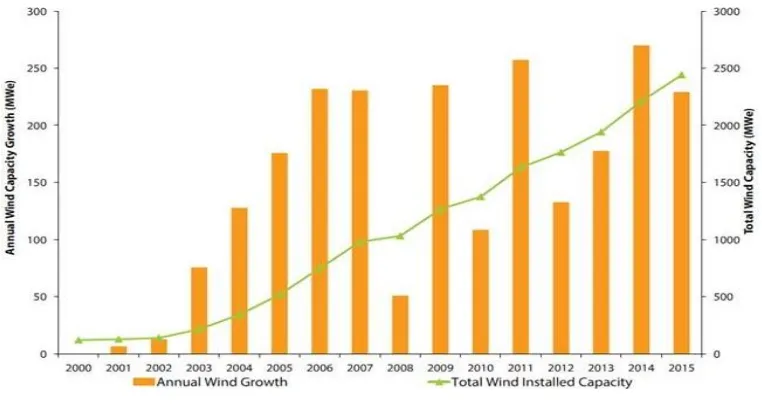
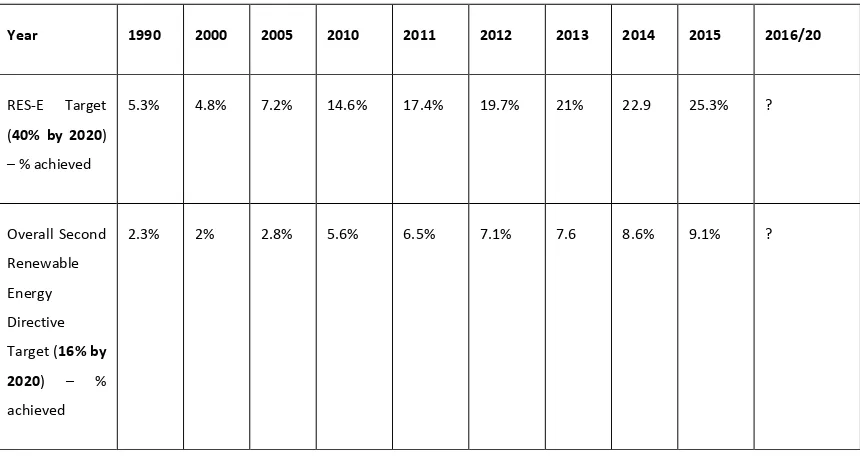
In the period from 2000 to 2015, the share of electricity derived from renewable sources in Ireland has risen from 4.8% to 25.3%.2 The greater part of this increase can be attributed to the period since 2003, and to wind generated electricity specifically, which now accounts for 22.8% of the increase.3 In 1990, wind generated electricity made no contribution to gross electricity consumed in Ireland; by 2000 it accounted for no more than 1%, but by 2015 it represented 21.1%.4 Graphs illustrating the increase in installed wind generation capacity show a gradual upward trend commencing in the late 1990s; gaining a greater upward trajectory from the mid-2000s.5 At the close of 2016, total installed wind generation capacity stood at 2,796 megawatts (MW).6 If the success of deployment of wind generating assets in Ireland is measured by reference to the rate of installed capacity over time, then it is difficult to argue that Ireland’s drive towards a sustainable and renewable future, has not been a successful one. A different, and somewhat more precise, yardstick is however employed in the measurement of success, or failure in this context namely, European Union (EU) mandated binding targets for each Member State, including Ireland.
The First Renewable Energy Directive set indicative targets at a European Community (Community), and Member State level, for electricity produced from renewable energy sources in total electricity consumption by 2010.7 At a Community level, the indicative target was 21%, while Ireland was set a target of 13.2%; a target that was met even if the Community did not meet its target.8 The Second Renewable Energy Directive followed this duality of approach with two important changes; higher and more ambitious targets, that were binding at a Community, and
1‘If one does not know to which port one is sailing, no wind is favourable’ Seneca the Younger, Epistulae Morales as Lucillum, no 71, sect 3; trans. Philip Gaskell, Landmarks in Classical Literature (Chicago Fitzroy Dearborn, 1999) 151.
2 SEAI, Energy in Ireland 1990-2015, 2016 Report (November 2016) 32.
3 In 2015 wind generated electricity accounted for over 80% of renewable electricity. See: SEAI, Renewable
Electricity in Ireland 2015-2016 Report (August 2016) 3; and DCCAE, National Mitigation Plan (July 2017) 37.
4 SEAI (n 2). 5 ibid 33.
6DCCAE (n 3) 37. For up to date wind data see: EirGrid, Smart Grid Dash Board <http://smartgriddashboard.eirgrid.com/#roi/wind> accessed 14 March 2017.
7 Council and Parliament Directive 2001/77/EC of 27 September 2001 on the promotion of electricity produced from renewable energy sources in the internal electricity market [2001] OJ L283/33, art 3. 8 Government of Ireland, National Renewable Energy Action Plan (NREAP)-Submitted under Article 4 of
2 Member State level. Under the Directive, the overall Community target is for 20% of all energy (gross final consumption), to be derived from renewable sources by 2020.9 The achievement of this target is supported by the imposition of individual binding targets on each Member State. Ireland must achieve 16% of gross final consumption of energy from renewable energy sources by 2020.10 Separately by 2020, 10% of all transport energy must come from renewable energy sources.11 The National Renewable Energy Action Plan (NREAP), prepared by Ireland pursuant to, and in the format required by, Article 4(1) of the Second Renewable Energy Directive, reflects the overriding binding target of 16%, and notes that it will be achieved by drawing on contributions from renewable energy in each of three sectors. Thus, three sub-targets for the share of energy from renewable sources in each of: electricity (40%) (RES-E Target); transport (10%) (RES-T Target); and heating (12%) (RES-H Target), consumed in 2020 are specified.12 Wind generated electricity has long been at the centre of Ireland’s plan to meet the overall 16% EU binding target, and the non-binding domestic RES-E Target.13 This thesis is solely focussed on Ireland’s management of, and approach to, this wind energy aspect of the 2020 renewable target obligations.
Outlining the Problem
The research for this thesis initially focussed on charting the course followed by Irish policy and law makers working under the pervasive umbrella of EU policy and law, with a view to garnering a better understanding of how they succeeded in creating an environment so conducive to the development of wind generation, against a background where, as recently as 1999, a single
9 Council and Parliament Directive 2009/28/EC of 23 April 2009 on the promotion of the use of energy from renewable sources and amending and subsequently repealing Directives 2001/77/EC and 2003/30/EC [2009] OJ L140/16, art 3(1) and Annex I. See also: Sarah White, Deputy Secretary General, DCENR, ‘Meeting
Ireland’s Renewable Energy Targets’ (16 April 2012)<
http://webcache.googleusercontent.com/search?q=cache:YsNGlmvG0KgJ:www.iiea.com/documents/sar a-white-powerpoint+&cd=1&hl=en&ct=clnk&gl=ie> accessed 7 September 2017.
10 ibid. See also: DCENR, Draft Renewable Electricity Policy and Development Framework-Draft Strategic
Environmental Assessment Scoping Report 2016 <http://www.dccae.gov.ie/en-ie/energy/consultations/Documents/24/consultations/Draft%20Strategic%20Environmental%20Assessm ent%20Scoping%20Report.pdf> accessed 3 October 2017.
11 ibid.
12 Government of Ireland (n 8) 5-6. The RES-E Target of 40% (renewable electricity); and RES-H Target of 12% (heating), are not binding at an EU level. Ireland has adopted these sub-targets as a means to achieving the overall binding EU target of 16% of gross final consumption of energy from renewable energy sources by 2020. The RES-T Target of 10% (transport) is binding at an EU level.
13 ibid. It is acknowledges that Ireland has one of the best wind regimes in Europe especially on the north and west coasts (See: Houses of the Oireachtas, Oireachtas Library and Research Service ‘Wind Energy-How
does it fit into Ireland’s hope for a green future?’ (2014) 3 Spotlight 6
3 vertically integrated undertaking, the Electricity Supply Board (ESB), held a virtual monopoly on the production, transmission, and supply of electricity in Ireland; and the level of installed wind powered generation was all but nominal.
With the passage of time however, a different narrative is beginning to emerge, and the final port of call for the current phase of Irish renewable energy policy now seems less certain. As the 2020 date for compliance with targets looms larger on the horizon, it is becoming apparent that there is a real possibility that Ireland will not meet its targets, and will incur very significant costs as a consequence.14 It is notable that a similar picture is emerging in at least three other Member States.15 By the end of 2015, renewable energy contributed 9.1% of energy consumption, against a 2020 target of 16% (a shortfall of 6.9%), whilst the share of electricity from renewable sources was 25.3%, against a 2020 target of 40% (a shortfall of 14.7%).16 In 2015 over 80% of renewable electricity was wind generated.17 Since the targets are based on gross final consumption of energy, they are not fixed and automatically adjust with consumption. Thus, between 2008 and 2012, gross final consumption of energy fell by 9.2%, mostly as a consequence of the economic crisis.18 However, with recovery of the economy, the demand for energy has grown, and gross final consumption of energy in 2015 was 4.4% higher than in 2012.19 Additional installed renewable energy plant is therefore required, and it is estimated that a wind generation build rate of 250-300 MW (or roughly 125 wind turbines), per annum is required to meet the 40% RES-E Target.20 The per annum build rate has varied considerably since 2000, and whilst the overall
14 The European Commission has noted that a number of Member States including Ireland may have to look to co-operation mechanisms such as statistical transfers to secure target compliance. The Commission estimate that Ireland will miss its target by .5%. See: Commission ‘Report from the Commission to the
European Parliament, the Council, the European Economic and Social Committee and the Committee of the Regions-Renewable Energy Progress Report’ COM (2017) 57 final 9-10, 17. Domestic commentators seem less optimistic. One commentator has reported that experts believe the shortfall will be as wide as 3%. See: Simon Rowe, ‘Ireland’s race against time to avoid €360m EU renewables fine’ independent.ie (14 June 2017) <http://www.independent.ie/business/irelands-race-against-time-to-avoid-360m-eu-renewables-fine-35502638.html> accessed 14 June 2017; and ’Paul O’Donoghue, ‘Ireland is expected to
miss its Renewables Target-and Cop a Multimillion Euro Bill’ the journal.ie (February 11 2017)<http://www.thejournal.ie/ireland-eu-2020-energy-fines-2-3231942-Feb2017/> accessed 14 March 2017.
15 The three Member States are Luxembourg, the Netherlands, and the United Kingdom: See Commission
(n 14) 10; and O’Donoghue (n 14).
16 SEAI (n 3) 3; and DCCAE (n 3) 37. At the end of 2015 Ireland’s RES-H Target compliance stood at 6.5% against a 2020 target of 12%; while Ireland’s RES-T Target compliance stood at 5.7% against a 2020 target of 10%. See: DCCAE (n 3) 37.
17 SEAI (n 3) 3. 18 ibid 10. 19 ibid.
4 trend is upward, it is notable that in 2015 (one of the highest years), new installed capacity was 229 MW. Whilst not insignificant, this is less than what is required if targets are to be met. The 2016 position shows evidence of improvement at 356 MW. At the other end of the spectrum, 2008 had one of the lowest build rates (less than 50 MW), a fact attributed by the Sustainable Energy Authority of Ireland (SEAI), to lack of finance, and uncertainty surrounding State aid clearance for the Renewable Energy Feed in Tariff (REFIT) Support Scheme.21 If the pursuit of Ireland’s 2020 targets is an uncertain one, so too is the level of cost or fines failure will attract. In 2016, the Energy Minister estimated that the cost of failure for the Irish taxpayer will be in the region of Euro 100-150 million for each percentage point by which Ireland fails to meet the 16% target.22 These figures show that a delay, for whatever reason, in the completion of a windfarm of say 25-30 MW, or 10% of the estimated targeted annual build rate can have a material impact on the overall total for the year, the ultimate 2020 RES-E Target, and the cost to Ireland.
Figure 1: Installed Wind Generating Capacity 1990-201523
21 SEAI (n 3) 14-15. The impact of uncertainty in support schemes and the economic crisis on wind development is considered at chapter 4 (Financing the Winds of Change-Irish Financial Support Schemes). 22 See response from Denis Naughton, T.D., and Minister for Communications, Climate Change and
Environment to a question posed by Timmy Dooley T.D., about the level of ‘fines that will be realised’ if
Ireland fails to meet 2020 targets: Dáil Deb 6 December 2016, vol 931, No.3. More recently, DCCAE has stated that it is open to Member States that fail to meet targets to purchase credits through the Statistical Transfers mechanism provided for in Article 6 of Second Renewable Energy Directive. However, as a market for such credits does not yet exist, the likely cost of such purchases is, as yet, unknown. SEAI has estimated that the cost may be in the range of €65 million to €130 million for each percentage point that Ireland falls short of the overall 16% target. (See: DCCAE (n 3) 37). IWEA put the cost, in terms of EU fines, at Euro 600m (See: Engineers Ireland, ‘IWEA Chief says Ireland will miss EU target and faces €600m fine’ Engineers Journal
(23 May 2017) <http://www.engineersjournal.ie/2017/05/23/iwea-ireland-eu-renewables-target/> accessed 7 October 2017.
5 Figure 2: Progression Towards Ireland’s RES-E Target and Ireland’s Overall 16% EU Target 1990-201524
Year 1990 2000 2005 2010 2011 2012 2013 2014 2015 2016/20
RES-E Target
(40% by 2020)
– % achieved
5.3% 4.8% 7.2% 14.6% 17.4% 19.7% 21% 22.9 25.3% ?
Overall Second
Renewable
Energy
Directive
Target (16% by
2020) – %
achieved
2.3% 2% 2.8% 5.6% 6.5% 7.1% 7.6 8.6% 9.1% ?
Figure 3: Ireland’s Progress Towards 2020 Targets-Year End 2015 Status (All Sectors)25
Sector Expected Renewable Energy
Share (RES) in 2020
Position as at 31 December
2015
Shortfall against 2020 Target
Electricity: RES-E (Non-
binding)
40% 25.3% 14.7%
Heat: RES-H (Non- binding) 12% 6.5% 5.5%
Transport: RES-T (Binding) 10% 5.7% 4.3%
Ireland’s Overall EU 2020
Target (Binding)
16% 9.1% 6.9%
Question for Study
What has emerged from this state of affairs is a much more interesting question for study namely, how an ostensibly considered, detailed, all-embracing, and at times prescriptive body of EU legal instruments, and decisions, can potentially fail to secure, over a reasonable period of time, what
[image:17.595.109.537.369.594.2]
6 is on the face of it, a clearly defined purpose in one of the smallest, and most isolated energy markets in the EU. This superseding question gives rise to several subsidiary questions, the answers to which have a bearing on the principal question. First among these is whether there is any uncertainty as to what the overall purpose or objective to be achieved is. Secondly, it is necessary to investigate whether, purpose and objective apart, there is some innate and fundamental flaw in the EU’s legislative scheme, or in the manner of its transposition in Ireland; and finally, it is necessary to consider whether any act or omission, or series of acts or omissions, on the part of the State (including agencies of the State), or other actors in the electricity market or wider society, have advertently or inadvertently subverted the overall objective to be achieved, and if so with what purpose or motive.
Overview of Arguments
Law, policy, and regulation have played a very significant role in securing a position for wind generated electricity in the Irish electricity market. The multitude of wind turbines installed across the rural landscape are built on a foundation of, and supported by a myriad of, policy, legal and regulatory interventions that have convinced domestic and international investors, financial institutions, developers, technology suppliers, and others, that unlocking Ireland’s enormous wind potential can be a rewarding enterprise for all concerned. Yet, notwithstanding all this tangible evidence of success and activity, Ireland is struggling to meet a new capacity build rate that will ensure that it meets its RES-E Target of 40% of electricity from renewable sources by 2020, with knock on consequences for its 16% Community target. A review of Ireland’s NREAP reveals, under a heading titled ‘Measures for achieving the targets’ an impressively long list (38 in total), of legal, financial, fiscal, regulatory, technical, and other adjustments aimed at removing barriers, and furthering the position of renewable energy, including wind generation.26 This list is followed by an even lengthier exposition of the specific domestic measures introduced ‘to fulfil the requirements under’ key provisions of the Second Renewable Energy Directive.27 What the NREAP does not contain is a list of the things Ireland is not doing, is doing with a lack of enthusiasm, or will not do, in furtherance of meeting its targets. This of course is not required, but anyone reviewing the many things that Ireland has enumerated in its NREAP could be forgiven for failing to see the wood from the trees and believing that meeting 2020 targets must be a foregone conclusion, given the armoury of instruments available to tackle obstacles, and encourage investment and development.
7 This thesis identifies several fundamental problems with implementation of EU climate change objectives in an Irish context. The first concerns the mechanisms for the advancement of these objectives. In this thesis, it is argued that notwithstanding clear published policy imperatives, underpinned by a seemingly comprehensive EU legislative scheme that includes defined mandatory targets, EU policy objectives for Ireland in the area of renewable energy are unlikely to be achieved because, in allocating responsibility for achievement of these objectives, the level of discretion apportioned to Ireland as a Member State, as well as the level of trust and confidence inherent in that allocation was too generous, and reflects a deference to the principles of subsidiarity and proportionality that is not aligned with the core policy objectives around climate change abatement, and completion of the internal market for electricity. The second problem (which flows from the first), concerns Ireland’s response to unbundling of electricity networks, an acknowledged enabler of investment in renewable development. In this thesis, it is argued that Ireland, in failing to implement Full Ownership Unbundling (FOU) of the Transmission System for reasons of political expediency, has put in place an avoidable, and unnecessarily complex regulatory framework, that has slowed renewable energy development in Ireland. The third problem concerns the emerging, and somewhat ironic conflict between sustainability objectives on the one hand, and EU driven protection of the environment considerations on the other. Put simply, setting aggressive targets for renewable energy penetration with its inevitable requirement for visible impacts on the landscape, has given rise to conflict between the developers of energy infrastructure (including wind generation), and citizens, newly empowered by EU legal instruments and Court of Justice of the European Union (CJEU) decisions, that guarantee more absolute and unqualified rights of access to, and participation in, decision making, and to judicial review of administrative decisions. In this thesis, it is argued that while the State has put in place a regulatory framework aimed at ensuring a more efficient process for the permitting of strategic infrastructure (including large-scale wind developments), this legislation has been critically undermined by a number of factors including: a definition of strategic infrastructure that is far too narrow; a lack of resources and expertise at Ireland’s principal planning body, An Bord Pleanála (ABP); a failure on the part of the State to correctly implement EU environmental requirements; and a degree of inconsistency in the exercise of judicial discretion in the context of judicial review of planning decisions.
8 and regulatory choices, decisions, and failings, predominantly, though not exclusively, at a national level, that for the most part are, or were at a point in time, avoidable. Together these choices, decisions, and failings conspire to ensure that Ireland is highly unlikely to meet its 2020 RES-E Target, and therefore, its binding EU 16% target, with the result that the Irish tax payer will be faced with significant financial costs and/or fines.
Existing Knowledge
Much has been written, and published, on the topic of barriers to the development of renewable energy. The published literature focusses for the most part on identifying and explaining the nature of barriers, and highlighting what is required by way of policy, legal, technical, or financial measures to overcome the obstacles identified. The fact that the Second Renewable Energy Directive specifically targets, many of the known, and accepted barriers suggests a strong understanding of what is required in terms of a suite of measures to place renewable generation on a level playing field with conventional generation.
Specific legislative intervention is generally seen as a prerequisite. Ottinger sees a clear role for legislation in creating a level playing field for new generation technologies.28 Wawryk sees the role of government, and the law, as one of ensuring that there is not only a level playing field in deregulated electricity markets for renewable generators, but also as providing education, information and protection for consumers.29 These themes are very much reflected in EU legislation including the Second Renewable Energy Directive. Xi, Runlin and Dong in their review of strategy, policy and law for the promotion of renewable energy resources in China, suggest that China should look to international best practice as a guide to determining the nature of legislation that should be introduced in China, noting that experience in other jurisdictions suggests that specific renewable energy laws are necessary.30 Whilst it is therefore generally accepted in published literature that specific legislation is required to create a level playing field for renewable generation, few commentators consider the detail, drafting, purpose and intent of the legislative provisions themselves, or how they interact with other provisions that may contain
28 Richard L. Ottinger,‘Legal Frameworks for Energy for Sustainable Development’inAdrian J. Bradbrook, Rosemary Lyster, Richard L. Ottinger, and Wang Xi (eds), The Law of Energy for Sustainable Development
(IUCN Academy of Environmental Law Research Studies, Cambridge University Press 2005) 103.
29 Alexandra S. Wawryk, ‘Green Pricing and Green Power Marketing: Demand-Side Mechanisms for
Promoting “Green Power” in Deregulated Electricity Markets’ in Adrian J. Bradbrook, Rosemary Lyster,
Richard L. Ottinger, and Wang Xi (eds), The Law of Energy for Sustainable Development (IUCN Academy of Environmental Law Research Studies, Cambridge University Press 2005) 154.
30 Wang Xi, Mao Runlin, and Maggie Dong, ‘Strategy, Policy, and Law Promoting Renewable Energy
9 competing objectives. Ross, a notable exception, examines in some detail the evolution of the treatment of the concept of sustainable development in legislation promulgated by the United Kingdom (UK), Scottish, and Northern Ireland parliaments in recent years.31 Following a relatively detailed analysis of Danish energy policy, and the factors that were supportive of wind generation in Denmark, Hansen affords an overview of the principal legislative provisions by summarising the evolution of the legislation, and the principal incentives provided for.32 Extracts of selected legislation are annexed to the paper, but there is no significant in-depth legal analysis of the provisions. Hansen’s paper was published before the Second Renewable Energy Directive, and so does not address its requirements or impact.
There is some published literature on the role the judiciary can play in advancing sustainable and renewable objectives. The literature considers in broad terms the dual role of the judiciary as the guardians of sustainability obligations on the one hand; and on the other, their role in reviewing administrative decisions of State agencies. Decleris for example, in his study of the law of sustainable development, reflects in some considerable detail on the case law of the Greek Court of the Fifth Section of the Council of State, and concludes that the judiciary in Greece are the custodians of legal obligations that underpin sustainable development.33 Ross also sees a role for the courts, and the judiciary, in the area of sustainability through enforcement, and judicial review of administrative decisions.34 In Ireland, the role the judiciary can play in sustainable and renewable development, is becoming more discernible in light of the myriad of recent judicial review cases concerning proposed wind energy developments. This issue is considered in detail in chapter 7 (Social Acceptability: A Judicial Eye at the Centre of the Perfect Storm).
The restructuring of electricity markets, and the unbundling of vertically integrated monopolies, has been the subject of several research papers many of which consider the benefits of electricity market restructuring from the perspective of encouraging new market entrants (including renewables), in generation and supply, and thus competition. Published research also considers the link between unbundling, and the ability of new technology (such as wind generation technology), to gain a foot-hold in a market and compete on a level playing field with conventional fossil fuel technology.35 There would seem to be a general consensus that if new market entrants,
31 Andrea Ross, Sustainable Development Law in the UK, From rhetoric to reality? (Earthscan 2012). 32 Rikke Munk Hassen, ‘Legislative measures for promotion of renewable energy: Wind development in
Denmark as a case study’ in Adrian J. Bradbrook, and Richard L. Ottinger (eds), Energy Law and Sustainable Development (IUNCH Environmental Law Programme, IUNCH-The World Conservation Union 2003) 115. 33 Michael Decleris, The Law of Sustainable Development, General Principles: A Report Prepared for the
European Commission (European Communities 2000) 5. 34 Ross (n 31) 198.
10 and new generation technology, are to gain a foot-hold in electricity markets that are dominated by monopolistic vertically integrated incumbents, those markets need to be restructured, and market power needs to be addressed. Pollitt notes the link between the requirement for investment in transmission networks to accommodate large amounts of intermittent wind capacity, and the impediment to this inherent in the vertically integrated utility model, where the incumbent monopoly utility has no incentive to make the necessary investment to accommodate competition from new non-conventional technology.36 This topic is considered further in chapter 3 (Unbundling the Opportunity for Irish Wind Generation Technology).
The challenges for renewable technology in emerging competitive markets have been documented in several studies. Barton, for example has looked at the legal design of electricity markets and considers how that design can assist or hamper energy sustainability.37 Barton notes that ‘Legislation and regulatory activity is eminently justified to pursue social justice or environmental sustainability, and the free operation of market forces must be subordinate to those objectives.’38 Beck and Martinot, argue that the wholesale competitive market may be a challenging place for new renewable technologies, and for numerous technical and financial reasons they may find it difficult to compete with conventional technology.39 Lyster sees difficulties for renewable energy technologies in competing in restructured competitive markets where incumbent conventional generators benefit from historical advantages and subsidies.40 The creation of a market for wind generated electricity and access to that market, is considered in chapter 5 (Prioritising the Wind-The Role of Policy, Law and Independent Regulation).
Barriers to the development of renewable energy more generally have been the subject of several studies. Ottinger and Zalcman, have surveyed the position in a number of jurisdictions, including India, and European and Scandinavian countries. They have listed amongst the barriers to the development of renewable resources: the lack of information by the public and key stakeholders concerning costs and benefits; the lack of knowledge on the part of developers of the energy and
407, 407-408; Michael Pollitt, and ESRC Electricity Policy Research Group, University of Cambridge, ‘The arguments for and against ownership unbundling of energy transmission networks’(2007) CWPE 0737 and
EPRG 0714 3; Fredric Beck and Eric Martinot, ‘Renewable Energy Policies and Barriers’, Encyclopaedia of Energy, (2004) vol 5, 365; Rosemary Lyster, ‘The Implications of Electricity Restructuring for a Sustainable Energy Framework: What’s Law Got to Do with It? ’in Adrian J. Bradbrook, Rosemary Lyster, Richard L. Ottinger, and Wang Xi (eds), The Law of Energy for Sustainable Development (IUCN Academy of Environmental Law Research Studies, Cambridge University Press 2005) 415, 419.
36 Pollitt (n 35).
37 Barry Barton, ‘Electricity Market Liberalisation and Energy Sustainability’ in Adrian J. Bradbrook, Rosemary Lyster, Richard L. Ottinger, and Wang Xi (eds), The Law of Energy for Sustainable Development
(IUCN Academy of Environmental Law Research Studies, Cambridge University Press 2005) 449. 38 ibid 465.
11 related social needs of rural communities; the failure to accurately compare the price of renewables with conventional generation technologies; a predisposition towards fossil fuel technology over newer renewable technology; difficulties with financing; and the need for research and development.41
The topic of social acceptance has also been considered in several recent studies. Ellis for example, has identified the lack of social acceptance of wind energy projects as the principal obstacle to the future development of wind energy in Ireland.42 Grid access too has been the subject of a number of studies including at an EU level in the context of the WindBarriers Project, which found that the barriers encountered by developers during the grid connection process are, for the most part, related to a lack of clear information on available grid connection capacity, a lack of planning for future grid extensions and reinforcement, insufficient grid capacity; and issues such as land ownership and Environmental Impact Assessment (EIA).43 On the topic of administrative barriers more generally, the WindBarriers Project reveals that the obstacles faced by developers during the permitting stage of development are often connected to the approval, and scope of the EIA, adherence with spatial planning, the number of authorities involved, and the involvement of other stakeholders (NGOs, community opposition, etc.), in the permitting process.44 Costs associated with the permitting process, transparency, and the absence of deadlines were also considered as potential obstacles.45 WindBarriers included Ireland among those EU countries that are performing significantly above the EU average in, authority approach, or the attitude of authorities, in dealing with permitting applications.46 It is submitted that much has changed since this finding was made in 2010. A new line of case law that has emerged since then has highlighted significant resource and expertise issues at An Bord Pleanála (ABP), that have resulted in considerable avoidable costs and delays for developers, and undermined investor confidence in the planning process. These issues are discussed in detail in chapter 7(Social Acceptability-A Judicial Eye at The Centre of the Perfect Storm).
Gururaja in his paper on the principal barriers to financing renewable energy projects, notes that renewable energy projects are often perceived to be more expensive and riskier, with a
41Richard L. Ottinger, and Fred Zalcman, ‘Legal measures to promote renewable and energy efficiency
resources’ in Adrian J. Bradbrook and Richard L. Ottinger (eds), Energy Law and Sustainable Development
(IUNCH Environmental Law Programme, IUNCH-The World Conservation Union 2003) 79.
42 Geraint Ellis, and SQW, A review of the context for enhancing community acceptance of wind energy in
Ireland: A Report Commissioned by the Sustainable Energy Authority of Ireland (Queen’s University Belfast,
June 2012).
43 European Wind Energy Association (EWEA), Wind Barriers, Administrative and grid access barriers to
wind power (July 2010) 8. 44 ibid 8.
12 requirement for longer term project finance debt, and are often promoted by ‘environmental radicals’ and financially weak developers.47
There is a considerable body of published literature on the nature of support mechanisms for renewable energy. Much of the literature compares and contrasts, the different mechanisms employed across various jurisdictions rather than considering in detail any particular jurisdiction. Hansen’s review of the position in Denmark is one notable exception.48 Xi, Runlin and Dong see government support as ‘a basic financial means for the promotion of the renewable energy industry.’49 Such support can, in their view, be provided through government subsidies, tax policy, low interest loans, credit guarantees, and preferential prices for renewable energy products.50 Irish financial support schemes are considered in detail in chapter 4 (Financing the Winds of Change-Irish Financial Support Schemes).
The role of government in the area of environmental protection was highlighted as far back as 1987 in the Brundtland Report51 which notes that ‘the major central economic and sectoral agencies of governments should now be made directly responsible and fully accountable for ensuring that their policies, programmes, and budgets support development that is ecologically as well as economically sustainable.’52 This theme is continued in the Rio Declaration where it is noted that: ‘In order to achieve sustainable development, environmental protection shall constitute an integral part of the development process and cannot be considered in isolation from it.’53 Ross has considered the UK’s evolution towards Environmental Policy Integration (EPI), and the ‘broader ideal of putting sustainable development at the heart of Government.’54 In an Irish context, Diamond, employing Liberatore’s Integration Table,55 has concluded that it can be determined that Ireland had, in the period up to 2009 (so before the Second Renewable Energy Directive, and the Third Package Directive56), endeavoured to ‘assimilate and prioritise wind
47 Jayaro Gururaja, ‘Financing Energy for Sustainable Development’ in Adrian J. Bradbrook, Rosemary Lyster, Richard L. Ottinger, and Wang Xi (eds), The Law of Energy for Sustainable Development (IUCN Academy of Environmental Law Research Studies, Cambridge University Press 2005) 226-227.
48 Hassen (n 32) 115.
49 Xi, Runlin, and Dong (n 30) 302. 50 ibid 320-323.
51 Brundtland Commission, Our Common Future (the Brundtland Report) (World Commission on Environment and Development (WCED) 1987).
52 ibid 314.
53 United Nations General Assembly, Rio Declaration on Environment and Development (UNGA, 1992), Principle 4.
54 Ross (n 31) 139.
55Angela Liberatore, ‘The integration of sustainable development objectives into EU policy-making-Barriers
and prospects’ in Susan Baker, Maria Kousis, Dick Richardson, and Stephen Young (eds), The Politics of Sustainable Development-Theory, policy and practice within the European Union (1997 London, Routledge) 107.
13 energy across the three key areas’ namely economic, grid connection, and planning but
‘repeating themes of ‘established organisational reluctance, economic objectives, and concern for competition resulted in the overall dilution of EPI on wind energy policy.’57
In summary therefore, the barriers to the development of renewable energy appear to be well understood both in an Irish, and international context, as are the nature and extent of measures that are required to overcome those barriers. What is less understood is the effectiveness of the Second Renewable Energy Directive, and the Third Package Directive in overcoming the barriers to, and encouraging, wind development. Also, though the emergence of a conflict between environmental and sustainable objectives has been noticed for some years now; how this conflict is evolving in the legal and policy sphere, and its potential impact on Ireland’s ability to meet its 2020 RES-E Target, has not been examined in any great detail to date.
New Area of Law
Energy law, of which the law relating to electricity is but one part, and the law relating to renewable energy a further sub-division of that part, draws on a multitude of legal practice areas and disciplines. To be a practitioner of energy law, is to be a practitioner of administrative law, constitutional law, EU law, the law of contract, and on occasion, the law of tort, and the law of property.58 Electricity law is not a new academic area or specialism, and whilst the current legal framework that governs the Irish electricity market is relatively new, and continues to evolve, laws governing the industry have existed since the establishment of the State and before. The nature of electricity law is however predominately statutory. This is not to say that there is no case law concerning electricity. As early as the late 19th century, the Privy Council, in an appeal from the Supreme Court of Cape Colony was asked to consider whether the escape of electricity from a tramway cable which caused interference with signals gave rise to a cause of action under the Common Law of the Colony.59 In more recent times, a body of case law concerning electricity, and electricity undertakings, has emerged in the areas of mergers and acquisitions, control of dominance; and EU unbundling requirements. These cases, which are predominantly European Union, have been the subject of some academic debate and discussion. Other lines of case law, more relevant to this study, are however also emerging and these are highlighted and discussed in this thesis. In this thesis, it is for example, argued that a new area of law is emerging in the
57Colm Diamond, ‘The effects of Environmental Policy Integration on wind energy policy-a comparative
case study of Ireland and Denmark’ (2009) IJPP 6.
58On the nature of electricity see: Ken Moon, ‘Intangibles as Property and Goods’ (July 2009) NZLJ 228; and
Jane Ball, ‘The Boundaries of Property Rights in English Law-Report to the XVIIth International Congress of
International Law’ (July 2006) EJCL 1.
59Eastern and South African Telegraph Company v Cape Town Tramway Company [1902) AC 381. See also:
14 recent case law concerning the application of Protocol 1, Article 1 of the European Convention on Human Rights, in the sphere of energy, where the provision has been successfully employed in the superior courts in England and Wales to protect investment in renewable energy technology following the unlawful curtailment of government financial support schemes introduced to encourage the investment.60 There is also some evidence in recent case law of a greater questioning of the accepted position in judicial review of judicial deference to An Bord Pleanála (ABP), and this is also explored further below.61 It also is argued that a new regulatory framework must now be written to provide for the export of wind generated electricity from Ireland, where that electricity is carried on networks owned, and operated by entities other than the ESB and EirGrid, and suggestions in this regard are considered below.62 Finally, this thesis examines the effectiveness of the EU’s flagship legal instrument, the Second Renewable Energy Directive, as a mechanism for delivering EU mandated renewable energy targets in Ireland.
Contribution of Thesis
The present state of knowledge concerning the role of law and policy in the promotion of renewable energy is summarised above. This thesis contributes to, and advances that corpus of knowledge at several levels; both from a theoretical and applied perspective.
This thesis presents a new perspective. Published literature has not yet examined, in any meaningful way, the effectiveness of one of the EUs flagship climate change instruments, the Second Renewable Energy Directive, in securing in a market with some, or all, of the principal characteristics of the Irish electricity market, one of its primary purposes namely, the attainment of specified national targets for renewable energy. This thesis highlights fundamental flaws in the design of the Second Renewable Energy Directive, its interaction with EU market liberalisation rules and Irish national legislation and submits that these deficiencies have contributed to the uncertainty and regulatory failure exposed and explored in this thesis.
This thesis offers a structured combined analysis of legal and policy initiatives aimed at furthering the position of wind energy, at an optimum point in time when there is still an opportunity to take steps to mitigate the potential costs to the Irish economy of failure, if not eliminate them in their entirety. This thesis, unlike much of the published literature, is not an ex-post academic discourse on what should have been done with the benefit of hindsight; rather it highlights contributing factors to the regulatory failure that is currently in motion, in real time, which if adjustments are made, may make a difference to the ultimate 2020 outcome. In this respect, this
60 These cases are discussed in chapter 4 (Financing the Winds of Change-Irish Financial Support Schemes). 61 See chapter 7 (Social Acceptability-A Judicial Eye at the Centre of the Perfect Storm).
15 thesis has a real time measurable value over and above any theoretical value that it may contribute, to the shaping of energy policy, and the design of regulation in the future.
Although this thesis is grounded in the legal dominion, it has significant and tangible societal and economic relevance for policy makers, regulators, and electricity consumers over and above mere legal theory. Should Ireland fail to meet its 2020 EU 16% target, the cost in mere compliance terms to the economy and society has been estimated to be in the region of Euro 65m-150m per percentage point deficit. The fact of leaving Ireland exposed to this possibility or, should Ireland actually fail to meet its target, and incur any significant percentage of the estimated cost, is a very relevant issue at a time when the demand for funding for critical services in Ireland is extreme. The possibility of such an outcome brings into focus the shortcomings and contradictions in, and politically motivated preservation of the vested interest approach to, Irish energy policy and regulation that is highlighted in this thesis. The societal relevance is however broader as this thesis also highlights the lack of deference paid by policy makers to electricity consumers, when the interests of the latter come into conflict with the vested State interests identified in this thesis.
Published literature confirms that the success of deployment of renewable energy is inexorably tied to the structure of the subject electricity market. This thesis considers the cumulative legal and policy impacts of almost two decades of government and regulatory decisions concerning the structural arrangements in the Irish electricity market, and employs the outcome of this review of historical decisions as an evidential basis for calling into question the respective roles, and the interactions of, the Energy Minister, the Commission for Energy Regulation (CER), the Single Electricity Market Committee (SEMC); and the Competition and Consumer Protection Commission (CCPC) in a way that no other published literature has done to date. This review demonstrates, amongst other things, that: the views of the CCPC on key aspects of the structure of the Irish electricity market around the role of ESB have been systematically ignored by successive administrations for almost 20 years; that CER and SEMC, while happy to regulate ESB’s
16 This thesis also contributes to the wider discussion on the future of European energy policy and, by extension, Irish energy policy. The conflict that has emerged between policy and legislation aimed at furthering the role of renewable energy on the one hand, and EU legislation aimed at protecting the environment on the other is addressed in some published literature. This thesis employs recent Irish and Court of Justice of the European Union (CJEU) case law to add to this body of literature, up to date evidence to suggest that firm targets and deadlines for renewable penetration and permitting regimes that prescribe timeframes for obtaining planning permission and other key permits, cannot co-exist, and are utterly inconsistent with, the ‘wide access to justice’ provisions of EU environmental law. Further, this thesis foresees a rewriting of Irish procedural rules around locus standi to bring those rules into line with the requirements of EU environmental law as interpreted by the CJEU and that this outcome will have a significant adverse impact on Ireland as a place to invest in renewable energy, and perhaps wider consequences for essential infrastructure, and by extension the economy. This thesis demonstrates that EU energy law, and EU environmental law, cannot continue to co-exist in parallel worlds that more often than is desirable collide in the courts of Member States, or in the CJEU.
This thesis is also important as it counters the narrative that is developing in Irish policy documents and that seeks to lay the responsibility for failure to achieve the required annual wind farm development rates necessary to meet the 2020 RES-E Target at the door of social opposition. This thesis demonstrates that whilst social opposition is a major contributing factor, it is far from being the sole cause, and to the extent that it is a cause, a portion of blame for this lies at the door of policy makers who have failed to address the issue satisfactorily.
17 constraints within which the measures will operate, and in this respect parallels can be drawn with the current difficulties in Ireland with implementation of the Water Framework Directive.63
Methodology and Approach
The nature of energy markets is such that it is impossible to give due consideration to, or gain an understanding of many aspects, without recourse to economic, and technical literature and data. This is an unavoidable feature of this study. Notwithstanding this, the overall approach to this research and thesis is predominantly from a legal and policy perspective. Where reference is made to technical and economic literature, no attempt is made to second guess any conclusions reached, though every effort has been made to incorporate and refer to, the findings of leading and reputable technical and economic organisations, and persons in the field of study, as well references to differing opinions where appropriate. This thesis does not seek to question the correctness of a now long-standing EU policy that seeks to pursue decarbonisation in the interests of climate change, or indeed an Irish policy that seeks to implement that policy through the preferment of wind generation. This thesis rather assumes that these decisions represent a collective assessment and agreement as to the best way forward for European and Irish energy policy. The focus of this thesis is to scrutinise the effectiveness of, and the role played by law and regulation in securing the desired outcomes of that policy. This thesis also reaches no conclusions on the politically sensitive, and economically challenging question of the cost of wind generated electricity to electricity consumers on the island of Ireland, though it is noted that O’ Mahony has recently considered the impact of wind generation on the spot price of electricity using simulation and empirical models, revealing that both ‘models result in cost savings as a result of wind generation on the Irish system’ and that the level of these ‘savings is non-trivial’64
This study is approached from the perspective and the experiences of someone who has been involved in the legal aspects of energy regulation and project development both domestically and internationally for over two decades and has had an active involvement in the development of the Irish electricity market since the commencement of liberalisation in 1999.
The principal question posed in this thesis relates to Ireland’s renewable energy targets as specified in the Second Renewable Energy Directive, and Ireland’s NREAP. To track Ireland’s progression towards meeting these targets, it has been necessary to have recourse to various non-legal publications. SEAI has been a particularly useful source of reliable data on Ireland’s
63 Council and Parliament Directive 2006/60/EC of 23 October 2000 establishing a framework for Community action in the field of water policy [2006] OJ L327/1.
18 progression towards its 2020 targets. Recourse has also been had to publications of EirGrid, the Commission for Energy Regulation (CER), the Economic and Social Research Institute (ESRI); the Organisation for Economic Co-operation and Development (OECD); and the International Energy Agency (IEA) for technical, financial and economic data. Though domestic policy publications are a fundamental part of the renewable energy narrative, in this thesis they are not employed as a primary source of financial, technical or economic data; rather they are considered to be a formalised statement of intent derived from successive Programmes for Government, or party-political positions. Similarly, policy documents produced by industry groups (including wind lobby groups), as well as trade associations are not, due to their acknowledged, and understandable industry, or sector bias, considered to be primary sources of financial, technical or economic data, though they often provide excellent summaries of otherwise complex arrangements, and positions.
Much of the basic research for this thesis has involved reviewing the substantial volume of energy legislation, market rules, industry codes, regulatory decisions, and consultation papers that have emerged in Ireland since the market liberalisation process commenced in the late 1990s. Electricity law, and renewable energy law specifically, is predominately a creature of statute. Research has therefore focussed heavily on primary and secondary legislation and the various EU Directives, Regulations and Treaty provisions that underpin Irish domestic legislation. One of the greatest challenges for those considering Irish domestic energy legislation is the absence of a consolidated version of the Electricity Regulation Act 1999 (ERA). The ERA has been extensively amended by primary and secondary legislation since its enactment, and the lack of a published consolidated version is the source of much frustration and confusion for lawyers, industry, and curious citizens generally.
Despite the heavily regulated, complex and risky nature of the Irish electricity market, the multiplicity of participants with competing interests, trades and opportunities for gain as well as loss, there has been a dearth of legal actions before the Irish courts on electricity, or indeed energy related matters. There is however evidence that this is changing, and a body of case law is starting to emerge. This is particularly so for cases concerning the permitting of wind energy developments. This emerging case law is examined under the various chapter headings with specific focus on the approach of the judiciary to this complex area where deference to regulators and expert bodies such as ABP and CER is often (but not always), the accepted position.
19 heavily on the processes leading up to regulatory decisions, the decisions themselves; and in appropriate instances, judicial review, over the past two decades. Regulatory decisions, determinations, directions, and consultation documents issued by CER and SEMC can be found on their respective web sites, details of which (together with other important web sites), can be found at Appendix 8 to this thesis. On 2 October 2017, and in accordance with section 4 of the Energy Act 2016, the Commission for Energy Regulation (CER) changed its name to the Commission for Regulation of Utilities (CRU). Notwithstanding this change, and to avoid confusion in this thesis (the substantial body of consultation papers and decisions referred to, and analysed in, this thesis and published since 1999 are all published in the name of the CER), the designation CER is employed. CRU has confirmed that the new CRU web site will contain all historical documents published by CER.
The energy sector perhaps more than any other sector is inundated with acronyms. Policy documents, regulatory papers, industry codes, and even on occasion legislative provisions, contain many acronyms that are now so well understood by participants in the sector that they have in many instances replaced the elongated form. To assist the reader, a full list of Abbreviations employed in this thesis is included at Appendix 1. In addition, each defined term is explained within the text of this thesis on its first use.
This research considers the principal question under a series of chapter headings. Areas where it is demonstrated that the application of policy or law, or the interpretation of law, has been successful in furthering the position of wind energy are contrasted with areas where there has been less success, with a view to highlighting differences in approach or emphasis that may prove to be determinative in the final analysis.
Overview and Purpose of Chapters
This thesis considers Ireland’s lengthy and uncertain pursuit of its 2020 renewable electricity target under a series of separate, but interrelated chapter headings. While certain themes permeate several chapters, and others stand alone, all themes converge at point in time (which for this research is 10 October 2017), and around the central research question in this thesis namely:
20 As noted above, this superseding question gives rise to several subsidiary questions, the answers to which have a bearing on the principal question. Firstly, whether there is any uncertainty as to what the overall purpose or objective to be achieved is. Secondly, it is necessary to investigate whether, purpose and objective apart, there is some innate and fundamental flaw in the EU’s
legislative scheme, or in the manner of its transposition in Ireland; and finally, it is necessary to consider whether any act or omission, or series of acts or omissions, on the part of the State (including agencies of the State), or other actors in the electricity market or wider society, have advertently or inadvertently subverted the overall objective to be achieved, and if so with what purpose or motive. These subsidiary questions are also examined, where appropriate, under each of the chapter headings.
Chapter 2 (Targeting Renewables), is intended to provide a brief overview of the origins of EU and Irish, law and policy around renewable energy, and to provide background, and set the scene for the principal topics discussed in subsequent chapters. The chapter also considers EU competency around energy matters, and the principles of subsidiarity and proportionality, and key aspects of this thesis, including the issue of whether deference to the principles of subsidiarity and proportionality in this instance has led to a regulatory failure in Ireland that has made the pursuit of Ireland’s 2020 renewable electricity targets an uncertain venture.