The Enrollment Effect: A Study of Amazon’s Vine Program
Dinesh Puranam Samuel Curtis Johnson Graduate School of Management
Cornell University [email protected]
Claire Cardie
Department of Computer Science Department of Information Science
Cornell University [email protected]
Abstract
Do rewards from retailers such as free products and recognition in the form of status badges1influence the recipient’s be-havior? We present a novel application of natural language processing to detect differences in consumer behavior due to such rewards. Specifically, we investigate the “Enrollment” effect, i.e. whether re-ceiving products for free affect how con-sumer reviews are written. Using data from Amazon’s Vine program, we con-duct a detailed analysis to detect stylis-tic differences in product reviews written by reviewers before and after enrollment in the Vine program. Our analysis sug-gests that the “Enrollment” effect exists. Further, we are able to characterize the effect on syntactic and semantic dimen-sions. This work has implications for re-searchers, firms and consumer advocates studying the influence of user-generated content as these changes in style could po-tentially influence consumer decisions.
1 Introduction
In 2007 Amazon introduced its Vine program2. According to Amazon, “Amazon invites cus-tomers to become Vine Voices based on their re-viewer rank, which is a reflection of the quality and helpfulness of their reviews as judged by other Amazon customers. Amazon provides Vine mem-bers with free products that have been submitted to the program by participating vendors. Vine re-views are the “independent opinions of the Vine
1A status badge is a special identification usually placed next to a username in online content.
2 http://blog.librarything.com/main/2007/08/amazon-vine-and-early-reviewers/
Voices.”3There could be potential concerns as to whether this enrollment affects the way reviews are written, introducing, for example, a positive bias.4
In this work, we investigate whether enroll-ment in the Vine program results in changes in the linguistic style used in reviews. We investi-gate this by looking at reviews by individuals be-fore and after enrollment in the program. Follow-ing Feng et al. (2012) and Bergsma et al. (2012), we conduct a stylometric analysis using a number of syntactic and semantic features to detect differ-ences in style. We believe that detecting changes in consumer behavior due to intervention by a firm is a novel natural language processing task. Our approach offers a framework for analyzing text to detect these changes. This work is relevant for social scientists and consumer advocates as re-search suggests that product reviews are influen-tial (Chevalier and Mayzlin, 2006) and changes in style could potentially influence consumer deci-sions.
2 Related Work
Our work lies at the intersection of research in four broad areas — Product Reviews, Product Sampling, Status and Stylometry.
Product Reviews Product reviews have
re-ceived considerable attention in multiple disci-plines including Marketing, Computer Science and Information Science. Research has addressed questions such as the influence of product reviews on product sales and on brands (Gopinath et al. (2014); Chevalier and Mayzlin (2006)), detection of deceptive reviews (Ott et al., 2011) and senti-ment summarization (Titov and McDonald, 2008).
3http://www.amazon.com/gp/vine/help, words italicized by authors.
4 http://www.npr.org/blogs/money/2013/10/29/241372607/top-reviewers-on-amazon-get-tons-of-free-stuff.
This list is by no means comprehensive, but it is indicative of the extensive work in this domain.
Product Sampling Here, consumers receive
products for free — as a marketing tactic. This is also a well-studied phenomenon. Research in this area has indicated that consumers value free products (Shampanier et al. (2007); Palmeira and Srivastava (2013)); that product sampling affects brand sales (Bawa and Shoemaker, 2004) and that sampling influences consumer behavior (Wadhwa et al., 2008).
Status Research shows that status can
influ-ence writing style. Danescu-Niculescu-Mizil et al. (2012) study discussions among Wikipedia edi-tors and transcripts of oral arguments before the U.S. Supreme Court and show how variations in linguistic style can provide information about power differences within social groups.
Stylometry focuses on the recognition of style
elements to identify authors (Rosen-Zvi et al., 2004), detect genders and even determine the venue where an academic paper was presented (Bergsma et al., 2012).
Our work draws from each of these research areas and in turn hopes to make a contribution to each in return. Our primary objective is to es-tablish a framework to detect behavioral change due to a decision by a firm (in this case enroll-ment to the Vine program characterized by free products and Vine membership status) by analyz-ing product reviews. Further, we hope to under-stand the dimensions on which this behavior may have changed. Consequently, we pursue a novel stylometric task. This type of work is especially important when the traditional numerical measure (rating) suggests there is no difference in the re-view pre and post-enrollment (see Section 4).
3 Data & Pre-processing Steps
We gathered all reviews by the top 10,000 review-ers ranked by Amazon as of September, 2012. These rankings are partly driven by helpfulness and recency of reviews5. The data collected in-cludes the review text, review title, rating as-signed, date posted, product URL, product price, whether the reviewed product was received for free via the Vine program (also referred to as
5 http://www.amazon.com/review/guidelines/top-reviewers.html/
“Vine Review”), “helpfulness” votes and badges received by the reviewer .
We collected a total of 2,464,141 reviews of which 282,913 reviews were for products received for free via the Vine program. These reviews cov-ered a total of 9,982 reviewers6 of which 3,566 were members of the Vine program. Approxi-mately half the reviews belonged to Vine mem-bers. We eliminated reviews that did not have a rating. We further excluded reviews where the re-view text was less than 20 words in length. We were left with 1,189,704 reviews by Vine mem-bers.
The date of enrollment to the Vine program for each reviewer is not explicitly available. We infer the date of enrollment in the following man-ner. We sort in ascending order all the “Vine Reviews” for each reviewer by posted date. We assume the earliest posted date for a “Vine re-view” is the enrollment date. This is an important assumption, as potentially reviewers could have moved in and out of the program at varying points of time. Reviewers can be moved out of the pro-gram for reasons such as not posting a “Vine Re-view” within 30 days of receipt of the product. In our data set we found 47,510 “Vine Reviews” by 163 reviewers who were not actively on the Vine program7. We can view these reviewers as having been dropped from the Vine program. Given the small volume of this type of reviews and review-ers, our assumption on date of enrollment appears reasonable.
Member
Type Free/Paid EnrollmentTiming ReviewCount
Non Vine Paid NA 1,169,561 Non Vine Free NA 47,510
Vine Paid Post 452,729
Vine Paid Pre 503,688
Vine Free Post 233,287
Table 1: Data Summary
4 Enrollment Effect
This research seeks to answer the question: does enrollment in the Vine program change the writ-ing styles of reviewers. One naive theory is that
6During the crawling, ranks changed resulting in fewer than 10,000 reviewers in our data set.
perhaps receiving products for free and receiving status badges will result in Vine members post-ing more positive reviews. Interestpost-ingly, the av-erage rating for reviews by Vine members posted before enrollment is 4.22 and after enrollment is 4.21 and this difference is not statistically signif-icant. In contrast, the length of reviews signifi-cantly increased from 251 words prior to enroll-ment to 306 words post-enrollenroll-ment. Natural lan-guage techniques are the only option to further investigate possible effects of enrollment. Con-sequently we focus on the review text posted by Vine members.
4.1 Approach
Following Ashok et al. (2013) and Bergsma et al. (2012) we construct features that represent writ-ing style from each review (discussed in more de-tail in the next section). We incorporate these fea-tures in a classification algorithm that attempts to classify each review as having been written pre or post-enrollment to the Vine program. We report whether the difference in accuracy for this clas-sifier vs. a majority vote classification is statisti-cally significant or not. In order to detect differ-ences in style pre and post-enrollment, we need to address certain confounding factors — Reviewer Specificity , Product Specificity and Time Speci-ficity.
Reviewer Specificity It may be possible that
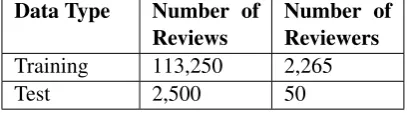
certain users post more reviews post-enrollment than pre-enrollment. Consequently the classifier may simply end up learning the differences in style betweenreviewers. To avoid this, we con-struct a balanced sample where we randomly se-lect 25 reviews for each reviewer prior to and post-enrollment (see Table 2). This also sets our base-line accuracy at 50%.
Product Specificity As the program started in
2007, the post-enrollment reviews are likely to predominantly contain products released in after 2007. This might result in the classifier simply learning the differences between products (say I Phone vs Palm). Given our focus on style, we do not use word tokens as such - thus avoiding the use of product specific features. However, for some products, the product specific details may result in the use of specific syntactic structures. We assume this is not a significant contributor to the prediction performance. A post-hoc analysis
of the top features supports this assumption. A second source of change in writing style could be due to simply whether the product was bought or received for free. We exclude “Vine Reviews”8to eliminate this confounding factor.
Time Specificity A similar concern asProduct
Specificityexists for date references. By focusing
on syntactic and semantic style, we avoid the use of time specific features.
Another concern is that perhaps post enroll-ment, reviewers receive writing guidelines from Amazon. This does not appear to be the case, as the writing guidelines9appear to be for all mem-bers.We now turn to the extraction of style fea-tures.
Data Type Number of
Reviews Number ofReviewers
Training 113,250 2,265
[image:3.595.313.517.298.355.2]Test 2,500 50
Table 2: Experiment Data
4.2 Feature Extraction
We consider three different features — “Bag of words/ unigrams”, “Parse Tree Based Features” and an umbrella category consisting of genre and semantic features (see Section 4.2.3).
4.2.1 Bag of Words
Bag of Words/Unigrams (UNIGRAMS)
Uni-grams have often been found to be effective pre-dictive features (Joachims, 2001). In our context, this serves as a competitive baseline for the clas-sification task.
4.2.2 Parse Tree Based Features
Following Feng et al. (2012) and Ashok et al. (2013) we use Probabilistic Context Free Gram-mar (PCFG) to construct a parse tree for each sen-tence. We then generate features from this parse tree and aggregate features to a review level.
All Production Rules (Γ) This set of features
include all production rule features for each re-view, including the leaves of the parse tree for
8Reviews where product was received for free via the Vine program.
each sentence in the review. This effectively rep-resents a combination of production rules and un-igrams as features and represents an additional competitive baseline.
Non Terminal Production Rules (ΓN) This
ex-cludes the leaves and hence restricts the feature set to non-terminal production rules. This allows us to investigate purely syntactic features from the text.
Phrasal/ Clausal Nodes (PHR/CLSL) We also
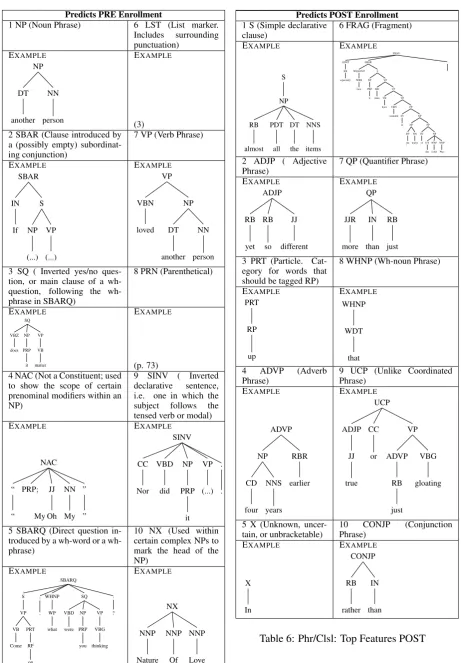
investigate features that incorporate phrasal or clausal nodes of the parse trees. Please see Table 5 and Table 6 for examples of these features.
Parse Tree Measures (PTM) We construct a
set of measures for each sentence based on the parse tree. These measures are maximum height of parse tree, maximum width of the parse tree and the number of sentences in each review.
Latent Dirichlet Allocation (LDA) We also
apply Latent Dirichlet Allocation (Blei et al., 2003) to the production rules extracted from the Probabilistic Context Free Grammar. We use the topics generated as features in our prediction task. Our objective was to determine whether certain co-occurring production rules offered better clas-sification accuracy. Our implementation includes hyper-parameter optimization via maximum like-lihood. The number of topics is selected by maxi-mizing the pairwise cosine distance amongst top-ics. We used the Stanford Parser (Klein and Man-ning, 2003) to parse each of the reviews and the Natural Language Toolkit (NLTK) (Bird et al., 2009) to post process the results.
4.2.3 Genre and Semantic Features
Style Metrics (STYLE) This includes three
dis-tinct types of metrics. Character Based - This includes counts of uppercased letters, number of letters, number of spaces and number of
vow-els. Word Based- This includes measures such as
number of short words (3 characters or less ), long words (8 characters or less), average word length and number of different words. Syntax Based -This includes measures such as number of peri-ods, commas, common conjunctions, interroga-tives, prepositions, pronouns and verbs.
Parts of Speech (POS) features have often been
surprisingly effective in tasks such as predicting deception (Ott et al., 2011). Consequently we test this feature set as well.
Domain-independent Dictionary We make
use of the Linguistic Inquiry and Word Count (LIWC) categorization (Tausczik and Pen-nebaker, 2010). One key advantage of this categorization is that it is domain independent and emphasizes psycho-linguistic cues. We run two variants of this set of features. The first (LIWC ALL) includes all the categories — both
sub-ordinate and super-ordinate categories. The second (LIWC SUB CATEG.) only includes the
sub-ordinate categories, thus ensuring the features are mutually exclusive.
Subjectivity Measures (OPINION) We measure
number of subjective, objective and other (neither subjective nor objective) sentences in each review. We use the “OpinionFinder System” (Wiebe et al., 2005) to classify each sentence with these mea-sures. We aggregate the count of subjective, ob-jective and other sentences at the review level and use these aggregates as features.10 We also re-port results on experiments where multiple feature types are included simultaneously in the model.
5 Experimental Methodology
All experiments use the Fan et al. (2008) im-plementation of linear Support Vector Machines (Vapnik, 1998). The linear specification allows us to infer feature importance. We learn the penalty parameter via grid search using 5 fold cross-validation and report performance on a held-out balanced sample of reviews from 50 randomly selected users (all of whom were excluded from the training set) from the group of reviewers with at least 25 reviews in pre and post enrollment peri-ods. While reporting the results, for some features we report the threshold (Thr) value set to exclude the least frequent features. These thresholds were also learned via the 5 fold cross validation pro-cess. Finally, text features can be binarized, mean centered and/or normalized. Each of these options were also selected via 5 fold cross validation.
6 Results & Analysis
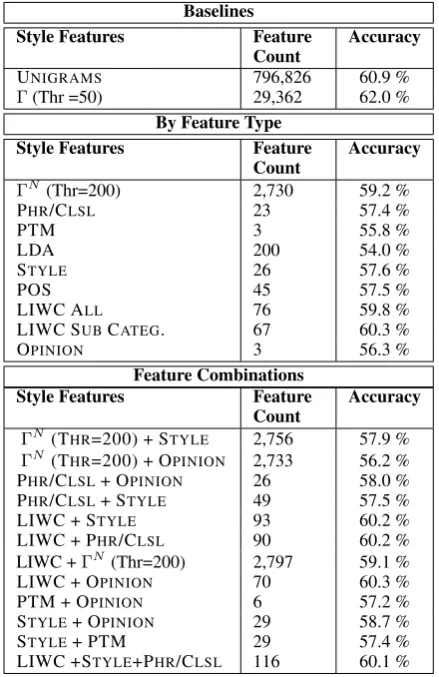
All of the feature sets perform statistically better11 than a majority vote (50%).
Baselines Unsurprisingly, the feature set
con-taining all production rules (Γ) yields the best
ac-10One drawback is that the classifiers are trained on sen-tences from the MPQA corpus. Domain specificity is likely to yield poorer classification performance on our data.
Baselines
Style Features Feature
Count Accuracy
UNIGRAMS 796,826 60.9 %
Γ(Thr =50) 29,362 62.0 %
By Feature Type
Style Features Feature
Count Accuracy
ΓN(Thr=200) 2,730 59.2 %
PHR/CLSL 23 57.4 %
PTM 3 55.8 %
LDA 200 54.0 %
STYLE 26 57.6 %
POS 45 57.5 %
LIWC ALL 76 59.8 %
LIWC SUBCATEG. 67 60.3 %
OPINION 3 56.3 %
Feature Combinations
Style Features Feature
Count Accuracy
ΓN(THR=200) + STYLE 2,756 57.9 %
ΓN(THR=200) + OPINION 2,733 56.2 % PHR/CLSL+ OPINION 26 58.0 %
PHR/CLSL+ STYLE 49 57.5 %
LIWC + STYLE 93 60.2 %
LIWC + PHR/CLSL 90 60.2 %
LIWC +ΓN(Thr=200) 2,797 59.1 %
LIWC + OPINION 70 60.3 %
PTM + OPINION 6 57.2 %
STYLE+ OPINION 29 58.7 %
STYLE+ PTM 29 57.4 %
[image:5.595.71.291.71.410.2]LIWC +STYLE+PHR/CLSL 116 60.1 %
Table 3: Experiment Results
curacy (62.0 %). Unfortunately, as expected, the top features all included terminal production rules that signal time or product specificity. For ex-ample in the pre-enrollment reviews the top 10 features forΓ include NNP→ ‘Update’, CD→ ‘2006’, NNP → ‘XP’ and NNP → ‘Palm’. In the post-enrollment reviews the top 10 features in-clude CD→‘2012’,CD→‘2011’, NN→‘iPad’ and NN→ ‘iPhone’. We observe the same issue with the UNIGRAMSfeature set. This supports our
contention that the analysis should restrict itself to style and domain-independent features. The best performing style feature set is LIWC SUB
CATEG. followed by Non Terminal Production
Rules (ΓN). OPINION is the most parsimonious feature set that performs significantly better than a majority vote.
Non Terminal Production Rules (ΓN) Table 7
presents the top Non Terminal Production Rules. We observe the following: First, pre-enrollment reviews have noun phrases(NP) that contain fewer leaf nodes than in the post-enrollment reviews. This appears to be due to the inclusion of
de-terminers (DT), adjectives (JJ), comparative ad-jectives (JJR), personal pronouns (PRP $) or simply more nouns (NN). This might indicate that topics are discussed with more specifics
in post-enrollment reviews. Second, clauses(S) begin with action oriented verb phrases (VP) in the pre-enrollment reviews. In contrast in the post-enrollment reviews clauses connect two clauses using coordinating conjunctions(CC) or prepositions(IN). One possibility is that review-ers are offering more detail/concepts per
sen-tence (where each clause is a detail/concept) in
the post-enrollment reviews. Finally, we ob-serve that pre-enrollment reviews include adjec-tival phrases (ADJP) connect to superlative ad-verbs (RBS)which conveycertainty. We will re-visit this finding when we review the results from the LIWC model below.
Phrasal/Clausal (PHR./CLSL.) Tables 5 and 6
suggest that post-enrollment reviews emphasize information usingdescriptive phrases— adjecti-val phrases (ADJP) and adverbial phrases (ADVP) — andquantifier phrases(QP). Penrollment re-views appear to have morecomplex clause struc-tures (SBAR, SINV, SQ, SBARQ - see table 5 for definitions).
Parse Tree Metrics (PTM) The three features
used are number of sentences, maximum height of parse tree and the maximum width of the parse tree, listed here in descending order of importance for the post-enrollment reviews. As mentioned earlier in section 4 the average review length is higher in the post-enrollment reviews so the find-ing that the number of sentences predict post-enrollment reviews is consistent. Maximum tree width predicts the pre-enrollment reviews. This flat structure indicates a morecomplex communi-cation structure.
Latent Dirichlet Allocation (LDA) This
Predicts PRE Enrollment
‘number of different words’, ‘uppercase’, ‘alphas’, ‘vowels’ , ‘short words’, ‘words per sentence’, ‘to be words’ , ‘punctuation symbols’, ‘long words’, ‘common prepositions’
Predicts POST Enrollment
‘average word length’, ‘spaces’, ‘verbs are’, ‘chars per sentence’ , ‘verbs be’, ‘common conjunctions’, ‘verbs were’, ‘personal pronouns’ , ‘verbs was’, ‘verbs am’
Table 4: Style Metrics: Top Features
Style (STYLE) Table 4 presents the top features
for this feature set. The features suggest that reviewers used a more varied vocabulary (num-ber of different words), more words per sentence (words per sentence) and more long words (long words) in pre-enrollment than in post-enrollment reviews. This might indicate that sentences in the pre-enrollment reviews were longer and more
complex. Interestingly, the average word length
did go up in the post-enrollment reviews as did the characters per sentence. In addition, more per-sonal pronouns and conjunctions are used — a finding replicated in the model using LIWC fea-tures (see below).
Parts of Speech (POS) The top features for
post-enrollment are commas, periods, compara-tive adjeccompara-tives, verb phrases and coordinating con-junctions. The top features for pre-enrollment are nouns, noun phrases, determiners , prepositions and superlative adverbs. These results are more difficult to interpret though the use of comparative adjectives suggest morecomparisonsbetween dif-ferent objects in the post enrollment reviews.
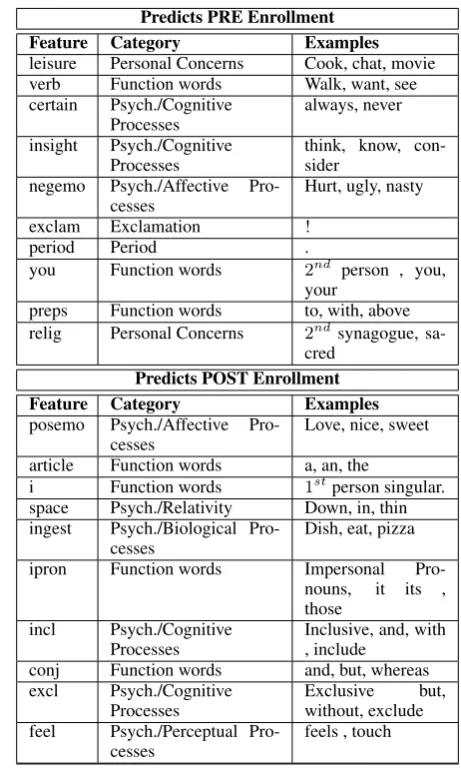
LIWC SUB CATEG. The top 10 LIWC
fea-tures are shown in Table 8. LIWC feafea-tures are cat-egories that are contained in broader catcat-egories. For examplePOSEMO(see Table 8, first feature for
“Predicts POST enrollment”) refers to the class of positive emotion words. POSEMO itself is
con-tained in a category called “Affective Features” which in turn is classified as a Psychological Pro-cess (abbreviated to Pscyh.). The analysis of the categories of features is in itself interesting. Psych./ Cognitive Features occur higher up in fea-tures predictive of pre-enrollment reviews than in the features predictive of post-enrollment reviews. “Psych./ Affective Features” occurs as a top fea-ture for the post-enrollment reviews. The ac-tual feature from the “Psych./ Affective Features” category is POSEMO suggesting that the positive
emotion is more strongly conveyed in the
post-enrollment reviews than in the ppost-enrollment re-views. Interestingly the corresponding negative feature NEGEMOis in the top 10 features
predict-ing the pre-enrollment reviews. This is especially intriguing since the average rating for reviews in the pre and post-enrollment reviews is the same (see 4). We were concerned that possibly our sam-pling had induced a bias in the ratings. But the av-erage ratings in our sample are 4.18 and 4.19 pre and post-enrollment respectively (difference is not statistically significant).
FUNCTIONWORDSoccur extensively in the
post-enrollment reviews. We also observe that inclusive (INCL) and exclusive (EXCL) terms are
used more in the post-enrollment reviews. Its pos-sible that reviewers are seeking to be more
bal-anced. Products are described in personal (I),
perceptual (FEEL) and relativistic (SPACE) terms.
Pre-enrollment reviews discuss personal concerns (LEISURE, RELIG) , indicate a level of certainty
(CERTAIN) and opinions are presented in terms of
thought process (INSIGHT). Interestingly, the
pre-enrollment reviews address the reader (YOU).
Opinions (OPINION) Features predicting
post-enrollment are number of objective sentences, number of subjective sentences and finally num-ber of other (neither subjective nor objective) sen-tences. This suggests that reviewers try to write somewhat more objectively in the post-enrollment reviews.
Feature Combinations With the exception of
the combinations STYLE+OPINION, PHR/CLSL
+OPINIONand PTM+OPINIONwhich improve
on either feature set used alone, none of the other combinations improved performance over all component feature sets modeled individually. Overall, none of the combinations improved over LIWC SUB CATEG. Hence we do not delve
fur-ther into features from these models.
Summary Overall pre-enrollment reviews are
Predicts PRE Enrollment
1 NP (Noun Phrase) 6 LST (List marker. Includes surrounding punctuation)
EXAMPLE EXAMPLE
NP
NN
person DT
another (3)
2 SBAR (Clause introduced by a (possibly empty) subordinat-ing conjunction)
7 VP (Verb Phrase)
EXAMPLE EXAMPLE
SBAR S VP (...) NP (...) IN If VP NP NN person DT another VBN loved
3 SQ ( Inverted yes/no ques-tion, or main clause of a question, following the wh-phrase in SBARQ)
8 PRN (Parenthetical)
EXAMPLE EXAMPLE
SQ VP VB matter NP PRP it VBZ does (p. 73) 4 NAC (Not a Constituent; used
to show the scope of certain prenominal modifiers within an NP)
9 SINV ( Inverted declarative sentence, i.e. one in which the subject follows the tensed verb or modal)
EXAMPLE EXAMPLE
NAC ” ” NN My JJ Oh PRP; My “ “ SINV . . VP (...) NP PRP it VBD did CC Nor
5 SBARQ (Direct question in-troduced by a word or a wh-phrase)
10 NX (Used within certain complex NPs to mark the head of the NP)
EXAMPLE EXAMPLE
SBARQ . ? SQ VP VBG thinking NP PRP you VBD were WHNP WP what , , S VP PRT RP on VB Come NX NNP Love NNP Of NNP Nature
Table 5: Phr/Clsl: Top Features PRE
Predicts POST Enrollment
1 S (Simple declarative
clause) 6 FRAG (Fragment)
EXAMPLE EXAMPLE
S NP NNS items DT the PDT all RB almost FRAG . . SBAR S VP VP VP PP NP PP NP NNP War NNP Cold DT the IN of NP NN midst DT the IN in VBN sounded VB have MD must NP PRP it WHADVP WRB how ADVP RB especially
2 ADJP ( Adjective
Phrase) 7 QP (Quantifier Phrase)
EXAMPLE EXAMPLE
ADJP JJ different RB so RB yet QP RB just IN than JJR more
3 PRT (Particle. Cat-egory for words that should be tagged RP)
8 WHNP (Wh-noun Phrase)
EXAMPLE EXAMPLE
PRT RP up WHNP WDT that
4 ADVP (Adverb
Phrase) 9 UCP (Unlike CoordinatedPhrase)
EXAMPLE EXAMPLE
ADVP RBR earlier NP NNS years CD four UCP VP VBG gloating ADVP RB just CC or ADJP JJ true
5 X (Unknown,
uncer-tain, or unbracketable) 10Phrase)CONJP (Conjunction
EXAMPLE EXAMPLE
[image:7.595.70.532.63.727.2]X In CONJP IN than RB rather
Predicts PRE Enrollment
Feature Examples
ROOT→S (1) And nearly every
sin-gle item seemed cute and usable to me. (2) Look closely, (...) overwhelming personal and cultural up-heaval.
NP→NNP NNP (1) Tim Bess (2) Jennifer Fitch
PP→IN NP (1) for its psychological and emotional richness (2) of loyalty
NP→DT NN (1) the price (2) a book NP→NNP POS (1) Frost ’s (2) Clough ’s ADJP→RBS JJ (1) most assuredly (2) most
entertaining
WHNP→WP (1) who (2) what
NP→NNP (1) Blessed (2) India PP→TO NP (1) to the crime (2) to me S→VP (1) linking Pye to the crime
scene (2) Gripping due to (...)
Predicts POST Enrollment
Feature Examples
S→S , IN S . (1) It is functionally the same as Apple’s 10 watt charger which outputs 2.1 A , so it is also suitable for charging the iPad. (2) It has 3 levels of trays that spread as you open the box, so you can easily access contents in all trays.
S→IN NP VP . (1) So I don’t think the investment in graphics (...) enjoyability in the game. (2) So we decided to try it again this year.
[image:8.595.298.529.69.457.2]ROOT→NP (1) Some kind of (...) disor-der ? (2) Proper Alignment and Posture; This segment (...) .
S→S CC S . (1) Mage and Takumo (...) but lacking in depth.(2) The light feature is great and it powers off (...).
NP→PRP$ NNP NN (1) your Alpine yodeling (2) my MacBook Pro S→VP . (1) Enough negativity. (2)
Suffice it to say that (...) . NP→DT JJR NN (1) a better future (2) a
slower flow
NP→DT JJ , JJ NN (1) an immediate , visceral reaction (2)a roots-based, singer-songwriter effort NP→DT NNP NNP NNP
NNP (1) the Post-Total BodyWeight Training (2) The Gunfighter DVD Gregory Peck
WHADVP→WRB RB (1) How far (2) how well
Table 7:ΓN : Top Features (PCFG Non Terminal)
Predicts PRE Enrollment
Feature Category Examples
leisure Personal Concerns Cook, chat, movie verb Function words Walk, want, see certain Psych./Cognitive
Processes always, never
insight Psych./Cognitive
Processes think, know, con-sider negemo Psych./Affective
Pro-cesses Hurt, ugly, nasty
exclam Exclamation !
period Period .
you Function words 2nd person , you, your
preps Function words to, with, above relig Personal Concerns 2ndsynagogue,
sa-cred
Predicts POST Enrollment
Feature Category Examples
posemo Psych./Affective
Pro-cesses Love, nice, sweet
article Function words a, an, the
i Function words 1stperson singular. space Psych./Relativity Down, in, thin ingest Psych./Biological
Pro-cesses Dish, eat, pizza
ipron Function words Impersonal Pro-nouns, it its , those
incl Psych./Cognitive
Processes Inclusive, and, with, include conj Function words and, but, whereas excl Psych./Cognitive
Processes Exclusivewithout, excludebut, feel Psych./Perceptual
Pro-cesses feels , touch
Table 8: LIWC Sub Category : Top Features
These reviews are are specific, balanced and contain more objective sentences as well.
Discussion on Readability One possibility is
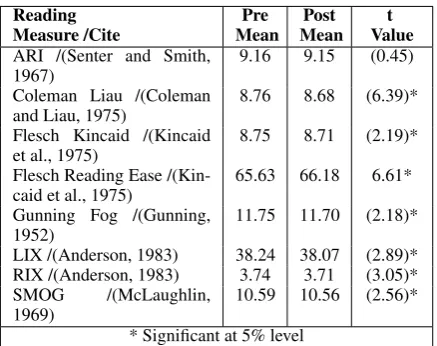
that the “Enrollment” effect leads to reviewers writing more readable reviews. To test this hy-pothesis we performed a paired t-test between readability scores for pre and post-enrollment re-views. Table 9 suggests that indeed this is the case. Flesch Reading Ease is the only measure where a higher score indicates simpler text. For the rest of the measures a higher score implies more complex text. All of the measures are within the average readability range and the magnitude of the differences are small. Nevertheless, these differences are statistically significant12with one exception lending support to the idea that “Enroll-ment” effect might lead to reviewers writing more readable reviews.
Reading
Measure /Cite MeanPre MeanPost Valuet
ARI /(Senter and Smith,
1967) 9.16 9.15 (0.45)
Coleman Liau /(Coleman
and Liau, 1975) 8.76 8.68 (6.39)*
Flesch Kincaid /(Kincaid
et al., 1975) 8.75 8.71 (2.19)*
Flesch Reading Ease
/(Kin-caid et al., 1975) 65.63 66.18 6.61* Gunning Fog /(Gunning,
1952) 11.75 11.70 (2.18)*
LIX /(Anderson, 1983) 38.24 38.07 (2.89)* RIX /(Anderson, 1983) 3.74 3.71 (3.05)* SMOG /(McLaughlin,
1969) 10.59 10.56 (2.56)*
[image:9.595.72.291.69.242.2]* Significant at 5% level
Table 9: Readability Measures
7 Discussion
So far we have ignored the possibility that writ-ing styles of reviewers may simply continuously evolve with experience and we are simply detect-ing a difference due to this underlydetect-ing trend. 13 To address this question we investigated the sub-periods within the the pre and post enrollment pe-riods.
We split the post enrollment period (i.e. from date of enrollment to the date the most recent re-view was posted) further into two equal time pe-riods for each reviewer. As before, we learn a classifier to discriminate between the sub periods. Interestingly the classifier performed the same as chance at p=0.05 (Test Accuracy= 51.0%).14 15 However a similar analysis in the pre-enrollment period results in a test set accuracy of 63.3% (sig-nificant at p=0.05). So there is a change in writing style within the pre-enrollment period, but there is no continued change post-enrollment. This is not consistent with the continuous style evolution hy-pothesis. One account would be that Amazon en-rolls reviewers whose styles have stabilized. This remains a possibility as Amazon actively selects the members (and we are not aware of the specific rules used by Amazon). The trends (see Figure 1
13Ideally, if a) the enrollment date had been the same for all reviewers and b) the enrollment was random, we would have a clean experimental framework to detect whether a similar trend exists for non-vine reviewers. Unfortunately, this is not the case.
14We report the results only on POS for conciseness. The other feature sets performed similarly.
15As before the test sample includes 50 users. However we sampled only 10 reviews in each sub period. Corresponding down sampled performance for Pre vs Post enrollment accu-racy is 57.5% (significant at p=0.05)using POS features.
[image:9.595.307.532.143.276.2])suggest that there are changes right upto the rollment dateand some levelling out in the post en-rollment period , providing some evidence against this hypothesis.
Figure 1: Feature Trends
Train
Size SizeTest Accuracy
Within
Pre-Enrollment 44,800 1000 63.3%
Within
Post-Enrollment 59,250 1000 51.0%
Pre vs Post Enroll.
[image:9.595.307.525.327.416.2]Down Sampled 53,840 1000 57.5%
Table 10: Sub Period Results
8 Conclusion
We view this work as a first step toward inves-tigating this phenomenon further. In particular, we plan to test the robustness of our results w.r.t. product specificity, to investigate stylistic differ-ences (a) between reviews for purchased products versus for products received for free amongst Vine members and (b) between reviews by Vine review-ers and non-Vine reviewreview-ers. Another line of in-quiry involves decomposing the “Enrollment” ef-fect into a reputation/status efef-fect (the influence of the status badge - Vine membership) and a product sampling effect (the influence of receiving goods for free). Finally, investigating the temporal dy-namics of style for these reviewers might prove in-teresting as would determining whether these sub-tle differences in style affect thereadersand influ-ence purchase decisions.
9 Acknowledgements
References
Jonathan Anderson. Lix and rix: Variations on a little-known readability index.Journal of Read-ing, pages 490–496, 1983.
Vikas Ganjigunte Ashok, Song Feng, and Yejin Choi. Success with style: Using writing style to predict the success of novels.Poetry, 580(9): 70, 2013.
Kapil Bawa and Robert Shoemaker. The ef-fects of free sample promotions on incremen-tal brand sales. Marketing Science, 23(3):345– 363, 2004.
Shane Bergsma, Matt Post, and David Yarowsky. Stylometric analysis of scientific articles. In
Proceedings of the 2012 Conference of the North American Chapter of the Association for Computational Linguistics: Human Language
Technologies, pages 327–337. Association for
Computational Linguistics, 2012.
Steven Bird, Ewan Klein, and Edward Loper.
Natural Language Processing with Python.
O’Reilly Media, 2009.
David M Blei, Andrew Y Ng, and Michael I Jor-dan. Latent dirichlet allocation. the Journal of
machine Learning research, 3:993–1022, 2003.
Judith A Chevalier and Dina Mayzlin. The ef-fect of word of mouth on sales: Online book reviews. Journal of marketing research, 43(3): 345–354, 2006.
Meri Coleman and TL Liau. A computer readabil-ity formula designed for machine scoring.
Jour-nal of Applied Psychology, 60(2):283, 1975.
Cristian Danescu-Niculescu-Mizil, Lillian Lee, Bo Pang, and Jon Kleinberg. Echoes of power: Language effects and power differences in so-cial interaction. In Proceedings of the 21st
international conference on World Wide Web,
pages 699–708. ACM, 2012.
Rong-En Fan, Kai-Wei Chang, Cho-Jui Hsieh, Xiang-Rui Wang, and Chih-Jen Lin. Liblin-ear: A library for large linear classification.
The Journal of Machine Learning Research, 9:
1871–1874, 2008.
Song Feng, Ritwik Banerjee, and Yejin Choi. Characterizing stylistic elements in syntactic structure. InProceedings of the 2012 Joint Con-ference on Empirical Methods in Natural Lan-guage Processing and Computational Natural
Language Learning, pages 1522–1533.
Associ-ation for ComputAssoci-ational Linguistics, 2012. Shyam Gopinath, Jacquelyn S Thomas, and
Lak-shman Krishnamurthi. Investigating the rela-tionship between the content of online word of mouth, advertising, and brand performance.
Marketing Science, 2014.
Robert Gunning. Technique of clear writing. 1952.
Thorsten Joachims. A statistical learning learn-ing model of text classification for support vec-tor machines. In Proceedings of the 24th an-nual international ACM SIGIR conference on Research and development in information
re-trieval, pages 128–136. ACM, 2001.
J Peter Kincaid, Robert P Fishburne Jr, Richard L Rogers, and Brad S Chissom. Derivation of new readability formulas (automated readability in-dex, fog count and flesch reading ease formula) for navy enlisted personnel. Technical report, DTIC Document, 1975.
Dan Klein and Christopher D Manning. Accurate unlexicalized parsing. In Proceedings of the 41st Annual Meeting on Association for
Com-putational Linguistics-Volume 1, pages 423–
430. Association for Computational Linguis-tics, 2003.
G Harry McLaughlin. Smog grading: A new read-ability formula.Journal of reading, 12(8):639– 646, 1969.
Myle Ott, Yejin Choi, Claire Cardie, and Jeffrey T Hancock. Finding deceptive opinion spam by any stretch of the imagination. In Proceed-ings of the 49th Annual Meeting of the Asso-ciation for Computational Linguistics: Human
Language Technologies-Volume 1, pages 309–
319. Association for Computational Linguis-tics, 2011.
Mauricio M Palmeira and Joydeep Srivastava. Free offer6=cheap product: A selective acces-sibility account on the valuation of free offers.
Journal of Consumer Research, 40(4):644–656,
2013.
Michal Rosen-Zvi, Thomas Griffiths, Mark Steyvers, and Padhraic Smyth. The author-topic model for authors and documents. In Pro-ceedings of the 20th conference on Uncertainty
in artificial intelligence, pages 487–494. AUAI
RJ Senter and EA Smith. Automated readabil-ity index. Technical report, DTIC Document, 1967.
Kristina Shampanier, Nina Mazar, and Dan Ariely. Zero as a special price: The true value of free products. Marketing Science, 26(6):742– 757, 2007.
Yla R Tausczik and James W Pennebaker. The psychological meaning of words: Liwc and computerized text analysis methods. Journal of
Language and Social Psychology, 29(1):24–54,
2010.
Ivan Titov and Ryan McDonald. A joint model of text and aspect ratings for sentiment sum-marization. In Proceedings of ACL-08: HLT, pages 308–316, Columbus, Ohio, June 2008. Association for Computational Linguistics. Vladimir N. Vapnik. Statistical Learning Theory.
Wiley-Interscience, 1998.
Monica Wadhwa, Baba Shiv, and Stephen M Nowlis. A bite to whet the reward appetite: The influence of sampling on reward-seeking behaviors. Journal of Marketing Research, 45 (4):403–413, 2008.
Janyce Wiebe, Theresa Wilson, and Claire Cardie. Annotating expressions of opinions and emo-tions in language. Language resources and