Probing for semantic evidence of composition by means of simple
classification tasks
Allyson Ettinger1, Ahmed Elgohary2, Philip Resnik1,3
1Linguistics,2Computer Science,3Institute for Advanced Computer Studies University of Maryland, College Park, MD
{aetting,resnik}@umd.edu,[email protected]
Abstract
We propose a diagnostic method for prob-ing specific information captured in vector representations of sentence meaning, via simple classification tasks with strategi-cally constructed sentence sets. We iden-tify some key types of semantic informa-tion that we might expect to be captured in sentence composition, and illustrate ex-ample classification tasks for targeting this information.
1 Introduction
Sentence-level meaning representations, when formed from word-level representations, require a process of composition. Central to evaluation of sentence-level vector representations, then, is evaluating how effectively a model has executed this composition process.
In assessing composition, we must first answer the question of what it means to do composition well. On one hand, we might define effective com-position as production of sentence representations that allow for high performance on a task of inter-est (Kiros et al., 2015; Tai et al., 2015; Wieting et al., 2015; Iyyer et al., 2015). A limitation of such an approach is that it is likely to produce overfit-ting to the characteristics of the particular task.
Alternatively, we might define effective compo-sition as generation of a meaning representation that makes available all of the information that we would expect to be extractable from the meaning of the input sentence. For instance, in a represen-tation of the sentence “The dog didn’t bark, but chased the cat”, we would expect to be able to ex-tract the information that there is an event of chas-ing, that a dog is doing the chasing and a cat is being chased, and that there is no barking event (though there is a semantic relation betweendog
andbark, albeit modified by negation, which we likely want to be able to extract as well). A model able to produce meaning representations that al-low for extraction of these kinds of key seman-tic characterisseman-tics—semanseman-tic roles, event informa-tion, operator scope, etc—should be much more generalizable across applications, rather than tar-geting any single application at the cost of others. With this in mind, we propose here a linguistically-motivated but computationally straightforward diagnostic method, intended to provide a targeted means of assessing the specific semantic information that is being captured in sentence representations. We propose to ac-complish this by constructing sentence datasets controlled and annotated as precisely as possible for their linguistic characteristics, and directly testing for extractability of semantic information by testing classification accuracy in tasks defined by the corresponding linguistic characteristics. We present the results of preliminary experiments as proof-of-concept.
2 Existing approaches
obser-vation is made by Lai and Hockenmaier (2014)), which means that we cannot draw firm composi-tion conclusions from performance on this task. Furthermore, if we want to examine the extent to which specific types of linguistic information are captured, SICK is limited in two senses. First, SICK sentences are annotated for transformations performed between sentences, but these annota-tions lack coverage of many linguistic charac-teristics important to composition (e.g., semantic roles). Second, even within annotated transforma-tion categories, distributransforma-tions over entailment la-bels are highly skewed (e.g., 98.9% of the entail-ment labels under the “add modifier” transforma-tion are ENTAILMENT), making it difficult to test phenomenon- or transformation-specific classifi-cation performance.
In an alternative approach, Li et al. (2015) use visualization techniques to better examine the par-ticular aspects of compositionality captured by their models. They consider recurrent neural net-work composition models trained entirely for one of two tasks—sentiment analysis and language modeling—and employ dimensionality reduction to visualize sentiment neighborhood relationships between words or phrases before and after apply-ing modification, negation, and clause composi-tion. They also visualize the saliency of individ-ual tokens with respect to the prediction decision made for each of their tasks.
In comparison, our proposal aims to provide generic (task-independent) evaluation and analy-sis methods that directly quantify the extractabil-ity of specific linguistic information that a com-position model should be expected to capture. Our proposed evaluation approach follows a sim-ilar rationale to that of the diagnostic test suite TSNLP (Balkan et al., 1994) designed for evaluat-ing parsers on a per-phenomenon basis. As high-lighted by Scarlett and Szpakowicz (2000) the sys-tematic fine-grained evaluation of TSNLP enables precise pinpointing of parsers’ limitations, while ensuring broad coverage and controlled evalua-tion of various linguistic phenomena and syntactic structures. Our proposal aims at initiating work on developing similar test suites for evaluating se-mantic composition models.
3 Probing for semantic information with targeted classification tasks
The reasoning of our method is as follows: if we take a variety of sentences—each represented by a composed vector—and introduce a classifica-tion scheme requiring identificaclassifica-tion of a particu-lar type of semantic information for accurate sen-tence classification, then by testing accuracy on this task, we can assess whether the composed representations give access to the information in question. This method resembles that used for de-coding human brain activation patterns in cogni-tive neuroscience studies of language understand-ing (Frankland and Greene, 2015), as well as work in NLP that has previously made use of classifica-tion accuracy for assessing informaclassifica-tion captured in vector representations (Gupta et al., 2015).
In order to have maximum confidence in our interpretation of performance in these tasks, our sentences must have sufficient diversity to ensure that there are no consistently correlating cues that would allow for strong performance without cap-turing the relevant compositional information. Re-latedly, we want to ensure that the classification tasks cannot be solved by memorization (rather than actual composition) of phrases.
3.1 Dataset construction
The goal in constructing the sentence dataset is to capture a wide variety of syntactic structures and configurations, so as to reflect as accurately as pos-sible the diversity of sentences that systems will need to handle in naturally-occurring text—while maintaining access to detailed labeling of as many relevant linguistic components of our data as pos-sible. Ideally, we want a dataset with enough vari-ation and annotvari-ation to allow us to draw data for all of our desired classification tasks from this sin-gle dataset.
3.2 Semantic characteristics
There are many types of semantic information that we might probe for with this method. For our pur-poses here, we are going to focus on two basic types, which are understood in linguistics to be fundamental components of meaning, and which have clear ties to common downstream applica-tions: semantic role and scope.
The importance of semantic role information is well-recognized both in linguistics and in NLP— for the latter in the form of tasks such as abstract meaning representation (AMR) (Banarescu et al., 2013). Similarly, the concept of scope is criti-cal to many key linguistic phenomena, including negation—the importance of which is widely ac-knowledged in NLP, in particular for applications such as sentiment analysis (Blunsom et al., 2013; Iyyer et al., 2015). Both of these information types are of course critical to computing entailment.
3.3 Example classification tasks
Once we have identified semantic information of interest, we can design classification tasks to target this information. We illustrate with two examples.
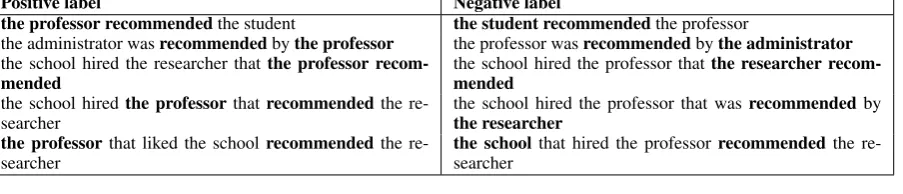
Semantic role If a sentence representation has captured semantic roles, a reasonable expectation would be extractability of the entity-event rela-tions contained in the sentence meaning. So, for instance, we might choose professor as our en-tity, recommend as our event, and AGENT as our relation—and label sentences as positive if they containprofessorin the AGENT relation with the verbrecommend. Negative sentences for this task could in theory be any sentence lacking this relation—but it will be most informative to use negative examples containing the relevant lexical items (professor,recommend) without the relation of interest, so that purely lexical cues cannot pro-vide an alternative classification heuristic.
Examples illustrating such a setup can be seen in Table 1. In this table we have included a sam-ple of possible sentences, varying only by ac-tive/passive alternation and placement of relative clauses, and holding lexical content fairly con-stant. The verb recommend and its agent have been bolded for the sake of clarity.
An important characteristic of the sentences in Table 1 is their use of long-distance dependencies, which cause cues based on linear order and word adjacency to be potentially misleading. Notice, for instance, that sentence 5 of the positive label
col-umn contains the stringthe school recommended, thoughschoolis not the agent ofrecommended— rather, the agent ofrecommendedis located at the beginning of the sentence. We believe that in-corporation of such long-distance dependencies is critical for assessing whether systems are accu-rately capturing semantic roles across a range of naturally-occurring sentence structures (Rimell et al., 2009; Bender et al., 2011).
This example task can obviously be extended to other relations and other entities/events as desired, with training and test data adjusted accordingly. We will remain agnostic here as to the optimal method of selecting relations and entities/events for classification tasks; in all likelihood, it will be ideal to choose and test several different com-binations, and obtain an average accuracy score. Note that if we structure our task as we have suggested here—training and testing only on sen-tences containing certain selected lexical items— then the number of examples at our disposal (both positive and negative) will be dependent in large part on the number of syntactic structures covered in the dataset. This emphasizes again the impor-tance of incorporating broad structural diversity in the dataset construction.
Negation scope Negation presents somewhat of a challenge for evaluation. How can we assess whether a representation captures negation prop-erly, without making the task as simple as detect-ing that negation is present in the sentence?
One solution that we propose is to incorpo-rate negation at various levels of syntactic struc-ture (corresponding to different negation scopes), which allows us to change sentence meaning while holding lexical content relatively constant. One way that we might then assess the negation infor-mation accessible from the representation would be to adapt our classification task to focus not on a semantic role relation per se, but rather on the event described by the sentence meaning. For in-stance, we might design a task in which sentences are labeled as positive if they describe an event in which a professor performs an act of recommend-ing, and negative otherwise.
Positive label Negative label
the professor recommendedthe student the student recommendedthe professor
the administrator wasrecommendedbythe professor the professor wasrecommendedbythe administrator
the school hired the researcher thatthe professor
recom-mended the school hired the professor thatmended the researcher
recom-the school hiredthe professorthatrecommendedthe
re-searcher the school hired the professor that wasthe researcher recommendedby the professorthat liked the schoolrecommendedthe
re-searcher the schoolsearcher that hired the professorrecommendedthe
re-Table 1: Labeled data for professor-as-agent-of-recommend task (recommend verb and its actual agent have been bolded).
and the professor entity does perform an act of recommending. In the second sentence, however, negation has scope over recommend, resulting in a meaning in which the professor, despite being agent ofrecommend, is not involved in performing a recommendation. By incorporating negation in this way, we allow for a task that assesses whether the effect of negation is being applied to the cor-rect component of the sentence meaning.
4 Preliminary experiments
As proof-of-concept, we have conducted some preliminary experiments to test that this method yields results patterning in the expected direction on tasks for which we have clear predictions about whether a type of information could be captured.
Experiments Settings
We compared three sentence embedding meth-ods: 1) Averaging GloVe vectors (Pennington et al., 2014), 2) Paraphrastic word averaging embed-dings (Paragram) trained with a compositional ob-jective (Wieting et al., 2015). and 3) Skip-Thought embeddings (ST) (Kiros et al., 2015).1 For each
task, we used a logistic regression classifier with train/test sizes of 1000/500.2 The classification
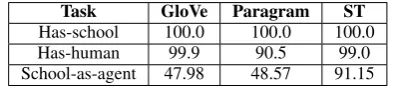
ac-curacies are summarized in Table 4.
We used three classification tasks for prelimi-nary testing. First, before testing actual indica-tors of composition, as a sanity check we tested whether classifiers could be trained to recognize the simple presence of a given lexical item, specif-ically school. As expected, we see that all three models are able to perform this task with 100% accuracy, suggesting that this information is well-captured and easily accessible. As an extension of this sanity check, we also trained classifiers to
1We used the pretrained models provided by the authors.
GloVe and Paragram embeddings are of size 300 while Skip-Thought embeddings are of size 2400.
2We tuned each classifier with 5-fold cross validation.
recognize sentences containing a token in the cate-gory of “human”. To test for generalization across the category, we ensured that no human nouns ap-pearing in the test set were included in training sentences. All three models reach a high classifi-cation performance on this task, though Paragram lags behind slightly.
Finally, we did a preliminary experiment per-taining to an actual indicator of composition: se-mantic role. We constructed a simple dataset with structural variation stemming only from ac-tive/passive alternation, and tested whether mod-els could differentiate sentences with school ap-pearing in an agent role from sentences with
school appearing as a patient. All training and test sentences contained the lexical item “school”, with both active and passive sentences selected randomly from the full dataset for inclusion in training and test sets. Note that with sentences of this level of simplicity, models can plausibly use fairly simple order heuristics to solve the classi-fication task, so a model that retains order infor-mation (in this case, only ST) should have a good chance of performing well. Indeed, we see that ST reaches a high level of performance, while the two averaging-based models never exceed chance-level performance.
5 Discussion
We have proposed a diagnostic method for directly targeting and assessing specific types of seman-tic information in composed sentence representa-tions, guided by considerations of the linguistic information that one might reasonably expect to be extractable from properly composed sentence meaning representations.
[image:4.595.78.530.66.163.2]sentence prof-ag-of-rec prof-recommends the professorthatdid notlike the schoolrecommendedthe researcher TRUE TRUE
the professorthat liked the schooldid notrecommendthe researcher TRUE FALSE
[image:5.595.82.279.162.206.2]the schoolthat liked the professorrecommendedthe researcher FALSE FALSE
Table 2: Sentence labeling for two classification tasks: “containsprofessor as AGENT ofrecommend” (column 2), and “sentence meaning involves professor performing act of recommending” (column 3).
Task GloVe Paragram ST
Has-school 100.0 100.0 100.0
Has-human 99.9 90.5 99.0
School-as-agent 47.98 48.57 91.15
Table 3: Percentage correct on school, has-human, and has-school-as-agent tasks.
generative process should allow us to cover a good deal of ground with respect to syntactic variation as well as annotation of linguistic characteristics. Human involvement in annotation should become necessary only if we desire annotation of linguistic characteristics that do not follow deterministically from syntactic properties.
One example of such a characteristic, which merits discussion of its own, is sentence plau-sibility. A clear limitation of automated sen-tence generation in general is the inability to con-trol for plausibility of the generated sentences. We acknowledge this limitation, but would ar-gue that for the purposes of evaluating compo-sition, the presence of implausible sentences is not only acceptable—it is possibly advantageous. It is acceptable for the simple reason that com-position seems to operate independently of plau-sibility: consider, for instance, a sentence such as blue giraffes interrogate the apple, which we are able to compose to extract a meaning from, despite its nonsensical nature. Arguments along this vein have been made in linguistics since Chomsky (1957) illustrated (with the now-famous example colorless green ideas sleep furiously) that sentences can be grammatical—structurally interpretable—without having a sensible meaning. As for the potential advantage, the presence of implausible sentences in our dataset may be desirable for the following reason: in evaluat-ing whether a system is able to perform compo-sition, we are in fact interested in whether it is able to compose completely novel phrases. To evaluate this capacity accurately, we will want to assess systems’ composition performance on phrases that they have never encountered. Elgo-hary and Carpuat (2016) meet this need by
dis-carding all training sentences that include any ob-served bigrams in their evaluation sentences. With implausible sentences, we can substantially reduce the likelihood that systems will have been trained on the phrases encountered during the classifica-tion evaluaclassifica-tion—while remaining agnostic as to the particulars of those systems’ training data. It would be useful, in this case, to have annotation of the plausibility levels of our sentences, in or-der to ascertain whether performance is in fact aided by the presence of phrases that may rea-sonably have occurred during composition train-ing. Possible approaches to estimating plausibility without human annotation include using n-gram statistics on simple argument/predicate combina-tions (Rashkin et al., 2016) or making use of se-lectional preference modeling (Resnik, 1996; Erk, 2007; S´eaghdha, 2010).
A final note: learning low-dimensional vec-tor representations for sentences is bound to re-quire a trade-off between the coverage of coded information and the accessibility of en-coded information—some semantic characteris-tics may be easily extractable at the cost of others. We have not, in this proposal, covered all semantic characteristics of interest, but it will ultimately be valuable to develop a broad-coverage suite of clas-sification tasks for relevant information types, to obtain an assessment that is both fine-grained and comprehensive. This kind of holistic assessment will be useful for determining appropriate models for particular tasks, and for determining directions for model improvement.
Acknowledgments
References
Lorna Balkan, Doug Arnold, and Siety Meijer. 1994. Test suites for natural language processing. Trans-lating and the Computer, pages 51–51.
Laura Banarescu, Claire Bonial, Shu Cai, Madalina Georgescu, Kira Griffitt, Ulf Hermjakob, Kevin Knight, Philipp Koehn, Martha Palmer, and Nathan Schneider. 2013. Abstract meaning representation
for sembanking. InProceedings of the 7th
Linguis-tic Annotation Workshop and Interoperability with Discourse, pages 178–186.
Emily M Bender, Dan Flickinger, Stephan Oepen, and Yi Zhang. 2011. Parser evaluation over local and non-local deep dependencies in a large corpus. In Proceedings of the Conference on Empirical Meth-ods in Natural Language Processing, pages 397– 408.
Luisa Bentivogli, Raffaella Bernardi, Marco Marelli, Stefano Menini, Marco Baroni, and Roberto Zam-parelli. 2016. SICK through the SemEval glasses. lesson learned from the evaluation of compositional distributional semantic models on full sentences through semantic relatedness and textual entailment. Language Resources and Evaluation, pages 1–30. Phil Blunsom, Edward Grefenstette, and Karl Moritz
Hermann. 2013. “not not bad” is not “bad”: A
distributional account of negation. InProceedings
of the 2013 Workshop on Continuous Vector Space Models and their Compositionality.
Noam Chomsky. 1957. Syntactic structures. Mouton
& Co.
Ahmed Elgohary and Marine Carpuat. 2016. Learn-ing monolLearn-ingual compositional representations via bilingual supervision. InProceedings of the Annual Meeting of the Association for Computational Lin-guistics.
Katrin Erk. 2007. A simple, similarity-based model
for selectional preferences. In Proceedings of the
Annual Meeting of the Association for Computa-tional Linguistics, pages 216–223.
Steven M Frankland and Joshua D Greene. 2015. An architecture for encoding sentence meaning in
left mid-superior temporal cortex. Proceedings of
the National Academy of Sciences, 112(37):11732– 11737.
Abhijeet Gupta, Gemma Boleda, Marco Baroni, and Sebastian Pad´o. 2015. Distributional vectors
en-code referential attributes. In Proceedingsof the
Conference on Empirical Methods in Natural Lan-guage Processing.
Mohit Iyyer, Varun Manjunatha, Jordan Boyd-Graber, and Hal Daum´e III. 2015. Deep unordered compo-sition rivals syntactic methods for text classification. In Proceedings of the 53rd Annual Meeting of the Association for Computational Linguistics and the
7th International Joint Conference on Natural Lan-guage Processing, pages 1681–1691.
Ryan Kiros, Yukun Zhu, Ruslan R Salakhutdinov, Richard Zemel, Raquel Urtasun, Antonio Torralba, and Sanja Fidler. 2015. Skip-thought vectors. InAdvances in Neural Information Processing
Sys-tems, pages 3276–3284.
Alice Lai and Julia Hockenmaier. 2014. Illinois-lh: A denotational and distributional approach to seman-tics. Proc. SemEval.
Jiwei Li, Xinlei Chen, Eduard Hovy, and Dan Jurafsky. 2015. Visualizing and understanding neural models in nlp. arXiv preprint arXiv:1506.01066.
Marco Marelli, Stefano Menini, Marco Baroni, Luisa Bentivogli, Raffaella Bernardi, and Roberto Zam-parelli. 2014. A SICK cure for the evaluation of compositional distributional semantic models. In Language Resources and Evaluation, pages 216– 223.
Jeffrey Pennington, Richard Socher, and Christopher D Manning. 2014. Glove: Global vectors for word
representation. InEMNLP, volume 14, pages 1532–
1543.
Hannah Rashkin, Sameer Singh, and Yejin Choi. 2016. Connotation frames: A data-driven investigation. In Proceedings of the Annual Meeting of the Associa-tion for ComputaAssocia-tional Linguistics.
Philip Resnik. 1996. Selectional constraints: An information-theoretic model and its computational realization.Cognition, 61(1):127–159.
Laura Rimell, Stephen Clark, and Mark Steedman. 2009. Unbounded dependency recovery for parser
evaluation. In Proceedings of the Conference on
Empirical Methods in Natural Language Process-ing, pages 813–821.
Elizabeth Scarlett and Stan Szpakowicz. 2000. The power of the tsnlp: lessons from a diagnostic
eval-uation of a broad-coverage parser. InAdvances in
Artificial Intelligence, pages 138–150. Springer. Diarmuid O S´eaghdha. 2010. Latent variable models
of selectional preference. InProceedings of the An-nual Meeting of the Association for Computational Linguistics, pages 435–444.
Kai Sheng Tai, Richard Socher, and Christopher D Manning. 2015. Improved semantic representa-tions from tree-structured long short-term memory
networks. InProceedings of the Annual Meeting of
the Association for Computational Linguistics. John Wieting, Mohit Bansal, Kevin Gimpel, and
Karen Livescu. 2015. Towards universal
para-phrastic sentence embeddings. arXiv preprint