3
With Special Thanks to
My Thesis Committee
Hannah Smotrich, Chair
Nick Tobier, Advisor
Müge Göçek, Advisor
Megan Levad, Advisor
for their advice, questions, thoughts,
wisdom, and support along the way,
and
My MFA Cohort
Juliet Hinely
Ann Bartges
Parisa Ghaderi
Molly Dierks
Rolando Palacio
John Gutoskey
Pete Leix
Katie St. Clair
5
For
Matthew
, who always knew,
7
Thanks you & dedication 3,5
Abstract 15
Introduction 17
Contextural Information & Literature Review 21
Working from Memory 21
History of Memory Reserach 23
Artists of Memory 27
Discussion 39
What do I remember? 39
Narrative Memories 41
Architecture & Absence 69
Tactile Contact & Gestural Remembering 73
Material & Construction Choices 79
Corporeality & Scale 101
Conclusion 103
New Questions for the Future 103
The Role of Design 109
Final Thoughts 117
9
Reconstructing
Recollection
Mia Cinelli MFA Thesis 2014
11
“I would like there to exist places that are stable, unmoving, intangible, untouched and almost untouchable, unchanging, deep-rooted; places that might be points of reference, or departure, of origin:
My birthplace, the cradle of my family, the house where I may have been born, the tree I may have seen grow (that my father may have planted the day I was born), the attic of my childhood filled with intact memories…
Such places don’t exist, and it’s because they don’t exist that space becomes a question, ceases to be self-evident, ceases to be incorporated, ceases to be appropriated. Space is a doubt: I have constantly to mark it, to designate it. It’s never mine, never given to me. I have to conquer it.
My spaces are fragile: time is going to wear them away, to destroy them. Nothing will any longer resemble what it was, my memories will betray me, oblivion will infiltrate my memory, I shall look at a few old yellowing photographs with broken edges without recognizing them.”
-Georges Perec 1
12
Reconstructing Recollection
15
Reconstructing Recollection
MFA Thesis Exhibition 2014 Mia Cinelli
Abstract
Reconstructing Recollection is a series of tangible, sculptural represen-tations of my recollections, highlighting the discrepancies between what I believe I remember and what I actually remember. Architectural frameworks of vivid experiences from my youth are reconstructed from memory, with the specificity and clarity of each recollection determining the size, opacity, and material choice of each object. In this cathartic process, the act of making became that of remembering. I had assumed my treasured memories of home and significant events were clear and unchanging, but during the process of constructing physical manifestations of memory I became acutely aware of the lack of definition and clarity of my recollections. A series of fragmented but recognizable domestic spaces, (a house, kitchen cabinets, a stoop) imply that there is part of each piece, or memory, missing. An audience to these works is able to recognize and consider what is absent, reconsidering the accuracy or scope of their own recollections as well.
17
Remembering is not the
re-excitation of innumerable, fixed,
lifeless and fragmentary traces. It
is an imaginative construction, or
reconstruction, built out of the
relation of our attitude towards
a whole active mass of organized
past reactions or experience, and to
a little outstanding detail which
commonly appears in image or
language form. It is thus hardly
really ever exact…”
- Frederic Bartlet
22 Remembering: A Study in Experimental and Social Psychology,
1932. Cambridge University Press.
“
18
I arrived at this project because I was nostalgic, but this is not a project about nostalgia.
Closing my eyes, I thought fondly of the house I lived in during college with my petite room-mates and our too-tall kitchen cabinets. I visualized my eighteenth birthday, sitting on a concrete stoop, smoking my first cigar. I felt myself opening the backdoor to my best friend’s house the summer before college, fantasizing about what dorm-living and declaring a major would be like. I thought of the comfort of my parents’ house, the familiar gray cushions on the carefully constructed couch they had made in their early 20s. I longed for the childhood freedom of laying on my grandmother’s moss-green shag-carpeting, and even before that—to a time I don’t even recall first-hand—watching my siblings throw water balloons on the hot concrete patio be-hind the tiny blue house where we once lived.
My memories seemed to telescope backwards, moving as far away from my current situation as possible. I could almost
feel the Victorian doorknob in my hand and the sprawling enormity of deep shag carpet around my tiny body. I knew the geography of my old house, the architecture of my parent’s living room. I had always pictured my memo-ries as clear, almost tangible—until I tried to sort out the specifics. I knew what the stoop looked like, the roughness of large stones pressed into concrete, my feet dangling off the edge— but how tall was it? How many steps did it have? Closing my eyes I thought could see it so clearly, but upon further investigation, I realized that I could not.
I drew these recollections and was surprised by what I saw. A house I lived in — which I believed was so pristine and accurate in my head— was almost incomprehensible on paper. The simple farm-house was sud-denly distorted and wrong, as if drawn by a small child. I felt deceived. I became aware of the discrepancies between the information I believed I had access to and the information that was actually available. How much of my memories could I actually recall? What about the parts I couldn’t?
My memory serves as the prologue for everything I do. Knowledge from my memories informs my actions: how I drive, cook, work, and communicate are determined by recalling past experiences and attempting to repeat or alter them. In The Texture of Memory, James Young inquires:
19
have remembered. That is, how do we respond to the current moment in light of our remem-bered past? This is to recognize that the shape of memory can not be divorced from the actions take on its behalf, and that memory without consequences contains the seeds of its own destruction.”3 If I re-visit my memory
and cannot recall the exactitude of the experi-ence, can I take accurate measures forward? I wanted to know what I recalled and what I did not; I needed to see what I had remembered by making my memories visual and tangible. Through this process I hoped I could spark a curiosity in others through the work, providing an accessible way for them to question the larger and more salient memo-ries of their lives. I hoped my investigations, creating visual and tangible representations of memory, could challenge them to ask themselves what they remember and what they may not.
21
In Reconstructing Recollection, making is an act of remembering, attempting to transfer the ethereal into the physical. I imagined this as a simple transition, a way to see clearly the thing I wanted to envision— but it wasn’t so direct. I imagined it, I saw it, and I tried to transfer the vision of my memory through my hands into a physical artifact. This proved difficult; the objects I tried to make were not the clear, vivid memories I thought I could see in my head. They were inaccurate with missing pieces and dissolving edges. When I moved my memories into the physical world, their clarity disintegrated, like some pristine deep-sea artifact recovered from the depths that crumbled when brought to the surface. I was both confused and intrigued. How could my memories lack the definition I believed them to have? The project, which began about nostalgia, became about the perception of memories: their inaccuracies and distortions made tangible and literal.
Contextual Information
& Literature Review
23
I have always relied on the validity of my memory. I assumed my memories were clear, correct, and unchanging, like files stored on a box to be dusted off upon retrieval and placed back carefully after use. Before beginning the research on Reconstructing Recollection, I could only speak of memory in a personal, non-sci-entific way, recognizing it as the ability to retell stories or to consciously visualize a moment of the past. A larger question still loomed: what, exactly, is a memory— and how does recollec-tion work?
Research on memory began with Plato’s Theaetetus, where he hypothesized that creat-ing memories was akin to makcreat-ing impressions on a wax tablet: a one-to-one relationship between the actual experience and the experi-ence recalled.4
Herman Ebbinghaus, a German psy-chologist who studied memory in the late 19th and early 20th century, pioneered the “store-house” theory of memory, “which
History of Memory Research
4 Small, Jocelyn Penny. Wax tablets of the mind: Cognitive studies of memory and literacy in classical antiquity.
24
assumes that records of events are placed within some multidimensional space.“ In this way, “remembering is then viewed as the act of locating these records within the store-house and examining the record.” This theory used a physical and understandable symbol of the time— the storehouse— to create a metaphor for the storage and later retrieval of memory, unchanged. Ebbinghaus’ theory fo-cused primarily on the quantity— as opposed to accuracy— of information being recalled. 5
In the 1930’s, Sir Frederic Bartlett challenged Ebbinghaus’s storehouse theory of perfect storage and retrieval. Instead, Bartlett pro-posed that memories were not static, but rather “constantly active, developing, and influenced by the present context.” He viewed remembering as “ a mental activity not funda-mentally different in kind from imagining and thinking”, proposing that memories were not permanent objects on storehouse shelves, but in fact something that could be changed or influenced.6
Elizabeth Loftus— an expert on memory and a cognitive psychologist— investigated Bartlett’s theory that memories were liable to change. In the 1970’s, she designed studies testing the fallibility of memory. Experimenters showed subjects an image of a car accident. Some participants were later asked how fast the cars were traveling when they “hit” each other. Others were asked how fast the cars were traveling when they “smashed” into each
other. Those subjects questioned using the word “smashed” were more likely to report having seen broken glass in the original image. The introduction of false verbal cues altered the participants’ memories.7 Through this
ex-periment, Loftus proved that memories can be altered (in this instance, using language) even though the altered memories were believed to be accurate by the individual recollecting them.
While Loftus’ work proves that memories can be altered by interactions with a third-party stimulus, memories can also be (and are most often) altered by the individuals, them-selves. While Ebbinghaus’ storehouse theory may seem outdated, it is still commonly believed— though a more contemporary metaphor is used. William L Randall of St. Thomas University believes people liken memories in the brain to files on a computer, with an accurate and unchanging storage and retrieval of memories. Randall offers that while memory is generally understood in terms of “encoding, storage, and retrieval” (verbiage as-sociated with technology and computer data) we should be using the compost heap as a metaphor for memory, where recollections of experiences are processed and changed by “ laying it on, breaking it down, stirring it up, and mixing it in.” 8
5 Lynn, Steven J., and Kevin M. McConkey. Truth in Memory. New York: Guilford, 1998. Print.
6 Wagoner, B. Meaning construction in remembering: A synthesis of Bartlett and Vygotsky. In P. Stenner (Ed.),
Theo-retical Psychology: Global Transformations and Challenges. (pp. 105-114). Captus Press Inc.)
7 Loftus, Elizabeth F., and John C. Palmer. “Reconstruction of Automobile Destruction: An Example of the Interaction
25
So, what is a memory? Studies in the late 20th and early 21st century concluded that memory consists of proteins. When individu-als experience an event, neurons form proteins in the brain (a cellular construction), creating a physical structure between brain cells. This structure is a memory.9 Because these
pro-teins are formed when a memory is made, a similar act takes place each time that memory is recalled. This is called reconstructive mem-ory. When a memory is recalled, the proteins completely reconstruct themselves during the act of recollection. This means that each memory is re-formed (slightly differently than its original construction) each time it is re-membered.10 Imagination, present knowledge/
experiences and third-party input— as shown in Loftus’ experiments— impact how the memory is re-constructed. When individuals recall an event, they do not actually recall the real event, but in fact recall the most recent time they have remembered it. In this way, the more an event is remembered, the less ‘origi-nal’ or ‘accurate’ it is. This re-constructive act of recollection explains how two individuals can recall the same event with different levels of clarity and accuracy, each with a differing version of what occurred— each believing their memories are unchanging.
Armed with this information, I find myself experiencing stark cognitive disso-nance. I am suddenly aware that recalling my cherished moments alters my original
memories forever. In Reconstructing Recollec-tion, two types of reconstruction take place: I reconstruct the memory mentally as proteins, and physically as sculpture. By making and remembering in tandem the objects become the residue of recollection.
8 Randall, William L. “From Computer to Compost Rethinking Our Metaphors for Memory.” Theory & psychology
17.5 (2007): 611-633.
27
Artists of Memory
There are many artists who have explored the realm of memory in relation to architecture, absence, and space. London-based sculptor Rachel Whiteread casts architectural spaces in concrete and resin. In House (1993) (Figure 1¬2), Whiteread cast the interior of a Victorian house in concrete: the framework of the home was then torn down, leaving only the internal cast structure to highlight the vacancies of the architecture which had enveloped the con-crete.11 The structure stood alone on a block
of long-gone Victorian houses that had been torn down. House references both monuments (a stand-in for/memorial to an absent person or place) and ruins, drawing attention to what is missing as well as what is present. In Water Tower (1998) (Figure 3), Whiteread used epoxy to cast the inside of a once-functioning cedar water tower on the roof of a building in New York City. The wooden water tower was then removed, leaving a translucent shell where the water tower had been. This material choice
One may be born with the potential
for a prodigious memory, but one is
not born with a disposition to
recollect; this comes only with
changes and separations in life—
separations from people, from
places, from events and situations,
especially if they have been of great
significance, have been deeply
hat-ed or lovhat-ed. It is, thus,
discontinui-ties, the great discontinuities in life,
that we seek to bridge, or reconcile
or integrate, by recollection and,
beyond this, by myth and art.”
- Oliver Sacks
24“
11 “Rachel Whiteread: Biography.” Tate. N.p., 2005. Web. 31 Mar. 2014.
28
[image:28.594.71.513.68.675.2]1 Figure 1
Figure 1 John Davies, Courtesy Michael Hoppen Contemporary. Rachel Whiteread House 1. Digital image. Http://www.
michaelhoppengallery.com/. N.p., n.d. Web. 9 Apr. 2014. <http://www.michaelhoppengallery.com/artist,show,3,7,176, 0,0,0x,0,0,john_davies_whiteread_house.html>.
Figure 2 The Gagosian Gallery. Rachel Whiteread’s House. Digital image. Http://blog.art21.org/. N.p., 7 Apr. 2011. Web. 9
Apr. 2014. <http://blog.art21.org/2011/04/07/on-view-now-rachel-whiteread-light-matters/#.U0XjeI4WI5t>.
29
leaves a whisper of the original object: the translucent and light-reflective qualities of the epoxy resin create a gossamer presence of an object which no longer exists.12 This use
of ghostly materials became important in
Reconstructing Recollection. Creating transpar-ent objects gave them the ethereal qualities of memory, but also spoke to a shadow or placeholder for an object or place which used to exist, much like Water Tower.
By intentionally leaving spaces blank,
Reconstructing Recollection speaks of absence as well as presence. House resembles a frag-ment or ruin; the last house on the block, left only in its cast interior, a fragment of its life. Because it is a recognizable social space only present in part, what is missing becomes as important as what is present. The impressions in the concrete and the sparseness of the street alert an audience to the houses that used to exist, but do not anymore. Within Reconstructing Recollection, the sculptures highlight the vacan-cies in the architecture I am trying to portray, much like Whiteread does in House. Although recognizable architecture, an audience can identify their elements as incomplete.
Korean sculptor Do-Ho Suh works in the realms of memory, monuments, architecture, and cultural identity. Working with ethereal materials in an attempt to remember or re-construct home, Do-Ho Suh often re-creates places he has lived out of sheer
Figure 3 Rachel Whiteread’s Water Tower. Digital image. Http://nypublicsculpture.wordpress.com/. N.p., 4 Dec. 2012.
Web. 9 Apr. 2014. <http://nypublicsculpture.wordpress.com/2012/12/14/do-we-need-outdoor-sculpture-site-speci-ficity-and-controversy/>.
12 Whitread, Rachel. Water Tower. MoMa. Museum Of Modern Art, 1998. Web. 31 Mar. 2014. <http://www.moma.
org/collection/object.php?object_id=82016>.)
silk fabric. In Seoul Home/L.A. Home/New York Home/Baltimore Home/London Home/Seattle Home/L.A. Home (1999) (Figure 4), he sewed a reproduction of his parents’ traditional Korean house, which can be folded and trans-ported in his suitcase while he travels.13 In his
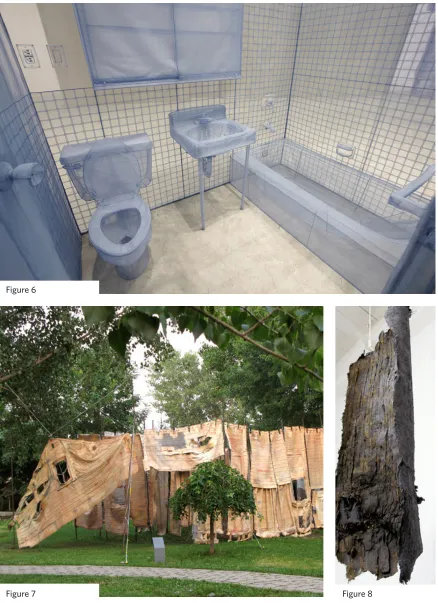
more recent work, Staircase V, (2008) (Figure 5) Suh re-creates the staircase leading to his landlord’s apartment out of sheer red poly-ester and stainless steel tubes. In, Specimen Series (2013) (Figure 6) he painstakingly recreates life-sized versions of appliances from his apartment ranging from his electric stove, to his cast-iron radiators and toilet.14
30
monument to the house which once stood and the force which ultimately destroyed it.15
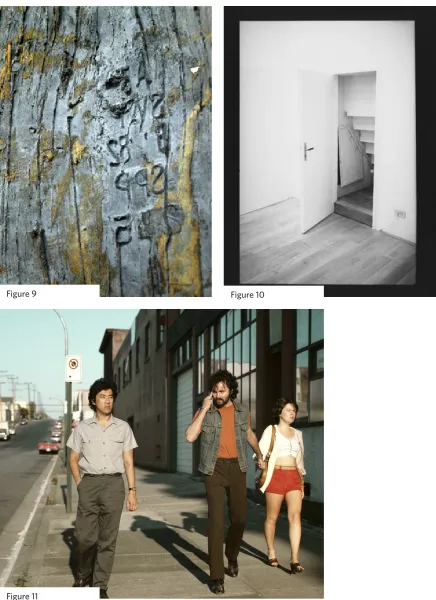
Horisaki also works on projects of a smaller scale. In Queens Telephone Pole (2006) (Figure 8¬9) 16, a splintering, rubbery latex fragment
of a telephone pole in Queens is suspended mid-air, a shadow of the real thing. Working with latex in Reconstructing Recollection, the hollowness of the cast doorknobs and ban-nisters of Best Friend/Back door 2007 acts as a metaphor for memory. The floppy, hollow objects mimic the visually vivid— but struc-turally flimsy— essence of memories, much like Horisaki’s Social Dress - New Orleans, and
Queens Telephone Pole.
Gregor Schneider is a German artist also working in the realm of memory, domestic spaces, and architecture. He often re-constructs rooms from his past or childhood, altering them in ways that render them useless or per-plexing. In TOTES HAUS u r (2001) (Figure 10), walls move and begin to seal-off spaces, doors and windows are permanently closed, and rooms become inaccessible from the outside. This changes the way these domestic spaces are understood. A bedroom, which seems intimate and comforting, suddenly becomes a place of isolation when an individual cannot get out or move freely. While these actions speak to isolation and trauma, I interpret the work using architecture as a frame for under-standing. By using familiar domestic spaces— that of the home— Schneider challenges these
13 “Art 21 - Art in the 21st Century.” Art 21. PBS. 2003. Television.
14 “Do-Ho Suh - Artists - Lehmann Maupin.” Do-Ho Suh - Artists - Lehmann Maupin. N.p., n.d. Web. 31 Mar. 2014.
<http://www.lehmannmaupin.com/artists/do-ho-suh>.
15 Horisaki, Takashi. Social Dress - New Orleans. Www.Takashihorisaki.com. N.p., 2007. Web. 30 Mar. 2014. <http://
www.takashihorisaki.com/sculpture_index.html>.)
assumptions by making accessible spaces isolated or off-putting, making the comfort of familiar domestic spaces constricting and frightening. 17 This drastic change of a
famil-iar space violates an audience’s expectation: entering a domestic space is typically not a jarring experience. In this way. Schneider uses the understanding of a recognizable social space to unexpectedly alter his viewer’s per-ceptions of that space. In Reconstructing Recol-lection, domestic spaces are also used to alter a viewer’s expectations and experience. View-ers become aware of what is missing from each piece. Suddenly seeing domestic spaces as ruinous or incomplete shifts the perception of the space from one of comfort and familiar-ity to that of absence and uncertainty.
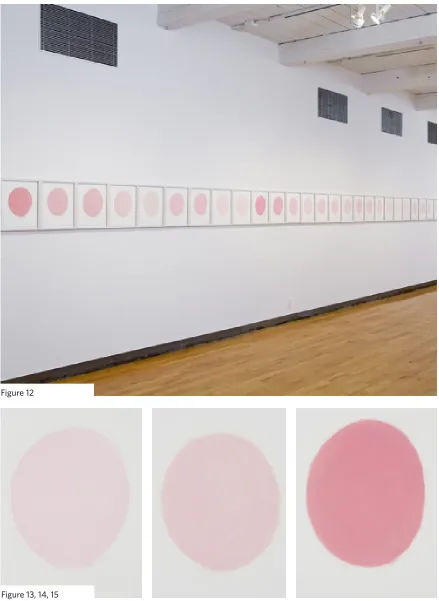
Spencer Finch is an American artist working in sculpture, painting, and installa-tion. In his piece Trying to recall the exact shade of Jackie O’s pink pillbox hat (1994) (Figure 12¬15), Spencer Finch painted dozens of pink ellipses — each slightly different in hue structure from the previous— in an effort to remember the exact shade of Jackie O’s iconic pink pillbox hat, worn on the day of her husband’s assassination. By using a physical and repetitive making process to remember, he asks again and again— what exactly was the shade of the hat? 18 His inability to recall the
remem-31
[image:31.594.86.524.69.667.2]Top Left: figure 1. rachel Whitread’s House
Figure 4 Seoul Home/L.A. Home/New York Home/Baltimore Home/London Home/Seattle Home/L.A. Home. Digital
image. Http://ocula.com/. N.p., n.d. Web. 9 Apr. 2014. <http://ocula.com/art-galleries/lehmann-maupin-hong-kong/ artworks/do-ho-suh/seoul-home-l-a-home-new-yor/>.
Figure 5 Do-Ho Suh’s Staircase V. Digital image. Http://www.tennysontippy.com/. N.p., 26 July 2-13. Web. 9 Apr. 2014.
<http://www.tennysontippy.com/theoretical-walls/>.
Figure 4
32
Figure 6 Do-Ho Suh’s Specimen Series. Digital image. Http://www.tennysontippy.com/. N.p., 26 July 2-13. Web. 9 Apr.
2014. <http://www.tennysontippy.com/theoretical-walls/>.
Figure 7 Horisaki, Takashi. Social Dress -New Orleans (full shot and detail). Digital image. Http://www.takashihorisaki.
com/. N.p., 2007. Web. 9 Apr. 2014. <http://www.takashihorisaki.com/sculpture_index.html>.
Figure 6
33
Figure 8-9 Horisaki, Takashi. Queens Telephone pole. Digital image. Http://www.takashihorisaki.com/. N.p., 2007. Web. 9
Apr. 2014. <http://www.takashihorisaki.com/sculpture_index.html>.
Figure 10 Wall, Jeff. Mimic. Digital image. Http://gordonmacdonald.org/. N.p., 5 Apr. 2012. Web. 9 Apr. 2014.
<http://gor-donmacdonald.org/2012/05/04/jeff-wall-tate-modern-2005-interview-with-gordon-macdonald/>.
[image:33.594.86.522.66.666.2]Figure 11 Schneider, Gregor. TOTES HAUS u r. Digital Image. http://www.gregor-schneider.de/. 5 April 2014.
Figure 9 Figure 10
34
bering, similar to Finch’s Trying to recall the exact shade of Jackie O’s pink pillbox hat. In both, the final collection of objects are artifacts of exploration: a visual array of the uncertainties of memory.
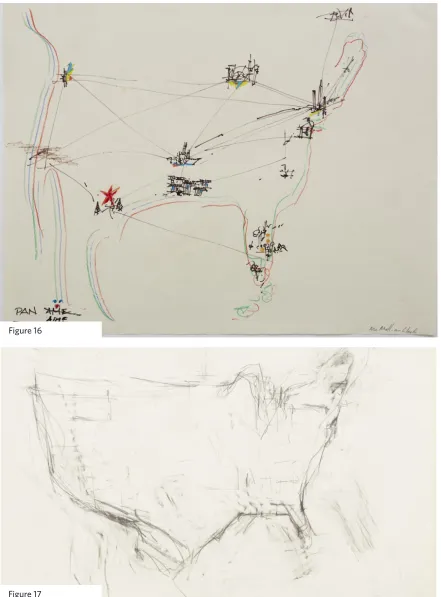
From 1971¬1972, Hisachika Takahashi, a Japanese visual artist, gave handmade Japanese paper to twenty-two fellow artists in New York City and asked them to draw or paint a map of the United States entirely from memory. 19
Robert Rauschenberg, Gordon Matta-Clark, Brice Marden took the request literally, attempting, in messy scrawls, to define an asymmetrical blob (consisting mostly of Maine and Florida) or delineate it into fifty states 20 (Figure 16¬18). This work served
as an example of the challenges of working from memory, exposing how intelligent and visually-inclined individuals struggled to recall something as simple as the iconic shape of the United States, without referencing documen-tation. Reconstructing Recollection too exposes the act of visualizing memory without the aid of documentation, showcasing the difficulty of remembering something as simple as a concrete stoop or a modest couch.
Sculptor Mike Kelley’s Educational Com-plex (1995) (Figure 19) casts recollection of space into a negative light. Kelley reconstruct-ed the floor plans from memory, claiming that the spaces he could not remember were sites where he had been abused. He constructed an assemblage of small models, replicas of
build-ings where he had gone to school. He claims to have constructed it from memory, stating that areas left out of the architecture were areas in which he was abused, in allusion to repressed memory syndrome. 21
Jeff Wall, a Canadian photographer carefully re-creates scenes from his memory that he finds striking or vivid. 22 He then
photographs these staged instances, using representation his memories to comment on social issues. In Mimic (1982), a man mock-ingly pulls his eye at a slant, insulting an Asian man walking near him.23 Mike Kelley’s
35 Figure 12 Spencer Finch’s Trying to Recall the Exact Shade of Jackie Kennedy’s Pillbox Hat. Digital images. Http://
[image:35.594.85.524.68.669.2]www.spencerfinch.com. Spencer Finch, n.d. Web. 9 Apr. 2014. <http://www.spencerfinch.com/view/drawings/31>.
Figure 12
36
Figure 16¬18 22 Artists Draw the United States from Memory- Gordon Matta-Clark, Brice Marden, Robert Rauschenberg.
Digital images. Huffington Post. N.p., 12 Sept. 2013. Web. 20 Apr. 2014. <http://www.huffingtonpost. com/2013/09/12/from-memory-exhibit_n_3909054.html>.
Figure 19¬20 Mike Kelley’s Educational Complex (3). Digital image. Http://mirjamvantilburg.wordpress.com/. N.p., 14 July
[image:36.594.71.512.69.666.2]2008. Web. 9 Apr. 2014. <http://mirjamvantilburg.wordpress.com/2008/07/14/mike-kelley-educational-complex-1995/>.)
Figure 16
37
16 Horisaki, Takashi. Queens Telephone Pole. Takashi Horisaki. N.p., 2006. Web. 31 Mar. 2014.
<http://www.takashi-horisaki.com/sculpture_index.html>.
17 Schneider, Gregor. TOTES HAUS u r. gregor. Venice, 2001. Gregor Schneider. 29 Mar. 2014
http://www.gregor-schneider.de/.
18 Finch, Spencer. Trying to recall the exact shade of Jackie O’s pink pillbox hat. Www.spencerfinch.com. 1994.
Spen-cer Finch. 27 Mar. 2014 <http://www.spenSpen-cerfinch.com/view/drawings/31>.
19 “From Memory.” Sean Kelly Gallery. N.p., 13 Oct. 2013. Web. 01 Apr. 2014.
<http://www.skny.com/exhibi-tions/2013-09-13_from-memory/>.
20 Brooks, Katherine. “22 Famous Artists Draw The United States From Memory.”
Www.huffingtonpost.com. N.p., 13 Sept. 2013. Web. 1 Apr. 2014. <http://www.huffingtonpost.com/2013/09/12/ from-memory-exhibit_n_3909054.html>.)
21 Kelley, Mike, and Anne Pontégnie. Mike Kelley: Educational Complex Onwards 1995-2008. Zurich: JRP/Ringier,
2009. Print.
22 “EXHIBITIONS.” MoMA. N.p., n.d. Web. 01 Apr. 2014. <http://www.moma.org/visit/calendar/exhibitions/12>. 23 Wall, Jeff. Mimic. Tate Modern. N.p., n.d. Web. 1 Apr. 2014.
<http://www.tate.org.uk/whats-on/tate-modern/exhi-bition/jeff-wall/room-buide-jeff-wal-room-3>.)
[image:37.594.87.524.72.482.2]Figure 18
39
The objects we make are given
the shapes we give them because
of where we are in time. Fashions
change, our needs change, and the
things we think are necessary today
will be quaint before long. We
sur-round ourselves with objects like a
sailor dropping buoys into the sea
around us, thinking, for a moment,
that they are marking a place. We
sail a short distance and look back
at the place where our wake has
subsided back to calm surface, and
find our buoys bogging randomly.
Did it matter that we were there
once, and where was that, exactly?”
- Tim McCreight
2323 McCreight, Tim. The Syntax of Objects. Portland,
Me.: Brynmorgen, 2005. Print.
“
Discussion
41 Reconstructing Recollection consists of six
sculptures. Because the pieces are abstract and at times unrecognizable, I chose very direct titles for the pieces. I also wanted there to be a noticeable difference between the clear titles and the fragmented nature of the pieces, serving as a metaphor for our perceived memories and our actual recollections. They are titled: First cigar on concrete stoop, 2007,
Kitchen Cabinet, 2009, Couch my parents made in 1974, 2011, Grandmother’s shag rug, 1998, Best friend/back door, 2007, and 717 Bluff Street (be-fore I was born), 1989. Each sculpture references where a specific event in my life occurred: a concrete stoop, the inside of a kitchen, the corner of a couch in a front room, a carpeted area in livingroom, the back entrance to a kitchen, a small ordinary house. The memories I chose were clear moments of my youth. They are not life milestones, yet they hold deep per-sonal significance as small, vivid moments of comfort, freedom, excitement and anticipation.
My heightened emotions increased my awareness of my surroundings, and I became acutely aware of the rough concrete, the impression of the doorknob, and the height of the cabinets. Because I was excited, or afraid, or comfortable— I was attached to my surroundings on a tactile level, creating such clear, vivid memories.
42
In my parents early twenties they moved to the small, cold town of Marquette, Michigan where my father had landed a job as a pro-fessor. They had no furniture. Together they purchased wood, foam and fabric, and built a beautiful couch with matching end tables. My mother carefully shaped the cushions and tai-lored covers from gray wool tweed. The couch, a combined effort of my parents early in their marriage, was a beautifully crafted object of love and necessity. The couch and both end tables traveled from their first apartment to their first house, and later to the home where I spent my childhood. The couch was the set-ting for family photos, Christmas mornings, angsty teenage phone-calls. I sat on the right corner nestled in the cushions, reading late into the night. The couch was a static fixture in my parents house; it seemed like it would never wear, and I hoped I would inherit it. Early in graduate school I received an excited call from my parents who had, after decades
of saving, finally purchased a La Corbusier sofa— the design trophy of tubular chrome and leather. I was happy to hear of their purchase, and was delighted myself: perhaps they would offer me their couch— until they casually mentioned that they had demolished it. They had thrown away the foam, removed the wool tweed, and broken apart— piece by piece— the couch they had so carefully made nearly 40 years prior. To match the height of the new sofa, they had even sawed down the legs of the wooden end tables. They confessed they had only made the couch out of necessity and had been hoping to replace it for years. I was dejected; I didn’t want the award-winning design icon. The ungiving, cold black leather was a poor replacement for a couch which had cradled my— and my parents’— life history.
46
Kitchen Cabinets, 2009
50
During the summer before college I spent my days enjoying the company of my best friend before we parted ways. She was moving ten hours east to attend school, while I was con-tinuing my education in my hometown. Each day I would walk down her long driveway to the back-door of her parent’s Victorian house. I would swing open the door, walk up the stairs and open the second door leading into the kitchen. We would sit for hours discuss-ing the possibility of our futures: dorm livdiscuss-ing, new friends, declaring a major. It was routine. Familiar. The feeling of the brass doorknob in my hand followed by flinging off the bannister and galloping up the stairs became analogous with reveling in the excitement and anxiety of starting college. We were ecstatic and afraid.
54
On my eighteenth birthday I sat on my boy-friend’s mother’s stoop, a large, rocky concrete stairway leading to a sage colored 1920’s house. It was mid-June. The sun was shining and I held in my hand my first cigar. It was large and papery in my hands. Sitting on the right side of the stoop with my legs dangling over the side onto the steps, I took a deep inhale of a peach-flavored White Owl and wheezed. I can picture the day and the cigar so clearly, but the most vivid memory is that of the stoop: what it looked like from my vantage point, the stairs cascading downward from my body— and the edges of the concrete pressed under my legs. I felt, for the first time, truly independent. I was rebelliously smoking a cigar (which I had not done before, and have not done since). It was an overwhelming feel-ing of befeel-ing cool and grown-up. I sat on the top of that stoop like a throne, experiencing the world for the first time as a legal adult.
58
When I was nine years old my family gathered in Park Ridge, Illinois for the annual family reunion. We ate chicken salad and hot dogs, and late on that muggy evening when the cicadas had come out and the jets from O’Hare soared overhead, I lay on my grand-mother’s large green shag carpeting. The shag of the carpet was long, and it engulfed my tiny body. I began to move my arms and legs along the carpet as if I were making a snow angel. I felt as though I were in a sea of green— a rich field of moss green polyester. I stood up and looked down at my creation: the movement of my body had left an impression in the rug— a “carpet angel.” I proudly proclaimed what I had done, and having unintentionally brought attention to the out dated carpeting, my grandmother decided it needed to be replaced. My uncle, a seasoned carpenter, enlisted the cousins and together we pulled the ancient green shag rug out of the hallway and living room as a collective act of the Cinelli family.
62
717 Bluff Street (before I was born) 1989
66
These moments and objects have all passed: my parents no longer inhabit their first house, and the shag carpeting no longer covers my grandmother’s floors. My best friend seldom returns to her parents home; I enter through the front door now. The house with the stoop is owned by a new family, the cabinets are used by another generation of college students, and my parent’s pristine couch lays disassembled in discarded pieces. The experiences (and objects I associate with them) are gone or forever changed. When I began this body of work, I had hopes that creating sculptural, tangible representations of my memories would somehow preserve these moments, making the framework of my fond memories physical and real again. I know this now to be impossible.
In Oliver Sacks’ An Anthropologist on Mars (The Landscape of his Dreams), he
investigates the work of Franco Magnani, a self-proclaimed “memory artist” who spent his life obsessively painting his childhood home of Pontito, Italy, from memory. 24 After
his pristine town of Pontito was occupied (and forever altered) during World War 2, Magnani left for the United States and began to paint nothing but Pontito, going into trance-like states in which he could ‘see’ pontito in great detail. They are surprisingly accurate, with angles and details painstakingly rendered— painted from the perspective of Magnani as a child.
After routinely painting for years, Magnani returned to Pontito, only to find it transformed, and himself a hero to the local residents for his work in attempting to ‘preserve’ Pontito— as it no longer was. In making Reconstructing Recollection I worked from memory to create sculptural representations of ethereal memo-ries, initially attempting to preserve places that were important to me.
69
I chose to work with architectural elements to represent memory because I understand the world around me physically, through touch and texture. I am drawn to objects, spaces, and materials— and I have always been this way. The memories I chose specifically link to architectural elements, which serve as a framework for my experiences, and are inevi-tably tied to them. They become intertwined: the memory and emotions are inextricable from the object and environments in which they were experienced. The kitchen cabinets are the long-gone days of ease with my room-mates, and my parents couch was the comfort of my childhood.
70
“Nostalgia is from the Greek nostos, to return home, and algia, a painful condition— thus, a painful yearning to return home.” 25 I thought
about my personal definition of “home”— the combination of emotional comfort, familial connections, and the physical, architectural presence of a place one inhabits.
I reference architecture that is both interior and exterior. “Architecture is increas-ingly used as a tool to help people experience space as an open and variable dimension. Architecture is no longer considered as an object, but as a cognitive field, as an extension of our capacity to perceive. Actually, there are no borders anymore between interior and exterior, there are no fixed partitions. Archi-tecture opens to the outside.” 26 Human beings
inhabit their bodies, experiencing the world around them in the first-person, participating in space in which they occupy. The experi-ences that take place in the space cannot be separated from the place itself, thus architec-ture provides the framework for experience and memory.
Semantically, these objects are under-stood through their recognizable form and the actions and emotions associated with them. Using familiar architectural elements (albeit, in an abstracted form) allows an audience to place the work within their own lives or recol-lections. In Unearthed: A Comparative Study of Jomon Dogu and Neolithic Figurines, the authors speak of absence in ruins and archeological
finds: “Paradoxically, Absence is powerful because it fails to persuade, convince, or fulfil. Absence invites questioning and uncertainty, promotes open-ended interpretations of representations, and prevents closed, secure meanings or interpretations of the part that are missing or about what is appropriate for filling the gaps left blank. “27 Through an obvious
lack of completion, Reconstructing Recollection
becomes fragmented or ruinous, providing space for an audience to ponder what may be missing.
25 Davis, Fred. Yearning for Yesterday: A Sociology of Nostalgia. New York: Free, 1979. Print.
26 Mahdalickova, Eva. “L’habitat, Un Monde à L’échelle Humaine.” Thesis. L’Université Paris VII, 2009. Http://www.
implications-philosophiques.org/. 2009. Web. 30 Mar. 2014.
27 Bailey, Douglass W., Andrew Cochrane, and Jean Zambelli. Unearthed: A Comparative Study of Jomon Dogu and
73
The objects in Reconstructing Recollection
are sculptural, created through the gestural and physical means of my body, echoing my tactile and movement-based memories. Using my hands and body, I worked from the most prominently remembered tactile aspect out-wards to the periphery of my recollection. Occasionally, throughout the process, I sketched in an attempt to visualize memories before physically constructing them.
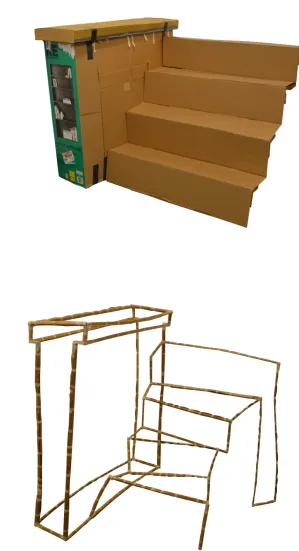
Working with cardboard, I constructed a mockup of the stoop from memory knowing it needed to be big enough to sit on and tall enough to swing my legs over. I approximated the height and number of steps, building slowly by hand. I stopped at the lowest step; I was unsure as to what went beyond. I had neither sat nor stepped on the other side of the stairs (Figure 21¬22). I worked similarly on Couch my parents made in 1974, 2011, and was surprised at how much of their form and detail was missing, the parts I hadn’t touched. They were
Tactile Contact
& Gestural Remembering
“Maybe memory is more creative
than that. Creative? Yes! On a
literal level it’s an act of creation.
We’re reconstructing those
memories. Construction! Maybe it’s
more like painting and sculpture!
Everyone is constantly their own
artist. We take bits and pieces of
experience— some things get
sharpened other things leveled,
and confused with imagination,
and out of that constructs what
feels like a recollection.
74
Figure 21
75
imperfect, oddly sloping objects, with large chunks simply missing (Figure 25¬26).This is how my clear memories had manifested them-selves physically.
For Best friend/back door, 2007, I reached into space and pulled forward where a door-knob would be. I piled cardboard into steps and trod up them, extending my hand out to where the bannister would be, and reached for the second doorknob to open the door lead-ing into the kitchen (Figure 27). I repeated this action over and over, marking my points of tactile contact (Figure 27). In Grandmother’s shag rug, 1998 I laid down on a blank carpet grid and made a snow angel. Marking out the outlines of my body, I imagined what parts of the carpet had felt like— where was the shag longest? I could recall so vividly the soft, deep carpet around my feet and hands. I could almost feel the sensation of green polyester encompassing my arms, legs, and head. In
Kitchen Cabinet, 2009, I closed my eyes and
imagined how small I felt clambering up onto the counter to reach the cabinet. I reached up-wards in space and thought the cabinet must be higher; I certainly remembered it that way. Crudely constructing a cabinet from wax pa-per, then chipboard, I began from the cabinet I used most (the lower right), and found that it drooped towards me slightly, closest to my reach (Figure 23¬24)
[image:75.594.87.318.81.193.2]In the instance of 717 Bluff Street (before I was born), 1989, I long for a tactile memory with the house that I only remember through documentation. The house was out of my reach— tiny and far away. I could not make this object by hand as I had no tactile recol-lections with it. For this reason, it was tiny, solid, and I did not construct it myself: I drew it from memory, rendered the drawings as a 3D file, and sent the file to be manufactured by a rapid-prototyping company (Figure 29).
76
Figure 25
77
Figure 27 Figure 28
79
The role of tactility in Reconstructing Recollection
is communicated to the viewer through the use of materials. Because an audience cannot physi-cally experience the artifact and the tactile aspect of remembering in the same way I do, I translated the recollections into materials which referenced the original experience, but embodied the ephemeral and airy qualities of memory. Through the use of construction methods, opacity, transparency, scale, and line quality, viewers could understand what something felt like without touching it, while simultaneously understanding the objects as metaphorical representations of recollections.
Material &
80
support their own weight, and were too heavy and too literal. I was intrigued by the color and line-quality of wrapped gray tape around wire, but it did not allude to the texture of concrete. I thought about concrete. I played with what-ever gray materials I could find. I cut vari-ous lengths of gray stripping, and bent wire through it. I wrapped it in tape, covered parts in roofing paper— but it wasn’t rectilinear, and felt lacking in its relationship to the concrete stoop. I began again with chipboard, enjoying the slightly grayer quality and speckled qual-ity. It wasn’t rigid enough to hold its shape, and its hue-structure still referenced organic materials. I then tried bookboard, a very thick, gray, rigid paper with a speckled surface that referenced rough concrete (Figure 30). I had found the way to make my stoop! I scored the material to create warped, rectilinear lines, and fastened it together with light gray mask-ing tape and epoxy (Figure 31¬32). With its haphazard, unevenly spaced tape and sloping edges; it is not an immaculate object. Instead, it is the imperfect residue of reconstructing a recollection.
In each piece, materials suggest a hier-archy of clarity through variations in trans-parency or line quality (Figure 35).Couch my parents made in 1974, 2011 begins at the right corner of the couch and moves outwards into space. The arm of the couch is assembled with straight lines and rigid angles, but as it moves towards where the end of the couch would In First cigar on concrete stoop, 2007, I
thought of the rough gray concrete under my body, becoming particularly aware of the hard edges of the stoop and stairs. I fashioned long, rectilinear cardboard dowels which defined only the edges of the structure. I began at the top of the stoop where I sat, using the thickest cardboard rods, and continued downwards, making thinner rods as I moved farther away from my primary point of contact. In this way, I hoped to mimic the way objects appear small-er in the distance. The parts of my memories I could not remember didn’t simply end, but dissolved toward a vanishing point, becoming wispy and frail. I was surprised by the way my memories dissolved, and often found myself frozen— with cardboard in hand— unsure as to what came next.
82
83 Figure 34
Figure 33
84
85
coating old brass stair hardware (bannister holders and a doorknob) with layers of liquid latex and paper napkins, I turned them inside out and carefully stitched them back together to create inverse casts of these objects. The latex absorbed the patina and coloration of the brass, creating an eerie, floppy, skin-like mirror of the real object. For the bannister, I stretched the cast form over a soldered metal structure to emphasize the hollowness of the object (Figure 37). Sewn organza creates the framework of an entry way, hinting at doors, walls and stairs, while latex doorknobs and a bannister protrude to show what was touched and remembered as I ascended the stairs. The open sides of the bannister and doorknobs are seen through the organza, exemplifying the fallacy of accurate memory, the illusion of depth and solidity (Figure 38). An audience may want (or be averse to) to touch(ing) them because of their mottled, skin-like surface. In either reaction, the use of hollow latex casts allows a viewer to become aware of the tactil-ity of the object and its relationship to their own bodies. The sewn door frame and hint of a staircase reference the work of Do-Ho Suh. By using sheer polyester to re-create domestic spaces, the quality of industrial or mundane objects changes from expected to ethereal (Figure 39). In Best friend/back door, 2007, the transparency of the door and the hollow latex hardware imply a frail or unreal quality. be, it begins to slope downwards. The
rigid-ity of the furniture deteriorates, and the lines become wobbly and end mid-air. Lengths of steel wire were soldered together to create a distorted outline of a rectangular modernist lamp, hovering above the surface of the end table. Galvanized steel wire (intended to hang industrial lighting) connected by duct-tape, fiberglass, and teflon plumbing tape create knobby, organic joints on the couch and end table. These corners create a sharp contrast to the metal, which was almost indiscern-ible from its surroundings (Figure 33). I then “upholstered” the couch with layers of trellis netting, giving the most prominently remem-bered areas several layers of netting, creating a complex visual surface of tangled black lines. As the memory fades, these lines become thinner and break, trailing off into a pile on the floor (Figure 34). The couch cushions were soldered from thin steel wire, then “stuffed” with trellis netting to create a fuzzy, smoky quality akin to a charcoal drawing. The use of unusual materials and sloping edges allowed the objects to dissolve into space where I could no longer remember them.
86
88
89
Kitchen Cabinets, 2009 uses layers of translucent material to create a ghostly appearance. My first model of Kitchen Cabi-nets, 2009 was constructed with wax paper, drawing paper, and white cotton (Figure 40). I enjoyed the sewn quality, but it lacked any material connections with the other pieces. I constructed a new version from chipboard, and found the stability of the material to be too solid and heavy, lacking the ethereal qualities of memory. In material conversation with
Couch my parents made in 1974, 2011, I began again, constructing a cabinet from soldered steel wire (Figure 41). I was intrigued by its line quality, the bulging soldering points were akin to a quick gesture drawing. I began to layer onto the structure, experimenting with cheese-cloth, gridded like the trellis netting, and trans-parent like organza (Figure 42). Concerned with the fragility of the material, I ironed lengths of the material starched with epsom salt into more structured sheets. I worked in layers beginning at the lowest cabinet, us-ing several sheets of cheesecloth to create a more opaque surface at the points of tactile contact (Figure 43). As the cabinets extended upwards outside of my reach, the cheesecloth feathered away until there was none— just a hint of the object remained.
[image:89.594.86.295.71.664.2]Grandmother’s shag rug, 1998 uses thick, green wool yarn of various lengths to translate the experience of making a snow angel in a shag rug. I recall so vividly the softness of the
90
Figure 40
92
Figure 43
green polyester beneath my body. I began by investigating materials which looked like shag carpet materials, but were not: green raffia tied together, green paracord cut in lengths, green flocking applied to a tactile surface (Figure 45). Working from the outside of the outline of my body, I worked my way in using fluffy green Alpaca wool, latch-hooking (with a dedicated and thoughtful team of friends) the longest lengths of wool around the perimeter of the outline. Slowly working with smaller lengths towards the center, I then wove green acrylic wool through the carpet backing, creat-ing a flat impression where my body had been (Figure 46-49). This created a space where my body had pressed the carpet (Figure 50),
with a small cradle for my head, leaving an indentation of where it had been (Figure 51).
717 Bluff Street (before I was born), 1989
94
Figure 46, 47, 48, 49
[image:94.594.73.509.470.666.2]96
plastic layers create a 3D object. 28 This tiny
house has a transluscent quality but is also incredibly solid. It lacks the delicate, flimsy qualities of Kitchen Cabinet 2009 or Couch my parents made in 1974, 2011. It manifested as solid and machine made because I had remembered it from documentation. It was distorted and irregular, but it lacked the frail, fleeting qualities of memory.
The materials of the objects inform the experience for the user: the softness and depth of Grandmother’s shag rug, 1998 can be understood visually. The bookboard used in
First cigar on concrete stoop, 2007 implies a textured, outdoor space and a rigidity of the original material. The cheesecloth used in Kitchen Cabinet 2007 was clean and delicate. It created an incredibly ghostly presence for an object out of reach. The layered trellis netting used in Couch my parents made in 1974, 2011
reminded me of the gray tweed upholstery of the couch cushions. Experimenting with net-ting, cheesecloth, wire and yarn allowed me to see the power of material. By fully experi-menting with materials, I was able to see how specific material choices could best represent memory in a tangible form.
I undertook an organic approach to re-membering-through-making. Working without measurements, I estimated the lengths and approximate connections my materials would make. I made as I recalled— even though I had prototyped earlier versions of each piece. I
28 “Frosted Detail Plastic Material Information.” Shapeways.com. N.p., n.d. Web. 1 Apr. 2014. <http://www.shapeways.
com/materials/frosted-detail-plastic>.
tend to be fastidious about quality in my work, sending exact measurements to machinists and woodworkers to produce my designs. Because these were my recollections and I re-member through tactile contact, I knew I needed to make them myself, by hand, without precise measurements. Making without measuring the cabinet was both terrifying and exhilarating; I was able to follow my intuition and create forms based on tactile instinct and remembering. I avoided consulting any video or photographic documentation, preferring to work from memory alone (or memory of documentation, in 717 Bluff Street (before I was born) 1989.) At one point, I sent my father a photo of the end-table lamp I had constructed from wire. He responded by texting me a photo of the actual lamp itself (Figure 52¬53). I was both excited (it was pretty close! My memory was accurate!) and alarmed— I didn’t want to see what documentation looked like; I wanted to see what my memories looked like. (I politely asked him not to send me any more photos.)
97
Figure 52 Figure 53
Reconstructing Recollection relied on intuition and estimates as opposed to photographic documentation of places I was reconstructing. Like a reconstructed memory, the pieces needed to be imperfect. The lengths of book-board in First cigar on concrete stoop, 2007 do not line-up perfectly, creating holes in the structure between tape and epoxy (Figure 54). The joints of Couch my parents made in 1974, 2011 are bulging and uneven, and the lengths of steel between them sag and bend. Threads hang off the sewn latex in Best friend/ back door, 2007, leaving gaps in the material to expose their hollow insides. Grandmother’s shag rug, 1998 is asymmetrical, with exposed carpet backing at the edges. Kitchen Cabinet,
2009’s cheesecloth pulls and frays (Figure 55). These imperfections were simultaneously intentional and unintentional. I could not sepa-rate the making from the remembering: there was imperfection in both. The only piece that is ‘perfect’ in its construction is 717 Bluff Street (before I was born), 1989, as it was not recalled through touch, but rather from documenta-tion— a source that can clearly articulate the details of the past.
98
99 Figure 55
neutral colors? Because the materials chosen needed to represent both the original material of object(s) and the ethereal nature of memory, the objects needed to be both representational and vague. First cigar on concrete stoop, 2007
was constructed in shades of gray to reference the gray concrete of the remembered stoop. In the instance of Couch my parents made in 1974, 2011, I made a conscious decision not to separate the materials into “wood” and “fabric”, choosing instead to work with trellis netting, which had a similar grid-like woven structure, and when bunched together, almost began to look like fabric. Thus, the hue remained in grayscale: gray steel rods, white teflon tape, and black trellis netting.
The doorknobs in Best friend/backdoor, 2007 have brown and even gold accents as a product of their making: latex reacts with brass, pulling off some of the patina and finish onto the latex mold. The latex casts are meant to be somewhat representative of brass hard-ware, but mostly represent the tactile quality of what my hand touched as I raced up the back stairs and into the kitchen. Because the color in these memories was not a salient part of the memory itself, it became secondary to the structure and tactile components of the objects. The ghostliness of the recollection became more important than color of the cabinets or the siding of the house.
101
Because the objects of Reconstructing Recol-lection are remembered through my own sight and touch, my body became the tool for mak-ing and the source of scale. Workmak-ing without measurements other than those of my body countered my intuition to find the “right” an-swer and the “correct” measurements. Several times I found myself hovering in the Google search-bar, poised and ready to search “pre-cise doorknob height” and “ergonomic slope for sitting”. Because my memories are recalled in the first-person, they are created
from my perspective. Because I stand at
(nearly) 5’4”, Kitchen cabinet, 2009 is displayed at an extraordinary height— far too tall for me, (or anyone else) to reach. In the instance of Grandmother’s shag rug, 1998, I recall the shag carpet as a young child. In my memory, the shag is extremely long, encompassing my tiny body as I dragged my limbs through it. As I am working from my memory as an adult, the enormity of the shag rug must increase to
102
encompass my body at its current size. The height of the doorknob in Best friend/back door, 2007 is not determined by the actual, mea-sured height of the doorknob, but rather by my gestural recollection. Just as recognizable architecture engenders an understanding of interactions within domestic social spaces, sculptures built largely to human-scale allow an audience to “interact” with them on a one-to-one scale. They can place themselves within the scenarios of attempting to reach tall cabinet or sitting on a sofa. They are neither giant, nor miniature— with the exception of one piece:
717 Bluff Street (before I was born), 1989 was not made in relation to the scale of my body. Here, scale is relative to the lack of tactile interaction and corporeal experience, defined by distance of a memory. In Susan Stewart’s On Longing, she writes: “There are no miniatures in nature: the miniature is a cultural product, the product of an eye per-forming certain operations, manipulating and attending in certain ways to the physical world.” 29 Because I cannot construct the
house in its entirety, and because my experi-ence with it is extremely limited, I am re-sponding to my understanding of a place by miniaturizing it. Stewart also notes, in Objects of Desire: “A miniature world is a more perfect world: the blemishes visible to the naked eye in life-sized objects are no-longer visible.” 30
This rings true for 717 Bluff Street (before I was
born), 1989. In my inability to touch or experi-ence this place, I can only imagine it perfect and pristine— my parents and siblings living in perfect harmony with their newest addition. The pieces of Reconstructing Recollection both reference and create space. In Best friend/ back door, 2007, only a hint of an entryway is shown, and yet the work requires enough surrounding room so that the entire entryway may be imagined by the viewer. In First cigar on concrete stoop, 2007, the far edge of the stoop is disconnected from the main structure, creating a framework where the whole stair-way should be, but instead creates a path that people may walk through— an impossibility in reality. The parts of the stoop are visually understood as one object using Gestalt’s prin-ciples of closure and proximity. 31
Paying special attention to figure-ground relationships, the objects were crafted and placed in the space with discontinuity in mind. The doorknobs of Best friend/Backdoor, 2007 are discontinuous from the organza behind it, but are also framed against a white wall. While the organza becomes part of the ground, or negative space, the doorknobs become the figure, the most prominent part of the piece— the part that was most remem-bered.
Without specific lighting, the objects of
Reconstructing Recollection inhabit their real (physical) space, and an imagined space, that of the “whole” object. When lit, the space
29 Stewart, Susan. On Longing: Narratives of the Miniature, the Gigantic, the Souvenir, the Collection. Baltimore: Johns
Hopkins UP, 1984. Print.
103
expands through the use of shadows, extend-ing the space from the physical sculpture onto the wall and floor. In the case of Kitchen Cabinet, 2009, the wireframe structure is cast onto the wall, projecting a shadow that appears like a wobbly line drawing. The lay-ers of cheesecloth, which appear so fragile within the object, become solid on the wall as a shadow, their single or double layers creat-ing dark, opaque areas (Figure 56). The space inhabited by Couch my parents made in 1974,
2011, becomes larger through the straggly wire extending into space where the other half of the couch should be, and the shadows it creates. The cacophony of trellis netting creates a visual web on the floor, contributing to the cloudiness and dispersive quality of that memory (Figure 57). Likewise, First cigar on concrete stoop, 2007
[image:103.594.86.521.276.666.2]casts overlapping spindles of shadows onto the floor in several directions extending out into nothing, its line quality becoming thinner and thinner, disappearing into space.
104
105
Conclusion
New Questions for the Future
In crafting Reconstructing Recollection, I was able to see for the first time what my memories
looked like. I learned and read about the phe-nomenon of memory: it is not as concrete and unchanging as I had previously thought, and I was able to see that first-hand through making. It was, at times, magical to cut cardboard and tape it together haphazardly, stepping away to see a fragment of a treasured memory, large and tangible, however incomplete. However, in some ways, this work is a futile effort. In an attempt to see memories more clearly, I only end up deteriorating them further, exposing the truth, that passed moments cannot be preserved in my mind as I wish they could be; I do not remember things with the clarity I desire to.
106
year; instead I chose to order the work based on physical relationship between pieces and the space, i.e. the height of the cabinet dis-played across from the tiny house. In the fu-ture, I want to investigate how or if the mean-ing changes dependmean-ing on the order in which the work is seen. I find the narrative aspect of the memories (however subtle) imperative to the work, so future titles may change from locations and dates, to simply an action and year “First cigar, 2007.” “Snow angel, 1998” etc.
I am also interested in how exhibiting the work in different locations will impact the meaning and understanding of the series. In its first showing, Reconstructing Recollection
was exhibited in the Warren Robbins Gallery, a small exhibition space with concrete floors and fixed walls, located on the 2nd floor of the Penny W. Stamps School of Art & Design. I was struck by intimacy of the space, its low-ceilings and warm lighting. The house-scale gallery felt like the right place to exhibit sculptures about memories in the form of architectural elements. The permanently angled walls allowed for surprises in the work: a viewer could turn an angle and see, for the first time, the staggering green of the rug and the extreme distortion of a miniature house. Whiteread’s House is dependent on its location for the meaning of the work— the empty block surrounding the house frames the stark power of the last ‘house’ remaining. What happens to Reconstructing Recollection when it is placed
in an Alzheimer’s cl