An Double Hidden HMM and an CRF for Segmentation Tasks with
Pinyin’s Finals
Huixing Jiang Zhe Dong
Center for Intelligence Science and Technology Beijing University of Posts and Telecommunications
Beijing, China
[email protected] [email protected]
Abstract
We have participated in the open tracks and closed tracks on four corpora of Chi-nese word segmentation tasks in CIPS-SIGHAN-2010 Bake-offs. In our experi-ments, we used the Chinese inner phonol-ogy information in all tracks. For open tracks, we proposed a double hidden lay-ers’ HMM (DHHMM) in which Chinese inner phonology information was used as one hidden layer and the BIO tags as an-other hidden layer. N-best results were firstly generated by using DHHMM, then the best one was selected by using a new lexical statistic measure. For close tracks, we used CRF model in which the Chinese inner phonology information was used as features.
1 Introduction
Chinese language has many characteristics not possessed by other languages. One obvious is that the written Chinese text does not have explicit word boundaries like western languages. So word segmentation became very significative for Chi-nese information processing, and is usually con-sidered as the first step of any further processing. Identifying words has been a basic task for many researchers who have devoted themselves on Chi-nese text processing.
The biggest characteristic of Chinese language is its trinity of sound, form and meaning (Pan, 2002). Hanyu Pinyin is the form of sound for Chinese text and the Chinese phonology informa-tion is explicit expressed by Pinyin which is the
inner features of Chinese Characters. And it nat-urally contributes to the identification of Out-Of-Vacabulary words (OOV).
In our work, Chinese phonology information is used as basic features of Chinese characters in all models. For open tracks, we propose a new dou-ble hidden layers HMM in which a new phonol-ogy information is built in as a hidden layer, a new lexical association is proposed to deal with the OOV questions and domains’ adaptation ques-tions. And for closed tracks, CRF model has been used , combined with Chinese inner phonology in-formation. We used the CRF++ package Version 0.43 by Taku Kudo1.
In the rest sections of this paper, we firstly in-troduce the Chinese phonology in Section 2. Then in the Section 3, the models used in our tasks are presented. And the experiments and results are described in Section 4. Finally, we give the con-clusions and make prospect on future work.
2 Chinese Phonology
Hanyu Pinyin is the form of sound for Chi-nese text and the ChiChi-nese phonology informa-tion is explicit expressed by Pinyin. It is cur-rently the most commonly used romanization sys-tem for Standard Mandarin. Hanyu means the Chinese language, and Pinyin means “phonetics”, or more literally, “spelling sound” or “spelled sound” (wikipedia, 2010). The system has been employed to teach Mandarin as home language or as second language by China, Malaysia, Sin-gapore et.al. Pinyin has been the most Chinese character’s input method for computers and other devices.
1
The romanization system was developed by a government committee in the People’s Repub-lic of China, and approved by the Chinese gov-ernment on February 11, 1958. The Interna-tional Organization for Standardization adopted pinyin as the international standard in 1982, and since then it has been adopted by many other organizations(wikipedia, 2010). In this system, pinyin is composed by initials(pinyin: shengmu), finals(pinyin: yunmu) and tones(pinyin: sheng-diao) instead of consonants and vowels used in European language. For example, the Pinyin of ”中” is ”zhong1” composed by ”zh”, ”ong” and ”1”. In which ”zh” is initial, ”ong” is final and ”1” is the tone.
Every language has its rhythm and rhyme, so Chinese is no exception. The rhythm system are the driving force from the unconscious habit of language(Edward, 1921). And the Pinyin’s finals contribute the Chinese rhythm system, Which is the basic assumption our research based on.
3 Algorithms
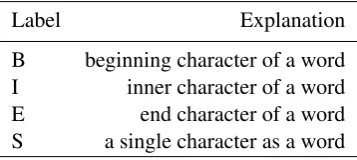
[image:2.595.319.501.328.436.2]Generally the task of segmentation can be viewed as a sequence labeling problem. We first define a tag set asT S={B, I, E, S}, shown in Table 1.
Table 1: The tag set used in this paper.
Label Explanation
B beginning character of a word I inner character of a word E end character of a word S a single character as a word
For the piece ”是 英 国 前 王 妃 戴 安 娜” of the example described in the experiments section, firstly, the T S tags are labeled to it. And its re-sult is ”是/S英/B国/E前/S王/B妃/E戴/B安/I 娜/E”. Then the tags are combined sequentially to get the finally result ”是 英国 前 王妃 戴安娜”.
In this section, A novel HMM solution is pre-sented firstly for open tracks. Then the CRF solu-tion for closed tracks is introduced.
3.1 Double hidden layers’ HMM
For a given piece of Chinese sentence, X =
x1x2. . . xT, wherexi, i = 1, . . . , T is a Chinese
character. Suppose that we can give each Chinese characterxi a Pinyin’s finalyi. And suppose the
label sequence of X is S = s1s2. . . sT, where
si ∈ T S is the tag ofxi. Then what we want to
find is an optimal tag sequenceS∗ which is de-fined in (1).
S∗ = arg max
S P(S, Y|X) = arg max
S P(X|S, Y)P(S, Y) (1)
[image:2.595.91.270.495.575.2]The model is described in Fig. 1. For a given piece of Chinese character strings, One hidden layer is label sequenceS. Another hidden layer is Pinyin’s finals sequenceY. The observation layer is the given piece of Chinese charactersX.
Figure 1: Double Hidden Markov Model
For transition probability, second-order Markov model is used to estimate probability of the double hidden sequences as described in (2).
P(S, Y) =∏ t
p(st, yt|st−1, yt−1) (2)
For emission probability, we keep the first-order Markov assumption as shown in (5).
P(X|S, Y) =∏ t
p(xt|st, yt) (3)
3.1.1 Nbest results
Based on the work of (Jiang, 2010), a word lat-tice is also built firstly, then in the second step, the backwardA∗ algorithm is used to find the top N results instead of using the backward viterbi al-gorithm to find the top one. The backward A∗
3.1.2 Reranking with a new lexical statistic measure
Given two random Chinese charactersXandY
[image:3.595.139.226.179.227.2]and assume that they appears in an aligned region of the corpus. The distribution of the two random Chinese characters could be depicted by a 2 by 2 contingency table shown in Fig. 2(Chang, 2002).
Figure 2: A 2 by 2 contingency table
In Fig. 2,ais the counts ofXandY co-occur;b
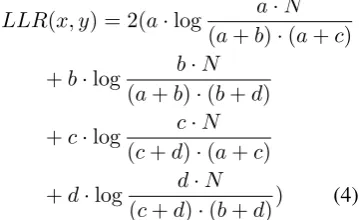
is the counts of the cases thatXoccurs butY does not; cis the counts of the cases that X does not occur butY does;dis the counts of the cases that bothX andY do not occur. The Log-likelihood rate is calculated by (4).
LLR(x, y) = 2(a·log a·N (a+b)·(a+c)
+b·log b·N (a+b)·(b+d)
+c·log c·N (c+d)·(a+c)
+d·log d·N
(c+d)·(b+d)) (4)
For the N-best result described in sec. 3.1.1, they can be re-ranked by (5).
S∗ = arg min
S (scoreh(S) +
λ K
K
∑
k=1
LLR(xk, yk))
(5) where scoreh is the negative log value of
P(S, Y|X). Kis the number of breaks inX and
xk is the left Chinese character of the k break
and yk is the right Chinese character of the k
break. λ is the regulatory factor(in our experi-mentsλ= 0.45).
Bigger value of LLR(xk, yk) means stronger
ability in combining of the two charactersxk and
yk, then they should not be segmented.
3.2 CRF model for closed tracks
Conditional random field, as statistical sequence labeling model, has been used widely in
segmen-tation(Lafferty, 2001; Zhao, 2006). In the closed tracks of the paper, we also use it.
3.2.1 Feature templates
[image:3.595.109.289.352.462.2]We adopted two main kinds of features: n-gram features and Pinyin’s finals features. The n-gram feature set is quite orthodox, they are, namely, C-2, C-1, C0, C1, CC-2, C-2C-1, C-1C0, C0C1, C1C2. The Pinyin’s finals feature set is the same as n-gram feature set. They are described in Table. 2.
Table 2: Feature templates
Templates Category
C-2, C-1, C0, C1, C2 N-gram: Unigram C-2C-1, C-1C0, C0C1, C1C2 N-gram: Bigram P-2, P-1, P0, P1, P2 Phonetic: Unigram P-2P-1, P-1P0, P0P1, P1P2 Phonetic: Bigram
4 Experiments and Results
4.1 Dataset
We build a basic words dictionary for DHHMM and a Pinyin’s finals dictionary for both DHHMM and CRF from The Grammatical Knowledge-base of Contemporary Chinese(Yu, 2001). For the fi-nals dictionary, we give each Chinese character a final extracted from its Pinyin. When it comes to a polyphone, we just combine its all finals simply to one. For example, ”中{ong}”, ”差{a&ai&i}”.
The training corpus (5,769 KB) we used is the Labeled Corpus provided by the organizer. We firstly add the Pinyin’s finals to each Chinese character of it, then we train the parameters of DHHMM and CRF model on it.
And the test corpus contains four domains: Lit-erature (A), Computer (B), Medicine (C) and Fi-nance(D).
4.2 Preprocessing
The date, time, numbers and symbols information are easily identified by rules. We propose four regular expressions’ processes, in which the reg-ular expressions’ processes are handled one after another in order of date, time, numbers and sym-bols. By now, a rough segmentation can be done. For a character stream, the date, time, numbers and symbols are firstly identified, then the whole stream can be divided by these units to some pieces of character strings which will be segment by the models described in sec. 3. For example, a character stream ”2009年的8月31日,是英国 前王妃戴安娜12周年忌日。” will be divided to ”2009年 的 8月 31日 , 是英国前王妃戴安 娜 12 周年忌日 。”. Then the pieces ”的”, ”是 英国前王妃戴安娜”, ”周年忌日” will be seg-mented sequentially by the models described in Section 3.
4.3 Results on DHHMM
We evaluate our system by Precision Rate(6), Re-call Rate(7), F1 measure(8) and OOV(Out-Of-Vocabulary) Recall rate(9).
P = C(correct words in segmented result)
C(words in segmented result)
(6)
R= C(correct words in segmented result)
C(words in standard result)
(7)
F1 = 2∗P ∗R
P +R (8)
OR= C(correct OOV in segmented result)
C(OOV in standard result)
(9) In (6-9),C(· · ·)is the count of(· · ·).
Table 3 are the results of the DHHMM on open tracks.
In Table 3, OOV RRis the recall rate of OOV,
IV RRis the recall rate of IV(In Vocabulary).
4.4 Postprocessing for CRF and Results on It
Since the CRF segmenter will not always return a valid tag sequence that can be translated into segmentation result, some corrections should be made if such error occurs. We devised a dynamic programming routine to tackle this problem: first we compute the valid tag sequence that closest to
Table 3: Results of open tracks using DHHMM: Literature (A), Computer (B), Medicine (C) and Finance(D)
A B C D
R 0.893 0.918 0.917 0.928 P 0.918 0.896 0.907 0.934 F1 0.905 0.907 0.912 0.931 OOV RR 0.803 0.771 0.704 0.808 IV RR 0.899 0.945 0.943 0.939
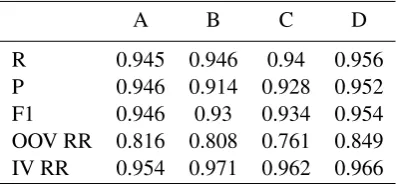
[image:4.595.311.510.398.490.2]the output of CRF segmenter (by term closest, we mean least hamming distance), if there is a tie, we choose the one has the least ’S’ tags, if the tie still exists, we choose the one that comes lexicograph-ically earlier (B < I < E < S, described in Table. 1). Table 4 are the results of the CRF on closed tracks.
Table 4: Results of closed tracks using CRF: Lit-erature (A), Computer (B), Medicine (C) and Fi-nance(D)
A B C D
R 0.945 0.946 0.94 0.956
P 0.946 0.914 0.928 0.952 F1 0.946 0.93 0.934 0.954 OOV RR 0.816 0.808 0.761 0.849 IV RR 0.954 0.971 0.962 0.966
From the results of Table 3 and Table 4, we can observe that the CRF model outperforms the DHHMM by average 2.72% in F1 measure. In the other hand, from Table 5, we can see that the com-putation cost in DHHMM is less than half of the time cost and lower one-fifth memory cost than CRF model.
Table 5: The computation cost in DHHMM and CRF
Time cost(ms) Memory cost(MB)
DHHMM 34398 16.3
5 Conclusions and Future works
This paper has presented a double hidden lawyers HMM for Chinese word segmentation task in SIGHAN bakeoff 2010. It firstly created N top results and then select the best one from it by a new lexical association.
Chinese phonology (specially by Pinyin’s final in text) is very useful inner information of Chinese language, which is the first time used in our mod-els. We have used it in both DHHMM and CRF model.
In future work, there are lots of improvements can be done. Firstly, which polyphone’s finals should be used in a given context is a visible ques-tion. And the strategy to train the parameterλ de-scribed in 3.1.2 can also be improved.
Acknowledgments
This research has been partially supported by the National Science Foundation of China (NO. NSFC90920006). We also thank Caixia Yuan for leading our discuss, Li Sun, Peng Zhang, Yaojing Chen, Zhixu Lin, Gan Lin, Guannan Fang for their useful helps in this work.
References
Wenguo Pan. 2002. zibenwei yu hanyu yanjiu:120–
141. East China Normal University Press.
Sapir Edward 1921. Language: An introduction to the
study of speech:230. New York: Harcourt, Brace and company.
wikipedia. 2010. Pinyin. http://en.wikipedia.org/wiki /Pinyin#cite note-6.
Baobao Chang, Pernilla Danielsson, and Wolfgang
Teubert. 2002. Extraction of translation unit from
chinese-english parallel corpora, Proceedings of the first SIGHAN workshop on Chinese language processing:1–5.
Huixing Jiang, Xiaojie Wang, Jilei Tian. 2010.
Second-order HMM for Event Extraction from Short Message, 15th International Conference on Ap-plications of Natural Language to Information Sys-tems, Cardiff, Wales, UK.
Franz Josef Och, Nicola Ueffing, Hermann Ney. 2001.
An EfficientA∗Search Algorithm for Statistical Ma-chine Translation, Proceedings of the ACL Work-shop on Data-Driven methods in Machine Transla-tion 14(Toulouse, France): 1-8.
Ye-Yi Wang, Alex Waibel. 2002. Decoding
Algo-rithm in Statistical Machine Translation, Proceed-ings of the 35th Annual Meeting of the Association for Computational Linguistics and Eighth Confer-ence of the European Chapter of the Association for Computational Linguistics: 366-372.
Yu Shiwen, Zhu Xuefeng, Wang Hui. 2001. New
Progress of the Grammatical Knowledge-base of Contemporary Chinese, ZHONGWEN XINXI XUEBAO, 2001 Vol. 01.
John Lafferty, A.Mccallum, F.Pereira. 2001.
Condi-tional Random Field: Probabilitic Models for Seg-menting and Labeling Sequence Data., Proceedings of the Eighteenth International Conference on Ma-chine Learning: 282–289.
Hai Zhao, Changning Huang, Mu Li. 2006. An