Context-Based Chinese Word Segmentation using SVM
Machine-Learning Algorithm without Dictionary Support
Chia-ming Lee
Department of Engineering Science
and Ocean Engineering,
National Taiwan University,
Taipei, Taiwan (R.O.C.)
[email protected]
Chien-Kang Huang
Department of Engineering Science
and Ocean Engineering,
National Taiwan University,
Taipei, Taiwan (R.O.C.)
[email protected]
Abstract
This paper presents a new machine-learning Chinese word segmentation (CWS) approach, which defines CWS as a break-point classifi-cation problem; the break point is the bound-ary of two subsequent words. Further, this paper exploits a support vector machine (SVM) classifier, which learns the segmenta-tion rules of the Chinese language from a context model of break points in a corpus. Additionally, we have designed an effective feature set for building the context model, and a systematic approach for creating the positive and negative samples used for train-ing the classifier. Unlike the traditional ap-proach, which requires the assistance of large-scale known information sources such as dictionaries or linguistic tagging, the pro-posed approach selects the most frequent words in the corpus as the learning sources. In this way, CWS is able to execute in any novel corpus without proper assistance sources. According to our experimental re-sults, the proposed approach can achieve a competitive result compared with the Chinese knowledge and information processing (CKIP) system from Academia Sinica.
1
Introduction
Chinese sentences contain sequences of charac-ters that are not delimited by white spaces or any other symbol used for word identification, so Chinese word segmentation (CWS) is one of the fundamental issues in Chinese natural language processing studies.
One of the major aspects in existing CWS re-searches is the resolution of word segment ambi-guities. The conventional approach of ambiguity detection is to use two maximum matching methods (MMs), which scan corpora forward
(Forward Maximum Matching, FMM) and backward (Backward Maximum Matching, BMM) based on dictionaries (Kit, Pan, & Chen, 2002). Meanwhile, disambiguation methods can be classified into two different categories: rule-based methods and statistical-rule-based methods. (Ma & Chen, 2003b). Problem disambiguity is often accompanied by the problem resolution of an unknown word or out-of-vocabulary (OOV) extraction (K.-J. Chen & Ma, 2002). Besides the MMs with dictionaries, which are also known as word-based approaches, there are character-based approaches. The word-character-based approach treats words as the basic unit of a language, and the character-based approach labels each charac-ter as the beginning, middle, or end of a word. Character-based approaches are often imple-mented with a machine-learning classification algorithm for handling disambiguation (Wang, Zong, & Su, 2012). In addition to dictionaries, other linguistic resources such as part-of-speech (POS) or semantic information can be integrated for further improvement (M.-y. Zhang, Lu, & Zou, 2004).
In addition to the disambiguation strategy, many researchers provide the best word sequence identification methods for their CWS. The Hid-den Markov model (HMM) (Lin, 2006; M.-y. Zhang et al., 2004), maximum entropy (ME), mutual information (MI) and boundary depend-ency (Peng & Schuurmans, 2001) are often used. Theoretically, to get the best CWS result is to obtain the optimized word sequence.
As described above, existing CWS research takes either words or characters as the core unit of their methodologies. Instead of identifying word ambiguity, finding word sequence or join-ing characters into words, we redefine the CWS problem as the identification of “break points” among the “joint points” in Chinese character sequences. In this paper, we define a “joint
point” as a point between adjacent characters, and a “break point” as the boundary of two sub-sequent words; further, the characters between two break points will consist of words.
The identification of break points among joint points is a binary classification problem. In this study, we use a support vector machine (SVM) machine-learning algorithm with contextual sta-tistical measures to construct the feature vector model of the joint points. Based on our assump-tion that the Chinese word segmentaassump-tion rule can be learned from non-linguistic contextual infor-mation, all features selected for the joint point model are purely statistical measures without any linguistic tagging information. Moreover, a sys-tematic approach for creating effective positive and negative samples is provided for training the SVM classifier.
Furthermore, in order to meet the need of a CWS approach for a novel corpus, which has no appropriate dictionaries or linguistic tagging, in this study, we select a small set of assistant known source from the experimental corpus as the learning samples, which can be reduced to only 3 words: the most frequent bi-gram, tri-gram, and four-gram words. The experimental results show that by using the joint point model within long contextual information, a small set of learning samples can lead to competitive CWS results compared with the Chinese knowledge and information processing (CKIP) system, which is supported by a large-scale term data-base that contains approximately 5 million Chi-nese terms, from Academia Sinica.
2
Related Works
Conventionally, ambiguity and OOV are two major problems in the field of CWS research (K.-J. Chen & Ma, 2002). From the methodolog-ical perspective, there are rule-based, statistmethodolog-ical- statistical-based, and machine-learning approaches (Kit et al., 2002; Peng & Schuurmans, 2001; Wang et al., 2012). Moreover, on the basis of the basic lan-guage unit used, existing research can be catego-rized into either word-based or character-based methods (Y. Zhang & Clark, 2007; Zhao, Huang, Li, & Lu, 2010). Most CWS research has re-solved problems using labeled corpora while a few have managed CWS using pure text corpora (Dai, Loh, & Khoo, 1999; Jin Kiat Low, 2005). In labeled corpora, the tagging of dictionary matches, parts-of-speech, semantics, and charac-ter positions inside a word, are all popular
meth-ods for incorporating known information (Kit et al., 2002).
2.1 Ambiguity and the unknown word
There are two types of ambiguities in CWS: overlapping and combinational ambiguities. They can be defined as follows: given a diction-ary D and a string “abc,” if the set of sub-strings
{ab, bc}⊂ D, “abc” involves an overlapping ambiguity; given a dictionary D and a string “ab,” if the set of sub-strings{a, b, ab}⊂ D, “ab” involves a combinational ambiguity.
Conventional dictionary-based FMM and BMM are straightforward strategies for detecting ambiguities (Kit et al., 2002) and certainly pro-vide an applicable foundation for disambiguation methods. However, dictionaries can never con-tain all words. Every corpus will have, on aver-age, 3% to 5% OOV words (K.-J. Chen & Ma, 2002); hence, the identification of unknown words has become an important branch of CWS studies (K.-J. Chen & Ma, 2002; Ma & Chen, 2003a). Besides MMs, there are other corpus-based learning approaches to detect ambiguities for CWS (K.-J. Chen & Bai, 1998).
2.2 Word-based and character-based ap-proaches
Another way to catalogue CWS is dependent on the basic information unit used; there are both word-based and character-based CWS methods. Word-based approaches treat the word as the basic unit, and POS and other word-based lin-guistic resources are often integrated into such approaches in order to improve the CWS results. From this point of view dictionary-based ap-proaches can be treated as word-based approach-es. Character-based approaches disregard the linguistic information and directly calculate the character-to-character statistical features. One popular way is to label each character as the be-ginning, middle, or the end of a word, and gener-ate sequence words in sentences on the basis of the position labels of the characters (Goh, 2005; Peng & Schuurmans, 2001; Zhao et al., 2010). There are few character-based CWS approaches that use pure text corpora without additional la-bel information (Dai et al., 1999; Jin Kiat Low, 2005).
2.3 Rule-based, statistical-based, and ma-chine-learning methods
Chen, 2003b) accompanied by the development of unknown word extraction or identification technologies (Ma & Chen, 2003a). Besides rule-based approaches, statistic-rule-based approaches in-volved the concept of language models trained on large-scale corpora, and many such algo-rithms have been used and improved over time, such as Maximum Entropy (ME), Mutual Infor-mation (MI), and boundary dependency (Jin Kiat Low, 2005; Peng & Schuurmans, 2001). Some statistic-based approaches do not focus on re-solving ambiguities, but provide strategies for word sequence identification in sentences. In general, statistical-based approaches tend to pro-vide a generative or discriminative (Wang et al., 2012) probability formula for Chinese words. In contrast, machine-learning approaches pay more attention to the selection of effective features for Chinese word representations. The HMM (Lin, 2006; M.-y. Zhang et al., 2004) and SVM (Li, Huang, Gao, & Fan, 2005) are popular in CWS studies. Currently, a combination of a character-based approach and statistical or machine-learning algorithms is a common strategy for CWS (Goh, 2005; Wang et al., 2012; Zhao et al., 2010).
2.4 Contextual information
Dai and Loh have proposed “The Contextual In-formation Formula” of Chinese bi-gram words (Dai et al., 1999). It is an MI improving formula trained on a large-scale corpus. In this formula, the frequency of a sample bi-gram, the frequen-cies of its context characters and document fre-quencies of its context bi-grams are used. They suggest that Chinese words can be defined by a non-linguistic formula that depends on context character measures. Low and Ng conducted a series of studies using context features for their CWS research (Jin Kiat Low, 2005). Further, the concept of contextual information has often been used in information extraction research as well as in existing Chinese term extraction research for entity identification (Gao, 2005; Lee, 2012). In addition, Japanese has no word delimiter like Chinese. Sassano and Neubig et al. have defined Japanese word segmentation (JWS) as a classifi-cation task of word boundaries, and also used contextual feature sets in their studies (Neubig, Nakata, & Mori, 2011; Sassano, 2002). Inspired by these ideas of using contextual information, our research aims to extract a contextual infor-mation feature vector of “joint points” and uses an SVM algorithm to train a break point classifi-er.
2.5 Complete lexical patterns
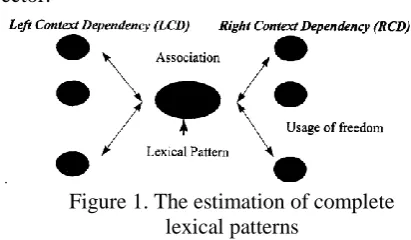
Chien has proposed the estimation of complete lexical patterns (Figure 1) (Chien, 1999) in a se-ries of Chinese term extraction papers. There are three important measures used in these lexical patterns, including association, and left and right dependency. These three measures will be inte-grated into our contextual information feature vector.
Figure 1. The estimation of complete lexical patterns
(1) Association(AEc) = f(x) / (f(y)+f(z)–f(x)) x is the lexical pattern; x = x1, x2, …, xn; y =
x1, …, xn-1, z = x2, …, xn; f(x) is the frequency of x; f(y) is the frequency of y; f(z) is the frequency of z
(2) Left Context Dependency(LCD) = f(max_xl) / f(x)
f(max_xl) is the maximum frequency of distinct
characters to the left of x
(3) Right Context Dependency(RCD) = f(max_xr)
/ f(x)
f(max_xl) is the maximum frequency of distinct
characters to the right of x
3
Method
In the proposed approach, the CWS was treated as the problem of identifying word break points among joint points in a corpus, and we resolved it by using a SVM machine-learning classifier. The term “joint point” in this paper refers to a point between two adjacent Chinese characters. Our approach is to classify all joint points into either a break point class or non-break point class. The function of break points is similar to that of white spaces in sentences in English.
un-known sample belongs to. Unun-known samples need to be formed using the same feature vector as the learning samples. In this paper, we set two classes, the break point class and the non-break point class, and the final predicted break-point outputs are the results of our CWS.
3.1 Positive and negative contextual sample generation
In this paper, we propose an efficient method of contextual learning sample generation to build a two class SVM classifier with positive learning samples for the break point class and negative learning samples for the non-break point class. Because break points are the boundaries of words, we first collect the known words in the corpus, and take their boundary points as the positive samples. In contrast, the negative sam-ples are the joint points inside these words. This means that every matching of a word will get two positive learning samples. It will also get one negative (learning sample) for a bi-gram match, tow negatives for a tri-gram match and three negatives for a four-gram match.
Take the sentence, “…。我行菩薩道時,…” (Figure 2), from the experimental corpus as an example, there are nine joint points, p1~p9, in this case. In this sentence, “。” is the period and “,” is the comma in Chinese, and “我行菩薩道 時 ” means ‘As I practice the way of Bohdhisattva.’ In this case, if 菩薩道 ‘the way of Bohdhisattva’, is a collected known word, then p4 and p7 will be the positive samples and p5 and p6 will be the negative samples; the other joint points will be the unknown samples.
Figure 2. Sample selection example
Joint points, including positive and negative learning samples, and unknown samples, are not characters and therefore do not take up space in a corpus. For making specific samples of the joint points, we always take the same number of char-acters before and after the joint point to generate contextual samples. Take “p4” in Figure 2 as an example, depending on how long the context in-formation we want to integrate, it can be sampled as a short-distance bi-gram 行菩, which takes one character on both sides of p4, a four-gram 我 行菩薩, or a longer-distance n-gram contextual positive sample. In our experiments, a six-gram
contextual sample, catching three characters on both sides of a learning sample, support a better SVM CWS classifier.
The known words, or learning words, for contextual learning sample generation can be collected from dictionaries. However, for the purpose of reducing the preparation loading of CWS for a novel corpus without appropriate dictionaries, in this study, we also set the high-est-frequency bi-gram, tri-gram and four-gram words in the corpus for the learning samples generation. Hence, the known words can be col-lected systematically in this way, and the exper-iment results suggest that the small size of the known words leads to a competitive result com-pared with the big numbers of known words, which collected from dictionaries.
The reason for using the most frequent bi-gram, tri-gram and four-gram words, but not uni-gram words is that single-character words do not have a negative case, which would cause an im-balance of positive and negative learning sam-ples. Further, bi-gram words are found to be the majority in Chinese texts, and long words tend to be combinations of short words (梁曉虹, 2005). Further, based on our observation, the highest-frequency bi-gram, tri-gram and four-gram in a Chinese corpus are almost always words and nouns, as well.
3.2 Feature vector extraction
The contextual learning sample needs to be mod-eled as a feature vector for the machine-learning algorithm. There are 10 types of features chosen for the feature vector extraction of the contextual learning sample, including frequency, the num-ber of distinct characters to the left and right, the number of breaking symbols (non-Chinese char-acters and paragraph marks) to the left and right, association, and the usage freedom to the left and right of characters in the contextual sample. Among these features, association and the usage freedom (also called left and right context de-pendency) refer to “The Estimation of Complete Lexical Patterns” as proposed by Chien (Chien, 1999). Table 1 shows the complete feature set used in our experiment.
the four-gram learning sample, 我行菩薩, gener-ated from p4 in Figure 2 as an example, there are a total of 34 features in its feature vector, includ-ing the four uni-gram frequencies of 我, 行, 菩, and 薩, and 30 features from three bi-gram fea-ture sets of 我行, 行菩, and 菩薩. Hence, de-pending on different extended length of context, there will be 56 features for a six-gram sample and 78 features for an eight-gram sample. Table 2 shows the numbers of features in different lengths of contextual samples.
No. Features
1 Frequency
2 Association (AEc) measure 3 Number of distinct characters
to the left side
4 Maximum frequency of dis-tinct characters
5 Number of breaking symbols 6 Left-context dependency
(LCD) measure
7 Number of distinct characters
to the right side
8 Maximum frequency of dis-tinct characters
9 Number of breaking symbols 10 Right-context dependency
(RCD) measure
Table 1. Feature set
Contextual sample length 4 6 8
-uni-grams 4 6 8
-bi-grams 3 5 7
-frequency of each uni-gram 4 6 8 -feature set of bi-grams 30 50 70 Total number of features 34 56 78
Table 2. Number of features in a four-gram feature vector
3.3 SVM algorithm and Libsvm package
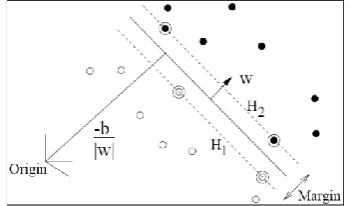
The Support Vector Machine (SVM) algorithm constructs a hyper-plane in a high-dimensional space for classification and other tasks (Cristianini & Shawe-Taylor, 2000). A good sep-aration is achieved by the hyper-plane farthest from the nearest training data point of any class.
Figure 3. Support Vector Machine (SVM)
In Figure 3, W is the good separation (the classi-fication hyper-plane) of the two classes—white spots and black spots—and H1 and H2 are the support hyper-planes.
0 b TX
W
H1:WTXb1
H2: WTXb1
To maximize the distance between H1 and H2 (2 / ||w||):
N
i
i T i
i y w x b
w b
w L
1 2
1 2
1 ,
,
In our study, Libsvm tools (Chang & Lin, 2011) were used for executing the SVM algorithm. The SVM algorithm includes two phases: model training and model using, called break-point-predicting phases. In the model-training phase, the input data for the Libsvm package is the fea-ture vector data set of all the learning samples, both positives and negatives, and the output data is a classification model file. Meanwhile, all joint points are considered to be unknown samples. The unknown samples should be converted to the feature vector data set in the exactly same way as the learning samples are. In the break-point-predicting phase, the input data is the feature vector data set of the unknown samples and the classification model file output from the earlier phase, and the output data contents of the joint points, which are predicted to be break points. The predicted output data are the CWS results.
4
Experiment
4.1 Corpus
The collection of Saddharma Puṇḍarīka (Lotus of the True Dharma), which is part of a Chinese text archive from the Middle Ages provided by the Chinese Buddhist Electronic Text Association (CBETA), was selected as the experimental cor-pus. It consists of 16 sutras labeled T0262 to T0277 of the Taisho Revised Tripitaka. This cor-pus contains 514,722 Chinese characters without punctuation, and there are a total of 514,721 joint points available for the experiment.
demonstrate the powerfulness of the proposed method.
4.2 Performance evaluation method
In this study, we selected paragraphs, evaluation texts, from the experimental corpus, and com-pared the results of the evaluation texts from a subject matter expert’s answers and the SVM CWS predicted answers as a means of evaluating the system’s performance.
Sàtánfēntuólìjīng, a sutra (T0265) from the collection of Saddharma Puṇḍarīka was chosen as the evaluation text. In Sàtánfēntuólìjīng, there are 1,588 joint points; the ratio size of the eval-uation text is 0.3% of the entire corpus. The evaluation text was not included in the training data, and experts provided 616 break points, true answers, and 972 non-break points, false answers for it. Precision, recall, and f-measure were used for evaluating the effectiveness of the CWS re-sults. The evaluation definitions were as follows:
Recall
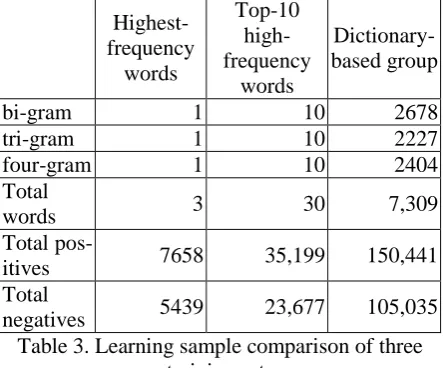
In order to reveal the effectiveness of the training data size, we prepared three training sets; each had different numbers of training data. The first set consisted of learning samples collected from the highest-frequency bi-gram, tri-gram and four-gram, for a total of three Chinese words in the corpus. The second set consisted of learning samples from the top-10 high-frequency words of each bi-gram, tri-gram, and four-gram in the corpus, and the third set consisted of learning samples from 7,309 words, which were collected from the book index of the corpus (大藏經學術
用語研究會, 198-?). Table 3 shows the number of learning samples for each training size.
At the end of the experiment, we compared the overall performance with that of CKIP, which is a Chinese word segmentation system supported by 4,892,324 Chinese-word database (Sinica, 2013).
In Table 3, the three highest-frequency words in the first training set are 菩薩 ‘bodhisattva’ (the bi-gram), which had a frequency of 3133; 摩訶
薩 ‘mahasattva’ (the tri-gram), which had a fre-quency of 382; and 文殊 師 利 ‘manjushri’, a name of the bodhisattvas (the four-gram), which
had a frequency of 514. This is a total of 4,029 matched strings, which contributed 7,658 posi-tive and 5,439 negaposi-tive samples. Since the matched strings are adjacent in some places, the total number of positives is not exactly twice the summation of the three frequencies. However this does not apply to the negatives samples be-cause there is no commonality of location.
Highest-negatives 5439 23,677 105,035
Table 3. Learning sample comparison of three training sets
Besides setting a different size of the training data, we set different context distances, character extensions in context, of samples. The more the context characters are extended, the more is the contextual information involved in the feature vector model. Hence, a two-character extension in context means catching 2 characters on both sides of the joint points to make a 4-gram context learning sample. Table 4 shows the CWS results for the highest-frequency training set, Table 5 shows the results of the top-10 high-frequency training set, and Table 6 shows the results of the dictionary-based training set. Every group was segmented in three different context distances. Sample
length Four-gram Six-gram Eight-gram Context
extension 2 characters 3 characters 4 characters
Precision 51.1% 51.2% 49.5%
Recall 94.5% 94.2% 96.3%
F-measure 66.3% 66.3% 65.3%
Table 4. CWS results of the highest frequency words
We believe that this shows the potential of the non-dictionary CWS method proposed in this paper.
Sample
length Four-gram Six-gram Eight-gram Context
extension 2 characters 3 characters 4 characters
Precision 56.6% 56.7% 57.0%
Recall 83.4% 82.1% 81.7%
F-measure 67.4% 67.1% 67.2%
Table 5. CWS results of the top 10 high frequen-cy words
Sample
length Four-gram Six-gram Eight-gram Context
extension 2 characters 3 characters 4 characters
Precision 57.9% 58.6% 59.1%
Recall 79.5% 80.4% 81.2%
F-measure 67.0% 67.8% 68.4%
Table 6. CWS results of the known words from the index book
4.4 Feature selection analysis
This section analyzes the importance of features used in the SVM classifier. A total of 56 features, in the highest frequency word dataset with 6-gram learning samples, were calculated and sort-ed by the f-score algorithm propossort-ed by Chen and Lin’s SVM feature-selected research (Y.-W. Chen & Lin, 2006).
Table 7, the top 10 features of the training da-taset, shows that the contextual dependency measures around joint points have a significant influence on the SVM classifier.
4.5 Iterative CWS strategy
Because the learning samples can be collected systematically and generated from very few words in the proposed CWS method, we provide an iterative training process to improve the CWS results. In the iterative CWS strategy, we select training samples for the next SVM CWS iterative round from the previous SVM CWS results.
Libsvm provides a probability measure for every joint point in the predicting phase, and in the Libsvm default setting, joint points will be classified in to the break point class when their predicting probability is greater than 50%, which is also the SVM classifier predicting threshold in our experiments.
Based on the probability measure, in the itera-tive experiment, points whose probability was greater than 90% were taken as positives and
points whose probability was less than 10% were taken as the negatives for the next round. In this way, the size of positives and negatives is imbal-anced, so we set a stricter threshold on the side having bigger numbers to make both sides have the same number of learning samples.
Table 8 shows a three-round iterative CWS result using the highest-frequency words training set with the context extension of three characters, the Six-gram learning samples, which led to bet-ter performance in the earlier experiment. Based on the performance evaluation over all rounds, the precision in the second round increased by approximately 10%, but other CWS results did not improve as expected.
No. Features of six-character context sample “ABCDEF”
f-score
1 RCD of “CD” 0.4420
2 LCD of “CD” 0.3304
3 LCD of “DE” 0.3281
4 RCD of “BC” 0.3144
5 Number of distinct characters to the left of “CD” 0.2284
6 Number of distinct characters to the right of “CD” 0.2199
7 AEc of “CD” 0.2108
8 Number of distinct characters to the left of “DE” 0.1598
9 LCD of “BC” 0.1513
10 Number of breaking symbols to the left of “CD” 0.1480
Table 7. Top 10 features of training dataset
Iteration 1 Iteration 2 Iteration 3
Positives 7658 39520 163849
Negatives 5439 39520 163849
Total learning
samples 13097 79040 327698
Precision 51.2% 62.3% 61.6%
Recall 94.2% 66.2% 65.3%
F-measure 66.3% 64.2% 63.4%
Table 8. CWS results of the iterative experiment
4.6 Comparison
that the control group has higher recall, the dic-tionary-based group has higher precision and the CKIP exhibits a more balanced result.
Highest frequency
words
Top10 high-frequency
words
Diction-ary
CKIP
Precision 51.2% 57.0% 59.1% 57.4%
Recall 94.2% 81.7% 81.2% 88.3%
F-measure 66.3% 67.2% 68.4% 69.6%
Table 9. Performance comparison
5
Conclusion and Discussion
In this paper, we proposed a novel corpus ma-chine-learning CWS approach that identified break points from joint points. The proposed ap-proach is different from existing researches, which tended to create a generating model or formula of Chinese words. In this study, we pro-vided a long-distance context model of joint points and defined the model by non-linguistic contextual features. The experimental results suggested that break points among Chinese texts could be identified on the basis of their non-linguistic contextual features in our chosen cor-pus.
According to the experimental results, the proposed approach can achieve precision 51.2% and recall 94.2% with only 3 learning words sys-tematically selected from the experiment corpus. It is a very competitive result comparing with the CKIP system, which achieves precision 57.4% and recall 88.3%, and it is supported by an ap-proximately 5-million Chinese-word database. Therefore, this study met the need of carrying out CWS in a novel corpus without appropriate dictionaries.
Further, the proposed approach can systemati-cally select balanced positive and negative learn-ing samples starlearn-ing from a very small number of learning words. Hence, we chunked long-distance context samples into short-long-distance strings, uni-grams and bi-grams, for feature vec-tor extraction. Thus, we could collect long-distance context information without dealing with the probability sparsity problem.
Since the CWS rules can be trained from con-text without linguistic information, the proposed CWS method might also work for Chinese texts from different ages. However, there are some issues and problems that require further investi-gation.
First, the selection of learning words can af-fect the final performances. Different learning
words may cause the different results, and this affection needs to be further studied. For instance, if we took learning words by their parts-of-speech instead of frequency, the proposed ap-proach might change its behavior.
Further, the detection of combination words and the overlapping problem needs to be ad-dressed. The Libsvm classifier can assign a pre-dicting probability measure to every joint point. Instead of setting a threshold to filter out break points via these probabilities, these probability measures can be used for identifying the combi-nation words and detecting overlapping problems, as well.
Finally, the effect of iterative process needs to be further studied. Currently, the iterative results can led to better precision in the second round. However, it performs worse in recall and f-measure. Besides, other iteration parameters need to be decided, such as the number of itera-tion, the optimal predicting threshold, and the saturation condition for stopping the iterative process properly.
Acknowledgments
The authors would like to thank the National Science Council of the Republic of China, Tai-wan, for financially supporting this research un-der Contract No. 102-2420-H-002-050-MY2 and No. 102-2410-H-002-083-.
References
Boser, Bernhard E., Guyon, Isabelle M., & Vapnik, Vladimir N. (1992). A training algorithm for optimal margin classifiers. Paper presented at the Proceedings of the fifth annual workshop on Computational learning theory, Pittsburgh, Pennsylvania, United States.
Chang, Chih-Chung, & Lin, Chih-Jen. (2011). LIBSVM: A library for support vector machines.
ACM Trans. Intell. Syst. Technol., 2(3), 1-27. doi: 10.1145/1961189.1961199
Chen, Keh-Jiann, & Bai, Ming-Hong. (1998).
Unknown Word Detection for Chinese by a
Corpus-based Learning Method. Paper presented at the Computational Linguistics and Chinese Language Processing.
Chen, Keh-Jiann, & Ma, Wei-Yun. (2002). Unknown word extraction for Chinese documents. Paper presented at the Proceedings of the 19th international conference on Computational linguistics - Volume 1, Taipei, Taiwan.
Chen, Yi-Wei, & Lin, Chih-Jen. (2006). Combining SVMs with Various Feature Selection Strategies.
Chien, L. (1999). PAT-tree-based adaptive keyphrase extraction for intelligent Chinese information retrieval. Information Processing and Management, 35(4), 501.
Cristianini, Nello, & Shawe-Taylor, John. (2000). An
introduction to support Vector Machines: and other kernel-based learning methods: Cambridge University Press.
Dai, Yubin, Loh, Teck Ee, & Khoo, Christopher S. G. (1999). A new statistical formula for Chinese text segmentation incorporating contextual information. Paper presented at the Proceedings of the 22nd annual international ACM SIGIR conference on Research and development in information retrieval, Berkeley, California, United States.
Gao, J. (2005). Chinese word segmentation and named entity recognition: A pragmatic approach.
Computational Linguistics, 31(4), 531.
Goh, C. L. (2005). Chinese word segmentation by classification of characters. International Journal of Computational Linguistics and Chinese Language Processing, 10(3), 381. Group, Chinese Knowledge Information Processing.
CKIP Chinese Word Segmentation System, from
http://ckipsvr.iis.sinica.edu.tw/
Jin Kiat Low, Hwee Tou Ng, Wenyuan Guo. (2005).
A maximum entropy approach to Chinese word
segmentation. Paper presented at the Proceedings of the Fourth SIGHAN Workshop on Chinese Language Processing, Korea.
Kit, Chunyu, Pan, Haihua, & Chen, Hongbiao. (2002). Learning case-based knowledge for disambiguating Chinese word segmentation: a preliminary study. Paper presented at the Proceedings of the first SIGHAN workshop on Chinese language processing - Volume 18. Lee, Chia-ming; Huang, Chien-Kang; Shi, Fayuan;
Chen, Kuang-Hua. (2012). Iterative Chinese
Bi-gram Term Extraction Using Machine-learning Classification Approach. Paper presented at the The 1st Workshop on Optimization Techniques for Human Language Technology -- Coling 2012, Mumbai, India.
Li, Hongqiao, Huang, Chang-Ning, Gao, Jianfeng, & Fan, Xiaozhong. (2005). The Use of SVM for Chinese New Word Identification
Natural Language Processing – IJCNLP 2004. In Keh-Yih Su, Jun’ichi Tsujii, Jong-Hyeok Lee & Oi Kwong (Eds.), (Vol. 3248, pp. 723-732): Springer Berlin / Heidelberg.
Lin, Qian-Xiang. (2006). Chinese Word Segmentation using Specializd HMM. (Master), National Central University, Jhongli.
Ma, Wei-Yun, & Chen, Keh-Jiann. (2003a). A bottom-up merging algorithm for Chinese
unknown word extraction. Paper presented at the Proceedings of the second SIGHAN workshop on Chinese language processing - Volume 17, Sapporo, Japan.
Ma, Wei-Yun, & Chen, Keh-Jiann. (2003b). Introduction to CKIP Chinese word segmentation system for the first international Chinese Word Segmentation Bakeoff. Paper presented at the Proceedings of the second SIGHAN workshop on Chinese language processing - Volume 17, Sapporo, Japan. Neubig, Graham, Nakata, Yosuke, & Mori, Shinsuke.
(2011). Pointwise prediction for robust, adaptable Japanese morphological analysis. Paper presented at the Proceedings of the 49th Annual Meeting of the Association for Computational Linguistics: Human Language Technologies: short papers - Volume 2, Portland, Oregon.
Peng, Fuchun, & Schuurmans, Dale. (2001). Self-Supervised Chinese Word Segmentation. In Frank Hoffmann, DavidJ Hand, Niall Adams, Douglas Fisher & Gabriela Guimaraes (Eds.),
Advances in Intelligent Data Analysis (Vol. 2189, pp. 238-247): Springer Berlin Heidelberg. Sassano, Manabu. (2002). An empirical study of
active learning with support vector machines for Japanese word segmentation. Paper presented at the Proceedings of the 40th Annual Meeting on Association for Computational Linguistics, Philadelphia, Pennsylvania.
Sinica, Academia. (2013). Academia Sinica Balanced Corpus of Modern Chinese, from
http://db1x.sinica.edu.tw/cgi-bin/kiwi/mkiwi/mkiwi.sh
Wang, Kun, Zong, Chengqing, & Su, Keh-Yih. (2012). Integrating Generative and Discriminative Character-Based Models for Chinese Word Segmentation. ACM Transactions on Asian Language Information Processing 11(2), 1-41. doi: 10.1145/2184436.2184440 Zhang, Mao-yuan, Lu, Zheng-ding, & Zou, Chun-yan.
(2004). A Chinese word segmentation based on language situation in processing ambiguous words. Inf. Sci., 162(3-4), 275-285. doi:
http://dx.doi.org/10.1016/j.ins.2003.09.010
Zhang, Yue, & Clark, Stephen. (2007). Chinese Segmentation with a Word-Based Perceptron
Algorithm. Paper presented at the Proceedings of the 45th Annual Meeting of the Association of Computational Linguistics.
Zhao, Hai, Huang, Chang-Ning, Li, Mu, & Lu, Bao-Liang. (2010). A Unified Character-Based Tagging Framework for Chinese Word Segmentation. ACM Transactions on Asian Language Information Processing, 9(2), 1-32. doi: 10.1145/1781134.1781135
大藏經學術用語研究會. (198-?). 大藏經索引. 台北:
新文豐.
梁曉虹, 徐時儀, 陳五雲. (2005). 佛經音義與漢語詞
彙研究. 北京: 北京商務印書館.