Munich Personal RePEc Archive
Explanations for strategic persistence in
the wake of others’ failures
Amankwah-Amoah, Joseph
Bristol University
2014
Online at
https://mpra.ub.uni-muenchen.de/63409/
Explanations for strategic persistence in the wake of
others’ failures
Working paper
2014
Joseph Amankwah-Amoah
Bristol University
School of Economics, Finance & Management,
Social Sciences Complex
8 Woodland Road
Clifton, Bristol, BS8 1TN
Abstract
Purpose– Although strategic persistence remains a key issue in change management and strategy literature, our understanding of strategic persistence in the face of other businesses’ failure remains limited. This article examines factors that determine strategic persistence in
the face of other businesses’ failures.
Design/methodology/approach– Through a review and synthesis of the multiple streams of research, we provide a number of explanations for strategic persistence. The study
complements the analysis with illustrative cases of failed companies. These led to
development of an integrated framework of explanations for strategic persistence in the wake
of other businesses’ failures.
Findings – The analysis led to identification of individual, firm-specific and environmental factors rooted in past events (i.e. past successes, prior commitment and decisions by the
top-management team), present circumstances (i.e. nature of the failure) and future outlook (i.e.
paradox of success, looming threats and opportunities), which foster strategic persistence. We
uncovered that persistence may also stem from factors such as “paradox of success” and “too much invested to quit”.
Research limitation/implications – We suggest that organisations can learn from others’ failures without compromising their values by drawing on the expertise released by failed
firms. The study also identified various mechanisms through which organisations can learn
from the failure of others and factors that constrain them from doing so.
Originality/value – Our theorisation and conceptualisation of the literature accommodates the multiple and contrasting perspectives of the subject such as the environmental buffers and
Introduction
Over the past few decades, the academic literature and popular press have become
increasingly replete with stories of business failures (Desai, 2011; Carter and van Auken,
2006; Heine and Rindfleisch, 2013). One of the reasons for the regular occurrence of business
failure is that firms often persist with the status quo and fail to learn from their own and
others’ failures (Baumard and Starbuck, 2005). Although strategic persistence can be beneficial when the environment is stable and there is a clear understanding of cause-effect
relationships, persistence in the face of environmental shifts such as regulatory changes, rival
businesses’ failures and technological breakthroughs can be fatal to the organisation (Audia et al., 2000; Meyer, 1982; Lant et al., 1992).
One of the most basic strategic decisions and least understood aspects is why organisations
fail to learn from others and persist with a current course of action in the wake of others’ failures (see Lant et al., 1992). Despite a body of research on business failure and strategic
persistence, lack of integration of the literatures has obscured past progress and, as such, our
understanding of the consequences of business failure and why firms engage in strategic
persistence in the face of other businesses’ failure, remains severely limited (see Kisfalvi,
2000). Furthermore, the existing research has uncovered strains, contradictions and lack of
clarity of factors that determine strategic persistence after others’ failures.
Our primary objective is to help address this deficit in our understanding by examining
factors that determine strategic persistence in the face of rival businesses’ failures. The
secondary objective is to articulate the effects of business failures. In an attempt to address
this theoretical deficit, we synthesise multiple streams of research and perspectives on
strategic persistence to develop a novel integrated framework to explain why some firms
explanations of strategic persistence articulated by Schwenk and Tang (1989) to present a
more comprehensive level of analysis.
We further contribute to the literature by advancing an integrated theory of post-business
failure effects to shed light on both the positive and negative consequences of business
failure. Here, we reconcile the two competing views towards enriching our understanding of
the subject. Cumulatively, we contribute to the burgeoning stream of research on strategic
persistence (Jansen, 2004; Park et al., 2011).
The rest of the paper is organised as follows. The article begins by articulating the
consequences of business failure. We then set out the main schools of thought on strategic
persistence in the wake of others’ failures and then present a synthesis of perspectives. We conclude by outlining a number of promising avenues for future research on business failure
and strategic persistence.
The consequences of business failure: A conceptual integration
Before we proceed to examine strategic persistence, there is a need to articulate the various
effects of business failure that await some firms that fail to learn from others’ failures. Business failure in this context refers to a situation where the firms cease to exist due to the
inability to identify and respond to changes in their environment (Watson and Everett, 1993).
Although business failure may stem from factors such as poor business decisions, lack of
skilled personnel to foresee strategic implementation, mismanagement, faulty routines and
processes, and poor attitude to work, organisations with a greater degree of foresight can
anticipate and respond to the early warning signals and thereby mitigate eventual failure. The
post-business failure effects are an umbrella concept encapsulating the effects of exit on
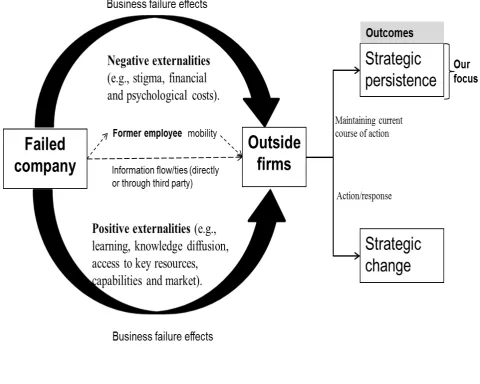
Broadly speaking, there are two schools of thought on the effects of business failure: positive
and negative externalities, as articulated in Figure 1. Business failure has a knock-on effect
on other firms connected or unconnected to the operations of the failed firms.
The negative externalities’ perspective contends that in the wake of others’ demise there are negative effects that befall individuals and organisations connected or unconnected to the
departed firm. There are various negative effects of the experience such as stigmatisation of
the individuals and loss of legitimacy. The experience of business failure may tarnish former
employees and owners’ employment prospect in societies where failure is stigmatised. The
distress and uncertainty emanating from the failure can have a profound effect on employees
who may have devoted their time and invested their career ambitions in an organisation
which has now lost its legitimacy and ability to exist (Gillespie and Dietz, 2009). This view
indicates that when companies cease to exist, it can have a devastating effect on families and
local communities, and disrupt the lifestyle of those whose livelihood depended on the
existence of that organisation (Ginter et al., 1992). For a business owner or employee, failure
means cessation of their sources of income which can have devastating effects on their
livelihood.
Another aspect of the effects of business failure is that it can sometimes lead to increased
regulation across industries as governments strive to mitigate the contagion effects of the exit
(Hora and Klassen, 2013). This was evident following the global financial crisis in 2008. This
is often attributed to the need to mitigate the potential that failure in one industry has the
potential to precipitate the demise of firms in the same or other industries (Platt, 1989). There
is growing evidence, however, that recruiting employees from failed firms has been found to
lead to diffusion of faulty routines, cognitions, processes and outmoded skills, which may
there is a need to ensure minimisation of diffusion of faulty practices stemming from others’ failures.
The other school of thought – the positive externalities – asserts that in the wake of organisational demise, there can be some positive news stemming from the bad news (Lang
and Stulz, 1992). Interestingly enough, a mounting body of research has suggested that the
exit of such firms not only paves the way for the emergence of new organisations, but also
releases resources and capabilities such as skilled workers to the market, for whom new and
existing firms compete (Pe’er and Vertinsky, 2008). This stream of research argues that there are some businesses that thrive on the exit of others by receiving new customers and rising
share prices (Amankwah-Amoah, 2013).
Firms that have been historically constrained by limited expertise can recruit employees
released by departed firms to respond to new environments. Pe’er and Vertinsky (2008, p.
285) put it this way, “reemployed skilled workers that were released when their firm exited can bring to the new entrant, in addition to know-how related to the technical aspects of their
skills, relationship capital, ideas about best practices and operating procedures, and perhaps
more importantly, the lessons from failures that might have caused the exit of their former
employer.”
The knowledge generated by failed firms can be expropriated by surviving firms through
sources such as employee turnover across firms, interactions with suppliers and customers,
publications in the trade literature, and patents (Hoetker and Agarwal, 2007; Knott and Posen,
2005).
A vast body of research has stressed the inherent value of organisations learning from their
Learning from others’ failure does not necessary entails major changes to the underlying
competences of a firm, it may entail modest changes to the current routines, processes and
procedures (see Henderson and Clark, 1990). Although some firms can benefits from
expertise release following other departure, they may also inherit faulty routines and
processes, which may emerge over time, thereby turning the initial advantage into a
disadvantage and vice versa. Therefore, there is a need to implement measures to ensure that
they learn the right lessons from the departure.
Although some knowledge about failed firms can be accessed through public channels such
as the popular press and trade journals, firms rarely make a concerted effort to recruit the
former employees to help learn the right lessons of a failed firm (Amankwah-Amoah, 2011).
It must be noted that visiting the former businesses’ premises, plants or buildings is unlikely
to yield any fruitful insights of the organisational structures and processes adopted by
managers that contributed to the demise of the firms. Organisational failure can foster
strategic persistence in cases where the rival firms gain from the exit by suddenly received
more customers’ orders or experiencing a sharp increase in its share prices.
--- Insert Figure 1 about here
---
Figure 1 summarised the various effects of business failure on outside firm. The figure also
demonstrates that former employees’ mobility and information diffusions from the failed from to outside firms. As described in detail later, three illustrative cases (i.e., Swissair,
Sabena and Air Liberté) provide insights on how business failure can lead to strategic
persistence in the outside firm. Having articulated the consequences of business failure, we
Explanations for strategic persistence in the wake of others’ failures
Strategic persistence refers to “the extent to which a firm’s strategy remains stable over time”
(Finkelstein and Hambrick, 1990, p. 487). However, Audia et al. (2000, p. 837) defined the
concept as “a tendency for firms to stick with strategies that have worked in the past”. Taken together, strategic persistence in this context refers to a decision by the top-management team
of a firm to maintain a current course of action regardless of counterinfluences, failures of
other businesses and enticing alternatives.
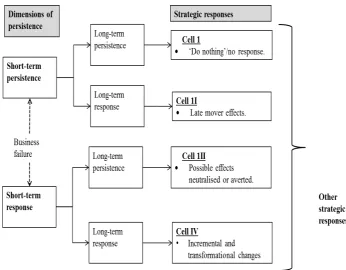
We contend that strategic persistence has two main dimensions: short-term and long-term
(see Figure 2). Short-term persistence is defined here as persistence immediately after the
event. This is where the outside firm concludes that there are potentially useful lessons but
the unevolved nature of events means that persistence is the right course of action. On the
other hand, long-term persistence is where the outside firms conclude that the failure is
attributed to firm-specific factors and therefore offers no useful insight for their businesses.
--- Insert Figure 2 about here
---
Our review of the literature led to the identification of broad categories of factors that explain
strategic persistence in the wake of other businesses’ failures. Below, we explicate these various perspectives on the subject.
The “locked-in” and “locked-out” perspectives
This perspective holds that largely due to large resource and capabilities commitment and the
desire to reap early-mover advantages; firms can become “locked-in” to certain markets and
operating environment (Ghemawat, 1991; Kraatz and Zajac, 2001; Gilbert, 2005). The
organisation then reaches an equilibrium which then allows strategic persistence to flourish.
This perspective is rooted in the concept of escalation of commitment advanced by Staw
(1981). This concept argues that there is a tendency for some top executive to escalate
commitment to failing courses of action even in the face of negative feedback (Brockner,
1992; Staw, 1981).
As the competitive landscape evolves and other firms fail, existing firms often have to decide
whether to maintain their current strategy or change course. When the firm decides to
examine their environment for a range of responses, they may be constrained by factors that
encourage strategic persistence.
The “too much invested to quit” perspective
One of the main pillars of the “locked-in” notion is the “too much invested to quit” (Teger, 1980) perspective. This view contends that the “cost of strategic change” or switching cost is simply too high for organisations to pursue and then commit to the status quo (Rumelt, 1995;
Schwenk and Tang, 1989). Switching costs refer to the financial and nonfinancial costs
incurred by the firm as it shifts its strategic focus and changes underlying resources and
routines to learn from others (see Holland and Shepherd, 2013).
Strategy change may require organisations to deviate from the well-established practices and
routines, new resource commitment and deployment, and a shift in thinking. The firm may
have committed so many resources and capabilities to the current course of action such that it
becomes difficult to admit failure and change course but rather presses on regardless of other
Another dimension of this perspective but related to the above is the sunk cost effect. The
sunk cost effect is ‘‘a maladaptive economic behavior that is manifested in a greater tendency
to continue an endeavor once an investment in money, effort, or time has been made’’ (Arkes and Ayton, 1999, p. 591). There is the contention that sunk costs and industry exit barriers
constrained firms from engaging in strategic change (Schwenk and Tang, 1989). In cases
where the alternative strategy entails higher financial cost such as cost of divestment, the firm
is more likely to persist with the current strategy (Holland and Shepherd, 2013; Karakaya,
2000). There is a general tendency in human behaviour to persist with a current course of
action when sunk costs have taken place than to deviate or add to it in an attempt to learn
from others (Arkes and Ayton, 1999).
Although some firms may seek to exit the market with declining prospects and following
others’ failure, they are often constrained by high exit barriers such as government regulation
and contractual arrangements which limit managers’ ability to act and the range of options
available. Long-term commitments often constrained firms from changing existing strategy
by redeploying the resources elsewhere or divesting from a particular line of business due to
recent changes in the environment. Barriers to exit play an influential role in encouraging
strategic persistence in the wake of other businesses’ failure. In some cases, the firm might be operating at a loss or on low margins but constrained by exit barriers (Karakaya, 2000).
A premise of this argument is that staying on the current course of action with proven
resources and capabilities is more efficient than attempting to develop new ones and the
complexities involved (Levitt and March, 1988). The reluctance of organisations to learn
from others’ failure may stem from the inability to attend to changes in the environment.
Accordingly, persistence entails the decision to maintain existing commitments and avoid
persistence might simply be a reflection of organisational commitment to a particular strategy
or chosen direction of travel (Grossman and Cannella, 2006).
Illustrative cases: SwissAir, Sabena and Air Liberté
To illustrate these lines of argument, we turn to the cases of two defunct European airlines,
Swissair and Sabena. Sabena was a Belgian national airline which collapsed in 2001. The
airline was founded in 1923 and became Europe's second oldest airline prior to exit (BBC,
2001a). The firm enjoyed some successes for some time and then collapsed with debt of
around 2bn euros ($1.8bn) and in so doing became Belgium's biggest ever corporate failure
(BBC, 2001a,b). At the time of exit, the government controlled 50.5% stake and the
remaining 49.5% owned by Swissair.
Following the sharp decline in global air travel in the aftermath of the September 11 terrorist
attacks, Sabena’s more than 70 years of service, heritage, experience and reputation was insufficient to sustain its operations (Flint, 2000). The airline was unable to respond
effectively and subsequently ceased operations. However, the airline’s problems far preceded this event and had been brewing for years.
Following the acquisition of the stake in Sabena by Swissair for Sf267 million in the 1990s, a
number of factors within the firm affected Swissair’s ability to implement major changes which ultimately contributed to the demise. The most notable was the strikes over proposed
cost reductions by Sabena's unions which eventually led to the exit chief executive Pierre
Godfroid in January 1996 (Sparaco, 2010). The departure paved the way for Paul Reutlinger
to be seconded to Sabena from SAirGroup as a “peacemaker” to help bring on-board the
However, this change put off the painful and urgent need of reforms to reduce staff level and
cost to reposition the airline for the future. As Buerkle and Anderson (2002, p. 24) put it this
way, Paul Reutlinger “bought labour peace, but at the expense of Swissair's cost-cutting goals: Instead of the intended one-third reduction in the airline's payroll, Swissair's head
count jumped about 70%”.
In December 1992, when Swiss voters rejected the country's bid to join the European
Economic Area and in so doing affected Swissair’s ability to expand and exert influence its partner, Sabena (Buerkle and Anderson, 2002). At the time, the European Union law
deprived such non-European Economic Area airlines opportunity to take the majority control
of their airlines. As a result, the Swiss airline was constrained and therefore unable to
“exercise real management control to integrate the two airlines' fleets and routes to reduce
costs” (Buerkle and Anderson, 2002, p. 24).
The inability to change the status quo within the subsidiary also affected effective integration
of functional areas such as marketing, sales and human resources. Consequently, both Sabena
and Swissair collapsed in 2001 and 2002 respectively partly attributed to the barriers to
change in both organisations. Indeed, months before the Swissair’s collapsed, it run out of
cash and several aircrafts were seized (Olson, 2001; Bonsu, 2001). Both cases help to
illustrate how inability to change and cost of change can lead to business failure.
One of the companies affected by the demise of Swissair was its former Swissair subsidiary
Air Liberté. It was founded in 1987 was declared bankrupt and ceased operation in 2003 with
3,200 job losses. Air Liberté’s over-reliance on Swissair for funding and scheduled payments meant that when Swissair collapsed its sources of finance were terminated and thereby
In an attempt to disentangle itself from the various underperforming partners, Swissair
promised regular payments to subsidiaries such as Sabena, AOM and Air Liberté. In
September 2001, Air Liberté and AOM decided to merge to become Air Lib, however, just a
month after the formation Swissair was declared bankrupt and therefore all planned payments
and exiting fees were never realised which put the firm on permanent path of decline leading
to exit. Swissair's inability to fulfil the exit fee of 1.3bn French francs ($174m) for AOM/Air
Liberté meant that the operations of Air Lib was no longer sustainable in the face increasing
competitions (BBC, 2003). This event left Air Lib “at the mercy of its creditors” as several of its planes were confiscated (BBC, 2001b).
One factor that has been strongly linked to strategic persistence within the firm was the lack
of financial resources to bring about change and long-term commitments. The constraints
perpetuated maintaining the status quo which ultimately led to the collapsed.
The paradox of success perspective
The paradox of success (Audia et al., 2000) or Icarus’ Paradox (Miller, 1990) perspective argues that the tendency to maintain the status quo in the face of changes in the external
environment and departure of other firms may stem from past successes of the organisation.
High past performance often breeds overconfidence in the existing processes, resources,
expertise, routines and course of action, thereby decreasing the chance of any change in the
firm’s strategy (Amason and Mooney, 2008; Greve, 1998). As organisations enjoy uninterrupted successes over a period of time, the success of the past strategies may emerge
to undercut the need to develop new resource or capabilities, let alone learn from the failures
A growing number of studies have suggested that past success discourages information
processing and consequently strategic persistence (Boeker, 1997; Lant and Montgomery,
1987). The tendency to stay the course can be attributed to decision-makers’ inability to update and upgrade their prior cognitions and beliefs with new information by committing
additional resources to a previous chosen course of action (Guler, 2007; Tetlock, 1985).
Largely due to their past successes, they become less attentive to the disappearances of other
firms and tend to repeat their mistakes. This perspective provides considerable evidence that
the decision to persist with existing courses of action is attributed to the dedication within an
organisation to the notion that “it cannot happen here” and “what underpinned our success is different”. As organisations become increasingly confident in their existing routines, practices and policies that have delivered success, the capacity and willingness to learn from
others diminish (Levinthal and March, 1993; Miller, 1997).
Over time, successful firms can be “lulled into a false sense of security by relying on
established beliefs and processes” which then become obsolete and liabilities in the face of changes in the external environment (Amason and Mooney, 2008, p. 407; Hedberg et al.,
1976). The past successes can create conditions that force managers to persist with a current
course of action and “blinds them to early signals that past strategies may fail” (Audia et al., 2000, p. 837). Indeed, Audia et al. (2000, p. 849) put it this way, “the very success that organizations strive to achieve plants the seeds of their possible future decline. Once
organizations achieve success, their natural tendency is to continue to exploit the strategies
that worked in the past”.
Another dimension of the paradox of success perspective is the reinforcement-expectancy
model of learning which contends that firms are more likely to replicate processes, practices
Bettis, 1986). The self-reinforcement occurs when a set of events decreases the attractiveness
of a course of action relative to others and thereby forcing strategic persistence to occur.
The paradox of success differs in subtle ways from the related concept of escalation of
commitment advanced by Staw (1981). First, paradox of success is rooted in the “belief that a
previously winning course of action will succeed in the future”, whereas the escalation of commitment is “caused by the belief that a previously losing course of action will succeed in the future” (Audia et al., 2000, p. 850; Staw, 1981). Second, in the case of escalation of commitment, decision makers assume that environmental conditions are likely to differ and
become more favourable in the future, whereas the Icarus Paradox supposes the conditions
will be the same (Audia et al., 2000).
Our contention here is that strategic persistence in the face of other businesses’ failure creates conditions that allow complacency and inattentiveness to the environment to thrive.
Therefore provides a partial explanation of why companies in the same sector often fail in
succession and for the same reasons. Organisations are more likely to learn from failure than
successes partly due to the very high cost of failure and the paradox of success (see also
Desai, 2011). Learning from failure and success is more likely to be punctuated periods of
strategic persistence as some firms attempt to make sense of the changes in the environment.
Another related line of research has suggested that the phenomenon of a “success trap” (Rhee and Kim, 2014). This represents a situation where an existing routines and practices of the
Illustrative cases
To shed light on the above theories further, we turn to the airline industry in Africa in the
early 2000s and the case of airlines such as Ghana Airways, Nigeria Airways and Air
Afrique. The beginning of the twenty-first century was marked by the growing number of
internet users and an incremental shift from paper tickets to paperless tickets in the industry.
Prior to these airlines’ collapse in the early 2000s, many European airlines had faltered, partly
due to their reliance on the traditional model which entailed payments of commission and
charges to travel agents, and competition from low-cost rivals.
As more foreign counterparts switched from outmoded technology and methods of doing
business, such as reliance on travel agents and ticket offices to sell the flight tickets and pay
commission, these firms continued their strategies of reliance on the traditional distribution
channels. These once successful airlines appeared to have become so welded into these
practices of using mainly travel agents well past the point of utility in the early 2000s when
most airlines had made giants step towards a paperless booking process.
In addition to the difficulties involved in coordinating between the airlines’ headquarters and
high-street travel agents, the airlines also had to pay commission. These, in tandem with the
extensive network and historically financial supports of their states, made the
top-management team so confident in the firms’ ability to compete and become successful in the
future. Indeed, it was well established at the time that the internet was the cheapest way to
make a booking with an airline (The Economist, 2005). The escalating commitment in terms
of resource commitment and investment to develop a network of travel agents across the
world inhibited the adoption of the new technology and made it costly for the firms to
operate. In these cases, the historical investment in building the network of travel agents
trust of hundreds of agents who relied on them for their revenue stream. These factors played
a major role in the three airlines’ collapse (Amankwah-Amoah, 2010; see also Pirie, 2014). The late adoption of online ticket selling affected their ability to compete on cost in an
environment where low fares were a major source of competitive advantage.
As the number of air travellers booking over the internet around the globe surges, the airlines
still focused mainly on using travel agents. The firms also resisted a shift from the traditional
model partly due to low internet adoption in their countries. On many international routes,
they were competing against Western and Middle East airlines that had successfully adopted
an online booking strategy much earlier.
Eventually, all the above firms ceased operations partly attributed to intense competition and
inability to develop a sustainable cost base (see Amankwah-Amoah and Debrah, 2010, 2014
for detailed analysis). These cases clearly show the potential outcome of organisations that
are unable to learn from the failure of others in their industry. Indeed, subsequent new
entrants such as Ghana International Airline, founded in 2005 after the failure of the three
airlines, also experimented with the traditional model before eventually shifting from using
the outdated approach of relying on travel agents (Amankwah-Amoah, 2010). By the same
token, strategic persistence can be an attempt by the top-management team not to lose face.
The psychological perspective
The psychological perspective of strategic persistence contends that managerial decisions are
influenced by prior cognitions, experiences, situations and characteristics of the
top-management team (Bateman and Zeithaml, 1989; Milliken and Lant, 1991). Past studies
decision-maker's psychological field and influence the strategic decision to maintain an
existing course of action (Bateman and Zeithaml, 1989).
A growing body of scholarly works suggests that executives who formulated past strategies
are often unwilling to discard them and even acknowledge the validity of information that
suggests a need to deviate from the failed past strategies they have championed (Milliken and
Lant, 1991; Lant et al., 1992). Top executives “who champion or sponsor a project stand to
benefit most from its success and have the most at stake if it fails” and therefore more likely
to persist with the status quo (Guler, 2007, p. 252). This is partly because such top managers
are often eager to take credit openly for projects that have produced exceptional outcomes for
the business and therefore become increasingly reluctant to alter the current course of action
(Guler, 2007; Miller, 1990, 1994).
“Corporate success encourages managers both to credit and take credit for their own policies, then to publicly endorse and tie their reputations to those policies, and ultimately to become
bound to the preservation and extension of the policies” (Miller, 1994, p. 327). Indeed, top
managers “may become psychologically invested in the strategies they have designed,
creating the tendency to persist with past strategies despite negative performance outcomes”
(Lant et al., 1992, p. 603).
An important feature of this psychological ownership of the existing firm’s strategy is that
executives tend to respond to early warning signals of decline by limiting “their search for new information, ignoring information that reflects negatively on the current strategy”
thereby bolstering their current course of action (Westphal and Bednar, 2005, p. 262;
Another aspect of this perspective is that strategic persistence is influenced by social and
psychological factors (characteristic of the top executives) associated with organisation
tenure (Finkelstein and Hambrick, 1990; Park et al., 2011). The characteristics of the
top-management team, such as prior experiences, their perceived status and values, influence
their strategic choices and the decision to maintain the current course of action or change in
respond to environmental shifts (Finkelstein and Hambrick, 1990). Indeed, when confronted
with looming challenges and the need to change the course of action, long-tenure executives
engage in minimal or no strategic change relative to short-tenure teams (Finkelstein and
Hambrick, 1990). This reinforced the assertion that outside successors are less likely to
persist with current strategy and more likely to initiate major strategic change. Long-tenured
senior executives have been found in past studies to demonstrate greater “commitment to the status-quo” (Hambrick et al., 1993).
One recent and promising stream of research has indicated that top executives who receive
high levels of flattery and opinion conformity (i.e. ingratiation) are more likely to become
over-confident in their abilities and leadership as well as existing processes and routines, and
are therefore more likely to persist with the current course of action even in the face of poor
firm performance, let alone the failures of others (Park et al., 2011).
Another psychological factor that explains why companies persist with a current course of
action can be attributed to the concept of “pluralistic ignorance” articulated by Westphal and Bednar (2005). Pluralistic ignorance can be defined as “a situation in which virtually all members of a group privately reject group norms [practices, or policies, or have concerns
about them] but believe that virtually all other group members accept them” (Miller et al., 2000, p. 103). This occurs when, in the face of decline and changes in the external
which then perpetuates the status quo whilst at the same time decreasing the chance of any
response or subsequent strategic change within the firm (Westphal and Bednar, 2005).
Although top executives and employees might be aware of issues and problems that warrant
the need to change the current strategy, they often fail to voice their views and thereby create
conditions that perpetuate the status quo (Morrison and Milliken, 2000). Strategic persistence
can be attributed to reluctance by group members and employees to speak up about their
disagreements with the current course of action or report bad news (Hutt et al., 1995).
Although boards of directors have been identified to play a pivotal role in counteracting
executives’ tendencies to persist with a failing course of action, they often fail in this task
(Westphal and Bednar, 2005; Sundaramurthy and Lewis, 2003).
An illustrative case
To examine shed light on these perspectives, we turn again to the case of Swissair. One of the
foundational causes of the firm’s demise can be traced to top executives’ desire and perceptions. In the mid-1990s, in an attempt to turn the airline into a major player alongside
dominant airlines such as BA, Air France and KLM led to the adoption of the so-called
“Hunter strategy” (Doganis, 2006; The Economist, 2001). The strategy entailed acquisition of stakes in multiple airlines including Sabena, Air Littoral, AOM, Air Liberté and TAP across
Europe (The Economist, 2001). The rapid expansion in the financially weak airlines
diminished the resources of the firm.
A number of factors that have been strongly linked to the persistence with the “Hunter strategy” are the “arrogance” and desperation of the top management team to “punch above” their weight in the global industry (Kay, 2007; Bonsu, 2001). More importantly, the “Hunter
appointment as chief executive in the mid-1990s adopted the strategy and, emotionally and
psychologically invested in the project (Kay, 2007). The personal investment and prior
commitments to the project became a barrier to change even in the face of other airlines’ demises and planted the seeds of its destruction.
However, the dismissal of the Philippe Bruggisser in early 2001 paved the way for the airline
to begin to undo the strategy, which was no connected with “reality” (Kay, 2007). It was therefore not surprising that his replacement in 2001 as chief executive Mario Corti
immediately brought an end to the strategy and thereby casting further doubt on the
soundness of the strategy. This was just before the firm collapsed. One of the enduring
consequences of the firms collapsed has been the increasing recognition that persistence with
losing course of action can accelerate and lead to failure.
An environment interpretive model
The basic tenet of this theory is that strategic persistence stems from understanding and
interpreting the business environment by the top-management team. There are several strands
to this theory.
One strand of this perspective is the “environmental buffers”, which holds that firms endowed with rich financial, social and human capital can be “buffered” from changes in the business environment, which then encourages persistence with the status quo (Kraatz and
Zajac, 2001; Milliken and Lant, 1991). Slack can be defined as “the pool of resources in an organisation that is in excess of the minimum necessary to produce a given level of
organizational output” (Nohria and Gulati, 1996, p. 1246). It includes under-utilised capacity and redundant employees, which can be effectively deployed to mitigate the effect of
that current changes in the environment are more likely to be “temporary or unimportant” and
therefore warrant inaction (Milliken and Lant, 1991, p. 138).
Proponents of this perspective have indicated that rich resources encourage strategic
persistence by fostering a false sense of security in the future and “desensitising” decision -makers to environmental shifts (Kraatz and Zajac, 2001). Resource-rich firms can
temporarily maintain the existing course of action irrespective of the nature of businesses in
their industry or operating environment (Levinthal, 1990).
In a related but distinct area, it has been suggested that persistence may stem from managers’
interpretation that the changes in the environment are “short-lived” with limited long-term consequences (Lant et al., 1992). This decision can be attributed to factors such as a short
recession or a national disaster, which precipitated the sudden changes in the environment but
unlikely to affect the business in the future. One of the key themes of the logic is that
top-management teams are often unlikely to track the things that are considered to be unimportant
including the failure of other firms; rather executives deploy resources and expertise to home
in on factors that explain the current success (Miller, 1990).
Another strand of this perspective contends that top managers who engage in strategic
decision making are often “flooded with information” but have limited capacity to process
the information and make sense of other businesses’ failures (Lant and Hewlin, 2002; Lant et al., 1992). As such, they face a difficult task of deciding which information to attend to and
which to discard, and often opt to maintain the status quo (Lant and Hewlin, 2002). This view
advocates that lack of fruitful knowledge of the departed firms often presents managers with
incomplete information which makes it difficult to implement any change. Persistence may
(Hambrick et al., 1993; Hannan and Freeman, 1977; Levinthal, 1992; Huang et al., 2013;
Tushman and O’Reilly, 1996).
The traditional economic theory views business failure as part of the national selection
process where weak firms in their industry cease operations largely due to intense
competition (Miner et al., 1999). This suggests that external forces such as deregulation,
lower entry barriers and sudden changes in government policies drive inefficient firms out of
the industry and frees up previously occupied resources for surviving firms (Delacroix and
Carroll, 1983; Hoetker and Agarwal, 2007).
A central theme of this view is that the causes of failure are attributed to uncontrollable
factors rather than firm-specific factors (Gimeno et al., 1997). Organisations and managers
that view other businesses’ failure is a natural selection process, where weak firms are upstaged by nimble and efficient rivals are less likely to be attentive to changes in the
external environment. Therefore, there is little incentive for executives to deviate from the
previously endorsed course of action to learn from others. Yet while these arguments go far
in enhancing our understanding of environmental factors, they offer no useful insights on
firm-level factors which make firms reluctant to learn from others’ failure. Given the one-sidedness (i.e., external factors) of this perspective, for a better of the concept this theory as a
standalone perspective is insufficient and needs to be integrated alongside with the firm-level
perspectives. Some scholars have linked strategic and organisational inertia with centralized
decision-making processes, which constrained line managers from responding to changes in
An illustrative case
To illustrate these lines of argument, we turn again to the case of Air Afrique (1961-2002).
The rise and fall of the airline offers useful insights on how strategic persistence and inability
to change course in timely manners can sealed the fate of once symbolic firm. The firm was
owned and controlled by more than 11 African nations. As such, the countries provided
regular cash injection to maintain its services and key routes to national capital of the states.
The cash injection and subsidies catered for loss-making services and “buffered” the airline from making necessary reforms such staff reductions and reducing unprofitable routes as the
environment changes and multiple African airlines failed in the same environment. The firm
persisted with staff level even as more customers shift to rival airlines (Amankwah-Amoah
and Debrah, 2014).
By the late 1990s, more customers had switched to rival airlines and the cost base was
unsustainable. Indeed, not only did the top executives maintain the existing strategy, they also
lobbied for government protection and against air transport liberalisation. The high level of
persistence within the firm has been referred to as the “escalating indecision phase” – a stalemate (Amankwah-Amoah and Debrah, 2014). These factors eventually culminated in the
firm’s demise.
Synthesis of research and theoretical perspectives
In synthesising the literature on strategic persistence in the wake of others’ failure, we invoke
Bateman and Zeithaml’s (1989) notion that strategic decisions influenced by prior history, present circumstances and future outlooks. As discussed above, strategic persistence is
shaped by a variety of factors rooted in past events (i.e. past successes enjoyed by the firm,
nature of the failure, magnitude of the effects on the business) and perspectives on the future
(i.e. similar environment in the future paradox of success, looming threats and opportunities).
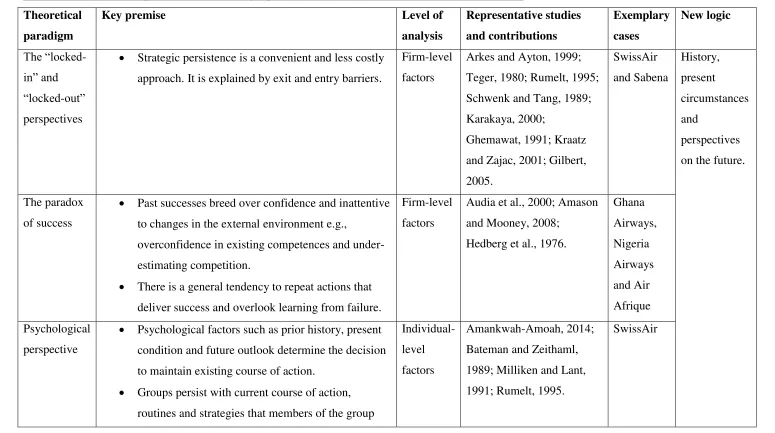
--- Insert Table 1 about here
---
Table 1 summarises the various theoretical perspectives and their underlying logic in
explaining strategic persistence in the face of other businesses’ failures. It also highlights the features of the decision to persist with existing courses of action whilst others fail. Guided by
these schools of thought, we advocate a shift away from viewing these perspectives as
competing views. Rather, they are complementary views geared towards stimulating a better
understanding of the subject. Taken together, the analysis led to identification of firm-level
and environmental factors rooted in the past, present and future outlook, which determine
strategic persistence (see Table 1).
There are multitudes of factors that determine whether competitors’ failures might affect the strategic persistence of the outside firm. These factors include firm size, network
embeddedness, market power, and resource endowments. It is important to note that strategic
persistence is more likely to occur in the wake of the failure of a small business than global
firm largely due to the limited nature, scope and impact of their operations. However, the
failure of a major player with an extensive network of suppliers, customers and allies, is more
likely to lead to a shift in strategy among those connected to the firm and beyond. To provide
further insights on how firm size and market power influence other firms’ decisions to maintain their current strategy or engage in strategic change, we turn to the failure of Lehman
Due to the extensive network of the partners in more than 50 countries with around 2,985
legal entities, the failure following the global economic crisis in 2008 forced the numerous
partners to respond to the failure by seeking new partners and expertise (Cornford, 2010).
The unanticipated loss of such large firms with control over key resources triggered a range
of strategic and systematic responses by firms connected to its operations to ensure their
long-term survival. In this particular case, the network embeddedness quickly shifted from an
asset to become a liability following the collapse of the core network player (see also Uzzi,
1997) and those in this case that failed to adapt in a timely manner eventually closed doors
and ceased operations (Cornford, 2010).
Another moderating influence is that large organisations are often guided by well-established
structures and bureaucratic processes which often prevent them from changing (Hannan and
Freeman, 1984).It has been suggested that when the threat to the business remain ambiguous,
organisational leaders are unlikely to adopt new practices for fear of undermining factors that
have contributed to their current success (Gilbert, 2005).
Discussion and implications
The paper sought to examine factors that determine strategic persistence in the wake of other
businesses’ failures. We have reviewed a range of theories that help us to better understand
how and why some firms persist with a current course of action and questionable strategies
even after others’ exit. The study complemented the review with illustrative cases of failed companies such as Swissair, Sabena and Air Liberté. Our theorisation and conceptualisation
of the literature led to the identification of a number of firm-level and environmental factors
rooted in organisation history, the present and those expected in the future, which broadly
determine the decision to persist with a current course of action in the wake of other
inertia (stemming from tendency to repeat past actions), and “too much invested to quit”, which constrained firms from learning from the failure of others and encourage strategic
persistence.
Our analysis lends support to the notion of Icarus Paradox (Miller, 1990) and articulates the
firm-level processes that allow past successes to breed over-confidence and inattentiveness to
changes in the internal environment including the failure of other firms. The analysis also
lends support to the assertion that the increasing occurrences of business failures can be
partly attributed to the perils of success which obstruct the need to learn from others and
adapt to change in the external environment. This echoes findings of studies on organisational
decisions that have suggested that the tendency to save face in the face of negative feedbacks
stemming from the business environment, forces firms to overlook the failures of others and
encourage strategic persistence (Guler, 2007; Schwenk and Tang, 1989).
Contributions to theory
The paper makes contributions to the literature on business failure and strategic persistence.
In addition to enriching our understanding of strategic persistence in the face of changes in
the competitive landscape, this study contributes to the burgeoning streams of research on
organisational failure that have examined why some organisations and top executives fail to
learn from others or even learn the wrong lessons from the failure of others (Finkelstein,
2006).
Although recent research suggested the need for firms to learn from the failures of others
(Desai, 2011), firms often remain reluctant or inattentive to others’ failure. This study departs from the current stream of research that has focused mainly on the causes of business failure
strategic persistence. In so doing, we respond to past studies that have called for a better
understanding of strategic persistence (Westphal and Bednar, 2005).
Contributions to practice
Notwithstanding these contributions to literature, there are practical implications that stem
from the analysis. First, this research highlights the need for organisations to create
conditions that foster learning from others as an ongoing strategy for sustainable success.
There is a need for organisations to develop and upgrade their existing capabilities and
resources to respond to environmental shifts. As business failures become increasingly
common and well known, there is a need for firms to identify those failures that offer useful
lessons for the future and firms also need to know when to persist with their current strategy
and ignore the failure of others.
By creating a long-term plan to learn from others, firms would be equipped to minimise the
effects stemming from others’ failure. In addition, there is a need for organisations to engage
in more incremental resource commitments to projects to provide space and time to
re-evaluate and thereby providing strategic options to maintain or discontinue the current course
of action at various stages (Guler, 2007). Such safeguards and incentives provide
opportunities to assess the environment and learn from the exit of other firms. This is
important given that organisations often lose track on when and how to discard previously
successful strategies even in the face of similar firms’ failure (Audia et al., 2000; Miller, 1990).
Furthermore, our findings suggest that in some organisations, changes in top-management
teams may be required to counteract strategic persistence forces. Such leadership changes
limitations of our work is that it is context specific and focuses on only strategic decisions in
the face of business failure. There is clearly an opportunity for future research to extend the
existing streams of research on “post-exit effects” (Hoetker and Agarwal, 2007) to include the strategic behaviour of bystander organisations in the competitive arena. Such an analysis
would significantly enrich our understanding of the subject.
Future research may build on this work by examining the effects on strategic persistence in
mitigating the “spillover” of other businesses’ failures. The existing works barely touch on
the subject and much deeper analysis is required. In closing, more research is needed to
provide a more detailed analysis of strategic persistence in the face of other businesses’ failure than has been achieved here.
References
1. Amankwah-Amoah, J. (2010), “Organisational responses to liberalisation: Evidence from the airline industry in Africa”, Unpublished doctoral thesis, University of Wales Swansea.
2. Amankwah-Amoah, J. (2011), “Learning from the failures of others: The effects of post-exit knowledge
spillovers on recipient firms”, Journal of Workplace Learning, Vol. 23 No. 6, pp. 358–375.
3. Amankwah-Amoah, J. (2013), “Cauterizing trial by fire: Observers’ interpretations of organizational
failure. Journal of General Management, Vol. 38 No. 3, pp. 51–72.
4. Amankwah-Amoah, J. (2014), “Old habits die hard: A tale of two failed companies and an unwanted
inheritance”,Journal of Business Research, , Vol. 67 No. 9, pp. 1894–1903.
5. Amankwah-Amoah, J. and Debrah, Y. A. (2010), “The protracted collapse of Ghana Airways: lessons in
organizational failure”, Group & Organization Management, Vol. 35, pp. 636–665.
6. Amankwah-Amoah, J. and Debrah, Y. A. (2014), “Air Afrique: The demise of a continental icon”,Business History, Vol. 56 No. 4, pp. 517–546.
7. Amason, A. C. and Mooney, A. C. (2008), “The Icarus paradox revisited: how strong performance sows the
8. Arkes, H. R., and P. Ayton. (1999), “The sunk cost and Concorde effects: Are humans less rational than
lower animals?”,Psychological Bulletin, Vol. 125 No. 5, pp. 591–600.
9. Audia, P. G., Locke, E. A. and Smith, K. G. (2000), “The paradox of success: An archival and laboratory
study of strategic persistence following radical environmental change”, Academy of Management Journal, Vol. 43 No. 5, pp. 837–854.
10. Baker, C. (2002), “Out of the ashes”, Airline Business, Vol. 18, Issue 3, pp. 38.
11. Bateman, T. S. and C. P. Zeithaml. (1989), “The psychological context of strategic decisions: A model and
convergent experimental findings”, Strategic Management Journal, Vol. 10, pp. 59–74.
12. Baumard, P. and Starbuck, W. H. (2005), “Learning from failures: why it may not happen”, Long Range Planning, Vol. 38, pp. 281–298.
13. BBC (2001a), “Belgian national airline bankrupt”, available at:
http://news.bbc.co.uk/1/hi/business/1642507.stm (accessed 1 August 2014).
14. BBC (2001b), “Sabena protected from creditors”, available at:
http://news.bbc.co.uk/1/hi/business/1581141.stm (accessed 5 June 2014).
15. BBC (2003), “French airline bail-out fails”, available at: http://news.bbc.co.uk/1/hi/business/2731843.stm.
16. Bloomberg News (2001), “Belgium Says Swissair Suits Seek Almost $1.75 Billion”, available at:
http://www.nytimes.com/2001/11/26/business/26AIR.html (accessed 1 August 2014).
17. Boeker, W. (1992), “Power and managerial dismissal: Scapegoating at the top”, Administrative Science Quarterly, Vol. 37, pp. 400–421.
18. Boeker, W. (1997), “Strategic change: The influence of managerial characteristics and organizational
growth”, Academy of Management Journal, Vol. 40, pp. 152–170. 19. Bonsu, H. (2001), “A nation in shock: Swissair crisis”, BBC, available at:
http://news.bbc.co.uk/1/hi/programmes/crossing_continents/1677085.stm (accessed 5 June 2014).
20. Brockner, J. (1992), “The escalation of commitment to a failing course of action: Toward theoretical
progress”,Academy of Management Review, Vol. 17, pp. 39-61.
21. Buerkle, T. &, Anderson, R. (2002), “Who lost Swissair?”, Institutional Investor-International Edition, Vol. 27, No 2, pp. 24.
23. Cornford, A. (2010), The failure of cross‐border financial firms: New thinking in the aftermath of the financial crisis, Geneva: Observatoire de la Finance.
24. Cyert, R. and March, J. G. (1963), A behavioral theory of the firm, Englewood Cliffs, NJ: Prentice-Hall. 25. Delacroix, J. and Carroll, G. R. (1983), “Organizational foundings: An ecological study of the newspaper
industries of Argentina and Ireland”, Administrative Science Quarterly, Vol. 28 No. 2, pp. 274–291. 26. Desai, V. (2011), “Mass media and massive failures: determining organizational effortsto defend the field’s
legitimacy following crises”,Academy of Management Journal, Vol. 54, pp. 263–278. 27. Doganis, R. (2006), The Airline Business. 2nd edition. London: Routledge.
28. Euronews (2007), “Air Liberte trial starts four years after bankruptcy”, available at:
http://euronews.com/2007/06/04/air-liberte-trial-starts-four-years-after-bankruptcy/(accessed 5 June 2014).
29. Finkelstein, S. (2006), “Why smart executives fail: Four case histories of how people learn the wrong
lessons from history”, Business History, Vol. 48 No. 2, pp. 153–170.
30. Finkelstein, S. and Hambrick, D. C. (1990), “Top-management-team tenure and organizational outcomes:
The moderating role of managerial discretion”,Administrative Science Quarterly, Vol. 35, pp. 484–503.
31. Flint, P. (2000), “Sabena's peacemaker”, Air Transport World, Vol. 37, No.1, pp.41-42.
32. Floitau, J. (2001), “Swissair refines recovery strategy”, Aviation Week & Space Technology, Vol. 155 No. 3, pp. 56.
33. Ghemawat, P. (1991), Commitment: The dynamic of strategy, New York: The Free Press.
34. Gilbert, C. (2005). “Unbundling the structure of inertia: Resource versus routine rigidity”, Academy of Management Journal, Vol. 48, pp. 741–763.
35. Gillespie, N. and Dietz, G. (2009), “Trust repair after organization-level failure”,Academy of Management Review, Vol. 34, pp. 127–145.
36. Gimeno, J., Folta, T. B., Cooper, A. C. and Woo, C. Y. (1997), “Survival of the fittest? Entrepreneurial
human capital and the persistence of underperforming firms”, Administrative Science Quarterly, Vol. 42, pp. 750–83.
37. Ginter, P. M., Duncan, J. W., Swayne, L. E. and Shelfer, A. G. (1992), “When merger means death:
Organizational euthanasia and strategic choice”, Organizational Dynamics, Vol. 20, No.3, pp. 21–33. 38. Greve, H. R. (1998), “Performance, aspirations, and risky organizational change”, Administrative Science
39. Grossman, W. and Cannella, A. A. (2006), “The impact of strategic persistence on executive
compensation”,Journal of Management, Vol. 32 No. 2, pp. 257–278.
40. Guler, I. (2007), “Throwing good money after bad? Political and institutional influences on sequential
decision making in the venture capital industry”, Administrative Science Quarterly, Vol. 52 No. 2, pp. 248– 285.
41. Hambrick, D. C., Geletkanycz, M. A. and Fredrickson, J.W. (1993), “Top executive commitment to the
status quo: Some tests of its determinants”, Strategic Management Journal, Vol. 14 No. 6, pp. 401–418. 42. Hannan, M. and Freeman, J. (1977), “The population ecology of organizations”, American Journal of
Sociology, Vol. 82, pp. 929–964.
43. Hannan, M. T. and Freeman, J. (1984), “Structural inertia and organizational change”, American Sociological Review, Vol. 49, pp. 149-164.
44. Hedberg, B. Nystrom, P. and Starbuck, W. (1976), “Camping on seesaws: Prescriptions for a self-designing
organization”, Administrative Science Quarterly, Vol. 21, pp. 41–65.
45. Heine, K. and Rindfleisch, H. (2013), “Organizational decline: A synthesis of insights from organizational
ecology, path dependence and the resource-based view”,Journal of Organizational Change
Management, Vol. 26, No.1, pp. 8–28.
46. Henagan, S. C. and Bedeian, A. G. (2009), “The perils of success in the workplace: Comparison target
responses to coworkers' upward comparison threat”,Journal of Applied Social Psychology, Vol. 39 No. 10,
pp. 2438–2468.
47. Henderson, R. and Clark, K. (1990), “Architectural innovation: The reconfiguration of existing product
technologies and the failure of existing firms”, Administrative Science Quarterly, Vol. 35, pp. 9–30. 48. Hoetker, G. and Agarwal, R. (2007), “Death hurts, but it isn’t fatal: the postexit diffusion of knowledge
created by innovative companies”, Academy of Management Journal, Vol. 50 No. 2, pp. 446–467.
49. Holland, D. and Shepherd, D.A. (2013), “Deciding to persist: adversity, values, and entrepreneurs’ decision
policies”, Entrepreneurship Theory and Practice, Vol. 37 No. 2, pp. 331–358.
50. Hora, M. and Klassen, R. D. (2013), “Learning from others’ misfortune: Factors influencing knowledge
acquisition to reduce operational risk”,Journal of Operations Management, Vol. 31, pp. 52–61.
51. Huang, H. C., Lai, M. C., Lin, L. H. and Chen, C. T. (2013), “Overcoming organizational inertia to
strengthen business model innovation: An open innovation perspective”,Journal of Organizational Change
52. Hutt, M.D., Walker, B.A. and Frankwick, G.L. (1995), “Hurdle the cross-functional barriers to strategic
change”,Sloan Management Review, Vol. 36, Vol. 3, pp. 22–30.
53. Ingram, P. and Baum, J. A. C. (1997), “Opportunity and constraint: Organizations’ learning from the
operating and competitive experience of industries”, Strategic Management Journal, Vol. 18, pp. 75–98. 54. International Labour Organization (ILO) (2001), Restructuring of civil aviation: Consequences for
management and personnel. Geneva: ILO.
55. James, B. (2001), “Liquidation for Sabena a first for EU airlines”, New York Times, November 8.
56. Jansen, K. J. (2004), “From persistence to pursuit: A longitudinal examination of momentum during the
early stages of strategic change”,Organization Science, Vol. 15, pp. 279–294.
57. Karakaya, F. (2000), “Market exit and barriers to exit: theory and practice”, Psychology and Marketing, Vol. 17 No. 8, pp. 651–68.
58. Kay, J. (2007), “Dreams are no basis for a sound corporate strategy”, Financial Times, March 20, pp. 20.
59. Kisfalvi, V. (2000), “The threat of failure, the perils of success and CEO character: Sources of strategic
persistence”,Organization Studies, Vol. 21, No.3, pp. 611–639.
60. Knott, A. M. and Posen, H. E. (2005), “Is failure good?”,Strategic Management Journal, Vol. 26, pp. 617– 641.
61. Kraatz, M.S., Zajac, E.J., (2001), “How organizational resources affect strategic change and performance in
turbulent environments: Theory and evidence”, Organization Science, Vol. 12, pp. 632–657.
62. Lang, L. H. P. and Stulz, R. M. (1992), “Contagion and competitive intra-industry effects of bankruptcy
announcements”, Journal of Financial Economics, Vol. 32, pp. 45–60.
63. Lant, T. K. and Hewlin, P. F. (2002), “Information cues and decision making: The effects of learning,
momentum, and social comparison in competing teams”, Group and Organization Management, Vol. 27, pp. 374–407.
64. Lant, T. K. and Montgomery, D. B. (1987), “Learning from strategic success and failure”,Journal of
Business Research, Vol. 15 No. 6, pp. 503–517.
65. Lant, T. K., Milliken, F. J. and Batra, B. (1992), “The role of managerial learning and interpretation in
strategic persistence and reorientation: An empirical exploration”, Strategic Management Journal, Vol. 13, pp. 585–608.
67. Levinthal, D. (1992), “Surviving Schumpeterian environments: An evolutionary perspective”, Industrial and Corporate Change, Vol. 1, pp. 427–443.
68. Levinthal, D. A. (1990), “Organizational adaptation, environmental selection, and random walks. J. Singh,
(ed.) Organizational Evolution: New Directions. Sage, Newbury Park, CA, pp. 201–223.
69. Levitt, B. and March, J. G. (1988). Organizational learning. In W. R. Scott & J. F. Short, Jr. (Eds.), Annual review of sociology, vol. 14, pp. 319-340. Palo Alto, CA: Annual Reviews.
70. Madsen, P. M. and Desai, V. (2010), “Failing to learn? The effects of failure and success on organizational
learning in the global orbital launch vehicle industry”, Academy of Management Journal, Vol. 53 No. 3, pp. 451–476.
71. Meller, P. (2001), “Filing for bankruptcy, Sabena shuts down”, available at:
http://www.nytimes.com/2001/11/07/business/filing-for-bankruptcy-sabena-shuts-down.html (accessed 5
June 2014).
72. Meyer, A. D. (1982), “Adapting to environmental jolts”, Administrative Science Quarterly, Vol. 27, pp. 515–537.
73. Miller, D. (1990), The Icarus paradox: How exceptional companies bring about their own downfall, New York: Harper Business.
74. Miller, D. (1994), “What happens after success: the perils of excellence”,Journal of Management
Studies, Vol. 31 No. 3, pp. 325–358.
75. Miller, D. (1997), “The perils of success, or failure, where is thy sting? A comment on Whyte, Saks and
Hook”, Journal of Organizational Behavior, Vol. 18, pp. 433–435.
76. Miller, D. T, Monin, M. and Prentice, D. A. (2000), “Pluralistic ignorance and inconsistency between
private and public behaviors”, in D. J. Terry and M. A. Hogg (eds.), Attitudes, behavior, and social context: The role of norms and group membership, NJ: Eribaum, Mahwah, pp. 95-113.
77. Miller, D., Lant, T. K., Milliken, F. J. and Kom, H. J. (1996), “The evolution of strategic simplicity:
Exploring two models of organizational adaption”,Journal of Management, Vol. 22 No. 6, pp. 863–887.
78. Miller, D., Steier, L. and Le Breton-Miller, I. (2003), “Lost in time: Intergenerational succession, change,
and failure in family business”,Journal of Business Venturing, Vol. 18 No. 4, pp. 513–531.
79. Milliken, F. J. and Lant, T. K. (1991), “The effect of an organization's recent performance history on
strategic persistence and change: The role of managerial interpretations'”, in J. Dutton, A. Huff, and P.