Abstract
In this work we present a novel approach to ensemble learning for regression models, by combining the ensemble generation technique of random subspace method with the ensemble inte-gration methods of Stacked Regression and Dynamic Selection. We show that for simple regression methods such as global lin-ear regression and nlin-earest neighbours, this is a more effective method than the popular ensemble methods of Bagging and Boosting. We demonstrate that the approach can be effective even when the ensemble size is small.
Introduction
Regression is a classical learning problem, the goal of which is to build a learning model from training data that predicts the values of a continuous target variable of test instances, where both the training and test stances are drawn from the same population. Each in-stance consists of a target variable together with a number of numeric or categorical variables which may act as predictors to the target variable.
The purpose of ensemble learning is to build a learn-ing model which integrates a number of diverse base learning models, so that the model gives better gener-alization performance on application to a particular data set than any of the individual base models. A popular theoretical consideration of the generalization error of a learning method is based on the bias-variance decomposition of the expected error. Infor-mally the bias is a measure of how closely the model’s average prediction, measured over all possible training sets of fixed size, matches the true prediction of a tar-get instance. Variance is a measure of how the models’ predictions will vary from the average prediction over all possible training sets of fixed size.
Ensemble learning consists of two problems;
ensem-ble generation: how does one generate the base
mod-els? and ensemble integration: how does one integrate the base models’ predictions to improve performance? Ensemble generation can be characterized as being
homogeneous if each base learning model uses the
same learning algorithm or heterogeneous if the base models can be built from a range of learning algo-rithms. More formally, an ensemble consists of a set of base models, h1..hN where N is the size of the ensemble and each base model in the ensemble uses training in-stances from the corresponding training set
i
T , i =1..N
. Ensemble integration can be addressed by either one of two mechanisms, either the predictions of the base models are combined in some fashion dur-ing the application phase to give an ensemble predic-tion (combinapredic-tion approach) or the predicpredic-tion of one base model is selected according to some criteria to form the final prediction (selection approach). Some ensemble learning algorithms, such as Boosting, define both how ensembles are generated and how the base models are integrated. Theoretical and empirical work has shown the ensemble technique to be effective with the proviso that the base models are diverse (where the diversity is measured by the degree of correlation be-tween their training errors) and accurate (Dietterich 00). These measures are however not necessarily inde-pendent of each other. If the prediction error of all base models is very low, then their learning hypothesis must be very similar to the true function underlying the data, and hence they must of necessity, be similar to each other i.e. they are unlikely to be diverse. In es-sence then there is often a trade-off between diversity and accuracy (Christensen 03).There has been much empirical work on ensemble learning for regression in the context of neural networks, however there has been little research carried out in terms of using homogeneous ensemble techniques to improve the performance of simple regression algorithms. In this paper we look at improving the generalization perform-ance of nearest neighbours (NN) and least-squares linear regression (LR). These methods were chosen as they are simple models with different approaches to learning and whereas linear regression is an eager learner which tries to approximate the true function by a globally linear
func-Random subspacing for regression ensembles
Niall Rooney
1, David Patterson
1, Alexey Tsymbal
2, Sarab Anand
11
Northern Ireland Knowledge Engineering Laboratory (NIKEL) University of Ulster
2
tion, k-nearest neighbours is a lazy learner which tries to approximate the true function locally.
Ensemble Generation
Ensemble generation for homogeneous learning is gener-ally addressed by using different samples of the training data for each base model (this is intrinsic to bagging and boosting techniques as will be described later) or if the learning method has a set of learning parameters, adjust-ing them to have different values for each of the base models (for example in the case of neural networks initial-izing the base models with different random weights).
An alternative approach for ensemble generation for homogeneous learning is the method of Random Sub-spacing was first proposed by Ho (Ho 98a, Ho 98b) for classification problems. Random subspace method (RSM) is a generation method where each base model is built from the training data which has been transformed to con-tain different random subsets of the variables. The RSM as proposed by Ho used a method of majority voting to combine the classifications of the base classifiers. Of course, such as the case with ensemble generation via sampling data, the ensemble generation of random sub-spacing can be combined with a variety of more sophisti-cated ensemble integration techniques. Ho has shown RSM to be both effective for unstable learners such as decision trees and for nearest neighbours if the data set size is small relative to its dimensionality. Skurichina et al. (Skurichina et al. 2003) have shown the conditions of training set size and data dimensionality where bagging, boosting and RSM may be effective for a range of linear classifiers. Tsymbal et al. (Tsymbal et al. 03) investigated the effect of RSM with more sophisticated ensemble gen-eration techniques than majority voting.
Ensemble Integration
The initial approaches to ensemble combination for re-gression were based on the linear combination of the base models according to the function:
1
( )
n
i i i
f x
α
=
∑
The simplest approach to determining the values of
α
i isto set them to the same value. This is known as the Base Ensemble Method (BEM). Merz and Pazzani (Merz and Pazzani 99) provide an extensive description of more ad-vanced techniques for determining the values of alpha.
The generic approach of Stacking was introduced by Wolpert (Wolpert 92), and was shown theoretically by LeBlanc and Tibshirani (LeBlanc and Tibshirani 92) to be a bias reducing technique. In the approach of Stacked Regression (SR), the base models produce meta-instances
consisting of the target value and the base models’ predic-tions, created by running a cross validation over the train-ing data. The meta-data is used to build a meta-model, based on a learning algorithm and the base models are built using the whole training data. Ensemble prediction is made by a 2-stage process. The test instance is passed to the base models whose output is composed as a meta-instance. The meta-instance is passed to the meta-model which makes the final prediction. Typically the generation of the base models is heterogeneous or homogeneous but built with different training parameters. Breiman (Breiman 96a) investigated the use of linear regression to form the meta-model and found that linear regression is a suitable meta-model so long as the coefficients of regression are constrained to be non-negative.
Model selection simply chooses the best “base” model to make a prediction. This can be either done in a static fashion using cross-validation majority (Schaffer 93) where the best model is the one that has the lowest train-ing error. Alternatively it can be done in a dynamic fash-ion (Merz 96, Puuronen et al. 99) where based on finding “close” instances in the training data to a test instance, a base model is chosen which has the lowest training error. The advantage of this approach is based on the rationale that a learner may perform better than other learning mod-els in a localised region of the instance space even if, on average over the whole instance space, it performs no better than the others. Dynamic Selection (DS) was one of a number of Dynamic Integration techniques developed by Puuronen and Tsymbal (Puuronen et al. 99, Tsymbal et al. 03) Similar to Stacking; it performs a cross-validation history to determine the errors in the models. The errors for each training instance and the instance itself form meta-data that allows a lazy learner based on weighted nearest neighbours to dynamically select which base model should make a prediction for a test instance by as-sessing which model had the lowest cumulative error for the neighbouring instances and selecting it to make a pre-diction.
boosting was adapted for regression by Drucker (Drucker 97), so that the weighted median of predictions made by the base regressors is used to form the ensemble predic-tion. This technique is known as AdaBoost.R1. Drucker showed this technique to be effective for regression trees. In general, Boosting and Bagging have shown to be good candidates for ensemble learning when the base models are unstable i.e. a small change in the input data can lead to a very different model being built (Opitz and Maclin 99).
In this paper, we focus on ensemble comprising of sim-ple homogenous learning models, which are generated using the feature sampling technique of RSM. We take as our ensemble learner (for model integration) the tech-niques of BEM, SR and DS. We compare these ensemble methods to the data sampling techniques of Bagging and AdaBoost.R1. This forms a preliminary investigation of the benefit or otherwise of using RSM to generate base models for regression problems.
Experimental Technique and Results
The techniques were assessed using 10 fold cross valida-tion and the mean absolute error was recorded for each technique. Data sets were pre-processed to remove miss-ing values usmiss-ing a mean or modal technique. The two base learners used were 5-NN and Linear Regression. The loss function for AdaBoost.R1 was chosen to be linear and the number of nearest neighbours in the meta-model for DS was chosen to be 5. We chose the model tree technique M5, which combines instance based learning with regres-sion trees (Quinlan 1993), as the meta-model for SR. We chose this as the technique as it provides greater flexibility in the model it induces than simple linear regression.
There has been much research into the optimal size of ensembles for classification problems in the area of bag-ging and boosting (Opitz and Maclin 99, Kohavi 99, Diet-terich 98). In general it only takes an ensemble of a few base classifiers, to reduce the generalization error, how-ever ensemble sizes up to 200 have been investigated (Dietterich 98). Zenobi and Cunningham (Zenobi and Cunningham 01) state from probabilistic considerations that the diversity and accuracy of the ensemble will pla-teau between 10 and 50. As such we chose 25 as a suitable size for all the ensemble methods.
The ensemble approaches were compared to the base technique for significant difference in Mean Absolute Error (MAE) using a paired sample t-test (p = 0.05). If the result for MAE for an ensemble technique is shown to be significantly better than the base model, the result is shown in bold. If the MAE for an ensemble technique is significantly worse than the base model it is shown itali-cised and underlined. For data sets where the MAE for the ensemble was significantly less than the MAE for the
base-model for a given data set, we measured the average relative percentage reduction in MAE (RRE) over those data sets. For data sets where the MAE was significantly greater than the base model, we measured the average relative percentage increase in MAE to the base model’ s MAE (RIE). This section shows the results on 15 data sets selected from the WEKA (Witten and Frank 99) reposi-tory. These data sets were chosen as they represent real world data. It is divided into two subsections, one where the base regressor was 5-NN and the other where it was Linear Regression.
[image:3.595.311.550.287.473.2]Nearest Neighbour Base Regressor
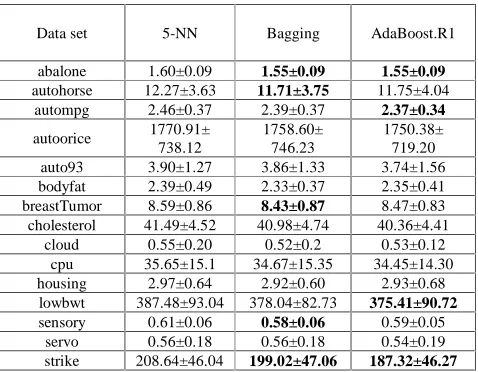
Table 1 shows a comparison of the MAE values for the data sampling techniques to the base model 5-NN.
Data set 5-NN Bagging AdaBoost.R1
abalone 1.60±0.09 1.55±0.09 1.55±0.09
autohorse 12.27±3.63 11.71±3.75 11.75±4.04
autompg 2.46±0.37 2.39±0.37 2.37±0.34
autoorice 1770.91±
738.12
1758.60± 746.23
1750.38± 719.20
auto93 3.90±1.27 3.86±1.33 3.74±1.56
bodyfat 2.39±0.49 2.33±0.37 2.35±0.41
breastTumor 8.59±0.86 8.43±0.87 8.47±0.83
cholesterol 41.49±4.52 40.98±4.74 40.36±4.41
cloud 0.55±0.20 0.52±0.2 0.53±0.12
cpu 35.65±15.1 34.67±15.35 34.45±14.30
housing 2.97±0.64 2.92±0.60 2.93±0.68
lowbwt 387.48±93.04 378.04±82.73 375.41±90.72
sensory 0.61±0.06 0.58±0.06 0.59±0.05
servo 0.56±0.18 0.56±0.18 0.54±0.19
strike 208.64±46.04 199.02±47.06 187.32±46.27
Table 1 MAE for the base technique and data-sampling ensembles
Either Bagging or Boosting or both proved effective in reducing the error significantly for the data sets abalone, autohorse, autompg, breastTumor, lowbwt, sensory, and strike
.
Bagging reduced the error significantly for 5 data sets: abalone, autohorse, breastTumor, sensory, strike with a RRE value of 3.61%. Boosting reduced significantly the error of 4 data sets: abalone, autompg, lowbwt and strike with a RRE value of 5.11%.Data set 5-NN BEM SR DS
Abalone 1.60±0.09 1.55±0.09 1.51±0.7 1.68±0.1
autohorse 12.27±3.63 10.18±3.96 9.35±3.34 8.86±3.49
autompg 2.46±0.37 2.40±0.34 2.05±0.45 2.32±0.44
autoprice 1770.91± 738.12
1658.59± 625.27
1395.89± 426.73
1561.30± 542.55
auto93 3.90±1.27 3.75±1.4 3.32±1.19 4.16±1.07
bodyfat 2.39±0.49 2.48±0.38 0.41±0.27 1.24±0.26
breast-Tumor
8.59±0.86 8.28±0.64 8.01±1.02 9.09±0.71
cholesterol 41.49±4.52 39.64±4.34 40.46±5.79 42.41±4.73
cloud 0.55±0.20 0.47±0.18 0.29±0.09 0.37±0.2
cpu 35.65±
15.1
31.81± 15.26
21.52± 7.02
31.99± 13.77
housing 2.97±0.64 2.92±0.59 2.19±0.28 2.54±0.4
lowbwt 387.48±
93.04
455.42± 60.16
377.90± 81.59
439.34± 84.97
sensory 0.61±0.06 1.24±0.08 0.60±0.06 0.68±0.09
servo 0.56±0.18 0.87±0.18 0.35±0.24 0.42±0.23
strike 208.64±
46.04
205..37± 42.66
226.75± 34.37
[image:4.595.46.288.100.306.2]181.80± 41.15
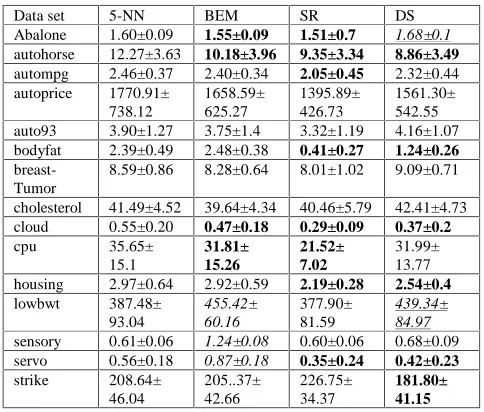
Table 2 MAE for 5-NN and feature-sampling ensembles
Table 3 Summary of significance comparison
However it improved the performance of 6 data sets auto-horse, bodyfat, cloud, housing, servo and strike with a RRE value of 26.76%. SR proved the most effective tech-nique. It never significantly reduced the accuracy of any of the data- sets and in the case of abalone, autohorse, autompg, bodyfat, cloud, cpu, housing, servo the error was reduced significantly with a RRE value of 35.01%. Comparing, the RRE values for DS and SR to the values for Bagging and Boosting, shows that when the techniques significantly reduce the error there are more substantive gains with DS and SR.
Table 3 summarises the results of the significance com-parison for both the data-sampling and feature sampling techniques. The format of this table is in the win/tie/loss format where a win indicates the number of data sets for which the ensemble technique significantly reduced the MAE in comparison to the base learner, tie indicates the number of data sets for which there was no significant difference and loss indicates the number of data sets for which the MAE was significantly increased.
Linear Regression Base Regressor
Table 4 shows a comparison of the MAE values for Bag-ging and Boosting to the base model LR. It is clear that neither Bagging nor Boosting provided any benefit over the data sets. In fact if anything Boosting was detrimental
to the performance for 5 data sets (abalone, bodyfat, hous-ing, sensory and strike) with an RIE value of 95.99%.
Dataset LR Bagging AdaBoost.R1
abalone 1.58±0.08 1.58±0.08 2.49±0.18
autohorse 7.30±1.79 7.80±4.17 7.15±3.44
autompg 2.27±0.34 2.25±0.21 2.47±0.24
autoprice 1919.90±
363.34
1936.25± 343.42
2065.06± 435.41
auto93 3.79±1.3 3.84±1.41 3.63±1.35
bodyfat 0.5±0.18 0.49±0.25 1.93±0.38
breastTumor 7.89±0.71 8.02±0.9 8.64±0.87
cholesterol 39.23±6.94 39.27±5.89 41.48±6.33
cloud 0.268±0.11 0.269±0.09 0.273±0.1
cpu 36.35±9.81 32.33±5 28.97±6.35
housing 3.40±0.43 3.42±0.31 4.78±0.46
lowbwt 370.48±
78.48
369.24± 56.37
380.26± 67.66
sensory 0.61±0.04 0.61±0.05 0.63±0.04
servo 0.62±0.12 0.64±0.27 0.75±0.23
strike 224.79
±45.05
220.41 ±36.87
426.37 ±81.16
Table 4 MAE for Linear Regression and data-sampling ensembles
Dataset LR BEM SR DS
abalone 1.58±0.08 1.66±0.11 1.51±0.08 1.57±0.06
autohorse 7.30±1.79 8.15±3.82 6.86±3.4 6.87±4.05
autompg 2.27±0.34 2.38±0.16 2.19±0.68 1.98±0.21
autoprice 1919.90± 363.34
1792.03± 390.64
1596.31± 491.39
1554.48± 321.11
auto93 3.79±1.3 3.23±1.16 3.6±1.33 4.21±1
bodyfat 0.5±0.18 1.65±0.28 0.43±0.228 0.43±0.26
breast- tumor
7.89±0.71 7.76±0.94 8.51±1.02 7.98±1.03
cholesterol 39.23±6.94 38.21±4.65 40.62±6.56 38.57±5.02
cloud 0.268±0.11 0.264±0.09 0.29±0.12 0.3±0.08
cpu 36.35±9.81 28.53±7.76 15.69±5.99 25.87±7.37
housing 3.40±0.43 3.76±0.62 2.53±0.37 2.66±0.54
lowbwt 370.48±
78.48
389.55± 80.08
369.7± 62.26
384.71± 71.68
sensory 0.61±0.04 0.62±0.06 0.58±0.05 0.58±0.05
servo 0.62±0.12 0.8±0.2 0.37±0.28 0.45±0.28
strike 224.79
±45.05
225.66± 35.5
219.24± 45.67
177.57± 46.58
Table 5 MAE for the base technique and feature sampling ensembles
Bagging Adaboost.R1 BEM SR DS
0/15/0 0/10/5 0/13/2 4/11/0 6/9/0
Table 6 Summary of significance comparison
Table 5 shows a comparison of the feature sampling niques to LR. BEM again proved an in-effective tech-nique. It never significantly improved the MAE for any data sets and in the case of bodyfat and servo it signifi-cantly increased the error with an RIE value of 129.56%. SR and DS never significantly decreased the accuracy of
Bagging Adaboost.R1 BEM SR DS
[image:4.595.311.549.347.547.2]any of the data sets. In the case of SR, the error for 4 data sets (cpu, housing, sensory, servo) was significantly re-duced. The RRE value for these data sets was 32.13%. DS reduced the error significantly also for 6 data sets (autompg, autoprice, cpu, housing, sensory, strike) with a RRE value of 18.99%. Table 6 summarises the results of the significance comparison for both the data-sampling and feature sampling techniques in a similar fashion to Table 3. It shows clearly that SR and DS were the most effective techniques at significantly reducing the error.
In summary, the regression ensemble techniques of SR and DS in combination with Random Subspace method proved a more effective mechanism of improving the gen-eralization performance of simple regressors than the popular ensemble methods of Bagging and AdaBoost. SR was most effective with nearest neighbours where the RRE value was much larger than that of Bagging and AdaBoost, whereas DS was more effective with Linear Regression. Clearly the technique of BEM did not per-form well because RSM, although creating diversity, does not guarantee the level of accuracy of the base models and simple averaging is often not able to compensate for that. The problem of inaccurate models is clearly better ad-dressed by the more sophisticated techniques of SR and DS.
It is perhaps not surprising that Bagging and Boosting would not be effective techniques for base learners such as nearest neighbours and linear regression. Primarily Bagging and Adaboost are variance reducing techniques which have shown to be effective in reducing the error of unstable learners. Typical examples of such learners are neural networks and regression trees. What is principally of interest is that the random sub-space method seems to ensure diversity, allowing bias-reducing techniques such as SR and DS to improve the performance of simple re-gression models. Tysmbal et al. (Tsymbal et al. 03) make the conjecture that for classification, RSM provides good coverage, i.e. at least, one base model is likely to classify the instance correctly. We intend to investigate further this issue in the context of regression.
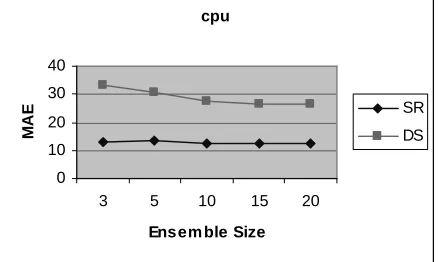
In addition, we assessed the effect of ensemble size for the techniques of SR and DS on the MAE. We chose the two data sets, housing and cpu, for which both the ensemble techniques had been effective in significantly reducing the error, and chose LR as our base model. The MAE was recorded for a given random sub-sample and ensemble size using cross-validation. This process was repeated 9 times using a different collection of random sub-samples and the same ensemble
size. The average
MAE over the 10 runs was then calculated. This process was carried out for ensemble size 3, 5, 10, 15 and 20. The results of these experiments are displayed in Figure 1 and 2.
Figure 1 The effect on MAE for the housing data set with in-creasing ensemble size
Figure 2 The effect on MAE for the cpu data set with increasing ensemble size
It is clear from Figure 1 and 2 that there are no real benefits of forming ensembles greater than size 3 for the SR technique. In the case of DS, the MAE reaches its minimum by size 10, beyond which there is no significant improvement in error. Clearly in both cases, the ensemble size is much less than the usual ensemble size of 25 cho-sen for Bagging and Boosting (Opitz and Maclin 99), in-dicating that RSM/DS and RSM/SR could be potentially a more efficient ensemble technique.
Conclusions
In this paper, we have shown that the technique of random subspace method can be used to create different sub-spaces of the data upon which the same regression algo-rithm can be used to build diverse models. These models can be combined using the integration methods of Stack-ing or Dynamic Selection in order to produce an ensemble that was demonstrated to be more effective for simple regression models than the popular ensemble learning techniques of Bagging and Boosting. We have presented
cpu
0 10 20 30 40
3 5 10 15 20
Ensem ble Size
M
A
E SR
DS
housing
0 1 2 3 4
3 5 10 15 20
Ensem ble Size
M
A
E SR
[image:5.595.311.533.88.221.2] [image:5.595.312.531.267.398.2]preliminary results which indicate that the ensemble size need not be large for this approach to work. We intend to focus on improving RSM to ensure small ensembles of sufficiently diverse and accurate base models. The reason for this is two-fold: it makes the learning approach more efficient, and it allows for the problem of comprehensibil-ity to be addressed.
Acknowledgements
We gratefully acknowledge the Weka (Witten and Frank 99) framework within which the experimental work was carried out. This material is based upon works supported by the Science Foundation Ireland under Grant No. S.F.I.-02IN.1I111.
References
Breiman, L. 1996a. Stacked Regression. Machine
Learn-ing, 24:49-64.
Breiman, L. 1996b. Bagging Predictors. Machine
Learn-ing, 24:123-140.
Christensen, S. 2003. Ensemble Construction via De-signed Output Distortion, In 4th International Workshop on Multiple Classifier Systems, LNAI, Vol. 2709, pp.
286-295, Springer-Verlag.
Dietterich, T. 1998. An experimental comparison of three methods for constructing ensembles of decision trees: bagging, boosting, and randomization. Machine Learning, 40:139-157.
Dietterich, T. 2000. Ensemble Methods in Machine Learning, In 1st International Workshop on Multiple
Classifier Systems LNAI, Vol 1857, pp. 1-10, Springer-Verlag.
Drucker, H. 1997. Improving Regressors Using Boosting Techniques. In Proceedings of the 14th International
Conference on Machine Learning, 107-215, Eds. Douglas
H. Fisher, Jr., Morgan-Kaufmann.
Freund, Y. and Schapire, R.E. 1996. Experiments with a new Boosting Algorithm, In Proceedings of 13th
Interna-tional Conference in Machine Learning, pp. 148-156.
Morgan Kaufmann.
Ho, T. K. 1998a. The random subspace method for con-structing decision forests. IEEE PAMI, 20(8):832-844. Ho, T.K. 1998b. Nearest Neighbors in Random Sub-spaces, In Proceedings of the 2nd Int'l Workshop on
Sta-tistical Techniques in Pattern Recognition, Lecture Notes
in Computer Science: Advances in Pattern Recognition, pp. 640-648.
LeBlanc, M. and Tibshirani, R. 1992. Combining esti-mates in Regression and Classification, Technical Report, Dept. of Statistics, University of Toronto.
Merz, C.J., 1996. Dynamical selection of learning algo-rithms. In Learning from data, artificial intelligence and statistics. .Fisher and H.-J.Lenz (Eds.) New York: Springer.
Merz, C. and Pazzani, M., 1999. A principal components approach to combining regression estimates, Machine
Learning, 36:9-32.
Opitz, D.W. and Maclin, R. 1999. Popular ensemble methods: An empirical study. Journal of Artificial
Intelli-gence Research, 11:169-198.
Perrone, M. and Cooper, L. 1993. When networks dis-agree: ensemble methods for hybrid neural networks. In
Artificial Neural Networks for Speech and Vision, pp.
126-142. Chapman & Hall, London.
Puuronen S., Terziyan V., Tsymbal A. 1999. A Dynamic Integration Algorithm for an Ensemble of Classifiers.
Foundations of Intelligent Systems, 11th International Symposium ISMIS’99, Lecture Notes in Artificial
Intelli-gence, Vol. 1609: 592-600, Springer-Verlag.
Quinlan, R. 1993. Learning with continuous classes, In
Proceedings of the 5th Australian Joint Conference on Artificial Intelligence, pp. 343-348, World Scientific.
Schaffer, C. 1993. Overfitting avoidance as bias. Machine
Learning 10:153-178.
Skurichina, M. and Duin, R.P.W. 2002 Bagging, Boosting and the Random Subspace Method for Linear Classifiers, Pattern Analysis and Applications, Vol. 5, pp. 121-135.
Tsymbal, A., Puuronen, S., Patterson, D. 2003. Ensemble feature selection with the simple Bayesian classification,
Information Fusion 4:87-100, Elsevier.
Witten, I. and Frank, E. 1999. Data Mining: Practical
Machine Learning Tools and Techniques with Java Im-plementations, Morgan Kaufmann.
Zenobi, G. and Cunningham, P. 2001. Using Diversity in Preparing Ensemble of Classifiers Based on Different Subsets to Minimize Generalization Error, In Proceedings
of the 12 European Conference on Machine Learning, pp.