Evaluating large-scale text mining applications
beyond the traditional numeric performance measures
Sofie Van Landeghem1,2, Suwisa Kaewphan3,4, Filip Ginter3, Yves Van de Peer1,2 1. Dept. of Plant Systems Biology, VIB, Belgium
2. Dept. of Plant Biotechnology and Bioinformatics, Ghent University, Belgium 3. Dept. of Information Technology, University of Turku, Finland
4. Turku Centre for Computer Science (TUCS), Turku, Finland [email protected], [email protected] [email protected], [email protected]
Abstract
Text mining methods for the biomedical domain have matured substantially and are currently being applied on a large scale to support a variety of applica-tions in systems biology, pathway cura-tion, data integration and gene summa-rization. Community-wide challenges in the BioNLP research field provide gold-standard datasets and rigorous evaluation criteria, allowing for a meaningful com-parison between techniques as well as measuring progress within the field. How-ever, such evaluations are typically con-ducted on relatively small training and test datasets. On a larger scale, sys-tematic erratic behaviour may occur that severely influences hundreds of thousands of predictions. In this work, we per-form a critical assessment of a large-scale text mining resource, identifying system-atic errors and determining their underly-ing causes through semi-automated analy-ses and manual evaluations1.
1 Introduction
The development and adaptation of natural lan-guage processing (NLP) techniques for the biomedical domain are of crucial importance to manage the abundance of available literature. The inherent ambiguity of gene names and complex-ity of biomolecular interactions present an intrigu-ing challenge both for BioNLP researchers as well as their targeted audience of biologists, geneticists and bioinformaticians. Stimulating such research, various community-wide challenges have been or-ganised and received international participation.
1The supplementary data of this study is freely
avail-able from http://bioinformatics.psb.ugent. be/supplementary_data/solan/bionlp13/
The BioCreative (BC) challenge (Hirschman et al., 2005; Krallinger et al., 2008; Leitner et al., 2010; Arighi et al., 2011) touches upon a variety of extraction targets. The identification of gene and protein mentions (‘named entity recognition’) is a central task and a prerequisite for any follow-up work in BioNLP. Linking these mentions to their respective gene database identifiers, ‘gene normal-ization’, is a crucial step to allow for integration of textual information with authoritative databases and experimental results. Other BC tasks are en-gaged in finding functional and physical relations between gene products, including Gene Ontology annotations and protein-protein interactions.
Focusing more specifically on the molecu-lar interactions between genes and proteins, the BioNLP Shared Task on Event Extraction (Kim et al., 2009; Kim et al., 2011b; Nedellec and others, 2013) covers a number of detailed molecular event types, including binding and transcription, regula-tory control and post-translational modifications. Additionally, separate tracks involve specific ap-plications of event extraction, including infectious diseases, bacterial biotopes and cancer genetics.
Performance of the participants in each of these challenges is measured using numeric metrics such as precision, recall, F-measure, slot error rate, MAP and TAP scores. While such rig-urous evaluations allow for a meaningful compar-ison between different systems, it is often difficult to translate these numeric values into a measure-ment of practical utility when applied on a large scale. Additionally, infrequent but consistent er-rors are often not identified through small-scale evaluations, though they may result in hundreds of thousands of wrongly predicted interactions on a larger scale. In this work, we perform an in-depth study of an open-source state-of-the-art event ex-traction system which was previously applied to the whole of PubMed. Moving beyond the tra-ditional numeric evaluations, we identify a
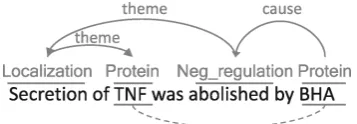
Figure 1: Example event and relation represen-tations, depicted in solid and dotted lines respec-tively. Picture by Kim et al. (2011a).
ber of systematic errors in the large-scale data, analyse their underlying causes, and design post-processing rules to resolve these errors. We be-lieve these findings to be highly relevant for any practical large-scale implementation of BioNLP techniques, as the presence of obvious mistakes in a text mining resource might undermine the credi-bility of text mining techniques in general.
2 Data and methods
In this section, we first describe the data and meth-ods used in previous work for the construction of the large-scale text mining resource that is the topic of our error analyses (Section 3).
2.1 Event extraction
Event extraction has become a widely studied topic within the field of BioNLP following the first Shared Task (ST) in 2009. The ST’09 in-troduced the event formalism as a more detailed representation of the common binary relation an-notation (Figure 1). Each event occurrence sists of an event trigger; i.e. one or more con-secutive tokens that are linked to a specific event type. While the ST’09 included only 9 event types, among which 3 regulatory event types, the ST’11 further broadened the coverage of event extraction to post-translational modifications and epigenetics (EPI).
To compose a fully correct event, an event trig-ger needs to be connected to its correct arguments. Within the ST, these arguments are selected from a set of gold-standard gene and gene product anno-tations (GGPs). The ST guidelines determine an unambiguous formalism to which correct events must adhere: most event types only take onetheme
argument, whileBindingevents can be connected to more than onetheme. Regulationevents further have an optionalcauseslot (Figure 1). Connecting the correct arguments to the correct trigger words is denoted as ‘edge detection’.
To perform event extraction, we rely on the publicly available Turku Event Extraction System (TEES) (Bj¨orne et al., 2012), which was origi-nally developed for the ST’09. The TEES mod-ules for trigger and edge detection are based upon supervised learning principles, employing support vector machines (SVMs) for multi-label classifi-cation. TEES has been shown to obtain state-of-the-art performance when measured on the gold-standard datasets of the Shared Tasks of 2009, 2011 and 2013.
2.2 Large-scale processing
Previously, the whole of PubMed has been anal-ysed using a large-scale event extraction pipeline composed of the BANNER named entity rec-ognizer, the McClosky-Charniak parser, and the Turku Event Extraction System (Bj¨orne et al., 2010). BANNER identifies gene and protein sym-bols in text through a machine learning approach based on conditional random fields (Leaman and Gonzalez, 2008). While the resulting large-scale text mining resource EVEX was focused only on abstracts and ST’09 event types (Van Landeghem et al., 2011), it has matured substantially during the past few years and now includes ST’11 EPI event types, full-text processing and gene normal-ization (Van Landeghem et al., 2013a). In this work, we use the version of EVEX as publicly available on 16 March 2013, containing 40 million event occurrences among 122 thousand gene and protein symbols in 22 million PubMed abstracts and 460 thousand PubMed Central full-text arti-cles. Each event occurrence is linked to a normal-ized confidence value, automatically derived from the original TEES SVM classification step and the distance to the hyperplane of each prediction.
While this study focuses on the EVEX resource as primary dataset, the findings are also highly rel-evant for other large-scale text mining resources, especially those based on supervised learning, such as the BioContext (Gerner et al., 2012).
2.3 Cross-domain evaluation
Event type Five most frequent trigger words
Binding binding interaction associated bind association
Gene expression expression expressed production expressing levels
Localization secretion release localization secreted localized
Protein catabolism degradation degraded cleavage proteolysis degrade Transcription transcription expression levels transcribed detected Acetylation acetylation acetylated deacetylation hyperacetylation activation Glycosylation glycosylated glycosylation attached N-linked absence Hydroxylation hydroxylation hydroxylated hydroxylate beta-hydroxylation hydroxylations Methylation radiation methylation methylated diffractometer trimethylation DNA methylation methylation hypermethylation methylated hypermethylated unmethylated Phosphorylation phosphorylation phosphorylated dephosphorylation phosphorylates phosphorylate Ubiquitination ubiquitination ubiquitinated ubiquitylation ubiquitous polyubiquitination
Regulation effect regulation effects regulated control
Positive regulation increased activation increase induced induction Negative regulation reduced inhibition decreased inhibited inhibitor
[image:3.595.75.536.61.237.2]Catalysis mediated dependent mediates removes induced
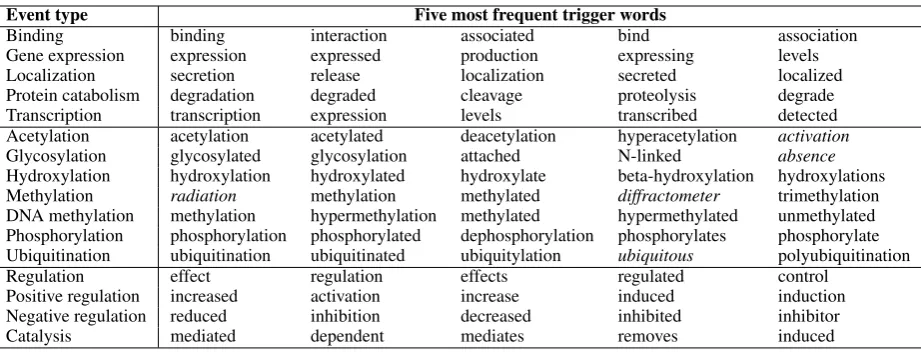
Table 1: The top-5 most frequently tagged trigger words per event type in EVEX. The first 5 rows represent fundamental event types, the next 7 post-translational modifications (PTMs), and the last 4 rows are regulatory event types. In this analysis, the PTMs and their reverse types are pooled together. Trigger words that refer to systematic errors are in italic and are discussed further in the text.
rate measured in the ST’09, with the literature data concerning human blood cell transcription factors, corresponded with a 58.6% precision rate for the plant-specific evaluation dataset (‘PLEV’). This encouraging result supports the general applicabil-ity of large-scale text mining methods trained on relatively small corpora. The findings of this pre-vious study and the resulting data are further inter-preted and analysed in more detail in this study.
3 Results
While the text mining pipeline underlying the EVEX resource has been shown to produce state-of-the-art results which are transferrable across domains and organisms, it is conceivable that the mere scale of the resource allows the accumula-tion of systematic errors. In this secaccumula-tion, we per-form several targeted semi-automated evaluations to identify, explain and resolve such cases. It is important to note that our main focus is on im-proving the precision rate of the resource, rather than the recall, aiming to increase the credibility of large-scale text mining resources in general.
3.1 Most common triggers
The trigger detection algorithm of the TEES soft-ware is based upon SVM classifiers (Section 2.1), and has been shown to outperform dictionary-based approaches (Kim et al., 2009; Kim et al., 2011c). To investigate its performance in a large-scale application, we first analyse the most fre-quent trigger words of each event type in EVEX
(Table 1). We notice the presence of different in-flections of the same word as well as related verbs and nouns, such as ‘inhibition’, ‘inhibited’ and ‘inhibitor’. The trigger recognition module suc-cessfully uses character bigrams and trigrams in its SVM classification algorithm to allow for the identification of such related concepts, even when some of these trigger words were not encountered in the training phase (Bj¨orne et al., 2009).
However, occasionally this approach results in confusion between words with small edit dis-tances, such as the trigger word ‘ubiquitous’ for
Ubiquitination events. Similarly, the Acetylation
trigger ‘activation’ is found within the context of a correct event structure in most cases, but should actually be of the type Positive regulation. The implementation of custom post-processing rules to automatically detect and resolve these specific cases would ultimately deal with more than 6,000 false-positive event predictions.
Further, the trigger ‘radiation’ seems to occur frequently for aMethylationevent, of which 82% of the instances can be identified in the ‘Exper-imental’ subsection of the article. The majority of these articles relate to protein crystallography, and that subsection describes the data from the ex-perimental set-up. Within such sections, phrases like ‘Mo Kalpha radiation’ are wrongly tagged as
Methylationevents. Similarly, many false-positive
Trigger words Most frequent typet2 Count Frequency Infrequent typet1 Count Frequency
acetylation Acetylation 40,291 0.298383 Binding 1,332 0.000216
Phosphorylation 1,050 0.001045 Gene expression 969 0.000093 Localization 1,045 0.000579 secretion Localization 376,976 0.208888 Acetylation 243 0.001800 glycosylation Glycosylation 24,226 0.141052 Phosphorylation 389 0.000387 Gene expression 214 0.000020 phosphorylation Phosphorylation 589,681 0.586772 Binding 454 0.000074 DNA methylation 225 0.001297 ubiquitylation Ubiquitination 4961 0.055976 Binding 128 0.000021 hypermethylation Methylation 19,501 0.112434 Phosphorylation 365 0.000363 cleavage Protein catabolism 20,552 0.073728 Gene expression 2,451 0.000234
Binding 3,011 0.000489
decreased Negative regulation 374,859 0.062372 Positive regulation 1,721 0.000173
Binding 855 0.000139
[image:4.595.83.516.61.271.2]Gene expression 2,928 0.000280 reduced Negative regulation 442,400 0.073610 Positive regulation 1,091 0.000110 reduction Negative regulation 164,736 0.027410 Positive regulation 389 0.000039 absence Negative regulation 65,180 0.010845 Positive regulation 226 0.000071
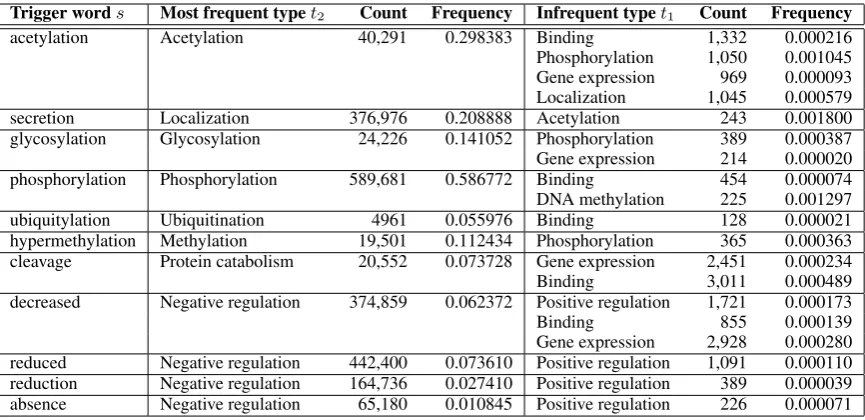
Table 2: Examples of trigger words that correspond to the type which has the highest relative frequency (left), but are also found with much lower frequencies in other types (right). The instances corresponding to the right-most column can thus be interpreted as wrong predictions. The full list is available as a machine readible translation table in the supplementary data.
than 82,000 false-positive event predictions. Finally, we notice that the trigger word ‘ab-sence’ forGlycosylation usually refers to a Neg-ative regulation. Similarly, some words appear as most frequent for more than one event type, such as ‘levels’ (Gene expression and Transcription). This type of error in trigger type disambiguation is analysed in more detail in the next section.
3.2 Event type disambiguation
While previous work has focused on the disam-biguation of event types on a small, gold-standard dataset (Martinez and Baldwin, 2011), the rich-ness of a large-scale text mining resource provides additional opportunities to detect plausible errors. To exploit this large-scale information, we anal-yse all EVEX trigger words and their correspond-ing event types, summarizcorrespond-ing their raw event oc-currence counts asOcc(t, s) where tdenotes the trigger type and s the trigger string. As some event types are more abundantly described in lit-erature, we normalize these counts to frequen-cies (F req(t, s)) depending on the total number of event occurrences per type (T ot(t)):
F req(t, s) = Occ(t, s) T ot(t)
with
T ot(t) =
n
X
i=1
Occ(t, si)
and n the number of different triggers for event typet. We then compare all trigger words and their relative frequencies across different event types.
First, we inspect those cases where a trigger word appears with comparable frequencies for two event typest1 andt2:
F req(t1, s)≤F req(t2, s)≤10×F req(t1, s)
(1) A first broad category of these cases are trig-ger words that refer to both regulatory and non-regulatory events at the same time, such as ‘over-expression’ (Gene expressionandPositive regula-tion), or ‘ubiquitinates’ (Ubiquitinationand Catal-ysis). The majority of these cases are perfectly valid and are in fact modeled explicitly by the TEES software (Bj¨orne et al., 2009).
Further, we find that two broad groups of non-regulatory event types are semantically similar and share common trigger words: Methylation and
DNA methylation (e.g. ‘methylation’, ‘unmethy-lated’, ‘hypomethylation’), as well as Gene ex-pressionandTranscription(‘expression’, ‘synthe-sis’, ‘levels’), with occasional overlap also with
Localization (‘abundance’, ‘found’). Similarly, trigger words are often shared among the four regulatory event types (‘dependent’, ‘role’, ‘regu-late’), as the exact type may depend on the broader context within the sentence.
necessar-Predicted event type
Curated event type Localization Transcription Expression
Localization 15 0 3
Transcription 0 12 1
Expression 0 2 12
No event 0 2 3
[image:5.595.169.431.62.134.2]Total 15 16 19
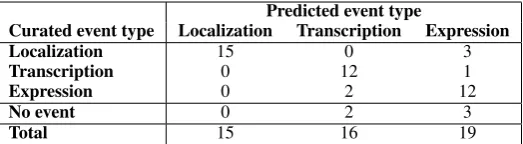
Table 3: Targeted evaluation of 50 mixed events of typeLocalization,TranscriptionandGene expression. The curated event type is compared to the original (hidden) predicted type.
ily refer to wrong predictions, we also notice the usage of punctuation marks as trigger words for various event types. This option was specifically provided in the TEES trigger detection algorithm as the ST’09 training data contains Binding in-stances with ‘-’ as trigger word. However, these punctuation triggers are found to be largely false positives in the PubMed-scale event dataset. Re-moving them in an additional post-processing step would result in the filtering of more than 130,000 event occurrences, of which the largest part is ex-pected to be incorrect predictions. Similarly, we can easily remove 25,000 events that are related to trigger words that are numeric values.
In a second step, we analyse those cases where
k×F req(t1, s)≤F req(t2, s). (2)
When this condition holds, it can be hypothesized that trigger predictions of the word s as type t1
are false positives and should have instead been of typet2. Automatically generating such lists from
the data, we have experimentally determined an optimal value ofk= 100 that represents a reason-able trade-off between the amount of false posi-tives that can be identified and the manual work needed for this.
From the resulting list, we can easily identify a number of such cases that are clearly incorrect (Ta-ble 2, right column). Specifically, a large number ofPositive regulationevents actually refer to Neg-ative regulation, providing an explanation of the lower precision rate ofPositive regulation predic-tions in the previous PLEV evaluation (Van Lan-deghem et al., 2013b). This semi-automated de-tection procedure can ultimately result in the cor-rection of more than 242,000 events.
The remaining cases for which condition (2) holds are more ambiguous and can not be au-tomatically corrected. However, these cases are more likely to be incorrect and their confidence values could thus be automatically decreased de-pending on the ratio between F req(t1, s) and
F req(t2, s). A general exception to this rule is
formed by the broad groups of semantically simi-lar events, such asTranscription-Gene expression
-Localization, which we analyse in more detail in the next section.
3.3 Gene expression, Transcription and Localization
Transcriptionis a sub-process ofGene expression, with both event types relating to protein produc-tion. However, the distinction between the two in text may not always be straightforward. Addition-ally, the ST training data forTranscriptionevents is significantly smaller than for Gene expression
events, which may be the reason why not only the TEES performance, but also those of other sys-tems, is considerably lower forTranscriptionthan forGene expression(Kim et al., 2011c). Further, cell-type specific gene expression should be cap-tured by additionalsitearguments connected to a
Localizationevent, which represents the presence or a change in the location of a protein.
To gain a deeper insight into the interplay be-tween these three different event types, we have performed a manual curation of 50 event occur-rences, sampled at random from theGene expres-sion,TranscriptionandLocalizationevents avail-able in EVEX. For each event, the trigger word and the corresponding sentence was extracted, but the predicted event type was hidden. An expert an-notator subsequently decided on the correct event type of the trigger. Within this evaluation we fol-lowed the ST guidelines to only annotateGene ex-pression when there is no evidence for the more detailedTranscriptiontype.
Table 3 shows the results. All 15 predicted
Localization triggers are recorded to be correct. From the 16 predictedTranscription events, two involve incorrect event triggers, and two other events refer to the more generalGene expression
type (75% overall precision). Likewise, only one
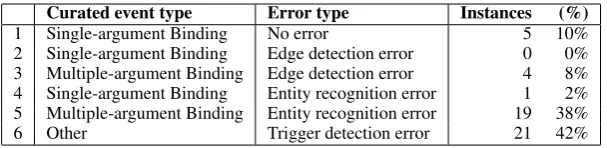
spe-Curated event type Error type Instances (%)
1 Single-argument Binding No error 5 10%
2 Single-argument Binding Edge detection error 0 0% 3 Multiple-argument Binding Edge detection error 4 8% 4 Single-argument Binding Entity recognition error 1 2% 5 Multiple-argument Binding Entity recognition error 19 38%
[image:6.595.148.452.61.135.2]6 Other Trigger detection error 21 42%
Table 4: Targeted evaluation of 50 single-argumentBindingevent triggers. Row 1: Fully correct event. Row 2: The correct argument was annotated but not linked. Row 3: At least one correct multiple-argumentBindingevent could have been extracted using the annotated entities in the sentence. Row 4: The correct argument was not annotated. Row 5: No event could be extracted due to missing argument annotations. Row 6: The trigger did not refer to aBindingevent.
Unannotated entity type Entity occurrence count Examples
GGP 10 SPF30, spinal muscular atrophy gene
Generic GGP 9 primary antibodies, peptides, RNA
Chemical compound 10 Ca(2+), iron, manganese(II)
Table 5: Manual inspection of the textual entity types for thoseBindingevents where a relevanttheme
argument was not annotated in the entity recognition step.
cificTranscriptiontype, three instances should be
Localization, and three more are considered not to be correct events at all (63% overall precision). In general, we remark that the predicted event type largely corresponds to the curated type (78% of all predictions and 87% of all otherwise correct events).
3.4 Binding
Moving beyond the event type specification as determined by the ST guidelines, the previous PLEV analysis (Section 2.3) has established a re-markable difference between single-argument and multiple-argumentBinding. In contrast to the reg-ular ST evaluations, this work considered single-and multiple-argument Binding as two separate event types, resulting in a precision rate of 93% for multiple-argumentBinding triggers and only 8% precision for single-argumentBindingtriggers.
As the PLEV study only focused on textual network data, single-argumentBindings were not analysed further. In this work however, we fur-ther investigate this performance discrepancy and perform an in-depth manual evaluation to try and detect the main causes of this systematic error.
Several hypotheses can be postulated to explain the low precision rate of single-argumentBinding
events. Firstly, a false negative instance of the entity recognition module might result in the ab-sence of annotation for a relevant second interac-tion partner. Another plausible explanainterac-tion is an error by the edge detection module of the event
extraction mechanism, which would occasionally decide to produce one or several single-argument
Bindingevents rather than one multiple-argument
Binding, even when all involved entities are cor-rectly annotated. Finally, it is conceivable that predicted single-argument triggers simply do not refer toBindingevents, i.e. they contain false pos-itive predictions of the trigger detection module of the event extraction system.
In some cases, one trigger leads to many dif-ferent Binding events, such as the trigger ‘bind’ in the sentence “Sir3 and Sir4 bind preferentially to deacetylated tails of histones H3 and H4”. In these cases, error types may accumulate: some events could be missed due to unannotated enti-ties, while others may be due to errors in the edge detection step. However, multiple events with the same trigger word are often represented by very similar feature vectors in the classification step, and consequently have almost identical final con-fidence values. For this reason, we summarize the error as ‘Edge detection error’ as soon as one pair of entities was correctly annotated but not linked, and as ‘Entity recognition error’ otherwise.
Curated event type Error type Instances (%)
1 Phosphorylation No error 34 68%
2 Phosphorylation Edge detection error 4 8%
3 Invalid Phosphorylation Edge detection error 2 4% 4 Phosphorylation Edge directionality detection error 4 8% 5 Invalid Phosphorylation Edge directionality detection error 1 2% 6 Phosphorylation Entity recognition error 3 6%
[image:7.595.134.466.62.145.2]7 Other Trigger detection error 2 4%
Table 6: Targeted evaluation of 50Phosphorylationevent triggers and theirthemearguments. Row 1: Fully correct event. Row 2: The correct argument was annotated but not linked. Row 3: An argument was linked but should not have been. Row 4: A causal argument was wrongly annotated as thetheme
argument. Row 5: A causal argument was wrongly annotated as thethemeargument. Row 6: The correct argument was not annotated. Row 7: The trigger did not refer to aPhosphorylationevent.
an entity recognition error (19/23 or 83%), while an edge detection error is much less frequent (17%). When we examine these entity recogni-tion errors in more detail, we find that 10 rele-vant entities are true GGPs in the sense of the Shared Task annotation. However, 9 entities refer to generic GGPs, and 10 instances relate to chemi-cal compounds (Table 5). As these type of entities can not be unambiguously normalized to unique gene identifiers, they fall out-of-scope of the orig-inal ST challenge. However, we feel this practice introduces an artificial bias on the classifier and the evaluation. Additionally, this information can prove to be of value within a large-scale text min-ing resource geared towards practical applications and explorative browsing of textual information.
Finally, we notice that a remarkable 42% of all predicted events contain trigger detection errors. Analysing this subclass in more detail, we found that 5 cases are invalid event triggers, 6 cases re-fer to other event types such asLocalization and
Gene expression, and 10 more cases were consid-ered to be out-of-scope of the ST challenge, such as a factor-disease association.
3.5 Phosphorylation
Within the PLEV evaluation (Section 2.3), it be-came apparent that Phosphorylation is easy to recognise from the sentence (98%) but the full cor-rect event has a much lower precision rate (65%). As we have seen in the previous section, even when a trigger word is correctly predicted, errors may still be generated by the edge detection or en-tity recognition step. For instance, we might hy-pothesize that the main underlying reason for the reduced final performance is an error by the en-tity recognition step, forcing the edge detection mechanism to link an incorrectthemedue to lack
of other options. Other plausible explanations in-volve genuine errors by the edge detection algo-rithm when the correct argument is annotated, as well as problems with the identification of causal-ity. As the TEES version applied in this work was developed for the Shared Task 2009 and 2011, it does not predict causal arguments for a Phospho-rylationevent directly, but instead addsRegulation
events on top of thePhosphorylations. Occasion-ally, we have noticed that thethemeof a Phospho-rylationevent should in fact have been thecause
of the embeddingRegulationassociation, resulting in a wrongly directed causal relationship.
from the set of annotated GGPs, or misinterprets the causality direction.
4 Discussion and conclusion
We have performed several semi-automated eval-uations and targeted manual curation experiments, identifying and explaining systematic errors in a large-scale event dataset. As a first observation, we notice that a few frequent trigger words are almost always associated to incorrect event pre-dictions, such as the trigger words ‘ubiquitous’ and ‘radiation’, or a punctuation symbol. These cases were identified through a large-scale auto-matic analysis in combination with a limited man-ual evaluation effort. The results are distributed as a blacklist of event triggers for the implementation or filtering of future large-scale event predictions efforts.
Further, a semi-automated procedure has iden-tified a list of likely incorrect predictions, by comparing the type-specific frequencies of trigger words across all event types. Manual inspection of the most frequent cases allowed us to determine a number of trigger words for which the event type can automatically be corrected. These results are also made publicly available.
Additionally, after removal of the most obvi-ous and frequent errors, a fully automated script can automatically reduce the confidence scores of those event occurrences where the trigger words are found to be much more frequent for another event type. We have established that this proce-dure should disregard triggers identified within a few specific semantically similar clusters: DNA methylation/Methylation,Regulation/Positive reg-ulation/Negative regulation/Catalysis and Gene expression-Transcription/Localization. An addi-tional targeted evaluation of these last three types revealed that, despite their semantic overlap, the largest fraction of these predictions refers to the correct event type (78±11.5%).
Finally, we note that trigger detection (47 ±
14.6%) and entity recognition errors (44±14.6%) are the main causes of wrongly predicted Bind-ingevents. The latter causes the event extraction mechanism to artificially produce single-argument
Bindings instead of multiple-argument Bindings. We believe this issue can be resolved by broaden-ing the scope of the entity recognition module to generic GGPs and chemical compounds, and re-applying the TEES algorithm to these entities as
if they were normal GGPs as defined in the ST formalism. In contrast, edge detection errors are much more frequently the cause of a wrongly pre-dictedPhosphorylationevent (statistically signifi-cant difference withp <0.05), caused by wrongly identifying the thematic object or the causality of the event. To resolve this issue, we propose fu-ture annotation efforts to specifically annotate the protein adding the phosphate group to the target protein as a separate class than the regulation of such a phosphorylation process by other cellular machineries and components (Kim et al., 2013).
In conclusion, we have performed several statistical analyses and targeted manual eval-uations on a large-scale event dataset. As a result, we were able to identify a set of rules to automatically delete or correct a number of false positive predictions (supplementary material at http://bioinformatics. psb.ugent.be/supplementary_data/ solan/bionlp13/). When applying these rules to the winning submission of the recent ST’13 (GE subchallenge), which was based on the TEES classifier (Hakala et al., 2013), 3 false positive predictions could be identified and removed. Even though this procedure only marginally improves the classification results (50.97% to 50.99% F-score), we believe the cleaning procedure to be crucial specifically for the credibility of any large-scale text mining application. For example, applied on the EVEX resource, it would ultimately result in the removal of 242,000 instances and a corrected event type of 230,000 more cases (1.2% of all EVEX events in total). These corrections will be implemented as part of the next big EVEX release. Additionally, the confidence score of more than 120,000 am-biguous cases could be automatically decreased. Alternatively, these cases could be the target of a large-scale re-annotation, for instance using the brat annotation tool (Stenetorp et al., 2012). The resulting dataset could then serve as a new training set to enable active learning on top of existing event extraction approaches.
Acknowledgments
References
Cecilia Arighi, Zhiyong Lu, Martin Krallinger, Kevin Cohen, J. Wilbur, Alfonso Valencia, Lynette Hirschman, and Cathy Wu. 2011. Overview of the BioCreative III workshop. BMC Bioinformatics, 12(Suppl 8):S1.
Jari Bj¨orne, Juho Heimonen, Filip Ginter, Antti Airola, Tapio Pahikkala, and Tapio Salakoski. 2009. Ex-tracting complex biological events with rich graph-based feature sets. In Proceedings of the BioNLP 2009 Workshop, pages 10–18.
Jari Bj¨orne, Filip Ginter, Sampo Pyysalo, Jun’ichi Tsu-jii, and Tapio Salakoski. 2010. Scaling up biomed-ical event extraction to the entire PubMed. In Pro-ceedings of the BioNLP 2010 Workshop, pages 28– 36.
Jari Bj¨orne, Filip Ginter, and Tapio Salakoski. 2012. Generalizing biomedical event extraction. BMC Bioinformatics, 13(suppl. 8):S4.
Martin Gerner, Farzaneh Sarafraz, Casey M. Bergman, and Goran Nenadic. 2012. BioContext: an in-tegrated text mining system for large-scale extrac-tion and contextualizaextrac-tion of biomolecular events. Bioinformatics, 28(16):2154–2161.
Kai Hakala, Sofie Van Landeghem, Tapio Salakoski, Yves Van de Peer, and Filip Ginter. 2013. EVEX in ST13: Application of a large-scale text mining resource to event extraction and network construc-tion. In Proceedings of the BioNLP Shared Task 2013 Workshop (in press).
Lynette Hirschman, Alexander Yeh, Christian Blaschke, and Alfonso Valencia. 2005. Overview of BioCreAtIvE: critical assessment of informa-tion extracinforma-tion for biology. BMC Bioinformatics, 6(Suppl 1):S1.
Jin-Dong Kim, Tomoko Ohta, Sampo Pyysalo, Yoshi-nobu Kano, and Jun’ichi Tsujii. 2009. Overview of BioNLP’09 Shared Task on event extraction. In Proceedings of the BioNLP 2009 Workshop, pages 1–9.
Jin-Dong Kim, Tomoko Ohta, Sampo Pyysalo, Yoshi-nobu Kano, and Junichi Tsujii. 2011a. Ex-tracting bio-molecular events from literature - the BioNLP’09 Shared Task. Computational Intelli-gence, 27(4):513–540.
Jin-Dong Kim, Sampo Pyysalo, Tomoko Ohta, Robert Bossy, Ngan Nguyen, and Jun’ichi Tsujii. 2011b. Overview of BioNLP Shared Task 2011. In Pro-ceedings of the BioNLP Shared Task 2011 Work-shop, pages 1–6.
Jin-Dong Kim, Yue Wang, Toshihisa Takagi, and Aki-nori Yonezawa. 2011c. Overview of Genia event task in BioNLP Shared Task 2011. InProceedings of the BioNLP Shared Task 2011 Workshop, BioNLP Shared Task ’11, pages 7–15.
Jin-Dong Kim, Yue Wang, Yamamoto Yasunori, Sabine Bergler, Roser Morante, and Kevin Cohen. 2013. The Genia Event Extraction Shared Task, 2013 edition - overview. In Proceedings of the BioNLP Shared Task 2013 Workshop (in press).
Martin Krallinger, Alexander Morgan, Larry Smith, Florian Leitner, Lorraine Tanabe, John Wilbur, Lynette Hirschman, and Alfonso Valencia. 2008. Evaluation of text-mining systems for biology: overview of the second BioCreative community challenge. Genome Biology, 9(Suppl 2):S1.
Robert Leaman and Graciela Gonzalez. 2008. BAN-NER: an executable survey of advances in biomedi-cal named entity recognition.Pacific Symposium on Biocomputing. Pacific Symposium on Biocomputing, pages 652–663.
F. Leitner, S.A. Mardis, M. Krallinger, G. Cesareni, L.A. Hirschman, and A. Valencia. 2010. An overview of BioCreative II.5. Computational Bi-ology and Bioinformatics, IEEE/ACM Transactions on, 7(3):385–399.
David Martinez and Timothy Baldwin. 2011. Word sense disambiguation for event trigger word detec-tion in biomedicine.BMC Bioinformatics, 12(Suppl 2):S4.
Claire Nedellec et al. 2013. Overview of BioNLP Shared Task 2013. In Proceedings of the BioNLP Shared Task 2013 Workshop (in press).
Pontus Stenetorp, Sampo Pyysalo, Goran Topi´c, Tomoko Ohta, Sophia Ananiadou, and Jun’ichi Tsu-jii. 2012. brat: a web-based tool for NLP-assisted text annotation. InProceedings of the Demonstra-tions at the 13th Conference of the European Chap-ter of the Association for Computational Linguistics, pages 102–107.
Sofie Van Landeghem, Filip Ginter, Yves Van de Peer, and Tapio Salakoski. 2011. EVEX: a PubMed-scale resource for homology-based generalization of text mining predictions. InProceedings of the BioNLP 2011 Workshop, pages 28–37.
Sofie Van Landeghem, Jari Bj¨orne, Chih-Hsuan Wei, Kai Hakala, Sampo Pyysalo, Sophia Ananiadou, Hung-Yu Kao, Zhiyong Lu, Tapio Salakoski, Yves Van de Peer, and Filip Ginter. 2013a. Large-scale event extraction from literature with multi-level gene normalization. PLoS ONE, 8(4):e55814.