Fault Localisation for WS-BPEL Programs based on Predicate Switching and
Program Slicing
Chang-ai Suna,∗, Yufeng Rana, Caiyun Zhenga, Huai Liub, Dave Toweyc, Xiangyu Zhangd
aSchool of Computer and Communication Engineering, University of Science and Technology Beijing, Beijing 100083, China
bCollege of Engineering and Science, Victoria University, Melbourne 8001 VIC, Australia
cSchool of Computer Science, University of Nottingham Ningbo China, Zhejiang, 315100, China
dDepartment of Computer Science, Purdue University, West Lafayette, Indiana, USA
Abstract
Service-Oriented Architecture (SOA) enables the coordination of multiple loosely coupled services. This allows users to choose any service provided by the SOA without knowing implementation details, thus making coding easier and more flexible. Web services are basic units of SOA. However, the functionality of a single Web service is limited, and usually cannot completely satisfy the actual demand. Hence, it is necessary to coordinate multiple independent Web services to achieve complex business processes. Business Process Execution Language for Web Services (WS-BPEL) makes the coordination possible, by helping the integration of multiple Web services and providing an interface for users to invoke. When coordinating these services, however, illegal or faulty operations may be encountered, but current tools are not yet powerful enough to support the localisation and removal of these problems. In this paper, we propose a fault localisation technique for WS-BPEL programs based on predicate switching and program slicing, allowing developers to more precisely locate the suspicious faulty code. Case studies were conducted to investigate the effectiveness of the proposed technique, which was compared with predicate switching only, slicing only, and one existing fault localisation technique, namely Tarantula. The experimental results show that the proposed technique has a higher fault localisation effectiveness and precision than the baseline techniques.
Keywords: Fault localisation, Debugging, Business Process Execution Language for Web Services, Web Services
1. Introduction 1
In recent years, Service-Oriented Architecture 2
(SOA) [1] has been widely adopted to develop dis-3
tributed applications in various domains. Web services, 4
as basic units in SOA, are often developed and owned 5
by a third party, and are published and deployed in an 6
open and dynamic environment. Since a single Web 7
service normally provides limited functionalities, multi-8
ple Web services are coordinated to implement complex 9
and flexible business processes. Business Process Exe-10
cution Language for Web Services (WS-BPEL) [2] is 11
a widely recognised language for service compositions. 12
In the context of WS-BPEL, all communications among 13
Web services are via standard eXtensible Markup Lan-14
guage (XML) messages [3]. Compared with traditional 15
programs written in C or Java, WS-BPEL programs 16
∗
Corresponding author
Email address:[email protected](Chang-ai Sun)
have many new features. For instance, a WS-BPEL 17
program is represented as an XML file, and dynamic 18
behaviours of the program are embedded into structural 19
XML elements; Web services composed by WS-BPEL 20
programs may be implemented in hybrid programming 21
languages; and WS-BPEL supports concurrency and 22
synchronisation that is not common in the traditional 23
programs. 24
The above unique features make the debugging of 25
WS-BPEL programs significantly different from that 26
of traditional programs. Unfortunately, very little re-27
search in this direction has been reported. In our pre-28
vious work [4], we presented a block-based fault lo-29
calisation framework for WS-BPEL programs, and syn-30
thesised the three well-known spectrum-based fault lo-31
calisation techniques: Tarantula [5], Set-Union [6], and 32
Code Coverage [7, 8]. We also conducted an empir-33
ical study to evaluate the effectiveness of the synthe-34
sized WS-BPEL-specific fault localisation techniques. 35
most effective technique, demonstrated by the highest 37
accuracy in localising the blocks that contain the faulty 38
statement. However, these techniques could only report 39
those suspicious faulty blocks without a deeper analysis 40
inside the suspicious block. 41
There also exist some development platforms for 42
WS-BPEL, such as ActiveBPEL Designer [9] and 43
Eclipse BPEL Designer[10]. Unfortunately, these plat-44
forms usually only provide support for WS-BPEL syn-45
tax checking, while the assistance with logical errors 46
that most developers expect is missing. If such assis-47
tance were available, perhaps as a plug-in to the plat-48
form, the debugging efficiency might be substantially 49
improved. 50
In this work, we attempt to develop a technique 51
to further improve the effectiveness and efficiency of 52
fault localisation for WS-BPEL programs. In particu-53
lar, we propose a new fault localisation technique for 54
WS-BPEL programs, based on two popularly used tech-55
niques, namely predicate switching [11] and program 56
slicing [12]. The proposed technique first employs pred-57
icate switching to narrow the range of blocks to be 58
checked for the fault localisation, and then makes use 59
of slicing to go more deeply into the block for a more 60
precise analysis of the fault. In particular, we focus 61
on the following unique challenges in applying predi-62
cate switching and program slicing into WS-BPEL pro-63
grams. 64
• Predicate switching for WS-BPEL programs: For 65
C, C++, or Java programs, predicate switching 66
is normally implemented through instrumentation. 67
However, WS-BPEL programs are basically the 68
workflow specifications based on XML, and their 69
executions normally rely on a specific interpreter. 70
For instance, Apache ODE [13] is a popular WS-71
BPEL engine that compiles all standard BPEL el-72
ements: the compiled VxBPEL is represented as 73
an object model containing all necessary resources 74
for execution. A runtime component is responsi-75
ble for the execution of compiled processes. Such 76
an execution mode means that dynamic changes to 77
WS-BPEL programs are not allowed. In contrast, 78
the original implementation of predicate switch-79
ing for C programs is based on Valgrind1.
Val-80
grind supports dynamic instrumentation by calling 81
the instrumentation functions. These functions, in 82
turn, instrument the provided basic block and re-83
turn the new basic block to the Valgrind kernel (re-84
fer to [11] for more details). Clearly, because no 85
1Valgrind is a well-known memory debugger and profiler for
x86-kubyx binaries. For more details, please refer to: http://valgrind.org/
interfaces are reserved for calling instrumentation 86
functions, it is not possible to implement dynamic 87
instrumentation in Apache ODE. Furthermore, in 88
this context, instrumentation is not a suitable so-89
lution for WS-BPEL programs. In order to im-90
plement an instrumentation function in WS-BPEL 91
programs, it would be necessary to make signifi-92
cant modifications to the original WS-BPEL pro-93
grams. Such modifications would definitely affect
94
the whole program, including the partner link, vari-95
able, and interaction sections. Furthermore, these 96
modifications would change the semantics of the 97
original program, which violates the fundamen-98
tal principle of instrumentation technique. On the 99
contrary, the original instrumentation for predicate 100
switching in C programs (again refer to [11]) does 101
not face this challenge, because it implements the 102
instrumentation functions in binaries, and the mod-103
ifications to the original program include only in-104
troducing a new basic block. Finally, collecting 105
the execution traces of instrumentation for WS-106
BPEL programs is also challenging. It is easy to 107
collect execution traces in the context of C pro-108
grams, which can be done by writing data into a 109
file or memory. In contrast, WS-BPEL programs 110
normally return a response message through a spe-111
cific activity (i.e. reply), and there is no channel 112
for throwing trace data. 113
• Dynamic program slicing for WS-BPEL programs: 114
Variables in WS-BPEL programs can be either 115
an atomic data type or a complex composite type 116
whose definitions are normally distributed in var-117
ious namespaces represented in XML files. Thus, 118
dynamic slicing of WS-BPEL programs must be 119
able to deal with recursive parsing and querying 120
of composite variables. Furthermore, it is neces-121
sary to analyse the interpreter’s logs in order to 122
obtain the execution traces of the WS-BPEL pro-123
gram. These issues all pose challenges for the dy-124
namic slicing of WS-BPEL programs. 125
Based on some new concepts, the above challenges are 126
effectively addressed in our proposed technique. 127
In order to evaluate the performance of the proposed 128
technique, we conducted a comprehensive empirical 129
study where three WS-BPEL programs were used as 130
object programs, and a total of 166 mutated versions 131
were used to simulate various faults. The effectiveness 132
and precision of the new technique were compared with 133
the Tarantula technique, which had shown the best per-134
formance in fault localisation for WS-BPEL programs 135
that the proposed technique demonstrates better effec-137
tiveness and higher precision than the previous tech-138
nique. 139
The rest of this paper is organised as follows. Sec-140
tion 2 introduces underlying concepts of WS-BPEL, and 141
some related fault localisation techniques. Section 3 142
describes the main idea of our new fault localisation 143
technique. Details on how to apply the technique to 144
WS-BPEL programs are also discussed. Section 4 de-145
scribes an empirical study that was conducted to eval-146
uate the proposed fault localisation technique. Section 147
5 presents the results of the empirical study, and offers 148
an analysis. Section 6 discusses some important work 149
related to our study. Finally, Section 7 concludes the 150
paper, and discusses the future work. 151
2. Background 152
2.1. WS-BPEL 153
The Business Process Execution Language for Web 154
Service (WS-BPEL) is a widely used language for com-155
posing Web services [2]. It can integrate multiple Web 156
services to form a business process, and make this avail-157
able in the form of Web services [4]. In this sense, a 158
WS-BPEL Web service is actually a composite Web ser-159
vice whose invocation interface can be described using 160
the Web Service Description Language (WSDL) [14]. 161
WS-BPEL programs aim to integrate all Web services 162
in one line to reduce the program redundancy, without 163
requiring details of the actual implementation of the ser-164
vice [15]. 165
WS-BPEL programs are usually composed of four 166
sections: variable section, partner link section, han-167
dler section, andinteraction section[4]. The variable 168
section defines input and output messages. The part-169
ner link section describes the relationship among the 170
WS-BPEL process and invoked Web services. The han-171
dler section declares the handlers when an exception or 172
specific event occurs. The interaction section describes 173
how external Web Services are coordinated to execute a 174
business process. 175
The basic interaction unit of a WS-BPEL program 176
is anactivity, which can be either abasic activity or a 177
structured activity. Basic activities describe an atomic 178
execution step (such asassign, invoke, receive, reply, 179
throw, wait, and empty); and structured activities are 180
composed of several basic activities or other structured 181
activities (such as sequence, switch, while, flow, and 182
pick). Figure 1 shows an interaction segment of a WS-183
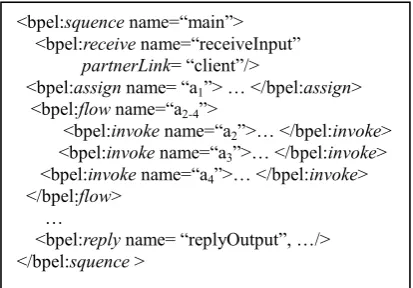
BPEL program. 184
<bpel:squence name=“main”> <bpel:receive name=“receiveInput”
partnerLink= “client”/>
<bpel:assign name= “a1”> … </bpel:assign> <bpel:flow name=“a2-4”>
<bpel:invoke name=“a2”>… </bpel:invoke> <bpel:invoke name=“a3”>… </bpel:invoke> <bpel:invoke name=“a4”>… </bpel:invoke> </bpel:flow>
…
[image:3.595.317.524.112.256.2]<bpel:reply name= “replyOutput”, …/> </bpel:squence >
Figure 1: Illustration of the interaction of a WS-BPEL Program
2.2. Fault localisation techniques 185
Many fault localisation techniques have been pro-186
posed and examined empirically [16]. These tech-187
niques explore the fault localisation problem in diff er-188
ent ways. The reported approaches include those based 189
on program analysis, on program execution, on pred-190
icates, and also using data mining or machine learn-191
ing [17]. Among them, spectrum-based fault localisa-192
tion is a family of fault localisation techniques based 193
on program execution that counts the executions of pro-194
gram elements in different executions, and uses the ratio 195
of a program element being exercised in a failed execu-196
tion and the one in a passed execution to calculate the 197
suspiciousness of the program element. We next intro-198
duce one representative spectrum-based technique that 199
will be included for evaluation in our experiments re-200
ported in Section 4. 201
Jones [5] proposed a program execution-based fault localisation technique, using statistics, called Tarantula. Tarantula involves multiple test cases and executions, recording the pass and fail status for each program ele-ment a test case executes. The suspiciousness value is calculated according to Formula 1 below:
suspicion(s)=
f ailed(s)
total f ailed passed(s)
totalpassed+ f ailed(s)
total f ailed
, (1)
where passed(s) is the number of test cases that have 202
executed the program element swith the output as ex-203
pected; f ailed(s) is the number of test cases that have 204
executed the program element swith the outputnotas 205
expected;totalpassedis the total number of passing test 206
cases; andtotal f ailedis the total number of failing test 207
cases. Program elements are ranked according to these 208
likelihood of containing the fault. Limitations of the 210
Tarantula method include that it requires a large set of 211
tests, with the pass or fail status known, and that if ei-212
thertotalpassedortotal f ailedis zero, then the formula 213
is invalid. 214
In our previous work [4], we evaluated the perfor-215
mance of three traditional spectrum-based fault local-216
isation techniques, namely Tarantula, Set-Union, and 217
Code Coverage, on two WS-BPEL programs. The fault 218
localisation effectiveness was mainly measured by the 219
correctness percentage, which refers to the percentage 220
of possible position sets that really contain the faulty 221
statements. For one program (SupplyChain), Tarantula, 222
Set-Union, and Code Coverage can successfully locate 223
7 (53.8%), 7 (53.8%), and 5 (38.5%) of 13 faults, re-224
spectively. For the other program (SmartShelf), Taran-225
tula, Set-Union, and Code Coverage can successfully 226
locate 10 (50%), 8 (40%), and 8 (40%) of 20 faults, 227
respectively. Such observations implied that Tarantula 228
was the most effective among these three fault local-229
isation techniques. However, it should be noted that 230
the performance of Tarantula (as well as Set-Union and 231
Code Coverage) on WS-BPEL programs is not as good 232
as that on traditional programs. For instance, Tarantula 233
can achieve a score of 90% (i.e. the fault was found 234
by examining less than 10% of the executed code) for 235
the 55.7% faulty versions in seven C programs in the 236
Siements suite [18]. In other words, there is a need 237
for more advanced techniques specifically for localising 238
faults in WS-BPEL programs. 239
In order to further improve the fault localisation ef-240
fectiveness and efficiency of WS-BPEL programs, we 241
explore predicate switching and program slicing-based 242
fault localisation for WS-BPEL programs, and address 243
the key issues of the proposed technique. We also com-244
pare the fault localisation effectiveness and efficiency of 245
the proposed technique with that of predicate switching 246
only, slicing only, and Tarantula, since Tarantula was 247
evaluated to be the most effective technique in our pre-248
vious work [4]. 249
3. BPELswice: A Fault Localisation Technique for 250
WS-BPEL Programs 251
Normally, traditional programs written in Java or C 252
focus more on trivial operations on various data struc-253
tures, from the simple data types such as char, integer, 254
boolean, and real to the complex data types such as ar-255
ray, struct/union, pointer, and their composites. Diff er-256
ent from them, WS-BPEL programs specify a work-257
flow with coarse-grained activities, which usually in-258
volve simple operations such as invoking an external 259
Web services or a variable assignment. The transitions 260
between the activities are implemented through some 261
common control logic such as sequence, optional, loop, 262
and also newly introduced concurrency and synchroni-263
sation. These unique features of WS-BPEL programs 264
pose challenges for fault localisation, and thus call for 265
new techniques. 266
3.1. Overview 267
A fault is considered to be detected when a test case 268
causes the program to have an incorrect output. The 269
fault-revealing test case is also called the failed test case, 270
the counterpart of which is called the successful test 271
case that results in correct output. Each failed test case 272
corresponds to the execution of a particular path, which 273
can help us precisely localise the fault. 274
A typical program usually contains a number of 275
branches, as part of its logical structure. These branches 276
are controlled by some conditional slice, called a predi-277
cate, which evaluates to either true or false. If we force a 278
predicate to change its true or false status, then we have 279
a process called predicate switching. The goal of this 280
process is to find a predicate that has strong influence 281
on the data flow, and if the branch outcome of the pred-282
icate is switched and execution is continued, the out-283
put of the program may be changed from “incorrect” to 284
“as expected”, thereby providing a valuable clue as to 285
the location of the fault. Such a predicate, if it exists, 286
is called a critical predicate. Statements that change 287
the values of variables related to this critical predicate, 288
which exist between it and the start of the program, are 289
called the backward slice. Because the critical predi-290
cate may be strongly influenced by the backward slice, 291
the analysis is necessary, and may provide further guid-292
ance to precisely locate the actual fault which caused 293
the predicate’s incorrect status. 294
We hereby propose a fault localisation technique for 295
WS-BPELprograms based on the predicateswitching 296
and backward slices, which is abbreviated as BPEL-297
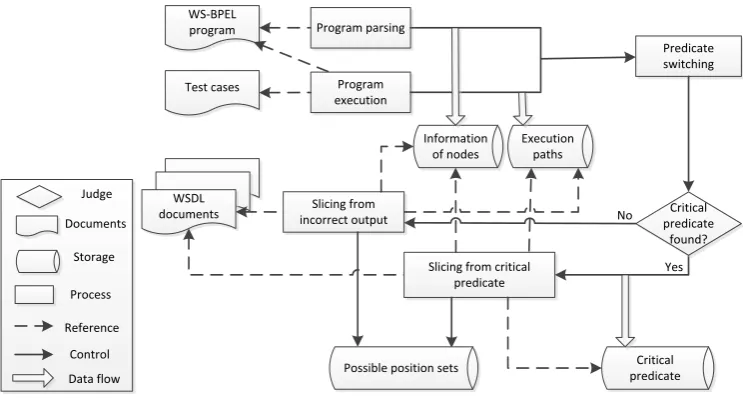
swice in the rest of the paper. Figure 2 shows the ba-298
sic framework of the technique, for which it is assumed 299
that at least one test case demonstrates the presence of a 300
fault in the WS-BPEL program. 301
As shown in Figure 2, BPELswice includes the fol-302
lowing five major steps: 303
1. Parsing the WS-BPEL programenables an enumer-304
ation of all the possible paths through the program 305
and all predicates associated with each path, which 306
facilitates the backward slice analysis. 307
2. Predicate switchingrevises a predicate of the WS-308
WS-BPEL
program Program parsing
Information of nodes
Test cases Program
execution
Execution paths
Predicate switching
WSDL documents
Critical predicate Slicing from critical
predicate Slicing from
incorrect output
Possible position sets Documents
Storage
Process
Reference
Control
Critical predicate
found?
Data flow
[image:5.595.111.483.132.331.2]Yes No Judge
Figure 2: Framework of the proposed BPELswice technique
BPEL program for execution. In order to exe-310
cute the different conditional part, this stage ac-311
tually changes the predicate value from “true” to 312
“false”, or vice versa. The switching is imple-313
mented by negating the predicate of the original 314
WS-BPEL program, and accordingly a WS-BPEL 315
program variant is derived in this stage. During the 316
switching, we can use some strategies to decide the 317
switching ordering of the predicates. 318
3. Executionincludes passing the failed test cases as 319
input for the deployed WS-BPEL program variant 320
and obtaining the actual output. This stage usu-321
ally involves a WS-BPEL engine, such as Apache 322
ODE [13], which produces a series of events in a 323
log file. Through the analysis of the log file, one 324
can extract all executed path nodes and variable’s 325
values during the current execution. 326
4. Evaluationinvolves comparison of the actual out-327
put with what was expected (i.e. the oracle). In this 328
stage, the main goal is to observe how the predicate 329
switching impacts on the output of the revised WS-330
BPEL program. If the output is different from the 331
expected output, then we continue to switch the re-332
maining ordered predicates (i.e. repeatpredicate 333
switching and evaluation steps). This switching 334
process is repeated until the actual output becomes 335
the same as the oracle, at which moment the crit-336
ical predicate is found and then we can go to the 337
next,slicing, step. 338
5. Slicingaims to further reduce the possible position 339
set of the fault. In this step, the main task is to 340
find backward slices between the critical predicate 341
and the start node (i.e. the receiveInput node of 342
the WS-BPEL program). Note that the backward 343
slices are those nearest statements that directly af-344
fect the values of the elementary variables in the 345
critical predicate. Through comparing the values 346
achieved at run-time with what we expected, we 347
can find the variable and its statement node that 348
are different from the expected ones. 349
Each major step is detailed in the following sections. 350
3.2. Parsing the WS-BPEL program 351
It is necessary to parse the WS-BPEL program for 352
user’s understanding of its structure. The document root 353
is critical for the parsing, and is the entry (the so-called 354
“main node”) to the program. Typically, there are two 355
traverse methods to read a program: Depth-First Traver-356
sal and Breadth-First Traversal. The choice of traversal 357
method does not affect the information we obtain from a 358
WS-BPEL program. Once all the WS-BPEL node infor-359
mation has been obtained, it is inserted on a JTree [19], 360
which shows all paths through the program. 361
The computation in a WS-BPEL program which cal-362
Data Part(DP) and theSelect Part(SP) [11]. The Data 364
Part includes execution instructions which help in com-365
puting data values or defining variables that are involved 366
in computing the output of the program. Sometimes 367
these are important parts for backward slices. The Se-368
lect Part includes instructions which cause the selection 369
of program branches — for example, in the conditionals 370
of “if”, “switch”, and “while” activities. Different pro-371
gram executions may involve different data slices, lead-372
ing to generation of differently computed output values. 373
Sometimes the conditions in Select Parts may depend 374
on the values computed in the Data Parts. Furthermore, 375
because the output values are determined by the selec-376
tion of program branches, it is necessary to analyse the 377
Select Parts to locate the faulty code. Figure 3 illustrates 378
the Data Part and the Select Part in a sample WS-BPEL 379
program. 380
<bpel:sequence name="main">
<bpel:receive name="receiveInput" partnerLink="client"/> <bpel:assign validate="no" name="Assign">
<bpel:copy>
<bpel:from>……</bpel:from>
<bpel:to variable="CheckStatusRequest"part="parameters"> </bpel:to>
</bpel:copy> </bpel:assign> <bpel:if>
<bpel:condition><![CDATA[$_amount < $init_amount]]></bpel:condition> <bpel:sequence>
<bpel:assign validate="no" name="Assign2">…</bpel:assign> </bpel:sequence>
</bpel:if> … </bpel:sequence>
Subset in Data Part
Subset in Select Part
Figure 3: Data Part and Select Part in WS-BPEL Program
In summary, the output of a program is influenced by 381
two things in the code: the data dependence part, and 382
the selection part. Altering code in the selection part 383
may lead to a change in the output, which may enable 384
us to track down where in the code an error was made. 385
The selection part of the code which controls the flow 386
is called a predicate, and a predicate whose outcome is 387
changed, e.g., from false to true, resulting in a change 388
to the overall program output changing to the expected 389
output, is called a critical predicate. The question of 390
how to find the critical predicate will be addressed in 391
the following. 392
3.3. Predicate Switching 393
We aim to reduce the possible location range of the 394
fault using the critical predicate technique [11], a central 395
part of which is predicate switching. Predicate switch-396
ing involves going through a sequence of predicates in 397
any executed path, switching the boolean status of each 398
(e.g. changing “true” to “false”), and examining the im-399
pact on the output: if the output changes to the expected 400
one, then the critical predicate is the predicate whose 401
status was most recently switched. 402
Before starting to switch predicates, we first order 403
them, to reduce the amount of time required to identify 404
the critical predicate. We hereby illustrate one typical 405
and widely-used ordering strategy, called Last Executed 406
First Switching ordering (LEFS) [11]. 407
The LEFS ordering strategy is based on the observa-408
tion that a failure (that is, the incorrect output diff er-409
ent from expectation) usually occurs not far away from 410
the execution of the faulty code. This leads to the de-411
cision to reverse the order of predicates such that the 412
first one to be checked will be the most recently exe-413
cuted. Suppose that a test case tcaused a failure of a 414
WS-BPEL program. We first identify the sequenceσn 415
of predicates when executington the program, saying 416
p1,p2, ...,pn−1,pn where pn is the predicate closest to
417
the point of program failure, while p1 is the predicate
418
farthest from the point of failure. LEFS would therefore 419
reorderσntoσ0n:pn,pn−1, ...,p2,p1, with the result that
420
the last encountered conditional branch is the first to be 421
switched. 422
The detailed predicate switching procedure is de-423
scribed next. Given a WS-BPEL program BPEL, 424
a failed test case t, its expected output O, and its 425
associated LFES reordered predicate sequence σ0n :
426
pn,pn−1, ...,p2,p1, the following steps will be taken.
427
1. Seti = n, where i is used to index the order of 428
predicates inσ0n. 429
2. Mutate the WS-BPEL programBPELby negating 430
pi(e.g. change the Boolean value ofpifrom TRUE
431
to FALSE, or vice versa) and derive the mutated 432
WS-BPEL programBPELVariant. 433
3. RedeployBPELVariant. 434
4. ExecuteBPELVariantwithtand obtain its output 435
O0, 436
- IfO0is the same asO,piis identified as the
437
critical predicate and the procedure is termi-438
nated; 439
- IfO0is different fromOandiis equal to 1, 440
there is no critical predicate and the proce-441
dure is terminated; 442
- Otherwise, decreaseiby one and go back to 443
Step 2. 444
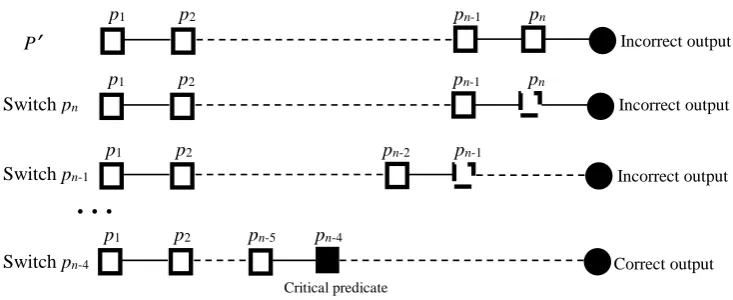
As an illustration, in Figure 4, the output remains in-445
correct until pn−4 is switched. In other words, pn−4 is
446
…
P’
p1 p2 pn-1 pn
Incorrect output
Switch pn Incorrect output
p1 p2 pn-1 pn
Switch pn-1
1
1
1
1
1
1
1
1
1
1
1
1
p1 p2 pn-2 pn-1
Incorrect output
Switch pn-4
1
1
1
1
Critical predicate Correct output [image:7.595.113.480.122.272.2]p1 p2 pn-5 pn-4
Figure 4: Illustration of searching critical predicate
of the predicates could be identified as the critical pred-448
icate even after all of them have been switched. In our 449
BPELswice technique, the backward slicing will be im-450
plemented either from the critical predicate (if it is iden-451
tified) or from the end node of the program (if no critical 452
predicate is identified). 453
Unlike the original predicate switching, our method 454
employs a mutation-based technique to implement pred-455
icate switching, i.e. we first mutate a predicate in the 456
WS-BPEL program according to the LEFS strategy and 457
then redeploy the mutated WS-BPEL program. This 458
treatment is different from the implementation of pred-459
icate switching for traditional programs. For instance, 460
a dynamic instrumentation technique was used to im-461
plement predicate switching for C programs [11]. We 462
do not believe instrumentation is suitable for WS-BPEL 463
programs, because it may introduce significant changes 464
to the original program and require modifications of the 465
existing WS-BPEL engine, as discussed in Section 1. 466
3.4. Execution 467
During the execution process, we use an Apache 468
ODE engine [13] to redeploy the WS-BPEL service. 469
The ODE engine is capable of talking to Web services, 470
sending and receiving messages, handling data manip-471
ulation and performing error recovery, as described in 472
the process definition. It supports both long and short 473
duration process executions to facilitate all services in 474
an application, and enables WS-BPEL programs to be 475
invoked as services. The execution process consists of 476
two steps: service deployment and process compiling. 477
During the service deployment, the package (including 478
all individual services and description files) is copied to 479
the server, where the ODE engine deploys the service 480
and outputs the deploy.xml file. We used Apache Tom-481
cat for this. The second step (process compiling) helps 482
ensure that the service can be executed and invoked suc-483
cessfully. When a new WS-BPEL program variant is 484
copied into the process directory of the engine, previous 485
ones are deleted, and the engine redeploys it at once. 486
Communication between the client and server de-487
pends on Apache Axis2 [20], which encapsulates the 488
test case in a soap message, and sends it to the server. 489
After sending these messages, Axis2 parses and passes 490
them to receiveInput in the WS-BPEL program. The 491
engine then assigns values and invokes some services to 492
complete the operation. As soon as the engine produces 493
the output, Axis2 parses and encapsulates it into a soap 494
message, and passes it to the client side. 495
3.5. Evaluation 496
Following the execution, an output is produced, and 497
one of the following two situations exists: either this is 498
the first execution, in which case the next step is to begin 499
the switching process; or it is necessary to compare the 500
output with what was expected to confirm whether or 501
not the current predicate under evaluation is the critical 502
predicate — output being consistent with expectation 503
means that the critical predicate has been found. If the 504
outputs remain different, then the critical predicate has 505
not yet been found, and the predicate switching process 506
continues. 507
3.6. Slicing 508
Once the critical predicate has been identified, we 509
first examine whether the fault is located in the criti-510
cal predicate. If yes, the fault localisation process can 511
should be examined to localise the most suspicious 513
statements related to the fault. The procedure for iden-514
tifying these slices is discussed as follows. 515
The input of the slicing procedure includes 516
• P(T), the execution trace when executing the 517
program P with a failed test case. P(T) =< 518
X1,X2, ...,Xi, ...,Xn >, where Xi is a node in the
519
execution path, 1≤i≤n, andnis the total number 520
of nodes in the path. 521
• Xq, the critical predicate, which is an element of
522
P(T), that is, 1≤q≤n. 523
• US(Xi), the set of def-use pairs of a node Xi.
524
US(Xi)={<vid1,v
i u1>, <v
i d2,v
i
u2>,· · · }. It can be
525
obtained from the parsing of WS-BPEL program 526
and WSDL documents, as detailed in the follow-527
ing. 528
According to the basic concepts of data flow analysis 529
[21], thedef of a variable refers to the operation where 530
a concrete value is allocated to the variable, while the 531
useoperation means that the variable is utilised either 532
in a calculation (c-use) or a predicate (p-use). Since the 533
data flow in WS-BPEL is different from that in tradi-534
tional programming languages, we have the following 535
definitions for the def and use in WS-BPEL programs. 536
• In WS-BPEL, the def of a variable normally hap-537
pens at 538
– TheReceiveactivity: the “variable” attribute, 539
– TheInvokeactivity: the “outputVariable” at-540
tribute, and 541
– TheAssign activity: the left part of the ex-542
pression in the “to” element. 543
• In WS-BPEL, the c-use of a variable normally hap-544
pens at 545
– TheInvoke activity: the “inputVariable” at-546
tribute, 547
– TheReply activity: the “variable” attribute, 548
and 549
– TheAssignactivity: the right part of the ex-550
pression in the “from” element. 551
• In WS-BPEL, the p-use of a variable normally hap-552
pens at 553
– TheSwitchactivity: the Boolean expression 554
in the “case” statement, 555
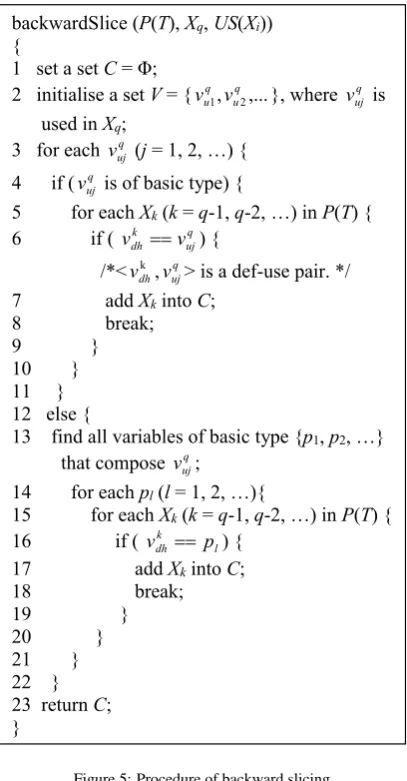
backwardSlice (P(T), Xq, US(Xi))
{
1 set a set C = Φ;
2 initialise a set V = { 1, q2,...
u q
u v
v }, where vujq is
used in Xq;
3 for each vujq (j = 1, 2, …) {
4 if ( q
uj
v is of basic type) {
5 for each Xk (k = q-1, q-2, …) in P(T) {
6 if ( q
uj k
dh v
v ) {
/*<vdhk ,vujq> is a def-use pair. */
7 add Xk into C;
8 break;
9 }
10 }
11 } 12 else {
13 find all variables of basic type {p1, p2, …}
that compose q
uj
v ;
14 for each pl (l = 1, 2, …){
15 for each Xk (k = q-1, q-2, …) in P(T) {
16 if ( k l
dh p
v ) {
17 add Xk into C;
18 break;
19 }
20 }
21 }
22 }
23 return C;
[image:8.595.319.523.111.502.2]}
Figure 5: Procedure of backward slicing
– TheWhileactivity: the “condition” attribute, 556
and 557
– TheIf activity: the “condition” attribute. 558
The basic procedure of backward slicing is as fol-559
lows. Assume that the critical predicate isXq, and all
560
the variables used inXqare{v q u1,v
q
u2,· · · }. For eachv
q u j,
561
we search the nearest node backward (that is, firstXq−1,
562
thenXq−2,. . .) until we find the nodeXk wherev q u j(or
563
the variables of basic type that comprisevqu j) is defined 564
(that is, the latest definition of vqu j before it is used in 565
Xq). The collection of allXkwill be the set of slices that
566
are expected to contain the fault. The detailed back-567
ward slicing procedure is given in Figure 5. Note that, 568
unlike programs written in traditional languages, WS-569
BPEL programs normally involve variables of complex 570
decompose it into variables of basic type ({p1,p2, . . .}in
572
Figure 5), and find the nearest node where eachplis
de-573
fined. Such a process, as shown by Statements 12 to 21 574
in Figure 5, is specific to WS-BPEL. 575
3.7. Illustration 576
We use the SmartShelf WS-BPEL program to illus-577
trate how our BPELswice technique works. SmartShelf 578
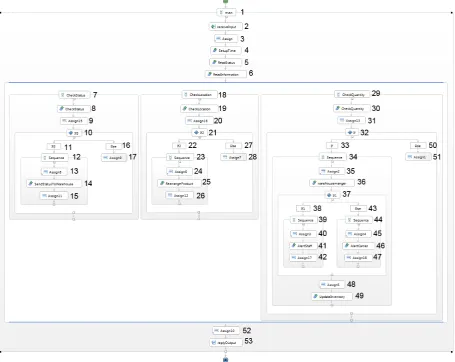
is composed of 53 nodes and 13 services, as shown in 579
Figure 6. Every service uses some parameters which 580
come from the WS-BPEL program ReceiveInput part: 581
SmartShelf uses the three parameters named “name”, 582
“amount” and “status”, the first two of which come from 583
ReceiveInput, and the third from the ReadStatus. 584
For the CheckStatus service, SmartShelf invokes dif-585
ferent services according to the variable “amount”, and 586
refers to the status to judge whether the product is ex-587
pired or not, returning “Expired commodity has been re-588
placed” or “Commodity is in good status”, respectively. 589
The CheckLocation service returns whether or not the 590
product is available on the shelf. If not, it invokes an-591
other service to correct the location. The CheckQuan-592
tity service checks whether or not a sufficient amount of 593
the good is available, returning either “Quantity is suffi -594
cient”, or “Warehouse levels are insufficient, alert staff 595
to purchase”, as appropriate. 596
The test case with “name”= candy, and “amount” 597
= 100, “candy&&100”, can be passed as input to this 598
WS-BPEL service. Because of the initial settings in 599
the database, the executed flow structure sequence in-600
volves the services “CheckStatus”, “CheckLocation” 601
and “CheckQuantity”. The executed runtime path is 602
Path1 ={1−6,7−10,16−17,18−21,27−28,29−
603
32,33−37,38 −42,48−53}, as obtained from the 604
ODE engine. Next, the predicate nodes are identi-605
fied in the path: the predicate set in Path1 is Pre1 =
606
{10,21,32,37}. These predicates can then be switched. 607
In this study, we use the LEFS ordering strategy, which 608
reordersPre1 toPre01 ={37,32,21,10}. The predicate
609
details forPath1are shown in Table 1.
610
When switching the predicates according to the order 611
inPre01, two steps are involved. First, we identify the 612
target predicate, and switch its status (e.g., status=0 613
becomes status!=0). Then, the previous WS-BPEL 614
file is deleted and replaced with this new one, and the 615
ODE engine is used to redeploy the service. 616
After each predicate is switched, the same test case 617
(“candy&&100”) is input, and the output is recorded 618
and compared with the expected output. Suppose that 619
when the predicate with “location =0” (that is, If2 at 620
node 21) is switched to “ location!=0”, the resulting 621
output becomes the same as the expected output — this 622
predicate is therefore the critical predicate, and is there-623
fore suspected to be strongly connected to the fault. If 624
the fault is found in this predicate, the localisation pro-625
cess can be successfully ended. Otherwise, some back-626
ward slices can be captured at runtime using the ODE 627
engine. In this example, from the critical predicate (at 628
node 21), we search backward and identify Assign16 629
(node 20), CheckLocation (node 18), and Assign (node 630
3) as the slices that are expected to contain the fault. 631
4. Empirical Study 632
We conducted a series of experiments to evaluate 633
the performance of the proposed BPELswice technique. 634
The empirical study was designed as follows. 635
4.1. Research Questions 636
Our empirical study was mainly focused on answer-637
ing the following four research questions. 638
RQ1 How effectively does BPELswice localise the 639
fault in a WS-BPEL program? 640
One critical criterion for evaluating the eff ective-641
ness of a fault localisation technique is whether 642
or not it can successfully identify the state-643
ments/blocks that contain the fault. In our study, 644
we applied BPELswice in the debugging of hun-645
dreds of mutants of three object programs, and then 646
measured its effectiveness through examining how 647
many faults BPELswice successfully localised. 648
RQ2 How precise is BPELswice in fault localisation? 649
In addition to the high fault localisation effective-650
ness, it is also important for a technique to have a 651
high precision in the localisation. One naive way 652
to maximise the high fault localisation eff ective-653
ness is to simply identify all executable statements 654
in the program, which must contain the fault. Ob-655
viously, such a way is useless and very inefficient. 656
In order to improve the efficiency of debugging, the 657
number of statements identified by a fault localisa-658
tion technique should be as small as possible, with-659
out eliminating the faulty statement. In our study, 660
we measured the precision of BPELswice by eval-661
uating how many statements it identified for each 662
mutant. 663
RQ3 How quickly can BPELswice localise the fault? 664
If a technique is very time-consuming, its appli-665
cability would be greatly hindered. Therefore, it 666
Figure 6: Structure of the SmartShelf WS-BPEL program
Table 1: SmartShelf’s Predicate Set inPath1for Test Case “candy&&100”
If3 (node 10) If2 (node 21) If (node 32) If1 (node 37)
$ status=0 $ location=0 $ amount<$init amount warehouseManagerReturn<$init amount
the proposed BPELswice technique to see whether 668
it can provide a high effectiveness and precision 669
within reasonable time. 670
RQ4 How many times does BPELswice need to switch 671
predicates? 672
It can be naturally conjectured that the computa-673
tional overhead in BPELswice is mainly related 674
to the predicate switching process. In this study, 675
we will evaluate the concrete number of predicate 676
switches conducted by BPELswice on WS-BPEL 677
programs. 678
4.2. Variables and Measures 679
4.2.1. Independent variable 680
The independent variable of our empirical study is the 681
fault localisation technique. Our proposed BPELswice 682
technique was selected for this variable. Since BPEL-683
swice is based on the predicate switching and backward 684
slicing techniques, it is natural to select each of these 685
two techniques (denoted switchOnly andsliceOnly in 686
the rest of the paper) as the baseline techniques for com-687
parison. In addition, we selected the Tarantula tech-688
nique as another baseline technique for a better compar-689
Tarantula was the most effective fault localisation tech-691
nique for WS-BPEL programs, compared with the Code 692
Coverage and Set-Union techniques [4]. 693
4.2.2. Dependent variable 694
The dependent variable relates to the measurement. 695
In order to answer RQ1, we used the metricsuccess rate 696
to measure the fault localisation effectiveness. Given a 697
number of faults, the success rate of a fault localisation 698
technique is defined as the percentage of the number of 699
successfully localised faults out of the total number of 700
faults, that is, 701
success rate= number of localised faults
total number of faults ×100%, (2)
where a fault is said to be localised by a technique if 702
the statement identified by the technique contains the 703
fault. Obviously, the higher the success rate is, the more 704
effective a technique is in fault localisation. 705
In order to answer RQ2, we measured the precision 706
with the metricidentification ratio. Given a fault, if a 707
technique successfully localises it, the precision of the 708
technique is defined as the percentage of the number of 709
statements identified by the technique against the total 710
number of statements of the program, that is, 711
identification ratio
=number of identified statements
total number of statements ×100%. (3)
Intuitively speaking, the lower the identification ratio 712
is, the more precise a technique is in fault localisation. 713
For RQ3, we made use of theruntimeto measure how 714
fast a fault localisation technique can be. For the BPEL-715
swice technique, the runtime is composed of the time 716
for finding the critical predicate and that for backward 717
slicing. Note that the execution time of the Tarantula 718
technique is not available, as the ranking of the pro-719
gram elements is purely based on suspiciousness val-720
ues, which are calculated based on the information at 721
the testing stage. Therefore, we only compared the run-722
time for BPELswice, switchOnly, and sliceOnly. 723
For RQ4, we measured the number of predicate 724
switches (denotedNps) that BPELswice requires when
725
it is used to localise a fault in a WS-BPEL pro-726
gram. Note that there is no predicate switching process 727
in sliceOnly and Tarantula, and the switchOnly tech-728
nique should have exactly the sameNpsas BPELswice.
729
Hence, we will only present theNpsof BPELswice.
730
4.3. Object Programs 731
We selected three WS-BPEL programs, SmartShelf, 732
TravelAgency, and QuoteProcess, as the objects in 733
our empirical study. The basic information of these 734
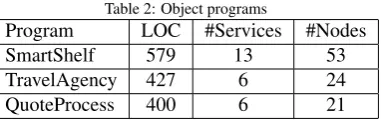
three programs is summarised in Table 2, which gives 735
the lines of code (LOC), the number of implemented 736
external services (#Services), and the number nodes 737
(#Nodes) of each program. The SmartShelf program 738
accepts the input parameters, including the name and 739
amount of commodity, implements various services, 740
and returns the status of commodity, the location of 741
shelf, the quantity in warehouse, etc. The TravelA-742
gency program is basically a booking system, involv-743
ing the selection of travel plan, hotel reservation, ticket 744
booking, and banking. The QuoteProcess program is 745
used to simulate the user’s selection of activities: it se-746
lects different activities according to user’s input param-747
eters. Note that TravelAgency is a sample WS-BPEL 748
program, which was first introduced by OASIS [22], 749
and is currently available at [23], while SmartShelf and 750
QuoteProcess, on the other hand, were created by us 751
according to third party business scenarios (available 752
[image:11.595.327.518.413.473.2]at [24]). 753
Table 2: Object programs
Program LOC #Services #Nodes
SmartShelf 579 13 53
TravelAgency 427 6 24
QuoteProcess 400 6 21
4.4. Mutant Generation 754
For each object program, we generated a family of 755
mutants using the MuBPEL tool [25]. Each mutant 756
contains one and only one fault, which was seeded by 757
applying a mutation operator into a certain statement. 758
In MuBPEL, there are totally over 30 mutation opera-759
tors [26]. However, not all the operators were applica-760
ble to each object program. As a matter of fact, due to 761
the unique features of WS-BPEL, normally only a few 762
mutation operators can be applied to a WS-BPEL pro-763
gram [27]. In our study, we used seven, nine, and seven 764
mutation operators to generate mutants for SmartShelf, 765
TravelAgency, and QuoteProcess, respectively. After 766
the mutants were generated, we found that some could 767
not be executed due to syntactic errors, so we eliminated 768
them. There were also several so-called equivalent mu-769
tants, that is, they always showed the same execution 770
behaviours as the basic programs. These equivalent mu-771
used 57, 56, and 53 mutants for SmartShelf, TravelA-773
gency, and QuoteProcess, respectively. The basic mu-774
tant generation information is summarised in Table 3. 775
Table 3: Mutant generation
Program #Operators #Mutants
SmartShelf 7 57
TravelAgency 9 56
QuoteProcess 7 53
4.5. Test Case Generation 776
We used random testing to generate a large amount 777
of test cases. For a given WS-BPEL program, we first 778
parsed the program to obtain the constraints on the in-779
put parameters. Random test data were generated for 780
each input parameter, with the condition that the random 781
data must satisfy the constraints. The random test case 782
generation process was repeated until each fault was de-783
tected by at least one test case. Here, a fault was consid-784
ered to be detected when a test case caused the relevant 785
mutant to show different behaviour (more specifically, 786
different output) to the basic program. 787
4.6. Experiment Procedure 788
Our empirical study was conducted on a laptop with a 789
Windows 7 64-bit Operating System, an 8-core 3.4GHz 790
CPU (i7-4790), and 16G memory. The experiments 791
were run on Tomcat 6 and the ODE engine [13], which 792
can provide a lot of runtime information, including the 793
execution path, predicates on the path, and the variable 794
values. All this information can assist us in finding the 795
fault. The basic procedure of the experiments is as fol-796
lows. 797
1. Start the ODE engine, and deploy one mutant of a 798
WS-BPEL program. 799
2. Execute the test cases. 800
3. Obtain the critical information, including execu-801
tion path, predicate sets, and actual output. 802
4. Find the test case that kills the mutant (that is, that 803
causes the actual output to differ from the expected 804
output). 805
5. Initiate predicate switching to identify the critical 806
predicate. 807
6. If the critical predicate is identified, execute back-808
ward slicing from the critical predicate to localise 809
the fault. 810
7. If the critical predicate is not identified, execute 811
backward slicing from the wrong output. 812
8. Repeat the above steps until all mutants of each 813
object program have been executed. 814
4.7. Threats to Validity 815
4.7.1. Internal validity 816
The main threat to internal validity relates to the im-817
plementation. The programming for implementing the 818
BPELswice involved a moderate amount of work. Two 819
of our authors conducted the programming work, one 820
mainly for predicate switching, and the other mainly 821
for slicing. All the source code was reviewed, cross-822
checked, and tested by different individuals. We are 823
confident that the proposed BPELswice technique was 824
correctly implemented, and thus the threat to internal 825
validity has been minimised. 826
4.7.2. External validity 827
The threat to external validity is concerned with the 828
selection of object programs and the fault types under 829
study. In our study, we selected three representative 830
WS-BPEL programs as the objects. These programs 831
implement different functionalities, invoke different ser-832
vices, and have different scopes. Although we have en-833
deavoured to maximise the diversity of object programs, 834
we cannot guarantee that the results obtained from these 835
three programs can be generally applied to any other 836
WS-BPEL program. In addition, due to the nature of 837
WS-BPEL programs, we could not study all possible 838
fault types (mutation operators) for WS-BPEL, so it is 839
also uncertain whether our conclusion is applicable to 840
those fault types that were not investigated in this study. 841
Moreover, it was assumed in this study that only one 842
fault exists in a mutant. However, it would be very un-843
likely that the BPELswice technique could not work ef-844
fectively for multiple faults — this is something that re-845
quires further empirical investigation. 846
4.7.3. Construct validity 847
There is little threat to construct validity in our study. 848
The two metrics used in this study, success rate and 849
identification ratio, are very straightforward in measur-850
ing the fault localisation effectiveness and precision. 851
4.7.4. Conclusion validity 852
In our experiments, we examined the performance of 853
BPELswice based on 166 mutants of three object pro-854
grams. A large amount of test cases were generated ran-855
domly. Therefore, a sufficient amount of experimental 856
data was collected to guarantee the reliability of our re-857
sults. In this sense, the threat to conclusion validity is 858
42/57
53/56
43/53
33/57
41/56
31/53
9/57
12/56 12/53
11/57
16/56
19/53
0% 10% 20% 30% 40% 50% 60% 70% 80% 90% 100%
SmartShelf TravelAgency QuotoProcess
Success
ra
te
[image:13.595.77.268.121.256.2]BPELswice switchOnly sliceOnly Tarantula
Figure 7: Comparison of success rates for BPELswice, switchOnly, sliceOnly, and Tarantula
5. Results and analysis 860
5.1. RQ1: Effectiveness 861
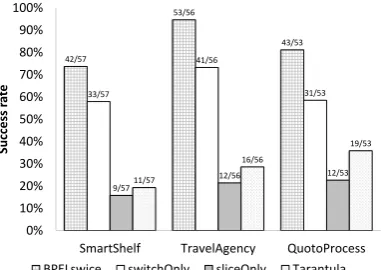
The experimental results of the success rates for 862
BPELswice, switchOnly, sliceOnly, and Tarantula are 863
given in Figure 7. 864
Based on Figure 7, we can observe that among 57, 56, 865
and 53 faults (each in one mutant) for SmartShelf, Trav-866
elAgency, and QuoteProcess, respectively, BPELswice 867
could successfully localise 42, 53, and 43 faults, giving 868
success rates of 73.68%, 94.64%, and 81.13%, which 869
were consistently the highest among the four fault lo-870
calisation techniques. These results clearly show that 871
BPELswice was much more effective than the other 872
three techniques in the fault localisation for WS-BPEL 873
programs. 874
We also investigated the faults that BPELswice failed 875
to localise. We found that all these faults are of the 876
types of “remove an activity” and “remove an element”. 877
Since BPELswice is based on the execution path, it can-878
not localise fault types related to “removal”. For the 879
same reason, Tarantula cannot localise these “removal” 880
fault types either. In other words, all the faults localised 881
by Tarantula were also successfully localised by BPEL-882
swice, but some faults localised by BPELswice could 883
not be localised by Tarantula. 884
5.2. RQ2: Precision 885
The identification ratios for BPELswice, switchOnly, 886
sliceOnly, and Tarantula are summarised in Figure 8. 887
In these figures, box plots are used to display the dis-888
tribution of identification ratios for one fault localisa-889
tion technique on one object program. In each box, the 890
lower, middle, and upper lines represent the first quar-891
tile, median, and the third quartile values of the identi-892
fication ratios, respectively, while the lower and upper 893
whiskers denote the min and max values, respectively; 894
in addition, the mean value is depicted with the round 895
dot. 896
Figure 8 clearly shows that the BPELswice technique 897
outperformed the other three techniques in terms of 898
identification ratio. In other words, BPELswice was 899
the most precise technique for fault localisation of WS-900
BPEL programs. 901
In summary, the proposed BPELswice technique was 902
not only effective in localising most faults, but also pre-903
cise in identifying a small number of statements that 904
contain the faults. This high efficacy and high precision 905
of BPELswice would, in turn, significantly improve the 906
cost-effectiveness of debugging WS-BPEL programs. 907
5.3. RQ3: Runtime 908
In our experiments, we executed a fault localisa-909
tion technique three times on every mutant, and then 910
recorded the runtime. The runtime results for BPEL-911
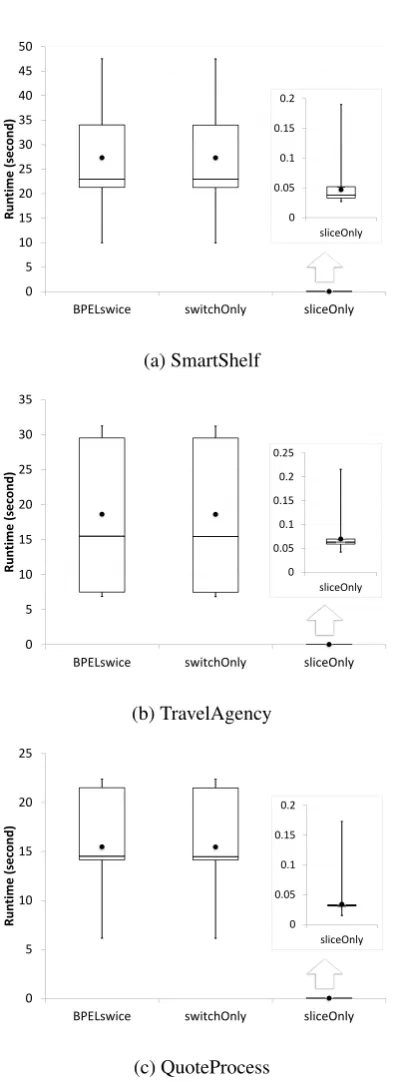
swice, switchOnly, and sliceOnly are given in Figure 9, 912
where box plots are again used to show the distribution 913
of the runtime (in seconds) for each object program. As 914
discussed in Section 4.2, the runtime of Tarantula is not 915
included here. 916
It can be observed from Figure 9 that, compared with 917
BPELswice and switchOnly, sliceOnly has a very short 918
runtime. This implies that predicate switching is much 919
more time-consuming than slicing. Also due to the neg-920
ligible runtime of slicing, the overall runtime of BPEL-921
swice is almost the same as that of switchOnly. We can 922
also observe that the complete fault localisation proce-923
dure of BPELswice only takes tens of seconds. Such 924
a runtime is acceptable, especially considering the high 925
effectiveness and precision of BPELswice. 926
5.4. RQ4: Predicate Switches 927
As shown in the previous section, predicate switching 928
is the main computation overhead in BPELswice. For 929
each mutant where BPELswice successfully localised 930
the fault, we also recorded the number of predicate 931
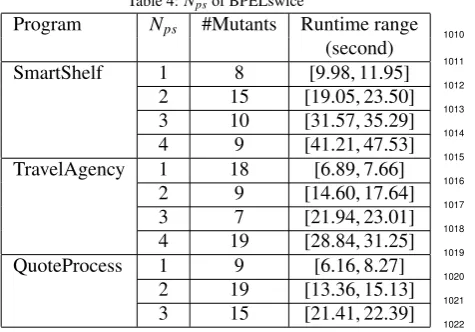
switches (Nps) for each mutant, as summarised in
Ta-932
ble 4. As discussed in Section 4.2, we only report the 933
Npsof BPELswice, as switchOnly has exactly the same
934
values. 935
In the third column of Table 4, we report the num-936
ber of mutants that are associated with the same value 937
of Nps(in the second column). In addition, the fourth
938
0% 5% 10% 15% 20% 25% 30% 35% 40% 45%
BPELswice switchOnly sliceOnly Tarantula
(a) SmartShelf
0% 10% 20% 30% 40% 50% 60%
BPELswice switchOnly sliceOnly Tarantula
(b) TravelAgency
0% 10% 20% 30% 40% 50% 60%
BPELswice switchOnly sliceOnly Tarantula
[image:14.595.319.516.132.674.2](c) QuoteProcess
Figure 8: Comparison of identification ratios for BPELswice, switchOnly, sliceOnly, and Tarantula
0 5 10 15 20 25 30 35 40 45 50
BPELswice switchOnly sliceOnly
0 0.05 0.1 0.15 0.2
sliceOnly
(a) SmartShelf
0 5 10 15 20 25 30 35
BPELswice switchOnly sliceOnly
0 0.05 0.1 0.15 0.2 0.25
sliceOnly
(b) TravelAgency
0 5 10 15 20 25
BPELswice switchOnly sliceOnly
0 0.05 0.1 0.15 0.2
sliceOnly
(c) QuoteProcess
[image:14.595.74.271.142.673.2]executing BPELswice with the sameNps. It can be
ob-940
served that BPELswice only needed to switch predi-941
cates several times, with a maximum number of four 942
times. In addition, there is a strong correlation between 943
the value ofNps and the runtime, which is intuitively
944
as expected — the more predicates switched, the longer 945
BPELswice executed. 946
6. Related work 947
How to effectively locate faults reported by testing is 948
a crucial activity in debugging. A lot of effort on this 949
topic has been made and a number of fault localisation 950
techniques have been proposed [16][28][17]. These 951
techniques explore the fault localisation problem in dif-952
ferent ways. The reported approaches include those 953
based on program analysis, on program execution, and 954
also using data mining or machine learning. Next, we 955
discuss related work in terms of slicing-based fault lo-956
calisation techniques, predicate-based fault localisation 957
techniques, and fault localisation techniques for WS-958
BPEL programs. 959
6.1. Slicing-based fault localisation techniques 960
One category of fault localisation techniques is based 961
on program analysis techniques such as program slic-962
ing [29], symbolic execution [30], and formal methods. 963
Program slicingis the most widely used one for debug-964
ging aids. The principle of program slicing is to strip 965
a program of statements without influence on a given 966
variable at a given statement [29]. The idea of program 967
slicing-based fault localisation is: given a program p 968
and a variablevat a statementiwhere a fault appears, 969
the suspicious slice is the statements that directly affect 970
[image:15.595.67.305.567.733.2]the value ofvati— this eliminates those that have no 971
Table 4:Npsof BPELswice
Program Nps #Mutants Runtime range
(second)
SmartShelf 1 8 [9.98,11.95]
2 15 [19.05,23.50]
3 10 [31.57,35.29]
4 9 [41.21,47.53]
TravelAgency 1 18 [6.89,7.66]
2 9 [14.60,17.64]
3 7 [21.94,23.01]
4 19 [28.84,31.25]
QuoteProcess 1 9 [6.16,8.27]
2 19 [13.36,15.13]
3 15 [21.41,22.39]
impact on the value of vati. A pioneering study was 972
reported by Weiser [31] and showed the evidence that 973
programmers slice when debugging. 974
Generally, program slicing can be either static or dy-975
namic: the former is only based on the source code, 976
while the latter works on a specific execution of the 977
program (for a given execution trace). Fault localisa-978
tion based on static program slicing analyzes the data 979
flow and control flow of the program statically to re-980
duce the search scope of faults [32], and its fault local-981
isation precision is low since no other information than 982
source code is used. Fault localisation based on dy-983
namic program slicing introduces more precise slicing 984
criteria for a particular execution and the search scope 985
of faults can be further reduced [33]. Many efficient 986
slicing algorithms have been proposed, and these algo-987
rithms may be used to further improve the efficiency 988
of program slicing-based fault localisation techniques. 989
For instance, roBDD is an efficient forward dynamic 990
slicing algorithm using reduced ordered binary decision 991
diagrams [34]. Recently, Wen [35] proposed program 992
slicing spectrum to improve the effectiveness of statisti-993
cal fault localisation methods, where the program slice 994
is first used to extract dependencies between program 995
elements and refine execution history, and then the sus-996
piciousness of each slice is calculated to locate the fault 997
based on statistical indices. 998
In our study, a backward dynamic program slicing 999
technique was used to further improve the efficiency of 1000
locating faults in WS-BPEL programs. Our approach 1001
first analyzes the execution trace from an WS-BPEL 1002
engine and then extract suspicious statements via data 1003
flow analysis. Only those statements that have a direct 1004
impact on the value of elementary variables in the crit-1005
ical predicate are chosen. Our approach addressed the 1006
challenges due to the fact that the syntax, data structure, 1007
and execution mode of WS-BPEL programs are diff er-1008
ent from that of traditional programs. 1009
6.2. Predicate-based fault localisation techniques 1010
The other category of fault localisation techniques is 1011
based on program execution. Typically, such techniques 1012
make use of a program execution spectrum obtained 1013
in software testing to locate the suspicious elements. 1014
These techniques count the executions of program ele-1015
ments in different executions, and use the ratio of a pro-1016
gram element being exercised in a failed execution and 1017
that in a passed execution to calculate the suspicious-1018
ness of the program element. Naishet al.[16] surveyed 1019
33 different formulas for the suspiciousness calculation. 1020
The existing approaches work either at the level of state-1021