Accepted
Article
This article has been accepted for publication and undergone full peer review but has not
been through the copyediting, typesetting, pagination and proofreading process, which may
DR. ANNA MARIA PICCININI (Orcid ID : 0000-0002-7588-0415)Article type : Review
A complex interplay between the extracellular matrix and the innate immune response
to microbial pathogens
Short title: The extracellular matrix and infection
Hannah Tomlin, Anna Maria Piccinini*
School of Pharmacy, University of Nottingham, Nottingham, UK
*Correspondence: Anna Maria Piccinini, Pharmacy School Building, East Drive, University Park, Nottingham, NG7 2RD, UK
[email protected] Tel: +44 (0) 115 82 32274
Accepted
Article
Summary
The role of the host extracellular matrix (ECM) in infection tends to be neglected. However, the complex interactions between invading pathogens, host tissues and immune cells occur in the context of the ECM. On the pathogen side, a variety of surface and secreted
molecules, including microbial surface components recognizing adhesive matrix molecules (MSCRAMM) and tissue degrading enzymes, are employed that interact with different ECM proteins in order to effectively establish an infection at specific sites. Microbial pathogens can also hijack or misuse host proteolytic systems to modify the ECM, evade immune responses or process biologically active molecules such as cell surface receptors and cytokines that direct cell behaviour and immune defense. On the host side, the ECM composition and three-dimensional ultrastructure undergo significant modifications, which have a profound impact on the specific signals that the ECM conveys to immune cells at the forefront of infection. Unexpectedly, activated immune cells participate in the remodelling of the local ECM by synthesizing ECM glycoproteins, proteoglycans and collagen molecules. The close interplay between the ECM and the innate immune response to microbial pathogens ultimately affects the outcome of infection. This review explores and discusses recent data that implicates an active role for the ECM in the immune response to infection, encompassing antimicrobial activities, microbial recognition, macrophage activation, phagocytosis, leukocyte population balance and transcriptional and post-transcriptional regulation of inflammatory networks, and may foster novel antimicrobial approaches.
Introduction
Accepted
Article
has been intensively studied in microbiology, immunology, cell biology, genetics and ecology research. Less attention has been given to the host extracellular matrix (ECM). However, the individual components of the ECM are substrates to which pathogens can directly bind to or degrade, facilitating adhesion and penetration into the host; evidence for this started to accumulate 40 years ago (2, 3). Furthermore, the ECM is a fundamental component of the host cellular microenvironment where most of the events leading to infection, disease and tissue repair take place and is also a reservoir of diverse and tissue-specific signals that feed into immunological pathways (4, 5). Recently, evidence has emerged that the ECM conveys specific signals to cells thereby modulating essential immune functions, immune cell migration into and within infected tissues and immune cell activation, proliferation and differentiation. Moreover, the ECM composition undergoes significant alterations during infection and, notably, specific immune cell types appear to contribute to that. Thus, regulatory circuits closely link the ECM and the immune system.
Accepted
Article
The ECM: an immunological perspective
Most infections and the resulting immune responses are tissue-specific. Each tissue has distinct ECM signatures which arise from complex and dynamic combinations of up to ~300 different proteins in varying concentrations and geometries within the three-dimensional extracellular space. This ever increasing number of proteins which contribute to matrices (the “matrisome”) include approximately 43 collagen subunits, 36 proteoglycans and 200 glycoproteins (6). ECM molecular multiplicity and complexity are amplified by posttranslational modifications, which can unveil cryptic epitopes or generate new ones capable of triggering immune reactions, and alternative splicing, which generates several
isoforms with distinct functions (7, 8). For instance, laminins 4 and 5 isoforms in
basement membranes contribute to immune cell subtype selectivity during leukocyte recruitment to sites of inflammation (9, 10).
Interstitial ECMs, loose fibril-like matrices that fill the tissue stroma, and basement membranes, laminar sheets that anchor cell layers to underlying tissues, are basic forms of ECM. Additionally, specialised reticular fibre networks combining features of these two ECM structures are found in secondary lymphoid organs (11, 12).
The ECM is a highly dynamic yet strictly regulated tissue component. Its composition and normal function are determined and maintained by a fine balance between ECM synthesis, orchestrated by cytokines such as transforming growth factor- (TGF-), and turnover,
Accepted
Article
monocytes/macrophages and promote immune cell migration into sites of infection and tissue damage and affect their ability to mount inflammatory responses (14).
Accepted
Article
necrosis factor (TNF), interferon- (IFN-) and TGF-, which regulate the expression of many
ECM molecules.
ECM-pathogen interactions
A tale of adhesion and colonization of the host
Tissue adherence represents the first essential mechanism that bacteria adopt to colonize the host. Failure to do so results in the organism being removed by physiological cleansing systems at sites of entry. The surface of host cells and the ECM are negatively charged and microbes employ a number of physico-chemical forces to overcome these repulsive forces and establish interactions between a microbial ligand or “adhesin” and a complementary molecule or “receptor” on the host tissue. These interactions are highly specific, contributing
to tissue tropism, species specificity and genetic specificity within a species. Bacterial adhesins are components of capsules, cell walls, pili or fimbriae, and those that bind to ECM components are called microbial surface components recognizing adhesive matrix molecules (MSCRAMM). Host receptors are usually glycoproteins found on the cell membrane and ECM components (24).
The binding of microbial pathogens to specific ECM proteins has been extensively reviewed elsewhere (1, 3, 25, 26) and will be briefly discussed here. The first report of a host ECM-pathogen interaction was published in 1978 by Kuusela et al. who studied the binding of
Staphylococcus aureus to fibronectin (2) and, a few years later, revealed two separate
binding sites on fibronectin, in the N- and C-terminus respectively (27). Other groups further characterised the interaction of this ubiquitous and promiscuous ECM glycoprotein with S.
Accepted
Article
binding adhesins (28-33). Several other ECM proteins such as laminin, collagen, heparan and chondroitin sulphate, vitronectin, thrombospondin, elastin, bone sialoprotein and tenascin-C, have since been implicated in specific interactions with pathogenic bacteria ((26, 34); Table 1).
Early studies were mostly limited by the use of binding assays, involving bacterial cells or recombinant adhesins and ECM molecules, and inhibition experiments to demonstrate these interactions. Cutting-edge technologies, including live cell imaging and particle-tracking methods, have now started to reveal the implications of these interactions in pathogenesis. For example, Niddam et al. showed that the Lyme disease spirochete Borrelia burgdorferi
exploits fibronectin to interact with vascular surfaces under physiological shear stress. Specifically, it recruits and induces polymerization of soluble plasma fibronectin that strengthens and stabilizes bacterial interactions with endothelia by a catch-bond mechanism (35).
Breaking down barriers to invade the host
Having colonized the host, most pathogens need to invade tissues in order to cause disease. This requires the breakdown of primary and/or secondary defences of the host, involving the crossing of basement membranes and interstitial matrices. Pathogens have developed distinct ways to modify the ECM (1, 36). They can directly degrade ECM components using “invasins” or bacterial tissue degrading enzymes such as hyaluronidases
Accepted
Article
response to their presence (discussed later in this review). Moreover, pathogens can hijack or misuse host proteolytic systems. For instance, S. aureus (37), Haemophilus influenzae
(38) and Pseudomonas aeruginosa (39) among other common pathogenic bacteria, manipulate the plasminogen-plasmin system thereby degrading laminin and fibronectin and activating MMP zymogens that not only degrade all types of ECM proteins, but also process many biologically active molecules (e.g. cell surface receptors and cytokines) that direct cell behaviour and host defence.
Strategies to evade the host immune response?
Although numerous pathogens undoubtedly exploit ECM components and ECM-associated molecules to adhere to and degrade tissues for efficient host colonization and invasion, it is not always clear whether pathogens interact with these ECM molecules also to evade immune responses. For instance, B. burgdorferi can avoid antibody-mediated clearance and this may be partly explained by its specific interaction with decorin (36). The H. influenzae
Accepted
Article
Altered ECM dynamics in infection and its implications
The ECM undergoes significant alterations upon infection that promote or inhibit the establishment of infection and the host response to it. Below is an overview of the changes in ECM synthesis, degradation and post-translational modification during infection and a discussion of their implications in pathogenesis.
ECM synthesis and deposition
Signal transduction pathways activated upon pathogen entry and recognition and by mediators of inflammation and tissue repair during infection all contribute to ECM synthesis and deposition. This involves structural ECM proteins (e.g. collagens, laminins and proteoglycans) as well as non-structural ECM components termed ‘matricellular proteins’, which are normally absent or scarcely expressed in healthy tissues (e.g. osteopontin, thrombospondins, galectins, tenascins, etc.). For instance, rhinovirus activates TLR3 and TLR7/8 signalling in airway smooth muscle (ASM) cells that leads to increased deposition of fibronectin, perlecan and collagen IV, contributing to airway remodelling and facilitating the migration of ASM cells to the infection site (44). IL-33 signalling induced by S. aureus
enhances fibronectin and collagen IIIa expression and deposition, accelerating wound repair (45). Systems biology approaches elucidating the ECM interactome network regulated by
Trypanosoma cruzi and its gp83 ligand, which mediates trypanosome attachment and entry,
have shown that activation of gp83 receptors in the cell via ERK1/2 results in upregulation of
laminin -1 and thrombospondin expression to facilitate trypomastigotes recruitment,
Accepted
Article
osteopontin-null mice are protected from viral myocarditis and inhibition of osteopontin transcription by vitamin D decreases cardiac fibrosis in wild type animals (48). Viral myocarditis also results in upregulation of tenascin-C before immune cell infiltration occurs and until scar tissue is formed (49). Elevated tenascin-C levels have also been reported in patients with sepsis, parapneumonic infection, tuberculosis and S.aureus infection (50-54). Furthermore, the lungs of mice infected with gram-negative bacteria show accumulation of versican, a chondroitin sulfate proteoglycan with multiple cytokine, chemokine, adhesion molecule and growth factor binding domains, that is implicated in the innate immune response (55). Similarly, when primary human lung fibroblasts are treated with the viral mimetic Poly I:C, they deposit a higher-order structured ECM, rich in versican and hyaluronan, to which T-cells avidly adhere and cease migration, an effect reversed by hyaluronidase treatment or versican antibody during matrix formation (56). Importantly, besides expression levels, infection can also alter the spatial distribution of ECM components as it emerges from influenza-infected lungs, which show distinct regions that are enriched with either fibronectin or collagen (57). Thus, specific infectious diseases seem to generate distinct compositional changes of the ECM, inevitably influencing its biophysical structure and presentation of bioactive compounds that impact bacterial colonization and invasion, immune cell response and tissue repair.
ECM degradation
The catabolic machinery that breaks down and remodels the ECM is also altered upon infection, affecting the supportive, barrier and biological functions of the ECM. Tissue degrading enzymes such as MMPs play a crucial role in regulating immune cell recruitment: they cleave the basement membrane ECM; expose cryptic pro-migratory sites of ECM
components (e.g. 2 chain of laminin 5); target non-ECM proteins such as adhesion
Accepted
Article
associated with cell migration (e.g. CD44), modulating inflammation (reviewed in (58-60)). With the exception of neutrophils, tissue degrading enzymes are not stored, but require de novo synthesis that is strictly regulated and can be induced by pro-inflammatory cytokines (e.g. TNF- and IL-1) and also by bacterial products (e.g. LPS and chlamydial heat shock
proteins) (61).
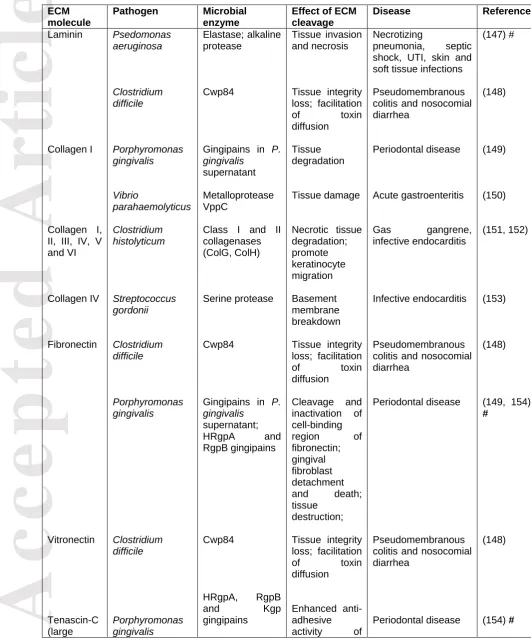
Several pathogens, including Mycobacterium bovis, Mycobacterium tuberculosis, S.
pyogenes and H. pylori, induce expression and activity of a number of MMPs, including
MMP-1, MMP-2, MMP-7, MMP-9 and MMP-13 (62-64). In particular, the extensive production of MMP-2 and MMP-9 during mycobacteria infection is regulated by macrophage- and T-cell-derived cytokines and causes ECM breakdown. This may be necessary for cell recruitment and granuloma formation, both protective immune responses to mycobacteria. However, dysregulation of MMP production at late stages of the infection could contribute to tissue damage and, by compromising tissue integrity, may facilitate bacterial dissemination and persistence of infection (62). Systemic E. coli infection, acute Lyme neuroborreliosis and pneumococcal meningitis can all lead to secretion of high amounts of MMP-9. In meningitis, MMP-9 has been suggested to contribute to blood-brain barrier destruction and neuronal injury (65-67). Similarly, gastrin-dependent induction of MMP-7 upon H. pylori
Accepted
Article
binding site of IFN-, preventing an uncontrolled immune response (69). In the same model
of viral myocarditis, MMP-9 exerts a protective role by inactivating IFN-/. Indeed,
MMP-9-null mice display higher viral load, infiltration of CD3+ cells and tissue damage (70). However, murine MMP-9 can also enhance susceptibility to infection and increase morbidity and mortality. This is the case of Francisella tularensis pulmonary infection where MMP-9 generates pro-inflammatory ECM-derived peptides (i.e. Pro-Gly-Pro (PGP) peptide from collagen I), enhancing neutrophil infiltration to lungs (71).
In addition to inducing MMP expression, pathogens can also activate pro-MMPs by secreting their own activating enzymes as in the case of P. aeruginosa, which activates pro-MMP-2 using LasB, a thermolysin-like metalloprotease (39). The role of dysregulated tissue degrading enzymes, individually or in combination, is not well understood in every infectious disease. However, it is clear that the MMP/TIMP system changes the ECM composition and biophysics and its presentation of bioactive molecules, generating environmental cues that are detected and processed by immune cells into signalling events that direct their behaviour and response to infection.
ECM post-translational modification
Post-translational modifications (PTMs) add complexity to the ECM. Some are generated by
proteolytic cleavage, while others by citrullination of arginine, glycosylation, cross-linking, hydroxylation of prolines, nitrosylation of tyrosines and aspartate isomerization (reviewed in (7)). Given the ability of pathogens to hijack host enzymes or secrete enzymes targeting host molecules, it is tempting to ask whether PTMs in the ECM are altered in infection. Indeed,
the Porphyromonas gingivalis enzyme peptidylarginine deiminase (PAD) can convert
Accepted
Article
citrulline is uncharged, increasing protein hydrophobicity and, thus, altering protein 3D structure and function. Notably, P. gingivalis periodontal infection has been linked to rheumatoid arthritis, an autoimmune disease of the joints characterised by high levels of citrullinated proteins and anticitrullinated ECM protein antibodies (77). T. cruzi, the etiologic agent of Chagas disease, which features extensive inflammation and fibrosis of the heart, has been reported to increase the expression of lysyl oxidase (LOX) (78). This enzyme carries out cross-linking of collagen fibers thereby altering matrix stiffness, which has been linked to cancer metastasis (79). By irreversibly altering collagen structure and function, LOX has been proposed to cause dysfunction of cardiomyocytes and, in turn, of the heart in Chagas disease. Similarly, dengue virus infection has been shown to suppress the expression of cartilage associated protein (CRTAP), alongside the protein associated to tight junctions (PATJ). CRTAP associates with the proteoglycan leprecan, which has collagen prolyl 3-hydroxylase activity, and cyclophilin B in the endoplasmic reticulum. This trimeric complex is required for proline 3-hydroxylation of collagen and, thus, collagen assembly. As the levels of CRTAP mRNA negatively correlate with viral replication, the authors of the study have speculated that CRTAP, together with PATJ, restrict dengue infection by influencing cell-cell adhesion (80).
Accepted
Article
alveolar architecture and vascular permeability, which are restored by LOX activity inhibition (82).
Macrophages: not just destroyers of the ECM
In bacterial and viral infection, activated macrophages (e.g. M(IFN), M(LPS)) have long
been implicated in ECM destabilization and destruction through the secretion of tissue degrading enzymes, including MMP-9. Similarly, parasitic infections involve activated macrophages (i.e. M(IL-4)), which release proteases such as MMP-1 and MMP-12 (83). However, macrophages can also produce a number of ECM proteins. Increasing evidence of this and its implications are discussed below.
Fibronectin is the first ECM glycoprotein reported to be produced by human macrophages and IFN-stimulated mouse peritoneal macrophages (84, 85). Moreover, bacterial
components induce tenascin-C expression in human monocyte-derived and mouse bone-marrow derived macrophages (53, 86). LPS from P. gingivalis induces thrombospondin-1 production in THP-1 cells (87), while LPS from E. coli and IFN upregulate galectin1 and
-3, including 5 galectin-3 truncated forms, in primary human macrophages (88). In mice with viral myocarditis, macrophages infiltrating the heart are the main producers of osteopontin (48). Notably, in murine macrophages, LPS causes the formation of chromosomal loops in the osteopontin promoter by bridging NF-kB and AP-1 together, leading to osteopontin transcription (89), which is negatively regulated by GSK3b (90).
Accepted
Article
degrading enzymes (hyaluronidases 1/2) (91). Serglycin, decorin and biglycan are also secreted by LPS-activated mouse peritoneal macrophages (92-94). By using inhibition, chromatin immunoprecipitation and NF-kB reporter gene assays, some of these studies have demonstrated that pathogenic activation of the NF-kB signalling pathway downstream of TLR4 leads to ECM molecule transcription (86, 89, 93-95). Importantly, in the case of tenascin-C, biglycan and decorin, which can activate TLR4, this can promote autocrine loops of inflammation (86, 93, 94). Thus, the infected cellular microenvironment influences TLR function and, in turn, TLR activation affects the microenvironment.
Intriguingly, there is mounting evidence that macrophages can synthesize collagen molecules. In Drosophila, phagocytes (hemocytes) produce functional collagen IV, which controls key signalling events in the germline stem cell niche (96). The first reports of collagen synthesis by mammalian macrophages were published in the 1990s. The first showed collagen I synthesis in mouse peritoneal macrophages and the second demonstrated collagen VIII synthesis and secretion in human macrophages that was decreased by IFN- and LPS treatment (97, 98). Collagen VIII is a short-chain, nonfibrillar
collagen that forms unique hexagonal lattice structures and possesses both structural and signalling properties. Later, human macrophages were shown to secrete collagen VI, which forms beaded filaments with a multidomain structure that interact with ECMs and cell surface receptors to anchor interstitial structures and cells within tissues. Expression of collagen VI was decreased by IFN- and LPS, but increased upon IL-4 treatment (99). Recently, the
Accepted
Article
collagenase-resistant collagen V, the collagen-containing von Willebrand factor collagen XXVIII and collagen I, IV, XVIII, XXV and XXVII. Collagen II, VIII, IX, XIII, XIV, XXIII and XXIV expression was not increased. LPS also downregulated the expression of collagen VI, confirming previous studies (99), and collagen XIII and XVII (95). By secreting collagens, depending upon their mode of activation, macrophages may contribute to the ECM and therefore tissue stabilization and repair and to cell-cell and cell-matrix interactions (e.g. in
vitro, monocytes adhere strongly to collagen VI (99)). Furthermore, macrophages may bind
to their secreted collagen molecules as they express several receptors known to interact with collagen (e.g. integrins and proteoglycans). However, collagen secretion by macrophages and its potential role in macrophage adhesion and immune response in vivo
remain to be clarified.
The ECM: an integral part of the innate immune response to infection?
Antimicrobial activity of the ECM
The innate immune system employs endogenous peptides like alpha-defensin and LL-37, which bind to heparin and dermatan sulphate glycosaminoglycans and have antimicrobial properties. During the inflammatory response to infection, tissue degrading enzymes generate bioactive ECM fragments. A number of studies showed that heparin-binding peptides derived from laminin isoforms, vitronectin, thrombospondin and fibronectin exert antimicrobial activities against gram-positive and gram-negative bacteria, and the fungus
Candida albicans (100-102).
Certain ECM proteins are also found in biological fluids. One such protein is tenascin-C,
which has been found in human breast milk (2.2-671 g/ml) where it acts as an innate
Accepted
Article
by binding to the HIV-1 Envelope gp120 protein at a CD4-inducible epitope that overlaps the chemokine coreceptor binding site. Accordingly, tenascin-C depletion abolishes the HIV-1-neutralizing activity of milk (103).
Direct antimicrobial activity has also been reported for the ECM-associated protein MMP-12, which is abundantly expressed in mature tissue macrophages and mobilized to macrophage phagolysosomes after the ingestion of bacteria. Inside phagolysosomes, MMP-12 adheres to bacterial cell walls and disrupts cellular membranes, killing the bacteria. Notably, the C-terminal domain of MMP-12, but not its catalytic domain, contains a four amino acid sequence on an exposed beta loop of the protein that is unique in nature and confers antimicrobial activity (104). Together, these data may help the search for safe, endogenous antimicrobial molecules from complex biological mixtures. Furthermore, binding epitopes could serve as templates for de novo synthesis of novel antimicrobial molecules.
ECM-mediated recognition of microbial pathogens, macrophage activation and phagocytosis
The innate immune system employs highly conserved receptors, namely pattern-recognition receptors (PRRs), to recognize conserved motifs in microbial pathogens, called pathogen-associated molecular patterns (PAMPs). Mindin, a member of the mindin-F-spondin family of secreted ECM proteins, has emerged as a unique pattern-recognition molecule in the ECM for microbial pathogens and has been proposed to function as an integral part of the innate immune response (105). He et al., showed that genetic ablation of mindin confers resistance to LPS-induced shock and systemic S. typhimurium and S. pneumoniae infections in vivo. Moreover, mindin-null mice feature impaired bacterial clearance in lungs infected with gram-positive group B streptococcus or H. influenza. In vitro, macrophages and mast cells lacking mindin display impaired TNF- and IL-6 production and defective phagocytosis. By using
Accepted
Article
it agglutinates bacteria. As glucose inhibited not only mind binding to pathogens but also macrophage activation by LPS, the authors concluded that mindin-mediated carbohydrate recognition of microbial pathogens is a secondary stimulation necessary for the activation of macrophages and mast cells (105) (Fig. 1). Notably, mindin is not a universal, but a rather specific pattern-recognition molecule as it only recognizes and opsonizes certain bacteria. Following this, the innate immune function of mindin has been extended to include promoting influenza virus clearance from the nasal cavity by allowing efficient macrophage activation (106). Furthermore, the proteoglycan lumican, whose core protein contains tandem repeats of leucine rich motifs similarly to PRRs, interacts with CD14 on the surface of macrophages and neutrophils, promoting CD14-TLR4-mediated responses to LPS (Fig. 1). Thus, lumican-null mice are hypo responsive to LPS-induced septic shock (107). In a P. aeruginosa model of lung infection, mortality of lumican deficient mice is increased as animals fail to clear bacteria from tissues. This study showed that CD14-mediated phagocytosis of E. coli and P.
aeruginosa bacteria by macrophages is impaired in the absence of lumican and identified
Accepted
Article
Leukocyte population balance in infection: emerging roles for ECM components
Severe infection demands large numbers of leukocytes that is compensated by the emergency myelopoiesis response, which is initiated by activated PRRs and cytokines, including IL-6, GM-CSF and G-CSF. This protects the host from systemic infection by quickly generating the required leukocyte population. Kanayama et al. have recently found that osteopontin skewed the balance of myeloid and lymphoid cell populations during systemic infection with C. albicans (112). Specifically, the authors showed that osteopontin limited the supply of neutrophils and Ly6C+ monocytes-macrophages by enhancing the apoptosis of common myeloid and granulocyte-macrophage progenitors through a downregulation of the expression of the apoptosis inhibitor survivin. This resulted in greater fungal load in kidneys and significantly higher mortality of wild type mice with systemic fungal infection compared to osteopontin deficient littermates. The detrimental effect of osteopontin was observed early, 24 hours post infection (112). However, it is unclear if this effect is maintained, exacerbated or reversed at later stages of infection.
Accepted
Article
less T cells in their spleen and higher cellular and humoral Th1 responses (114). Although this study shows that galectin-3 expression by DCs modulates the proliferation and cytokine release by T cells, it does not explain the mechanism responsible for the biased Th1 response. Efficient T cell priming by DCs has also been shown to depend on mindin (115). When DCs from mindin-null mice are activated with bacterial components, including LPS from Salmonella typhosa or E. coli and lipoteichoic acid from S. aureus, CD4+ T cell priming is 60-70% lower than that of wild type mice. Investigation of this demonstrated that DCs interact with mindin via integrins 41 and 51, leading to upregulated expression of the Rho
GTPases Rac1/2, which are known to regulate DC priming of T cells (115). As DCs link innate to adaptive immunity and unbalanced effector T cell populations leads to pathological inflammation, understanding how the ECM can regulate T cell responses is crucial.
Transcriptional and post-transcriptional roles for ECM molecules in host defense signalling pathways
Pathogen recognition via PRRs initiates inflammatory signalling pathways which are tightly regulated to allow microbial clearance with minimal damage to the host. Recent research implicates a role for ECM and ECM-associated proteins in regulating inflammatory networks at the transcriptional and post-transcriptional level during the immune response to infection.
An elegant study by Marchant el al. found a transcriptional role for MMP-12 (macrophage elastase) in immunity against viral infection (69). During coxackievirus type B3 and respiratory syncytial virus infections, MMP-12-null mice display increased viral load, mortality and lower levels of IFN-, which is essential for viral immunity. Mechanistically, secreted
MMP-12 is taken up by virus-infected cells and traffics to the nucleus, where it binds to the
NFKBIA promoter, driving its transcription, which is essential for optimal IFN- secretion and
Accepted
Article
mechanisms: 1) through DNA binding of gene exons (e.g. exons encoding PSME3, the immunoproteasome cap protein, and secreted protein acidic and rich in cysteine (SPARC)-like protein 1, which decreases their mRNA and protein levels in MMP-12-null mice); and 2) extracellularly, through substrate protein cleavage (e.g. INF- receptor 2 binding site). Thus,
MMP-12 clears systemic INF- and, accordingly, selective inhibition of extracellular MMP-12
in infected wild type mice elevates systemic INF- levels and reduces viral replication (69).
At the post-transcriptional level, a role for decorin and tenascin-C has been found in regulating miRNAs in LPS-induced sepsis (53, 93, 116). Merline et al. detected increased decorin levels in septic patients and mice with LPS-induced sepsis, and elevated IL-10 amounts in decorin-null mice. They demonstrated that, in the presence of LPS, decorin reduces the levels of the anti-inflammatory cytokine IL-10 via two mechanisms. Firstly, it activates ERK and p38 MAP kinases downstream of TLR2 and TLR4 thereby inducing the expression of the pro-inflammatory modulator PDCD4 (programmed cell death 4), which translationally represses IL-10. Secondly, decorin inhibits TGF-1 signaling, leading to lower
levels of miR-21, which represses PDCD4 expression and thus decreases IL-10 levels (93). Soon after, tenascin-C was shown to orchestrate the secretion of specific cytokine subsets in response to LPS. Specifically, tenascin-C regulates the biosynthesis of the LPS-responsive miRNA miR-155, allowing optimal TNF- production in macrophages and effective immune
Accepted
Article
The ECM in infectious granulomas
Tuberculosis, syphilis, toxoplasmosis, infectious mononucleosis and measles are a few examples of infectious diseases characterized by the formation of granulomas. Traditionally considered host-protective structures, infectious granulomas are compact, organised immune cell clusters that are generated in response to specific pathogens. Granulomas contain large numbers of mature macrophages, which can fuse into multinucleated giant cells or differentiate into foam cells. Neutrophils, dendritic cells, B, T and natural killer cells, and fibroblasts are also found in granulomas, which are surrounded by epithelial cells. Granulomas also contain ECM proteins, whose expression and function in infectious granulomatous disease pathogenesis has only recently been investigated.
In humans, osteopontin has been detected in granulomas of diverse etiology (117) and, in those caused by Paracoccidioides brasiliensis, it localizes in ECM, macrophages and multinucleated giant cells at the center of lesions in the early phase of infection (118). In tuberculosis granulomas, osteopontin is markedly expressed within lymphocytes, macrophages, epithelioid cells and multinucleated giant cells, but not in the central necrotic core (54). These granulomas also stain strongly for tenascin-C in the surrounding fibrotic rings and weakly inside, in the ECM. A diffuse ECM-associated staining of galectin-9 is detected in the granuloma and in epithelioid and multinucleated giant cells. Notably, osteopontin, tenascin-C and galectin-9 are absent in non-infectious Crohn disease granulomas (54). Analysis of human lung biopsies from patients with atypical mycobacteriosis and tuberculosis revealed expression of tenascin-C and precursor proteins of collagens I and III around granulomas. Precursor proteins of collagen I were also found within granulomas that colocalized with myofibroblasts (119). In mice infected with P.
brasiliensis, Gonzalez et al. detected increased expression of laminin, fibronectin, fibrinogen,
Accepted
Article
sporadically inside it. Initially arranged in a disorganised manner, ECM fibres later acquired a compact, concentric arrangement, which originated from an anchorage point that may contribute to tissue integrity and enhance distribution of growth factors and cytokines (120). Notably, during chronic mycobacterial infection, the fibrinolytic system has been shown to limit progressive fibrosis with plasminogen regulating the turnover of ECM proteins within the granuloma (121).
Recent studies on ECM turnover in tuberculosis granuloma has helped rewrite tuberculosis immunopathology. Traditionally considered a host-protective structure that ‘quarantines’ the
infecting mycobacteria, tuberculosis granuloma has been implicated in the expansion and dissemination of infection. Specifically, caseous necrosis leading to ECM destruction and bacterial dissemination was thought to be the cornerstone of tuberculosis pathogenesis. Conversely, collagen destruction has now been proposed to initiate caseous necrosis. Elkington et al. have first shown that MMP-1-expressing mice develop collagen destruction within granulomas upon infection with M. tuberculosis in the absence of caseous necrosis (122). They then demonstrated that proteolytic collagen destruction of the lung ECM is the initial pathological event that reduces the survival of M. tuberculosis-infected cells, resulting into caseous necrosis and cavitation, thus diverting the immune response in favour of the pathogen. Conversely, intact collagen fibrils increase survival of infected cells (123, 124). In line with this, Parasa et al. reported upregulation of MMP1, 3, 9 and 12 in a human lung tissue model and in biopsies from patients with non-cavitary tuberculosis. Global MMP inhibition via marimastat reduced granuloma formation and bacterial load (125).
Accepted
Article
genetically modified animals to understand the role of the ECM in granuloma formation and function.
Concluding remarks and future perspectives
The ECM and the innate immune response to infection are inextricably linked. Largely ignored or overlooked, the diverse yet specific functions of the ECM in infection influence the establishment and dissemination of microbial pathogens in host tissues as well as the outcome of the immune response to the infection (Fig. 2). In addition to the studies discussed here, ECM-immunological research, which is expanding into the areas of prion disease (126), virus transmission (127), exosomes in viral pathogenesis (128) and vaccine development (129), shows the breadth and complexity of ECM activity and regulation in infection.
The ECM undergoes significant changes upon microbial invasion, magnifying the complexity of the cellular microenvironment at sites of infection. This presents challenges in setting up appropriate model systems and identifying the ECM and immunological pathways that are directly responsible for the outcome of individual infectious diseases. Unbiased omics, systems biology and genome editing approaches are promising resources for defining these pathways, designing mechanistic studies, and, in the longer-term, elucidating them in the context of the microbiota.
Accepted
Article
Acknowledgements
The authors are supported by an Anne McLaren Fellowship (University of Nottingham; awarded to AMP) and a BBSRC-DTP studentship (HT). We thank E. P. Ling for assistance with the literature search and N. Zordan for help with the figures.
Disclosures
None to declare.
References
1. Pizarro-Cerda J, Cossart P. Bacterial adhesion and entry into host cells. Cell. 2006;124(4):715-27.
2. Kuusela P. Fibronectin binds to Staphylococcus aureus. Nature. 1978;276(5689):718-20. 3. Chagnot C, Listrat A, Astruc T, Desvaux M. Bacterial adhesion to animal tissues: protein determinants for recognition of extracellular matrix components. Cell Microbiol. 2012;14(11):1687-96.
4. Sorokin L. The impact of the extracellular matrix on inflammation. Nat Rev Immunol. 2010;10(10):712-23.
5. Boyd DF, Thomas PG. Towards integrating extracellular matrix and immunological pathways. Cytokine. 2017;98:79-86.
6. Hynes RO, Naba A. Overview of the matrisome--an inventory of extracellular matrix constituents and functions. Cold Spring Harb Perspect Biol. 2012;4(1):a004903.
7. Leeming DJ, Bay-Jensen AC, Vassiliadis E, Larsen MR, Henriksen K, Karsdal MA. Post-translational modifications of the extracellular matrix are key events in cancer progression: opportunities for biochemical marker development. Biomarkers. 2011;16(3):193-205.
8. Boyd CD, Pierce RA, Schwarzbauer JE, Doege K, Sandell LJ. Alternate exon usage is a commonly used mechanism for increasing coding diversity within genes coding for extracellular matrix proteins. Matrix. 1993;13(6):457-69.
9. Kenne E, Soehnlein O, Genove G, Rotzius P, Eriksson EE, Lindbom L. Immune cell recruitment to inflammatory loci is impaired in mice deficient in basement membrane protein laminin alpha4. J Leukoc Biol. 2010;88(3):523-8.
10. Wu C, Ivars F, Anderson P, Hallmann R, Vestweber D, Nilsson P, et al. Endothelial basement membrane laminin alpha5 selectively inhibits T lymphocyte extravasation into the brain. Nat Med. 2009;15(5):519-27.
Accepted
Article
12. Sixt M, Kanazawa N, Selg M, Samson T, Roos G, Reinhardt DP, et al. The conduit system transports soluble antigens from the afferent lymph to resident dendritic cells in the T cell area of the lymph node. Immunity. 2005;22(1):19-29.
13. Lu P, Takai K, Weaver VM, Werb Z. Extracellular matrix degradation and remodeling in development and disease. Cold Spring Harb Perspect Biol. 2011;3(12).
14. Chou J, Chan MF, Werb Z. Metalloproteinases: a Functional Pathway for Myeloid Cells. Microbiol Spectr. 2016;4(2).
15. Leitinger B. Transmembrane collagen receptors. Annu Rev Cell Dev Biol. 2011;27:265-90. 16. Campbell ID, Humphries MJ. Integrin structure, activation, and interactions. Cold Spring Harb Perspect Biol. 2011;3(3).
17. Doyle JJ, Gerber EE, Dietz HC. Matrix-dependent perturbation of TGFbeta signaling and disease. FEBS Lett. 2012;586(14):2003-15.
18. Yan D, Lin X. Shaping morphogen gradients by proteoglycans. Cold Spring Harb Perspect Biol. 2009;1(3):a002493.
19. Travis MA, Sheppard D. TGF-beta activation and function in immunity. Annu Rev Immunol. 2014;32:51-82.
20. Chen GY, Nunez G. Sterile inflammation: sensing and reacting to damage. Nat Rev Immunol. 2010;10(12):826-37.
21. Piccinini AM, Midwood KS. DAMPening inflammation by modulating TLR signalling. Mediators Inflamm. 2010;2010.
22. Matzinger P. The danger model: a renewed sense of self. Science. 2002;296(5566):301-5. 23. Gordon S. Pattern recognition receptors: doubling up for the innate immune response. Cell. 2002;111(7):927-30.
24. Kline KA, Falker S, Dahlberg S, Normark S, Henriques-Normark B. Bacterial adhesins in host-microbe interactions. Cell Host Microbe. 2009;5(6):580-92.
25. Westerlund B, Korhonen TK. Bacterial proteins binding to the mammalian extracellular matrix. Mol Microbiol. 1993;9(4):687-94.
26. Singh B, Fleury C, Jalalvand F, Riesbeck K. Human pathogens utilize host extracellular matrix proteins laminin and collagen for adhesion and invasion of the host. FEMS Microbiol Rev. 2012;36(6):1122-80.
27. Kuusela P, Vartio T, Vuento M, Myhre EB. Binding sites for streptococci and staphylococci in fibronectin. Infect Immun. 1984;45(2):433-6.
28. Kreikemeyer B, Klenk M, Podbielski A. The intracellular status of Streptococcus pyogenes: role of extracellular matrix-binding proteins and their regulation. Int J Med Microbiol. 2004;294(2-3):177-88.
29. Schwarz-Linek U, Werner JM, Pickford AR, Gurusiddappa S, Kim JH, Pilka ES, et al. Pathogenic bacteria attach to human fibronectin through a tandem beta-zipper. Nature. 2003;423(6936):177-81.
30. Joh D, Wann ER, Kreikemeyer B, Speziale P, Hook M. Role of fibronectin-binding MSCRAMMs in bacterial adherence and entry into mammalian cells. Matrix Biol. 1999;18(3):211-23.
31. Terao Y, Kawabata S, Kunitomo E, Murakami J, Nakagawa I, Hamada S. Fba, a novel fibronectin-binding protein from Streptococcus pyogenes, promotes bacterial entry into epithelial cells, and the fba gene is positively transcribed under the Mga regulator. Molecular Microbiology. 2001;42(1):75-86.
32. Hanski E, Caparon M. Protein-F, a Fibronectin-Binding Protein, Is an Adhesin of the Group-a Streptococcus Streptococcus-Pyogenes. Proceedings of the National Academy of Sciences of the United States of America. 1992;89(13):6172-6.
Accepted
Article
34. Ljungh A, Moran AP, Wadstrom T. Interactions of bacterial adhesins with extracellular matrix and plasma proteins: pathogenic implications and therapeutic possibilities. FEMS Immunol Med Microbiol. 1996;16(2):117-26.
35. Niddam AF, Ebady R, Bansal A, Koehler A, Hinz B, Moriarty TJ. Plasma fibronectin stabilizes Borrelia burgdorferi-endothelial interactions under vascular shear stress by a catch-bond mechanism. Proc Natl Acad Sci U S A. 2017;114(17):E3490-E8.
36. Steukers L, Glorieux S, Vandekerckhove AP, Favoreel HW, Nauwynck HJ. Diverse microbial interactions with the basement membrane barrier. Trends Microbiol. 2012;20(3):147-55.
37. Beaufort N, Wojciechowski P, Sommerhoff CP, Szmyd G, Dubin G, Eick S, et al. The human fibrinolytic system is a target for the staphylococcal metalloprotease aureolysin. Biochem J. 2008;410(1):157-65.
38. Barthel D, Singh B, Riesbeck K, Zipfel PF. Haemophilus influenzae uses the surface protein E to acquire human plasminogen and to evade innate immunity. J Immunol. 2012;188(1):379-85. 39. Beaufort N, Seweryn P, de Bentzmann S, Tang A, Kellermann J, Grebenchtchikov N, et al. Activation of human pro-urokinase by unrelated proteases secreted by Pseudomonas aeruginosa. Biochem J. 2010;428(3):473-82.
40. Bergmann S, Hammerschmidt S. Fibrinolysis and host response in bacterial infections. Thromb Haemost. 2007;98(3):512-20.
41. Lahteenmaki K, Edelman S, Korhonen TK. Bacterial metastasis: the host plasminogen system in bacterial invasion. Trends Microbiol. 2005;13(2):79-85.
42. Ringner M, Valkonen KH, Wadstrom T. Binding of vitronectin and plasminogen to Helicobacter pylori. FEMS Immunol Med Microbiol. 1994;9(1):29-34.
43. Kolar SL, Kyme P, Tseng CW, Soliman A, Kaplan A, Liang J, et al. Group B Streptococcus Evades Host Immunity by Degrading Hyaluronan. Cell Host Microbe. 2015;18(6):694-704.
44. Kuo C, Lim S, King NJ, Johnston SL, Burgess JK, Black JL, et al. Rhinovirus infection induces extracellular matrix protein deposition in asthmatic and nonasthmatic airway smooth muscle cells. Am J Physiol Lung Cell Mol Physiol. 2011;300(6):L951-7.
45. Yin H, Li X, Hu S, Liu T, Yuan B, Ni Q, et al. IL-33 promotes Staphylococcus aureus-infected wound healing in mice. Int Immunopharmacol. 2013;17(2):432-8.
46. Nde PN, Lima MF, Johnson CA, Pratap S, Villalta F. Regulation and use of the extracellular matrix by Trypanosoma cruzi during early infection. Front Immunol. 2012;3:337.
47. Assi K, Bergstrom K, Vallance B, Owen D, Salh B. Requirement of epithelial integrin-linked kinase for facilitation of Citrobacter rodentium-induced colitis. BMC Gastroenterol. 2013;13:137. 48. Szalay G, Sauter M, Haberland M, Zuegel U, Steinmeyer A, Kandolf R, et al. Osteopontin: a fibrosis-related marker molecule in cardiac remodeling of enterovirus myocarditis in the susceptible host. Circ Res. 2009;104(7):851-9.
49. Imanaka-Yoshida K, Hiroe M, Yasutomi Y, Toyozaki T, Tsuchiya T, Noda N, et al. Tenascin-C is a useful marker for disease activity in myocarditis. J Pathol. 2002;197(3):388-94.
50. Schenk S, Muser J, Vollmer G, Chiquet-Ehrismann R. Tenascin-C in serum: a questionable tumor marker. Int J Cancer. 1995;61(4):443-9.
51. Kaarteenaho-Wiik R, Lakari E, Soini Y, Pollanen R, Kinnula VL, Paakko P. Tenascin expression and distribution in pleural inflammatory and fibrotic diseases. J Histochem Cytochem. 2000;48(9):1257-68.
52. Paallysaho T, Tervo K, Kivela T, Virtanen I, Tarkkanen A, Tervo T. Cellular fibronectin and tenascin in an orbital nylon prosthesis removed because of infection caused by Staphylococcus aureus. Graefes Arch Clin Exp Ophthalmol. 1993;231(2):61-5.
53. Piccinini AM, Midwood KS. Endogenous control of immunity against infection: tenascin-C regulates TLR4-mediated inflammation via microRNA-155. Cell Rep. 2012;2(4):914-26.
Accepted
Article
55. Wight TN, Frevert CW, Debley JS, Reeves SR, Parks WC, Ziegler SF. Interplay of extracellular matrix and leukocytes in lung inflammation. Cell Immunol. 2017;312:1-14.
56. Evanko SP, Potter-Perigo S, Bollyky PL, Nepom GT, Wight TN. Hyaluronan and versican in the control of human T-lymphocyte adhesion and migration. Matrix Biol. 2012;31(2):90-100.
57. Overstreet MG, Gaylo A, Angermann BR, Hughson A, Hyun YM, Lambert K, et al. Inflammation-induced interstitial migration of effector CD4(+) T cells is dependent on integrin alphaV. Nat Immunol. 2013;14(9):949-58.
58. Sternlicht MD, Werb Z. How matrix metalloproteinases regulate cell behavior. Annu Rev Cell Dev Biol. 2001;17:463-516.
59. McCawley LJ, Matrisian LM. Matrix metalloproteinases: they're not just for matrix anymore! Curr Opin Cell Biol. 2001;13(5):534-40.
60. Van Lint P, Libert C. Chemokine and cytokine processing by matrix metalloproteinases and its effect on leukocyte migration and inflammation. J Leukoc Biol. 2007;82(6):1375-81.
61. Gaffney J, Solomonov I, Zehorai E, Sagi I. Multilevel regulation of matrix metalloproteinases in tissue homeostasis indicates their molecular specificity in vivo. Matrix Biol. 2015;44-46:191-9. 62. Quiding-Jarbrink M, Smith DA, Bancroft GJ. Production of matrix metalloproteinases in response to mycobacterial infection. Infect Immun. 2001;69(9):5661-70.
63. Sakurai A, Okahashi N, Maruyama F, Ooshima T, Hamada S, Nakagawa I. Streptococcus pyogenes degrades extracellular matrix in chondrocytes via MMP-13. Biochem Biophys Res Commun. 2008;373(3):450-4.
64. Yin Y, Grabowska AM, Clarke PA, Whelband E, Robinson K, Argent RH, et al. Helicobacter pylori potentiates epithelial:mesenchymal transition in gastric cancer: links to soluble HB-EGF, gastrin and matrix metalloproteinase-7. Gut. 2010;59(8):1037-45.
65. Kirchner A, Koedel U, Fingerle V, Paul R, Wilske B, Pfister HW. Upregulation of matrix metalloproteinase-9 in the cerebrospinal fluid of patients with acute Lyme neuroborreliosis. J Neurol Neurosurg Psychiatry. 2000;68(3):368-71.
66. Leib SL, Leppert D, Clements J, Tauber MG. Matrix metalloproteinases contribute to brain damage in experimental pneumococcal meningitis. Infect Immun. 2000;68(2):615-20.
67. Paemen L, Jansen PM, Proost P, Van Damme J, Opdenakker G, Hack E, et al. Induction of gelatinase B and MCP-2 in baboons during sublethal and lethal bacteraemia. Cytokine. 1997;9(6):412-5.
68. Hu VH, Weiss HA, Ramadhani AM, Tolbert SB, Massae P, Mabey DC, et al. Innate immune responses and modified extracellular matrix regulation characterize bacterial infection and cellular/connective tissue changes in scarring trachoma. Infect Immun. 2012;80(1):121-30.
69. Marchant DJ, Bellac CL, Moraes TJ, Wadsworth SJ, Dufour A, Butler GS, et al. A new transcriptional role for matrix metalloproteinase-12 in antiviral immunity. Nat Med. 2014;20(5):493-502.
70. Cheung C, Marchant D, Walker EK, Luo Z, Zhang J, Yanagawa B, et al. Ablation of matrix metalloproteinase-9 increases severity of viral myocarditis in mice. Circulation. 2008;117(12):1574-82.
71. Malik M, Bakshi CS, McCabe K, Catlett SV, Shah A, Singh R, et al. Matrix metalloproteinase 9 activity enhances host susceptibility to pulmonary infection with type A and B strains of Francisella tularensis. J Immunol. 2007;178(2):1013-20.
72. Wegner N, Wait R, Sroka A, Eick S, Nguyen KA, Lundberg K, et al. Peptidylarginine deiminase from Porphyromonas gingivalis citrullinates human fibrinogen and alpha-enolase: implications for autoimmunity in rheumatoid arthritis. Arthritis Rheum. 2010;62(9):2662-72.
Accepted
Article
74. Tutturen AE, Fleckenstein B, de Souza GA. Assessing the citrullinome in rheumatoid arthritis synovial fluid with and without enrichment of citrullinated peptides. J Proteome Res. 2014;13(6):2867-73.
75. Chang X, Yamada R, Suzuki A, Kochi Y, Sawada T, Yamamoto K. Citrullination of fibronectin in rheumatoid arthritis synovial tissue. Rheumatology (Oxford). 2005;44(11):1374-82.
76. Anzilotti C, Pratesi F, Tommasi C, Migliorini P. Peptidylarginine deiminase 4 and citrullination in health and disease. Autoimmun Rev. 2010;9(3):158-60.
77. Wegner N, Lundberg K, Kinloch A, Fisher B, Malmstrom V, Feldmann M, et al. Autoimmunity to specific citrullinated proteins gives the first clues to the etiology of rheumatoid arthritis. Immunol Rev. 2010;233(1):34-54.
78. Soares MB, de Lima RS, Rocha LL, Vasconcelos JF, Rogatto SR, dos Santos RR, et al. Gene expression changes associated with myocarditis and fibrosis in hearts of mice with chronic chagasic cardiomyopathy. J Infect Dis. 2010;202(3):416-26.
79. Erler JT, Bennewith KL, Nicolau M, Dornhofer N, Kong C, Le QT, et al. Lysyl oxidase is essential for hypoxia-induced metastasis. Nature. 2006;440(7088):1222-6.
80. Afroz S, Giddaluru J, Abbas MM, Khan N. Transcriptome meta-analysis reveals a dysregulation in extra cellular matrix and cell junction associated gene signatures during Dengue virus infection. Sci Rep. 2016;6:33752.
81. Mammoto T, Parikh SM, Mammoto A, Gallagher D, Chan B, Mostoslavsky G, et al. Angiopoietin-1 requires p190 RhoGAP to protect against vascular leakage in vivo. J Biol Chem. 2007;282(33):23910-8.
82. Mammoto A, Mammoto T, Kanapathipillai M, Wing Yung C, Jiang E, Jiang A, et al. Control of lung vascular permeability and endotoxin-induced pulmonary oedema by changes in extracellular matrix mechanics. Nat Commun. 2013;4:1759.
83. Mosser DM, Edwards JP. Exploring the full spectrum of macrophage activation. Nat Rev Immunol. 2008;8(12):958-69.
84. Alitalo K, Hovi T, Vaheri A. Fibronectin is produced by human macrophages. J Exp Med. 1980;151(3):602-13.
85. Cofano F, Comoglio PM, Landolfo S, Tarone G. Mouse immune interferon enhances fibronectin production of elicited macrophages. J Immunol. 1984;133(6):3102-6.
86. Goh FG, Piccinini AM, Krausgruber T, Udalova IA, Midwood KS. Transcriptional regulation of the endogenous danger signal tenascin-C: a novel autocrine loop in inflammation. J Immunol. 2010;184(5):2655-62.
87. Gokyu M, Kobayashi H, Nanbara H, Sudo T, Ikeda Y, Suda T, et al. Thrombospondin-1 production is enhanced by Porphyromonas gingivalis lipopolysaccharide in THP-1 cells. PLoS One. 2014;9(12):e115107.
88. Novak R, Dabelic S, Dumic J. Galectin-1 and galectin-3 expression profiles in classically and alternatively activated human macrophages. Biochim Biophys Acta. 2012;1820(9):1383-90.
89. Zhao W, Wang L, Zhang M, Wang P, Zhang L, Yuan C, et al. NF-kappaB- and AP-1-mediated DNA looping regulates osteopontin transcription in endotoxin-stimulated murine macrophages. J Immunol. 2011;186(5):3173-9.
90. Song H, Deng B, Zou C, Huai W, Zhao R, Zhao W. GSK3beta negatively regulates LPS-induced osteopontin expression via inhibiting its transcription. Scand J Immunol. 2015;81(3):186-91.
91. Chang MY, Tanino Y, Vidova V, Kinsella MG, Chan CK, Johnson PY, et al. Reprint of: A rapid increase in macrophage-derived versican and hyaluronan in infectious lung disease. Matrix Biol. 2014;35:162-73.
Accepted
Article
93. Merline R, Moreth K, Beckmann J, Nastase MV, Zeng-Brouwers J, Tralhao JG, et al. Signaling by the matrix proteoglycan decorin controls inflammation and cancer through PDCD4 and MicroRNA-21. Sci Signal. 2011;4(199):ra75.
94. Zeng-Brouwers J, Beckmann J, Nastase MV, Iozzo RV, Schaefer L. De novo expression of circulating biglycan evokes an innate inflammatory tissue response via MyD88/TRIF pathways. Matrix Biol. 2014;35:132-42.
95. Piccinini AM, Zuliani-Alvarez L, Lim JM, Midwood KS. Distinct microenvironmental cues stimulate divergent TLR4-mediated signaling pathways in macrophages. Sci Signal. 2016;9(443):ra86. 96. Van De Bor V, Zimniak G, Papone L, Cerezo D, Malbouyres M, Juan T, et al. Companion Blood Cells Control Ovarian Stem Cell Niche Microenvironment and Homeostasis. Cell Rep. 2015;13(3):546-60.
97. Vaage J, Lindblad WJ. Production of collagen type I by mouse peritoneal macrophages. J Leukoc Biol. 1990;48(3):274-80.
98. Weitkamp B, Cullen P, Plenz G, Robenek H, Rauterberg J. Human macrophages synthesize type VIII collagen in vitro and in the atherosclerotic plaque. FASEB J. 1999;13(11):1445-57.
99. Schnoor M, Cullen P, Lorkowski J, Stolle K, Robenek H, Troyer D, et al. Production of type VI collagen by human macrophages: a new dimension in macrophage functional heterogeneity. J Immunol. 2008;180(8):5707-19.
100. Andersson E, Rydengard V, Sonesson A, Morgelin M, Bjorck L, Schmidtchen A. Antimicrobial activities of heparin-binding peptides. Eur J Biochem. 2004;271(6):1219-26.
101. Malmsten M, Davoudi M, Schmidtchen A. Bacterial killing by heparin-binding peptides from PRELP and thrombospondin. Matrix Biol. 2006;25(5):294-300.
102. Kobayashi N, Yoshida T. Binding sites on laminin receptors as components for antibiotics. Protein Pept Lett. 2007;14(1):33-6.
103. Fouda GG, Jaeger FH, Amos JD, Ho C, Kunz EL, Anasti K, et al. Tenascin-C is an innate broad-spectrum, HIV-1-neutralizing protein in breast milk. Proc Natl Acad Sci U S A. 2013;110(45):18220-5. 104. Houghton AM, Hartzell WO, Robbins CS, Gomis-Ruth FX, Shapiro SD. Macrophage elastase kills bacteria within murine macrophages. Nature. 2009;460(7255):637-41.
105. He YW, Li H, Zhang J, Hsu CL, Lin E, Zhang N, et al. The extracellular matrix protein mindin is a pattern-recognition molecule for microbial pathogens. Nat Immunol. 2004;5(1):88-97.
106. Jia W, Li H, He YW. Pattern recognition molecule mindin promotes intranasal clearance of influenza viruses. J Immunol. 2008;180(9):6255-61.
107. Wu F, Vij N, Roberts L, Lopez-Briones S, Joyce S, Chakravarti S. A novel role of the lumican core protein in bacterial lipopolysaccharide-induced innate immune response. J Biol Chem. 2007;282(36):26409-17.
108. Shao H, Lee S, Gae-Scott S, Nakata C, Chen S, Hamad AR, et al. Extracellular matrix lumican promotes bacterial phagocytosis, and Lum-/- mice show increased Pseudomonas aeruginosa lung infection severity. J Biol Chem. 2012;287(43):35860-72.
109. Shao H, Scott SG, Nakata C, Hamad AR, Chakravarti S. Extracellular matrix protein lumican promotes clearance and resolution of Pseudomonas aeruginosa keratitis in a mouse model. PLoS One. 2013;8(1):e54765.
110. van den Berg TK, Honing H, Franke N, van Remoortere A, Schiphorst WE, Liu FT, et al. LacdiNAc-glycans constitute a parasite pattern for galectin-3-mediated immune recognition. J Immunol. 2004;173(3):1902-7.
111. Sano H, Hsu DK, Apgar JR, Yu L, Sharma BB, Kuwabara I, et al. Critical role of galectin-3 in phagocytosis by macrophages. J Clin Invest. 2003;112(3):389-97.
Accepted
Article
113. Ruhmann M, Piccinini AM, Kong PL, Midwood KS. Endogenous activation of adaptive immunity: tenascin-C drives interleukin-17 synthesis in murine arthritic joint disease. Arthritis Rheum. 2012;64(7):2179-90.
114. Breuilh L, Vanhoutte F, Fontaine J, van Stijn CM, Tillie-Leblond I, Capron M, et al. Galectin-3 modulates immune and inflammatory responses during helminthic infection: impact of galectin-3 deficiency on the functions of dendritic cells. Infect Immun. 2007;75(11):5148-57.
115. Li H, Oliver T, Jia W, He YW. Efficient dendritic cell priming of T lymphocytes depends on the extracellular matrix protein mindin. EMBO J. 2006;25(17):4097-107.
116. Piccinini AM, Midwood KS. Illustrating the interplay between the extracellular matrix and microRNAs. Int J Exp Pathol. 2014;95(3):158-80.
117. Carlson I, Tognazzi K, Manseau EJ, Dvorak HF, Brown LF. Osteopontin is strongly expressed by histiocytes in granulomas of diverse etiology. Lab Invest. 1997;77(1):103-8.
118. Nishikaku AS, Scavone R, Molina RF, Albe BP, Cunha Cda S, Burger E. Osteopontin involvement in granuloma formation and in the severity of Paracoccidioides brasiliensis infection. Med Mycol. 2009;47(5):495-507.
119. Kaarteenaho-Wiik R, Sademies O, Paakko P, Risteli J, Soini Y. Extracellular matrix proteins and myofibroblasts in granulomas of sarcoidosis, atypical mycobacteriosis, and tuberculosis of the lung. Hum Pathol. 2007;38(1):147-53.
120. Gonzalez A, Lenzi HL, Motta EM, Caputo L, Restrepo A, Cano LE. Expression and arrangement of extracellular matrix proteins in the lungs of mice infected with Paracoccidioides brasiliensis conidia. Int J Exp Pathol. 2008;89(2):106-16.
121. Sato J, Schorey J, Ploplis VA, Haalboom E, Krahule L, Castellino FJ. The fibrinolytic system in dissemination and matrix protein deposition during a mycobacterium infection. Am J Pathol. 2003;163(2):517-31.
122. Elkington P, Shiomi T, Breen R, Nuttall RK, Ugarte-Gil CA, Walker NF, et al. MMP-1 drives immunopathology in human tuberculosis and transgenic mice. J Clin Invest. 2011;121(5):1827-33. 123. Al Shammari B, Shiomi T, Tezera L, Bielecka MK, Workman V, Sathyamoorthy T, et al. The Extracellular Matrix Regulates Granuloma Necrosis in Tuberculosis. J Infect Dis. 2015;212(3):463-73. 124. Tezera LB, Bielecka MK, Chancellor A, Reichmann MT, Shammari BA, Brace P, et al. Dissection of the host-pathogen interaction in human tuberculosis using a bioengineered 3-dimensional model. Elife. 2017;6.
125. Parasa VR, Muvva JR, Rose JF, Braian C, Brighenti S, Lerm M. Inhibition of Tissue Matrix Metalloproteinases Interferes with Mycobacterium tuberculosis-Induced Granuloma Formation and Reduces Bacterial Load in a Human Lung Tissue Model. Front Microbiol. 2017;8:2370.
126. Marbiah MM, Harvey A, West BT, Louzolo A, Banerjee P, Alden J, et al. Identification of a gene regulatory network associated with prion replication. EMBO J. 2014;33(14):1527-47.
127. Pais-Correia AM, Sachse M, Guadagnini S, Robbiati V, Lasserre R, Gessain A, et al. Biofilm-like extracellular viral assemblies mediate HTLV-1 cell-to-cell transmission at virological synapses. Nat Med. 2010;16(1):83-9.
128. Kulkarni R, Prasad A. Exosomes Derived from HIV-1 Infected DCs Mediate Viral trans-Infection via Fibronectin and Galectin-3. Scientific Reports. 2017;7.
129. Sun X, Mei M, Zhang X, Han F, Jia B, Wei X, et al. The extracellular matrix protein mindin as a novel adjuvant elicits stronger immune responses for rBAG1, rSRS4 and rSRS9 antigens of Toxoplasma gondii in BALB/c mice. BMC Infect Dis. 2014;14:429.
130. Farfan MJ, Cantero L, Vidal R, Botkin DJ, Torres AG. Long polar fimbriae of enterohemorrhagic Escherichia coli O157:H7 bind to extracellular matrix proteins. Infect Immun. 2011;79(9):3744-50.
Accepted
Article
132. Ozeri V, Tovi A, Burstein I, Natanson-Yaron S, Caparon MG, Yamada KM, et al. A two-domain mechanism for group A streptococcal adherence through protein F to the extracellular matrix. EMBO J. 1996;15(5):989-98.
133. Cue D, Southern SO, Southern PJ, Prabhakar J, Lorelli W, Smallheer JM, et al. A nonpeptide integrin antagonist can inhibit epithelial cell ingestion of Streptococcus pyogenes by blocking formation of integrin alpha 5beta 1-fibronectin-M1 protein complexes. Proc Natl Acad Sci U S A. 2000;97(6):2858-63.
134. Kreikemeyer B, Talay SR, Chhatwal GS. Characterization of a novel fibronectin-binding surface protein in group A streptococci. Mol Microbiol. 1995;17(1):137-45.
135. Salazar N, Castiblanco-Valencia MM, da Silva LB, de Castro I, Monaris D, Masuda HP, et al. Staphylococcus aureus manganese transport protein C (MntC) is an extracellular matrix- and plasminogen-binding protein. PLoS One. 2014;9(11):e112730.
136. Dorsey CW, Laarakker MC, Humphries AD, Weening EH, Baumler AJ. Salmonella enterica serotype Typhimurium MisL is an intestinal colonization factor that binds fibronectin. Mol Microbiol. 2005;57(1):196-211.
137. Kingsley RA, Keestra AM, de Zoete MR, Baumler AJ. The ShdA adhesin binds to the cationic cradle of the fibronectin 13FnIII repeat module: evidence for molecular mimicry of heparin binding. Mol Microbiol. 2004;52(2):345-55.
138. Vollmer T, Hinse D, Kleesiek K, Dreier J. Interactions between endocarditis-derived Streptococcus gallolyticus subsp. gallolyticus isolates and human endothelial cells. BMC Microbiol. 2010;10:78.
139. Brissette CA, Verma A, Bowman A, Cooley AE, Stevenson B. The Borrelia burgdorferi outer-surface protein ErpX binds mammalian laminin. Microbiology. 2009;155(Pt 3):863-72.
140. Montealegre MC, Singh KV, Somarajan SR, Yadav P, Chang C, Spencer R, et al. Role of the Emp Pilus Subunits of Enterococcus faecium in Biofilm Formation, Adherence to Host Extracellular Matrix Components, and Experimental Infection. Infect Immun. 2016;84(5):1491-500.
141. Hendrickx AP, van Luit-Asbroek M, Schapendonk CM, van Wamel WJ, Braat JC, Wijnands LM, et al. SgrA, a nidogen-binding LPXTG surface adhesin implicated in biofilm formation, and EcbA, a collagen binding MSCRAMM, are two novel adhesins of hospital-acquired Enterococcus faecium. Infect Immun. 2009;77(11):5097-106.
142. Wagner C, Khan AS, Kamphausen T, Schmausser B, Unal C, Lorenz U, et al. Collagen binding protein Mip enables Legionella pneumophila to transmigrate through a barrier of NCI-H292 lung epithelial cells and extracellular matrix. Cell Microbiol. 2007;9(2):450-62.
143. Muhlenkamp MC, Hallstrom T, Autenrieth IB, Bohn E, Linke D, Rinker J, et al. Vitronectin Binds to a Specific Stretch within the Head Region of Yersinia Adhesin A and Thereby Modulates Yersinia enterocolitica Host Interaction. J Innate Immun. 2017;9(1):33-51.
144. Imai DM, Feng S, Hodzic E, Barthold SW. Dynamics of connective-tissue localization during chronic Borrelia burgdorferi infection. Lab Invest. 2013;93(8):900-10.
145. Eidhin DN, Perkins S, Francois P, Vaudaux P, Hook M, Foster TJ. Clumping factor B (ClfB), a new surface-located fibrinogen-binding adhesin of Staphylococcus aureus. Molecular Microbiology. 1998;30(2):245-57.
146. McDevitt D, Nanavaty T, House-Pompeo K, Bell E, Turner N, McIntire L, et al. Characterization of the interaction between the Staphylococcus aureus clumping factor (ClfA) and fibrinogen. Eur J Biochem. 1997;247(1):416-24.
147. Heck LW, Morihara K, Abrahamson DR. Degradation of soluble laminin and depletion of tissue-associated basement membrane laminin by Pseudomonas aeruginosa elastase and alkaline protease. Infect Immun. 1986;54(1):149-53.
Accepted
Article
149. Sofat N, Wait R, Robertson SD, Baines DL, Baker EH. Interaction between extracellular matrix molecules and microbial pathogens: evidence for the missing link in autoimmunity with rheumatoid arthritis as a disease model. Front Microbiol. 2014;5:783.
150. Kim SK, Yang JY, Cha J. Cloning and sequence analysis of a novel metalloprotease gene from Vibrio parahaemolyticus 04. Gene. 2002;283(1-2):277-86.
151. Shi L, Ermis R, Garcia A, Telgenhoff D, Aust D. Degradation of human collagen isoforms by Clostridium collagenase and the effects of degradation products on cell migration. Int Wound J. 2010;7(2):87-95.
152. Watanabe K. Collagenolytic proteases from bacteria. Appl Microbiol Biotechnol. 2004;63(5):520-6.
153. Juarez ZE, Stinson MW. An extracellular protease of Streptococcus gordonii hydrolyzes type IV collagen and collagen analogues. Infect Immun. 1999;67(1):271-8.
154. Ruggiero S, Cosgarea R, Potempa J, Potempa B, Eick S, Chiquet M. Cleavage of extracellular matrix in periodontitis: gingipains differentially affect cell adhesion activities of fibronectin and tenascin-C. Biochim Biophys Acta. 2013;1832(4):517-26.
Figure legends
Figure 1. Mindin, lumican and galectin-3: three extracellular sentinels. Mindin, lumican and galectin-3 recognize and bind to sugar moieties found in the cell wall of several types of bacteria. All of them promote phagocytosis of bacteria by macrophages. Mindin binds to bacteria, causes their opsonisation and agglutination, and facilitates their phagocytosis by macrophages. Mindin also induces the synthesis of proinflammatory cytokines by these cells. Lumican instead interacts with CD14 on the surface of macrophages, promoting CD14-TLR4-mediated responses to LPS and CD14-mediated phagocytosis.
Figure 2. Multiple functions of the ECM in the immune response to infection.
Accepted
Article
Accepted
Article
Tables
Table 1. Examples of specific host ECM-pathogen interactions that facilitate microbial adhesion to tissues and pathogenesis (* indicates that animal models of infection were used in the study)
ECM molecule Pathogen Adhesin Effect of interaction
Disease Referenc e Fibronectin Plasma fibronectin Enterohemorrhagi c Escherichia coli O157:H7 Streptococcus pyogenes (group A streptococci, GAS) Staphylococcus aureus Salmonella typhimurium Borrelia burgdorferi Lpf fimbriae (LpfA1 major subunit) Protein F1 (functiona l upstream domain) Protein F2 (C-terminal domains) SfbII (C-terminal domain) Fba MntC MisL (N-terminal non-conserve d region) ShdA BBK32 Colonization of GI tract
Fibronectin links F1 to integrin receptors, helping bacterial uptake Host cell adhesion and internalization Host cell adhesion and internalization Host cell adhesion and internalization Mucosal colonization Intestinal colonization Binding to fibronectin 13FnIII repeat module and intestinal colonization Fibronectin polymerizatio n and Acute diarrhea; bloody diarrhea; hemolytic uremic syndrome Tonsillopharyngitis; necrotizing fasciitis; myositis; streptococcal toxic shock syndrome Nosocomial infections,septicaemi a, osteomyelitis, endocarditis, etc. Gastroenteritis Lyme disease (130) (131-133) (33) (134)
(31) *
(135)
(136) *
(137)