Correlations of Biomechanical Characteristics with Ball Speed in Penalty Corner Push-In
Effect of Taekwon-Do Practice on Selected Physiological Variables among College Students
Dr.S.Rajamony
Vice-Principal, Mother Theresa College of Physical Education, Illupur, Pudukottai, Tamilnadu, India.
Received 26th January 2018, Accepted 16th February 2018
Abstract
The aim of the present study was to find out the effect of Taekwondo practice on resting heart rate, breath holding time and respiratory rate among College students. For achieving the purpose of the study total of 30 subjects were selected as samples from the age group of 18 to 23 years college men students. The selected subjects were divided in to two groups equally with 15 each as experimental group with Taekwondo practice and control group. The experimental group was given Taekwondo training for a period of six weeks in a schedule of weekly five days for the duration of two hours each. The pre and posttest were conducted on physiological variables of resting heart rate, breath holding time and respiratory rate before and after the six weeks experimental training. Analysis of covariance (ANCOVA) was used as a statistical tool to determine the significant difference, if any exciting between pre and post test data on Resting Heart Rate, Breath Holding time and Respiratory rate. The level of significance was fixed at 0.05 levels. The statistical findings of the study revealed that the experimental group done the Taekwondo practice significantly improved the Resting Heart Rate, Breath Holding time and Respiratory rate.
Keywords: Taekwondo, Resting Heart Rate, Breath Holding time and Respiratory rate.
© Copy Right, IJRRAS, 2018. All Rights Reserved.
Introduction
Taekwondo comes from the words Tae, or "foot" or "to step on;" Kwon, which means means "fist" or "fight;" and Do refers to a "way," "art" or "discipline." The combination of these words embodies the essence of the sport. Taekwon-Do or Tae Kwon Do is a Korean martial art with a heavy emphasis on kicks. Taekwondo is both an ancient Korean Martial Art, and a modern International Olympic sport.Taekwondo is a mental and physical discipline designed over 2000 years with the ultimate goal being mental and physical health. Doing regular practice makes many physiological benefits.
They are often defined as offensive and defensive combat systems. Taekwondo was developed during the 1940s and 1950s by various Korean martial artists, as a combination of Shotokan karate and the indigenous traditions of taekkyeon, gwonbeop, and subak. This emphasis on speed and agility is a defining characteristic of taekwondo and has its origins in analyses undertaken by Choi Hong Hi. Practicing taekwondo provides an aerobic workout, improving cardio fitness and also enhancing strength and balance.Martial arts have an extremely positive effect on cardiovascular health. They improve heart rate, while increasing blood flow throughout the body. They are excellent for strengthening heart muscles and keeping
Correspondence Dr.S.Rajamony
E-mail:[email protected], Ph. +9189406 73937
blood vessels flexible and normal functioning. The present study was intended to found out the effect of Taekwondo practice on resting heart rate, breath holding time and respiratory rate among College students.
Methodology
For achieving the purpose of the study total of thirty subjects were selected as samples from college students. Their age group between 18 to 23 years and the selected subjects were divided in to two groups equally with 15 each as experimental group with Taekwondo practice and Control Group. The experimental group practiced Taekwondo for a period of six weeks in a schedule of weekly five days for the duration of two hours each. The pre and posttest were conducted on selected physiological variables of resting heart rate, breath holding time and respiratory rate. All the tests were assessed through standardized procedure. Analysis of covariance (ANCOVA) was used as a statistical tool to determine the significant difference, if any exciting between pre and post test data on Taekwondo. The level of significance was fixed at 0.05 levels.
Results and Discussions
The analysis of covariance on the data obtained on resting heart rate, breath holding time and respiratory rate of pre and post tests are tabulated and presented in the tables I, II and III.
International
Journal of Recent Research and Applied Studies
28 International Journal of Recent Research and Applied Studies, Volume 5, Issue 2 (6) February 2018
Table 1
Computation of analysis of covariance on resting heart rate
TEST Group sv Sum of Squares
df Mean Square
F value Exp. Con.
Pre test 76.4 78.2 B 24.3 1 24.3 0.047
W 14198 28 507.07
Post test 72.06 77.66 B 235.2 1 235.2 10.31* W 638.266 28 22.79
Adjusted
Mean 72.08 77.64
B 231.202 1 231.20
9.90* W
630.144 27 23.33 *Significant at 0.05 level of confidence
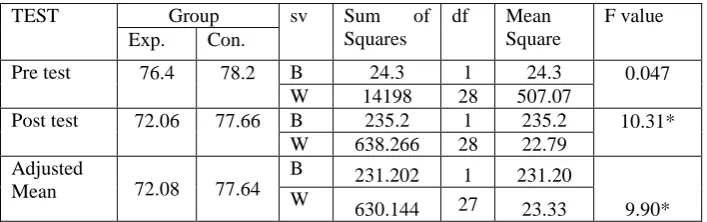
It was observed from the Table-1 that there was no significant difference in the pretest (F=0.047<4.20) and posttest (F=10.31<4.20) for df 1 and 28. However a significant difference was observed in adjusted posttest (F=9.90> 4.21) for df 1 and 27 at 0.05 level of confidence. It discussion clearly indicated that there was
an influence on resting heart rate through Taekwondo practice among college men students. The mean value clearly indicated that the experimental group was considerably reduced on resting heart rate due to six weeks Taekwondo practice.
Figure I
Bar diagram showing the pre and posttest mean value of resting heart rate
Table 2
Computation of analysis of covariance on breath holding time
*Significant at 0.05 level of confidence
78.2
76.4 77.66
72.06 77.64
72.08
68 70 72 74 76 78 80
Con. Group Exp. Group
Pre post Adjusted
TEST Group SV Sum of
Squares
df Mean Square
F value Exp. Con.
Pre test 36.2 35.8 B 1.2 1 1.2 0.064
W 520.8 28 18.6
Post test 42.46 36.26 B 288.3 1 288.3 10.95* W 736.66 28 26.309
Adjusted Mean
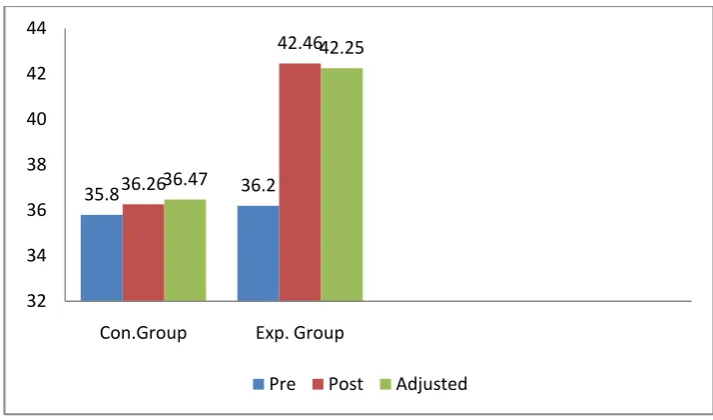
It was observed from the Table-2 that there were no significant difference in the pretest (F=0.064<4.20). The significant differences were observed in posttest (F=10.95<4.20) for df 1 and 28 at 0.05 level of confidence and adjusted posttest (F=40.79< 4.21) for df 1 and 27 at 0.05 level of confidence. It discussion clearly
indicated that there was a significant improvement in agility due to six weeks taekwondo practice among college students. The mean value clearly indicated that the experimental group was higher improvement on breath holding time due to six weeks taekwondo practice.
Figure II
Bar diagram showing the pre and posttest mean value of breath holding time
Table 3
Computation of analysis of covariance on respiratory rate
TEST Group sv Sum of Squares
df Mean Square
F value Exp. Con
.
Pre test 19 18.66 B 0.833 1 0.833 0.267 W 87.333 28 3.119
Post test 16.46 17.73 B 12.033 1 12.033 7.22* W 46.666 28 1.666
Adjusted Mean
16.39
17.80
B 14.939 1 14.939
14.07* W
28.650 27 1.061 *Significant at 0.05 level of confidence
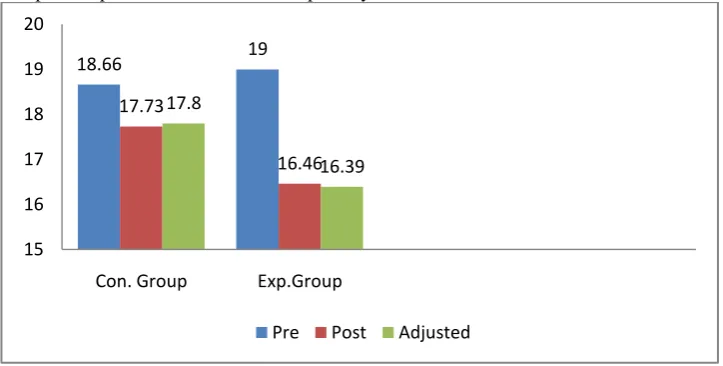
It was observed from the Table-III that there was no significant difference in the pretest (F=0.267<4.20). A significant difference in the post test (F=7.22<4.20) for df 1 and 28 and adjusted posttest (F=14.07>4.21) for df 1 and 27 at 0.05 level of confidence. It discussion clearly indicated that there was
a significant difference on respiratory rate through six weeks taekwondo practice among college students. The mean value clearly indicated that the experimental group was reduced on respiratory rate due to six weeks taekwondo practice.
35.836.26 36.2
42.46
36.47
42.25
32 34 36 38 40 42 44
Con.Group Exp. Group
30 International Journal of Recent Research and Applied Studies, Volume 5, Issue 2 (6) February 2018
Figure III
Bar diagram showing the pre and posttest mean value of respiratory rate
Conclusions
From the analysis and discussions of the present study, the following conclusions were drawn
1. Taekwondo practice is useful to improve the physiological qualities of a resting heart rate, breath holding time and respiratory rate among college students
2. Taekwondo practice is beneficial not only physiological benefits but also self-defense program for the college students.
3. Further the result of the study indicated that the martial art training including Taekwondo may be included in the physical fitness program.
References
1. Craig A. Bridge, Jonatas Ferreira da Silva Santos, HelmiChaabene, Willy Pieter Emerson Franchini (2014). Physical and Physiological Profiles of Taekwondo Athlete, Sports Medicine, 44 (6), 713– 733
2. Seven benefits of practicing martial arts https://youqueen.com/life/7-benefits-of-practicing-martial-arts/
3. Walter R. Thompson & Cesar Vinueza M.S.(1991). Physiologic profile of tae kwon do black belts, Journal Sports Medicine, Training and Rehabilitation, 3 (1), 49-51.
4. Dr S Suthakar, Dr Sundar Raj Urs DP Shivakumar, 2016, Effect of Selected Yogic Exercises on Cardiovascular Endurance and Lung Capacity of Secondary School Children, IJESC, 6, 6 PP. 7286-7289.
5. Dr S Suthakar, Dr Sundar Raj Urs DP Shivakumar, 2016, Effect of selected yogic exercises on selected physiological variable of secondary school children., International Journal of Physical Education, Sports and Health, 4-114.
6. S.Suthakar and Dr.A.Pushparajan, Effects of Silambam and Karate with Yogic Training on Agility and Arm Explosive Power of Collegiate Male
Students., International Journal of Innovative Research and Development|| ISSN 2278–0211 7. R.Ashok kumar Dr.S.Suthakar, K.M.Ashokkumar,
2016. An Effective Approach through Strength, Endurance and Skill Training Program Combinations on Muscular Strength and Endurance and Explosive Power of Male Basketball Players., International Journal of Innovative Research and Development., 5,4,218-220.
8. R. Ashok Kumar K. Babu , S. Suthakar, 2016. Effects of Volleyball Specific Resistance Training and Skill Training Packages on the Development of Leg Explosive Power and Speed on the Higher Secondary Level School Boys,2016/3, international journal of innovative research and development, 5, 4,231-235.
9. Dr.S.Suthakar Venkata chalapathi G, 2016. Analysis of physical growth on specific fitness training among tribal and non-tribal school boys, 2016/10/27, International Journal of Physical Education, Sports and Health3,6, 137-142.
10. Satheesh B. and Dr.S. Suthakar. 2016.A Study on the selected motor fitness variables among the bicycle benificiaries and non benificiaries of the secondary school children, 2016/10, Indian Streams Research Journal6,9,1-4.
11. M Sankar, S Suthakar, 2016. Influence Of Isolated And Combined Circuit And Fartlek Trainings On Selected Endurance Parameters Among College Men Students, 2016/9/15, International Education and Research Journal, 2,9.
12. Satheesh B and Dr.S. Suthakar, 2016. Comparative study of the psychological well-being and self-confidence between the bicycle beneficiaries and non beneficiaries of the secondary school children,2016/8/27, International Journal of Physical Education, Sports and Health, 3,5, 495-497.
13. Dr.S.Suthakar M. Sankar, 2016. Influence of the Isolated and Combined Circuit and Fartlek Trainings on the Selected Strength Parameters among the
18.66 19
17.73
16.46 17.8
16.39
15 16 17 18 19 20
Con. Group Exp.Group
College Men Students, 2016/8, International Journal of Recent Research and Applied Studies, 3, 8(16), 70-74.
14. Dr. S. Suthakar, Nayak Darshana Habbu, 2016. Effects of the Combination of Plyometric and Specific Training with Skill Training in the Development of Anaerobic Capacity, Leg Explosive Power and Over All Playing Ability of the Volleyball Players, 2016/8, International Journal of Recent Research and Applied Studies, 3, 8(19), 83-87. 15. Dr. S. Suthakar Muniraju M. G, 2016.Effects of the
Short Term Resistance and Regular Resistance Training in the Development of Lower Body Strength, Leg Explosive Power and Shooting Ability on the Male Basketball Players, International Journal of Recent Research and Applied Studies, 3, 8,(12), 51-54.
16. Dr.S.Suthakar Muniraju, M. G, 2016.Effects of the Short Term Resistance and Regular Resistance Training in the Development of Muscular Strength Endurance, Upper Body Strength and Passing Ability of the Male Basketball Players, 2016/8, International Journal of Recent Research and Applied Studies, 3,8,(13),55-59.
17. Dr.S.Suthakar Nayak Darshana Habbu, 2016. Effect of Combination of Plyometric and Skill Training in the Development of Speed, Muscular Strength Endurance and Serving Ability among the Volleyball Players,2016/8, International Journal of Recent Research and Applied Studies, 3,8,(7),25-29. 18. Dr. S. Suthakar Adengada A. Kushalappa,
2016.Correlations of Biomechanical Characteristics with Ball Speed in Penalty Corner Push-In Effect of Basketball Specific Training on Skill Performance Variables among the Inter-collegiate Men Basketball Players of Mangalore University, 2016/7/10, International Journal of Recent Research and Applied Studies, 3, 7(12), 60-63.
19. Dr. S. Suthakar Adengada A. Kushalappa, Effect of Basketball Specific Training on Selected Physical Fitness Variables among the Inter Collegiate Men Basketball Players of Mangalore University, 2016/7, International Journal of Recent Research and Applied Studies, 3, 7 (14), 60-63.
20. Dr. S Suthakar and Dr. Sundar Raj Urs DP Shivakumar, 2016. Effect of selected yogic exercises on selected physiological variable of secondary school children, 2016/6/23,International Journal of Physical Education, Sports and Health, 3, 4, 114-116.
21. DP Shivakumar, S Suthakar, Sundar Raj Urs, 2016. Effect of Selected Yogic Exercises on Cardiovascular Endurance and Lung Capacity of Secondary School Children, 2016/6, International Journal of Engineering Science, 7286.
22. Dr.Sundar Raj Urs Kishor V, Dr. S Suthakar, 2016. Analysis of physical fitness and adjustment between physical education and general education teachers,