System Behaviours between Small and Large
Scale Robotic Platforms
Amanda M. Whitbrook, Uwe Aickelin, and Jonathan M. Garibaldi
Intelligent Modelling and Analysis Research Group (IMA),
School of Computer Science, University of Nottingham, Nottingham, NG8 1BB
[email protected], [email protected], [email protected]
Abstract. This paper demonstrates that a set of behaviours evolved in simulation on a miniature robot (epuck) can be transferred to a much larger scale platform (a virtual Pioneer P3-DX) that also differs in shape, sensor type, sensor configuration and programming interface. The chosen architecture uses a reinforcement learning-assisted genetic algorithm to evolve the epuck behaviours, which are encoded as a genetic sequence. This sequence is then used by the Pioneers as part of an adaptive, id-iotypic artificial immune system (AIS) control architecture. Testing in three different simulated worlds shows that the Pioneer can use these behaviours to navigate and solve object-tracking tasks successfully, as long as its adaptive AIS mechanism is in place.
1
Introduction
Evolutionary robotics is a technique that refers to the genetic encoding of au-tonomous robot control systems and their improvement by artificial evolution. Ideally the end product should be a controller that evolves rapidly and has the properties of robustness, scalability and adaptation. However, in practice it proves difficult to achieve all of these goals without introducing an additional mechanism for adaptability since behaviour is essentially an emergent property of interaction with the environment [11]. Thus, the major challenge facing evo-lutionary robotics is the development of solutions to the problem of brittleness via the design of controllers that can generalize to modified environments.
The characteristics of the robot body and its sensorimotor system may be regarded as part of the environment [2] as all embodied systems are physically embedded within their ecological niche and have a dynamic reciprocal coupling to it [9]. Indeed, artificial evolution often produces control systems that rely heavily on body morphology and sensorimotor interaction [3], and when these are subsequently altered, the changes can affect behavioural dynamics drasti-cally. Thus, a solid test for robustness, scalability and adaptation is the ability of an evolved control system to function not only in different physical environ-ments, but also on a number of robotic platforms that differ in size, morphology, sensor type and sensor-response profile. This paper is therefore concerned with
P. Collet et al. (Eds.): EA 2009, LNCS 5975, pp. 122–133, 2010. c
demonstrating the theoretical and practical cross platform transferability of an evolutionary architecture designed to combat adaptation problems.
Adaptation is usually made possible through the introduction of additional mechanisms that permit some kind of post-evolutionary behaviour modification. The architecture used here falls into the general category of approaches that combine evolution or long term learning (LTL) with a form of lifelong or short term learning (STL) to achieve this [14]. The particular technique consists of the rapid evolution of a number of diverse behaviour sets using a Webots [10] simulation (LTL) followed by the use of an idiotypic artificial immune system (AIS) for selecting appropriate evolved behaviours as the robot solves its task in real time (STL). The approach differs from most of the evolutionary schemes employed previously in the literature in that these are usually based on the evolution of neural controllers [6] rather than the actual behaviours themselves. Previous papers have provided evidence that the idiotypic AIS architecture has advantages over a reinforcement learning scheme when applied to mobile robot navigation problems [15] and have shown that the idiotypic LTL-STL architecture permits transference from the simulator to a number of different real-world environments [16]. The chief aim of this paper is, therefore, to supply further support for the robustness, scalability and adaptability of the architec-ture by showing that it can be extended to the much larger scale Pioneer P3-DX robots. For this purpose, the behaviours evolved for the epuck in the Webots simulator are transplanted onto the Pioneer and used both with and without the idiotypic network in Player’s Stage [5] simulator. The results successfully demonstrate the scalability of the method in the virtual domain, and provide strong empirical evidence that the idiotypic selection feature is a vital component for achieving this.
The remainder of this paper is structured as follows. Section 2 introduces some essential background information about the problem of platform transfer in mobile robotics and previous attempts to achieve it. Section 3 describes the LTL-STL control system, including its modular structure and the encoding of the evolved behaviours. In particular, it shows how platform transfer is achieved between the epuck and Pioneer P3-DX robots. Section 4 provides information regarding the simulated test environments and experimental set-up and Section 5 presents and discusses the results. Section 6 concludes the paper.
2
Background and Relevance
distributed systems, transfer may also be hindered by diversity of middleware, operating systems, communications protocols and programming languages and their libraries [13]. Furthermore, portability is made even more challenging by differences in sensor type, sensor characteristics and the mechanical structure of the robot.
Despite its rarity, platform transfer for evolved control systems is reported in the literature. Floreano and Mondada [2,3] use an incremental approach to evolve artificial neural networks for solving a looping maze navigation problem. Evolution begins with a real miniature Khepera robot and gradually moves to a Koala, a larger, more fragile robot supplied by the same manufacturer. Within this architecture, previously evolved networks are gradually adapted, combined, and extended to accommodate the changing morphology and sensorimotor inter-faces [3]. However, the scheme possesses some significant drawbacks. The use of physical robots for the evolution is both impractical and infeasible due to the ex-cessive amount of time and resources required. For example, adaptability to the Koala platform emerges only after 106 generations on the real Khepera and an additional 30 on the Koala (each generation taking approximately 40 minutes). Also, if each new environment or platform requires additional evolution then there is no controller that is immediately suitable for an unseen one. Another consideration is that the Koala was deliberately designed to support transfers from the Khepera and is thus very similar in terms of the wheel configuration, IR sensors, vision module, low-level BIOS software and communication method. This is good from a practical perspective, but one could argue that the new, supposedly unknown environment is far too engineered.
Floreano and Urzelai [4,12] also evolve a neural network to control a light-switching robot but evolve the mechanisms for self-organization of the synaptic weights rather than the weights themselves. This means that the robot is rapidly able to adapt its connection weights continuously and autonomously to achieve its goal. The authors transfer the evolved control system from simulation to a real Khepera and also from a simulated Khepera to a real Koala. They report no reduction in performance following the transfer. However, since the same platforms are used as in [2,3], the new environment is, again, too engineered. In addition, the task is very simple and the environment is sparse, requiring minimal navigational and obstacle avoidance skills.
Section 3.4, Table 1. In addition, the achievement of platform transfer between epucks and Pioneers is of practical value since Pioneer behaviours cannot be evolved directly on the Stage simulator within a realistic time frame; Stage is not fast or accurate enough, and control systems used in the Webots programming environment are not directly transferable to real Pioneers. Moreover, simulation of the epuck in Webots requires a 3D model that is readily available, so it is computationally much cheaper to reuse the epuck’s evolved behaviours in Stage rather than to design a complex 3D Pioneer model for Webots.
3
System Architecture
3.1 Artificial Immune Systems and the Behavioural Encoding
AISs mimic the properties of the vertebrate immune system (for example anti-body recognition of and stimulation by antigens). Idiotypic systems in particular exploit Jerne’s notion of an idiotypic network [7], where antibodies are capable of recognizing and being stimulated or suppressed by other antibodies via their paratopes and idiotopes, see [15] for further details. Idiotypic AIS algorithms are often based on Farmeret al.’s computational model [1] of Jerne’s theory and are characterized by a decentralized behaviour-selection mechanism. They are a popular choice for STL in robotic control systems [8] since they allow much greater flexibility for determining a robot’s actions. The LTL and STL aspects of the control system presented here thus work together to produce adaptability; diversity of the behaviour sets is provided by the evolutionary (LTL) component and the idiotypic network (STL) exploits the wide range of choice available to select behaviours appropriate for a given environmental scenario.
3.2 LTL Phase
The LTL phase is a reinforcement learning-assisted genetic algorithm (GA) that evolves a suitable behaviour for each antigen. It works by selecting two differ-ent pardiffer-ent robots via the roulette-wheel method and determining behaviour at-tribute values for their offspring as described in [17]. The reinforcement learning component constantly assesses the performance of the behaviours during evo-lution so that poorly-matched ones are replaced with newly-created ones when the need arises, which accelerates the GA. All the test problems are assessed by measuring task completion timeti and number of collisionsci i= 1, ..., x, thus, the relative fitnessμi of each member of the population is calculated using:
μi= t 1
i+ρcixk=1(tk+ρck)−1, (1)
whereρrepresents the weighting given to collisions (ρ= 1 here) andxis the num-ber of robots in the population. After convergence, the fittest robot in the final population is selected. However, since the idiotypic network requires a numbern of distinct behaviours for each antigen, the whole process is repeatedntimes in order to obtainnrobots from separate populations that never interbreed. This is an alternative to selecting a number of robots from a single, final population and means that greater diversity can be achieved with smaller population sizes without reducing speed of convergence. The attribute values representing the behaviours of the n robots and their final reinforcement scores are saved as a genetic sequence (a simple text file) for seeding the AIS system.
3.3 STL Phase
The AIS system reads the genetic sequence generated by the LTL phase and then calculates the relative fitness μi of each behaviour (or antibody) set using (1), whereρ= 8 to increase the weighting given to the number of collisions. It then produces ann×8 matrixP (analogous to an antibody paratope) representing the reinforcement scores, or degree of match between antibodies and antigens. The elements of this matrix (Pij i= 1, ..., n, j= 1, ...,8) are calculated by multiplying each antibody’s final reinforcement score by the relative fitness of its setμi. An
n×8 matrixI(analogous to an antibody idiotope) is also created by assigning a value of 1.0 to the element corresponding to the minimumPij for eachj, and designating a value of 0.0 to all other elements. The matrixP is adjusted after every iteration through reinforcement learning, butI remains fixed throughout. If an idiotypic network is not used then P alone governs antibody selection; the antigen-matching antibody with the highest reinforcement score is used. If idiotypic stimulation and suppression of antibodies are taken into account then
3.4 Mechanisms of Cross Platform Transfer
Following convergence of the GA, the selected behaviours are encoded as nine integers in a simple text file that contains all the genetic information necessary to reproduce them. The first integer represents the antigen code, and the next seven represent the behavioural attributesT,S,F,A,D,Rf andRa. The last integer is the final reinforcement score attained by the behaviour prior to convergence. The genetic sequence encodes the principal wheel speeds in epuck speed units per second (ψ per second) whereψ= 0.00683 radians. A speed value of 600 ψ per second thus corresponds to 600×0.00683 = 4.098 radians per second. An example line from a genetic text file is: 0 2 537 80 51 2 37 76 50, which encodes wandering in both directions with a speed of 537ψ per second, turning 80% of the time. The robot turns right 37% of this time by reducing the speed of the right wheel by 76%, and turns left 63% of this time by reducing the speed of the left wheel by 51%. A particular genetic sequence thus governs how the left and right wheel speeds change with time.
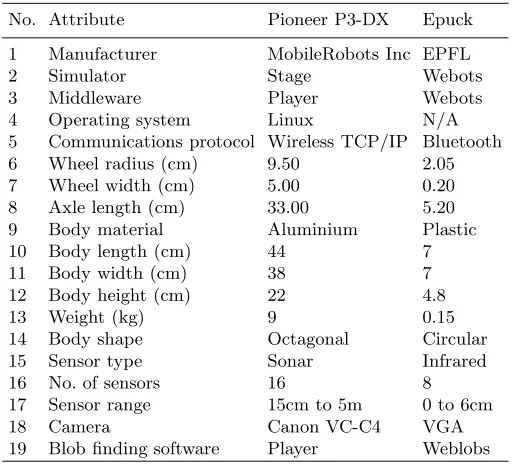
In theory, the behavioural encoding may be extended to any two-wheeled, non-holonomic, mobile-robot, since the wheel motions of such robots are fully described by their changing speeds. Furthermore, since the output from the LTL phase is a simple text file, any program is capable of reading it and ex-tracting the information necessary to form the wheel motions. Moreover, speci-fication of the speeds in radians per second permits automatic scaling between different-sized environments, without requiring knowledge of the particular scales involved, since wheel size is generally related to the scale of the environment. However, it is also necessary to consider some fundamental hardware and soft-ware differences between the Pioneer P3-DX and epuck robots when making the transfer. Table 1 below shows the technical specification for each robot type. The most fundamental considerations are the larger scale of the Pioneer, the use of different programming environments, the use of sonar sensors on the Pioneer and the spatial arrangement of these sensors. These affect the transfer in three main ways; how velocity is expressed, how the sensors are read and translated into antigen codes, and how blob finding is implemented.
Table 1.Differences between the Pioneer and Epuck Robotic Platforms
No. Attribute Pioneer P3-DX Epuck
1 Manufacturer MobileRobots Inc EPFL
2 Simulator Stage Webots
3 Middleware Player Webots
4 Operating system Linux N/A
5 Communications protocol Wireless TCP/IP Bluetooth
6 Wheel radius (cm) 9.50 2.05
7 Wheel width (cm) 5.00 0.20
8 Axle length (cm) 33.00 5.20
9 Body material Aluminium Plastic
10 Body length (cm) 44 7
11 Body width (cm) 38 7
12 Body height (cm) 22 4.8
13 Weight (kg) 9 0.15
14 Body shape Octagonal Circular
15 Sensor type Sonar Infrared
16 No. of sensors 16 8
17 Sensor range 15cm to 5m 0 to 6cm
18 Camera Canon VC-C4 VGA
19 Blob finding software Player Weblobs
v=ψrp(R+L)
2 , (2)
ω= ζψre(R−L)
ae , (3)
whererp is the radius of the Pioneer wheel,reis the radius of the epuck wheel, andae is the axle length of the epuck. The parameterζ = 1.575 is determined by empirical observation and is introduced in order to replicate the angular movement of the epuck more accurately.
The antigens indexed 3 to 8 describe an obstacle’s orientation with respect to the robot (right, left or rear) and classify its distance from the robot as either “obstacle” (avoidance is needed) or “collision” (escape is needed). Thus, two threshold values τ1 and τ2 are required to mark the boundaries between “no
obstacle” and “obstacle” and between “obstacle” and “collision” respectively. The epuck’s IR sensors are nonlinear and correspond to the quantity of reflected light, so higher readings mean closer obstacles. In contrast, the Pioneer’s sonar readings are linear denoting the estimated proximity of an obstacle in metres, so lower readings mean closer obstacles. Since direct conversion is difficult, the threshold valuesτ1and τ2 (250 and 2400 for the epuck) are determined for the
Pioneer by empirical observation of navigation through cluttered environments, (τ1 = 0.15 and τ2 = 0.04). Additionally, in order to determine the orientation
where indices 0, 1 and 2 correspond to the right, 3 and 4 correspond to the rear and 5, 6 and 7 correspond to the left. For the Pioneer it is necessary to use the index of the minimum sonar reading and encode positions 4 to 9 as the right, 10 to 13 as the rear and positions 0 to 3 and 14 to 15 as the left, due to the different spatial arrangement of the sensors.
Blob finding software (named Weblobs) was developed for the epuck as part of this research, since the Webots C/C++ Controller API has no native blob finding methods. However, the Pioneer robot is able to use methods belonging to the BlobfinderProxy class of libplayerc++. The objective is to determine whether blobs (of the target colour) are visible, and if so, to establish the direction (left, centre or right) of the largest from the centre of the field of view. The two robot types thus use different blob finding software, but collect the same information.
3.5 Modular Control Structure
The entire STL program is broken down into the pseudo code below in order to demonstrate its modular structure and the ease with which this facilitates adaptation for the Pioneer P3-DX platform. Each block shows the module it calls and the method it uses within that module. Blocks marked with an asterisk are dealt with in the main body of the program and do not call other modules.
1 I n i t i a l i z e r o b o t (ROBOT−−> I n i t i a l i z e R o b o t ( ) −−> I n i t i a l i z e S e n s o r s ( ) ) 2 Read g e n e t i c s e q u e n c e ∗
3 B u i l d m a t r i c e s P and I ∗ REPEAT
4 Read s e n s o r s (ROBOT−−> R e a d S e n s o r s ( ) ) 5 Read c am e ra (BLOBFINDER−−> G e t B l o b I n f o ( ) ) 6 D e t e r m i n e a n t i g e n c o d e ∗
7 S c o r e p r e v i o u s b e h a v i o u r u s i n g r e i n f o r c e m e n t l e a r n i n g ∗ 8 Update P ∗
9 S e l e c t b e h a v i o u r ∗
10 Update a n t i b o d y c o n c e n t r a t i o n s ∗
11 E x e c u t e b e h a v i o u r (BEHAVIOUR−−> E x e c u t e ( ) ) UNTIL s t o p p i n g c r i t e r i a met
The only blocks that require changes for the Pioneer platform are 1, 4, and 5. Since these are dealt with by calling other modules, the main body of the program can be wholly reused, although an additional two lines in block 11 are necessary to convert the wheel speeds to the Player format. Some slight changes to block 7, which deals with using sensor data to determine the reinforcement score are also required.
4
Test Environments and Experimental Set-Up
The genetic behaviour sequences are evolved using 3D virtual epucks in the Webots simulator, where the robot is required to track blue markers in order to navigate through a number of rooms to the finish line, see [17]. Throughout evolution, five separate populations of ten robots are used and the mutation rate
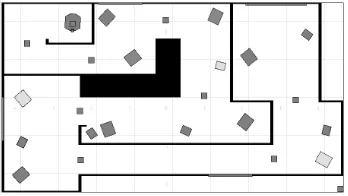
behaviour sequences are used with 2D virtual Pioneer robots in three different Stage worlds, S1, S2, and S3. S1and S2require maze navigation and the tracking
of coloured door markers (Figure 1 and Figure 2), and S3 involves search and
retrieval of a blue block whilst navigating around other obstacles (Figure 3). Sixty runs are performed in each Stage world, thirty using the idiotypic selection mechanism, and thirty relying on reinforcement learning only. In addition, in S3
the obstacle positions, target block location, and robot start point are changed following each idiotypic and nonidiotypic test, so that the data is paired. For all runs, the task time t and number of collisions c are recorded. However, a fast robot that continually crashes or a careful robot that takes too long to complete the task is undesirable, so an additional score metricϕthat combinestandcis computed for each run. This is given by:
ϕ= t+σic
2 , (4)
whereσi is the ratio of the mean task time ¯tto mean number of collisions ¯cfor world Si. In all worlds, ¯t, ¯cand ¯ϕare computed with and without using idiotypic effects and the results are compared using a 2-tailed t-test (paired for world S3),
[image:9.595.210.385.440.538.2]with differences accepted as significant at the 99% level only. As another measure of task performance, runs with an above averageϕfor each world are counted as good and those with fitness in the bottom 10% of all runs in each world are counted as bad. Additionally, for each task, robots taking longer than 900 seconds are counted as having failed and are stopped.
Fig. 1.2D Stage world S1 used in the Pioneer STL phase
5
Results and Discussion
Fig. 2.2D Stage world S2 used in the Pioneer STL phase
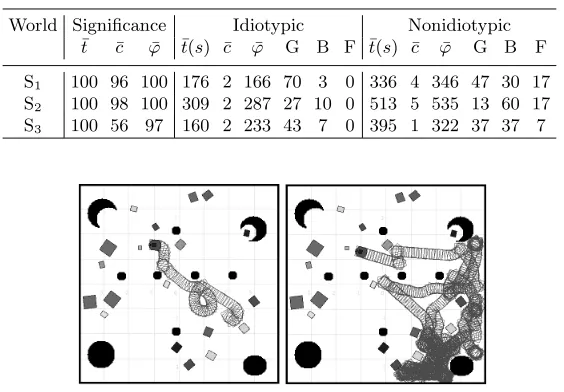
rate and in world S3there is a 7% failure rate. Furthermore, mean task time is
significantly higher than for the idiotypic case in all worlds, although the number of collisions is consistently low and not significantly different between the idio-typic and nonidioidio-typic cases. In addition, the number of bad runs is higher and the number of good runs is lower for nonidiotypic robots in all worlds and the score is significantly better when idiotypic effects are employed in worlds S1and
S2. These observations provide strong empirical evidence that the behaviours
evolved in simulation on an epuck robot can be successfully ported to the vir-tual Pioneer P3-DX platform provided that the adaptive idiotypic mechanism is applied within the STL architecture. As with the STL results for virtual and real epucks (documented in [16]), the results show that the evolutionary (LTL) phase is capable of producing sets of very diverse behaviours but that the STL phase requires the use of a scheme that selects from the available behaviours in a highly adaptive way. This is further illustrated in Figure 3 which shows the paths taken by an idiotypic (left) and nonidiotypic (right) Pioneer when solving the block-finding problem in world S3. It is evident that the nonidiotypic Pioneer
takes a much less direct route and repeats its path several times. This is because it is less able to adapt its behaviour and consequently spends much more time wandering, getting stuck and trying to free itself. This result is typical of the S3
experiments.
them. A possible improvement would be constant execution of the LTL phase, which regularly updates the genetic sequence, allowing fresh antibodies to be used if the need arises. In addition, success with transference to other platforms is presently too heavily dependent upon parameter tuning and readjustment of the reinforcement scheme for the particular sensor characteristics.
Table 2.Results of Experiments with and without Idiotypic Effects in Each World. G = % Good, B = % Bad, F = % Fail.
World Significance Idiotypic Nonidiotypic
¯
t c¯ ϕ¯ ¯t(s) ¯c ϕ¯ G B F ¯t(s) ¯c ϕ¯ G B F
S1 100 96 100 176 2 166 70 3 0 336 4 346 47 30 17
S2 100 98 100 309 2 287 27 10 0 513 5 535 13 60 17
S3 100 56 97 160 2 233 43 7 0 395 1 322 37 37 7
Fig. 3.World S3showing the trail of an idiotypic (left) and nonidiotypic (right) robot
6
Conclusions
References
1. Farmer, J.D., Packard, N.H., Perelson, A.S.: The Immune System, Adaptation, and Machine Learning. Physica D 2(1-3), 187–204 (1986)
2. Floreano, D., Mondada, F.: Evolutionary Neurocontrollers for Autonomous Mobile Robots. Neural Networks 11(7-8), 1416–1478 (1998)
3. Floreano, D., Mondada, F.: Hardware Solutions for Evolutionary Robotics. In: Proceedings of the First European Workshop on Evolutionary Robotics, pp. 137– 151. Springer, London (1998)
4. Floreano, D., Urzelai, J.: Evolutionary Robots with On-line Self-organization and Behavioural Fitness. Neural Networks 13, 431–443 (2000)
5. Gerkey, B., Vaughan, R., Howard, A.: The Player/Stage Project: Tools for Multi-Robot and Distributed Sensor Systems. In: Proceedings of the International Confer-ence on Advanced Robotics (ICAR 2003), Coimbra, Portugal, pp. 317–323 (2003) 6. Goosen, T., van den Brule, R., Janssen, J., Haselager, P.: Interleaving Simulated and Physical Environments Improves Evolution of Robot Control Structures. In: Proceedings of the 19th Belgium-Netherlands Conference on Artificial Intelligence (BNAIC), pp. 135–142. Utrecht University Press (2007)
7. Jerne, N.K.: Towards a Network Theory of the Immune System. Annales d’Immunologie 125C(1-2), 373–389 (1974)
8. Krautmacher, M., Dilger, W.: AIS Based Robot Navigation in a Rescue Scenario. In: Nicosia, G., Cutello, V., Bentley, P.J., Timmis, J. (eds.) ICARIS 2004. LNCS, vol. 3239, pp. 106–118. Springer, Heidelberg (2004)
9. Lungarella, M., Sporns, O.: Mapping Information Flow in Sensorimotor Networks. PLOS Computational Biology 2(1), 1301–1312 (2006)
10. Michel, O.: Cyberbotics Ltd - WebotsTM: Professional Mobile Robot Simulation. International Journal of Advanced Robotic Systems 1(1), 39–42 (2004)
11. Nolfi, S., Floreano, D.: Evolutionary Robotics, The Biology, Intelligence, and Tech-nology of Self-Organizing Machines, 1st edn. MIT Press, Cambridge (2000) 12. Urzelai, J., Floreano, D.: Evolutionary Robotics: Coping with Environmental
Change. In: Proceedings of the Genetic and Evolutionary Computation Confer-ence GECCO-00, pp. 941–948. Morgan Kaufmann, San Francisco (2000)
13. Utz, H., Sablatnog, S., Enderle, S., Kraetzschmar, G.: Miro- Middleware for Mobile Robot Applications. IEEE Transactions on Robotics and Automation 18(4), 493– 497 (2002)
14. Walker, J.H., Garett, S.M., Wilson, M.S.: The Balance Between Initial Training and Lifelong Adaptation in Evolving Robot Controllers. IEEE Transactions on Systems, Man and Cybernetics- Part B: Cybernetics 36(2), 423–432 (2006) 15. Whitbrook, A.M., Aickelin, U., Garibaldi, J.M.: Idiotypic Immune Networks in
Mobile Robot Control. IEEE Transactions on Systems, Man and Cybernetics, Part B- Cybernetics 37(6), 1581–1598 (2007)
16. Whitbrook, A.M., Aickelin, U., Garibaldi, J.M.: An Idiotypic Immune Network as a Short-Term Learning Architecture for Mobile Robots. In: Bentley, P.J., Lee, D., Jung, S. (eds.) ICARIS 2008. LNCS, vol. 5132, pp. 266–278. Springer, Heidelberg (2008)