doi:10.1017/fms.2017.10
MINIMALITY AND MUTATION-EQUIVALENCE
OF POLYGONS
ALEXANDER KASPRZYK1, BENJAMIN NILL2and THOMAS PRINCE3
1School of Mathematical Sciences, University of Nottingham, University Park, Nottingham NG7 2RD, UK;
email: [email protected]
2Fakult¨at f¨ur Mathematik, Otto-von-Guericke-Universit¨at Magdeburg, Postschließfach 4120, 39016 Magdeburg, Germany;
email: [email protected]
3Department of Mathematics, Imperial College London, 180 Queen’s Gate, London SW7 2AZ, UK;
email: [email protected]
Received 1 April 2015; accepted 3 March 2017
Abstract
We introduce a concept of minimality for Fano polygons. We show that, up to mutation, there are only finitely many Fano polygons with given singularity content, and give an algorithm to determine representatives for all mutation-equivalence classes of such polygons. This is a key step in a program to classify orbifold del Pezzo surfaces using mirror symmetry. As an application, we classify all Fano polygons such that the corresponding toric surface is qG-deformation-equivalent to either (i) a smooth surface; or (ii) a surface with only singularities of type 1/3(1,1).
1. Introduction
1.1. An introduction from the viewpoint of algebraic geometry and mirror symmetry. AFano polygon P is a convex polytope in NQ:= N ⊗ZQ, where
N is a rank-two lattice, with primitive verticesV(P)inN such that the origin is
contained in its strict interior,0∈ P◦
. A Fano polygon defines a toric surfaceXP
given by thespanning fan(also commonly referred to as theface fanorcentral
fan) of P; that is, XP is defined by the fan whose cones are spanned by the faces
ofP. The toric surfaceXPhas cyclic quotient singularities (corresponding to the
c
cones over the edges ofP) and the anti-canonical divisor−KXP isQ-Cartier and
ample. HenceXPis a toricdel Pezzo surface.
The simplest example of a toric del Pezzo surface is P2, corresponding, up
to GL2(Z)-equivalence, to the triangle P = conv{(1,0), (0,1), (−1,−1)}. It is well known that there are exactly five smooth toric del Pezzo surfaces, and that these are a subset of the sixteen toric Gorenstein del Pezzo surfaces (in bijective correspondence with the famous sixteen reflexive polygons described by Batyrev
and Rabinowitz [7,37]). More generally, if one bounds theGorenstein index r(the
smallest positive integer such that−r KXP is Cartier) the number of possibilities
is finite. Dais classified those toric del Pezzo surfaces with Picard rank one and
r 63 [15]. A general classification algorithm was presented in [28].
A new viewpoint on del Pezzo classification is suggested by mirror symmetry.
We shall sketch this briefly; for details see [11]. Ann-dimensional Fano variety
X is expected to correspond, under mirror symmetry, to a Laurent polynomial
f ∈ C[x1±1, . . . ,x ±1
n ][5,8,11,12]. Under this correspondence, the regularized
quantum periodGbX ofX– a generating function for Gromov–Witten invariants –
coincides with the classical periodπf of f – a solution of the associated Picard–
Fuchs differential equation – given by
πf(t)=
1 2πi
nZ
|x1|=···=|xn|=1
1 1−t f
d x1
x1
· · ·d xn xn
=X
k>0
coeff1(fk)tk.
If a Fano varietyXis mirror to a Laurent polynomial f then it is expected thatX
admits a degeneration to the singular toric variety XP associated to the Newton
polytopePof f.
In general there will be many (often infinitely many) different Laurent
polynomials mirror dual to X, and hence many toric degenerations XP.
It is conjectured that these Laurent polynomials are related via birational transformations analogous to cluster transformations, which are called
mutations [2, 17, 19, 20]. A mutation acts on the Newton polytope
P:=Newt(f)⊂ NQof a Laurent polynomial via ‘rearrangement of Minkowski
slices’ (see Section2.1), and on the dual polytope P∗ ⊂
MQ,M :=Hom(N,Z),
via a piecewise-GLn(Z) transformation (see Section 2.2) [2]. At the level of
Laurent polynomials, if f and g are related via mutation then their classical
periods agree [2, Lemma 2.8]:πf = πg. Ilten [26] has shown that if two Fano
polytopesPandQare related by mutation then the corresponding toric varieties
XP and XQ are deformation equivalent: there exists a flat familyX → P1 such
thatX0 ∼= XP andX∞ =∼ XQ. In factXP andXQ are related via aQ-Gorenstein
(qG) deformation[1].
Classifying Fano polygons up to mutation-equivalence thus becomes a
content(see Section3.1) [3]. This consists of a pair(n,B), wherenis an integer
– the number ofprimitive T -singularities– andBis abasket– a collection of
so-calledresidual singularities. A residual singularity is a cyclic quotient singularity
that is rigid under qG-deformations; at the other extreme a T-singularity is a
cyclic quotient singularity that admits a qG-smoothing [29]. The toric del Pezzo
surfaceXP is qG-deformation-equivalent to a del Pezzo surface X with singular
points given byBand Euler number of the nonsingular locus X\Sing(X)equal
ton.
DEFINITION 1 [1]. A del Pezzo surface with cyclic quotient singularities that admits a qG-degeneration (with reduced fibres) to a normal toric del Pezzo surface is said to be of classTG.
Notice that not all del Pezzo surfaces can be of class TG: not every del Pezzo hash0(X,−K
X) >0, for example (see Example5). But it is natural to conjecture
the following:
CONJECTURE 1 [1, Conjecture A]. There exists a bijective correspondence between the set of mutation-equivalence classes of Fano polygons and the set of qG-deformation-equivalence classes of locally qG-rigid class TG del Pezzo surfaces with cyclic quotient singularities.
The main results of this paper can be seen as strong evidence in support of the
conjecture above. First, an immediate consequence of Theorem6is:
THEOREM 1. There are precisely ten mutation-equivalence classes of Fano polygons such that the toric del Pezzo surface XP has only T -singularities. They are in bijective correspondence with the ten families of smooth del Pezzo surfaces.
Second, combining the results of [14] with Theorem9we have:
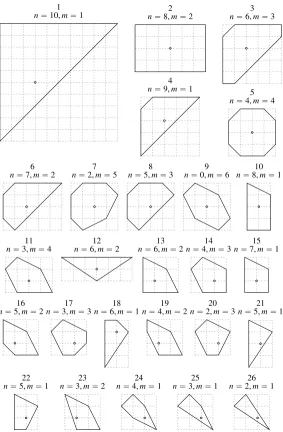
THEOREM 2. There are precisely 26 mutation-equivalence classes of Fano polygons with singularity content (n,{m × 1/3(1,1)}), m > 1. They are in bijective correspondence with the 26 qG-deformation families of del Pezzo surfaces with m×1/3(1,1)singular points that admit a toric degeneration.
In Theorem 7 we prove more generally that, up to mutation, the number of
Fano polygons with basket B is finite, and give an algorithm that outputs a
the algorithm are representatives for the same mutation-equivalence class. While there is currently no algorithm to determine whether two Fano polygons are
mutation-equivalent, a useful necessary condition is provided by Lemma3. If
one accepts Conjecture1 then Theorem 7 tells us that, for fixed basket B, the
number of qG-deformation-equivalence classes of del Pezzo surfaces of type TG
with singular pointsBis finite, and gives an algorithm for classifying their toric
degenerations.
1.2. An introduction from the viewpoint of cluster algebras and cluster varieties. One can obtain information about mutations of polygons using
quivers and the theory of cluster algebras [16, 17]. There is a precise analogy
between mutation classes of Fano polygons and the clusters of certain cluster
algebras, as we now describe. Let L ∼= Zn, and fix a skew-symmetric form{·,
·} on L. A cluster C is a transcendence basis for C(L), and a seed is a pair
(B,C)where B is a basis of L. There is a notion of mutationof seeds, given
in Definition 9below; this depends on the form {·,·}. Acluster algebrais the
algebra generated by all clusters that can be obtained from a given initial seed by
mutation. To a seed(B,C)one can associate a quiverQB with vertex set equal to
B and the number of arrows from ei ∈ B to ej ∈ B equal to max({ei,ej},0).
Changing the seed (B,C) by a mutation changes the quiver QB by a quiver
mutation(see Definition10). Conversely, from a quiver with vertex setBand no
vertex-loops or two-cycles, one can construct a cluster algebra by settingL=ZB,
defining{ei,ej}to be the (signed) number of arrows fromei ∈ Btoej ∈ B, and
taking the initial seed to be(B,C), whereC is the standard transcendence basis
forC(L).
We can also associate a quiver and a cluster algebra to a Fano polygon P
as follows. Suppose that the singularity content of P is (n,B). The associated
quiver QP hasnvertices; each vertexvcorresponds to aprimitive T -singularity
(Definition 3), and hence determines an edge E of P (these edges need not
be distinct). The number of arrows from vertex v to vertex v0
is defined to
be max(w∧w0,0), where ∧ denotes the determinant, and w and w0 are the
primitive inner normal vectors to the edges E andE0
of P. The cluster algebra
AP associated toP is the cluster algebra associated toQP; we denote the initial
seed of this cluster algebra by(BP,CP).
We show in Proposition2below that a mutation from a seed(B,C)to a seed
(B0,
C0)
induces a mutation between the corresponding Fano polygonsPandP0
.
We then show, in Proposition3, that a mutation from a Fano polygonPto a Fano
polygon P0
induces a mutation between the corresponding quivers QP and QP0.
EXAMPLE 1. Consider a Fano polygon P ⊂ NQcontaining only two primitive
T-singularities, and suppose that the corresponding inner normal vectors form a
basis for the dual latticeM. Then there are at most five polygons, up to GL2(Z)
-equivalence, that are mutation-equivalent toP. This follows from the fact that the
quiver associated to P has underlying graph A2, and that the exchange graph of
theA2cluster algebra is pentagonal; see Corollary4below.
1.3. An introduction from the viewpoint of the geometry of numbers. The relation between the lattice points in a convex body and its geometric shape and volume is a key problem in convex geometry and integer optimization. These connections have been addressed specifically for lattice polytopes, independently of their significance in toric geometry. Here we focus only on the case of interest in this paper, that of a Fano polygon. A classical result in this area is the following
(these statements can be generalized and quantified, see [24]):
THEOREM3 [31,39]. There are only finitely manyGL2(Z)-equivalence classes of Fano polygons P with I interior lattice points, for each I ∈Z>0.
COROLLARY 1. There are only a finite number of possibilities for the area and number of lattice points of a Fano polygon with I interior lattice points, for each I ∈Z>0.
In [2] a new equivalence relation on Fano polygons P was introduced,
called mutation-equivalence, that is weaker than GL2(Z)-equivalence. There
exist infinitely many mutation-equivalent Fano polygons that are not GL2(Z)
-equivalent (see, for example, [4, Example 3.14]) and so their area and number
of lattice points cannot be bounded. Mutation-equivalence does, however,
preserve the Ehrhart series (and hence area) of the dual polygon P∗ ⊂
MQ
(see Section2.2) [2, Proposition 4].
REMARK 1. It is known that the product Vol(P) · Vol(P∗)
of the (lattice
normalized) area of a polygonPand of its dual polygon P∗
cannot be arbitrarily
small [32], however it is easy to construct families of polygons where both
Vol(P)and Vol(P∗)
can simultaneously become arbitrarily large. For example,
Pk:=conv{(k,1), (k,−1), (−1,0)}fork∈Z>0.
Given a Fano polygon P there exists an explicit formula for the Ehrhart
series and area of the dual polygon P∗
in terms of the singularity contentof P
(see Section3.1) [3]. A consequence of this formula is that mutation-equivalent
Fano polygons cannot have an arbitrarily large number of vertices [3, Lemma 3.8];
equivalently, singularity content gives an upper bound on the Picard rank ofXP
Recall that theheight rE ∈Z>0 of a lattice line segmentE ⊂ NQis the lattice
distance ofEfrom the origin, and thelengthof the line segmentEis given by the
positive integerk= |E∩N| −1. Clearly there exist unique nonnegative integers
n and k0, 0 6 k0 < rE, such that k = nrE +k0. Suppose that E is the edge
of a Fano polygon, so that the vertices of E are primitive. As described in [3]
(see also Section3.1), one can decompose E into n+1 (ornifk0 =0) lattice
line segments with primitive vertices. Of these,nline segments have their length
equal to their height; the cones over these line segments correspond toprimitive
T -singularities. Ifk06=0 then there is one additional lattice line segment of length
k0<rE; the cone over this line segment corresponds to aresidual singularity.
Although there may be several different decompositions of this form for an
edgeE, it turns out that the residual singularity is unique – it does not depend on
the choice of decomposition. In addition, the collection of residual singularities
arising from all of the edges ofP, which we call thebasketof P and denote by
B, is a mutation invariant. We say that a lattice point of Pisresidualif it lies in
the strict interior of a residual cone, for some fixed choice of decomposition. The number of residual lattice points does not depend on the chosen decomposition,
but only on the basketBof P, and is invariant under mutation. The main results
of this paper can now be stated in a way analogous to the classical results above:
THEOREM4. There are only finitely many mutation-equivalence classes of Fano polygons P with N residual lattice points, for each N ∈Z>0.
Proof. If there are no residual cones then the result follows from Theorem5. In
order to use Theorem7we only have to show that the heightrE of an edge E
containing a residual cone is bounded. Letv1 andv2 be primitive points on E
such that cone{v1, v2}is a residual cone. The line segment joiningv1andv2 has length 16k <rE. We see that the lattice triangle conv{0, v1, v1+(v2−v1)/k}
has at mostN+3 lattice points. Pick’s formula [35] implies that its area and thus
the heightrEis bounded in terms of N.
COROLLARY2. There are only a finite number of possibilities for the dual area and the number of vertices of a Fano polygon with N residual lattice points, for each N ∈Z>0.
2. Mutation of Fano polygons
In [2, Section 3] the concept of mutation for a lattice polytope was introduced.
We state it here in the simplified case of a Fano polygon P⊂ NQand refer to [2]
for the general definitions.
2.1. Mutation in N. Letw∈ M :=Hom(N,Z)be a primitive inner normal
vector for an edgeEof P, sow: N →Zinduces a grading on NQandw(v)=
−rEfor allv∈E, whererE is the height ofE. Define
hmax:=max{w(v)|v∈ P} and hmin:= −rE =min{w(v)|v∈ P}.
We have thathmax> 0 andhmin< 0. For eachh ∈Zwe definewh(P)to be the
(possibly empty) convex hull of those lattice points in Pat heighth,
wh(P):=conv{v∈ P∩N |w(v)=h}.
By definitionwhmin(P)= Eandwhmax(P)is either a vertex or an edge of P. Let
vE ∈ N be a primitive lattice element of N such that w(vE) = 0, and define
F :=conv{0, vE}, a line segment of unit length parallel to Eat height 0. Notice
thatvE, and henceF, is uniquely defined only up to sign.
DEFINITION2. Suppose that for each negative heighthmin6 h<0 there exists
a (possibly empty) lattice polytopeGh ⊂ NQsatisfying
{v∈V(P)|w(v)=h} ⊆Gh+ |h|F⊆wh(P), (1)
where ‘+’ denotes the Minkowski sum, and we define ∅+ Q = ∅ for any
polytopeQ. We call Fafactorof P with respect tow, and define themutation
given by the primitive normal vectorw, factorF, and polytopes{Gh}to be:
mutw(P,F):=conv
−1
[
h=hmin Gh∪
hmax [
h=0
(wh(P)+h F) !
⊂NQ.
Although not immediately obvious from the definition, the resulting mutation
is independent of the choices of {Gh} [2, Proposition 1]. Furthermore, up to
isomorphism, mutation does not depend on the choice of vE: we have that
mutw(P,F)∼=mutw(P,−F). Since we consider a polygon to be defined only up
to GL2(Z)-equivalence, mutation is well defined and unique. Any mutation can
be inverted by inverting the sign ofw: ifQ :=mutw(P,F)thenP =mut−w(Q,
F)[2, Lemma 2]. Finally, we note that P is a Fano polygon if and only if the
We call two polygons P and Q ⊂ NQ mutation-equivalent if there exists a
finite sequence of mutations between the two polygons (considered up to GL2(Z)
-equivalence). That is, if there exist polygonsP0,P1, . . . ,PnwithP∼= P0,Pi+1= mutwi(Pi,Fi), andQ
∼
= Pn, for somen∈Z>0.
REMARK2. We remark briefly upon the three ways in which our definition above
differs slightly from that in [2].
(i) First, [2] does not require that the factor F be based at the origin. The
condition that0∈V(F)is harmless, and indeed we have touched on this
above when we noted thatFand−Fgive GL2(Z)-equivalent mutations: in
general translation of a factor F by a lattice point v ∈ w⊥ ∩
N, where
w⊥ := {v ∈
NQ | w(v) = 0}, results in isomorphic mutations. It is
reasonable to regard a factor as being defined only up to translation by
elements inw⊥∩
N, with the resulting mutation defined only up to ‘shear
transformations’ fixing the points inw⊥.
(ii) Second, the more general definition places no restriction on the dimension
of the factor F, although the requirement that F ⊂ w⊥
does mean that
codim(F)>1. In particular it is possible to take F =v, wherew(v)= 0.
But observe thatv=0+v, and mutw(·,0)is the identity, hence mutw(P, v)
is trivial. Thus our insistence that dim(F)=1 is reasonable.
(iii) Finally, our requirement thatFis of unit length is a natural simplification: in
general, if the factor can be written as a Minkowski sumF=F1+F2, where
we can insist that each Fi ⊂w⊥ and dim(Fi) >0, then the mutation with
factor F can be written as the composition of two mutations with factors
F1andF2(with fixedw). Thus it is reasonable to assume that the factor is
Minkowski-indecomposable and hence, for us, a primitive line segment.
In two dimensions, mutations are completely determined by the edges ofP:
LEMMA 1. Let E be an edge of P with primitive inner normal vectorw∈ M. Then P admits a mutation with respect towif and only if|E∩N| −1>rE.
Proof. Let k := |E∩N| −1 be the length of E. At height h = hmin = −rE,
condition (1) becomes E = Ghmin +rEF. Hence this condition can be satisfied
if and only ifk >rE. Suppose thatk >rE and consider the coneC :=cone(E)
generated byE. At heighthmin<h<0,h∈Z, the line segmentCh := {v∈C |
w(v) = h} ⊂ NQ (with rational end points) has length |h|k/rE > |h|. Hence
wh(C) ⊂ wh(P) has length at least |h| − 1. Suppose that there exists some
length at least|h|. Hence condition (1) can be satisfied. If{v ∈V(P)| w(v)=
h} =∅then we can simply takeGh =∅to satisfy condition (1).
Lemma1 states that the existence of a mutation of a polygon is completely
determined by a purely local condition on edge length (this is not the case in higher dimensions). As a consequence, we can rephrase mutation of polygons as follows.
COROLLARY 3 (See [1]). Choose an orientation of N and label the vertices of P byv1, v2, . . .counterclockwise, such thatw(v1)=hmaxandw(v2)6=hmax. Let
f ∈w⊥∩
N be a primitive lattice element. Then P admits a mutation with respect towand the unit line segment F =conv{0, f}if and only if there exists an edge
conv{vi, vi+1} such that w(vi) = w(vi+1) = hmin andvi+1 −vi = k f , where
k>−hminis a positive integer. In order to describe the mutation, we distinguish
between two cases:
(I) P has n verticesv1, . . . , vn andv1is the unique maximum forwon P;
(II) P has n+1verticesv1, . . . , vn+1andw(v1)=w(vn+1)=hmax.
Then the mutation of P with respect towis the Fano polygon with n+1vertices v0
1, . . . , v 0
n+1given by:
Case (I) Case (II)
v0
j =
vj if16 j 6i; vj+w(vj)f if i < j 6n; v1+hmaxf if j =n+1.
v0
j =
vj if16 j 6i; vj+w(vj)f if i< j 6n; vn+1+hmaxf if j=n+1.
2.2. Mutation in M. Given a Fano polygon P ⊂ NQ we define the dual
polygon
P∗ := {
u∈ MQ|u(v)>−1 for allv∈P} ⊂ MQ.
In general this has rational-valued vertices and necessarily contains the origin in its strict interior. Define
ϕ:MQ→ MQ
u7→u−uminw whereumin:=min{u(v)|v∈F}.
SinceF =conv{0, vE}, this is equivalent to
ϕ(u)=
This is a piecewise-GL2(Z) map, partitioning MQ into two half-spaces whose
common boundary is generated by w. Crucially [2, Proposition 4 and the
discussion on p. 12]:
ϕ(P∗)= Q∗ whereQ :=mutw(P,F).
An immediate consequence of this is that the area and Ehrhart series of the dual polygons are preserved under mutation:
Vol(P∗)=Vol(Q∗) and EhrP∗(t)=EhrQ∗(t).
Equivalently, mutation preserves the anti-canonical degree and Hilbert series of the corresponding toric varieties:
(−KXP)
2=(−K
XQ)
2 and Hilb(X
P,−KXP)=Hilb(XQ,−KXQ).
EXAMPLE 2. Consider the polygon P(1,1,1) := conv{(1,1), (0,1), (−1,−2)}
⊂ NQ. The toric variety corresponding to P(1,1,1) is P2. Let w = (0,−1)∈ M,
so thathmin = −1 andhmax =2, and set F = conv{0, (1,0)} ⊂ NQ. Then F is
a factor ofP(1,1,1)with respect tow, giving the mutation P(1,1,2):=mutw(P(1,1,1),
F)with vertices (0,1),(−1,−2),(1,−2)as depicted below. The toric variety corresponding toP(1,1,2)isP(1,1,4).
In MQwe see the mutation as a piecewise-GL2(Z)transformation. This acts on
the left-hand half-space{(u1,u2)∈ MQ|u1 <0}via the transformation
(u1,u2)7→(u1,u2)
1 −1 0 1
and on the right-hand half-space via the identity.
We can draw a graph of all possible mutations obtainable fromP(1,1,1): the vertices
vertices are connected by an edge if there exists a mutation between the two Fano polygons (notice that, since mutations are invertible, we can regard the edges as being undirected). We obtain a tree whose typical vertex is trivalent
[4, Example 3.14]:
(1,1,1)
(1,1,2)
(1,2,5)
(2,5,29)
(5,29,433) (2,29,169)
(1,5,13)
(5,13,194) (1,13,34)
Here the vertices have been labelled with weights(a,b,c), where the polygon
P(a,b,c) corresponds to the toric variety P(a2,b2,c2). The triples (a,b,c) are
solutions to the Markov equation
3x yz=x2+y2+z2,
and each mutation corresponds, up to permutation of a, b, and c, to a
transformation of the form(a,b,c)7→(3bc−a,b,c). In the theory of Markov
equations these transformations are also called mutations. A solution (a,b,c)
is calledminimal ifa +b+c is minimal, and every solution can be reached
via mutation from a minimal solution. Minimal solutions correspond to those
triangles with Vol(P(a,b,c)) minimal. In this example (1,1,1) is the unique
minimal solution. These statements can be generalized to any mutation between
triangles [4]. Hacking–Prokhorov [25] use these minimal solutions in their
classification of rank-one qG-smoothable del Pezzo surfaces of class TG.
3. Invariants of Fano polygons
We wish to be able to establish whether or not two Fano polygons are mutation-equivalent. In this section we introduce two mutation invariants of a Fano polygon
P ⊂ NQ: singularity content, discussed in Section3.1below, can be thought of
as studying the part of P that remains untouched by mutation (the basketB of
residual singularities); the cluster algebraAP, discussed in Section 3.3 below,
Although we have no proof, it seems likely that together these two invariants
completely characterize the mutation-equivalence classes. Finally, in Section3.4
we briefly mention the connection with affine manifolds and the Gross–Seibert program [22].
3.1. Singularity content. In [3] the concept of singularity content for a Fano polygon was introduced. First we state the definition for a cyclic quotient singularity 1/R(a,b), where gcd{R,a} =gcd{R,b} =1. (Recall that 1/R(a,b)
denotes the germ of a quotient singularityC2/µR, whereε∈µRacts via(x,y)7→
(εax, εby).) Letk,r,c∈
Zbe nonnegative integers such thatk =gcd{R,a+b},
R=kr, anda+b=kc. Thenris equal to theGorenstein indexof the singularity,
andk is called thelength(orwidth). Thus 1/R(a,b)can be written in the form
1/kr(1,kc−1)for somec∈Zwith gcd{r,c} =1.
DEFINITION3 (r|k). A cyclic quotient singularity such thatk=nrfor somen∈ Z>0, that is, a cyclic quotient singularity of the form 1/nr2(1,nr c−1), is called
aT -singularityor a singularity ofclass T. Whenn=1, so that the singularity is of the form 1/r2(1,r c−1), we call it aprimitive T -singularity.
DEFINITION4 (k<r). A cyclic quotient singularity of the form 1/kr(1,kc−1) withk<r is called aresidual singularityor a singularity ofclass R.
T-singularities appear in the work of Wahl [41] and Koll´ar–Shepherd–Barron
[29]. A cyclic quotient singularity is of class T if and only if it admits a
qG-smoothing. At the opposite extreme, a singularity is of class R if and only if
it is rigid under qG-deformation. More generally, consider the cyclic quotient singularityσ =1/kr(1,kc−1). Let 06k0<r andnbe the unique nonnegative
integers such thatk = nr +k0. Then either k0 = 0 and σ is qG-smoothable,
ork0 > 0 and σ admits a qG-deformation to the residual singularity 1/k0r(1,
k0c−1)[1,3]. This motivates the following definition:
DEFINITION 5 [3, Definition 2.4]. With notation as above, let σ = 1/kr
(1,kc−1)be a cyclic quotient singularity. Theresidueofσ is given by
res(σ ):=
∅ ifk0=0;
1
k0r
(1,k0c−1) otherwise.
EXAMPLE 3. Let σ = 1/nr2(1,nr c− 1) be a T-singularity. Then SC(σ ) =
(n,∅).
Singularity content has a natural description in terms of the coneC defining
the singularity. We call a two-dimensional coneC ⊂ NQaT -cone(respectively
primitive T -cone) if the corresponding cyclic quotient singularity is a T
-singularity (respectively primitiveT-singularity), and we callC anR-coneif the
corresponding singularity is a residual singularity. LetC = cone{ρ0, ρ1} ⊂ NQ
be a two-dimensional cone with rays generated by the primitive lattice points
ρ0 and ρ1 in N. The line segment E = conv{ρ0, ρ1} is at height r and has
length|E∩N| −1=k. Writek = nr +k0. Then there exists a partial crepant
subdivision ofC intonconesC1, . . . ,Cn of lengthr and, ifk0 6=0, one coneC0
of lengthk0 < r. Although not immediately obvious from this description, the
singularity corresponding to theR-coneC0is well defined and equal to 1/k0r(1,
k0c−1), where we refer to [3] for the precise definition ofc. The singularities
corresponding to thenprimitiveT-conesC1, . . . ,Cn depend upon the particular
choice of subdivision: again, see [3, Proposition 2.3] for the precise statement.
DEFINITION 6. Let P ⊂ NQ be a Fano polygon with edges E1, . . . ,Em,
numbered cyclically, and let σ1, . . . , σm be the corresponding two-dimensional
cyclic quotient singularities σi = cone(Ei), with SC(σi) = (ni,res(σi)). The singularity content of P, denoted by SC(P), is the pair (n,B), where n := Pm
i=1ni andB is the cyclically ordered list {res(σi)|16i 6m,res(σi)6=∅}.
We callBthebasketof residual singularities of P.
Singularity content is a mutation invariant of P [3, Proposition 3.6]. Intuitively
one can see this from Lemma 1: mutation removes a line segment of length
|hmin|from the edge at heighthmin, changing the corresponding singularity content
by(n,res(σ )) 7→(n−1,res(σ)); mutation adds a line segment of lengthhmax
at height hmax, changing the singularity content by (n0,
res(σ0)) 7→ (
n0 + 1, res(σ0))
. Put another way, mutation removes a primitiveT-cone with Gorenstein
index−hmin and adds a primitive T-cone with Gorenstein index hmax, leaving
the residual cones unchanged. We can rephrase Lemma1in terms of singularity
content:
LEMMA 2. Let E be an edge of P with primitive inner normal vectorw∈ M, and let(n,res(σ ))be the singularity content ofσ =cone(E). Then P admits a mutation with respect towif and only if n6=0.
Singularity content provides an upper bound on the maximum number of
on the Picard rankρof the corresponding toric varietyXP [3, Lemma 3.8]:
|V(P)|6n+ |B|, ρ6n+ |B| −2. (2)
EXAMPLE 4. Consider P(1,1) = conv{(1,0), (0,1), (−1,−3)}with correspond-ing toric varietyP(1,1,3). This has singularity content(2,{1/3(1,1)}), hence,
by (2), any polygon Qmutation-equivalent toP(1,1)has three vertices. Mutations
between triangles were characterized in [4]: the mutation graph is given by
(1,1) (1,4) (4,19) (19,91) (91,436) · · ·
Here the vertices have been labelled by pairs (a,b) ∈ Z2
>0, and correspond
to P(a2,b2,3) and its associated triangle. These pairs are solutions to the
Diophantine equation 5x y=x2+y2+3. Up to exchangingaandb, a mutation
of triangles corresponds to the mutation(a,b)7→(5b−a,b)of solutions. There is a unique minimal solution given by(1,1).
As noted in Section1.1, the toric variety XP is qG-deformation-equivalent to
a del Pezzo surface X with singular pointsB and topological Euler number of
X\Sing(X) equal to n [1, 3]. The degree and Hilbert series can be expressed
purely in terms of singularity content. Recall that information about a minimal
resolution of a singularityσ =1/R(1,a−1)is encoded in the Hirzebruch–Jung
continued fraction expansion[b1, . . . ,bs]ofR/(a−1); see, for example, [18]. For
eachi ∈ {1, . . . ,s}we inductively define the positive integersαi, βi as follows:
α1=βs =1,
αi/αi−1 := [bi−1, . . . ,b1], 26i 6s,
βi/βi+1:= [bi+1, . . . ,bs], 16i 6s−1.
The values−bi give the self-intersection numbers of the exceptional divisors of
the minimal resolution of σ, and the values di := −1+(αi +βi)/R give the
discrepancies. The degree contribution ofσ is given by:
Aσ :=s+1− s X
i=1
di2bi+2 s−1
X
i=1
didi+1.
The Riemann–Roch contributionQσ ofσ can be computed in terms of Dedekind
sums (see [38, Section 8]):
Qσ =
1 1−tR
R−1
X
i=1
(δai −δ0)ti−1 whereδj := 1 R
X
ε∈µR
ε6=1
εj
PROPOSITION 1 [3, Proposition 3.3 and Corollary 3.5]. Let P ⊂ NQbe a Fano polygon with singularity content(n,B). Let XP be the toric variety given by the spanning fan of P. Then
(−KXP)
2=12−
n−X
σ∈B Aσ
and Hilb(XP,−KXP)=
1+ (−KXP)
2−2 t +t2
(1−t)3 +
X
σ∈B Qσ.
The termsQσ can be interpreted as a periodic correction to the initial term
1+((−KXP)
2−2)t+t2
(1−t)3 =
X
i>0
i+1
2
(−KXP)
2+
1
ti.
Set Qnum :=(1−tR)Qσ. The contribution from Qσ at degreei is equal to the
coefficient oftm inQnum, wherei ≡m(mod R).
EXAMPLE 5. Let P ⊂ NQbe a Fano polygon with SC(P)= (n,{m ×1/3(1, 1)}), for somen∈Z>0,m ∈Z>0. ThenA1/3(1,1)=5/3,Q1/3(1,1)= −t/3(1−t3),
giving
Vol(P∗)=(−
KXP)
2 =12−n−5m/3
EhrP∗(t)=Hilb(XP,−KX P)
= 1+(11−n−2m)t +(12−n−m)t
2+(11−
n−2m)t3+t4 (1−t3)(1−t)2 .
In particular, for anyi >0,
|i P∗∩M| =h0(XP,−i KXP)=
i +1 2
(−KXP)
2+
1−
(m
3 ifi ≡1(mod 3);
0 otherwise.
Since|P∗∩
M| =13−n−2m>1 we have that 06n610 and 16m66−n/2.
Notice that (5,{4×1/3(1,1)}), (3,{5×1/3(1,1)}), and (1,{6×1/3(1,1)})
giveh0(X,−K
X) = 0, hence there cannot exist a corresponding Fano polygon
P(or toric surfaceXP). They do, however, correspond to the Euler numbers and
singular points of the del Pezzo surfaces X4,1/3, X5,2/3, and X6,7/2, respectively,
described in [14]. These three del Pezzo surfaces cannot be of class TG. It is
tempting to conjecture that havingh0(X,−K
X)=0 is the only obstruction to a
3.2. The sublattice ΓP of M. There exist examples of Fano polygons that have the same singularity content, but that are not mutation-equivalent (see
Example6below); there is additional structure in the arrangement of the primitive
T-singularities that singularity content ignores.
DEFINITION 7. Let P ⊂ NQ be a Fano polygon. DefineΓP to be the sublattice
ofM generated by all primitive inner normal vectorswto an edgeE of P with
|E∩N| −1>rE. Let[M :ΓP]denote the index of this sublattice inM.
We thank one of the referees for making the following observation. After
making a generic partial smoothingXofXPthe groupM/ΓP is the fundamental
group of the complement U of an anti-canonical divisor in X. Indeed, U
is homotopy equivalent to a torus with discs glued along representatives of homology classes defined by vanishing cycles of a (singular) torus fibration from
U to a disc, and these classes are precisely the vectorsw∈Min Definition7.
LEMMA 3. Let P ⊂ NQ be a Fano polygon and let Q := mutw(P,F) be a
mutation of P. Then[M :ΓP] = [M :ΓQ].
Proof. Recall from Section 2.2that mutation acts on the element of M via the piecewise-linear mapϕ:u7→u−uminw, whereumin:=min{u(vF)|vF ∈V(F)}.
By Lemma1,w∈ΓP andϕmapsΓP to itself. Mutations are invertible, with the
inverse to mutw(·,F)being mut−w(·,F). Thus the index is preserved.
EXAMPLE6. Consider the reflexive polygons
R15=conv{(1,0), (0,1), (−1,−1), (0,−1)} ⊂NQ and R16=conv{(1,0), (0,1), (−1,0), (0,−1)} ⊂ NQ.
The toric varieties defined via the spanning fan are the del Pezzo surfaces F1
and P1 ×
P1 respectively. Both R15 and R16 have singularity content (4,∅).
The primitive normal vectors to the edges of R15 generate all of M, whereas
the normal vectors of the edges of R16 generate an index-two sublattice ΓP =
h(1,1), (−1,1)i ⊂ M. Lemma 3 shows that R15 and R16 are not
mutation-equivalent. We give another proof of this, using quiver mutations, in Example7
below.
3.3. Quivers and cluster algebras. We first recall the definition of cluster
algebra [16,17], having fixed a rank-nlatticeLand skew-symmetric form{·,·}.
DEFINITION9. Given a seed(B,C)withB= {e1, . . . ,en}andC = {x1, . . . ,xn},
the j th mutation of (B,C) is the seed (B0,
C0)
, where B0 = {
e0 1, . . . ,e
0
n} and C0= {
x0 1, . . . ,x
0
n}are defined by:
e0k=
−ej ifk = j,
ek+max(bk j,0)ej otherwise,
wherebk j = {ek,ej},
xk0 =xk ifk6= j and xjx
0
j = Y
ksuch that
bj k>0 xbj k
k +
Y
lsuch that
bjl<0 xbl j
l .
Recall from Section 1.2that there is a quiver QP and a cluster algebra AP
associated to a Fano polygonP. Let SC(P)=(n,B)and fix a numbering of the
n primitiveT-cones in the spanning fan of P. Theith primitive T-cone in the
spanning fan of P corresponds to a vertex vi of QP, and thus corresponds to a
basis elementei in BP, where(BP,CP)is the initial seed forAP. Let Ei denote
the edge ofPdetermined by theith primitiveT-cone; note that different primitive
T-cones can determine the same edge.
PROPOSITION2 (Mutations of seeds induce mutations of polygons). Let P⊂NQ be a Fano polygon with singularity content (n,B). Denote by wi ∈ M the primitive inner normal vector to Ei. Consider the map π: L → M such that π(ei)=wifor each i . Let(BP,CP)be the initial seed forAP, and write B= {e1,
. . . ,en}, C = {x1, . . . ,xn}. Let(B0,C0)be the j th mutation of(BP,CP), and write B0= {
e0 1, . . . ,e
0
n}. Then{π(e
0
1), . . . , π(e 0
n)}are the primitive inner normal vectors to the edges of P0
, where P0
is the mutation of P determined bywj. Furthermore, every mutation P0
of P arises in this way.
Proof. This is a straightforward calculation using mutation inM(see Section2.2).
There is a well-known notion of quiver mutation, going back to Bernstein–
Gelfand–Ponomarev [9], Fomin–Zelevinsky [17], and others.
DEFINITION10. Given a quiverQand a vertexvofQ, themutation of Q atvis
the quiver mut(Q, v)obtained fromQby:
(i) adding, for each subquiverv1→v→v2, an arrow fromv1tov2;
(ii) deleting a maximal set of disjoint two-cycles;
The resulting quiver is well defined up to isomorphism, regardless of the choice of two-cycles in(ii).
PROPOSITION3 (Mutations of polygons induce mutations of quivers). Let P be a Fano polygon, letvbe a vertex of QP corresponding to a primitive T -cone in P, and let P0
be the corresponding mutation of P. We have QP0 =mut(QP, v).
Proof. Let E denote the edge of P determined by the primitive T-cone
corresponding to v, and let w ∈ M denote the primitive inner normal vector
toE. Mutation with respect towacts onM as a piecewise-linear transformation
that is the identity in one half-space, and on the other half-space is a shear
transformation u 7→ u + (w ∧ u)w. Thus determinants between the pairs of
normal vectors change as follows.
(i) The inner normal vectorwto the mutating edgeEbecomes−w, so that all
arrows intovchange direction.
(ii) For a pair of normal vectors in the same half-space (as defined byw), the
determinant does not change.
(iii) Consider primitive T-cones with inner normal vectors in different
half-spaces (as defined byw), let the corresponding vertices ofQP bev1andv2,
and let the corresponding inner normal vectors inMbew1andw2. Without
loss of generality we may assume thatw1∧w > 0 andw2∧w < 0, so
that there are arrowsv1 → v → v2in QP. Under mutation, the primitive
inner normal vectors change as w1 7→ w10, w2 7→ w02 where w
0
1 = w1,
w0
2 =w2+(w∧w2)w. Thus:
w0
1∧w
0
2=w1∧w2+(w∧w2)(w1∧w)
and so we add an arrow for each path v1 → v → v2. Cancelling
two-cycles results in precisely the result of calculating the signed total number of arrows fromv1tov2.
Observing finally that ifv1, v2 give normal vectors in the same half-space then
there are no pathsv1 →v → v2 orv2 → v →v1, we see that this description
coincides with that of a quiver mutation.
Propositions2and3give upper and lower bounds on the mutation graphs of
Fano polygons. For example:
corresponding to the two primitive T -cones form a basis of the dual lattice M (that is, ifΓP = M), then the mutation-equivalence class of P has at most five members.
Proof. The quiver associated to P is simply the A2 quiver. The cluster algebra
APis therefore well known (being the cluster algebra associated to theA2quiver)
and its cluster exchange graph forms a pentagon. However, note that thequiver
mutation graph is trivial, as the A2 quiver mutates only to itself. Proposition2
implies that the mutation graph ofPhas at most five vertices. (Proposition3does
not give a nontrivial lower bound here: indeed polygon7in Figure2(page40)
gives an example of such a polygonPwith trivial mutation graph.)
EXAMPLE 7. For the polygons R15and R16considered in Example6above the associated quiversQR15andQR16 are:
• +3•
•
O
O ??
•
k
s
_
_ • +3•
•
K
S
•
k
s
QR15 QR16
Observe that forQR16the number of arrows between any two vertices is even. It is
easy to see that this property is preserved under mutation. Therefore, the quivers
QR15 andQR16 are not mutation-equivalent, and so the polygons R15andR16 are
not mutation-equivalent.
REMARK 3. Following Fock–Goncharov [16], Gross–Hacking–Keel [20], and
Mandel [33], there is a rich interplay between the theory of cluster algebras and
the geometry of log Calabi–Yau surfaces.
In [20, Construction 5.3] a cluster structure analogous to the one defined
in Section1.2 is given. In this construction, the collection of basis vectors ei
comprising a seed is mapped to a collection of vectorswi which are interpreted
as generating elements for the rays of a fan in a two-dimensional lattice. This
toric surface is then blown up at k points on each divisor Dw, where k is the
number of seed vectors mapping tow, and the family of such surfaces is denoted
Y. Combining this with the construction described in Section1.2, given a Fano
polygon P we can produce a log Calabi–Yau surface by blowing upm points
on the boundary of a toric surface given by the normal fan toP, wheremis the
singularity content of the corresponding edge ofP.
Following [20] further, the family of surfacesY obtained by this elementary
variety’ defined in [16]. Indeed, Fock–Goncharov define a pair of (mirror-dual)
varieties (theX- andA-type cluster varieties) directly from the data of a cluster
algebra. Interpreting Y as a cluster variety, it is covered by seed tori whose
transition functions are the mutations appearing in [2].
The expected mirror-duality in this context is between the X-type cluster
variety equipped with a superpotential W, and the generic smoothing of the
toric variety XP. Indeed, a mirror construction for log Calabi–Yau surfaces is
described by Gross–Hacking–Keel in [21], and in [36] it is shown that, in this
context, the corresponding family does indeed arise from the smoothing of the toric varietyXP.
3.4. Affine manifolds. This section sketches a more geometric approach to finding mutation invariants of polygons, based on the foundational papers of
Gross–Siebert [23] and Kontsevich–Soibelman [30]. In broad terms, one wishes
to generalize the fact that the dual polygonP∗
is the base of a special Lagrangian torus fibration given by the moment map, by allowing more general bases and more general torus fibrations. Specifically, the base of a special Lagrangian torus
fibration carries anaffine structure [22, 30]. Deforming the torus fibration then
leads to a deformation of the ‘candidate base’ (actually exhibiting a fibration over the deformed base is fraught with difficulty); the deformed base does not have the
structure of a polygon, but rather is anaffine manifold.
REMARK 4. While the passage from affine manifolds to algebraic geometry requires sophisticated technology from the programs of Kontsevich–Soibelman
and Gross–Siebert, a construction of a Lagrangian fibration over this affine
manifold with ‘smoothed corners’ was described by Symington [40].
DEFINITION 11. A two-dimensional integral affine manifold B is a manifold
which admits a maximal atlas with transition functions in GL2(Z)n Z2.
EXAMPLE 8. The interior of P∗
is an example of an integral affine manifold,
covered as it is by a single chart. The polygonP∗itself is an example of an
affine manifold with corners.
Allowing singular fibres in the special Lagrangian torus fibration corresponds
roughly to the base manifold acquiring focus–focus singularities. Here we say
‘roughly’ because, following Gross–Siebert [22], we should be considering toric
degenerationsrather than torus fibrations; see [23,30]. The local model for such
a singularity isR2\{0}, regarded as an affine manifold via a cover with two charts
with the transition function
(x,y)7→
(x,y) ify>0; (x+y,y) ify<0.
Sliding singularities, which Kontsevich–Soibelman callmoving worms[30], gives
an affine analogue of the deformations of the varieties. In particular, allowing singularities to collide with boundary points of the affine manifold creates corners and provides an analogue for the toric qG-degenerations of the surface. This process, and its lifting via the Gross–Siebert program to construct the
corresponding degeneration of algebraic varieties, are described in [36].
Given the dual polygonP∗
, the set of singularities that we can introduce is in
natural bijection with the primitiveT-cones appearing in the singularity content of
P. Consider the following process. Take a primitiveT-coneσ ofP, and introduce
the corresponding singularity into the interior of P∗
, partially smoothing that
corner and forming an affine manifold B. Now slide this singularity along the
monodromy-invariant line, all the way to the opposite of B, and so forming a
polygonP0∗
with dual polygonP0
.
LEMMA4. P0
is equal to the mutation of P defined by the primitive T -coneσ.
Proof. Mutation induces a piecewise-linear transformation on the dual polygon. In fact this corresponds exactly to the transition function between the two charts
defining B. As the singularity approaches a corner, one of the charts covers all
but a line segment with vanishing length, hence the polygons are related by the piecewise-linear transition function applied to the entire polygon.
Given a polygon P∗
one can introduce a maximal set of singularities and
thus form an affine manifold B. Regarding two affine manifolds which differ
by moving singularities along monodromy-invariant lines as equivalent, we see that every polygon in the same mutation class is equivalent as an affine manifold.
This gives a mutation invariant — the affine manifold B — which we can use
to distinguish minimal polygons. Specifically, we can compare the respective
monodromy representations. Since the transition functions of B are in GL2(Z) we can define parallel transport of integral vector fields. Fixing a basepoint
in B, parallel transport around loops gives a representation π1(B) → SL2(Z).
Properties of this representation may be used to distinguish different mutation
classes of polygons. For example, in the cases considered in Example 6, one
4. Minimal Fano polygons
Given a polygon P ⊂ NQ we want to find a preferred representative in the
mutation-equivalence class ofP. Let∂Pdenote the boundary ofPand letP◦:=
P\∂Pdenote the strict interior of P. We introduce the following definition:
DEFINITION12. We call a Fano polygonP⊂ NQminimalif for every mutation
Q:=mutw(P,F)we have that|∂P∩N|6|∂Q∩N|.
Minimality is a local property of the mutation graph. It is certainly possible for there to exist more than one minimal polygon in a given mutation-equivalence
class (see Example 9 below); however, the number is finite. This is shown in
Theorem5in the case whenB= ∅, and in Theorem7whenB 6= ∅. Given a
polygonP⊂NQone can easily construct a mutation-equivalent minimal polygon.
Set P0 := P and recursively define Pi+1 as follows. LetΓi := {Pi} ∪ {mutw(Pi,
F) | for all possiblew ∈ M} where, as usual, we regard a polygon as being
defined only up to GL2(Z)-equivalence. PickPi+1∈Γi such that|∂Pi+1∩N| =
min{|∂Q∩N| | Q∈Γi}. If|∂Pi∩N| = |∂Pi+1∩N|we stop, and Piis minimal.
Notice that this process must terminate in a finite number of steps.
LEMMA5 (Characterization of minimality). Let P ⊂NQbe a Fano polygon. The
following are equivalent:
(i) P is minimal;
(ii) |∂P∩ N|6|∂Q∩N|for every mutation Q:=mutw(P,F);
(iii) |P◦∩
N|6|Q◦∩
N|for every mutation Q :=mutw(P,F);
(iv) Vol(P)6Vol(Q)for every mutation Q:=mutw(P,F);
(v) r1+ · · · +rn6s1+ · · · +sn for every mutation Q:=mutw(P,F), where the ri (respectively si) are the Gorenstein indices of the primitive T -cones associated with P (respectively Q).
Proof. LetC be an arbitrary cone (not necessarily a T-cone) corresponding to the cyclic quotient singularity 1/R(a,b). Letρ1, ρ2 ∈ N be the primitive lattice
vectors generating the rays ofC. Recall thatk = gcd{R,a+b}is the length of
the line segmentρ1ρ2, and that the Gorenstein indexr = R/gcd{R,a+b}is the
height ofρ1ρ2. SetD :=conv{ρ1, ρ2,0}. SinceR=k+2|D◦∩N|we have that:
|D◦∩N| = R−k
2 =
k(r −1)
2 .
Let P have singularity content (n,B), and let r1, . . . ,rn be the Gorenstein
indices of the primitiveT-cones. Then the number of boundary points is
|∂P∩ N| = n X
i=1
ri+ X
B
(|∂D∩N| −1), (3)
whereP
B(|∂D∩N| −1)is the contribution arising from the basketB, and the
number of interior points is given by
|P◦∩N| =1+ 1
2
n X
i=1
ri(ri−1)+ X
B
|D◦∩N|, (4)
whereP
B|D
◦∩
N|is the contribution arising from the basketB. Notice that the
values of bothP
B(|∂D∩N| −1)and P
B|D
◦∩
N|are fixed under mutation. By
applying Pick’s formula we obtain
Vol(P)= |∂P∩N| +2|P◦∩
N| −2= n X
i=1
ri2+B (5)
where B:=P
B(|∂D∩N| −1)+2P B|D
◦∩
N|is a constant under mutation.
Mutation can change the value of only oneri at a time, hence equations (3), (4),
and (5) are all locally minimal with respect to mutation if and only ifr1+ · · · +rn
is locally minimal with respect to mutation.
REMARK 5. Recall that mutations between Fano triangles are characterized in
terms of solutions to a Diophantine equation [4]. Every solution can be obtained
from a minimal solution – a solution(a,b,c) ∈ Z3>0 whose suma +b+c is
minimal – and a minimal solution corresponds to a triangle with smallest area [4,
Lemma 3.16]. By Lemma5(iv)we see that the notion of minimality introduced in
Definition12above can be viewed as a generalization of the concept of minimal
solution.
EXAMPLE 9. Any reflexive polygon P has |P◦∩
N| = 1, and so is minimal
by Lemma 5(iii). In particular this gives us examples of mutation-equivalent
polygonsP16∼= P2, both of which are minimal. For example, one could takeP1=
conv{(±1,0), (0,±1)} and P2 = conv{(1,0), (0,1), (−1,−2)} (the polygons
associated withP1×
P1andP(1,1,2), respectively).
An immediate consequence of Lemma5(v)is the following:
EXAMPLE 10. Any centrally symmetric polygon (that is, any polygon P
satisfying v ∈ P if and only if −v ∈ P) is minimal: for any primitive inner
normal vectorw∈M,|hmin| =hmax.
COROLLARY6. Let P:=conv{v0, v1, v2}be a Fano triangle with residual basket B=∅. Then P is minimal if and only ifv0+v1+v2∈ P.
Proof. Setv :=v0+v1 +v2 ∈ N. Let E be an edge of P and letw∈ M be
the corresponding primitive inner normal vector. Thenw(v)=w(v0)+w(v1)+
w(v2) = 2hmin+hmax, and|hmin| 6 hmax if and only ifvlies in the half-space
HE := {v ∈ NQ | w(v) > hmin}. By Corollary5we have that P is minimal if
and only ifv∈T
HE, where the intersection is taken over all edgesEof P. The
result follows.
5. Minimal Fano polygons with onlyT-singularities
In Theorem 5 below we classify all minimal Fano polygons with residual
basketB=∅. Conjecture1tells us that the mutation-equivalence classes should
correspond to the ten qG-deformation classes of smooth del Pezzo surfaces, and in
Theorem6we find that this is indeed what happens. In particular, in the case when
XP is a rank-one toric del Pezzo surface with onlyT-singularities we recover the
results of Hacking–Prokhorov [25, Theorem 4.1]. Perling has also studied these
surfaces from the viewpoint of mutations of exceptional collections [34].
DEFINITION 13. Let P ⊂ NQ be a Fano polygon with vertex set denoted by
V(P)and edge set denoted byF(P). For each edgeE ∈F(P)ofPthe unique
primitive lattice point in the dual lattice M := Hom(N,Z) defining an inner
normal of Eis denoted bywE. The positive integerrE := −wE(E)(that is, the
height ofEabove the origin0) is equal to the Gorenstein index of the singularity
associated with cone(E). We call rE the Gorenstein index (or local index) of
E. Themaximum Gorenstein index(also called themaximum local index) is the
maximum Gorenstein index of all edges ofP:
mP :=max{rE | E ∈F(P)}.
TheGorenstein index rP of a Fano polygonPis the least common multiple of the
Gorenstein indices:
rP :=lcm{rE | E ∈F(P)}.
Equivalently,rPis equal to the smallest positive integer`such that`P∗is a lattice
polygon. In terms of the toric variety XP, rP is equal to the smallest positive
LEMMA 6. Let P = conv{v0, v1, v2} ⊂ NQ be a Fano triangle, and let(λ0, λ1,
λ2)∈Z3>0be such thatλ0v0+λ1v1+λ2v2=0. Then:
Vol(P)·Vol(P∗)= (λ0+λ1+λ2)
3
λ0λ1λ2
.
Proof. We give a toric proof; for a combinatorial argument, see [6,
Proposition 6.2]. We can assume that the weights (λ0, λ1, λ2) are coprime
and, since P is a Fano polygon, this implies that the weights are pairwise
coprime. Recall [27] that the Fano trianglePcorresponds to some fake weighted
projective spaceXP = P(λ0, λ1, λ2)/G, whereG = N/N0 is the quotient ofN
by the sublatticeN0 = v
0·Z+v1 ·Z+v2·Z generated by the vertices of P.
The order |G|, or equivalently the index[N : N0]
of the sublattice N0
, is called themultiplicityofP, and denoted by mult(P). Let Q ⊂ NQbe the Fano triangle
associated with weighted projective spaceXQ =P(λ0, λ1, λ2). Then
Vol(Q)=λ0+λ1+λ2 and Vol(Q∗)= (λ0+λ1+λ2)
2
λ0λ1λ2
,
where the second value is simply the degree(−KXQ)
2of the weighted projective
space XQ. But Q is GL2(Z)-equivalent to the restriction of P to N0. Hence
Vol(P)=mult(P)·Vol(Q)and:
Vol(P∗)= 1
mult(P)·Vol(Q
∗
)= (λ0+λ1+λ2)
3
λ0λ1λ2
· 1
Vol(P).
LEMMA7 [28, Lemma 2.1]. Let P⊂NQbe a Fano polygon and let E be an edge
with Gorenstein index equal to the maximum Gorenstein index of P, rE = mP. Assume that there exists a nonvertex lattice pointv∈cone(E)withwE(v)= −1. For every lattice pointv0∈
P∩N\E we have thatv+v0∈
P∩N . In particular, if E0
is an edge of P that is not parallel tov, then|E0∩
N|6|E∩N|.
THEOREM 5. Let P ⊂ NQ be a minimal Fano polygon with residual basket B=∅. Then, up toGL2(Z)-equivalence, P is one of the following35polygons:
(i) the five reflexive trianglesR1, . . . ,R5in Table1;
(ii) the eleven reflexive polygonsR6, . . . ,R16in Table2;
(iii) the nine nonreflexive trianglesT1, . . . ,T9in Table1;
A.
Kasprzyk,
B.
Nill
and
T
.
Prince
[image:26.420.100.495.114.355.2]26
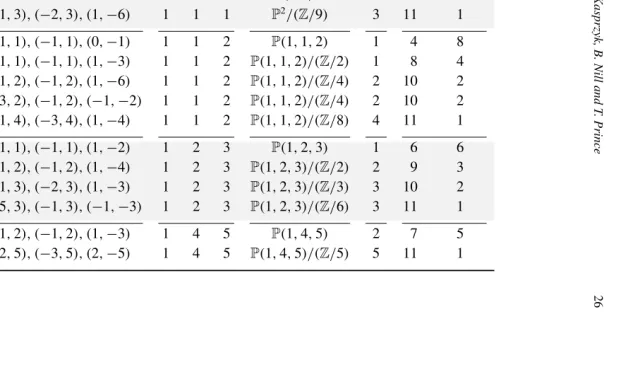
Table 1. The minimal Fano triangles P ⊂ NQ with singularity content(n,∅), vertices V(P),
maximum Gorenstein index mP, and weights(λ0, λ1, λ2), up to the action of GL2(Z). The
corresponding toric varieties XP and degrees(−KXP)
2 = 12−n are also given. Those P
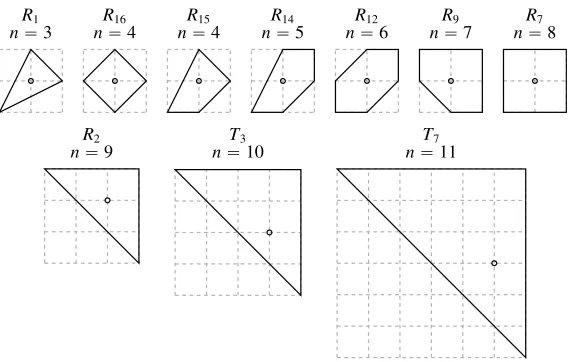
marked with?are chosen as the representative polygon in the mutation-equivalence class, and
are depicted in Figure1(page32).
P V(P) λ0 λ1 λ2 XP mP n (−KXP)
2
?R1 (1,0), (0,1), (−1,−1) 1 1 1 P2 1 3 9 ?R2 (1,1), (−2,1), (1,−2) 1 1 1 P2/(Z/3) 1 9 3
T1 (1,3), (−2,3), (1,−6) 1 1 1 P2/(Z/9) 3 11 1
R3 (1,1), (−1,1), (0,−1) 1 1 2 P(1,1,2) 1 4 8
R4 (1,1), (−1,1), (1,−3) 1 1 2 P(1,1,2)/(Z/2) 1 8 4
T2 (1,2), (−1,2), (1,−6) 1 1 2 P(1,1,2)/(Z/4) 2 10 2
?T3 (3,2), (−1,2), (−1,−2) 1 1 2 P(1,1,2)/(Z/4) 2 10 2
T4 (1,4), (−3,4), (1,−4) 1 1 2 P(1,1,2)/(Z/8) 4 11 1
R5 (1,1), (−1,1), (1,−2) 1 2 3 P(1,2,3) 1 6 6
T5 (1,2), (−1,2), (1,−4) 1 2 3 P(1,2,3)/(Z/2) 2 9 3
T6 (1,3), (−2,3), (1,−3) 1 2 3 P(1,2,3)/(Z/3) 3 10 2
?T7 (5,3), (−1,3), (−1,−3) 1 2 3 P(1,2,3)/(Z/6) 3 11 1
T8 (1,2), (−1,2), (1,−3) 1 4 5 P(1,4,5) 2 7 5
T9 (2,5), (−3,5), (2,−5) 1 4 5 P(1,4,5)/(Z/5) 5 11 1
https://www.cambridge.org/core/terms
.
https://doi.org/10.1017/fms.2017.10
https://www.cambridge.org/core
. IP address:
46.22.140.136
, on
21 Aug 2017 at 16:43:06
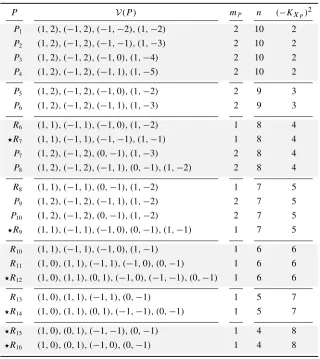
Table 2. The minimal Fano m-gons,m > 4, P ⊂ NQ with singularity content(n,∅), vertices V(P), and maximum Gorenstein index mP, up to the action of GL2(Z). The
degrees(−KXP)
2 = 12−n of the corresponding toric varieties are also given. Those
P marked with?are chosen as the representative polygon in the mutation-equivalence class, and are depicted in Figure1(page32).
P V(P) mP n (−KXP)
2
P1 (1,2), (−1,2), (−1,−2), (1,−2) 2 10 2
P2 (1,2), (−1,2), (−1,−1), (1,−3) 2 10 2
P3 (1,2), (−1,2), (−1,0), (1,−4) 2 10 2
P4 (1,2), (−1,2), (−1,1), (1,−5) 2 10 2
P5 (1,2), (−1,2), (−1,0), (1,−2) 2 9 3
P6 (1,2), (−1,2), (−1,1), (1,−3) 2 9 3
R6 (1,1), (−1,1), (−1,0), (1,−2) 1 8 4
?R7 (1,1), (−1,1), (−1,−1), (1,−1) 1 8 4
P7 (1,2), (−1,2), (0,−1), (1,−3) 2 8 4
P8 (1,2), (−1,2), (−1,1), (0,−1), (1,−2) 2 8 4
R8 (1,1), (−1,1), (0,−1), (1,−2) 1 7 5
P9 (1,2), (−1,2), (−1,1), (1,−2) 2 7 5
P10 (1,2), (−1,2), (0,−1), (1,−2) 2 7 5
?R9 (1,1), (−1,1), (−1,0), (0,−1), (1,−1) 1 7 5
R10 (1,1), (−1,1), (−1,0), (1,−1) 1 6 6
R11 (1,0), (1,1), (−1,1), (−1,0), (0,−1) 1 6 6
?R12 (1,0), (1,1), (0,1), (−1,0), (−1,−1), (0,−1) 1 6 6
R13 (1,0), (1,1), (−1,1), (0,−1) 1 5 7
?R14 (1,0), (1,1), (0,1), (−1,−1), (0,−1) 1 5 7
?R15 (1,0), (0,1), (−1,−1), (0,−1) 1 4 8 ?R16 (1,0), (0,1), (−1,0), (0,−1) 1 4 8
Proof. We consider the cases when Pis reflexive, that ismP =1, and whenPis
not reflexive, that ismP >1, separately.
mP =1: Every reflexive polygon is minimal since |P◦∩N| = 1. The
there are sixteen polygons [7, 37], of which five are triangles. This proves (i)
and(ii).
mP >1: LetE∈F(P)be an edge of maximum Gorenstein indexrE =mP >1.
By assumption the length ofEis some multiplek∈Z>0ofrE, that is,|E∩N| =
krE +1. Since the coneC =cone(E)is a union ofkprimitiveT-cones, each of
which contains exactly one point at height−1 with respect towE, there existk
distinct pointsv1, . . . , vk∈C◦∩N such thatwE(vi)= −1. After suitable change of basis we can insist thatE = conv{(−a,rE), (b,rE)}wherea,b> 0,a <rE,
anda+b =krE. Hence the point((i −1)rE,rE)lies in the strict interior of E
and so, after possible reordering,vi =(i−1,1), for eachi =1, . . . ,k.
Letv ∈ V(P) be a vertex of P such thatwE(v) = max{wE(v0)|v0∈
P} =
hmax. Since P is minimal by assumption, we have that wE(v) > rE = |hmin|
(Corollary5). By Lemma7we have thatvis contained in the stripE−v1·Z>0.
Hence we can writev =(α,−β)for someβ >rE and−a 6 α 6b. Ifk > 1
then we havev∈ E−vk·Z>0and so
−a6α6b−(k−1)(rE +β)6b−2(k−1)rE = −a−(k−2)rE. (6)
We conclude thatk 62.
k=2: Let us first consider the case whenk=2. By (6) Pis a triangle given by
P=conv{(−a,rE), (−a+2rE,rE), (−a,−rE)},
where 0<a<rE,gcd{a,rE} =1.
Let E0 ∈ F(
P) be the edge with vertices (−a,rE) and (−a,−rE). Since the
corresponding cone is of class T, we have that a | 2rE, and so a = 1 or 2.
Analogously, by considering the edge with vertices(−a,−rE)and(2rE −a,rE)
of length 2rEand Gorenstein indexrE−a, we seerE−a|2rE. This leads to(rE, a)∈ {(2,1), (3,1), (3,2), (4,2), (6,2)}. The first possibility gives the triangleT3
in Table1, the second and third possibilities define the triangleT7, and the final
two possibilities are excluded because of gcd{a,rE} =1.
k=1: We now consider the case whenk =1. This is subdivided into two cases
depending on whether or not there exists an edgeE0∈F(
P)parallel to E.
EdgeE0
parallel toE: Let us assume that there exists a second point of P at
heightwE(v); that is, that there exists an edge E0 ∈ F(
P)such thatwE(E0)=
wE(v), so thatEandE0are parallel. By minimality we see that
rE0 =rE, and by
Lemma7we have that|E0∩
N|6|E∩N| =rE+1. Recalling that cone(E0)is
aT-cone, and hencerE0 | |E0∩N| −1, we see that Pis a rectangle:
SincePis minimal we have that 2a=rEand, by primitivity of the vertices,a=1, rE =2, giving P1in Table2.
No edge parallel toE: We are now in the situation wherevis the unique vertex
satisfying wE(v) = max{wE(v0)|v0∈
P}. We subdivide this into two cases
depending on whether one of the edgesE0∈F(
P)with vertexvis vertical.
E0
not vertical: Let us assume that there is no vertical edge adjacent to v =
(α,−β). We consider the case α > 0 (the case α < 0 being similar). By our
assumption, we can choose an edge E0
adjacent tovwithwE0 = (−γ, δ)∈ M,
whereγ, δ > 1. We have thatrE > −wE0(v)= γ α +δβ > α+β > β >rE.
Hence(α,−β) = (0,−rE), wE0 = (−γ,1), and rE0 = rE = mP. Exchanging
the roles of E and E0
we have that E0
is of length either 2rE, in which case
we are in the casek = 2 above, or of lengthrE, in which case (rE, (γ −1)rE)
is a vertex of P. This is a contradiction, since as rE > b, this vertex is not
contained in the stripE−v1·Z>0.
E0
vertical: The majority of cases arise whenv is contained in a vertical edge
E0 ∈ F(
P). This edge necessarily contains one of the two vertices of E, and
without loss of generality (since a + b = rE) we may assume that E
0
=
conv{v, (b,rE)}. Hencev = (b,rE − j b)for some j ∈ Z>0. Minimality forces rE − j b6−rE, so that
j b>2rE. (7)
Moreover, minimality implies
2b6rE. (8)
In particular we see that j >4.
j =4: The case when j = 4 is different from the cases when j > 5, and
we deal with it now. Equations (7) and (8) gives that 2b = rE, and so by
primitivity we have thatrE =2 andb=1. HencePis contained in the rectangle
[−1,1] × [−2,2]. Notice that the requirement that0∈ P◦ means that
Pcannot
be a triangle. We findP5,P8,P9, andP10in Table2.
j >5: Consider the triangle
T :=conv{(b−rE,rE), (b,rE), (b,rE − j b)}.
By (7)−rE>rE−j b, so the point(b,−rE)is inT. The midpoint of(b,−rE)and (b−rE,rE)is(b−rE/2,0). Equation (8) impliesb−rE/260. Ifb−rE/2<0
then0∈T◦
. Ifb−rE/2=0 then j >5 implies that(b,−rE)is not equal to the
vertex(b,rE − j b), so0=(b−rE/2,0)∈T◦again.
This shows thatT is a Fano triangle. We have that Vol(T)= j brE. Moreover,
one can check that
(j b2,j brE− j b2−r2E,r
2
E)∈Z
3
satisfy the conditions of Lemma6. Hence
Vol(T∗)= j
j brE − j b2−r2E .
By Proposition1(note Vol(P∗)=(−
KXP)
2andB=
∅), Vol(P∗)∈Z>0, and so
16Vol(P∗)
6Vol(T∗)
. Letb=rEq, where 2/j 6q 61/2, by (7) and (8), so
that the lower bound on Vol(T∗)
gives:
rE2(−j q2+ j q−1)6 j. (9)
The quadratic inq on the left-hand side of (9) is strictly positive in the range
2/j 6q61/2 and obtains its minimum value whenq =2/j. Hence (9) gives:
r2E 6 j 2
j−4. (10)
Recall from Proposition1 that Vol(P∗) =
12−n > 1, wheren is the total
number of primitiveT-cones spanned by the edges ofP; equivalently,
n= X
F∈F(P)
|F∩N| −1
rF .
Since Pmust have at least three edges, each of which corresponds to a T-cone,
and by construction we have that the top edge decomposes into a single primitive
T-cone, and that the right-hand vertical edgeE0
decomposes into j >5 primitive
T-cones, we conclude that j ∈ {5, . . . ,9}. From the inequalities (7), (8), (10), and
mP =rE >2, along with the requirement that gcd{b,rE} =1, we obtain finitely
[image:30.420.60.362.425.468.2]many possibilities for the triple(j,rE,b), as recorded in Table3.
Table 3. The possible values of(j,rE,b).
j 5 5 6 6 7 7 8 8 8 9 9 9
rE 2 5 2 3 2 3 2 3 4 2 3 4
b 1 2 1 1 1 1 1 1 1 1 1 1
Analysis of Table3: First we consider the cases whererE = 2 andb =1. Here
P is contained in the rectangle[−1,1] × [−j +2,2]. LetE00 be the edge with
(0,−1) ∈cone(E00)
that contains the lower right vertex(1,2− j) ∈ E00
. If(0,
−1) /∈ P then one immediately finds that j =5 and Pis a triangle. This is the
or one of P6or P7in Table2. Finally, if(0,−1)∈ P◦then the Gorenstein index ofE00
must be two. Therefore,(0,−2)∈E00
, giving either the triangleT2, or one ofP2, P3, orP4.
In the cases (5,5,2), (8,4,1), and (9,3,1), we have equality in (9), hence
1 = Vol(P∗) =
Vol(T∗)
and so P = T is uniquely determined. This gives the
trianglesT1,T4, andT9. In the case(6,3,1)the triangleT =T6. In the remaining
cases it is easily verified thatTis not a minimal triangle with onlyT-singularities;
this completes the proof of(iii).
Consider the cases(6,3,1),(7,3,1), and(8,3,1). In all three casesrE = 3
and b = 1, hence P is contained in the rectangle [−2,1] × [−j + 3,3],
j ∈ {6,7,8}. If we assume that Pis not a triangle, it follows that(0,−1)∈ P◦ , therefore(0,−1) ∈ cone(E00)
for an edge E00 ∈ F(
P)containing the
bottom-right vertex(1,3− j). This implies that the edge E00
has Gorenstein index two
or three. Let us assume the Gorenstein index of E00
is three. Then it must have
length three, and so P is not a triangle; there must exist one more vertex with
first coordinate −2. However, this means that there exists a left vertical edge,
contradicting minimality. Now assume that the Gorenstein index of E00
is two. Hence(0,−2)is an interior point in E00
, and since E00
has length two there is
a unique vertex with first coordinate−1. Hence there can be at most one vertex
left with first coordinate−2, excluding the vertex (−2,3). Enumerating these
possibilities shows that none result in a minimal Fano polygon with onlyT-cones.
Finally, consider the case (9,4,1). We see that (0,−2) ∈ P◦
, hence the
nonvertical edge E00 ∈ F(
P) containing (1,−5)is of Gorenstein index either
three or four. If rE00 = 3 then (−2,1) is a vertex of P, and if rE00 = 4 then
(−3,−1)is a vertex ofP. In either casePfails to have onlyT-cones, and so(iv)
is complete.
COROLLARY 7. There are precisely two mutation-equivalence classes of Fano polygons with singularity content(4,∅). These classes are given byR15andR16,
corresponding to the toric varietiesF1andP1×P1, respectively.
Proof. By Theorem 5 there are only three minimal polygons with singularity
content(4,∅): R3, R15, and R16. It is easy to see that R3 andR16 are
mutation-equivalent. That R15 and R16are distinct up to mutation is shown in Example 6.
THEOREM6. There are ten mutation-equivalence classes of Fano polygon with residual basketB =∅. Representative polygons for each mutation-equivalence class are given by R1, R16, R15, R14, R12, R9, R7, R2, T3, and T7. These