Asymptotic behaviour of tests for a unit root against
an explosive alternative
David I. Harvey and Stephen J. Leybourne
School of Economics, University of Nottingham
September 2013
Abstract
We compare the asymptotic local power of upper-tail unit root tests against an explosive alternative based on ordinary least squares (OLS) and quasi-di erenced (QD) demeaning/detrending. We nd that under an asymptotically negligible initialization, the QD-based tests are near asymptotically e cient and generally o er superior power to OLS-based approaches; however, the power gains are much more modest than in the lower-tail testing context. We also nd that asymptotically non-negligible initial conditions do not a ect the power ranking in the same way as they do for lower-tail tests, with the QD-based tests retaining a power advantage in such cases.
Keywords: Unit root testing; Explosive autoregression; Asymptotic power; Ini-tial condition.
JEL Classi cation: C22; C12.
1
Introduction
Testing the null hypothesis of a unit root against a stationary alternative has received a great deal of attention in the econometrics literature. Indeed, it is now a matter of regular practice in empirical time series research to conduct unit root tests such as the
t-ratio tests of Dickey and Fuller (1979) [DF] and Elliott et al. (1996) [ERS]. While the DF approach accounts for the assumed deterministic component of the series via prior ordinary least squares (OLS) demeaning or detrending, ERS demonstrate that gains in power are available by instead demeaning or detrending based on a quasi-di erenced (QD) transformation of the regression. Assuming a negligible initialization
for the stochastic process, ERS show that the QD version of the DF test is near asymptotically e cient, lying arbitrarily close to the Gaussian local power envelope. However, M•uller and Elliott (2003) show that the superiority of tests based on QD demeaning or detrending compared to their OLS demeaned or detrended counterparts does not carry over to the case where the initial value of the series is asymptotically non-negligible; here, the power ranking is reversed for large initial conditions.
While tests of the unit root null have predominantly been directed towards the stationary alternative, there has been growing interest in testing against an explosive
alternative, particularly in the analysis of nancial time series where explosive autore-gressive behaviour can act as a model for an economic bubble. For example, Phillipset al. (2011) make use of forward recursive upper-tail OLS-based DF tests to determine whether the Nasdaq stock price index displayed explosive bubble-type behaviour in the 1990s. Given the di erential behaviour of OLS- and QD-demeaned/detrended tests already established when testing in the lower tail, in this paper we consider whether similar features are manifest when tests are implemented in the upper tail, i.e. whether upper-tail QD-based DF tests attain higher levels of power than OLS-based tests under an assumption of an asymptotically negligible initial condition, and whether asymptot-ically non-negligible initial conditions create a reversal of this power ranking. We nd that under an asymptotically negligible initialization, the upper-tail QD-based tests are again near asymptotically e cient and generally o er superior power to tests based on OLS demeaning/detrending; however, the power gains are much more modest than in the lower-tail testing context. Moreover, we nd that asymptotically non-negligible initial conditions do not a ect the power ranking in the same way as for lower-tail tests, with the QD-based variants retaining a power advantage in this setting.
2
The model and test statistics
We consider a DGP given by
yt = + t+ut; t= 1; :::; T (1)
ut = Tut 1+"t; t= 2; :::; T: (2) where"tis a martingale di erence sequence with conditional variance 2and suptE("4t)<
1. We assume T = 1 +c=T, where c is a nite constant. We consider two cases for the initial condition, modelling u1 as either asymptotically negligible via Assumption
1: u1 = op(T 1=2), or asymptotically non-negligible via Assumption 2: u1 = T1=2 ,
where 6= 0 is a nite constant, cf. M•uller and Elliott (2003).1
Our interest in this paper centres on discriminating between the unit root null hypothesis H0 : T = 1 (c= 0) and either the local-to-unit root stationary alternative
HS : T <1 (c <0) or the local-to-unit root explosive alternative HE : T >1 (c > 0). The unit root tests we consider are thet-ratio test of DF based on OLS demeaning or
1Note that (1)-(2) restricts the deterministic constant/trend to enter linearly, and ensures that any
locally explosive behaviour in ytarises from the stochastic component utalone, cf. Phillips, Shi and
detrending (denoted byDF-OLS andDF-OLS respectively) and the DF-typet-ratio test of ERS based on QD demeaning or detrending (denoted byDF-QD andDF-QD
respectively).
The DF-OLSi test (i = , ) is based on the t-statistic for testing = 1 in the tted regression equation
^
ut = ^ut 1+et; t= 2; :::; T (3) where ^ut := yt zt0^ is the residual from an OLS regression of yt on zt := 1, = (DF-OLS ) or zt := (1; t)0, = ( ; )0 (DF-OLS ). The corresponding DF-QDi test (i= , ) is based on thet-statistic for testing = 1 in the tted regression
~
ut = ~ut 1+et; t= 2; :::; T (4) where, on setting T := 1 +c=T for some chosen constant c, ~ut := yt zt0~, where ~ is obtained from the QD regression of yc := (y1; y2 Ty1; :::; yT TyT 1)0 on Zc := (z1; z2 Tz1; :::; zT TzT 1)0, where zt := 1 for DF-QD , and zt := (1; t)0 for DF-QD . When the DF-OLS and DF-QD tests are considered, the implicit assumption is that = 0 in (1).
3
Asymptotic behaviour
The asymptotic properties of the four tests, assuming = 0 in (1) for DF-OLS and
DF-QD , are as follows:
DF-OLS !d Kc(1)
2 K
c(0)2 1
2qR01Kc(r)2dr
; DF-QD !d Kc(1)
2 1
2qR01Kc(r)2dr
;
DF-OLS !d Kc(1)
2 K
c(0)2 1
2qR01Kc(r)2dr
; DF-QD !d K
;c
c (1)2 1
2qR01Kc;c(r)2dr
;
where
Kc(r) := Kc(r)
Z 1
0
Kc(s)ds;
Kc(r) := Kc(r) 12 r 1
2
Z 1
0
s 1
2 Kc(s)ds;
Kc;c(r) := Kc(r) r c Kc(1) + 3(1 c )
Z 1
0
sKc(s)dr with c := (1 c)=(1 c+c2=3) and
Kc(r) :=
Wc(r) under Assumption 1
(erc 1) +W
c(r) under Assumption 2 where Wc(r) :=
Rr
0e
(r s)cdW(s) and W(r) is a standard Wiener process. These limit distributions follow directly from results in M•uller and Elliott (2003).2
2Note that these limit results continue to hold in the case of serially correlated"
t, provided
The asymptotic distributions of the tests under H0 are found by setting c = 0, at
which valueKc(r) =W(r) under both Assumptions 1 and 2, and so the initial condition plays no role. For the stationary alternativeHS we require lower-tail asymptotic critical values, while for the explosive alternativeHE it is upper-tail asymptotic critical values that are needed. Under Assumption 1, the initial condition is asymptotically negligible and has no impact on the limit distributions of the tests. Under Assumption 2, however, under either alternative hypothesis (i.e. when c 6= 0), the initial condition does have an e ect in the limit.
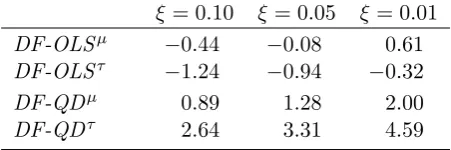
ERS choose c such that when testing H0 against HS, the Gaussian point optimal invariant test ofc= 0 against c=c, which forms the asymptotic Gaussian local power envelope, has a power of 0.50. For a nominal 0.05-level test, this yields the (approx-imate) values c = 7 and c = 13:5 for DF-QD and DF-QD , respectively. We repeated this exercise in the context of testingH0 against HE, and found the (approx-imate) values c = 1:6 and c = 2:4 for DF-QD and DF-QD , respectively, and these are adopted in what follows. Asymptotic critical values for testing against HS are already documented; for testing againstHE, Table 1 reports asymptotic critical values at conventional signi cance levels for the four tests we consider. Here and throughout the paper, numerical results are obtained by direct simulation of the limiting distri-butions, approximating the Wiener processes using N IID(0;1) random variates, and with the integrals approximated by normalized sums of 2000 steps. The simulations were programmed in Gauss 9.0 using 50,000 Monte Carlo replications.
3.1
Asymptotically negligible initial conditions
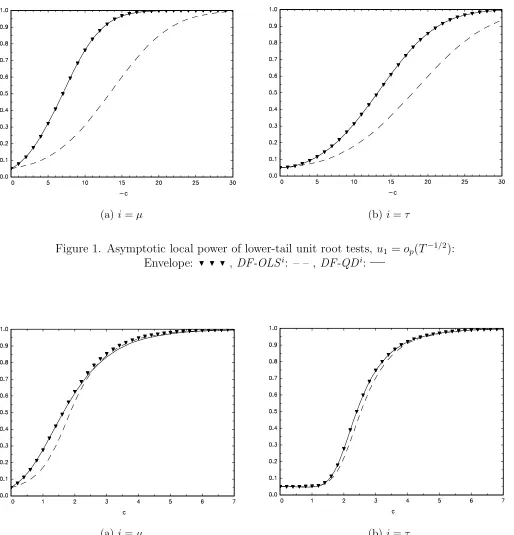
For the case of Assumption 1, where the initial condition has no asymptotic e ect, Figure 1 plots the local asymptotic power for lower-tail tests of H0 against HS, con-ducted at the 0.05 level, acrossc 0, together with the Gaussian local power envelope. We report results for c=f0; 0:5; 1:0; :::; 30:0g so that the envelope powers range from 0:05 at c = 0 to values in excess of 0:995. We observe the familiar ERS result showing that, in Figure 1(a), the power of DF-QD (e ectively) coincides with the power envelope across all c and is substantially higher than that of DF-OLS , while in Figure 1(b), the power of DF-QD again coincides with the power envelope and is higher than that of DF-OLS .
Figure 2 examines whether these results continue to hold for upper-tail tests of
being much closer than for the lower-tail tests of H0 againstHS shown in Figure 1(b). Overall, we conclude that whether lower-tail or upper-tail tests are being considered, theDF-QD andDF-QD tests should be thought of as preferable to the corresponding
DF-OLS and DF-OLS tests, as the former almost never deviate from the power envelope. However, the case for this preference is rather weaker for upper-tail testing than it is for lower-tail testing.
3.2
Asymptotically non-negligible initial conditions
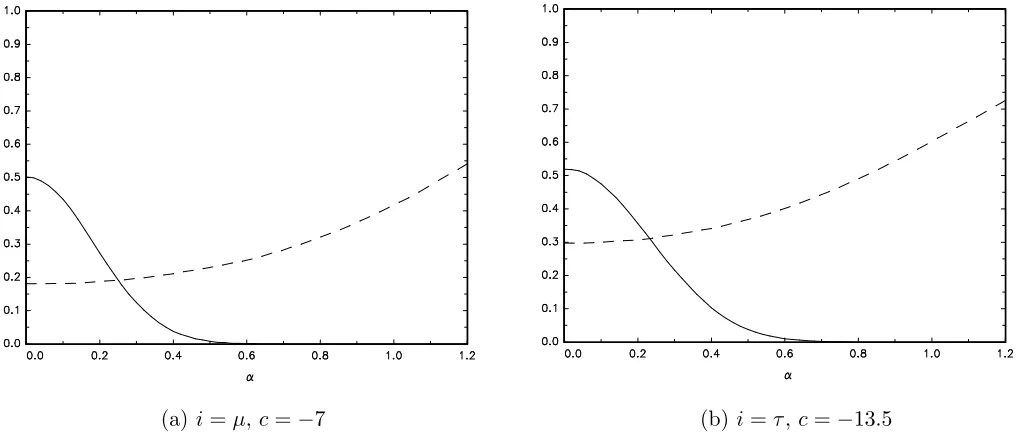
We now turn to the case of Assumption 2, where the initial condition does have an asymptotic in uence on the local power of the tests. Figures 3(a) and 3(b) show asymptotic local powers for lower-tail tests ofH0againstHS, across 0 whenc= 7 and c = 13:5, respectively; these are the values of c that yield an (approximate) asymptotic power of 0.50 for DF-QD and DF-QD under Assumption 1. Results are reported for =f0;0:02;0:04; :::;1:20g.3 Again we observe the familiar M•uller-Elliott
pattern that the power pro les ofDF-QD andDF-QD exhibit monotonic decrease in , whilst the powers ofDF-OLS andDF-OLS demonstrate precisely the reverse form of behaviour. The powers ofDF-QD and DF-QD are e ectively zero for >0:6 and 0:7, respectively; it is this unappealing feature of theDF-QD and DF-QD tests that makes it highly questionable whether, when little is known about the initial condition (as is typically the case in practice), they should be considered a better option than
DF-OLS and DF-OLS .
Figures 4(a) and 4(b) show local asymptotic powers for upper-tail tests ofH0against
HE whenc= 1:6 andc= 2:4, respectively, these values of cbeing those that give (ap-proximate) power of 0.50 forDF-QD andDF-QD under Assumption 1. The standout feature is that the powers of DF-QD and DF-QD are here monotonically increasing
in , as are their counterparts DF-OLS and DF-OLS . Moreover, the powers of the
DF-QD and DF-QD tests consistently exceed those of the corresponding DF-OLS
and DF-OLS tests across .
Clearly then, asymptotically non-negligible initial conditions do not reproduce their pernicious power e ects onDF-QD andDF-QD from lower-tail testing ofH0 against
HS once the context changes to upper-tail testing of H0 against HE.4 Therefore, for this latter testing problem theDF-QD andDF-QD pair of tests emerge, pretty much without contention, as the tests of choice.
4
Conclusion
The results of this paper show that when the initial condition of a time series is asymp-totically negligible, upper-tail QD-based DF unit root tests are near asympasymp-totically e cient, as has been observed previously for their lower-tail counterparts. They also
3Note that the limit distributions of the tests are invariant to the sign of .
4Unreported simulations con rm that similar qualitative patterns of results are obtained for
generally possess superior local asymptotic power properties to tests based on OLS demeaning or detrending, although the power gains that the QD approach delivers are considerably less signi cant than for lower-tail testing. Interestingly, when the initial condition is asymptotically non-negligible, the power of the upper-tail QD-based tests exceeds that of the corresponding OLS-based tests, and is increasing with the mag-nitude of the initial value, in complete contrast to what is found for lower-tail unit root tests. It seems clear, therefore, that when conducting unit root tests against an explosive alternative, QD demeaning or detrending does not su er from the same draw-backs that are associated with testing against a stationary alternative, and worthwhile gains are available compared to OLS demeaning or detrending, regardless of the precise speci cation of the process's initialization. For these reasons, there is little need for a parallel development of lower-tail procedures that attempt to exploit di erences in QD and OLS approaches across initial conditions, such as the union of rejections-based procedures of Harvey et al. (2009). Overall, QD demeaning or detrending o ers an improved approach for practitioners testing for explosive behaviour in economic and nancial time series, notwithstanding the fact that the potential gains are quite modest. Finally, we also investigated whether such gains translate to related testing ap-proaches such as the recursive upper-tail DF-type tests of Phillips et al. (2011) for detecting asset price bubbles. Speci cally, we simulated the large sample power perfor-mance of OLS and QD demeaned and detrended versions of the Phillips et al. (2011) test, using (1)-(2) with the same settings as underlie Figures 2 and 4. As might be expected, we found the relative behaviour of the OLS and QD recursive tests to be qualitatively very similar to that observed for the non-recursive test results reported in the gures, thus the ndings of this paper apply also to recursive-based procedures.5
References
Dickey, D.A. and Fuller, W.A. (1979). Distribution of the estimators for autoregressive time series with a unit root. Journal of the American Statistical Association 74, 427{31.
Elliott, G., Rothenberg, T.J. and Stock, J.H. (1996). E cient tests for an autoregres-sive unit root. Econometrica 64, 813{36.
Harvey, D.I., Leybourne, S.J. and Taylor, A.M.R. (2009). Unit root testing in practice: dealing with uncertainty over the trend and initial condition (with commentaries and rejoinder). Econometric Theory 25, 587{667.
M•uller, U.K. and Elliott, G. (2003). Tests for unit roots and the initial condition.
Econometrica 71, 1269{86.
Phillips, P.C.B., Shi, S. and Yu, J. (2013). Speci cation sensitivity in right-tailed unit root testing for explosive behaviour. Oxford Bulletin of Economics and Statistics, in press.
Table 1. Asymptoticξ-level critical values for upper-tail unit root tests
ξ= 0.10 ξ= 0.05 ξ = 0.01
DF-OLSµ −0.44 −0.08 0.61
DF-OLSτ −1.24 −0.94 −0.32
DF-QDµ 0.89 1.28 2.00
(a) i=µ (b)i=τ
Figure 1. Asymptotic local power of lower-tail unit root tests, u
1 =op(T−1/2):
Envelope: H H H , DF-OLSi: – – , DF-QDi:
(a) i=µ (b)i=τ
Figure 2. Asymptotic local power of upper-tail unit root tests, u
1 =op(T−1/2):
[image:9.595.53.554.73.303.2](a)i=µ,c=−7 (b)i=τ,c=−13.5
Figure 3. Asymptotic local power of lower-tail unit root tests,u
1 =T1/2σα:
DF-OLSi: – – ,DF-QDi:
[image:10.595.56.551.379.608.2](a)i=µ,c= 1.6 (b)i=τ,c= 2.4
Figure 4. Asymptotic local power of upper-tail unit root tests, u
1 =T1/2σα: