Dynamically Controlled Resonance Fluorescence Spectra from a Doubly Dressed
Single InGaAs Quantum Dot
Y. He,1,2 Y.-M. He,1,2 J. Liu,3,4,*Y.-J. Wei,1,2 H. Y. Ramírez,1,2 M. Atatüre,5,1 C. Schneider,6 M. Kamp,6 S. Höfling,6,1,2,7 C.-Y. Lu,1,2,†and J.-W. Pan1,2,‡
1Hefei National Laboratory for Physical Sciences at Microscale and Department of Modern Physics,
University of Science and Technology of China, Hefei, Anhui 230026, China
2CAS Centre for Excellence and Synergetic Innovation Centre in Quantum Information and Quantum Physics,
University of Science and Technology of China, Hefei, Anhui 230026, China
3Institute for Research in Electronics and Applied Physics, University of Maryland, College Park, Maryland 20742, USA 4
South China Academy of Advanced Optoelectronics, South China Normal University, Guangdong, Guangzhou 510006, China
5Cavendish Laboratory, JJ Thomson Avenue, University of Cambridge, CB3 0HE Cambridge, United Kingdom 6
Technische Physik, Physikalisches Instität and Wilhelm Conrad Röntgen-Center for Complex Material Systems, Universitat Würzburg, Am Hubland, D-97074 Wüzburg, Germany
7
SUPA, School of Physics and Astronomy, University of St. Andrews, St. Andrews KY16 9SS, United Kingdom
(Received 15 November 2014; published 4 March 2015)
We report the first experimental demonstration of the interference-induced spectral line elimination predicted by Zhu and Scully [Phys. Rev. Lett. 76, 388 (1996)] and Ficek and Rudolph [Phys. Rev. A 60, R4245 (1999)]. We drive an exciton transition of a self-assembled quantum dot in order to realize a two-level system exposed to a bichromatic laser field and observe the nearly complete elimination of the resonance fluorescence spectral line at the driving laser frequency. This is caused by quantum interference between coupled transitions among the doubly dressed excitonic states, without population trapping. We also demonstrate a multiphoton ac Stark effect with shifted subharmonic resonances and dynamical modifications of resonance fluorescence spectra by using double dressing.
DOI:10.1103/PhysRevLett.114.097402 PACS numbers: 78.67.Hc, 42.50.Ct, 42.50.Hz, 78.55.Cr
Self-assembled semiconductor quantum dots (QDs) have attracted considerable interest in both fundamental studies of quantum optics and promising applications in optoelec-tronics and quantum information [1–3], as their atomlike properties can be tailored artificially through epitaxial growth and band-gap engineering. Their compatibility with semiconductor nanofabrication technologies enables monolithical integration to micro- and nanostructures to enhance light-matter interaction [4]. The atomlike behav-iors of QDs have been confirmed by numerous experiments such as photon antibunching [5,6]and spontaneous emis-sion control [7,8]. More recently, coherent control of the QD two-level systems has allowed the observations of Rabi oscillation [9], Ramsey interference [10], Autler-Townes splitting [11], Mollow absorption [12], and a resonance fluorescence triplet[13–15], which can be well preserved even under strong optical excitations. Resonance fluorescence from QDs has also provided a versatile tool in spectroscopy [16,17] and spin readout [18], and as a high-quality single-photon source[19–21].
New physics beyond the Mollow fluorescence triplet arises when a two-level system is exposed to strong bichromatic driving fields, exhibiting a range of nonlinear and multiphoton dynamics of light-matter interaction
[22,23]. In particular, it has been pointed out that a dynamical cancellation of the spontaneous emission spectral line, initially predicted for a three-level system[24,25], may
be possible in a two-level atom[26,27], which is not due to population trapping, but induced by quantum interferences between different transition channels in a doubly dressed atom. This occurs when a two-level atom is driven by a strong resonant laser with a Rabi frequency2Ω[28], and a second, weaker laser is detuned by2Ωfrom the strong field. The suppression of spontaneous emission spectral lines also appears when the second laser is coupled to the shifted subharmonics of2Ω, which can be attributed to the multi-photon ac Stark effect [22]. Despite the extensive efforts undertaken to observe this phenomenon [29–34], the experimental demonstration of a complete cancellation of spontaneous emission lines has been claimed once in a V-type level atom[29], where there was also an alternative interpretation based on population trapping possible [32]. Here, we use a single QD, doubly dressed by bichromatic fields, to demonstrate unequivocally the complete cancella-tion of spontaneous emission spectral lines and other features arising from this phenomenon including shifted subharmonic resonances and modifications of sideband spectra.
Our experiments are carried out on self-assembled InGaAs QDs embeded in a low-Q planar microcavity (Q≈200) and housed in a cryogen-free bath cryostat operating at 4.2 K, as shown in Fig.1(a). The measurements are performed on the neutral exciton transition of a single QD with a confocal microscope allowing bichromatic excitations of the QD from the side arm and collection of
the emitted fluorescence through the top arm. By using a cross-polarization configuration the resonance fluorescence is separated from the excitation lasers with a signal to background ratio exceeding 28:1 for the highest excitation power of100μW (2Ω≈14.2γsp) used in this experiment, in which γsp denotes the spontaneous emission rate of the neutral exciton state.
Figure 1(b) shows a typical Mollow triplet spectrum from a single QD resonantly driven by a strong, narrow-band (<2MHz) laser. Exciton states in QDs are treated as two-level systems with ground state jgi, excited state jei, transition frequency ω0, and dipole transition moment μ~. Because of the light-matter interaction induced by the pumping laser, the dressed states (doublets) are formed:
ji; Ni ¼ 1ffiffiffi
2
p ½jg; Ni−ð−1Þije; N−1i; i¼1;2 ð1Þ
with energiesEi;N ¼ℏðNω0ΩÞ, whereNis the number of photons in the driving field and2Ωis the Rabi frequency. The four transitions between neighboring doublets result in three distinct transition frequenciesω0andω02Ωin the
Mollow triplet spectrum, see Fig.1(c). The exciton lifetime T1¼390ps is obtained from time-resolved measurements while the Rabi frequency of the driving laser2Ω¼5.8
0.1GHz and the coherence time of the exciton stateT2¼
424ps are extracted by fitting the Mollow triplet spectrum (see Sec. 3 of the Supplemental Material [35]). It is worthwhile to notice that the two transitions contributing to the central peak exhibit antiparallel dipole moments, i.e., 1
2μ~, but the calculated correlation functions of these
transitionshσþiiNσ−jjNiði≠jÞare equal to zero[26], indicat-ing these two transitions decay independently. σiiN ¼ ji; NihN−1; jj(i; j¼1;2) is the transition dipole moment operator of the dressed atom transition.
[image:2.612.60.554.58.297.2]in the Mollow triplet splits into a daughter triplet because of the formation of quartet states by dressing the doublet states, as shown in Fig. 1(d). In such a spectrum nine emission lines in total are expected; however, in the measured spectrum shown in Fig.1(e)the central emission line is completely suppressed as a result of the destructive quantum interference induced by the coupling laser.
This quantum interference is easier to interpret by tracing the transitions between doubly dressed states back to their eigenstates. One of the transitions corresponding to the central peak, from jNþM; nþi to jNþM−1; nþi, is highlighted in Fig. 1(d) and traced back to the super-impositions of their eigenstates (singly dressed states) in Fig. 1(f): jNþM; nþi ¼ ð1=p2ffiffiffiÞ½j2; N−n−1; Mþnþ
1i þ j1; N−n; Mþni,jNþM−1;nþi ¼ ð1=pffiffiffi2Þ½j2;N− n−2;Mþniþj1;N−n−1;Mþn−1i. Among the pos-sible decay channels between these eigenstates, only the transitions from j2; N−n−1; Mþnþ1i to j2; N−n−
2; Mþni and from j1; N−n; Mþni to j1; N−n−
1; Mþni are allowed by selection rules. Detailed calcu-lations (see Sec. 5 of the Supplemental Material[35]) reveal that these two transitions should be antiphased and inter-fere destructively, eliminating the central spectral line. Similarly, other degenerate transitions corresponding to the central peak, e.g., the transition from jNþM; n−ito jNþM−1; n−i, also exhibit destructive interferences.
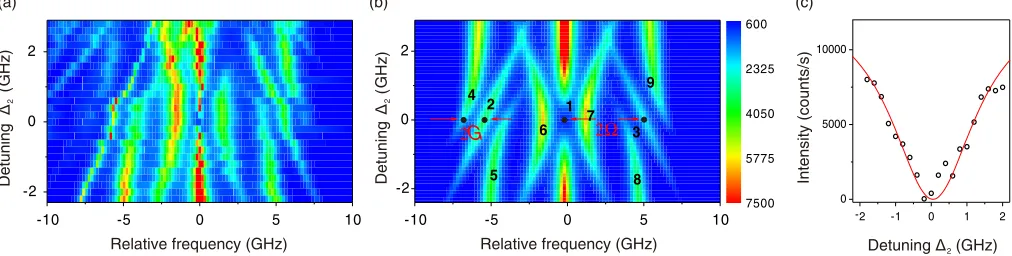
A quantitative comparison between the predicted and the measured spectra is performed by scanning the coupling laser across the resonance dip (ω0−2Ω). Frequency detuning between the coupling laser and inner transition of the doublets is denoted as Δ2¼ω2−ðω0−2ΩÞ. Figure 2(a) represents a 2D contour plot of the Δ2 -dependent doubly dressed spectra, which are well repro-duced in the simulation of Fig.2(b)by using the parameters extracted from the experiments (see Sec. 6A of the Supplemental Material [35]). The driving laser detuning
Δ1¼−0.977GHz used in the simulation is obtained from
a fit of the central peak intensity as a function of Δ2 in Fig. 2(a), as shown in Fig. 2(c) (see Sec. 6B of the
Supplemental Material[35]). Comparing the experimental spectra to the prediction, we find that both the peak evolution trends and their corresponding strengths agree remarkably well. The anticrossing feature of peaks 4,5 (6,7 or 8,9) in Fig.2(b) is an indication of the coupling laser induced interaction while peaks 2,3 evolve linearly with coupling laser detuning Δ2. As the coupling laser moves away from the resonance, the center peak suppressed by quantum interference gradually emerges and the Mollow triplet recovers at large detuning ranges.
To investigate the multiphoton absorption process and spectral eliminations at subharmonic resonances, we tune the coupling laser from the bare exciton energyω0 to the inner doublet transitionω0−2Ω; i.e., the frequency differ-ence between the coupling laser and the bare exciton energy
Δ3¼ω2−ω0 is tuned from zero to −2Ω. A 140-MHz
etalon with a 9.18 GHz free spectral range is employed to filter out the central peak fluorescence signal when tuning the coupling laser. The center peak intensity as a function of
−Δ3is plotted in Fig.3and spectral line suppressions are clearly observed near to the subharmonic Rabi frequencies
2Ω=n (n¼1–5). Instead of quantum interference induced by single photons, here the coupling laser via ann-photon process[36]couples the dressed states created by the strong driving field, which results in a dynamic Stark shift of the states and effectively shifts the positions of the subhar-monics. The shifts of the subharmonics can be calculated in the framework of high-order perturbation theory by taking all other doublet states within the same energy manifold into account [22]asΔ1¼ ð1=8Þα2Ωfor n¼1 and Δn¼ nα2Ω=½2ðn2−1Þ for n >1, where α is the power ratio
between the coupling and driving laser. The calculated frequency displacements are 0.13, 0.34, and 0.19 GHz for
2Ω,2Ω=2, and2Ω=3, respectively, and are very close to the shifts 0.11, 0.24, and 0.20 GHz observed in the experiments. The incomplete suppression of the center peak at subhar-monics is an effect of the reduced splitting of the doubly dressed states in higher multiphoton processes [22]. The spectral cancellation induced by quantum interferences is
-10 -5 0 5 10
-2 0 2
600.0
2325
4050
5775
7500
-10 -5 0 5 10
-2 0 2
2G 2Ω
1 2
3 4
5
6 7
8 9
-2 -1 0 1 2
0 5000 10000
Detuning
(
GHz)
2
Detuning
(GHz)
2
Detuning 2 (GHz)
Relative frequency (GHz) Relative frequency (GHz)
Intensity (counts/s)
(a) (b) (c)
[image:3.612.54.560.536.664.2]different from the processes with the population trapped in a specific state, such as coherent population trapping [37]
or electromagnetically induced transparency [38]. In our system, population Pn;N¯ ¼ hn;N¯jρjN; n¯ i is evenly
distributed within these states [26], where jN; n¯ i is the doubly dressed eigenstate,N¯ ¼MþN is the total photon number, and ρis the state density matrix.
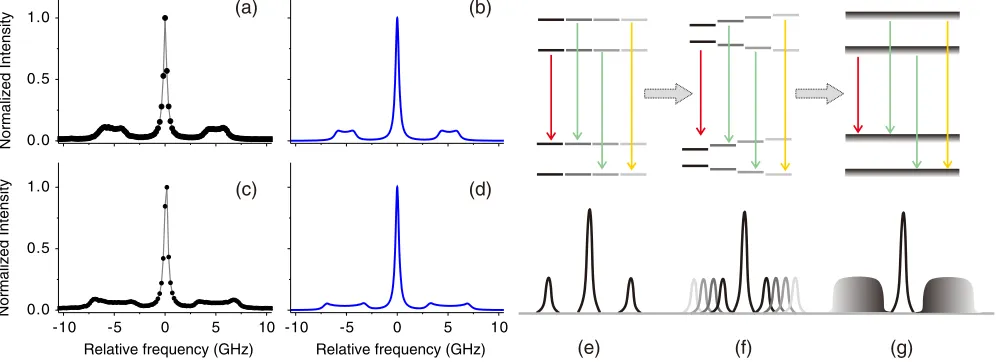
Finally, the coupling laser is tuned to zero detuning with the exciton energy, i.e., exactly the same frequency as the driving laser. This degenerate excitation scheme generates a modified Mollow triplet in which the two side peaks evolve into flat and broad sidebands, as predicted by Freedhoff and Ficek[39]. Figures4(a)and4(c)represent the experimental spectra for the power ratios of α¼0.2 and α¼0.4,
respectively. while the simulated spectra are shown in Figs.4(b)and4(d). The plateau of the sidebands originates from the continuum energy levels with the same population when dressing the dressed QDs at the same frequency.
Here we give a concise physical picture of this process as schematically illustrated in Figs.4(e)–4(g). First, given the frequency degeneracy of the two excitation lasers, the doublets extend to degenerate doublet manifolds and each energy level has infinite inner states before additional effects due to the coupling laser, see Fig. 4(e). Second, owing to the interaction between the weak field and singly dressed states, the infinite inner states shift from each other, forming a band of continuum states. Each pair of the lifted inner doublet substates shows a different energy splitting and consequently exhibits a Mollow triplet spectrum with side peaks shifted but the central peak remaining, see Fig. 4(f). These spectra convolve to create the spectrum shown in Fig.4(g). This effect might be of importance in simulating continuum energy levels for studying light-matter interaction. Moreover, it can be used directly to develop tunable wideband single-photon sources.
In conclusion, we have for the first time demonstrated spontaneously induced spectral cancellation together with a multiphoton ac Stark shift and modulations of resonance fluorescence spectra using the transitions of a solid-state quantum emitter. Our results indicate that the self-assembled QD system, accompanied by its advantages of stability, near background free fluorescence, long lifetime, and short line-width, serves as a complementary test bed to natural atoms for quantum physics research. The bichromatic excitation scheme provides a unique and versatile tool to control and modulate the spontaneous emission process, especially in vacuum where modifications of the photonic density of states are not feasible. By further exploring the quantum interference generated by spontaneous emission, spectral
Detuning -Δ3 (GHz)
Intensity (counts/s)
0 2 4 6 8 10
0 4000 8000 12000
1/4 1/5 1/6
1/3
1/2
1
FIG. 3 (color online). Subharmonics of the central peak for the doubly dressed QD. The positions of the subharmonics observed in experiments are indicated by black arrows while the unshifted frequencies for the first three subharmonics are shown by red arrows, exhibiting observable shifts as a result of a multiphoton ac Stark shift.
(a) (b)
(c) (d)
(e) (f) (g)
0.0 0.5 1.0
Normali
ze
dI
n
tens
ity
-10 -5 0 5 10
0.0 0.5 1.0
Norm
a
lized
Intensi
ty
Relative frequency (GHz)
-10 -5 0 5 10
Relative frequency (GHz)
[image:4.612.58.556.484.665.2]line narrowing [40], lasing without inversion [41], and quantum entanglement generation [42] can be envisioned in QDs. Along this direction, our work may facilitate the study of complicated spectra of two-level systems under multicolor laser excitations and stimulate research on novel quantum interference phenomena in solid-state quantum systems.
We acknowledge P. Wu, and M. Cramer for useful discussions. This work was supported by the National Natural Science Foundation of China, the Chinese Academy of Sciences, and the National Fundamental Research Program.
Y. H. and Y.-M. H. contributed equally to the work.
*
jin.liu@coer‑scnu.org †[email protected] ‡[email protected]
[1] A. N. Vamivakas and M. Atature, Contemp. Phys. 51, 17 (2010).
[2] S. Buckley, K. Rivoirem, and J. Vuĉković,Rep. Prog. Phys.
75, 126503 (2012).
[3] R. J. Warburton,Nat. Mater.12, 483 (2013).
[4] P. Lodahl, S. Mahmoodian, and S. Stobbe,arXiv:1312.1079 [Rev. Mod. Phys. (to be published)].
[5] P. Michler, A. Kiraz, C. Becher, W. V. Schoefeld, P. M. Petroff, L. Zhang, E. Hu, and A. Imamoğlu,Science290, 2282 (2000).
[6] C. Santori, M. Pelton, G. Solomon, Y. Dale, and Y. Yamamoto,Phys. Rev. Lett.86, 1502 (2001).
[7] Q. Wang, S. Stobbe, and P. Lodahl,Phys. Rev. Lett. 107, 167404 (2011).
[8] D. Englund, D. Fattal, E. Waks, G. Solomon, B. Zhang, T. Nakaoka, Y. Arakawa, Y. Yamamoto, and J. Vučković,
Phys. Rev. Lett.95, 013904 (2005).
[9] H. Kamada, H. Gotoh, J. Temmyo, T. Takagahara, and H. Ando,Phys. Rev. Lett.87, 246401 (2001); A. J. Ramsay, A. M. Fox, M. S. Skolnick, A. V. Gopal, E. M. Gauger, B. W. Lovett, and A. Nazir,Phys. Rev. Lett.104, 017402 (2010). [10] H. Jayakumar, A. Predojević, T. Huber, T. Kauten, G. S. Solomon, and G. Weihs,Phys. Rev. Lett.110, 135505 (2013). [11] X. Xu, B. Sun, P. R. Berman, D. G. Steel, A. S. Bracker, D.
Gammon, and L. J. Sham,Science317, 929 (2007). [12] X. Xu, B. Sun, E. D. Kim, K. Smirl, P. R. Berman, D. G.
Steel, A. S. Bracker, D. Gammon, and L. J. Sham,Phys. Rev. Lett.101, 227401 (2008).
[13] A. Muller, E. B. Flagg, P. Bianucci, X. Y. Wang, D. G. Deppe, W. Ma, J. Zhang, G. J. Salamo, M. Xiao, and C. K. Shih,Phys. Rev. Lett.99, 187402 (2007).
[14] A. N. Vamivakas, Y. Zhao, C.-Y. Lu, and M. Ataüre, Nat. Phys.5, 198 (2009).
[15] E. B. Flagg, A. Muller, J. W. Robertson, S. Founta, D. G. Deppe, M. Xiao, W. Ma, G. J. Salamo, and C. K. Shih,Nat. Phys.5, 203 (2009).
[16] E. B. Flagg, J. W. Robertson, S. Founta, W. Ma, M. Xiao, G. J. Salamo, and C. K. Shih,Phys. Rev. Lett.102, 097402 (2009).
[17] S. M. Ulrich, S. Ates, S. Reitzenstein, A. Löffler, A. Forchel, and P. Michler,Phys. Rev. Lett.106, 247402 (2011).
[18] A. N. Vamivakas, C.-Y. Lu, C. Matthiesen, Y. Zhao, S. Fält, A. Badolato, and M. Atatüre, Nature (London) 467, 297 (2010).
[19] S. Ates, S. M. Ulrich, S. Reitzenstein, A. Löffler, A. Forchel, and P. Michler,Phys. Rev. Lett.103, 167402 (2009). [20] Y.-M. He, Y. He, Y.-J. Wei, D. Wu, M. Atatüre, C.
Schneider, S. Höfling, M. Kamp, C.-Y. Lu, and J.-W. Pan,Nat. Nanotechnol.8, 213 (2013).
[21] C. Matthiesen, M. Geller, C. H. H. Schulte, C. L. Gall, J. Hansom, Z. Li, M. Hugues, E. Clarke, and M. Atatüre,
Nat. Commun.4, 1600 (2013).
[22] T. Rudolph, H. S. Freedhoff, and Z. Ficek,J. Opt. Soc. Am. B 15, 2325 (1998).
[23] Y. Ota, S. Iwamoto, N. Kumagai, and Y. Arakawa,Phys. Rev. Lett.107, 233602 (2011).
[24] S.-Y. Zhu and M. O. Scully,Phys. Rev. Lett.76, 388 (1996). [25] H. Lee, P. Polynkin, M. O. Scully, and S.-Y. Zhu,Phys. Rev.
A55, 4454 (1997).
[26] Z. Ficek and T. Rudolph,Phys. Rev. A60, R4245 (1999). [27] Z. Ficek and H. S. Freedhoff,Phys. Rev. A53, 4275 (1996). [28] The Rabi frequency here is defined as2Ω, which follows the
definition in Refs.[26,27].
[29] H.-R. Xia, C.-Y. Ye, and S.-Y. Zhu,Phys. Rev. Lett. 77, 1032 (1996).
[30] C. C. Yu, J. R. Bochinski, T. M. V. Kordich, T. W. Mossberg, and Z. Ficek,Phys. Rev. A56, R4381(R) (1997). [31] L. Li, X. Wang, J. Yang, G. Lazarov, J. Qi, and A. M. Lyyra,
Phys. Rev. Lett.84, 4016 (2000).
[32] P. R. Berman,Phys. Rev. A58, 4886 (1998).
[33] J. Wang, H. M. Wiseman, and Z. Ficek,Phys. Rev. A62, 013818 (2000).
[34] M. Peiris, K. Konthasinghe, Y. Yu, Z. C. Niu, and A. Muller,
Phys. Rev. B89, 155305 (2014).
[35] See Supplemental Material at http://link.aps.org/ supplemental/10.1103/PhysRevLett.114.097402, for de-tails of the experimental setup, sample information and calculations.
[36] J. R. Bochinski, C. C. Yu, T. Loftus, and T. W. Mossberg,
Phys. Rev. A63, 051402(R) (2001).
[37] K. Bergmann, H. Theuer, and B. W. Shore,Rev. Mod. Phys.
70, 1003 (1998); X. Xu, B. Sun, P. R. Berman, D. G. Steel, A. S. Bracker, D. Gammon, and L. J. Sham,Nat. Phys.4, 692 (2008); D. Brunner, B. D. Gerardot, P. A. Dalgarno, G. Wüst, K. Karrai, N. G. Stoltz, P. M. Petroff, and R. J. Warburton,Science325, 70 (2009).
[38] M. Mücke, E. Figueroa, J. Bochmann, C. Hahn, K. Murr, S. Ritter, C. J. Villas-Boas, and G. Rempe, Nature (London)
465, 755 (2010).
[39] H. S. Freedhoff and Z. Ficek,Phys. Rev. A55, 1234 (1997). [40] P. Zhou and S. Swain,Phys. Rev. Lett. 77, 3995 (1996); Z. Ficek and S. Swain, Phys. Rev. A69, 023401 (2004); F.-L. Li and S.-Y. Zhu, Phys. Rev. A 59, 2330 (1999); E. Paspalakis and P. L. Knight, Phys. Rev. Lett. 81, 293 (1998); M. Kiffner, J. Evers, and C. H. Keitel,Phys. Rev. A
73, 063814 (2006).
[41] P. Zhou and S. Swain,Phys. Rev. Lett.78, 832 (1997); S. E. Harris,Phys. Rev. Lett.62, 1033 (1989).