A ring system detected around the Centaur (10199) Chariklo
Journal-ref: Braga-Ribas et al., Nature, Volume 508, Issue 7494, pp. 72-75 (2014) DOI: 10.1038/nature13155
F. Braga-Ribas1, B. Sicardy2, J. L. Ortiz3, C. Snodgrass4, F. Roques2, R.
Vieira-Martins1,5,6, J. I. B. Camargo1, M. Assafin5, R. Duffard3, E. Jehin7, J. Pollock8, R.
Leiva9, M. Emilio10, D. I. Machado11,12, C. Colazo13,14, E. Lellouch2, J. Skottfelt15,16, M. Gillon7, N. Ligier2, L. Maquet2, G. Benedetti-Rossi1, A. Ramos Gomes Jr5,
P. Kervella2, H. Monteiro17, R. Sfair18, M. El Moutamid2,6, G. Tancredi19,20, J.
Spagnotto21, A. Maury22, N. Morales3, R. Gil-Hutton23, S. Roland19, A. Ceretta20,24, S.-h. Gu25,26, X.-b. Wang25,26, K. Harpsøe15,16, M. Rabus9,27, J. Manfroid7, C.
Opitom7, L. Vanzi28, L. Mehret10, L. Lorenzini11, E. M. Schneiter14,29,30,31, R. Melia14,
J. Lecacheux2, F. Colas6, F. Vachier6, T. Widemann2, L. Almenares19,20, R. G. Sandness22, F. Char32, V. Perez19,20, P. Lemos20, N. Martinez19,20, U. G. Jørgensen15,16,
M. Dominik33,†, F. Roig1, D. E. Reichart34, A. P. LaCluyze34, J. B. Haislip34, K. M.
Ivarsen34, J. P. Moore34, N. R. Frank34, D. G. Lambas14,30.
1. Observat´orio Nacional/MCTI, Rua General Jos´e Cristino 77, CEP 20921-400 Rio de Janeiro, RJ, Brazil. 2. LESIA, Observatoire de Paris, CNRS UMR 8109, Univ. Pierre et Marie Curie, Univ. Paris-Diderot, 5
place Jules Janssen, F-92195 MEUDON Cedex, France.
3. Instituto de Astrof´ısica de Andaluc´ıa, CSIC , Apt. 3004, 18080 Granada, Spain.
4. Max Planck Institute for Solar System Research, Justus-von-Liebig-Weg 3, 37077 G¨ottingen, Germany. 5. Observat´orio do Valongo/UFRJ, Ladeira Pedro Antonio 43, CEP 20.080-090 Rio de Janeiro, RJ, Brazil. 6. Observatoire de Paris, IMCCE, UPMC, CNRS, 77 Av. Denfert-Rochereau, 75014 Paris, France. 7. Institut d’Astrophysique de l’Universit´e de Li`ege, All´ee du 6 Aoˆut 17, B-4000 Li`ege, Belgium. 8. Physics and Astronomy Department, Appalachian State Univ., Boone, NC 28608, USA.
9. Instituto de Astrof´ısica, Facultad de F´ısica, Pontificia Universidad Cat´olica de Chile, Av. Vicu˜na Mackenna 4860, Santiago, Chile.
10. Universidade Estadual de Ponta Grossa, O.A. - DEGEO, Av. Carlos Cavalcanti 4748, Ponta Grossa 84030-900, PR, Brazil.
11. Polo Astronˆomico Casimiro Montenegro Filho / FPTI-BR, Av. Tancredo Neves, 6731, CEP 85867-900, Foz do Igua¸cu, PR, Brazil.
12. Universidade Estadual do Oeste do Paran´a (Unioeste), Av. Tarqu´ınio Joslin dos Santos, 1300, CEP 85870-650, Foz do Igua¸cu, PR, Brazil.
13. Ministerio de Educaci´on de la Provincia de C´ordoba, C´ordoba, Argentina.
14. Observatorio Astron´omico, Universidad Nacional de C´ordoba, C´ordoba, Argentina.
15. Niels Bohr Institute, University of Copenhagen, Juliane Maries vej 30, 2100 Copenhagen, Denmark. 16. Centre for Star and Planet Formation, Geological Museum, Øster Voldgade 5, 1350 Copenhagen,
Denmark.
17. Instituto de F´ısica e Qu´ımica, Av. BPS 1303, CEP 37500-903, Itajub´a, MG, Brazil.
18. UNESP - Univ Estadual Paulista, Av Ariberto Pereira da Cunha, 333, CEP 12516-410 Guaratinguet´a, SP, Brazil.
19. Observatorio Astronomico Los Molinos, DICYT, MEC, Montevideo, Uruguay. 20. Dpto. Astronomia, Facultad Ciencias, Uruguay.
21. Observatorio El Catalejo, Santa Rosa, La Pampa, Argentina.
22. San Pedro de Atacama Celestial Explorations, Casilla 21, San Pedro de Atacama, Chile.
23. Complejo Astron´omico El Leoncito (CASLEO) and San Juan National University, Av. Espa˜na 1512
27. Max Planck Institute for Astronomy, K¨onigstuhl 17, 69117 – Heidelberg, Germany.
28. Department of Electrical Engineering and Center of Astro-Engineering, Pontificia Universidad Cat´olica de Chile, Av. Vicu˜na Mackenna 4860, Santiago, Chile.
29. Consejo Nacional de Investigaciones Cient´ıficas y T´ecnicas (CONICET), Argentina. 30. Instituto de Astronom´ıa Te´orica y Experimental IATE–CONICET, C´ordoba, Argentina.
31. Facultad de Ciˆencias Exactas, F´ısicas y Naturales, Universidad Nacional de C´ordoba (UNC), C´ordoba, Argentina.
32. Unidad de Astronom´ıa, Facultad de Ciencias B´asicas, Universidad de Antofagasta, Avenida Angamos 601, Antofagasta, Chile.
33. SUPA, University of St Andrews, School of Physics & Astronomy, North Haugh, St Andrews, KY16 9SS, United Kingdom. †Royal Society University Research Fellow.
Until now, rings have been detected in the Solar System exclusively around the four giant planets1. Here we report the discovery of the first minor-body ring
system around the Centaur object (10199) Chariklo, a body with equivalent radius2
124±9 km. A multi-chord stellar occultation revealed the presence of two dense rings around Chariklo, with widths of about 7 km and 3 km, optical depths 0.4 and 0.06, and orbital radii 391 and 405 km, respectively. The present orientation of the ring is consistent with an edge-on geometry in 2008, thus providing a simple explanation for the dimming of Chariklo’s system between 1997 and 20083, and for
the gradual disappearance of ice and other absorption features in its spectrum over the same period4,5. This implies that the rings are partially composed of water ice. These rings may be the remnants of a debris disk, which were possibly confined by embedded kilometre-sized satellites.
Chariklo is the largest known Centaur object orbiting in a region between Saturn and Uranus with orbital eccentricity 0.171 and semi-major axis 15.8 astronomical units (1AU is the Earth-Sun distance). It may be a former transneptunian object that has been recently (less than 10 Myr) scattered by gravitational perturbations from Uranus6. No clear detection of Chariklo’s rotation has been made so far. Its surface is very dark with a geometric albedo2 0.035±0.011,
and it is subject to long-term spectral and photometric variabilities3,4,5, although no cometary
activity has ever been reported.
An occultation of an R=12.4 magnitude star by Chariklo was predicted7 to cross South
America on June 3, 2013; see Extended Data Figures 1 and 2. We obtained data from sites distributed in Brazil, Argentina, Uruguay and Chile (Extended Data Table 1). While the occultation by Chariklo itself was recorded at three sites in Chile, seven sites detected a total of thirteen rapid stellar flux interruptions (secondary events), two of them being resolved into two sub-events by the Danish 1.54m telescope at the European Southern Observatory (ESO) at La Silla (Figure 1).
Displayed in the Extended Data (ED) and analysed in the Supplementary Information (SI), all those secondary events (see ED Tables 2 and 3) can be readily explained by the presence of two narrow and azimuthally homogeneous rings (Figure 2) whose widths and optical depths are given in Table 1. Even if the events were generally not resolved (see ED Fig. 3), their depths provide a measure of the integrated light loss of the events, which in turn depends on the local geometry of the occultation in the plane of the sky. The fact that all the events are consistent with an azimuthally homogeneous ring system makes other interpretations, such as an ensemble of cometary jets, very unlikely.
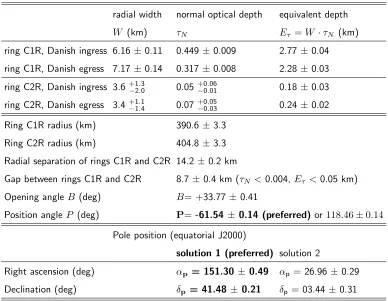
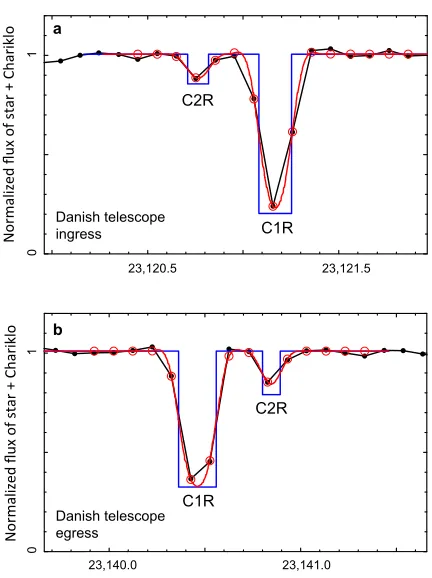
Due to its higher acquisition rate (10Hz), the Lucky Imager camera8,9 of the Danish 1.54 m telescope actually resolved the secondary events into two rings, denoted “2013C1R” and “2013C2R” (“C1R” and “C2R” for short) in Fig. 3. Hereby, the term “ingress” (resp. “egress”) refers to the first (resp. second) of a pair of ring events at a given site. All the Danish events are satisfactorily fitted by sharp-edged ring models whose radial widths (W), in the ring plane, and normal optical depths (τN), are listed in Table 1. We also provide the equivalent depths (Eτ =W τN), which can be related to the amount of material contained in
the ring10. The ring C2R is about 40% narrower than C1R, and contains about 12 times less
material. Note that no material is detected in the gap between C1R and C2R, up to a limit of 0.004 in normal optical depth and 0.05 km in equivalent depth (ED Table 4).
By analogy with Saturn’s A ring11or the dense Uranus’ rings12, we estimate that the surface
density of C1R lies in the range 30 – 100 g cm−2 (see SI). Then, the mass of C1R is equivalent to an icy body of radius of roughly one kilometre, while the ring C2R would correspond to a body of half that size. If the photometric variability of Chariklo’s system3 between 1997
and 2008 is entirely due to the ring changing geometry, we estimate the ring reflectivity
I/F ∼ 0.09 ± 0.04 (I is the intensity of light reflected by the surface, πF is the incident solar flux density). Thus, Chariklo’s ring particles would be significantly brighter than those of Uranus’ rings13 (I/F ∼ 0.05), but significantly darker than those of Saturn’s A ring14
(I/F ∼ 0.3). Note that, if part of the photometric variability is caused by Chariklo itself, then the ring material would be darker than estimated above; see SI.
Constraints on Chariklo’s limb shape are based on only two occultation chords (see SI and ED Table 5). Our simplest model describes an oblate Chariklo surrounded by a circular equatorial ring system (see ED Table 6). The fitted limb (Fig. 2) has an equivalent radius of 127 km (the radius of an equivalent spherical body), consistent with the value derived from thermal data2, 124 ± 9 km, thus supporting our model.
From the Roche critical density limit15, we estimate in the SI that typical densities for Chariklo and ring particles, are consistent to explain the present rings location. Moreover, an unperturbed ring of some kilometres in width and thickness h should spread, due to inter-particle collisions16, in 104/(h/metre)2 ∼ a few thousand years, assuming h of a few metres (by analogy with Saturn’s rings). Furthermore, Poynting-Robertson drag16 should spread
sub-cm particles in a few million years at most (see SI). Thus, the rings are either very young or actively confined. A confinement mechanism, may be provided by kilometre-sized “shepherd satellites” that would have a mass comparable to that of the rings, see the SI.
We do not know if rings around minor bodies stem from a generic, yet unknown process, or are exceptional systems. We note that many stellar occultations by main belt asteroids and almost ten transneptunian events17,18,19,20 did not reveal rings so far (nor did direct images).
Stellar occultations and appulses involving (2060) Chiron (another Centaur object similar in size to Chariklo) in 1993 and 1994, revealed a narrow jet-like feature and diffuse material around that object21,22. This was interpreted as material ejected from the surface, supported
parts are more likely to form from impacts24, or rotational disruptions25, possibly re-accreted from a remaining disk after that. To date, no observations have shown satellites around Chariklo (the rings span at most 0.04 arcsec around the primary, making direct detections of associated small satellites a challenge). Several scenarios for Chariklo’s rings origin can be proposed, all relying on a disk of debris where the largest elements acted as shepherds for the smaller material: (1) an impactor that excavated icy material from Chariklo’s outer layers; or destroyed a pre-existing satellite; or was itself disrupted during the impact; (2) a disk of debris formed from a rotational disruption of the main body or fed by a cometary-like activity; (3) two pre-existing satellites that collided through a mechanism yet to be explained or (4) a retrograde satellite that migrated inward and eventually got disrupted by tidal forces.
Note that the mass and angular momentum of the rings and their hypothetical shepherds are very small (by a factor of less than10−5) compared to that of Chariklo. The typical escape velocity at the surface of Chariklo is ∼ 0.1 km s−1. Thus, if an impact from an outsider generated the rings, it must involve low incoming velocities. While the impact velocities in the Main Belt of asteroids are of the order of 5 km s−1, they are∼ 1 km s−1 in the outer Solar System, and even lower before the Kuiper Belt was dynamically excited26, possibly explaining why no rings have been found yet around main belt asteroids. Finally, Chariklo’s orbit is perturbed by Uranus, which transferred the Centaur from the transneptunian region less than
∼ 10 Myr ago6. As estimated in the SI, a very close encounter at about five Uranus radii is actually necessary to disrupt the ring system. Such an event has a small probability of occurrence27, which supports the possibility that the rings formed in the transneptunian region
and survived the transfer episode.
1. Tiscareno, M. S. Planetary Rings, in Planets, Stars and Stellar Systems. Volume 3: Solar
and Stellar Planetary Systems. (eds Oswalt, T. D., French, L. M. & Kalas, P.), 309–375
(Springer Netherlands, 2013).
2. Fornasier, S.,et al.TNOs are Cool: A survey of the trans-Neptunian region VIII. Combined Herschel PACS and SPIRE observations of nine bright targets at 70-500 µm. Astronomy
& Astrophysics, 555, A15 (2013).
3. Belskaya, I. N.,et al. Polarimetry of Centaurs (2060) Chiron, (5145) Pholus and (10199) Chariklo. Icarus, 210, 472–479 (2010).
4. Guilbert, A.,et al. A portrait of Centaur 10199 Chariklo.Astronomy & Astrophysics,51, 777–784 (2009).
5. Guilbert-Lepoutre, A. A Thermal Evolution Model of Centaur 10199 Chariklo. The
As-tronomical Journal, 141, 103 (2011).
6. Horner, J., Evans, N. W. & Bailey, M. E. Simulations of the population of Centaurs -I. The bulk statistics. Monthly Notices of the Royal Astronomical Society, 354, 798–784 (2004).
9. Skottfelt, J., et al. EMCCD photometry reveals two new variable stars in the crowded central region of the globular cluster NGC 6981. Astronomy & Astrophysics, 553, A111, (2013).
10. French, R. G., Nicholson, P. D., Porco, C. C. & Marouf, E. A. Dynamics and structure of the Uranian rings, in Uranus.(eds Bergstralh, J. T., Miner, E. D. & Matthews, M. S.), 327–409 (Univ. Arizona Press, Tucson 1991).
11. Colwell, J. E., et al. The Structure of Saturn’s Rings, in Saturn from Cassini-Huygens.
(eds Dougherty, M. K., Esposito, L. W. & Krimigis, S. M.), 375–412 (Springer, 2009).
12. Esposito, L. W., Brahic, A., Burns, J. A., & Marouf, E. A. Particle properties and processes in Uranus’ rings, in Uranus. (eds Bergstralh, J. T., Miner, E. D. & Matthews, M. S.), 410–465 (Univ. Arizona Press, Tucson 1991).
13. Karkoschka, E. Comprehensive Photometry of the Rings and 16 Satellites of Uranus with the Hubble Space Telescope. Icarus,151, 51–68 (2001).
14. Hedman, M. M.,et al. Connections between spectra and structure in Saturn’s main rings based on Cassini VIMS data. Icarus, 223, 105–130 (2013).
15. Tiscareno, M. S., Hedman, M. M., Burns, J. A. & Castillo-Rogez, J. Compositions and Origins of Outer Planet Systems: Insights from the Roche Critical Density. The
Astro-physical Journal, Letters, 765, L28 (2013).
16. Goldreich, P. & Tremaine, S. Towards a theory for the Uranian rings.Nature,277, 97–99 (1979).
17. Elliot, J. L.,et al. Size and albedo of Kuiper belt object 55636 from a stellar occultation.
Nature, 465, 897–900 (2010).
18. Sicardy, B., et al. A Pluto-like radius and a high albedo for the dwarf planet Eris from an occultation. Nature, 478, 493–496 (2011).
19. Ortiz, J. L., et al. Albedo and atmospheric constraints of dwarf planet Makemake from a stellar occultation. Nature,491, 566–569 (2012).
20. Braga-Ribas, F., et al. The Size, Shape, Albedo, Density, and Atmospheric Limit of Transneptunian Object (50000) Quaoar from Multi-chord Stellar Occultations. The
As-trophysical Journal, 773, 26 (2013).
21. Bus, S. J., et al. Stellar Occultation by 2060 Chiron. Icarus, 123, 478–490 (1996).
22. Elliot, J. L.,et al.Jet-like features near the nucleus of Chiron.Nature,373, 46–49 (1995).
23. Brunini, A. On the dynamical evolution and end states of binary centaurs.Monthly Notices
25. Ortiz, J. L., et al. Rotational fission of trans-Neptunian objects: the case of Haumea.
Monthly Notices of the Royal Astronomical Society, 419, 2315–2324 (2012)
26. ´Cuk, M., Ragozzine, D. & Nesvorn´y D. On the dynamics and origin of Haumea’s moons.
The Astronomical Journal, 146, 89 (2013).
27. Nogueira, E., Brasser, R. & Gomes, R. Reassessing the origin of Triton. Icarus, 214, 113–130 (2011).
Supplementary Information is linked to the online version of the paper at
www.nature.com/nature.
Author contributions. F.B.R. planned the observation campaign, centralised the occultation predictions, participated in the observations, analysed data and results, ran the diffraction and limb-fitting codes and wrote the paper. B.S. helped to plan the campaign, analysed data and results, wrote and ran the diffraction and limb-fitting codes, and wrote the paper. J.L.O. helped to plan the campaign, analysed data for the prediction, obtained and analysed data and results. C.S. coordinated and analysed the data from Danish 1.54 m telescope. F.R. analysed data, wrote and ran the diffraction and limb-fitting codes. R.V.M. coordinated the predictions, analysed data. J.I.B.C., F.B.R., R.V.M. and M.A. discovered the star candidate and analysed data for the prediction. R.D. coordinated the SOAR and Bosque Alegre observations and helped to analyse the results. E.J., J.P, R.L., M.E., D.I.M., C.C., J.S., obtained and analysed the positive occultation detections from TRAPPIST, PROMPT, UCO Sta. Martina, UEPG, Foz do Igua¸cu, Bosque Alegre and Danish telescopes, respectively. E.L. helped to analyse the results. J.S., M.G., L.M., N.L., G.B.R., A.R.G., helped to obtain the occultation light curves and/or analysed the data. P.K. ran stellar models to determine the apparent star diameter. H.M. obtained the stellar spectrum. R.S. calculated the rings stability in short term. M.E.M. worked on the confinement mechanisms of the rings. G.T., J.P., A.M., N.M., R.G.H., S.R., A.C., obtained the negative detections. S.h.G., X.b.W., K.H., M.R., J.M., C.O., L.V., L.M., L.L., E.M.S., R.M., helped to obtain and analyse the positive occultation detections. J.L., F.C., F.V., T.W., K.H., helped to make the predictions and analyse the data. L.A., B.S., F.C., V.P., P.L., N.M., U.G.J., M.D., F.R., D.E.R., A.P.L., J.B.H., K.M.I., J.P.M., N.R.F., D.G., are related to the event observations. All authors were given the opportunity to review the results and comment on the manuscript.
radial width normal optical depth equivalent depth
W (km) τN Eτ =W·τN (km)
ring C1R, Danish ingress 6.16±0.11 0.449±0.009 2.77±0.04
ring C1R, Danish egress 7.17±0.14 0.317±0.008 2.28±0.03
ring C2R, Danish ingress 3.6−+12..30 0.05−+00..0601 0.18±0.03
ring C2R, Danish egress 3.4−+11..14 0.07−+00..0503 0.24±0.02
Ring C1R radius (km) 390.6±3.3
Ring C2R radius (km) 404.8±3.3
Radial separation of rings C1R and C2R 14.2±0.2 km
Gap between rings C1R and C2R 8.7±0.4 km (τN <0.004,Eτ <0.05 km)
Opening angleB (deg) B= +33.77±0.41
Position angleP (deg) P=-61.54 ±0.14 (preferred)or118.46±0.14
Pole position (equatorial J2000)
solution 1 (preferred) solution 2
Right ascension (deg) αp = 151.30±0.49 αp= 26.96±0.29
[image:9.612.105.493.101.402.2]Declination (deg) δp= 41.48±0.21 δp = 03.44±0.31
Table 1 | Ring physical parameters. The geocentric distance of Chariklo’s system at the moment of the occultation,D = 2.031×10⁹ km, provides a scale of 9846 km per arcsecond
in the plane of the sky. All the secondary events besides those of the Danish 1.54m telescope (Fig. 3) are satisfactorily fitted by a model where the rings C1R and C2R have widths and optical depths that are averages of the Danish ingress and egress values given above, i.e.
WC1R = 6.6 km, τN,C1R = 0.38, WC2R = 3.4 km and τN,C2R = 0.06, see the SI. The ring
opening angle B is the absolute value of the elevation of the observer above the ring plane. The position angle P is the angle between the semi-minor axis of the ring projected in the plane of the sky, counted positively from celestial north to celestial east. By convention, it refers to the projected semi-major axis that corresponds to superior conjunction. The solution that best explains the photometric and spectral variations of Chariklo’s system3,4,5 is chosen
Time (seconds a-er 3 June 2013, 00:00:00.0 UTC)
N
or
m
al
ize
d
flu
x
of
st
ar
+
Ch
ar
ik
lo
La Silla - ESO Danish 1.54 m
0
1
23,140 23,120 23,130
2013C1R
2013C1R
2013C2R
2013C2R
[image:10.612.77.518.27.319.2]ingress
egress
Time (seconds a-er 3 June 2013, 00:00:00.0 UTC) N or m al ize
d
flu
x
of s tar + Ch ar ik lo N or m al ize
d
flu
x
of s tar + Ch ar ik lo
23,140.0 23,141.0
23,120.5 23,121.5
[image:12.612.181.397.117.406.2]0 1 0 1 a b Danish telescope ingress Danish telescope egress C1R C2R C2R C1R
Figure 3 | Fits to the Danish ring events. The red curves are synthetic occultation profiles produced by semi-transparent bands with square-well profiles (the blue lines), after convolution by Fresnel diffraction, observed bandwidth, the stellar radius projected at Chariklo, and the finite integration time. The open red circles are the values of the model for the times corresponding to the observed data points at ingress and egress (panels aand b, respectively) The χ2 values per degree of freedom of the fits to the four ring events vary from 0.4 to 1.2, see the Extended Data Table 2. This indicates satisfactory fits, and shows that the events are compatible with sharp-edged rings. The resulting widths and optical depths of rings C1R and C2R are listed in Table 1, after the appropriate projections into the plane of the rings have been performed. Examination of ED Table 3 shows that the widths and optical depths of ring C1R at the Danish 1.54 m telescope differ moderately but significantly between ingress and egress. The equivalent depth of ring C1R differs by 21% between ingress and egress. Similar variations are observed in Uranus’ narrow rings, and might be associated with normal mode oscillations that azimuthally modulates the width and optical depth of the rings10. Differences
Extended Data Figure 1 | The Chariklo 03 June 2013 occultation campaign. The continuous straight lines indicate Chariklo’s shadow track on Earth, while the dotted lines correspond to the ring shadow, as reconstructed from our post-occultation analysis. The shadows move from right to left, see the arrow. The red stars indicate the center of Chariklos’s shadow at various UT times. The green dots are the sites where the occultation was detected. The blue dots are the sites that had obtained data but did not detect the event, and the white ones are the sites that were clouded out (Extended Data Table 1).
Extended Data Figure 2 | The occulted star spectrum and model. The star spectrum obtained at Pico dos Dias Observatory/Brazil with the 1.6 m telescope and a Cassegrain spectrograph. Observations were made with the spectrograph configuration, used a 600 l/mm grating, giving a resolution of 2.3 ˚A/pixel covering from 3700 to 7700 ˚A. We obtained three 300 s exposures with a 2” slit. The calibration was done with the usual procedures and one flux standard star (LTT6248). The thick blue curve represents the observed spectrum. The red, orange and blue thin curves represent model spectra database35 used for comparison (see
Extended Data Table 1 | Circumstances of observations.
Site Coordinates Telescope Detector Observers
Lat dd:mm:ss Name Camera
Lon dd:mm:ss Aperture Exposure (s)
Altitude (m) Filter Cycle time (s) Notes
Main body and ring positive detections.
La Silla 29◦ 15’ 21.3” S Danish Lucky Imager C. Snodgrass,
- Chile 70◦ 44’ 20.2” W 1.54 m 0.1 J. Skottfelt, M. Rabus,
2336 Z 0.10091 U. G. Jorgensen
La Silla 29◦ 15’ 16.6” S TRAPPIST FLI PL3041-BB E. Jehin
- Chile 70◦ 44’ 21.8” W 0.6 m 4.5 C. Opitom
2315 no filter 5.7976456 s Some cycles 6.15-6.19 s
Cerro Tololo 30◦ 10’ 03.4” S PROMPT U47-MB J. Pollock
- Chile 70◦ 48’ 19.0” W 0.4 m(∗) 0.7
2207 no filter 2.0 Some 4 s cycles.
Cerro Pach´on 30◦ 14’ 16.8” S SOAR SOI R. Duffard
- Chile 70◦ 44’ 01.35” W 4 m 3
2738 R 3.6–4.6 Unstable cycling.
Ring positive detections.
Santa Martina(†) 33◦ 16’ 09.0” S M16 Raptor/Merlin127 R. Leiva Espinoza
- Chile 70◦ 32’ 04.0” W 0.4 m 1.0 L. Vanzi
1450 no filter 1.0016887
Bosque Alegre 31◦ 35’ 54.0” S EABA Apogee AU9 C. Colazo
- Argentina 64◦ 32’ 58.7” W 1.54 m 3 E.M. Schneiter
1250 no filter 3.5616717 R. Melia
Bosque Alegre 31◦ 35’ 54.0” S ORBA C11 Apogee AU10 C. Colazo
- Argentina 64◦ 32’ 58.7” W 0.275 m 4 E.M. Schneiter
1250 no filter 4.71 R. Melia
Ponta Grossa 25◦ 05’ 22.2” S RCX 400 SBIG STL6E M. Emilio
- Brazil 50◦ 05” 56.4’ W 0.4 m 5 L. Mehret
909 no filter 9.78
Foz do Igua¸cu 25◦ 26’ 05.4” S C11 SBIG ST-7XME D. I. Machado
- Brazil 54◦ 35’ 37.4” W 0.275 m 4 L. Lorenzini
185 no filter 5.65
Cerro Burek 31◦ 47’ 12” S ASH SBIG-STL11000 N. Morales
- Argentina 69◦ 18’ 25” W 0.45 m 7 The ring event was
2665 no filter 8.4 marginally detected.
Negative detections.
Santa Rosa 36◦ 38’ 16” S El Catalejo Meade DSI-I J. Spagnotto
- Argentina 64◦ 19’ 28” W 0.20 m 5
182 no filter 1
San Pedro 22◦ 57’ 12”S Planewave Apogee U42 A. Muray
de Atacama 68◦ 10’ 48” W 0.50 m 2 F. Char
- Chile(¶) 2400 no filter 2.871 B. Sandness
Montevideo 34◦45’ 20” S OALM FLI PL0900 S. Roland
- Uruguay 56◦11’ 23” W 0.46 m 2 N. Martinez
130 no filter 2.83 passing clouds.
Site N(†) t(∗)
C1R χ
2
dof t
(∗)
C1R χ
2
dof
ingress egress
Santa Martina 5 23,121.03±0.29 1.48 23,131.811±0.025 4.61
Bosque Alegre/1.54m 3 (23,094.265±0.17)(§) 1.08 23,111.44±0.14 0.27
Bosque Alegre/0.275m 3 (23,095.45±1.85)(?) 0.39 (23,109.45±1.75)(?) 0.94
SOAR 3 (23,118.8±1.3)(‡) 1.47 (23,138.4±1.4)(‡) 0.11
PROMPT 11 23,120.046±0.011 1.06 (23,140.445±0.155)(§) 0.81
TRAPPIST 3 23,120.9±1.9 2.99 23,140.88±0.53 2.01
Ponta Grossa 3 23,038.6±2.5 6.70 23,058.0±2.5 1.93
Foz do Igua¸cu 3 23,057.5±1.7 1.64 23,074.1±2.0 0.42
Extended Data Table 2 | Timings of the ring events besides the Danish telescope.
(∗)Assuming that rings C1R and C2R have widths and optical depths that are averages of
the ingress and egress values at the Danish telescopes; i.e. WC1R= 6.6 km, τN,C1R = 0.38,
WC2R= 3.4 km andτN,C2R= 0.06, radial separation between rings C1R and C2R: 14.2 km. The fitted time for the middle of ring C1R, seconds after 00:00:00 UT (3 June 2013).
(†)The number of fitted data points.
(§)Obtained from non-detections of the rings, see text.
(?)Confirms the ring detection at Bosque Alegre, but is not used in the fit of the ring
orbits due to larger error bars compared to the 1.54 m telescope.
(‡)The SOAR timings are probably affected by a systematic offset, and are not used in
the fits of the ring orbits and Chariklo’s limb shape, see text.
ESO La Silla Danish 1.54 m
Δt= -0.6 s
CTIO PROMPT
Δt= 0 s
UCO Sta. Martina
Δt= +3.8 s
Time%(seconds%a-er%3%June%2013,%00:00:00.0%UTC)%%
23,130 23,140
23,120 N or m al ize d% flu x% of %st ar %+% Ch ar ik lo % 0 1 1 1 N or m al ize d% flu x% of %st ar %+% Ch ar ik lo % Time%(seconds%a-er%3%June%2013,%00:00:00.0%UTC)%%
23,120 23,140
23,100 23,160
0
1
1
ESO La Silla TRAPPIST
Δt= -0.6 s
Cerro Pachón SOAR
Δt= +1.2 s
Time%(seconds%a-er%3%June%2013,%00:00:00.0%UTC)%% N or m al ize d% flu x% of %st ar %+% Ch ar ik lo %
23,120 23,140
23,100 23,160
0
1
1
Ponta Grossa
Δt= +82.3 s Foz do Iguaçu
Δt= +64.4 s
Time%(seconds%a-er%3%June%2013,%00:00:00.0%UTC)%% N or m al ize d% flu x% of %st ar %+% Ch ar ik lo %
23,120 23,140
23,100 23,160
0
1
1
Bosque Alegre 1.54 m
Δt= +27.3 s
Bosque Alegre 0.275 m
Δt= +27.3 s
Ring N χ2dof t W (km) τN Eτ (km)
ingress
C1R 10 0.95 23,121.168±0.0007 6.16±0.11 0.449±0.009 2.77±0.04
C2R 8 0.69 23,120.765±0.011 3.6−+12..30 0.05+0−0..0601 0.18±0.03
Radial separation (C2R minus C1R): 14.6±0.4 km
Gap between rings C1R and C2R: 9.0±0.4 km τN <0.004 Eτ <0.04 km
egress
C1R 10 1.19 23,140.462±0.0012 7.17±0.14 0.317±0.008 2.28±0.03
C2R 8 0.71 23,140.847±0.006 3.4−+11..14 0.07+0−0..0503 0.24±0.02
Radial separation (C2R minus C1R): 14.1±0.2 km
Gap between rings C1R and C2R: 8.3±0.2 km τN <0.004 Eτ <0.05 km
Extended Data Table 3 | Physical parameters of rings C1R and C2R. N: number of fitted data points (there are M = 3 free parameters: t, W and τN); χ2dof = χ2/(N −M), the χ2 per degree of freedom; t: mid-times of ring events, in seconds after 00:00:00 UT (3
Elliptical fit to the ring events, projected in the plane of the sky
Number of ring positions fitted: 14, number of adjusted parameters: 5,χ2dof= 1.48
fc (km) gc(km) a(km) e B (deg) P (deg)
-2734.7±0.5 +793.8±1.4 390.6±3.3 0.444±0.006 +33.77±0.41 -61.54±0.14
or 118.46±0.14
Ring pole (equatorial J2000)
αp(deg ) δp (deg)
151.30±0.49 41.48±0.21 Solution 1 (preferred, see text)
26.96±0.29 03.44±0.31 Solution 2
Extended Data Table 4| Ring geometry. The elliptical fit uses the timings and associated error bars of Extended Data Table 2, and the methodology used in our previous works18,20.
Definitions of listed parameters are (see also text): (fc, gc): centre of the ring in the plane of
the sky, counted positively toward local celestial east and north, respectively. This is the offset to apply to Chariklo’s ephemeris in order to fit the observations. Transformation in arcsec can be performed using a geocentric distance D = 2.031×10⁹ km during the occultation. We
use here the star position given in Eq. 1 and the JPL#20 Chariklo ephemeris; a: apparent semi-major axis of the ring projected in the plane of the sky; e: aspect ratio of the ring
e= (a−b)/a; wherebis the apparent semi-minor axis of the ring projected in the plane of the sky;P: The position angle defines the angle between the semi-minor axis of the ring projected in the plane of the sky, counted positively from celestial north to celestial east. By convention, it refers to the projected semi-major axis that corresponds to superior conjunction. B: the ring opening angle, calculated from |sin(B)|= 1−e. Equivalently, it is the absolute value of the elevation of the observer above the ring plane.
Site N ingress χ2
dof egress N χ
2
dof
Danish(∗) 10 23,127.861±0.014 0.30 23,133.188±0.014 10 3.3
TRAPPIST 9 23,127.893±0.019 0.84 23,133.155±0.007 10 1.47
PROMPT 22 23,124.835±0.009 0.71 23,135.402±0.015 26 0.58
SOAR(†) 3 (23,124.34±0.59) 0.72 (23,134.597±0.009) 3 0.57
Extended Data Table 5 | Timings of the Chariklo event.
fc (km)(∗) gc (km)(∗) Req (km) Requiv(km)
(†)
e P (deg)(∗)
-2734.7±0.5 +793.8±1.4 144.9±0.2 126.9±0.2 0.213±0.002 -61.54±0.14
Geocentric position derived from the occultation (J2000)(§)
Time (UT) Right Ascension Declination
06:30:00 16h56min 06.4618s±0.006s −40◦310 30.00900±0.00200
Extended Data Table 6 | Chariklo Physical Properties.
(∗) The centre and position angle of the elliptical fit to the Chariklo chords, were taken from
the ring fit, see Extended Data Table 4.
(†) R
equiv = Req
√
1− is the radius of a circle having the same apparent area of the fitted ellipse.
Supplementary Information
1
Prediction and observations
The star UCAC4 248-108672 was found as a potential candidate for an occultation by the Centaur object (10199) Chariklo in 3 June 2013. This event was discovered in a systematic search7 conducted at the Max-Planck 2.2 m telescope of the European Southern Observatory (ESO). The sky paths of 39 Transneptunian and Centaur objects from 2012.5 to 2014 were imaged, and stars up to magnitudeR ∼19 were astrometrically measured against the UCAC4 frame28.
The 3 June 2013 event involved one of the brightest stars to be occulted by Chariklo in 2013, withR ∼12.4 andK ∼7.4. The shadow path was predicted to cross Brazil, Chile, Argentina and Uruguay on 3 June 2013 around 06:25 UT (Extended Data Figure 1). Astrometric updates of the star and Chariklo were performed at the beginning of May 2013 at the ESO 2.2 m telescope and at the 0.6 m Boller & Chivens telescope of Pico dos Dias Observatory (OPD), Brazil. These observations provided the following ICRF (J2000) star position:
α =16h 56min 06.4876s±0.0058s
δ =−40◦ 310 30.20500±0.002300
(1)
Further observations with the large field of view of the Astrograph for the Southern Hemisphere (ASH) 0.45m telescope, Cerro Burek, Argentina, confirmed the predictions above, as Chariklo and the candidate star could be imaged in the same field of view.
An observational campaign was organized with 14 different sites involved (Extended Data Ta-ble 1). Information about the event, finding charts and tips were made availaTa-ble in a dedicated web-page (http://devel2.linea.gov.br/~braga.ribas/campaigns/2013-06-03_Chariklo.
html).
2
Timing issues
Image calibration and light curve derivations proceeded as for our previous observations18,19,20. Specific information, about some timing issues on some instruments, are given below.
Danish telescope - The best data in terms of signal-to-noise ratio (SNR) per second of
star disappearance and re-appearance from behind Chariklo occurred during those blind time intervals.
TheLucky Imager uses GPS (Global Positional System) to synchronize local dual NTP
(Net-work Time Protocol) servers to provide a high precision time reference. However, comparison with the timestamps from the TRAPPIST29 (TRAnsiting Planets and PlanetesImals Small
Telescope) at the same observatory shows that the Danish timing was ahead by about 1.6 sec-onds. This appears to be introduced by the software controlling the camera. It has a high internal relative precision over the course of an observing sequence and writes timestamps to the output file every 100 frames (10 seconds), but contains an offset from the absolute reference time which varies with observing sequences taken on different nights. The origin of this offset remains unknown. This said, the TRAPPIST timing is preferred because it has been used in various occultation campaigns in the previous years without showing evidence of timing offsets relative to other stations. In particular, a stellar occultation by Pluto observed on 4 May 2013 from six stations in Argentina, Brazil and Chile (including TRAPPIST and the Danish telescope) showed that all the stations had consistent timings, except for the Danish, whose timing was lagging the other stations by about 2.5 seconds. So, we decided to use the Chariklo occultation timings obtained at TRAPPIST, and then align the mid-occultation times obtained at the Danish telescope with TRAPPIST, which requires a correction of -1.622 sec-onds to the Danish timings. All the Danish timings quoted in the letter and here are given with this correction applied. Note that the uncertainty in the absolute timing of the Danish data comes from the uncertainties of the TRAPPIST occultation fit, or ±0.014 s. However, the relative timings of the Chariklo and ring occultations obtained at the Danish have a better accuracy of the order of the millisecond (see ED Table 3).
SOAR - The Southern Astrophysical Research (SOAR) 4.1 m Telescope at Cerro Pach´on, Chile, acquired images in R band, with 3 s exposure time and 4.5 s average cycle time. The timing of the star re-appearance from behind Chariklo at SOAR indicates a discrepancy of about 0.5 s when compared to the same event observed at PROMPT (at CTIO), which is located ∼ 10 km away from SOAR. We have no way to re-calibrate the SOAR timing using another nearby station as a reference. The shift of about 0.5 s that needs to be applied to the SOAR chord to be compatible with the PROMPT timing can be explained by a shutter delay in the SOAR Optical Imager (SOI). Shutter delays of the order of the second are not unusual in cameras that are not specifically designed for very high timing accuracy applications. Large mechanical shutters of large format CCDs coupled to computer software and network issues can result in delays of the image acquisition compared to the time stamped in the fits headers of the images. Unfortunately we have not been able to calibrate this delay for SOI, and the corresponding timings published in this work have not been corrected. Consequenty, although the SOI data are important to confirm the Chariklo and the ring events, its timings are not used for the ring orbit fitting, nor for the Chariklo limb fitting.
material is detected between the two events, see the discussion below (Sec. 3.2).
3.1
Diffracting ring model
The rings are modelled as sharp-edged, semi-transparent bands of transmission T (along the line of sight) and apparent width Wapp (along the occultation chord, see Fig. 2). We use an
algorithm30 that describes the Fresnel diffraction on such bands, with further convolution by
the finite bandwidth of the instrument, the stellar diameter and the finite integration time.
To generate the ring profile, we actually needv⊥, the perpendicular velocity of the star relative
to the local ring projected in the plane of the sky. This requires the knowledge of the ring geometry, i.e. its opening angle B and position angle P, see ED Table 4. These two angles are determined by an elliptical fit to the various events (the green segments in Fig. 2).
The optical depth along the line of sight, τ, is related to the transmission byT = exp(−2τ). The factor two is caused by the diffraction on individual particles31, that scatters the light over
an Airy scale FA ∼(λ/2r)D. Here λ is the wavelength of observation, r is the radius of the
particles, andDis the distance to Chariklo. Assuming thatris of the order of meters at most, as in Saturn’s32 or Uranus’ rings12, and using D = 2.031×10⁹ km, we obtain F
A >∼ 50 km
in the red band, significantly larger thanW⊥, the local perpendicular width of the ring in the
plane of the sky, that is of the order of only 5 km (ED Table 3).
Assuming a multi-layer particle ring, τ is related to the normal optical depth τN by τN =
τ · |sin(B)|. Finally, the radial width W of the ring (in the ring plane) is derived from W⊥
using the pole position given in ED Table 4. For a multi-layer ring, a physically relevant quantity is the equivalent depthEτ =W·τN, which is related to the total amount of material
contained in the ring at the sub-occultation point10. The star radiusrstarprojected at Chariklo,
about 1 km (see below), is comparable to the Fresnel diffraction scale,FF =
q
λD/2∼0.8km in the red band. Hence it has to be correctly evaluated for a correct fit to the ring events.
To estimate the angular diameter of the occulted star, we consider its following magnitudes
mB = 15.24±0.11, mV = 13.38±0.07 (UCAC428), mJ = 8.67±0.04, mH = 7.62±0.04,
mK = 7.26±0.08(2MASS33),m3.35µm = 6.98±0.05andm4.60µm = 7.14±0.05(WISE34).
The comparison of the observed spectrum of the star (ED Fig. 2) with models35 of different
temperatures indicates an effective temperature between 3,500 and 4,000 K for the occulted star. For the star’s spectral energy distribution, we therefore choose the Teff = 3,750K
template spectral energy distribution (log(g) = 2.0, solar metallicity). For the reddening, we adopt RV = AV/E(B −V) = 3.1, a standard interstellar dust model36. A simultaneous fit
3.2
Fits to the Danish ring events
Due to its higher acquisition rate (10 Hz), the Danish telescope is the only instrument that could resolve the rings C1R and C2R. Extended Data Table 3 provides the three adjusted parameters of each fit: the time t of the mid ring event, the radial width W (in the plane of the ring) and its normal optical depthτN (providing the equivalent widthEτ =W ·τN). Also
listed are the radial distances from ring C1R to ring C2R. The fits are shown and discussed in Fig. 3. The error bars quoted in ED Table 3 account for the error bars stemming from the noise in the data when performing the diffracting fits, and the errors bars caused by the uncertainty in the ring opening angle B = 33.77±0.41 degrees (see ED Table 4), which modify the projections of the various quantities of interest from the sky plane to the ring plane. Although being of the same order of magnitude, the error bars caused by the noise in the data always dominate the error bars caused by the uncertainty in B.
No material is detected between the events C1R and C2R, to within the noise level (Fig. 3). Considering that the signal to noise ratio of the Danish light curve is 64 per data point (Fig. 1), the 1σ upper limit of normal optical depth τN,gap for inter-ring material is given by exp(−2τN,gap/|sin(B)|) = 1−(1/64), or τN,gap <0.004. We also provide in ED Table 3 the
corresponding upper limits for the equivalent depth of that material.
In the rest of the text, the term “ingress”, resp. “egress”, will hereby refer to the first, resp. second, of a pair of ring events at a given station.
3.3
Fits to the other ring events
Besides those of the Danish telescope, none of the ring events are resolved. They are detected in one data point, with a drop of signal that only depends on the total equivalent depth of rings C1R and C2R. To determine the timings of the events, we have fitted a model that includes both rings, assuming that their widths, optical depths and radial separation are constant in longitude. The values of those parameters are given in ED Table 2.
The fits to all the events are displayed in ED Fig. 3, while the timings and the quality factorχ2
dof
of the fits are listed in ED Table 2. Note that the PROMPT ingress ring event is detected over two data points, but they were in fact obtained at two separate telescopes with overlapping integration intervals (ED Table 1).
The worst fit is obtained for the ingress Ponta Grossa ring event. A closer inspection of the fit (ED Fig. 3, third panel) shows that part of the high value of the residual is due to the fact that the third fitted data point is higher than the synthetic point, while the second data point, caused by the ring, is below the synthetic point by about the same amount (at 2.8σ
that the ring is actually present in this region. As they present larger error bars than the
non detection from the 1.54 m telescope at the same site, they are not used for the ring fit. The egress ring event at PROMPT was not detected either, with only a possible, very marginal detection of ring C2R. This is again consistent with a blind interval of 0.60 seconds in the acquisition, due to an incomplete time coverage of the three PROMPT telescopes. Assuming that the ring is uninterrupted, these non-detections are still useful as they provide a ring position with good accuracy, and thus constrain further the ring geometry, see the red segments in Fig. 2.
In total, we have fifteen ring detections in thirteen different ring positions (as in La Silla and Bosque Alegre more than one telescope was used, and we are counting here each of Danish double events C1R+C2R as a single event), as well as the two non-detections discussed just above. At Cerro Burek the ring detections were marginal (less than 2.4σ), due to the long integration time and limited signal-to-noise ratio, so they do not bring any further constraints to our ring analysis. Note however, that the non-detection of Chariklo occultation itself may provide relevant upper limits for the size of the main body. Excluding the two SOAR events, because of timing problems, the rest of positive and negative detections provide the ring geometry shown in Fig. 2. An elliptical fit to all the positions (weighted according to their respective radial error bars) provides the centre (fc, gc) of the rings, the apparent
semi-major axis a of ring C1R (the semi-major axis of the ring C2R being 14.2 km larger), their opening angle B and position angle P, see ED Table 4 for details. Assuming that the rings have circular orbits (so that a coincides with the orbital radius of ring C1R), their apparent ellipticity and orientation provide two possible ring poles, one being preferred as it explains Chariklo’s photometric and spectroscopic variations, see the letter.
4
Ring photometry
The ring intrinsic brightness may be estimated by assuming that the dimming of Chariklo’s system3 between 1997 and 2008 is entirely due to the gradual disappearance of the rings, as
their opening angleB went from 60 to 0 degrees, as predicted from our preferred ring orbital solution given in Table 4 (NB. the solution 2 predicts that the rings were observed edge-on in 1995, and wide-opened by about 50 degrees in 2008). Chariklo’s reflectivity (I/F)C(α)
at phase angle α is given by (I/F)C(α) = pCΦC(α), where I is the intensity of the light
reflected by the surface, pC is Chariklo’s geometric albedo and ΦC(α) is its phase function.
As absolute magnitudes will be considered here, we take α = 0, so that ΦC(0) = 1. Using
the same notation for the ring surface, but with subscript r, we obtain the ratio of the fluxes received from the rings and Chariklo:
Fr
FC
= (I/F)r (I/F)C
· Sr
SC
corresponding to a reduction of brightness by a factor of 1.75 with error bars that we estimate as±0.15. Thus, Fr/FC ∼ 0.75±0.15in 1997. The equivalent radius and geometric albedo
of Chariklo are estimated2 to be R
C = 124±9km and pC = 0.035±0.01. We consider here
that most of the flux comes from the ring C1R, which hasaC1R = 391 km andW = 6.6 km
(ED Table 3), and B ∼60 degress in 1997, so that:
I
F
r
∼0.09±0.04. (2)
We may compare this value with the reflectivity of Saturn’s A ring14, which has an optical depth comparable to that of ring C1R,(I/F)ring A ∼0.3. Conversely, Uranus rings13 αand β,
which also have optical depths comparable to that of C1R, (I/F)α,β ∼0.05. Thus, in terms
of reflectivity, Chariklo’s rings appear about three times darker than Saturn’s A ring, twice as bright as Uranus’ α and β rings, and about three times brighter than Chariklo’s surface. Finally, we see that a ring to Chariklo flux ratioFr/FC ∼ 0.75 in 1997 (with B ∼60◦) would
imply a flux ratio Fr/FC ∼ 0.5 as of today (B ∼34◦).
Note that part of the photometric variation observed between 1997 and 2008 may be due to the changing viewing geometry of Chariklo itself. For instance, if we accept that Chariklo is an oblate spheroid with flattening 0.33 (derived from an apparent flattening 0.212 at opening angleB ∼34 degrees in June 2013, see Section 6), then we calculate that its apparent surface area varied by a factor of 1.23. This would reduce the ring contribution relative to Chariklo from 0.75 (as estimated above) to about 0.50, which would in turn darken the ring by a factor of 0.5/0.75 ∼ 0.65. As Chariklo’s shape is not known, however, this correcting factor cannot be assessed precisely at present time.
5
Ring dynamics
The closest analogue to Chariklo’s rings in terms of structure is the Uranus system, with nine dense and narrow rings10, some of them (in particular theα and β rings) comparing in widths and optical depths to the ring C1R. In terms of composition and optical depth, the presence of water ice in Chariklo’s rings (see the letter) make them akin to Saturn’s outer A ring11.
In addition, changes in the Chariklo’s spectrum from 1999 to 20084 indicate that the rings’ spectrum includes a steep slope below 0.55 µm, also seen in Saturn’s A ring14, where it is
attributed to some contaminant, possibly an organic compound or nanometre-sized grains of iron and hematite.
We note also that an icy body like Chariklo, of radius ∼ 125 km, has a mass of the order of 1019 kg, so that the mean motion at orbital radius ∼ 400 km is n ∼ 10−4 s−1. This is comparable to the orbital mean motions of Uranus’ rings and of the outer part of Saturn’s main rings. A collisional disk tends to stabilize near a Toomre parameterQ=csn/πGΣ∼1, where
close link to their origin and confinement, providing constraints on their formation1,37, and pointing toward a possible satellite system near Chariklo. This said, considering that the ring diameter subtends 0.08 arcsec as seen from Earth, direct imaging of any satellite near the rings is very challenging. Consequently, all the estimations given below remain speculative, and are intended to provide order of magnitude considerations on the rings and their hypothetical companion satellites.
An unperturbed collisional ring of width W spreads out on a time scale38 tν, where ν is the
kinematic viscosity of the ring:
tν ∼
W2
ν , (3)
A typical value ofν is∼nh2, wherehis the ring thickness. Taking W ∼5km (ED Table 3),
we derive tν ∼ 104/h2 years, where h is expressed in metres. Assuming h ∼ a few metres
(typical of Saturn’s A ring11), we obtain tν ∼ a few thousand years. Moreover, a ring with
a range of particle sizes around a typical value R, spreads due to Poynting-Robertson (PR) differential drag, on a time scale16
tP R ∼
c2
4f
! W
a
ρτ R, (4)
wherecis the velocity of light,fis the solar flux density at Chariklo,a is the ring semi-major
axis, ρ the density of the particles and τ is the optical depth. Assuming icy particles, we obtain a typical value of tP R ∼109R years for R expressed in metres, i.e. a few million years
for sub-cm particles. The effect of PR drag is even more drastic for smaller grains, with the fall on the central body in a few million years for 100 µm-sized particles, and depletion of micrometric particles by the radiation pressure (39) on a time-scale of months only. Even if very crude, this estimation shows that Chariklo’s rings are either very young, or confined by an active mechanism.
A classical theory invokes the presence of “shepherd satellites”. In its simplest version, the shepherds confine the edges of the rings through torquesTmassociated with discretem+1 :m
mean motion resonances38:
Tm ∼8.5m2a4n2Σ
M
s
MC
2
, (5)
where m is an integer, a is the semi-major axis and Ms and MC are the masses of the
satellites and Chariklo, respectively. As m increases, the resonances overlap and the torque density (torque exerted per unit interval of semi-major axis) is
dT
da ∼2.5a
3n2ΣMs
MC
2a
x
4
, (6)
ρs is:
Rs
RC
∼ ρC
ρs
!1/3
h ma
!1/3
∼a few km
Concerning the gap between C1R and C2R, it must be opened in the overlapping resonance regime (Eq. 6), in which case, the radius of the satellite is38
Rs
RC
∼ ρC
ρs
!1/3
h a
!1/3
Wgap
a
1/2
<
∼1 km
whereWgap ∼8.5 km is the full width of the gap, see ED Table 3.
Complications arise because the viscous torque (Eq. 7) can be significantly reduced due to the local reversal of the viscous angular momentum flux, caused by the satellite itself40. This
in turn reduces the masses of the shepherds estimated above. More elaborate theories are beyond the the scope of this work, especially because we know nothing about the sizes and locations of the putative shepherd satellites. The important point, however, is to note that small, kilometre-sized satellites may confine Chariklo’s rings according to the standard model of confinement.
6
Chariklo size and shape
Chariklo’s limb is determined by using the ingress and egress timings as given in ED Table 5, and proceeding as for the elliptical fit to the ring events (ED Table 4). As explained earlier, the SOAR timings may have suffered from shutter delays and are not used in the limb fitting. This leaves us with three occultation chords, two of them (Danish and TRAPPIST) being virtually identical, finally providing only two independent occultation chords, one at La Silla and one at Cerro Tololo.
If Chariklo’s rings have circular orbits, their projections in the plane of the sky are ellipses whose centre should coincide with Chariklo’s centre of mass. If Chariklo is a homogeneous spheroid or ellipsoid, this centre of mass coincides with the limb centre. Forcing the limb and the ring centres to coincide, we are left with M = 3 free parameters for the limb fit, its semi-major axis
Req, apparent oblateness = (Req−b)/Req (b is the semi-minor axis) and position angle, to
adjust in N = 4 independent data points (the four extremities of the occultation chords, see Fig. 2). The fit is thus overdetermined, and, in general, a satisfactory solution is not expected.
However, we note that the ring centre (fc, gc) (see ED Table 4) is on the line that connects
the centres of the two chords used for the limb fitting. This means that a solution for which the centre of the elliptical limb coincides with the centre of the rings does exist. This is encouraging evidence that the rings are indeed concentric with Chariklo.
radius Requiv =
q
Req·b = 128.57±0.03 km, apparent flattening = 0.212±0.002 and
position angleP =−53.5◦±0.25◦. Note that those are formal 1σerror bars from the fit, that may not reflect the real size determination error, as our limb profile result can be affected by topographic features of the order of some kilometres41. The fit also provides the astrometric
position of Chariklo with respect to the star (ED Table 6).
The best elliptical fit presents very small radial residuals at all the four points (0.7 km), which indicate a satisfactory solution. Nevertheless, we see that with P = −53.5◦, the limb is not aligned with the rings, having a mismatch of about 8◦ (ED Table 4).
If Chariklo is an oblate spheroid, this discrepancy is not expected. So we investigate the sim-plest possible solution, where both the centre and the position angle of Chariklo are coincident with those from the rings (ED Table 4). In this case, we are left with M = 2 free parameters for the limb (Req and ) to fit on N = 4 chord extremities. By the same procedure described
above, we obtain an elliptical fit with semi-major axis of Req =142.9 ± 0.2 km and flattening
= 0.213 ± 0.002 (1σ internal error bars), see ED Table 6. If Chariklo is an oblate spheroid observed with a tilt angle B = 33.77 degrees (i.e., equal to the ring opening angle), then the corresponding true flattening would be 0.330.
The solution’s radial residual is almost 4 km (rms), which is fully compatible with the pres-ence of putative topographic features in Chariklo’s limb41. We stress that, due to
possi-ble topographic features, our effective error bars are of the order of some kilometres. This fit has an equivalent radius of Requiv = 127 km (and corresponding geometric albedo of
0.031), compatible with the thermal measurements2 made with theHerschel Space Telescope
(Requiv = 124±9 km). Note, however, that Herschel’s results are model dependent, and
(like our results) may give different values to Chariklo’s equivalent radius and albedo if it is an irregular body.
7
Chariklo Roche limit
A ring is expected to lie inside its Roche zone, the region where a body with critical density
ρRoche is pulled apart by tidal forces15. Note that some minor mixing between small satellites
and ring, like the Saturn satellites Pan and Daphnis, is allowed at the boundary. The limit
aRoche is related (Eq. 8) to the central object density ρC and its equatorial radius Req (i.e.,
the limb semi-major axis).
ρC =
γ ρRoche
4π
aRoche
Req
!3
(8)
Req ∼ 145 km from ED Table 6, we have thatρC = 1.67γ ρRoche. Assuming plausible values
for γ and ρRoche (knowing that typical values1 for ρRoche are 0.5 g cm−3, for Saturn’s outer
ring, and 1.2 g cm−3 for Uranus outer rings), we see that an ice body density for Chariklo
(∼ 1 g cm−3) can explain the ring position, respecting the Roche limit constraint.
8
Ring disruption by a planet encounter
As Chariklo is on an unstable orbit with a short life-time (10 Myr) controlled by Uranus6, it
is instructive to calculate the encounter distance with the giant planet, ∆disrupt, that would
disrupt the ring. Binary system disruption by an encounter with a giant planet had been studied as a mechanism of satellite capture43, the closest distance to avoid disruption is given
by the classical Hill sphere for a three body encounter:
∆disrupt ∼a
3M
U
MC
1/3
(9)
Here MU ∼ 1026 kg is Uranus’ mass, a ∼ 400 km is the ring radius and MC ∼ 1019 kg is
Chariklo’s mass, providing∆disrupt ∼0.0008AU∼5 Uranus radii. More sophisticated analysis,
like the effect of the ring orientation with respect to Uranus during the encounter, may change this number but will keep the same order of magnitude.
1. Tiscareno, M. S. Planetary Rings, in Planets, Stars and Stellar Systems. Volume 3: Solar
and Stellar Planetary Systems. (eds Oswalt, T. D., French, L. M. & Kalas, P.), 309–375
(Springer Netherlands, 2013).
2. Fornasier, S.,et al.TNOs are Cool: A survey of the trans-Neptunian region VIII. Combined Herschel PACS and SPIRE observations of nine bright targets at 70-500 µm. Astronomy
& Astrophysics, 555, A15 (2013).
3. Belskaya, I. N.,et al. Polarimetry of Centaurs (2060) Chiron, (5145) Pholus and (10199) Chariklo. Icarus, 210, 472–479 (2010).
4. Guilbert, A.,et al. A portrait of Centaur 10199 Chariklo.Astronomy & Astrophysics,51, 777–784 (2009).
5. Guilbert-Lepoutre, A. A Thermal Evolution Model of Centaur 10199 Chariklo. The
As-tronomical Journal, 141, 103 (2011).
6. Horner, J., Evans, N. W. & Bailey, M. E. Simulations of the population of Centaurs -I. The bulk statistics. Monthly Notices of the Royal Astronomical Society, 354, 798–784 (2004).
7. Camargo, J.I.B., et al. Candidate stellar occultations by Centaurs and trans-Neptunian objects up to 2014. Astronomy & Astrophysics, 561, A37 (2014).
8. Harpsøe, K. B. W., Jørgensen, U. G., Andersen, M. I., & Grundahl, F. High frame rate imaging based photometry. Photometric reduction of data from electron-multiplying charge coupled devices (EMCCDs). Astronomy & Astrophysics,542, A23, (2012).
9. Skottfelt, J., et al. EMCCD photometry reveals two new variable stars in the crowded central region of the globular cluster NGC 6981. Astronomy & Astrophysics, 553, A111, (2013).
10. French, R. G., Nicholson, P. D., Porco, C. C. & Marouf, E. A. Dynamics and structure of the Uranian rings, in Uranus.(eds Bergstralh, J. T., Miner, E. D. & Matthews, M. S.), 327–409 (Univ. Arizona Press, Tucson 1991).
11. Colwell, J. E., et al. The Structure of Saturn’s Rings, in Saturn from Cassini-Huygens.
(eds Dougherty, M. K., Esposito, L. W. & Krimigis, S. M.), 375–412 (Springer, 2009).
12. Esposito, L. W., Brahic, A., Burns, J. A., & Marouf, E. A. Particle properties and processes in Uranus’ rings, in Uranus. (eds Bergstralh, J. T., Miner, E. D. & Matthews, M. S.), 410–465 (Univ. Arizona Press, Tucson 1991).
15. Tiscareno, M. S., Hedman, M. M., Burns, J. A. & Castillo-Rogez, J. Compositions and Origins of Outer Planet Systems: Insights from the Roche Critical Density. The
Astro-physical Journal, Letters, 765, L28 (2013).
16. Goldreich, P. & Tremaine, S. Towards a theory for the Uranian rings.Nature,277, 97–99 (1979).
17. Elliot, J. L.,et al. Size and albedo of Kuiper belt object 55636 from a stellar occultation.
Nature, 465, 897–900 (2010).
18. Sicardy, B., et al. A Pluto-like radius and a high albedo for the dwarf planet Eris from an occultation. Nature, 478, 493–496 (2011).
19. Ortiz, J. L., et al. Albedo and atmospheric constraints of dwarf planet Makemake from a stellar occultation. Nature,491, 566–569 (2012).
20. Braga-Ribas, F., et al. The Size, Shape, Albedo, Density, and Atmospheric Limit of Transneptunian Object (50000) Quaoar from Multi-chord Stellar Occultations. The
As-trophysical Journal, 773, 26 (2013).
21. Bus, S. J., et al. Stellar Occultation by 2060 Chiron. Icarus, 123, 478–490 (1996).
22. Elliot, J. L.,et al.Jet-like features near the nucleus of Chiron.Nature,373, 46–49 (1995).
23. Brunini, A. On the dynamical evolution and end states of binary centaurs.Monthly Notices
of the Royal Astronomical Society, 437, 2297–2302 (2014).
24. Noll, K. S., Grundy, W. M., Chiang, E. I., Margot, J.-L. & Kern, S. D. Binaries in the Kuiper Belt, in The Solar System beyond Neptune. (eds Barucci, M.A., Boehnhardt, H., Cruikshank, D.P. & Morbidelli, A.), 345–363 (Univ. Arizona Press, Tucson 2008).
25. Ortiz, J. L., et al. Rotational fission of trans-Neptunian objects: the case of Haumea.
Monthly Notices of the Royal Astronomical Society, 419, 2315–2324 (2012)
26. ´Cuk, M., Ragozzine, D. & Nesvorn´y D. On the dynamics and origin of Haumea’s moons.
The Astronomical Journal, 146, 89 (2013).
References
28. Zacharias, N.,et al.The Fourth US Naval Observatory CCD Astrograph Catalog (UCAC4).
The Astronomical Journal, 145, 44 (2013).
29. Jehin, E.,et al.TRAPPIST: TRAnsiting Planets and PlanetesImals Small Telescope. The
Messenger, 145, 2–6 (2011).
30. Roques, F., Moncuquet, M. & Sicardy, B. Stellar occultations by small bodies: diffraction effects. The Astronomical Journal, 93, 1549–1558 (1987).
31. Cuzzi, J. N. Rings of Uranus: Not So Thick, Not So Black. The Astronomical Journal,
63, 312–316 (1985).
32. Cuzzi, J., et al. Ring particle composition and size distribution, in Saturn from
Cassini-Huygens.(eds Dougherty, M. K., Esposito, L. W. & Krimigis, S. M.), 459–509 (Springer,
2009).
33. Skrutskie, M. F., et al. The Two Micron All Sky Survey (2MASS). The Astronomical
Journal,131, 1163–1183 (2006).
34. Cutri, R. M., et al. WISE All-Sky Data Release (2012+). VizieR Online Data Catalog,
2311, 0 (2012).
35. Castelli, F. & Kurucz, R. L. New Grids of ATLAS9 Model Atmospheres, in Modelling of
Stellar Atmospheres.(eds N. E. Piskunov, W. W. Weiss, & D. F. Gray),ASP-S210, A20
(IAU Symp., Uppsala, Sweden 2003).
36. Fitzpatrick, E. L. Correcting for the Effects of Interstellar Extinction.Publications of the
Astronomical Society of the Pacific, 111, 63–75 (1999).
37. Colwell, J. E. & Esposito, L. W. Origins of the rings of Uranus and Neptune. I - Statistics of satellite disruptions. J. Geophys. Res., 97, 10227–10241 (1992).
38. Goldreich, P. & Tremaine, S. The Dynamics of Planetary Rings. Annual Review of
As-tronomy & Astrophysics, 20, 249–283 (1982).
39. Burns, J. A., Lamy, P. L. & Soter, S. Radiation forces on small particles in the solar system. Icarus,40, 1–48 (1979).
40. Goldreich, P. & Porco, C. C. Shepherding of the Uranian rings. II. Dynamics. The
Astro-nomical Journal,93, 730–737 (1987).
41. Johnson, T. V. & McGetchin, T. R. Topography on satellites surfaces and the shape of asteroids. Icarus, 18, 612–620 (1973).