Uncertain IMM Estimator for Multi-Sensor Target Tracking
Ming CEN1,3, Xingfa LIU2, Daisheng LUO3
1School of Automation, Chongqing University of Posts and Telecommunications, Chongqing, China
2Institute of Optics and Electronics, Chinese Academy of Sciences, Chengdu, China
3School of Electronics and Information Science, Sichuan University, Chengdu, China
E-mail: [email protected], [email protected], [email protected] Received July 17, 2009; accepted August 3, 2009
Abstract
Interacting Multiple Model (IMM) estimator can provide better performance of target tracking than mono model Kalman filter. In multi-sensor system ordinarily, availability of measurement from different sensors is stochastic, and it is difficult to construct uniform global observation vector and observation matrix appropri-ately in existing method. An IMM estimator for uncertain measurement is presented. By the method invalid measurement is regarded as outlier, and approximation is reconstructed by feedback of system state estima-tion of fusion center. Then nominally generalized certain measurement can be obtained by substituting re-constructed one for invalid one. The generalized certain measurement can be centralized to construct global measurement and provided to IMM estimator, and existing multi-sensor IMM estimation method is general-ized to uncertain environment. Theoretical analysis and simulation results show the effectiveness of the method.
Keywords:Target Tracking, IMM, Uncertain Measurement, State Feedback
1. Introduction
In many applications of multi-sensor system, such as target tracking and surveillance, intelligent robot or wireless sensor networks (WSN), a group of heteroge-neous sensors with different function and performance are integrated to operate cooperatively. Typical sensors include radar, vision-based sensor (including infrared, mono vision and stereo vision), acoustic or laser radar (lidar), and differ in field of view, resolution, range and procession interval. For instance, radar can measure the accurate distance of target in radial direction and support all-weather operation, but it has coarse measurement in angular direction. Reversely, vision-based sensor has sufficient lateral resolution, but the distance measure-ment is less accurate than radar. To estimate the state such as location, size, pose and motion information of maneuvering target accurately and reliably, multi-sensor fusion is necessary to exploit the advantages of each sensor [1–3].
Because of variant target maneuvering such as con-stant acceleration, swerving or concon-stant speed cruising, and the transition between them, there are many dynamic models to characterize different target motion [4,5]. Be-cause mono model tracking method can not adapt to the target maneuver correctly, then many multiple model
approaches are available for target tracking and IMM method is used widely [6–8]. In IMM estimator, original measurement information, including measurement data and characteristic of precision, is centralized to construct global measurement, and filtered with multiple models and combined to obtain uniform optimal target state es-timate. It is assumed in existing IMM algorithm that ob-servation is available and covariance of measurement is known already. Because of various disturbances in measurement and communication, it is untenable to multi-sensor system that each sensor is valid at any time. In fact, uncertainty of measurement is one of the charac-teristics of multi-sensor system [9]. Because availability of measurement is not expressed, existing measurement fusion algorithm of IMM estimator is incomplete and inappropriate to apply without improving. Therefore, it is quite necessary to discuss IMM estimator for uncertain measurement. The estimate method of two sensors fusion with partial observation losses is discussed by linear ma-trix inequality method [10,11]. According to the equation of invalid measurement and valid measurement with
in-finite variance,the generalized measurement is
recon-structed to denote the precision and availability of meas-urement [12].
forward to be convenient for numerical calculation of practical application. In the method invalid measurement is regarded as outlier, and generalized measurement is reconstructed based on target state feedback of IMM estimator.
……
2. IMM Estimator of Certain Measurement
Fusion
Presuming there are n independent sensors and r models utilized in multi-sensor tracking system, target state and measurement equation of model i and sensor j are
r i k k k k
k i i i i
i( ) Φ( )X( ) Γ( )W( ), , ,...,
X 1 1 1 1 12
(1) And n j k k k k i j i j i
j( ) H ( )Xi( ) V ( ), , ,...,
Z 12 (2)
where Xi(k) is state vector, Φi(k-1) is state transfer matrix,
Γi(k-1) is process noise input matrix of model i at time k.
Zi
j(k) is observation vector of model i and sensor j at
time k with corresponding observation spaceΩi
j, Hij(k) is
observation matrix. Process noise {Wi(k)} and
measure-ment noise {Vi
j(k)} are zero-mean white Gaussian noise
sequence with covariance matrices Qi and Ri
j
respec-tively, and Qi is symmetrical nonnegative matrix, Ri
j is
symmetrical positive matrix. Then calculation process of multi-sensor IMM estimator can be described as follows.
Step 1: Global measurement constructing
The first step of multi-sensor IMM estimator is con-structing global measurement from sensors. It is assumed in existing measurement fusion algorithm that measure-ment of each sensor is valid constantly, then uniform global observation vector can be constructed by central-izing all measurement to form global measurement
vec-tor Zi(k)∈Ωi [13,14], where
i j n
j
i
10 (3)
Global observation equation corresponding to model i is expressed as
) ( V ) ( X ) ( H ) (
Zi k i k i k i k (4)
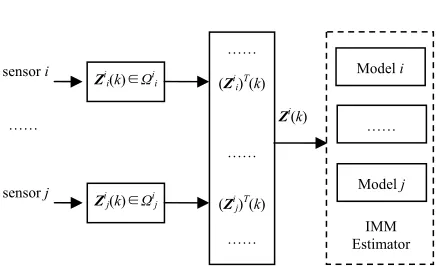
[image:2.595.310.532.67.200.2]where
) ( ... ) ( ) ( ) ( ) ( ... ... ... ... ) ( ... ) ( ) ( ) ( ) ( ... ) ( ) ( ) ( ) ( ) ( ... ) ( ) ( ) ( ) ( ) ( ) ( ) ( ... ) ( ) ( ) ( ) ( ) ( ) ( ) ( ... ) ( ) ( ) ( ) ( ) ( 2 1 2 2 12 1 12 1 2 1 2 1 2 1 k k k k k k k k k k k k k k k k k k k k k k i n T i n T i n i n i T i i n i i i T T i n T i T i i T T i n T i T i i T T i n T i T i i R R R R R R R R R R V V V V H H H H Z Z Z Z (5)Figure 1. Constructing of global measurement.
Hi(k) is global observation matrix, Vi(k) and Ri(k) is
ob-servation noise and covariance corresponding to model i respectively. Equations (1) and (3) constitute state trans-fer and observation equation of Kalman filter based IMM estimator.
Step 2: Model interacting
Let pij denote Markov transition probability and μi(k)
denote the probability of the mode i at time k, model interacting is calculated as
) | ( μ ) | ( Xˆ ) | (
X 1 1 1 1 | 1 1
1
k k k k k k r j i j ji (6)
and ] )) | ( Xˆ ) | ( X ( )) | ( Xˆ ) | ( X ( ) | ( P [ ) | ( μ ) | ( P | T j i j i j r j i j i k k k k k k k k k k k k k k 1 1 1 1 1 1 1 1 1 1 1 1 1 1 1
(7) where i=1,2,..,r, ) ( ) ( ) | ( | 1 1 1 1 1 p k
k c k k j ji i i j
(8)
is mixing probabilities, and
r j j jii k p k k
c
1
1 1
1) ( | )
( (9)
is normalizing factor.
Step 3: Model filtering
Based on r models from (4) and corresponding to
global measurement Zi(k), target state and covariance
estimation is calculated by Kalman
filters. ) | ( ), | (
ˆi k k Pi k k
X
State prediction equations are
) 1 | 1 ( ) 1 ( ) 1 | (
ˆi k k Φi k Xi k k
X (10)
T i i i T i i i i k k k k k k k k k )) 1 ( )( 1 ( ) 1 ( )) 1 ( )( 1 | 1 ( ) 1 ( ) 1 | ( Γ Q Γ Φ P Φ P (11)
Filtering updating equations are
(Zi i)T(k)
……
(Zi j)T(k)
……
Zi i(k)∈Ωii
sensor i
Zi j(k)∈Ωij
sensor j
…… Zi(k) ……
IMM Estimator
Model i
) ( )) ( )( 1 | ( ) ( )
(k i k i k k i k T i k
i H P H R
S (12)
1
))
(
))(
(
)(
1
|
(
)
(
k
ik
k
ik
ik
i
P
H
S
K
(13)))
1
|
(
ˆ
)
(
)
(
)(
(
)
1
|
(
ˆ
)
|
(
ˆ
ik
k
X
ik
k
K
ik
Z
ik
H
ik
X
ik
k
X
(14)T i i i i
i(k|k) P(k|k 1) K(k)S(k)(K(k))
P (15)
Step 4: Model probability updating
The likelihoods of each model are calculated as r i
k k
N
k i i
i( )~ (V ( );0,S ( )), 1,2,...,
Λ (16)
where Vi(k) is residual of model i with zero mean and the
covariance Si(k), N is Gaussian distribution. Then
prob-abilities of each model are calculated as
) 1 ( ) ( 1 )
( k c k
c
k i i
i Λ
(17)
rj
i i k c k c
1
) ( ) (
Λ (18)
Step 5: State estimation and covariance fusion
State estimation and associated covariance are com-bined by
r i
i
i k k
k
1
) ( ) ( ˆ ) (
ˆ X μ
X (19)
and
] )) | ( ˆ ) | ( ˆ (
)) | ( ˆ ) | ( ˆ ( ) | ( [ ) | ( ) | (
1
T i
i i
r
i i
k k k k
k k k k k k k k k
k
X X
X X
P P
(20)
i.e. total state estimation is probabilistic weighted sum-mation of every filters.
The method above differs from ordinary IMM estima-tor in Step 1 where global measurement is constructed by multiple sensors. Because of the presuming that meas-urement of any sensor is valid constantly, the method is a certain algorithm.
To multi-sensor tracking system with different perform-ance and complicated environment, uncertainty of meas-urement is one of the characteristics, and it is necessary to discuss IMM estimator for uncertain measurement.
3. IMM Estimator for Uncertain
Measurement
3.1. Optimal Uncertain IMM Estimator
To any sensor i, it is possible that some element zi
i,j(k) of
observation vector Zii(k)∈Ωii is invalid at time k. When
invalid measurement exists in multi-sensor system, if certain method is applied to construct global measure-ment by (4) and (5), because availability of measuremeasure-ment
is not considered in certain method and all measurement data are regarded as valid ones, the global observation
vector Zi(k) is incorrect and filters of IMM estimator can
perform incorrectly.
The problem above can be resolved by only combin-ing valid measurement data to construct new observation
space and new global observation equation.
Because of any measurement of any sensor being invalid by any possibility, the type and amount of invalid data
are uncertain, i.e. to any , Zi(k)∈Ωi′ may be
valid. Thus constructing different Zi(k) and observation
equation in different Ωi′ is required in each filter and
each filtering step. Apparently, to satisfy all the condi-tions of uncertain measurement, the amount of filters
corresponding to model i is , and the total
amount of filters in IMM estimator will be
i
i
'
i
i
'
dim(
2 i)
r
i
i
1 ) dim(
2
Then extreme complexity and inconvenience is resulted, and the resolution is difficult to be applicable.
Because there is no parameter to express availability of measurement in fusion filters of IMM estimator, ap-parently existing method can not solve the problem of invalid data in uncertain measurement appropriately. Then it is necessary to generalize existing method. If uncertainty of measurement is avoided by reconstructing the measurement, existing filtering method of IMM es-timator can be applicable.
In state estimate equation of Kalman filter (14), the
proportion of Zi(k) and in is
determined by filter gain Ki(k). If Ki(k) reduces, the
pro-portion of Zi(k) will reduce and the one of
will increase. Ki(k) is determined by Ri(k) and Pi(k, k-1)
according to (12) and (13). If Ri(k) increase, Ki(k) will
reduce and the proportion of Zi(k) will reduce also. In
limit case, when ||R(k)||→∞, it is satisfied that||K(k)||→0,
and Equation (7) will be
) 1 , ( ˆi k k
X Xˆi(k,k)
, ( ˆi k k
X 1)
) , ( Xˆ ) , ( Xˆ ) , (
Xˆ lim
lim
) ( K )
(
1 0
k k k k k
k i i
k i k
Ri i
(21)
here Zi(k) has no effect on optimal estimation of target
state, and it is equivalent to that Zi(k) is invalid when
||Ri(k)||→∞. Then Ri(k) can indicate the available extent
of measurement. Ri(k) only denotes precision of valid
measurement in existing algorithm, and is necessary to be generalized.
To evaluate availability of measurement, availability
function of zi
i,m(k), i.e. component m of Zii(k)
corre-sponding to sensor i at time k is defined as
invalid is ) (
valid is ) ( 1 ) ), ( (
, , ,
k z t
k z t
k z
a i
m i
i m i i
m
Then Ri
i(k)=[rii,lm(k)] of Zii(k) can be generalized as
)] , ( ~ [ ) , ( ~
, k t r t
k i
lm i i
i
R (23)
and
m l r t k z a t k z a
m l r
t k z a t
k
r i
lm i i
m i i
l i
i lm i i
m i i
lm i
, , ,
, ,
,
) ), ( ( ) ), ( (
1 ) ), ( ( )
, (
~ (24)
where a(zi
i,l(k), t) and a(zii,m(k), t) is availability function
of component i and j of Zi
i(k). It means that when zii,l(k)
and zi
i,m(k) are valid, availability functions equal to 1 and
) , ( ~
t k
i i
R =Rii(k). When zii,l(k) or zii,m(k) is invalid,
corre-sponding availability function tends to infinite, i.e. a(zi
i,l(k), t)→∞ or a(zii,m(k), t)→∞, and variance of invalid
measurement will tend to infinite also and be irrelevant to other measurement.
By defining availability function to reconstruct
gener-alized variance , uncertainty of measurement is
avoided formally and existing fusion filtering method
can be applicable to IMM estimator. Constructing Zi(k, t)
from {Zi
m(k), m=1,2,…,n} according to (4)-(5) and
from (22)–(24), multi-sensor IMM estimator is
achieved and estimation of target state is
ob-tained according to (6)–(20). Let t→∞, optimal
estima-tion of target state from IMM estimator without parame-ter t is obtained as
) , ( ~i k t
i
R
) , ( ~i kt
i
R
) , ( ˆ k t
X
) , ( Xˆ ) (
Xˆ k lim kt
t
(25)
3.2. Suboptimal IMM Estimator Based on Target State Feedback
It is inconvenient in practical application that availability
function is defined using limit operation t→∞ according
to (25). To solve the problem, invalid measurement can be regard as outlier, and corresponding valid measure-ment can be reconstructed with target state feedback of IMM estimator approximatively.
In target tracking system, when target is faint or in-terference is strong, there are outliers in measurement sequence ordinarily and tracking accuracy reduces.
Presuming measurement Zi
i(k) of sensor i at time k is
outlier, typical solution is discarding Zi
i(k) and
recon-structing one step prediction of the observation
by state estimation of
ac-cording to (10) as ) 1 , (
ˆi k k
i
Z
X
ˆ
i(
k
,
k
1
)
) 1 , ( ˆ ) ( ) 1 , (
ˆi k k i k i k k
i H X
Z (26)
Substituting Zˆi(k,k1) for Zi
i i(k) to filter, the effect
of outliers can be avoided. Defining generalized meas-urement as
invalid is ) (
valid is ) ( ) 1 , ( ˆ
) ( )
( ~
k k k
k k
k i
i i i i
i i i i
i
Z Z Z
Z
Z (27)
And keeping covariance matrix Ri
i(k) invariant, the
inva-lid measurement is converted to approximate generalized one having availability always.
When all measurement is valid, each generalized measurement in (27) is equal to corresponding actual measurement, and IMM estimator for uncertain meas-urement is degenerated to certain one. Therefore, exist-ing method is a special case of method presented and the latter is more general.
Compared to existing method, IMM estimator for un-certain measurement presented only adds a calculation
step of constructing generalized measurement Z~i(k) in
(26),(27). Calculational cost of this step can be ignored almost comparing to one of IMM algorithm, so that cal-culational cost of uncertain method presented is almost as the same as certain one.
4. Simulation Results
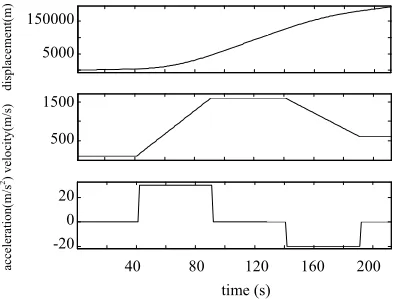
To evaluate effect of method presented, simulation data are obtained from a multi-sensor target tracking system including two detectors with different precision. The
target moves with constant velocity at time t[0,40],
] 140 , 91 [
t and t[191,210]
] 90 , 41 [
, with constant
accelera-tion at time t and . The perfect
state of target is shown in Figure 2.
] 190 , 141 [
t
[image:4.595.321.520.547.697.2]It is assumed that IMM estimator is composed of two filters based on CA and CV model respectively. Markov transition probability is [0.95 0.05; 0.05 0.95], and the probability of two models are 0.5 at initial time. Sam-
Figure 2. The perfect state of target.
1 500 50000
0
1500 500
acceleration(
m/s
2) velo
city(m/s)
displace
me
nt(m)
20 0 -20
pling time is T=1s, process noise is σ=10m, observation
noise of detector 1 is σ1=100m and that of detector 2 is
σ2=10m. Let detector 1 is valid and detector 2 is invalid
at , detector 1 is invalid and detector 2 is valid
at , and detector 1 and 2 are both valid at
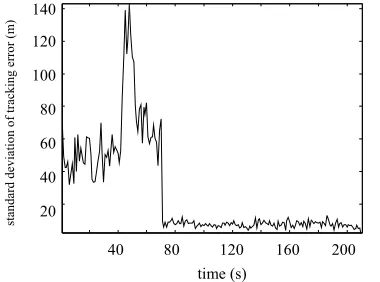
, and target state are estimated by the method presented at each moment. Executing simulation 10 times, and calculating standard deviation of estima-tion errors at each moment, the results of three uncertain cases are shown in Figure 3.
] 70 , 0 [
t
140 , 71 [
t
] 210 , 141 [
]
[image:5.595.74.262.212.352.2]t
[image:5.595.70.261.377.514.2]Figure 3. Standard deviation of tracking error (σ1=100, σ2=10).
Figure 4. Standard deviation of tracking error (σ1=100,
σ2=50).
Figure 5. Standard deviation of tracking error (σ1=100,
σ2=100).
Performing the simulation with σ2=50m and
σ2=100m respectively, the result is shown in Figure 4
and Figure 5.
In situation 1 and 2 only one sensor is valid. From
Fig-ure 3, since σ1>>σ2, tracking error of situation 1 is
com-parative larger than that of situation 2. Each sensor is valid in situation 3, so tracking error of situation 3 is
least. Because σ1>>σ2 similarly, estimation result of
tar-get state is determined by measurement of detector 2 mainly and almost the same as which of the situation 2. From Figures 4 and 5, there are 2 valid sensors at
] 210 , 141 [
t , and corresponding tracking error is least.
40 80 120 160 200 time (s)
140
120 multi-sensor IMM estimator for uncertain measurement. Simulation results demonstrate a typical scenario of
The results are consistent with theoretic analyses, so method presented can solve the problem of multi-sensor IMM estimator with varied validity preferably. Simulta-neously calculational cost of method presented is almost the same as existing one.
100 80 60 40 20
standard dev
iation o
f tr
acking error (
m)
5. Conclusions
In multi-sensor system there’s invalid measurement sometimes, and uncertainty of measurement is one of the typical characteristics. Existing IMM estimator is a cer-tain algorithm where it is presumed that all measurement is valid always, so it can not perform uncertain meas-urement appropriately.
140 120 100 80 60 40 20
One of approaches to avoid uncertainty of measure-ment defines availability function for each component of observation vector and reconstructs observation covari-ance matrix to express uncertainty of measurement. But limit operation is involved in this approach. The ap-proach presented substitutes target state feedback for invalid measurement to reconstruct generalized meas-urement. Then target state estimation can be obtained by existing IMM estimator with generalized measurement, and existing method is generalized and as a special case of uncertain one presented.
6
. References
[1] S. Tokoro, K. Moriizumi, T. Kawasaki, T. Nagao, K. Abe, and K. Fujita, “Sensor fusion system for pre-crash safety system,” Proceedings of 2004 IEEE Intelligent Vehicles Symposium, pp. 945–950, 2004.
[2] A. Polychronopoulos, M. Tsogas, A. J. Amditis, and L. Andreone, “Sensor fusion for predicting vehicles’ path for collision avoidance systems,” IEEE Transactions on Intelligent Transportation Systems, Vol. 8, No. 3, pp. 549–562, 2007.
[3] G. Alessandretti, A. Broggi, and P. Cerri, “Vehicle and guard rail detection using radar and vision data fusion,” IEEE Transactions on Intelligent Transportation Systems, Vol. 8, No. 1, pp. 95–105, 2007.
[4] X. R. Li and V. P. Jilkov, “Survey of maneuvering target
standard dev
iation o
f tr
acking error (
m)
40 80 120 160 200 time (s)
40 80 120 160 200 time (s)
140 120 100 80 60 40 20
standard dev
iation o
f tr
acking error (
[image:5.595.71.261.553.694.2]tracking, Part I: Dynamic models,” IEEE Transactions on Aerospace and Electronic Systems, Vol. 39, No. 4, pp. 1333–1364, 2003.
[5] H. Zhou, Z. Jing, and P. Wang, “Maneuver target tack-ing,” National Defence Industry Press, Beijing, 1991. [6] X. R. Li and V. P. Jilkov, “Survey of maneuvering target
tracking, Part V: Multiple-model methods,” IEEE Trans-actions on Aerospace and Electronic Systems, Vol. 41, No. 4, pp. 1255–1321, 2005.
[7] E. Mazor, A. Averbuch, Y. Bar-Shalom, and J. Dayan, “Interacting multiple model methods in target tracking: A survey,” IEEE Transactions on Aerospace and Electronic Systems, Vol. 34, No. 1, pp. 103–123, 1998.
[8] M. Mallick and B. F. La Scala, “IMM estimator for ground target tracking with variable measurement sam-pling intervals,” Proceedings of 9th International Con-ference Information Fusion, pp. 1–8, 2006.
[9] H. Chen and P. Meer, “Robust fusion of uncertain infor-mation,” IEEE Transactions on Systems, Man and Cy-bernetics, Part B, Vol. 35, No. 3, pp. 578–586, 2005.
[10] X. Liu and A. Goldsmith, “Kalman filtering with partial observation losses,” Proceedings of 43rd IEEE Confer-ence Decision and Control, Vol. 4, pp. 4180–4186, 2004. [11] Z. Wang, D. W. C. Ho, and X. Liu, “Variance-constrained
filtering for uncertain stochastic systems with missing measurements,” IEEE Transactions on Automatic Control, Vol. 48, No. 7, pp. 1254–1258, 2003.
[12] M. Cen and C. Fu, “Combined measurement fusion of unequal dimensional measurement vectors,” Journal of Sichuan University (Engineering Science Edition), Vol. 38, No. 4, pp. 45–149 (Ch), 2006.
[13] G. Qiang and C. J. Harris, “Comparison of two measure-ment fusion methods for Kalman-filter-based multisensor data fusion,” IEEE Transactions on Aerospace and Elec-tronic Systems, Vol. 37, No. 1, pp. 273–280, 2001. [14] J. A. Roecker and C. D. McGillem, “Comparison of