NOVEL SEMICONDUCTOR BASED LIGHT SOURCES
Andrew Douglas McRobbie
A Thesis Submitted for the Degree of PhD at the
University of St. Andrews
2008
Full metadata for this item is available in the St Andrews Digital Research Repository
at:
https://research-repository.st-andrews.ac.uk/
Please use this identifier to cite or link to this item: http://hdl.handle.net/10023/565
This item is protected by original copyright
Novel semiconductor based light sources
Thesis presented for the degree of Doctor of Philosophy
to the University of St Andrews
by
Andrew Douglas McRobbie
School of Physics and Astronomy University of St Andrews
Declarations
I, Andrew Douglas McRobbie, hereby certify that this thesis, which is approximately fifty thousand words in length, has been written by me, that it is the record of work carried out by me and that it has not been submitted in any previous application for a higher degree.
Date Signature of candidate
I was admitted as a research student and as a candidate for the degree of Doctor of Philosophy in October, 2004; the higher study for which this is a record was carried out in the University of St Andrews between 2004 and 2008.
Date Signature of candidate
In submitting this thesis to the University of St Andrews I understand that I am giving permission for it to be made available for use in accordance with the regulations of the University Library for the time being in force, subject to any copyright vested in the work not being affected thereby. I also understand that the title and abstract will be published, and that a copy of the work may be made and supplied to any bona fide library or research worker, that my thesis will be electronically accessible for personal or research use, and that the library has the right to migrate my thesis into new electronic forms as required to ensure continued access to the thesis. I have obtained any third-party copyright permissions that may be required in order to allow such access and migration.
Date Signature of candidate
I hereby certify that the candidate has fulfilled the conditions of the Resolution and Regulations appropriate for the degree of Doctor of Philosophy in the University of St Andrews and that the candidate is qualified to submit this thesis in application for that degree.
for
Abstract
The research described in this thesis relates to the design, fabrication and testing of novel semiconductor-based light sources that have been designed for the generation of infra-red light. The thesis is formatted to account for two distinct components of my work, where the first part concerns sources producing coherent light by direct laser emission, notably, ultrashort-pulse quantum-dot lasers. These types of lasers continue to show considerable promise as efficient, compact sources of ultrashort pulses with durations of hundreds of femtoseconds, while giving rise to unique and interesting electronic properties such as low lasing thresholds through the quantum nature of their density of states.
At the outset a study of the most relevant aspects of the lasing dynamics of an optically pumped quantum-dot laser is outlined. Pumping of the device with intense discrete optical pulses leads to output from multiple electronic states, each having a characteristic wavelength and temporal properties. I show that pulses produced by excited-state emission have shorter durations (24 ps) and arrive earlier in time than those due to transitions from the ground state, which themselves have durations of around 180 ps. Investigations are then made on two different mode-locked quantum-dot laser systems. One is an all-quantum-quantum-dot external-cavity laser that is mode locked using a quantum-dot SESAM device at a repetition frequency of 860 MHz with output power approaching 20 mW. This is followed by a study of a monolithic two-section quantum-dot laser that is mode locked stably in a wide temperature range of 20°C to 70°C. The excellent performance characteristics presented serve to demonstrate both the versatility of quantum-dot material as components in mode-locked laser systems and the temperature stability of such laser devices.
Unfortunately, the high losses incurred, which reached 250 dB/cm, could not be removed without also destroying the modulation in nonlinearity.
Table of Contents
Declerations II
Abstract IV
Contents VI
List of Publications XI
Acknowledgements XIV
1 Introduction
1
1.1. Background 1
1.1.1 Optoelectronic sources 2
1.2 Direct laser emission – Ultrashort-pulse mode-locked quantum-dot lasers 4
1.2.1 Uses of Ultrashort-pulse quantum-dot lasers 4
1.2.2 Mode-locked lasers 8
1.3 State-of-the-art ultrashort-pulse lasers 10
1.4 Quantum-dot ultrashort-pulse semiconductor lasers 12
1.5 Nonlinear properties of semiconductor material 15
1.5.1 Uses of nonlinear frequency conversion 16
1.6 Semiconductor materials for nonlinear optics 18
1.7 State-of-the-art nonlinear frequency conversion in semiconductors 19
1.8 Work contained in this thesis on nonlinear optical frequency conversion 24
1.9 Thesis overview 25
References 26
2 Underpinning theory of ultrashort-pulse quantum-dot lasers
32
2.1 Laser Pulses 32
2.1.1 Mathematical description of an optical pulse 33
2.1.2 Linear pulse propagation 34
2.1.4 Self phase modulation in semiconductor lasers 36
2.1.5 Dispersion compensation 38
2.2 Methods of obtaining ultrashort-pulse operation in lasers 40
2.2.1 Gain switching 40
2.2.2 Q-switching 41
2.2.3 Mode locking 42
2.3 Mode locking techniques in quantum-dot lasers 44
2.3.1 Passive mode locking 45
2.3.2 Semiconductor saturable absorber mirrors and saturable Bragg reflectors 46 2.3.3 Important SESAM parameters for successful mode locking 47 2.3.4 Ideal SESAM parameters for a semiconductor laser 51
2.4 Ultrashort-pulse measurement 52
2.4.1 The two-photon autocorrelator 52
2.5 Conclusions 55
References 56
3 Fabrication
58
3.1 Molecular beam epitaxy 58
3.2 Photolithography 60
3.3 Chemically-assisted Ion-beam etching 64
3.4 Ion Implantation 71
3.5 Analytical tools 73
3.6 Concluding remarks 75
References 76
4 Properties of quantum-dot materials
77
4.1 Background Semiconductor Physics 77
4.1.1 The p-n junction 78
4.1.2 Recombination 80
4.3 Quantum Confinement 81
4.3.1 Additional Quantum Confinement – Dots 82 4.3.2 Self-organised Growth (Stranski-Krastanow [S-K]) 84
4.4 Investigation of the Transition Dynamics of Quantum-dot Material 86
4.4.1 Motivation 86
4.4.2 Sample Growth 88
4.4.3 Experimental Assessment 89
4.5 Results 91
4.6 Future work and conclusions 99
References 101
5 All-quantum-dot, External-cavity, mode-locked laser
104
5.1 Introduction 104
5.2 Motivation 105
5.2.1 Advantages of external-cavity configurations 105
5.3 The Quantum-dot SESAM 109
5.4 Material Description 112
5.5 Experimental setup 114
5.6 Results 116
5.7 Additional work on quantum-dot lasers 130
5.8 Conclusions and future work 133
References 136
6 Nonlinear Frequency Conversion Theory
139
6.1 Polarisation 139
6.2 Nonlinear Polarisation Response 140
6.3.1 Solving the Coupled-wave Equations for Second Harmonic generation 143 6.3.2 Solving the Coupled-wave Equations for the Case of
Difference-frequency Generation 144
6.4 The Manley-Rowe Relations 145
6.5 Phase Matching 146
6.5.1 Refractive-index Dependence on Wavelength 147 6.5.2 Birefringent Phase Matching 149 6.5.3 Quasi-phase Matching (QPM) 151
6.6 Optical Parametric Oscillation 154
6.9 Conclusions 156
References 157
7 Nonlinear Frequency Conversion Experimental
158
7.1 PSN Concept 158
7.2 Ion implantation for destruction of nonlinear coefficient 161
7.3 Design and Calculations 162
7.3.1 Ion implantation calculations 163 7.3.2 Phase matching calculations 164
7.4 Sample Preparation 166
7.5 Linear-loss experimental setup and technique 168
7.5.1 Fourier analysis loss method 170
7.6 Ion Implantation and Thermal Annealing 175
7.7 Assessment of nonlinear optical properties 177
7.8 Orientation-patterned GaAs 180
7.8.1 Sample Preparation 181
7.8.2 Sample Preparation 2 184
7.9 Conclusions and Future Work 187
8 Summary and outlook
192
8.1 Mode-locked quantum-dot lasers 192
8.2 Nonlinear Frequency Conversion 195
References 198
List of Publications
Recent publications
Self-sustained pulsation in the oxide-confined vertical-cavity surface-emitting lasers based on submonolayer InGaAs quantum dots
Kuzmenkov, A. G. Ustinov, V. M. Sokolovskii, G. S. Maleev, N. A. Blokhin, S. A. Deryagin, A. G. Chumak, S. V. Shulenkov, A. S. Mikhrin, S. S. Kovsh, A. R. McRobbie, A. D. Sibbett, W. Cataluna, M. A., Rafailov, E. U.
Appl Phys Lett Vol 91,12, 121106 (2007)
High power all-quantum-dot based external cavity mode-locked laser
A. D. McRobbie, M. A. Cataluna, S.A. Zolotovskaya, D.A. Livshits, W. Sibbett, E.U. Rafailov
IEE Electronics Letters, Vol. 43(15), p812-813 (2007).
Stable modelocked operation up to 80°C from an InGaAs quantum-dot laser
E. U. Rafailov, M. A. Cataluna, A. D. McRobbie, W. Sibbett, D. A. Livshits and A.R. Kovsh
IEEE Photonic Technology Letters, Vol. 18(14), p1500-1502 (2006).
Investigation of transition dynamics in a quantum-dot laser optically pumped by femtosecond pulses
E. U. Rafailov, A. D. McRobbie, M. A. Cataluna, L. O'Faolain, W. Sibbett and D. A. Livshits
Cover image for Applied Physics Letters 23 Jan 2006 and featured article Appl. Phys. Lett. Vol. 88, 041101 (2006).
This paper was also selected to be published on:
Recent conference and poster presentations
Self-starting femtosecond Cr4+:YAG laser mode locked with a GaInNAs saturable Bragg reflector
C. G. Leburn, A. D. McRobbie, A. A. Lagatsky, S. Calvez, D. Burns, C. T. A. Brown, H. D. Sun, J. A. Gupta, G. C. Aers, M. D. Dawson and W. Sibbett
Advanced Solid-State Photonics (ASSP), Vancouver, Canada (2007)
Self-sustained pulsation and signal peaking in the oxide-confined VCSELs based on submonolayer InGaAs quantum dots
G.S.Sokolovskii, N.A.Maleev, A.G.Kuzmenkov, S.A.Blokhin, A.D.McRobbie, M.A.Cataluna, A.G.Deryagin, S.V.Chumak, .S.Shulenkov, S.S.Mikhrin, A.R.Kovsh, V.I.Kuchinskii, V.M.Ustinov, W.Sibbett, E.U.Rafailov
CLEO/Europe 2007,Munich, Germany, CB7-6-WED, 2007.
All-quantum-dot based external cavity mode locked laser
McRobbie, A.D., M.A. Cataluna, S.A. Zolotovskaya, D.A. Livshits, W. Sibbett, and E.U. Rafailov
SIOE'07. Cardiff, UK. (2007)
High power all-quantum-dot based external cavity mode-locked laser
A. D. McRobbie, M. A. Cataluna , S. A. Zolotovskaya, D. A. Livshits, W. Sibbett, E.U.Rafailov
LEOS annual meeting,Montreal, Canada, Th J4 (2006)
Low-loss GaInNAs saturable Bragg reflector for femtosecond mode locking of a Cr4+:YAG laser
C.G. Leburn, A.D. McRobbie, A.A. Lagatsky, C.T.A. Brown, W. Sibbett,
QEP 17/Photon 06,LTE7 16:15, Manchester, UK, 2006
New mode locking regime in a quantum-dot laser: enhancement by simultaneous cw excited-state emission
M. A. Cataluna, A. D. McRobbie, W. Sibbett, D. A. Livshits, A. R. Kovsh and E. U. Rafailov
CLEO 2006, Paper CThH3,Long Beach, USA (2006).
Investigation of Transition Dynamics in a Quantum dot laser optically pumped by femtosecond pulses
E. U. Rafailov, A. D. McRobbie, L. O'Faolain, M. A. Cataluna, W. Sibbett and D. A. Livshits
European Network of Excellence on Photonic Integrated Components and Circuits, Pontresina, Switzerland (2006)
Femtosecond semiconductor quantum-dot lasers
M. A. Cataluna, E. U. Rafailov, A. D. McRobbie, W. Sibbett, ,D. A. Livshits, and A. R. Kovsh
Investigation of Transition Dynamics in a Quantum dot laser optically pumped by femtosecond pulses
E. U. Rafailov, A. D. McRobbie, L. O’Faolain, M. A. Cataluna, W. Sibbett and D. A. Livshits
LEOS Annual Meeting, Sydney, Australia ThN4 (2005)
Ground and excited-state modelocking in a two-section quantum-dot laser
M. A. Cataluna, E. U. Rafailov, A. D. McRobbie, W. Sibbett, D. A. Livshits, and A. R. Kovsh
LEOS 2005, Sydney, Australia, ThS2 (2005).
Design parameters of periodically-switched nonlinear structures for efficient nonlinear process
Edik U. Rafailov, A. D. McRobbie, Wilson Sibbett, David Artigas and Pablo Loza-Alvarez
Acknowledgements
I have enjoyed my PhD studies immensely. During their course, I have had the opportunity to interact with some fantastic people who have made the experience as a whole, one of the most fulfilling.
First and foremost I am extremely indebted to my supervisors Prof Thomas Krauss and Prof Wilson Sibbett for giving me the opportunity to be part of their respective research groups. Their enormous experience and intellect have been a constant restorative force for me, ensuring that I move in a forwards direction at all times. Secondly, my most sincere gratitude is reserved for Dr Edik Rafailov, now affiliated with Dundee University. His deep knowledge of the particular details of my project, enthusiasm and practical skills were of great use on countless occasions.
Throughout my studies, I have been fortunate to be surrounded by extremely learned postdoctoral researchers and academic staff who have always surprised and delighted me with their patience and eagerness to share the benefit of their bountiful experience. For this reason I am very grateful to (in no particular order) Dr Alexander Lagatsky, Dr Liam O’Faolain, Dr Tom Brown, Dr Christopher Leburn, Dr Maria Ana Cataluna, Dr Ben Agate and Dr Arvydas Ruseckas.
Throughout the course of my PhD I have been in the constant debt of the technical staff of the School of Physics and Astronomy. I am particularly grateful for the talents of Mr George Robb and Mr Stevie Balfour whose ability to fix almost anything ensured the smooth running of the cleanroom facility which was essential to the day to day activities of my project.
I am also indebted to the skilled researchers with whom I was fortunate enough to collaborate, particularly Dr Nianhua Peng of the University of Surrey who assisted with the ion implantation work; Dr John Roberts at the National III-V semiconductor facility in Sheffield who helped with various aspects of my project and Dr Alexey Zhukov at the Ioffe institute who provided access to an excellent epitaxial growth facility.
On a personal level, I am very grateful to my parents and extended family for their unwavering support and advice over the last three and a half years. My Mum and Dad have been endlessly compassionate and for this I will be eternally thankful.
Chapter 1 Introduction
1.1
Background
An impressive amount of optoelectronic devices are in use in the modern world. The fact that they are ubiquitous bears strong testimony to both their versatility and reliability. It is because of these virtuous qualities that mankind and equipment based on optoelectronic technology have become inexorably linked. Indeed, to compile a list of instruments, used even in a domestic capacity, that contain optoelectronic-based components would be an exhaustive, lengthy process. From somewhat trivial applications such as the light emitting diodes used in household appliances through laser diodes used in CD players to globe-spanning pieces of technology such as the internet, optoelectronic devices contribute to the lives of people in many ways each and every day.
Optoelectronics is defined as the basic physics of light and matter and their interactions [1], whether in a specific device or in a more general context. A large amount of study in the last 50 years or so has led to an explosion in this field with significant milestones being the development of the p-n junction [2], the laser [3] and more recently the growth of fibre optic communications and biophotonics.
1.1.1 Optoelectronic sources
The application and further development of modern technology requires many different light sources that exhibit various properties. Applications as diverse as remote sensing, medical research and telecommunications have rather different requirements, so the light sources used in these different areas should accommodate these requirements via differing characteristics. In spectroscopic applications, the high degree of spectral purity inherent to a narrow linewidth source is a necessary feature [4]; the operating wavelength is also of great importance depending on the absorption or scattering properties of the sample to be analysed.
In the case of the lasers used in commercial CD players, small size, efficiency, reliability and low manufacturing costs are the key factors. This of course is why semiconductor diode lasers are so well suited to this particular application. Hence, if we consider the myriad of possible characteristics that sources should exhibit, it is not surprising that there exists a plethora of research into sources throughout the electromagnetic spectrum. Figure 1.1 shows a green laser pointer device which is an example of a compact optoelectronic product combining much of the physics pertinent to my project. This device has ferroelectric crystals at its core whereas my project specifically exploits semiconductor media as a base material.
This thesis comprises two main parts; the first half concerns ultrashort-pulse semiconductor lasers where I studied the fundamental physics of compact, low-threshold quantum-dot semiconductor material and its utilisation as a gain material in a mode-locked laser configuration. Study of the fundamental material properties was performed by the investigation of the transition dynamics of an optically pumped quantum-dot (QD) laser. The unique three-dimensional carrier confinement in quantum-dot material, produces discrete electronic states with distinct spectral and temporal characteristics. This knowledge is then applied to two mode-locked QD laser systems. In quantum-dot material, broad gain bandwidths and ultrafast carrier dynamics allow the generation of ultrashort pulses. I managed to show that in a quantum-dot laser, lasing transitions from different electronic states happen on different timescales. I then demonstrated mode-locked operation from an all-quantum-dot external cavity laser. In a separate investigation, I showed stable mode locking over a wide operating temperature range in a monolithic QD laser.
The second part of my thesis concerns the use of the nonlinear properties of semiconductor material. Novel GaAs-based quasi-phase-matched structures were designed, manufactured and tested. The use of semiconductor material for this application type paves the way for a new class of low threshold waveguide based optical parametric oscillator (OPO) system operating in the infra-red region of the spectrum. Here I investigated a system based on periodic switching ofand another based on orientation-patterning.
1.2 Direct laser emission – Ultrashort-pulse mode-locked
quantum-dot lasers
Semiconductors are excellent candidates as laser gain materials, capable of producing light over a large range of wavelengths depending on which of the many possible material configurations are implemented. These range from sub-400 nm wavelength emission for GaN-based devices to the mid-and far infrared for quantum cascade devices. In comparison with other laser materials, semiconductor lasers are typically several orders of magnitude smaller and are mainly monolithic electrically-pumped devices. It is these types of lasers, operated in pulse regimes around 1.3 microns that were investigated as part of this work. The gain material is based on self-assembled quantum dots.
1.2.1 Uses of ultrashort-pulse quantum-dot lasers
Optical communications
Since the 1990s, optical technology has become increasingly important in the areas of telecommunications and more recently in data communications due to the tremendous growth enjoyed in this area over the last ten years or so. Modern systems incorporate lasers that are used to transmit pulses of light through optical fibres in preference to conducting electrical signals in copper wire. The use of light as a transmission vector allows for faster transmission speeds due to the bosonic nature of photons. These pulses are encoded in a digital pattern which is used to represent bits of data.
emission bandwidth of QD lasers could be exploited to allow multiplexed channels of data comprised of many different bit streams [5].
An alternative scheme operating in the time domain is referred to as optical time division multiplexing (OTDM). In this scheme, several lower repetition frequency signals are joined together by the use of variable delay lines, again to form a composite signal containing all the information of the others. This can then be transmitted as a single very high repetition frequency signal using the one transmission line and then split up back into its constituent parent signals after receiving. Quantum-dot lasers could be particularly well suited to this application because their inherent short cavity length allows them to be incorporated in high repetition-rate schemes. Low jitter is also an advantage here as it allows improved bit error rates.
Figure 1.2. Dispersion and loss of silica-based optical fibre
Recently, OFS optics have pioneered the development of what they describe as ‘AllWave’ fibre. Conventional silica fibre displays increased loss between 1300 nm and 1400 nm due to OH- absorption. However, improvements in manufacturing technology allows AllWave fibre to exhibit a flat low-loss profile from 1280 nm to 1625 nm with no increased loss between 1300 nm 1400 nm. This improvement allows the potential to expand the capacity of optical networks [7].
Biophotonics
Another important application of pulsed lasers is in the area of biophotonics. Ultrashort pulses have been used, for example, to transfect DNA into living cells [8] and to cause two-photon ablation of biological tissue [9]. This type of application is becoming more commonplace as scientists realise the possible ways in which short pulses of light can be used to study biological processes.
Another potential biophotonics-related application is the field of optical coherence tomography. Here, a laser beam shone into tissue can be used to provide information about its composition due to the backscattered signal. The resolution of this technique is proportional to the bandwidth of the source of illumination. Sources exhibiting a short coherence length are also of particular use for the same reason [10, 11].
water makes lasers operating in the near infra-red well suited to cellular investigation. Specific wavelengths have demonstrated advantages in terms of cell viability when compared with others. For example, Neuman and Block state in their review of optical trapping that 830nm and 970 nm [12]. In this work viability was quantified by measuring the cloning efficiency of E.coli and Chinese hamster ovarian cells after 5 mins trapping as a function of wavelength. While these wavelengths are not possible in the quantum-dot system I studied, other types of semiconductor laser can readily produce these wavelengths.
Currently, solid-state and fibre lasers dominate these types of applications since they satisfy the power, bandwidth and coherence length criteria. Mode-locked quantum-dot lasers with their small size and inexpensive manufacturing costs could allow for the creation of biophotonics systems with reduced complexity, size and cost. While quantum-dot lasers currently struggle to match the peak power and bandwidths available from their solid-state counterparts, the continued development of techniques such as chirped-pulse amplification and engineering of the inhomogeneous broadening of QD material could allow these systems system to become competitive [13, 14].
Recently, QD lasers operating in a continuous wave configuration were integrated with microfluidic channels to create an integrated optical trap for the study of biological matter [15]. Using radiation pressure from the laser beams, cellular material was manipulated and subsequently interrogated. The QD laser system was intrinsically aligned for optimal trapping allowing a layperson to use the system with minimal training. This is in contrast to macroscopic optical trap systems which require skilled laser experts to operate and maintain. The system was also very small in size and the low numbers of components mean that it would be cheap to mass produce. While this is not a specific example of pulsed laser implementation, this type of small-footprint, turn-key operation is one of the key advantages of diode lasers in biophotonics applications.
Optical switching and datacomms
to keep pace. For example, current CPUs are clocked at around 2-4 GHz and are preferentially employed in dual core configurations since it is easier to link two slower processors together than construct one faster element [16]. The high repetition rates and short pulse durations coupled with the small footprint of QD lasers could be of enormous advantage in these areas. Small, electrically-pumped quantum-dot lasers could be used, e.g. for generating and distributing the clock around an electronic microcircuit.
1.2.2 Mode-locked lasers
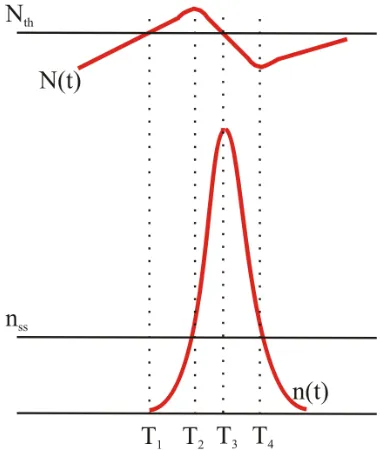
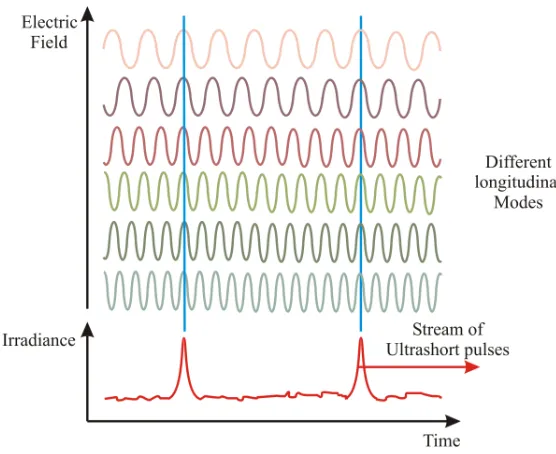
Despite the many ways of generating short pulses from a laser, such as Q-switching or gain Q-switching, the technique of mode locking is the only currently available method of producing ultrashort (femtosecond) pulses directly from a laser without external compression. These methods will be discussed in further depth in Chapter 2 with a specific emphasis on mode locking and the factors that influence it.
For now I will define the features of a mode-locked laser and introduce the parameters that play an important role in pulse shaping. This will enable a comparison of the different ultrashort pulse mode-locked laser systems currently available and how these pulse defining characteristics apply to each laser system. More importantly, it will help to identify differences between various laser systems and provide valuable insights into the optimal parameters required for the developments of the quantum-dot lasers described in this thesis.
Requirements for mode locking
laser field such that pulsed operation is favoured over continuous wave. Other important schemes include active and hybrid mode locking. Furthermore, the production of ultrashort pulses in the femtosecond regime requires that the gain material and saturable absorber satisfy additional criteria.
Pulse duration is fundamentally limited by the width of the stimulated emission bandwidth of the gain material. A wide emission bandwidth can support shorter pulses than one of narrower extent. Traditional solid-state sources, such as Cr4+:YAG or Ti:sapphire lasers, that generate femtosecond pulses possess emission bandwidths that can support the evolution of pulses having durations below 30fs. In the case of Ti:sapphire, pulse durations as short as 5 fs have been produced [17]. Quantum-dot semiconductor material can exhibit gain bandwidths that are capable of supporting ultrashort pulses [18].
Sources of ultrashort pulses also need to have very fast acting mechanisms to initiate pulse evolution. The Kerr-lensing mechanism used in some solid-state lasers can be considered to be instantaneous in its response since the nonlinear focusing effect adapts to changes in intensity immediately. In the case of lasers which use a saturable absorber element to initialise mode locking, the absorber must recover from a bleaching event long before the next pulse arrives.
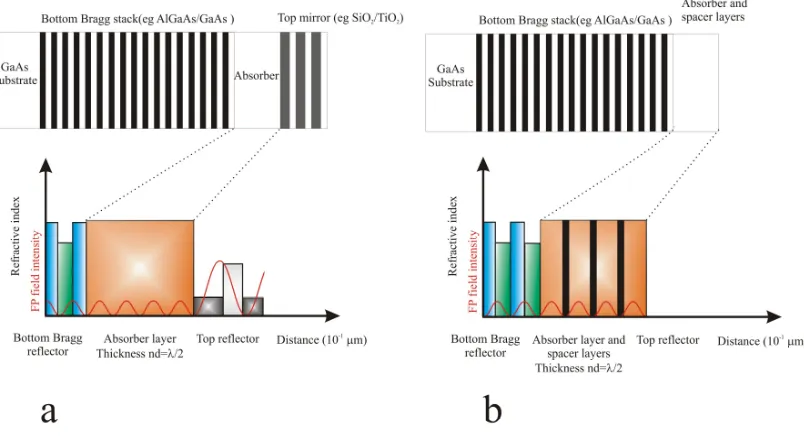
Saturable absorbers based on QD material have also been able to demonstrate ultrafast recovery, indicating their ability to act as mode locking elements [19-21]. This has enabled absorbers based on QD material to successfully mode lock a variety of laser systems from solid-state-based systems through fibre based lasers to semiconductor lasers [22-24]. The size of modulation introduced to the circulating field is also of crucial importance to the process. The magnitude of modulation required is related to the gain per unit length of the laser gain material which is lower in the case of solid-state lasers than in the case of semiconductor or fibre lasers. The fact that QD absorbers have been utilised successfully in all three of these systems bears testament to their versatility.
The spacing of the etalon is fixed such that its loss profile matches the inverse of the laser gain profile, resulting in a subsequently flat resultant gain and loss product. This technique however, requires a significant increase in the complexity of the system.
Another key requirement of any optimised mode-locked laser is the need to control or compensate the dispersive properties of the gain material. In semiconductor lasers, the nonlinear refractive index is strongly dependent on the numbers of carriers present locally in the material. Variations in this nonlinear index lead to chirping of the pulse frequency and subsequent pulse lengthening. In the gain section of a semiconductor laser, this chirping is positive in that the instantaneous frequency of the pulse increases with time. This is one of the fundamental limiting factors in the generation of femtosecond pulses from semiconductor lasers. With appropriate dispersion compensation, chirped pulses with picosecond durations can be compressed dramatically into the femtosecond domain [27].
1.3
State-of-the-art ultrashort-pulse lasers
Favourable characteristics such as emission bandwidth have helped establish solid-state lasers as the most widely used sources of ultrashort pulses. The gateway to exceptionally short pulses was the discovery of Kerr lens mode locking by Spence, Kean and Sibbett [28]. This method has now also been employed at the telecoms windows through gain materials such as Cr4+:Forsterite operating at 1.3 m and Cr4+:YAG operating at 1.5m. These have both been utilised to produce pulses in the femtosecond domain [29, 30]. Some of the shortest pulses ever produced at optical frequencies use solid-state lasers that have been mode locked using the Kerr lens technique [17].
performance of a KLM system. The durations available and increased operational tolerance in the mode locking parameters in SESAM-based lasers however, makes this type of laser configuration suitable for many applications.
Ultrashort-pulse semiconductor lasers
The lasers described above are all quite large and because none is directly electrically pumped, the wall plug efficiency is low, typically below 25% [32]. Semiconductor lasers, being small compared to solid-state lasers, offer much higher pulse repetition frequencies but their high efficiencies really set them apart. Furthermore, a monolithic device cannot be internally tweaked or become misaligned over a period of time, which makes them very robust for practical implementations.
Most ultrashort-pulse semiconductor lasers prior to 2001 incorporated quantum wells. These devices have been operated mainly in a picosecond regime using a variety of schemes involving passive mode locking [33] and colliding pulse passive mode locking [34] and typical pulse durations have been between 1-2 picoseconds and even less in the case of the work of Chenet al [35]. It is possible to use QW lasers to generate even shorter pulses by incorporating an external cavity to compress the pulses further after they have been produced. This can be done with prisms or a grating [36] or indeed by using rather more complicated schemes to control the precise shape of spectra from the laser.
In this thesis, I will concentrate on quantum-dot-based InAs/GaAs gain media as investigated by Goldstein et al [37]. Systems based on this combination of materials are by far the best developed of the various types of QD configurations currently being investigated for ultrashort pulse production.
nature and not governed by the discrete timing characteristics of a pulse profile. Timing jitter is a particular problem in passively mode-locked devices as there is no external ‘clocking’ signal [40]. Improved ASE levels have thus allowed QD lasers to display considerably lower timing jitters than those reported for the alternative QW-based devices [41]. These factors suggest that equivalent and even potentially superior pulse performance could be obtained from a quantum-dot laser compared to a quantum-well device.
1.4 Quantum-dot ultrashort-pulse semiconductor lasers
Some of the subject matter in this section is extracted from the content of the review paper recently co-authored by Rafailovet al and the thesis of M.A. Cataluna on the topic of mode-locked QD lasers [6, 42]. The results are shown in table 1.1 below in chronological order. Those deemed to be of particular importance are also briefly discussed.
Several authors have investigated passively mode-locked configurations for QD semiconductor lasers. For instance, Huanget al were among the first to explore this type of laser and reported the generation of 17 ps pulses which had a time-bandwidth product of around 3, indicating highly frequency-chirped pulses [24]. Shortly after this, in 2004, Thompson et al demonstrated 10 ps pulses with a time – bandwidth product of 0.315, indicating that the pulses from their passively mode-locked system were transform limited [43]. This difference in time-bandwidth product is connected to the very good balance of pulse broadening and compression mechanisms which must have been achieved between the gain section and absorber in the latter result.
A significant result using this type of system was obtained by Rafailov et al
bias on the gain section meant that a broad spectral bandwidth of 14 nm was created (the broadest mode-locked spectrum at that time) which could potentially support shorter pulses. The high values of reverse bias used in this work assisted in the optimal recovery of the absorber which is an important pulse shaping mechanism. The pulses were still slightly frequency chirped, indicating that yet shorter pulses are possible from similar systems. Since this breakthrough, several other groups have also reported subpicosecond pulses with durations around 700 fs [45, 46]. These serve to illustrate that it is possible to produce exceptionally short pulses using a simple and self-contained device configuration.
Another important factor in the assessment of sources for ultrafast applications is the repetition frequency of the laser. QD lasers have shown an ability to deliver ultrashort pulses with impressively high repetition frequencies. Currently, the highest observed value from a simple two-section QD laser configuration under the conditions of passive mode locking is 80 GHz [45]. Still higher repetition frequencies have been obtained using a variation of colliding-pulse mode locking (CPM) (schemes where the saturable absorber section is in the centre of the laser) called harmonic mode locking. In such CPM configurations, multiple pulses circulate within the cavity and so the repetition frequency is equal to the product of the round-trip frequency and the number of circulating pulses. Using this technique, Raeet almode-locked a QD laser diode at the 6th harmonic with a pulse repetition frequency of 238 GHz [47]. There is however still has some way to go to match the impressive result of Yansonet al, who realised a pulse repetition frequency of 2.1 THz from a compound-cavity harmonically-mode-locked quantum-well device [48]
Laser type and Mode locking configuration Pulse width (ps) Peak power (mW) Spectral bandwidth (nm) Time Bandwidth product (dimensionless) Repetition frequency (GHz) Ref # Monolithic
passive 17 7 1 3.1 G 7.4 [24]
Monolithic
Hybrid/passive
<14.2
(hybrid)
4
(hybrid) 0.8 (hybrid)
< 2.78 G
(hybrid) 10 (hybrid) [50]
Monolithic
passive 10 2.5 0.2 0.315 S 18 [43]
Monolithic
Hybrid/passive 12/7 N/A/6 0.18/NA N/A 20/35 [51]
Monolithic
passive 2 1100 N/A N/A 21 [44]
Monolithic
passive 0.39 3000 14 ~1 G 21 [44]
Monolithic
Hybrid/passive 3 6 N/A N/A 20/50 [52]
Monolithic assive 1.7 57 0.86 0.27 L 9.7 [53]
Monolithic
passive 5.7 290 ~5 ~5 5.17 [54]
Monolithic
Colliding pulse 7 13 0.32 0.54 G 20 [55]
Monolithic
(flared
waveguide)
0.79 500 3.6 0.5 G 24 [46]
External cavity + SOA + compressor
1.2 1220 3.1 0.69 G 4.95 [56]
Monolithic
+ SOA hybrid 0.7 130 8.5 1.1 S 20 [45]
Monolithic
+ SOA hybrid 3.3 26 6.5 3.9 S 20 [45]
Monolithic
+ SOA hybrid 1.9 14 2.2 0.7 S 40 [45]
Monolithic
+ SOA passive 2.2 11 4.2 1.5 S 80 [45]
Monolithic 1.3 10 1.4 0.45 S 238 [47]
Monolithic 6.4 224 1.8 3.4 42.4 [57]
Table 1.1. Table showing state of the art in QD performance. S, G and L refer to a sech2,Gaussian and Lorenzian
One interesting point of note is that the 390 fs result of Rafailov et al still remains the shortest pulse duration achieved directly from a QD laser to my knowledge at the time of writing this thesis. This is despite the fact that many other researchers have investigated lasers with very similar characteristics. The precise mechanisms leading to these very short pulses are not currently fully understood. It is also worth pointing out that lasers exhibiting the smallest TBP do not necessarily yield the shortest pulses given that a suitable combination of a wide emission bandwidth and chirp control is required for optimal pulse duration.
These results confirm that a great deal more work is required to understand the processes at work within mode locked quantum-dot lasers and implement them in the sorts of simple monolithic configurations which best exploit their comparative advantage. The ultimate realisation of this would be a monolithic semiconductor laser capable of producing pulses of the order of 100 fs. If this could be achieved and pulse amplification techniques employed to boost the peak power, then QD lasers could be truly competitive with existing solid-state systems in a broad range of applications.
1.5 Nonlinear optical properties of semiconductor material
The second thrust of my project concerned the use of semiconductor material for nonlinear optical frequency conversion (NLOFC) applications in the mid infrared where there is a relative lack of practical optical sources. NLOFC is a “parametric” nonlinear process - a term that has been derived from electrical engineering. In electronic parametric amplifiers, signals of differing frequency interact in a nonlinear manner dictated by the parameters of the circuit. In the case of optical parametric processes, the nature of the nonlinear process depends on the characteristics of the material and of the interacting waves.
Current materials used for these processes are ferroelectric crystalline materials such as lithium niobate (LINbO3), potassium titanyl phosphate (KTP) and
response, will allow this material to be used as the basis for devices that may be shown to be superior to those currently available.
1.5.1 Uses of nonlinear frequency conversion
As stated previously, nonlinear means are used to produce light in regions of the spectrum where it is difficult to generate coherent light otherwise. Reliable efficient sources are important to many types of applications. One of the principal uses of nonlinear optical wavelength generation is in spectroscopic applications. These demand light sources whose wavelength can be precisely matched to the absorption resonances pertaining to particular molecular species. By variation of materials and methods, parametric processes can deliver light with wavelengths ranging from the ultraviolet right through to the far infrared.
This technique is central to the area of trace gas detection. Recently, Stothard
Figure 1.3. Visible light LIDAR system used to probe the sky during strong aurora activity in Antarctica. Image taken from http://www.aad.gov.au/default.asp?casid=2933.
Another spectroscopic application is that of light detection and ranging (LIDAR). This can be thought of as radar but done at optical frequencies. An example of the use of LIDAR is for atmospheric monitoring. By directing a light beam at the sky and collecting the back-scattered signal, one can gather information on the distribution and movement of clouds and aerosols. In addition, by employing a differential absorption methodology (DIAL), it is possible to ascertain the nature of the species present. This enables the monitoring of air quality, by detection of specific molecules indicative of things such as smog [62]. Atmospheric LIDAR operates over large distances, requiring sources delivering several Watts of average power [63]. Other types of LIDAR such as those used for more close range analysis would require less power to function effectively.
can then be used as the channels of a WDM system. Due to its complexity, this system would be quite bulky if implemented using currently available technology.
From the above, it is clear that nonlinear frequency conversion has many applications due to the versatility of the approach to arbitrary wavelength regimes. In terms of scientific research, tunable parametric sources represent excellent investments as they can be applied to many different tasks. With the use of new materials, new wavelengths can be generated and new applications can be explored, further enhancing the usefulness of the approach.
1.6 Semiconductor materials for nonlinear optics
Despite the success of current ferroelectric materials such as LiNbO3 , there are
several reasons for considering nonlinear processes in semiconductors (GaAs), such as transparency window, photo-stability and nonlinear conversion efficiency, typically described by.
The second-order nonlinear susceptibility of a material describes how the material develops a nonlinear polarisation under the influence of an external electric field. This nonlinear polarisation subsequently gives rise to frequencies in addition to that of the fundamental driving field through the coupled wave equations which are covered in Chapter 6. GaAs has a coefficient of around an order of magnitude larger than that of LiNbO3(d36 GaAs = 170 pm/V whereas d31LiNbO3=4.6 pm/V d33
LiNbO3=25.2 pm/V) [65]. The second advantage of semiconductor material relates to
the transparency range. For instance, GaAs is transparent from its band edge at around 870 nm through to about 17m [66]. Correspondingly, the transparency range of LiNbO3lies between around 320 nm and around 4m [67].
crystals [68]. Semiconductor materials do not suffer from these effects due to their different electronic structure, but do exhibit lower damage thresholds.
An extremely important advantage of using semiconductor material is the inherent ability of integration, which offers the potential to realise a monolithic frequency conversion device comprising an integrated pump laser and ‘nonlinear’ section. This goal is aided by the ability in semiconductor to fabricate waveguide structures less than 10 m wide of high optical quality, exhibiting low losses. This technology can be readily applied in order to produce a semiconductor based nonlinear waveguide, providing efficient conversion due to the high intensity of light propagating within. With these advantages it is easy to understand why there is significant research interest worldwide in harnessing semiconductor materials for NLOFC
1.7 State-of-the-art nonlinear frequency conversion in
semiconductors
oxidation was performed on the AlAs sections to increase the index contrast between these areas and those of GaAs [75]. Parametric amplification was demonstrated with up to 80 nW of difference frequency generated (DFG) power at 1058 nm using 0.4 mW and 11.6 mW of Nd:YAG and Titanium sapphire pump power respectively. [76]. After this initial demonstration, several other authors also used form birefringence for second-harmonic-generation (SHG), producing an efficiency of 1.3% and 650W of second-harmonic power at 1m [77] as well as optical parametric generation (OPG) where 4 nW from 50 mW of pump power atp = 1060 nm [78] were demonstrated
Modal phase matching (MPM) is another way to compensate for dispersion and achieve phase matching. This technique utilises careful design in multimode waveguide structures such that the differing propagation speeds of transverse modes in the waveguide can be exploited. The refractive index experienced by higher-order modes is smaller and the propagation speed higher than that of lower order modes. Also, in a material exhibiting normal dispersion, a second-harmonic beam will propagate more slowly than the fundamental. By then engineering a situation where, the SH field propagates in a higher-order mode than the fundamental, the two fields can experience the same phase velocity and are thus phase matched.
This method has the advantage of being an ‘all optical’ method of achieving phase matching where there is no complicated processing of the structure to engineer the phase matching effect. Instead, the geometry of the waveguide causes the difference in mode velocities which balances the dispersion. This was first demonstrated practically in 1971 producing SHG from a CO2 pump [79]. Several
other authors have since also utilised the effect in NLOFC applications. Recently, Moutzouris et al demonstrated 10 W of SHG from 65 mW input power with a fundamental frequency of 1.55 m [80]. Due to the simple nature of this method, it offers (in comparison to other GaAs NLOFC schemes) ease of monolithic integration.
Normally, in ferroelectric materials such as LiNbO3or KTP, this is achieved
by periodic electric poling of the material, which acts to alter the material properties such that the sign of the nonlinearity is changed [81]. It is normally achieved through applying an electric field to the material through the use of patterned electrodes. Periodic poling, allows continued conversion from pump to converted wave by resetting the phase slip between propagating waves every coherence length.
Given that GaAs is non-ferroelectric, the poling approach cannot be used. Alternative methods are thus required to achieve domain inversion and QPM operation. One novel way to perform QPM in non-ferroelectric materials such as GaAs is to employ a periodic switching of the nonlinearity (PSN) in the material between a low and high value every coherence length. This allows a net gain in the converted field over two coherence lengths. Switching the nonlinearity can be done by a variety of methods including regrowing domains of material with a nonlinear coefficient which alternates between a high and low value. This is less technically demanding than the micron scale reorienting demanded in order to create periodically poled material in non- ferroelectric materials. This method has been explored from a theoretical perspective [82] and utilised to produce SHG in an AlGaAs/GaAs waveguide crystal [83]. Despite the fact that this method is inherently half as efficient as periodic poling due to only providing a net gain in converted field every 2 coherence lengths, the higher nonlinear coefficients available in GaAs could in principle allow this method to be more efficient than a periodically poled LiNbO3
system.
Figure 1.4. Diagram showing zincblende crystal structure such as in GaAs
The two different sizes of atoms shown in the diagram represent the Ga and As atoms present in the structure. It is possible to replicate the effect of periodic poling (reversing the sign of the nonlinear coefficient) by inverting the crystal domain, thus turning the crystal through 180 degrees. Inverting the crystal domain can be achieved by rotating the structure about the x ([100]) direction by 90 degrees [84].
Early approaches for achieving domain inversion and subsequent QPM in GaAs involved the stacking of plates of alternating domain. This was first demonstrated experimentally in 1976 by Szilagyiet alwho showed SHG of 10.6m CO2laser light
using a stack of plates with a thickness of 308m which gave third order QPM [85]. These early attempts operated with coherence lengths of hundreds of microns. To truly exploit the vast transparency range of GaAs it was necessary to formulate a method capable of producing far thinner plates of material (<10m).
In 1993, diffusion bonding was first used by Fejer’s group to join together plates of GaAs into a continuous slab of material. This proof of concept paper exhibited reduced losses due to the elimination of reflections at the boundaries between adjacent plates [86]. The authors managed to demonstrate slabs as thin as 3
power from 2.3 mW of fundamental power at around 1.5 m [90]. Here, third-order refers to the fact that in this case the quasi-phase-matching acts over every third coherence length of the material.
A key breakthrough in the quest to obtain low loss periodically orientation inverted material was the development of so-called sublattice reversal epitaxy (SRE) [91], or orientation patterning (OP) as it is otherwise known. The SRE/OP technique (which underwent significant development during the timeframe of this thesis) allows the creation of epitaxially grown material with alternating domains required for QPM. This can be thought of as ‘periodic poling for non ferroelectric materials’. Developed independently by groups at Stanford University and the University of Tokyo, the basis of the technique is growth of GaAs in antiphase to the material beneath.
Using this technique, Fejer’s group at Stanford University demonstrated SHG with an internal conversion efficiency of around 33%[92] and DFG, producing a cw idler power level just 2.8 times lower than theory predicted [93]. They also demonstrated optical parametric generation [94]. In this work they utilised the broad transparency range of GaAs with a pulsed pump at 1.9m generating light from 2.28 and 9.14m with a maximum output energy of over 3J (idler) from around 60J of pump. This broad range was then further extended into the IR by exploiting pump wavelengths connected with zero group velocity dispersion. This allowed the generation of light from 4.5 – 10.7m. Recently, a French group using this technique managed to recreate the work, producing the highest slope efficiency and output from an OPGaAs system producing 57% and 1.2W (signal and idler combined) respectively [95]. These devices are all based on bulk material. In this configuration, the pump light has relatively low intensity. By operating in a waveguide configuration, the pump intensity is dramatically increased due to the smaller cross sectional area when comparing waveguide to bulk.
of the waveguide. Improvements in both of these could lead potentially to significant increases in efficiencies.
1.8 Work contained in this thesis on NLOFC
Two methods for achieving nonlinear frequency conversion were investigated in my project work. Initially, a PSN methodology was investigated using ion implantation to selectively destroy the nonlinear coefficient in patterned GaAs waveguides. The underlying research hypothesis was that NLOFC waveguides fabricated in this manner would have low losses due to the fact that no regrowth is required. Once the active region is grown, it is modified rather than removed and replaced as in orientation-patterned schemes or in PSN schemes such as [83]. These waveguides were then studied with a view to measuring OPG and SHG.
While this work was in progress, the orientation-patterning technique discussed in the previous section reached a level of prominence such that its utilisation was considered in the context of my project. The approach was recognised as being very practical and offered the prospect of twice the efficiency of an identical PSN system. Orientation-patterned GaAs frequency conversion waveguide chips were therefore explored as an additional and potentially superior method of nonlinear parametric generation. This work will be described in Chapter 7.
1.9 Thesis overview
The overarching theme of my project activities was the development of novel GaAs-based light sources, either by direct laser action or by nonlinear conversion. Concentrating first on semiconductor devices that produce light by direct means, ultrashort-pulse quantum-dot-based semiconductor lasers were explored. In Chapter 2 I deal with the physics of the operation and ultrashort-pulse production of quantum-dot lasers. Chapter 3 provides a summary of the main fabrication techniques used in my work to fabricate both quantum-dot devices and structures suitable for NLOFC applications. In Chapter 4 I describe how these ideas were used to investigate quantum-dot, gain-switched lasers that were optically pumped by femtosecond pulses. With research colleagues, I then investigated how emission from the ground and excited states evolved and what type of temporal differences could be observed in QD devices. The subject matter of Chapter 5 is a description of the mode locking of a semiconductor quantum-dot laser in an external cavity scheme and how mode locking could be achieved over a broad temperature range for a monolithic laser.
References
1. Wilson. J., Hawkes. P.,Optoelectronics an introduction. 3rded.: Prentice hall. 1998,
2. Hoddeson, L.,The origins of the pn junction,IEEE SPECTRUM. 1997. p. 46 -51.
3. Maiman, T.H.,Stimulated optical radiation in ruby.Nature, 1960.187(4736): p. 493-494.
4. McAleavey, F.J., et al.,Narrow linewidth, tunable Tm3+ - doped fluoride fiber laser for optical-based hydrocarbon gas sensing.IEEE Journal of Selected Topics in Quantum Electronics, 1997.3(4): p. 1103-1111.
5. Liu, J., et al.,Uniform 90-channel multiwavelength InAs/InGaAsP quantum dot laser.Electronics Letters, 2007.43(8): p. 458 - 460.
6. Rafailov, E.U., M.A. Cataluna, and W. Sibbett,Mode-locked quantum-dot lasers.Nature Photonics, 2007.1(7): p. 395-401.
7. Chang, K. and W.M. Flegal.Full spectrum fibre performance today and tomorrow with OFS AllWave fibre, 2003
http://www.ofsoptics.com/resources/hydrogenaging-0503web.pdf.
8. Stevenson, D., et al.,Femtosecond optical transfection of cells:viability and efficiency.Optics Express, 2006.14: p. 7125 - 7133.
9. Fischer, P., et al.,Two-photon ablation with 1278 nm laser radiation.Journal of Optics A-Pure and Applied Optics, 2007.9(6): p. S19-S23.
10. Wikipedia.Optical coherence tomography. 2008,
http://en.wikipedia.org/wiki/Optical_coherence_tomography .
11. Drexler, W.,Ultrahigh-resolution optical coherence tomography.Journal of Biomedical Optics, 2004.9(1): p. 47-74.
12. Neuman, K.C. and S.M. Block,Optical Trapping.Review of Scientific Instruments, 2004.75(9): p. 2787-2809.
13. Kovsh, A., et al.,Quantum dot laser with 75 nm broad spectrum of emission.
Optics Letters, 2007.32(7): p. 793-795.
14. Kim, K., S. Lee, and P.J. Delfyett,eXtreme chirped pulse amplification -Beyond the fundamental energy storage limit of semiconductor optical amplifiers.IEEE Journal of Selected Topics in Quantum Electronics, 2006.
12(2): p. 245-254.
15. Cran-McGreehin, S.J., K. Dholakia, and T.F. Krauss,Monolithic integration of microfluidic channels and semiconductor lasers.Optics Express, 2006.
14(17): p. 7723 - 7729.
16. Kronlund, D.Dual core processing: Over-simplified, demystified and explained. 2004 http://icrontic.com/articles/dual_core
17. Ell, R., et al.,Generation of 5-fs pulses and octave-spanning spectra directly from a Ti : sapphire laser.Optics Letters, 2001.26(6): p. 373-375.
18. Rossetti, M., et al.,Quantum dot superluminescent diodes emitting at 1.3 mu m.IEEE Photonics Technology Letters, 2005.17(3): p. 540-542.
19. Rafailov, E.U., et al.,Fast quantum-dot saturable absorber for passive mode-locking of solid-state lasers.IEEE Photonics Technology Letters, 2004.
16(11): p. 2439-2441.
21. Borri, P., et al.,Ultrafast carrier dynamics in InGaAs quantum dot materials and devices.Journal of Optics a-Pure and Applied Optics, 2006.8(4): p. S33-S46.
22. McWilliam, A., et al.,Quantum-dot-based saturable absorber for femtosecond mode-locked operation of a solid-state laser.Optics Letters, 2006.31(10): p. 1444-1446.
23. Herda, R., et al.Quantum-dot based saturable absorber for mode locking of fibre lasers. IEEELEOS 2005. Paper ThN5. Sydney, Australia.
24. Huang, X.D., et al.,Passive mode-locking in 1.3 mu m two-section InAs quantum dot lasers.Applied Physics Letters, 2001.78(19): p. 2825-2827. 25. Siegman, A.,Lasers. 1986: University Science Books. 1283.
26. Gee, S., et al.,Ultrashort pulse generation by intracavity spectral shaping and phase compensation of external-cavity modelocked semiconductor lasers.
IEEE Journal of Quantum Electronics, 2000.36(9): p. 1035-1040.
27. Matsui, Y., M.D. Pelusi, and A. Suzuki,Generation of 20-fs optical pulses from a gain-switched laser diode by a four-stage soliton compression technique.IEEE Photonics Technology Letters, 1999.11(10): p. 1217-1219. 28. Spence, D.E., P.N. Kean, and W. Sibbett,60-Fsec Pulse Generation from a
Self-Mode-Locked Ti-Sapphire Laser.Optics Letters, 1991.16(1): p. 42-44. 29. Tong, Y.P., P.M.W. French, and J.R. Taylor,All-solid-state Kerr lens
mode-locked Cr4+:forsterite laser.Electronics Letters, 1996.32(8): p. 737-738. 30. Leburn, C.G., et al.,Femtosecond Cr4+: YAG laser with 4GHz pulse
repetition rate.Electronics Letters, 2004.40(13): p. 805-807.
31. Lebum, C.G., et al.Self-starting Cr4+:YAG laser mode-locked with a GaInNAs saturable Bragg reflector.Advanced solid state photonics, 2007 Paper WA6 ,Vancouver Canada
32. RPPhotonics.Encyclopedia of laser physics and technology article : Wall plug efficiency. http://www.rp-photonics.com/wall_plug_efficiency.html,
33. Ogawa, K., et al.,Pulse characterisation of a quantum-well mode-locked laser diode by two-photon absorption frequency-resolved optical gating.Optical and Quantum Electronics, 2001.33(7-10): p. 727-733.
34. Wu, M.C., et al.,Transform-Limited 1.4 Ps Optical Pulses from a Monolithic Colliding-Pulse Mode-Locked Quantum-Well Laser.Applied Physics Letters, 1990.57(8): p. 759-761.
35. Chen, Y.K., et al.,Subpicosecond Monolithic Colliding-Pulse Mode-Locked Multiple Quantum-Well Lasers.Applied Physics Letters, 1991.58(12): p. 1253-1255.
36. Ludwig, R. and A. Ehrhardt,Turn-Key-Ready Wavelength, Repetition Rate and Pulsewidth-Tunable Femtosecond Hybrid Modelocked Semiconductor-Laser.Electronics Letters, 1995.31(14): p. 1165-1167.
37. Goldstein, L., et al.,Growth by Molecular-Beam Epitaxy and Characterization of Inas/Gaas Strained-Layer Superlattices.Applied Physics Letters, 1985.
47(10): p. 1099-1101.
38. Kirstaedter, N., et al.,Gain and differential gain of single layer InAs/GaAs quantum dot injection lasers.Applied Physics Letters, 1996.69(9): p. 1226-1228.
40. Derickson, D.J., et al.,Comparison of Timing Jitter in External and Monolithic Cavity Mode-Locked Semiconductor-Lasers.Applied Physics Letters, 1991.59(26): p. 3372-3374.
41. Thompson, M.G., et al.Absorber length optimisation for sub-picosecond pulse generation and ultra-low jitter performance in passively mode-locked 1.3 /spl mu/m quantum-dot laser diodes.Optical fibre communication conference.
2006. Paper OThG3 .
42. Cataluna, M.A.,Ultrashort-pulse generation from quantum-dot semiconductor diode lasers,PhD Thesis,School of Physics and Astronomy, 2007, University of St Andrews: St Andrews,.
43. Thompson, M.G., et al.,Transform-limited optical pulses from 18GHz monolithic modelocked quantum dot lasers operating at similar to 1.3 mu m.
Electronics Letters, 2004.40(5): p. 346-347.
44. Rafailov, E.U., et al.,High-power picosecond and femtosecond pulse generation from a two-section mode-locked quantum-dot laser.Applied Physics Letters, 2005.87(8).
45. Laemmlin, M., et al.,Distortion-free optical amplification of 20-80 GHz modelocked laser pulses at 1.3 mu m using quantum dots.Electronics Letters, 2006.42(12): p. 697-699.
46. Thompson, M.G., et al.,Subpicosecond high-power mode locking using flared waveguide monolithic quantum-dot lasers.Applied Physics Letters, 2006.
88(13). p. 133119
47. Rae, A.R., et al.Harmonic Mode-Locking of a Quantum-Dot laser diode. in
LEOS annual meeting,2006, Paper ThR5. Montreal Canada.
48. Yanson, D.A., et al.,Terahertz repetition frequencies from harmonic mode-locked monolithic compound-cavity laser diodes.Applied Physics Letters, 2001.78(23): p. 3571-3573.
49. Choi, M.T., et al.,Ultralow noise optical pulse generation in an actively mode-locked quantum-dot semiconductor laser.Applied Physics Letters, 2006.88: p. 131106.
50. Thompson, M.G., et al.,10GHz hybrid modelocking of monolithic InGaAs quantum dot lasers.Electronics Letters, 2003.39(15): p. 1121-1122. 51. Kuntz, M., et al.,35 GHz mode-locking of 1.3 mu m quantum dot lasers.
Applied Physics Letters, 2004.85(5): p. 843-845.
52. Kuntz, M., et al.,Direct modulation and mode locking of 1.3 mm quantum dot lasers.New Journal of Physics, 2004.6.
53. Gubenko, A.E., et al.Mode-locking at 9.7 GHz repetition rate with 1.7 ps pulse duration in two-section QD lasers.Semiconductor laser conference,
2004. Paper ThB1.
54. Zhang, C., L., et al.Low timing jitter, 5 GHz optical pulses from monolithic two-section passively mode-locked 1250/1310 nm quantum dot lasers for high-speed optical interconnects.Optical Fiber Communication Conference,2005.
PaperOWM4.
55. Thompson, M.G., et al.,Colliding-pulse modelocked quantum dot lasers.Electronics Letters, 2005.41(5). P 248-250
56. Choi, M.T., et al.,Ultrashort, high-power pulse generation from a master oscillator power amplifier based on external cavity mode locking of a quantum-dot two-section diode laser.Applied Physics Letters, 2005.87(22). 57. Xin, Y.C., et al.,Reconfigurable quantum dot monolithic multi-section passive
58. Taverner, D., et al.,Highly efficient second-harmonic and sum-frequency generation of nanosecond pulses in a cascaded erbium-doped fiber
periodically poled lithium niobate source.Optics Letters, 1998.23(3): p. 162-164.
59. Katz, M., et al.,Vapor-transport equilibrated near-stoichiometric lithium tantalate for frequency-conversion applications.Optics Letters, 2004.29(15): p. 1775-1777.
60. Stothard, D.J.M., M.H. Dunn, and C.F. Rae,Hyperspectral imaging of gases with a continuous-wave pump-enhanced optical parametric oscillator.Optics Express, 2004.12(5): p. 947-955.
61. Owano, T.G.T., M.W. Paldus, B.A. Vodopyanov, K.L.Ultrasensitive detection of explosives vapor using mid-IR cavityring-down spectroscopy.
Conference on lasers and electro-optics. CLEO'01. 2001. Technical Digest, page 591-520. Baltimore USA.
62. Butler, C.F.Lidar Atmospheric Sensing Experiment (LASE): Measuring Water Vapor, Aerosols and Clouds., 2007
http://asd-www.larc.nasa.gov/lase/ASDlase.html
63. Nuphoton.com.NP3000MOPA-4.0 4W LIDAR Source. 2008 http://www.nuphoton.com/NP3000MOPA4W.html
64. Spurr, M.B.,Frequency comb generation in a pump enhanced optical parametric oscillator, PhD Thesis.School of physics and astronomy. 2005, University of St Andrews: St Andrews. p. 231.
65. Shoji, I., et al.,Absolute scale of second-order nonlinear-optical coefficients.
Journal of the Optical Society of America B-Optical Physics, 1997.14(9): p. 2268-2294.
66. Kuo, P.S., et al.,Optical parametric generation of a mid-infrared continuum in orientation-patterned GaAs.Optics Letters, 2006.31(1): p. 71-73.
67. Hum, D.S. and M.M. Fejer,Quasi-phasematching.Comptes Rendus Physique, 2007.8(2): p. 180-198.
68. Furukawa, Y., et al.,Green-induced infrared absorption in MgO doped LiNbO3.Applied Physics Letters, 2001.78(14): p. 1970-1972.
69. Stothard, D.J.M., Personal communication, 2008
70. Jermann, F., M. Simon, and E. Kratzig,Photorefractive Properties of Congruent and Stoichiometric Lithium-Niobate at High Light Intensities.
Journal of the Optical Society of America B-Optical Physics, 1995.12(11): p. 2066-2070.
71. Ashkin, A., et al.,Optically induced refractive index inhomogeneities in LiNbO3 and LiTaO3.Applied Physics Letters, 1966.9(1): p. 72 - 74. 72. Myers, L.E. and W.R. Bosenberg,Periodically poled lithium niobate and
quasi-phase-matched optical parametric oscillators.IEEE Journal of Quantum Electronics, 1997.33(10): p. 1663-1672.
73. van der Ziel, J.P.,Phase-Matched Harmonic-Generation in a Laminar
Structure with Wave-Propagation in Plane of Layers.Applied Physics Letters, 1975.26(2): p. 60-61.
74. Rao, S.V., K. Moutzouris, and M. Ebrahimzadeh,Nonlinear frequency conversion in semiconductor optical waveguides using birefringent, modal and quasi-phase-matching techniques.Journal of Optics A-Pure and Applied Optics, 2004.6(6): p. 569-584.
76. Fiore, A., et al.,Phase matching using an isotropic nonlinear optical material.
Nature, 1998.391(6666): p. 463-466.
77. Moutzouris, K., et al.,Efficient second-harmonic generation in birefringently phase-matched GaAs/Al2O3 waveguides.Optics Letters, 2001.26(22): p. 1785-1787.
78. De Rossi, A., et al.,Parametric fluorescence in oxidized aluminum gallium arsenide waveguides.Applied Physics Letters, 2001.79(23): p. 3758-3760. 79. Anderson, D.B. and J.T. Boyd,Wideband Co2 Laser Second Harmonic
Generation Phase Matched in Gaas Thin-Film Waveguides.Applied Physics Letters, 1971.19(8): p. 266-8.
80. Moutzouris, K., et al.,Second-harmonic generation through optimized modal phase matching in semiconductor waveguides.Applied Physics Letters, 2003.
83(4): p. 620-622.
81. Fejer, M.M., et al.,Quasi-Phase-Matched 2nd Harmonic-Generation - Tuning and Tolerances.IEEE Journal of Quantum Electronics, 1992.28(11): p. 2631-2654.
82. Artigas, D., et al.,Periodically switched nonlinear structures for frequency conversion: Theory and experimental demonstration.IEEE Journal of Quantum Electronics, 2004.40(8): p. 1122-1130.
83. Rafailov, E.U., et al.,Second-harmonic generation from a first-order quasi-phase-matched GaAs/AlGaAs waveguide crystal.Optics Letters, 2001.26(24): p. 1984-1986.
84. Kondo, T. and I. Shoji,Study on wavelength conversion by compound semiconductor based quasi phase matching devices:Photonics Based on Wavelength Integration and Manipulation. IPAP. 2005 p. 151 - 160. 85. Szilagyi, A., A. Hordvik, and H. Schlossberg,Quasi-Phase-Matching
Technique for Efficient Optical Mixing and Frequency Doubling.Journal of Applied Physics, 1976.47(5): p. 2025-2032.
86. Gordon, L., et al.,Diffusion-Bonded Stacked Gaas for Quasi-Phase-Matched 2nd-Harmonic Generation of a Carbon-Dioxide Laser.Electronics Letters, 1993.29(22): p. 1942-1944.
87. Yoo, S.J.B., et al.,Quasi-Phase-Matched 2nd-Harmonic Generation in Algaas Wave-Guides with Periodic Domain Inversion Achieved by Wafer-Bonding.
Applied Physics Letters, 1995.66(25): p. 3410-3412.
88. Yoo, S.J.B., et al.,Wavelength conversion by difference frequency generation in AlGaAs waveguides with periodic domain inversion achieved by wafer bonding.Applied Physics Letters, 1996.68(19): p. 2609-2611.
89. Haidar, R., P. Kupecek, and E. Rosencher,Nonresonant quasi-phase matching in GaAs plates by Fresnel birefringence.Applied Physics Letters, 2003.83(8): p. 1506-1508.
90. Helmy, A.S., et al.,Quasi phase matching in GaAs-AlAs superlattice waveguides through bandgap tuning by use of quantum-well intermixing.
Optics Letters, 2000.25(18): p. 1370-1372.
91. Kondo, T. and I. Shoji,Study on wavelength conversion by compound-semiconductor-based quasi phase-matching devices, inPhotonics Based on Wavelength Integration and Manipulation. 2005. IPAP. p. 151 - 160. 92. Skauli, T., et al.,Measurement of the nonlinear coefficient of
93. Levi, O., et al.,Difference frequency generation of 8-mu m radiation in orientation-patterned GaAs.Optics Letters, 2002.27(23): p. 2091-2093. 94. Vodopyanov, K.L., et al.,Optical parametric oscillation in
quasi-phase-matched GaAs.Optics Letters, 2004.29(16): p. 1912-1914.
95. Faye, D., et al.Highly efficient mid-infrared OPO based on low-loss
Orientation-Patterned GaAs samples. inCLEO-IQEC 2007.Technical digest p 1 . Munich, Germany.