Drama and the representation of affect – structures of feeling and signs
of learning
Anton Franks
School of Education, University of Nottingham
Published May 2014 in Research in Drama Education: The Journal of Applied Theatre and Performance, 19 (2). pp. 195-207. ISSN 1356-9783
Keywords: School drama, affect, bodyliness, representation, learning
There exists a dynamic meaningful system that constitutes a unity of affective and intellectual processes. Every idea contains some remnant of the
individual’s affective relationship to that aspect of reality which it represents. (Vygotsky, 1987, 50, emphasis in original)
This is how we wanted the audience to feel
(15-year-old student, from a written reflection on drama presented in a lesson)
Reflecting on his experience working in and through drama, James Thompson has in recent times focused on drama and affect, its “bodily responses, sensations and aesthetic pleasures” (2009, 7). “Attention to affects,” he argues, emphasises “arts processes”, and in adopting this emphasis his aim is “to encourage a shift from a
sole focus on cognitive/representational issues to ensure the vitality of the arts process is not lost” (120). As an art form in culture, drama always represents
affective dimensions of human relationships through bodily actions and interactions.
At the same time, dramatic performance is designed to elicit affective responses in
audiences. There are, of course, always ideas, themes, intellectual or ‘rational’
aspects of dramatic representation, but these are inextricably intertwined with and
coloured by affect. So, the focus here is on the ways that school students represent
affect in drama and, from this, to suggest some implications for ways in which
learning in drama might be viewed.
The significance of affect in the processes and purposes of learning drama in
schools is an area that remains ripe for development. Affect is intimately connected
with bodily presence and experience. Connected with this idea, Helen Nicholson
suggests that theoretical engagement with “embodied pedagogies”–
discourses of the body might be enacted, interpreted and re-interpreted in the process of the work itself
(2005, 59)
Along with Thompson, Nicholson might be seen as representative of an ‘affective turn’ in thinking about applied drama and theatre. She suggests that “a more complex understanding” should not be limited to the perceptions and insights of
teachers or researchers, but should also admit those of all members of the group involved in drama. The second epigraph above, taken from a student’s written reflection on drama she had made with others in a drama lesson, gestures toward a complex understanding that students might develop about how drama works to elicit and evoke affective responses in audiences. There is an awareness that includes, but reaches beyond, her experience as an actor towards explicit awareness of how drama affects audience. In making drama with her peers, the student shows that she is conscious of her involvement in a dynamic process moving from ‘how I feel’, through ‘how we feel’, to ‘how we shall show’ and how, through showing, she might
affect others.
In broad terms, Nicholson and Thompson can, from a post-structuralist standpoint, be seen to be concerned with the aesthetics and ethics of applied drama and theatre. Although ethical and aesthetic aspects of drama are, of course, a persistent concern, my main interest and standpoint is different here – rather, I am interested in how the depiction and representation of affect in drama reveals something about patterns of learning. It is an interest complementary to, or in dialogue with, other perspectives and specific areas of interest, engaging with a wider current of thought about the place and role of emotion in education. In what follows, the interpretation of
processes of learning draws mainly on the work of Lev Vygotsky, Raymond Williams and Gunther Kress, who share what might be described as a culturalist perspective.
Hitherto, approaches to school learning have downplayed the significance of both affective and bodily aspects in patterns of learning. Even less attention has been devoted to looking at school students’ depiction and representation of affect as significant evidence of learning. The emphasis on process and patterning is in contradistinction to other perspectives that might be interested in the development of specific skills or is concerned with particular outcomes. Here, learning is seen to emerge as a multidimensional, reiterative and recursive process over periods of time.
curriculum and pedagogy (Winston, 2010). From an instrumental position, the ability to deal with the complexities of contemporary social, cultural and economic
circumstances might be reduced to the need for developing sets of identifiable and manageable social skills, skills that develop ‘emotional literacy’ and ‘emotional intelligence’ (Goleman, 1996). From another viewpoint, there persists a tendency to view education in the arts as an induction into as ‘the best that is thought and said’ – an Arnoldian view of culture that emphasises the utility of the arts as part of a
‘civilising’ process. Such an emphasis on the arts as an education of the sensibilities through exposure to ‘high’ culture can be detected in historical approaches to the arts as a means of ‘educating the emotions’ (Bantock, 1986). It is a view that can also be seen to underlie recent reports on the role of ‘cultural education’ in contemporary
schooling in England (Henley, 2012). Although such utility orientated and skills-based perspectives appear to value affective aspects of teaching the arts, they carry little sense of the agency of students that learners might bring to and express through drama and other arts. Finally, such instrumental approaches bring little or nothing to an understanding of the processes of learning in and through the arts.
It is worth persisting just a little in this argument against the notion of involvement in the arts as the acquisition of social skills, particularly to counter a view that children and young people are currently deficient in sociability, or lacking in insight, sensitivity and empathy. I want also to counter the view that young people lack agency, that they are simply subject to, or passive consumers of, an impoverished or superficial culture. Such a view is perhaps represented by Susan Greenfield, the ennobled neuroscientist, who took the floor in the UK’s House of Lords to air her concerns
about the deleterious effects that digitally mediated social networking has on the young. After commenting on the particular plasticity of the adolescent brain, she spoke of her fear that a perceived increase in the incidence of Attention Deficit Disorders is connected with young people’s involvement in social networking. She points to the development of instant, multiple, and (what she regards as) superficial relationships formed through such social media, with the consequence that
empathetic face-to-face relationships are being attenuated and impaired. “One teacher of 30 years’ standing,” she offered as evidence, “wrote to me that she had witnessed a change over the time she had been teaching in the ability of her pupils to understand others. She pointed out that, previously, reading novels had been a good way of learning about how others feel and think, as distinct from oneself” (Greenfield,
represents a particular form of scientific reductionism, one that looks for simple rather than complex correlations and causalities. It is a perspective devoid of any kind of critical theory, one that scarcely acknowledges the complexities of cultural
phenomena or of the processes involved learning and development.
In educational policy and practice, then, instrumental attitudes to education and schooling, emphases on instruction, negative views of student agency and creativity appear to prevail. A closer examination of the ways in which young people represent the world of affective social relations, in this case through devised drama, might enable a finer grained, more nuanced approach to students’ capabilities and positioning in culture. Such an account of subjectivity credits young people with a sophisitication of perception that feeds from and into their productive and creative capacities. Because it involves the whole person depicting physical, affective and ideational aspects of human social relations with and to others, a view on devised drama gives insight into the relationship and interaction between action, affect and intellect in learning and development.
A note on use of the term ‘affect’ before moving to an example of some school drama. As James Thompson points out, ‘affect’ is a capacious term that can be viewed from many angles and resists tight definition (op. cit., 119-120). In social psychology, ‘affect’ is seen as encompassing both inward and internalised feeling, and the outward representation of emotion through face, gesture, posture, position and so forth (see, e.g., Ekman, 2003). Inward feeling and outward representations of emotion are, of course, intertwined and not reducible to one another – some feelings
may not be visibly displayed and some displayed emotions may not be inwardly felt. Such a definition, however, is too tightly individualised and psychologistic, too static and contained to fit present purposes. Referring to contemporary psychoanalytic and social theory, Thompson prefers a version of ‘affect’ that is generative and dynamic, that refers to capacities and intensities, and is strongly related to ‘somatic
experience’ (ibid.). The intense, dynamic and capacious qualities of affect come near to the sense of ‘affect’ to fit present purposes. My concern is with the role of affect in
affect that sits within the sociocultural and multimodal social semiotic perspectives elaborated on here and that will be expanded on below.
In what follows, I offer a vignette based on a drama lesson that I observed in February 2008 in a school in Hackney, northeast London. It is a narrative derived from fieldnotes that are supplemented with images. This is a school that I have known and visited over an extended period of time and one in which I have observed a range of drama lessons, both from new and experienced teachers, each time using narrative description, occasional sketching and, more recently, photographs (for which I have sought and received student and parental consent). The approach to research is therefore broadly longitudinal, ethnographic, semiotic and interpretative in its methods, an open-ended case study method that generates questions. Both vignette and images are offered as ‘heuristic devices’, catalysts for a theoretical exploration. Multimodal semiotic methods are applied that focus on the exteriorities of dramatic action – that of socially organised, thinking and feeling bodies located in particular places at a particular time.
Now a co-educational comprehensive school, at the time of the observation it was a girls’ school. The school then had about 850 students who were said (by Inspectors) to be drawn from “one of the most deprived boroughs in England.” Over 75% of the school’s students were from “minority ethnic groups” with many multilingual students who between them speak something over 30 languages at home. Overall, the Inspectors judged the school to be a largely harmonious, vivacious and friendly environment (Ofsted, 2005). Although the school community might be typified as ‘deprived’ in economic terms, and perhaps in its students’ access to certain highly valued kinds of cultural capital, I see it as a school in which its students are rich in culture, possessing a great deal of creative energy.
The current head of Performing Arts and lead teacher in drama has been at the school for many years. She has developed a very particular pedagogic and aesthetic approach to drama. In their first year of doing drama here, for example, students work mostly with ‘still images’ or ‘tableaux’ to make drama which serves as a
techniques, approaches to and ways of describing drama that serve as a common stock of resources, tools and ‘materials’ for constructing dramatic scenes. Overall, the effect of the drama students make is more visual, plastic and kinaesthetic than it is verbal. It is a method of making drama that emphasises affective dimensions of human social relations and, as such, a useful case for exploring how the
representation of affect might give insight into learning processes.
The observed lesson was developed from a narrative based on a true story, the case of ‘Craig and Bentley’, a popular theme for school drama (many years ago, I used to
teach a sequence based on the same story). Set in the early 1950s, the story concerns two teenagers – Christopher Craig, then 16 years-old, and his associate
Derek Bentley, aged 19. The police had caught the boys breaking into a warehouse, had given chase and cornered them on the roof. Craig carried a gun. An unarmed policeman demanded that he surrender it. Bentley was alleged to have called out, “Let him have it, Chris!” after which Craig fired and shot the policeman dead. Both were apprehended and, at trial, were found guilty of murder. Although he had not fired the gun, it was Bentley who, because he was over 18, was seen to be complicit in the murder and was executed. Craig, who at 16 was deemed to be below the age of legal responsibility, was imprisoned. In this lesson, however, the first in a
sequence, the teacher does not reveal the whole of this story.
It is the first lesson in the series and she chooses to concentrate on establishing the key players and the first meeting between ‘Craig’ and ‘Bentley’. First, she narrates
descriptions of each character. How, she asks the group, do you move if you are quite small and wiry, feel quite cocky and confident, if you are always on the lookout for a main chance, if you like mixing with the ‘wrong crowd’? The, how do you move if
Next, the teacher introduces and names ‘Craig’ and ‘Bentley’, giving brief biographies of each. Craig, small for his age, had often been in trouble at school, and both his brother and his uncle had fallen on the wrong side of the law and been imprisoned. Craig is characterised as cocky and confident. Bentley, on the other hand, was large, powerfully built but from a secure and supportive family background. At the trial, he was said to have learning difficulties and had the ‘mental age’ of an 11-year-old. The teacher tells them that the pair had first met at a party – a fiction, but designed to be a starting point for some devised drama. The students are next divided into small groups and sent off to the studio next door to work on devising a short scene
depicting ‘Craig’ and ‘Bentley’s’ first meeting. In their scenes, they should show how
each character felt about themselves and each other. Under no circumstances, the teacher again emphasises, are they to represent the meeting naturalistically, but instead they are to use movement, gesture, posture, face and positioning stylistically. Words may be used, but not as part of a naturalistic conversation.
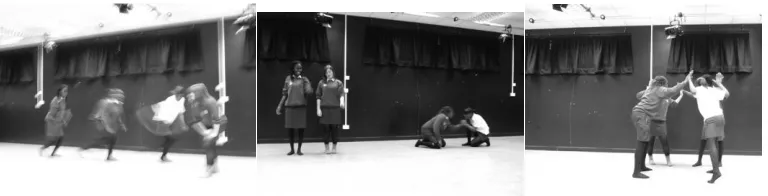
The image sequence in Figure 1 (approximately 10-second gaps between each shot), showing a short section of a movement-based, dance-like scene that lasted less than a minute gives the sense of one group’s presentation. They included some spoken words, but no fully articulated dialogue (see Figure 2, below). At one stage, the students produced a heart-beat effect by beating hands against their chests. Illustrated in the central image below, they dramatized the meeting by pairing up to make each character – Craig is represented by the crouching, hand-clasping pair on
[image:7.595.94.478.602.700.2]the left and Bentley depicted by the pair standing on the right. On either side, the characters’ encounters at the ‘party’ are represented in carefully choreographed, dance-like, linear and circular movements, some with physical contact between members of the group and some without.
Figure 1: Craig and Bentley’s first meeting
the school students wrote about the scene for the documented coursework element of the examination. Below (Figure 2), reflecting on the making and showing of this scene, is an excerpt of one student’s written work.
Chris and Derek’s meeting
N and I walk in and circle each other and go back to our original places. The both pairs walk towards each other. S (blue) and I represent Chris’ thoughts. N and P (pink) represent Derek’s thoughts. I say “boy, he is huge! Na, act cool, act cool,” S then says to P, “you got a light?” N says as speaking thoughts “what’s a light?” Then P says “what’s a light?” I say “Are you dumb?” Then S says “how old are you?” N says “hmmmm”
I move round to P and she stutters. “17” P says finally. N and I begin to beat our chests with our left hands. I move back round the S’s, and S says “you’re an idiot man” and we both walk away.
We used a heart beat to show Derek in his worst scenario. He has been asked a question and he knows it but can’t say it. He feels like he is losing time and looking stupid. I move back to S because we thought Derek felt like if he likes someone new he drives them away by being himself. This is how we wanted the audience to feel.
Figure 2 (names omitted, but otherwise as written)
With the exception of the final statement (the one serving as an epigraph), the tone and structure of the writing reflect the students’ contribution to the evaluative discussion – more a descriptive narrative of what was done than a fully articulated piece of analysis or evaluation.
Raising a caution against interpretation and a researcher’s ability to penetrate the interior worlds of the psyche, John Yandell writes of “the elusiveness of learning”
(2012, 276). So, first, the resort to semiotics and to the explanatory potential of cultural learning theory is to concentrate on visible surfaces in an attempt to ‘fix’
moments of learning. Looking at signs of learning is necessarily an interpretative exercise requiring attention and alertness to the semiotic potential of socially organised bodies and ways in which meanings are physically realised by the students through dramatic activity and presentation to an audience. For this task, explanatory principles drawn from particular sources of cultural theory that deal with drama and the arts in culture will be applied and extended.
Semiotic theory, drawing principally on the work of Gunther Kress and colleagues, is applied in recognition that the means and material of drama are the bodies of
contemporary cultural landscapes in which communication encompasses many modes of meaning making (Kress and Leeuwen, 2001,
Kress
,2010
). In amultimodal account of meaning making, meaning is socially produced between sign-maker and audience. Furthermore, the making of meaning is rarely, if ever, confined to one mode of communication – instead, meanings are made in the combination and intersection of different modes (word as speech, written or printed word, image, colour, sound and so forth). Multimodal approaches are particularly apposite in application to drama as bodily communication because drama is always orientated toward an audience and meanings are generated througha combination of face-work, gesture, posture, movement, position in space, time and relationship with and use of objects as props and so forth.
Looking at the drama made by the students at a level of a whole text, then, it is apparent that ‘word’ has lost its privileged position, and movement of the body
acquires more status and significance than words. The limitation on words imposed by the teacher was (and remains) partly a prophylactic against students’ tendency to construct rather banal, static, narrative dramas based on their viewing of television soap opera. Releasing them from sedentary or static forms of drama, students are encouraged to develop an expressive range and repertoire for drama, one that accentuates the movement and gestures of bodies in space, playing out in and over time. At the same time, the visual, plastic and kinetic features of drama, its dance-like quality, plays not only the contemporary turn towards physical theatre, but also to the students’ sensibilities, their own experience of visual ‘body culture’ displayed in social
networking, on music videos and so forth.
One of the key points here is that the students’ presentation draws from their
experiences of contemporary culture and feeds into current aesthetic sensibilities, both in the local culture of the school drama department, but also strongly relating to wider cultural phenomena. Notions of cultural currency, circulation and the
development of historically located aesthetic sensibilities articulate with particular perspectives on the place of drama and performance in contemporary culture. In the early 1970s, Raymond Williams, one of the key originators of cultural studies in the UK, spoke and wrote about “the dramatized society” in which “drama, in quite new ways, is built into the rhythms of everyday life” and has become “habitual experience”
Returning to the students’ presentation, although it is defined as ‘drama’ by its location on the curriculum and timetable, its generic qualities exceed the boundaries of what might previously have been known as drama and is perhaps more
appropriately classified as ‘performance’. At the level of the whole text, therefore, students’ choice and arrangement of particular forms and modes has been affected by their participation in both global and local cultures and has had a strong bearing on the ways in which they have chosen to represent the affective aspects of the meeting between ‘Craig’ and ‘Bentley’. This abstracted movement based drama
represents a structure of feeling.
Shifts in modes, from verbal utterance, through imagistic physical work in tableaux and then movement in space to the creation of the scene involves processes of ‘transformation’ and ‘transduction’ (Kress, 2010, 129). The process of transformation
is evident in the ways in which students repurpose and reframe the resources of movement, posture, gesture and positioning worked through in the initial workshop activities. Transduction, on the other hand, refers to the ways in which one mode of communication is interpreted in another mode, and is evident in the ways in which students interpret the verbal narrative offered by the teacher, choreographing it in movement and positioning in and through space and over time. The scene provides some insight into the processes of production, apparent in the way students have taken up and moulded the resources offered them – the story told evocatively by the teacher, through the exercises embodying the characters’ postures and ways of
moving, to the construction of the scene. They have selected and shaped particular modes of bodily communication to represent what they know of and feel about ‘Craig’s’ and ‘Bentley’s’ characters and their emerging relationship.
Following the teacher’s instruction to make a non-naturalistic, stylised scene, the students choose to represent complexity and depth in character and relationship by using paired performers in a sequence where image and movement dominate over the use of word. The students representing ‘Craig’ arrange themselves
symmetrically, mirroring each other’s postures, signifying confidence and a unity of identity and purpose, their crouch and clasped hands evoking a sense of
It underlines and contrasts with the awkwardness of ‘Bentley’ in relation to the complicit and conspiratorial aspect of ‘Craig’. The heartbeat sound effect, a familiar trope in the language of film and television, accentuates ‘Bentley’s’ vulnerability and nervousness – a feature picked out in the student’s written commentary. Yet there is ambiguity in that it also serves to highlight ‘Craig’s’ excitement as he senses the
power he wields in the relationship. The linear movement sequence through space materialises and gives a dynamic to the concept of relationship-as-pursuit. Here, the ‘Craig’ pair leads, one of them turning to check that they are being followed by ‘Bentley’. The shape that emerges in the final frame, with inwardly directed gazes
and hands meeting to support inward-leaning bodies, evokes a sense of
interdependence. In the context of what has come before, however, the audience is made aware of the inequalities of power in the relationship. Craig and Bentley’s relationship is represented by the plasticity of the actors’ bodies, the dynamics of movement through three-dimensional space. It is stylised work that represents the ways the characters feel about themselves and towards each other with the actor-students’ ideas about the relationship. As such, the work represents a fusion of
affect, concept and physicality.
A cultural theory of learning extends and complements the semiotic perspective in accounting for learning in drama. At the core of this approach are some ideas taken from the work of Vygotsky and his theory’s elaborators. As the ideas are large-scale and complex and available space is limited, my attempt will be somewhat
adumbrated and, as before, largely interpretative. Vygotsky’s work reveals his
involvement in the arts and that he maintained a particular interest in drama, especially in how drama can reveal deeply embedded aspects of the individual and social mind (Daniels et al., 2007, 23-4). His doctoral thesis was on Hamlet. In the book based on his doctoral studies, he wrote that, “Art is the social within us, and
even if its action is performed by a single individual, it does not mean that its essence is individual”. Elaborating on this, he claims that, “Art is the social technique of
emotion, a tool of society which brings the most intimate and personal aspects of our being into the circle of social life” (1971, 249). Vygotsky’s view of drama (within a
range of arts activity), strongly articulates the formation and expression of individuals – perception, consciousness, sensibilities and subjectivities – with wider cultural life,
placing particular emphasis on the affective load carried by the arts.
outwardly representing intimate, personal and affective aspects of ‘Bentley’ and ‘Craig’s’ relationship. Ethnographer Clifford Geertz observed that the arts are not a separate aspect of culture, but are an intrinsic part of a whole culture. The function of the arts is to “materialise a way of experiencing” and to “bring a particular cast of mind out into the world of objects” (1993, 99). The drama made by the students draws not only on resources provided in the school’s particular pedagogic and artistic genre of drama, it inevitably draws from texts, images and forms circulating in wider culture. It is a form and medium that exteriorises internal domains of feeling – feelings for an about the self and about others.
Geertz’s ethnographer’s perspective chimes with Raymond Williams’s view of drama
as habitual, ingrained in culture and in patterns of thinking and feeling. Williams, too, works at what the relationship between culture and individual acts of creativity reveals about the nature of subjective formation. Connecting with my current project, he aspires towards explanation and understanding and writes,
When we have grasped the fundamental relation between meanings arrived at by creative interpretation and description, and meanings embodied in
conventions and institutions, we are in a position to reconcile the meanings of culture as ‘creative activity’ and ‘a whole way of life’, and this reconciliation is then a real extension of our powers to understand ourselves and our societies. (1965, 65)
Core to and held in common between semiotic, psychological and cultural
approaches are issues of meaning and sense-making. Writing on the role of play in development, Vygotsky observes that in early, spontaneous dramatic playing, small children’s situated actions lead the making of meaning, but as the child develops,
meaning comes to dominate action. He oberves spontaneous dramatic playing to be the mainspring of the socially organised human’s ability to make signs and symbols, to represent, ideas and concepts, notably in an example he quotes of sisters being observed to say, ‘Let’s play sisters’, after which they commence to play at being
sisters. Motivating such an activity is desire and involved is a form of decentring the self to explore the feelings and concepts underlying ‘sisterliness’ (Vygotsky, 1978,
94). In seeking to explain and understand the nature, source and development of imagination in school-age children in later stages of childhood, Vygotsky shifts focus from early spontaneous dramatic play to examine the role and intervention of
particular art-forms to examine the place of drama, particularly improvised drama, about which he writes,
imagination … finds complete fulfilment. (1967/2004, 70)
He is concerned in part with the distinction between meaning that isavailable and circulates in social and cultural life and the full sense of culturally available concepts and affects. To illustrate this, he again refers back to drama at the conclusion of his most fully articulated work, Thinking and Speech, where he uses an example of Stanislavskian practice, looking at the ways that in enactment, directors and actors develop a fuller sense of the relationship between the text, sub-text and the
motivation to speak. Vygotsky is clear that, thought “is not born of other thoughts”, but that the “affective, volitional tendency stands behind thought” (1987, 282). Vygotsky’s focus is on word based drama – indeed, his project pivoted on the
relationship between speech and thinking. In the above example of drama, however, a newer form of imagistic, physicalised drama is privileged. The sense of the piece, the thoughts and feeling involved in and generated out of the relationship between ‘Craig’ and ‘Bentley’ is represented by the students through concerted physical action. In so doing, the students convey the protagonists’ inner feelings and the
feelings and attitudes that they have towards each other.
Moving through maturational and developmental stages, examining the peculiar creativity and productiveness of adolescence, Vygotsky writes about the ways in which the spontaneous, everyday creativity of adolescents develops out of an interaction between the experience, thinking and feeling of young people and their encounter with forms and concepts available from wider cultural contexts (1994, 185-265). In the instance represented above, the particular modes of working in the school’s drama department give form and shape to what they think and feel in response to the story of ‘Craig’ and ‘Bentley’s’ first encounter. The creativity of their production, moreover, is shaped by their consciousness of audience and the need to communicate their sense of the emergent relationship, that is reflected in the
comment, “This is how we want the audience to feel.”
interference of our will”, but that the “path is far more tortuous”, more like “coaxing”. Thus, he notes, “Only indirectly, creating a complex system of ideas, concepts, and images of which emotions is a part, can we arouse the required feelings” (1997,
243). My contention here is that these young people, through movement and an imagistic use of words, can best convey ‘Craig’ and ‘Bentley’s’ relationship with
complexity.
The experience of the actor, his emotions, appear not as functions of his personal mental life, but as a phenomenon that has an objective, social sense and significance that serves as a transitional stage from psychology to
ideology. (244)
This leaves some points to return to and some questions that remain open. In the first place, there remain questions of affect in relation to effect, of facility in relation to utility. The physical drama that I have been thinking about appears to me to facilitate a more fully articulated representation of affect and concept than these particular young people were able to articulate in speech or writing. Their drama work was complex, confident and precise – their ability to speak or write less so. Whether the experience of making the drama will help facilitate the students’ ability to write or speak about the drama remains an unknowable. What is clear to me, though, is that the drama gives a strong indication of what the students know and feel about the range of human social relations. This does not, as Greenfield might have it believed, indicate that these students are less capable of understanding, developing, or commenting on empathetic social relations. Neither is there evidence that the facilities of new modes, multiple modes of communicating and making meaning are less refined or complex than those encountered in the reading of novels. Some cultural theorists of learning have recently promoted a view of learning as
fundamentally productive, text-making activity, texts that reflect the heterogeneity and variegation of contemporary culture (Carpay and Van Oers, 1999, 298-313; Bruner, 1986). Such notions of the productivity of learning processes counter a view of learning as being about receptivity and acquisition. Rather, it is to promote a view of learning as an active dialectical process of production and reception in which learners are formed as much by what they make as by what they are subject to. In the above example, the diversity of the group and their contributions is evident, but over and above such diversity is the coherence and cohesion that form and
What is clear, is that such forms of drama for representing affect and making meaning are indicative of a contemporary cultural sensibility with an orientation towards the bodyliness of social relations. The representation of difference, the exercise of power and consequent inequality experienced in face-to-face relations is clearly there for exploration. It is an engagement with subjectivities and, as such, it is likely that learning in drama impacts on the development of learners’ subjectivities. Finally, the movement toward an aesthetic mode of representation, one that engages with a full sense of the nature of human relations and does not simply respond to meanings given and circulating in culture, is an engagement with what Winston refers to as ‘the power of beauty’ in education (2010). It is to draw from and contribute to a view of culture put forward by Raymond Williams, engaging with ‘structures of feeling’ that are powerful, authentic and constantly in process.