
Split or Steal?
Cooperative Behavior When the Stakes Are Large
Martijn J. van den Assem
Erasmus School of Economics, Erasmus University Rotterdam
Dennie van Dolder
Erasmus School of Economics/Tinbergen Institute, Erasmus University Rotterdam
Richard H. Thaler
Booth School of Business, University of Chicago
Published in Management Science, January 2012 (58:1), 2−20
Abstract: We examine cooperative behavior when large sums of money are at stake,
using data from the TV game show “Golden Balls”. At the end of each episode,
contestants play a variant on the classic Prisoner’s Dilemma for large and widely
ranging stakes averaging over $20,000. Cooperation is surprisingly high for amounts
that would normally be considered consequential but look tiny in their current
context, what we call a “big peanuts” phenomenon. Utilizing the prior interaction
among contestants, we find evidence that people have reciprocal preferences.
Surprisingly, there is little support for conditional cooperation in our sample. That is,
players do not seem to be more likely to cooperate if their opponent might be
expected to cooperate. Further, we replicate earlier findings that males are less
cooperative than females, but this gender effect reverses for older contestants
because men become increasingly cooperative as their age increases.
JEL: C72, C93, D03
Version: September 2011 (first draft: April 2010)
Keywords: natural experiment, game show, prisoner’s dilemma, cooperation,
cooperative behavior, social behavior, social preferences, reciprocity, reciprocal
behavior, context effects, anchoring
Postal address for manuscript correspondence: Erasmus University of Rotterdam, P.O. Box 1738, 3000 DR, Rotterdam, the Netherlands. E:
[email protected], T: +31104081329, F: +31104089165. We are grateful to Guido Baltussen, Han Bleichrodt, Uri Gneezy and the
anonymous reviewers for their many constructive and valuable comments. We thank Endemol UK and in particular Tara Ali and Tom
Blakeson for providing us with information and recordings of “Golden Balls”, and Shirley Kremer, Thomas Meijer and Sanne van Bemmel
for their skillful research assistance. The paper benefited from discussions with seminar participants at the Erasmus University of
Rotterdam and Tilburg University, and with participants of the Decision & Uncertainty Workshop 2010 at HEC Paris, BDRM 2010 Pittsburgh,
SABE 2010 San Diego, and SPUDM 2011 Kingston upon Thames. We gratefully acknowledge support from the Erasmus Research Institute of
[2]
Cooperation is vital for the functioning of society, and the organizations and communities that form
its fabric. Not surprisingly, cooperative behavior is the focus of many studies across a wide range of
scientific disciplines, including psychology (Dawes, 1980; Dawes and Messick, 2000), sociology
(Marwell and Ames, 1979, 1980; Raub and Snijders, 1997), economics (Ledyard, 1995; Fehr and
Gächter, 2000a; Fischbacher and Gächter, 2010), political science (Ostrom, Walker and Gardner,
1992) and biology (Gardner and West, 2004; West, Griffin and Gardner, 2007). The key question in
this literature is why humans cooperate even in situations in which doing so is not in line with their
material self-interest.
While cooperation is ubiquitous in social life and an important topic for all kinds of economic
interaction, field data rarely allow for a clean discrimination among competing theories. Because
carefully designed laboratory experiments do allow for such rigorous comparisons, laboratory
experiments have provided numerous important insights into cooperative behavior, and the resulting
rich literature forms the basis of most of our knowledge on human cooperation. Still, laboratory
settings inevitably have limitations that some argue may hinder the generalization of findings to
situations beyond the context of the lab (Levitt and List, 2007, 2008). Subjects are often volunteering
students who thus constitute a non-random sample of the population at large. Also, they generally
have less familiarity with decision tasks in the laboratory than with those in everyday life, no
opportunity to seek advice from friends or experts, and they know that their behavior is examined in
detail.
From an economic perspective, another obvious drawback to lab studies is that the financial stakes
employed tend to be relatively small. Even those experiments that utilize relatively large payoffs do
not involve amounts in excess of a few hundred dollars (e.g., Hoffman, McCabe and Smith, 1996a;
List and Cherry, 2000; Carpenter, Verhoogen and Burks, 2005), giving rise to the question to what
extent findings will generalize to situations of significant economic importance. One solution is to
perform experiments in low-income countries, where small nominal amounts carry a larger value. In
the domain of social interaction, such experiments are, for example, employed by Slonim and Roth
(1998), Cameron (1999), Fehr, Fischbacher and Tougareva (2002), Munier and Zaharia (2002),
Johansson-Stenman, Mahmud and Martinsson (2005), and Kocher, Martinsson and Visser (2008).
While this might appear an ideal approach, it has its own drawbacks. Culture, for example, has been
shown to play an important role in social interaction (Henrich et al., 2001, 2004; Herrmann, Thöni
and Gächter, 2008), making it difficult to generalize findings from low-income countries.1 And while
1
the stakes in these experiments are larger than commonly employed, they still rarely exceed a few
months’ wages.
In the current paper, we study cooperative behavior using another source of data, namely the
behavior of contestants on the British TV game show “Golden Balls”. Although the game show setting
is an unusual environment, it has the benefit of employing large and varying stakes. Furthermore,
game shows are markedly different from laboratory experiments in terms of participant selection,
scrutiny, and familiarity of participants with the decision task. Combined with the strict and
well-defined rules, game shows can therefore provide unique opportunities to investigate the robustness
of existing laboratory findings.
Because game shows are often competitive in nature and ask contestants to make risky or strategic
choices, is it not surprising that they have mostly been used to study decision making under risk (e.g.,
Gertner, 1993; Metrick, 1995; Beetsma and Schotman, 2001; Post et al., 2008) or strategic reasoning
(e.g., Bennett and Hickman, 1993; Berk, Hughson and Vandezande, 1996; Tenorio and Cason, 2002).
More recently, however, game shows have also been used to study social interaction, in particular
discrimination (Levitt, 2004; Antonovics, Arcidiacono and Walsh, 2005) and cooperative behavior
(List, 2004, 2006; Belot, Bhaskar and van de Ven, 2010a; Oberholzer-Gee, Waldfogel and White,
2010). The current paper is in the latter category.
In the final stage of “Golden Balls”, contestants make a choice on whether or not to cooperate in a
variant of the famous Prisoner’s Dilemma. In particular, the two final contestants independently have
to decide whether they want to “split” or “steal” the jackpot. If both contestants choose “split”, they
share the jackpot equally. If one chooses “split” and the other chooses “steal”, the one who steals
takes the jackpot and the other gets nothing. If they both “steal”, both go home empty-handed. On
average, the jackpot is over $20,000. The variation is large: from a few dollars to about $175,000.
If we assume that each player only cares about maximizing her immediate financial payoff, the
choice problem in “Golden Balls” can be labeled as a “weak” form of the Prisoner’s Dilemma.2 Where
in the classic form of the Prisoner’s Dilemma defecting strictly dominates cooperating, here defecting
only weakly dominates cooperating: choosing “steal” always does at least as well, and sometimes
better than choosing “split”. Of course, contestants may consider other factors aside from their own
monetary payoff when deciding which choice to make. Much experimental research suggests that
people have social preferences in the sense that the payoffs to others enter their utility functions.
For discussions, see, for example, Fehr and Gächter (1998, 2000b), Fehr and Schmidt (1999), Bolton
2
and Ockenfels (2000), Charness and Rabin (2002), Camerer (2003), Fehr and Gintis (2007), and
Cooper and Kagel (2009).
The fact that the show is aired on TV of course creates another set of rather special circumstances
that could affect our results, although there is little existing theory to suggest what the effect of a
large TV audience would be. One might argue that players would not want to be seen as a “jerk” on
national television and so would be more likely to cooperate, but one can also argue that a player
would not want to been seen as a “sucker” (or someone who cannot detect the weakly dominant
solution to a simple game) in public.3 The public nature of the choice could also magnify subtle
features created by the fact that the game is a “weak” form of the Prisoner’s Dilemma. Specifically, if
a player thinks that the other player will steal, she might decide to split on the grounds that it costs
her nothing to appear “nice” on TV. These complications do not render our results uninteresting, but
do need to be incorporated in any attempt to evaluate how our results should be interpreted in the
context of existing theories and experimental findings on cooperation.
Although “Golden Balls” is unique in its format, the show shares the Prisoner’s Dilemma element
with a few game shows from other countries including “Friend or Foe” (US, aired in 2002-2003) and
“Deelt ie ‘t of deelt ie ‘t niet?” (in English: “Will he share or not?”; Netherlands, 2002). These two
shows have been studied in four different papers. List (2004, 2006) and Oberholzer-Gee, Waldfogel
and White (2010) analyze data from “Friend or Foe”, and Belot, Bhaskar and van de Ven (2010a) use
the Dutch show. List focuses on the effects of demographic variables such as gender, race and age.
Studying the same game show, Oberholzer-Gee, Waldfogel and White compare the behavior in the
first season of the show with later seasons in which the contestants have had a chance to observe
prior episodes. Finally, Belot, Bhaskar and van de Ven find that making a promise to cooperate prior
to the decision is positively related to cooperation if the promise was voluntary, but not if it has been
elicited by the host.
In this paper we replicate many of the earlier investigations, but also undertake several novel
analyses that are possible due to some unique features in the format of “Golden Balls”. The way the
stakes are determined and the very wide range they cover provide the basis for new insights into the
effect of stakes and context. The dynamic setting of the show enables us to look at reciprocity in
cooperative behavior, and also at the effect of earlier deceitful behavior.
3
In our sample, individual players on average cooperate 53 percent of the time. Although this rate is
similar to earlier findings from the experimental literature (Dawes and Thaler, 1988; Sally, 1995),
direct comparisons are hampered by systematic differences in the stakes, the visibility of decisions,
characteristics of the subjects, and preceding opportunities for communication or other social
interaction.
We find only limited support for the notion that cooperation will decrease if the stakes get
significant. The cooperation rate is unusually high when the stakes lie in the low range of our sample,
perhaps because contestants think that for so little money (relatively speaking) they might as well
cooperate in public. Cooperation does decline with the stakes for stakes below the median, but
plateaus at around 45 percent for medium to large amounts.
The high cooperation rate for relatively small stakes suggests that context can convert money
amounts that would normally be considered consequential or “big” into amounts that are perceived
to be small, just “peanuts”. This idea is supported by our finding that cooperation is not only based
on the actual stakes but also on what the jackpot potentially could have been. This effect is especially
pronounced for those who appeared in the earlier episodes of the show and had no or little
opportunity to watch the show on TV and learn what sizes are large or small in the context of this
game.
A special property of “Golden Balls” is the interaction that occurs among contestants prior to the
final. Utilizing the dynamic setting, we find evidence that contestants show some tendency toward
reciprocity. Among contestants whose final opponent has attempted to vote them off the show, the
propensity to cooperate is significantly lower. Contestants do not appear to reciprocate against
opponents who have lied earlier in the game. Lying seems to be accepted here, similar to bluffing in
poker. A possible reason for this is that, in contrast to a vote cast against someone, lying is a
defensive act that is not aimed at anyone in particular.
Surprisingly, we find little evidence that contestants’ propensity to cooperate depends positively on
the likelihood that their opponent will cooperate. While an opponent’s promise to cooperate is a
strong predictor of her actual choice, contestants appear not to be more likely to cooperate if their
opponent might be expected to cooperate. Our final main result is that young males cooperate less
than young females. This difference decreases and even reverses as age increases and men become
increasingly cooperative.
The paper proceeds as follows. Section I describes the game show in more detail, discusses our data
and presents descriptive statistics. Sections II – VI cover the various possible factors behind
other background, explains the variables that we use, and discusses the results of our Probit
regression analyses. Section VII concludes.
I. Game Show and Data
Description of “Golden Balls”
The TV game show “Golden Balls” was developed by the Dutch production company Endemol. It
debuted on the ITV network in the United Kingdom in June 2007 and ran until December 2009. Each
episode consists of four rounds and starts with four contestants, usually two men and two women.
In Round 1, twelve golden balls are randomly drawn from the “Golden Bank”, a lottery machine
containing one hundred “golden” balls. Each of these balls has a hidden cash amount inside, ranging
from a minimum of £10 to a maximum of £75,000.4 Contestants know that this is the range for the
amounts in the balls, but they do not know the precise distribution (though this becomes clearer
over time as the show is aired). At a later stage of the game, a subset of the cash balls drawn will
contribute to the final jackpot. Also, four balls hiding the word “killer” inside are mixed with the
twelve cash balls. Killer balls are undesirable in a way we will explain below. From the sixteen balls,
each contestant receives four balls at random. For each contestant, two are placed on the front row
with their contents - either a cash amount or the word “killer” - openly displayed; the other two are
placed on the back row and their contents are known by the particular contestant alone. (Poker
players can think of this as two “up” cards and two “down” cards.) The contestants now have to
decide by vote which player will be kicked off the show. Because the balls of voted-off contestants
are removed from the game and the remaining contestants’ balls matter for the ultimate jackpot,
there is a strong incentive to retain players with high value balls and kick off players with low value
balls or killer balls.
Before the voting starts, each contestant publicly announces the contents of the balls on her back
row (knowing that these values will subsequently be revealed, but only after the vote). Then, the
four contestants together have an open discussion in which they can voice their evaluation of other
players’ statements and their opinion of who should be voted off. Each player then anonymously
casts a vote against one specific opponent. After the votes are tallied, the player who received the
4
most votes leaves the game.5 Lastly, all the players reveal the values of their back row balls, and
differences between the actual values and the previous claims are noted.
In Round 2, two additional cash balls from the lottery machine and one extra killer ball are added to
the twelve remaining balls from Round 1. The fifteen balls are then randomly allocated to the three
contestants. Each of them receives two balls on her front row and three on her (hidden) back row.
Similar to Round 1, contestants make (cheap talk) statements on the balls on their back row, a round
of banter follows, votes are cast anonymously and tallied, the player who receives the most votes
leaves the game, and all hidden ball values are revealed.6 Two players and their ten balls proceed to
Round 3.
Round 3 determines the size of the final jackpot. First, one additional killer ball is mixed with the ten
balls from Round 2. Then five of the balls are selected sequentially at random. If a ball selected is a
cash ball, its face value is added to the jackpot. If a killer ball is drawn, the current cumulative jackpot
is divided by ten. For example, if the first two balls were £50,000 and £1,000 and the third is a killer
ball, the level of the jackpot is reduced from £51,000 to £5,100. A killer ball does not affect the
jackpot contribution of cash balls drawn thereafter. If the fourth and fifth ball in our example were
another killer ball and £25,000, respectively, then the actual jackpot would be £25,510. Note that this
round is a completely stochastic process, and that contestants have full information on the balls that
are in play. Before the five balls are drawn, special attention is always paid to the highest possible
jackpot (that is, the sum of the five largest cash values). This value, and the number of killer balls, are
explicitly stressed by the game show host.
After Round 3 determined the jackpot, in the fourth and final round the contestants play a variant of
the Prisoner’s Dilemma. Each contestant receives two golden balls. One of the balls says “split” and
the other says “steal” on the inside. The contestants then simultaneously have to decide which ball
they want to play. If both choose “split”, they share the jackpot equally. If one chooses “split” and
the other chooses “steal”, the contestant who steals takes the whole jackpot and the other gets
nothing. If they both choose “steal”, both go home empty-handed. Before each contestant makes
her actual decision, a brief time period is reserved for a discussion between the players in which they
can make non-binding promises, ask about intentions, or attempt to get assurances of cooperative
behavior. This is the final round of cheap talk. Importantly, the contestants have not met before the
5
If two contestants receive two votes each, their opponents openly discuss who they want to keep in the show. If they cannot decide, a decision is made at random. If all four contestants receive one vote each, contestants openly attempt to form a coalition against one specific contestant. Again, if they cannot decide, a decision is made at random.
6
game starts, and have no opportunity before or during the show to make any kind of collusive
agreement.
A relevant question is how the contestants are selected. A spokeswoman of Endemol informed us
that anyone can apply to be on “Golden Balls” by submitting a detailed application form. Shortlisted
contestants are then invited to an audition in order to determine their skills at playing the game,
their character and their suitability to appear on a TV show such as Golden Balls. Producers watch
tapings of these auditions and put together shows such that, according to the producers, “a good mix
of characters” is represented on each show. Thus while the contestants are not a random sample of
society, the selection process does not seem to create any obvious confounds with the analyses we
conduct here.
Data and descriptive game characteristics
We examine the “split” and “steal” decisions of 574 final contestants appearing in 287 episodes aired
between June 2007 (when the show was introduced) and December 2009. During this period, 288
episodes were aired, and, at the time of writing, no further episodes were aired thereafter.
Recordings from the show and additional information such as recording and airing dates were kindly
provided by Endemol’s local production company Endemol UK. The one missing episode could not be
supplied because it was not present in their archives.7
For each episode we collected data on the relevant observables in the show, such as the hidden and
visible ball values, statements made by contestants, the votes, the jackpot size, and the decision to
“split” or “steal” at the end. Some variables were estimated based on contestants’ physical
appearance and on information provided in the introductory talk and other conversations during the
show.
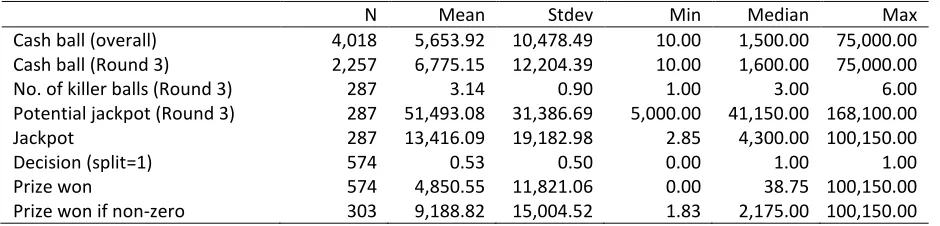
Table 1 displays some descriptive characteristics of the game. Cash balls drawn from the lottery
machine during the first two rounds have a mean value of £5,654 and a median of £1,500. Clearly,
the distribution is positively skewed. The mean value of the cash balls taken to Round 3 is £6,775,
which is statistically significantly greater than the average value of all cash balls in the show, implying
that the contestants are successful in using their votes to keep high-value balls in play and eliminate
small ones. The average number of killer balls in the game at the start of Round 3 is 3.14, significantly
less than the 3.67 we would statistically expect if voting was random. Contestants thus also seem
7
successful in eliminating killer balls from the game. Unreported analyses of contestants’ voting
behavior clearly show that contestants indeed try to vote off the opponents that have the worst set
of balls on their front row.
At the start of Round 3, special attention is paid to the highest possible jackpot. Dependent on the
cash balls and killer balls taken to this stage, this maximum varies between £5,000 and £168,100,
with a mean of £51,493 and a median of £41,150. The actual jackpot for which contestants play the
Prisoner’s Dilemma game is generally considerably smaller due to the skewed distribution of cash
ball values and the effect of killer balls, but still has a mean size of £13,416 and a median of £4,300.
These amounts are many times the amounts typically used in laboratory experiments, and also large
sums relative to the median gross weekly earnings of £397 in the UK in April 2009 (Source: Statistical
Bulletin Office for National Statistics, 12 November 2009). About half of the time, the jackpot in our
show exceeds three months of median UK earnings, and 21 percent of the contestants decide over a
jackpot that is even larger than a median annual salary (the third quartile in our sample is at
£18,350). The stakes are also large compared to the two other game shows employed in earlier
analyses of cooperative behavior: in “Friend or Foe”, the average is about $3,500 (List, 2004, 2006;
Oberholzer-Gee, Waldfogel and White, 2010), and for the Dutch show, Belot, Bhaskar and van de Ven
(2010a) report a median of €1,683. The wide range of the jackpot in our sample is caused by its
random construction, by the highly skewed distribution of cash ball values, and by the effect of killer
balls. The largest jackpot was played for in an exhilarating episode from March 2008; trainee
accountant Sarah stole the entire jackpot of £100,150 from collection agent Stephen.8
For the jackpot to be awarded, at least one player needs to cooperate. We find that 52.8 percent of
the contestants decide to “split”. While this might seem high, the rate is actually remarkably similar
to earlier experimental evidence (see, for example, Sally, 1995). In our sample, both players split the
jackpot 31 percent of the time, one splits while the other one steals occurs in 44 percent of the
shows, and in the remaining 25 percent of the shows both players steal. The efficiency rate in terms
of the percentage of jackpots that is actually awarded thus amounts to 75 percent. The efficiency
rate obtained by dividing the sum of earnings across all episodes by the sum of all jackpots is slightly
lower at 72 percent. (The difference in efficiency results from contestants’ lower propensity to
cooperate when the stakes are larger; we explore this effect in detail later.) These simple statistics
are a first indication that contestants do not condition their behavior on that of their opponent.
Given the average cooperation rate, we would expect to observe (split, split) in 28 percent of the
8
Table 1: Selected Game Show Characteristics
The table shows selected characteristics for the British TV game show “Golden Balls”, extracted from our sample of 287 episodes. Cash ball (overall) is the monetary value of a cash ball drawn from the lottery machine in the first or second round of the game. Cash ball (Round 3) is the monetary value of a cash ball that is in play at the start of the third round. No. of killer balls (Round 3) describes the number of killer balls that are in play at the start of the third round. Potential jackpot (Round 3) is the jackpot size that is attained during the third round if the best-case scenario would occur. Jackpot describes the actual size of the jackpot. Decision is a contestant’s decision in the Prisoner’s Dilemma at the end of the show, with a value of 1 for “split” and 0 for “steal”. Prize won (if non-zero) records the take home prize for a contestant who made it to the final (if she did not leave empty-handed). All monetary values are in UK Pounds (£1.00 ≈ $1.75).
N Mean Stdev Min Median Max
Cash ball (overall) 4,018 5,653.92 10,478.49 10.00 1,500.00 75,000.00 Cash ball (Round 3) 2,257 6,775.15 12,204.39 10.00 1,600.00 75,000.00 No. of killer balls (Round 3) 287 3.14 0.90 1.00 3.00 6.00 Potential jackpot (Round 3) 287 51,493.08 31,386.69 5,000.00 41,150.00 168,100.00
Jackpot 287 13,416.09 19,182.98 2.85 4,300.00 100,150.00
Decision (split=1) 574 0.53 0.50 0.00 1.00 1.00
Prize won 574 4,850.55 11,821.06 0.00 38.75 100,150.00
Prize won if non-zero 303 9,188.82 15,004.52 1.83 2,175.00 100,150.00
cases and (steal, steal) 22 percent of the time if the individual decisions in our sample were randomly
matched. Although the actual percentages are higher (31 and 25), the differences are relatively small
considering that each pair of contestants operates under highly similar conditions (same jackpot,
same potential jackpot, and many shared unobserved conditions).
On average, a finalist goes home with £4,851, but the median prize is only £39 because 47 percent of
the contestants get nothing. The 303 contestants who end up with a non-zero prize take home
£9,189 on average, with a median of £2,175. It is worth noting that would we have run this show as
an experiment ourselves, the total costs in subject payoffs alone would have been £2.8 million.
Modeling the decision to “split” or “steal”
In the following sections, we will analyze the decisions to “split” or “steal” the jackpot using a binary
Probit model. We assume that when people enter the final round they have a latent propensity to
“split” y*, where y*∈(−∞,∞). Furthermore, we assume that this latent propensity is a linear
function of personal demographic characteristics x and context characteristics z, in the form
u z x
y*= 'β+ 'γ+ , where β and γ are parameter vectors and u represents an unobserved
stochastic component. We do not observe the latent propensity to “split” directly, but only the actual
decision y, where y=1 if a contestant chooses “split” and y=0 if a contestant chooses “steal”. We
impose the observation criterion y=1(y*>0), where (.)1 is the indicator function taking the value of
1 if y*>0 and 0 otherwise. Assuming that the stochastic component has a standard normal
where Φ(.) is the standard normal cumulative distribution function. Using this framework we
estimate the parameter vectors β and γ using maximum likelihood estimation. We allow for the
possibility that the decisions of contestants within the same episode are correlated by performing a
clustering correction on the standard errors (see, for example, Wooldridge, 2003).
Because coefficients in a Probit model do not have an immediate intuitive economic meaning due to
the inherent nonlinearities, we will follow the common approach of reporting marginal effects
instead. More specifically, the marginal effects we report apply to the medians of the explanatory
variables, with two exceptions. To highlight some of the interaction effects that we find in our data,
we set Age to be 20 and Transmissions (the number of times the show has aired at the time of
recording) to be 0. The resulting “representative agent” is a 20 year old white female without higher
education, who lives in a relatively small town and plays the final of our game for a jackpot of £4,300,
which potentially could have been £41,150. For dummy variables we consider the effect of a discrete
change from 0 to 1. As noted by Ai and Norton (2003), the traditional way of calculating marginal
effects and their standard errors is not valid for interaction terms, and we therefore apply the
alternative method they propose. For the sake of consistency, we report significance levels that apply
to the marginal effects, though these levels do not differ materially from the significance levels for
the original regression coefficients. Original coefficients and their significance levels are available
from the authors upon request.
II. Demographic Characteristics
First, we investigate how various demographic characteristics are related to the propensity to
cooperate. Our later analyses include these demographic variables as control variables.
In previous studies examining the relations between demographic characteristics and cooperative
behavior, most attention has been directed to gender. Psychologists have a long history when it
comes to investigating the relation between gender and behavior, and, over the past decade,
economists have become increasingly interested in gender effects as well. The standard finding is
that women act more pro-socially than males, but the reverse is also found.9 For contextual settings
similar to ours, List (2004, 2006), Oberholzer-Gee, Waldfogel and White (2010) and Belot, Bhaskar
9
and van de Ven (2010a) report that women are more cooperative than men, although some results
are only marginally significant.
For other demographic characteristics, the experimental findings are also mixed. Carpenter, Daniere
and Takahashi (2004), for example, run public good experiments with symbolic but costly
punishment in Bangkok and Ho Chi Minh City. They find that in Bangkok males and higher educated
subjects contribute more, while there is no significant age effect. The same experiment in Ho Chi
Minh City, however, shows the opposite findings: males and higher educated subjects cooperate less
and age increases cooperation. Gächter, Herrmann and Thöni (2004) find no influence of background
characteristics in a one-shot public good experiment with Russian subjects.
In order to add to this literature we will explore the effect of various demographic characteristics on
cooperative behavior. We employ the following set of variables:
- “Gender” is a dummy variable indicating whether a contestant is male (1) or female (0).
- “Age” is a continuous variable measuring the contestant’s age in years. In many instances the
contestant’s age is not explicitly mentioned during the show. In these cases we estimate age
on the basis of physical appearance and other helpful information such as the age of children.
- “Race” is a dummy variable indicating whether a contestant is white (1) or non-white (0). We
apply such a broad distinction because the large majority of contestants are white.
- “City” and “London” are two dummy variables that are constructed in order to distinguish
contestants that live in major urban areas from those that reside in more rural surroundings.
Contestants’ city or county of residence is always an integral part of the introductory talk. City
indicates whether a contestant lives in a large urban area (1) or not (0). We define a large
urban area as a conurbation with a population exceeding 250,000 inhabitants.10 For some
contestants we only know their region and not their exact town or city; we then assume a
small domicile. London indicates whether a contestant lives inside (1) or outside (0) the
Greater London Urban Area.
- “Education” is a dummy variable for the level of education and differentiates between those
with at least a bachelor degree (1) and those without (0). Players generally do not talk about
their education during the show. We therefore estimate a contestant’s level of education on
10
the basis of her occupation, which is always explicitly mentioned when she is introduced, and
on the basis of other information given in talks. Contestants who are currently enrolled in
higher education and people whose job title suggests work experience equivalent to the
bachelor level or higher are included in the higher education category. From the information
that we have about each contestant, the proper binary values are generally clear.
- “Student” is a dummy variable indicating whether the contestant currently is a higher
education (undergraduate or postgraduate) student (1) or not (0).
Estimates for Age and Education are based on the independent judgments of three research
assistants, where each value is based on the assessments of two of them. When the estimates for
Education were different, we decided on the most appropriate value ourselves. For Age we took the
mean of the two judgments, and included our own assessment as a third input if the values of the
coders diverged more than five years.
We have also attempted to collect data on contestants’ marital status and the existence of children.
These topics were, however, not systematically discussed in the program and values would therefore
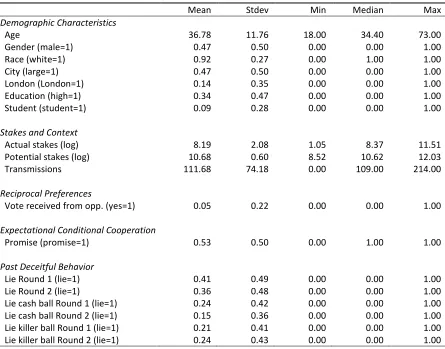
be unknown for the large majority of our contestants. Table 2 summarizes all the variables that are
included in our analyses, including the demographic characteristics.
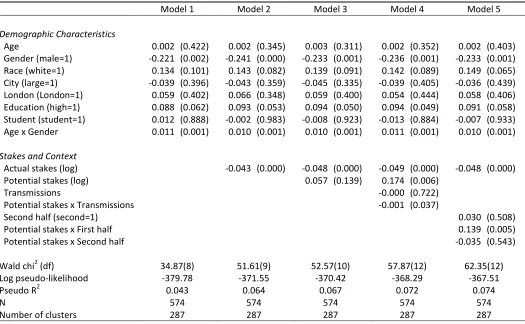
Table 3, Model 1 shows the regression results for a model that includes demographic characteristics
only. To be able to distinguish both general gender and age effects as well as a possible interaction
effect, the interaction of gender and age is also included. The results show that, relative to our
representative 20 year-old female agent, young males are 22 percentage points less likely to
cooperate (p = 0.002). In line with past results by List (2004) and Carpenter, Connolly and Myers
(2008), this difference disappears when age increases. The effect of age is significantly different for
males and females (p = 0.001). Women do not become significantly more or less cooperative when
age increases (p = 0.422). Men, on the other hand, do have a higher propensity to cooperate as they
are older: their cooperation rate increases by more than one percentage point per year (p = 0.000;
untabulated). 11 Contrary to the two previous studies, we find that the gender difference not only
disappears as age increases, but actually reverses; males become significantly more likely to “split”
from age 46 onwards. Figure 1 displays observed cooperation rates at different age levels for both
11
Table 2: Summary Statistics
The table shows descriptive statistics for the explanatory variables in our analyses of cooperative behavior based on the decisions of 574 contestants to either “split” or “steal” the jackpot in the Prisoner’s Dilemma at the end of the British TV game show “Golden Balls”. Age is the contestant’s age measured in years. Gender, Race, City, London, Education and Student are dummy variables taking the value of 1 if the contestant is male (Gender), is white (Race), lives in a conurbation with a population exceeding 250,000 inhabitants (City), is a resident of the Greater London Urban Area (London), has completed or is enrolled in higher education (bachelor degree or higher) or has equivalent working experience (Education), or is a student (Student), respectively. Actual stakes is the natural logarithm of the size of the jackpot in the Prisoner’s Dilemma game. Potential stakes is the natural logarithm of the highest possible jackpot at the start of the third round. Transmissions expresses the number of episodes that was already aired when the current episode was recorded in the studio. Vote received from opp. is a dummy variable taking the value of 1 if the contestant’s final opponent has tried to vote her off the program at an earlier stage of the game. Promise is a dummy variable taking the value of 1 if the contestant explicitly promised her opponent to “split” (or not to “steal”) the jackpot. Lie Round 1(Round 2) is a dummy variable taking the value of 1 if the contestant has misrepresented her back row balls – either by overstating a cash ball or by hiding a killer ball – in the first (second) round. Lie cash (killer) ball Round 1 (Round 2) is a dummy variable taking the value of 1 if the contestant has overstated a cash ball (hidden a killer ball) in the first (second) round. Standard deviations for the two stakes variables and the transmissions variable are calculated across episodes (N = 287) to avoid the effect of clusters at the episode level. All monetary values are in UK Pounds (£1.00 ≈ $1.75).
Mean Stdev Min Median Max
Demographic Characteristics
Age 36.78 11.76 18.00 34.40 73.00
Gender (male=1) 0.47 0.50 0.00 0.00 1.00
Race (white=1) 0.92 0.27 0.00 1.00 1.00
City (large=1) 0.47 0.50 0.00 0.00 1.00
London (London=1) 0.14 0.35 0.00 0.00 1.00
Education (high=1) 0.34 0.47 0.00 0.00 1.00
Student (student=1) 0.09 0.28 0.00 0.00 1.00
Stakes and Context
Actual stakes (log) 8.19 2.08 1.05 8.37 11.51
Potential stakes (log) 10.68 0.60 8.52 10.62 12.03
Transmissions 111.68 74.18 0.00 109.00 214.00
Reciprocal Preferences
Vote received from opp. (yes=1) 0.05 0.22 0.00 0.00 1.00
Expectational Conditional Cooperation
Promise (promise=1) 0.53 0.50 0.00 1.00 1.00
Past Deceitful Behavior
Lie Round 1 (lie=1) 0.41 0.49 0.00 0.00 1.00
Lie Round 2 (lie=1) 0.36 0.48 0.00 0.00 1.00
Lie cash ball Round 1 (lie=1) 0.24 0.42 0.00 0.00 1.00
Lie cash ball Round 2 (lie=1) 0.15 0.36 0.00 0.00 1.00
Table 3: Binary Probit Regression Results [1/2]
[image:15.595.37.562.193.517.2]The table displays results from the Probit regression analyses of contestants’ decisions to “split” (1) or “steal” (0) the jackpot in the Prisoner’s Dilemma at the end of the British TV game show “Golden Balls”. First (Second) half is a dummy variable taking the value of 1 if less (more) than 50 percent of the episodes in our sample were already aired when the current episode was recorded in the studio. Definitions of other variables are as in Table 2. For each explanatory variable, the marginal effect is shown for a representative agent who takes the median value on all variables, except for Age and Transmissions, which are set to 20 and 0, respectively. Standard errors are corrected for clustering at the episode level, p-values are in parentheses.
Model 1 Model 2 Model 3 Model 4 Model 5
Demographic Characteristics
Age 0.002 (0.422) 0.002 (0.345) 0.003 (0.311) 0.002 (0.352) 0.002 (0.403) Gender (male=1) -0.221 (0.002) -0.241 (0.000) -0.233 (0.001) -0.236 (0.001) -0.233 (0.001) Race (white=1) 0.134 (0.101) 0.143 (0.082) 0.139 (0.091) 0.142 (0.089) 0.149 (0.065) City (large=1) -0.039 (0.396) -0.043 (0.359) -0.045 (0.335) -0.039 (0.405) -0.036 (0.439) London (London=1) 0.059 (0.402) 0.066 (0.348) 0.059 (0.400) 0.054 (0.444) 0.058 (0.406) Education (high=1) 0.088 (0.062) 0.093 (0.053) 0.094 (0.050) 0.094 (0.049) 0.091 (0.058) Student (student=1) 0.012 (0.888) -0.002 (0.983) -0.008 (0.923) -0.013 (0.884) -0.007 (0.933) Age x Gender 0.011 (0.001) 0.010 (0.001) 0.010 (0.001) 0.011 (0.001) 0.010 (0.001)
Stakes and Context
Actual stakes (log) -0.043 (0.000) -0.048 (0.000) -0.049 (0.000) -0.048 (0.000) Potential stakes (log) 0.057 (0.139) 0.174 (0.006)
Transmissions -0.000 (0.722)
Potential stakes x Transmissions -0.001 (0.037)
Second half (second=1) 0.030 (0.508)
Potential stakes x First half 0.139 (0.005)
Potential stakes x Second half -0.035 (0.543)
Wald chi2 (df) 34.87(8) 51.61(9) 52.57(10) 57.87(12) 62.35(12)
Log pseudo-likelihood -379.78 -371.55 -370.42 -368.29 -367.51
Pseudo R2 0.043 0.064 0.067 0.072 0.074
N 574 574 574 574 574
Number of clusters 287 287 287 287 287
males, females and aggregates, clearly depicting an age effect for men. Further analyses show that
there is no evidence of a quadratic age effect, neither for men nor for women. We have also
experimented with specifications where the (semi-) continuous age variable is replaced by a set of
dummy variables that represent various age groups. The results are economically and statistically
similar.
When it comes to race we find weak evidence that whites are more likely (about 13 percentage
points) to cooperate than non-whites (p = 0.101; p < 0.10 in the models discussed hereafter). List
(2004, 2006) and Oberholzer-Gee, Waldfogel and White (2010) report a similar pattern, yet in more
conventional experiments the reverse is often found (see, for example, Cox, Lobel and McLeod,
1991). Since possible but unobservable wealth effects could contribute to this result, it should be
Figure 1: Age and the Propensity to Cooperate for Males and Females. The figure displays the relative frequency of contestants who decide to “split” across various age intervals. Bars depict the percentage of cooperators within specific age brackets for males, females and the aggregate, respectively. For each category, the number of contestants is displayed at the bottom of the bar.
Higher educated contestants are about 9 percentage points more cooperative (p = 0.062), although
this effect is only marginally significant in the current model and not consistently significant across
the various regression models discussed hereafter (0.041 < p < 0.070). Similar to the effect of race,
the effect of education could be spurious due to an unobservable wealth effect.
Students are frequently used as subjects in experiments, and the reliance on such a specific subject
pool is often criticized. Sears (1986), for example, extensively describes how the use of student
subjects might produce misleading or mistaken conclusions about social behavior. It is therefore
interesting to investigate whether there is evidence that students behave differently from others,
holding other observable characteristics constant. This turns out not to be the case. Controlling for
demographics such as age and education, our regression results yield no indications of a different
attitude toward cooperation among students (p = 0.888).12
12
In a similar vein, van Lange et al. (1997) and Bellemare and Kröger (2007) do not detect a difference, whereas Carpenter, Connolly and Myers (2008) and Egas and Riedl (2008) do report a negative bias.
51 44 95 45 52 97
None of the residence dummy variables have a significant effect. Possibly, relatively small social
differences between urban and more rural areas in the UK explain this null result.13
III. Stakes and Context
Economists typically argue that behavior will converge toward the prediction of rational self-interest
if the stakes increase (e.g., Rabin, 1993; Telser, 1995; Levitt and List, 2007). The evidence from lab
and field experiments is, however, not generally supportive of this view. Except for the finding that
people seem to become more willing to accept relatively low offers in ultimatum bargaining games
when the stakes are high, empirical research generally finds no evidence that stake size affects
behavior, even when the stakes are increased up to several months’ wages.14
Given that the stakes in “Golden Balls” are widely ranging, and, on average, considerably larger than
in previous studies, the show provides an excellent opportunity to re-examine the relation between
cooperation and stakes. In addition, compared to earlier game-show studies on cooperation, an
advantage of “Golden Balls” is that the stakes are mainly built up by a random process and not by
contestants’ answers to trivia questions. The latter may lead to a spurious correlation because the
ability to answer trivia questions may be related to unobserved background characteristics such as
income, which in turn may well be related to the propensity to cooperate.
The variable that we use in our regressions is labeled “Actual stakes” and defined as the natural
logarithm of the size of the jackpot.
Model 2 in Table 3 displays the regression results when the stakes are included. Clearly, cooperative
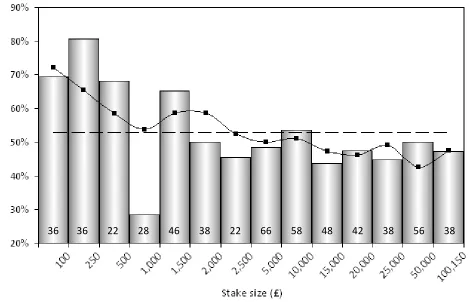
behavior in our show is sensitive to the amount that is at stake. To illustrate this effect, Figure 2
depicts the actual and estimated cooperation rates for different stake levels. The fitted line based on
our full regression model (Model 6 presented later on) appears to capture the pattern rather well.
Cooperation is high when the stakes are relatively small: for amounts up to £500, people on average
13
In experiments conducted in a region of Russia where there is a large gap, Gächter and Herrmann (2011) do find that rural residents are more cooperative than urban residents.
14
Figure 2: Stakes and the Propensity to Cooperate. The figure displays the relative frequency of contestants who decide to “split” across various stake intervals. Tick mark values represent the endpoints of the intervals. Each bar depicts the percentage of cooperators within a specific stake bracket. The dashed line reflects the average cooperation rate across our full sample, while the solid line connects the average estimate of the propensity to cooperate for each stake bracket. The estimates are computed using our “full model”, which is Model 6 in Table 4. For each interval, the number of contestants is displayed at the bottom of the bar.
cooperate 73.4 percent of the time. The rate drops to approximately 45 percent as the stakes
increase and remains relatively stable for the largest amounts. An unreported test shows that we
cannot reject that the relation becomes essentially flat for stakes larger than £1,500.
While the absolute level of the stakes thus appears to have some influence on the propensity to
cooperate, behavioral research suggests that people do not always evaluate prospects just in
absolute terms, but rather they sometimes use relative comparisons to determine subjective values.
This way, what comprises the context can strongly influence choices (Kahneman, Ritov and Schkade,
1999). In choice tasks, for example, one can increase the likelihood that a given option is chosen by
adding an alternative to the choice set that is dominated by the given option but not by the other
alternatives available (Huber, Payne and Puto, 1982). Also, as a consequence of the use of relative
judgments, seemingly irrelevant anchors can influence how people value goods of various kinds
(Green et al., 1998; Ariely, Loewenstein and Prelec, 2003; Simonson and Drolet, 2004) and even
(risky) monetary prospects (Johnson and Schkade, 1989).
[image:18.595.64.533.80.382.2]For our purposes, the question of interest is whether the game show influences the contestants’
perceptions of what constitutes “serious money”. Suppose that some contestants decide that for
“serious” money they are willing to bear the reputational costs, if any, of defecting on national TV,
but if the stakes are small, so-called “peanuts”, then they will just cooperate to look good. In this
scenario, we would observe the pattern of cooperation in our data: high cooperation rates for low
stakes and lower cooperation for high stakes. The interesting point, however, is that the “small”
stakes on this show, several hundred Pounds, are quite large relative to most experiments. So even
when the contestants are playing for what seems to be peanuts, these are big peanuts!
In “Deal or No Deal”, another game show that has even larger stakes than Golden Balls, Post et al.
(2008) also find strong evidence of such a “big peanuts” phenomenon. Namely, when unlucky
contestants faced decisions near the end of the show that were “merely” for thousands of euros,
they displayed little or no risk aversion. In fact, some of their contestants made risk-seeking choices
in such situations. The authors provide further evidence for this behavior in classroom experiments
designed to mimic the show at two levels of stakes, call them “low” and “medium”. In the low stakes
treatment the average prize was €40 with a maximum of €500, while in their medium stakes
treatment the average prize was €400 with a maximum of €5,000. While risk aversion increased with
stakes within each treatment, such an effect was not found across treatments: despite the very
different money amounts, risky choices were similar for the low and medium stakes session. Choices
in both conditions were even remarkably similar to those made in the actual TV show, despite the
huge stakes used there (average €400,000, maximum €5,000,000).
These results suggest that a context can convert a sum of money that would normally be considered
consequential into perceived peanuts. In the “Golden Balls” scenario, earlier expectations about the
jackpot size or a specific value from the game might operate as an anchor or reference value by
which the actual size of the jackpot is evaluated.15 The most obvious benchmark contestants may use
seems to be the maximum possible jackpot at the beginning of Round 3. Though the expected
jackpot size might be an alternative candidate, it is neither salient nor easily calculated. In fact, even
a rough assessment is rather complicated, particularly because of the influence of killer balls. The
maximum potential jackpot, however, is always visually displayed and explicitly stressed by the game
show host.
In order to test for such an effect, we include the variable “Potential stakes” in our analyses, defined
as the highest possible jackpot at the start of Round 3. As with the actual stakes, we take the natural
15
logarithm. Not surprisingly, the actual and the potential stakes variable are significantly correlated,
but due to the effect of killer balls and the skewed distribution of cash balls the degree is rather
limited; the Pearson correlation coefficient is ρ = 0.30.
Model 3 shows the new results. The positive sign of the potential stakes coefficient is in line with
what we would expect, but the effect is statistically insignificant for the entire sample (p = 0.139).
Interestingly, the effect becomes marginally significant if we exclude the (returning) contestants who
already appeared in a previous episode of the show (p = 0.066; untabulated). This gives rise to the
idea that the anchoring effect of the potential jackpot may decrease over time as contestants
become more familiar with the show by watching it on TV. Prior shows will give contestants an
impression of expected payoffs, which may help them to evaluate whether the stakes they face
themselves are high or low in the context of the game and reduce the role of an episode-specific
reference value such as the maximum possible jackpot size.
We explore the effect of experience by testing whether the effect of the potential jackpot changes as
contestants have watched more episodes on TV. As a (noisy) proxy for how many shows a contestant
has watched, we define the variable “Transmissions” as the number of different episodes broadcast
on TV prior to the studio recording of the current episode. Model 4 in Table 3 displays the results.
There is no significant main effect of this variable (p = 0.722), indicating that there is no evidence of a
trend in the cooperation rate over time. However, the interaction effect of the number of
transmissions and the potential stakes is significantly negative (p = 0.037), and implies that the
anchoring effect of the maximum possible jackpot decreases by 0.10 percentage point for each
previously aired episode. Controlling for this interaction effect, the effect of the maximum potential
jackpot is highly significant in the early episodes (p = 0.006), where doubling the maximum potential
jackpot increases cooperation by more than 12 percentage points.16
The pattern of a pronounced effect of the potential jackpot size in the earlier but not in the later
shows also becomes apparent if we include dummy variables that subdivide our sample. Model 5, for
example, uses a natural subdivision and employs a dummy variable for the first 149 episodes (0-112
transmissions prior to the recordings) and for the remaining 138 (149-214 prior transmissions).
Clearly, the effect is significant across the first half our data (p = 0.005) and insignificant thereafter
(p = 0.543).
16
IV. Reciprocal Preferences
Reciprocity refers to a tendency to repay kindness with kindness and unkindness with unkindness.
Reciprocal behavior in the field is generally embedded in long term social interaction, and reputation
concerns therefore form a plausible explanation for virtually all instances where people reciprocate
(Sobel, 2005). Reciprocal actions can sometimes also be explained by preferences over outcome
distributions, most notably by a desire for equity or equality (Fehr and Schmidt, 1999; Bolton and
Ockenfels, 2000). Interestingly, laboratory experiments in which such motivations are controlled for
have convincingly demonstrated that people also have a real intrinsic preference for reciprocity.17
“Golden Balls” provides a neat opportunity to investigate the presence of reciprocal preferences
outside of the laboratory and for substantial stakes. In particular, in the first two rounds contestants
cast votes to determine who has to leave the show. Each vote carries a significant weight due to the
small number of contestants, and voting against somebody can be viewed as unkind, particularly
when the other votes were cast against other players. If people indeed have reciprocal preferences,
we would expect that a contestant who makes it to the final in spite of her opponent’s vote against
her, has a lower propensity to cooperate.18
Although the voting is anonymous, it is often straightforward to deduce who has voted against
whom. If a contestant in Round 1 (Round 2) receives three (two) votes it is obvious that all others
have voted against her and that she herself has voted against the contestant who received one vote.
For the other possible distributions of votes, we can usually deduce the individual votes from the
banter preceding the vote, or, in the case of a tie, from the discussion following the vote. In the
banter leading up to a vote, contestants generally make abundantly clear whom they intend to vote
against (possibly out of an attempt to coordinate voting with other contestants). In the case of a tie,
contestants openly discuss who they want to leave the program; if it was not already clear from the
banter whom they had originally voted against, this post-vote discussion generally makes it apparent.
This procedure allows us to determine a contestant’s vote 95 percent of the time. For various
17
See, for example, Kahneman, Knetsch and Thaler (1986), Blount (1995), Brandts and Solà (2001), Kagel and Wolfe (2001), McCabe, Rigdon and Smith (2003), Charness and Rabin (2002), Cox (2002, 2004), Falk, Fehr and Fischbacher (2003, 2008), Offerman (2002), Charness (2004), de Quervain et al. (2004). For theoretical accounts, see, for example, Rabin (1993), Levine (1998), Dufwenberg and Kirchsteiger (2004), Falk and Fischbacher (2006), Cox, Friedman and Gjerstad (2007), and Gul and Pesendorfer (2010).
18
reasons it is much more difficult to determine clear instances of someone going out of their way to
be nice to another player, so we limit our analysis to negative rather than positive reciprocity.
Based on the voting information, we create a dummy variable entitled “Vote received from
opponent”, taking the value of one if a contestant received a vote from her final opponent and zero
otherwise. If we could not establish whether a contestant received a vote from her final opponent,
she is assigned the value of zero as well (exclusion of these cases does not change our results). Since
contestants who receive votes often do not make it to the next round, relatively few contestants
qualify: as displayed in Table 2, 5 percent (28 subjects) of the final-round contestants received a vote
from their opponent.
Model 6 in Table 4 includes the new dummy variable. In line with the idea that people have
reciprocal preferences, the likelihood of a contestant to cooperate with her final opponent plummets
by approximately 21 percentage points if this opponent has voted against her earlier in the game
(p = 0.019). There are, however, three alternative explanations for such a behavioral pattern that are
unrelated to a genuine preference for reciprocity. Although we cannot rule out that these alternative
explanations explain part of the effect, they do not appear particularly strong.
First, the causality may not run from receiving a vote to cooperativeness, but the other way around,
players voting against contestants with a less cooperative disposition. This would imply that
cooperation is also related to the number of votes received from other players, which appears not to
be the case (p = 0.231; untabulated).
Second, a contestant may like to match her opponent’s choice for reasons other than reciprocal
concerns, and interpret the earlier vote against her as a signal that her opponent dislikes her and will
not cooperate. However, her interpretation would generally not be legitimate: players do not
cooperate less with someone they voted against (p = 0.403; untabulated). Moreover, the next
section finds little support for such expectational conditional cooperation.
Last, a contestant’s lower propensity to cooperate with someone who voted against her may be out
of reputation concerns (“I am not to be messed with”) instead of an intrinsic preference for
reciprocity. However, when asked to explain their choice after the final decisions, contestants never
V. Expectational Conditional Cooperation
There is considerable evidence that many people have a preference for conditional cooperation,
defined as the desire to match the cooperation of others. In laboratory and field experiments, about
half of the subjects are more willing to cooperate if others do so as well (e.g., Fischbacher, Gächter
and Fehr, 2001; Frey and Meier, 2004). Conditional cooperation can arise from reciprocal
preferences, but also for other reasons. Social norms or a desire for conformity might account for it,
and, especially in the laboratory, egalitarian motives can often explain conditional cooperative
behavior because equality in payoffs generally only arises if players coordinate on their level of
cooperation, as is also the case in our show.
Experimental studies typically investigate conditional cooperation in settings where subjects have the
possibility to condition their behavior directly on the behavior of others. In everyday life, such
clear-cut conditioning is usually not possible, especially in one-shot situations. Conditional cooperation
then has to be based on expectations about the behavior of others, and the degree of coordination
would depend on the predictive power of available information and on whether and how this
information is interpreted. A natural question is whether conditional cooperation can be observed
when the conditioning is only on an expectation of cooperation rather than on actual cooperation.
In “Golden Balls” it is not possible for a contestant to condition directly on her opponent’s behavior
since the two are playing a simultaneous move game. However, we can investigate whether
contestants condition their behavior on factors that form reliable predictors of their opponent’s
behavior. That is, we can investigate the joint hypothesis that players make rational forecasts of their
opponent’s behavior and then condition their behavior on those expectations.
The first step in such an analysis is determining the factors that a contestant could use to form an
expectation about their opponent’s likelihood of cooperation. One such factor is whether an
opponent made a promise to “split”. While the literature on conditional cooperation is rather recent,
literature investigating the role of communication and, especially, promises in social dilemma
situations already pointed towards tendencies of conditional cooperation. In a meta-analysis of
Prisoner-Dilemma experiments, Sally (1995), for example, finds that cooperation occurs more often
when the other player makes an explicit though non-binding promise that she will cooperate. The
combination of a preference for conditional cooperation and a reluctance to lie (e.g., Charness and
Dufwenberg, 2005, 2006; Gneezy, 2005) can explain why promises have such an effect: people like to
cooperate if others do, and a promise is a reliable signal of others’ behavior if they have a reluctance
In the conversation prior to the decision to either “split” or “steal”, many contestants explicitly
promise to “split” or otherwise make a definitive statement of their intention to do so. Based on the
statements made in this small talk, we create a dummy variable labeled “Promise”, indicating
whether the contestant made an explicit, unambiguous promise or announcement that she will
choose “split” (1) or not (0).19 As shown in Table 2, about half (53 percent) of the contestants make
such a promise. We investigate both whether observing a promise is predictive of the cooperative
behavior of the contestant making the promise, and whether a contestant conditions her behavior
on whether or not her opponent made a promise.
As shown in Table 4, Model 7, a player’s promise is a highly significant predictor of her propensity to
cooperate (p = 0.000). Those who make a promise are about 31 percentage points more likely to
cooperate. In fact, an explicit promise is the single most reliable predictor of whether someone will
cooperate.20
While a promise is a strong signal of cooperation, contestants whose opponent made a promise do
not have a higher propensity to choose split. In fact, as Model 7 also shows, if an opponent promises
to be cooperative, the other player even displays a marginally significant decrease in the likelihood of
choosing “split”. Belot, Bhaskar and van de Ven (2010a) obtain a similar result.
An explicit promise is the strongest predictor of cooperation, but, as we have previously shown,
there are also demographic factors that a contestant could use to forecast cooperation. For example,
we have seen that young males cooperate less than young females. However, inferences from this
sort of analysis have to be tentative since there could be an additional confound if opponents have a
taste for cooperating with someone with particular demographic characteristics.
As Table 4, Model 8 shows, we find little evidence that contestants condition their behavior on their
opponents’ background characteristics. The only weak evidence for conditional cooperation is that
people cooperate significantly more frequently with higher educated opponents (p = 0.017), but
education is not a very strong predictor of behavior. If we assess the joint significance of the various
19
If a contestant responds affirmative to a question whether she will choose “split” or if she announces that she will not choose “steal”, Promise takes the value of one as well. The value is zero in all other cases, including when people give the impression that they plan to split but do not explicitly express themselves as such, when they just refer to earlier intentions (for example, “I came here to split”), when they confine themselves to statements like “you can trust me” and “I will not let you down”, and when they only express their preference for a coordinated outcome (“I want us to split”; “I do not want both of us to go home empty-handed”).
20

![Table 4: Binary Probit Regression Results [2/2]](https://thumb-us.123doks.com/thumbv2/123dok_us/8716188.383910/25.595.41.556.161.675/table-binary-probit-regression-results.webp)
