Fault Tolerance for Input Faults in a Class of
Asynchronous Sequential Machines
Jung–Min Yang and Seong Woo Kwak
Abstract—In this paper, we address the problem of tolerating the adverse effects of input faults on the operation of a class of asynchronous sequential machines. Occurring to either the external input or the control input generated by the controller, input faults can cause unauthorized changes of the input value. In the framework of corrective control, we present the necessary and sufficient condition for the existence of an appropriate controller that invalidates the effects of input faults, while controlling the considered machine so as to match the stable state behavior of the closed-loop system to a reference model. An illustrative example is provided for demonstrating the proposed control scheme.
I. Introduction
As a novel automatic control theory for asynchronous sequential machines, corrective control has been successfully utilized to amend the stable state behavior of asynchronous machines with various deficiencies [1]–[3]. Whereas the structure of the corrective control system bears resemblance to traditional automatic control, its control law is somewhat different. Discrete mathematics and automata theory are involved in generating control inputs of corrective controllers and especially, asynchronous mechanisms [4] are used to materialize compensation of the closed-loop system in a desirable manner.
Among subjects of corrective control, fault tolerance is a major accomplishment that has been validated both in theoretical analysis and experimental studies. In rough terms, fault-tolerant corrective control is classified according to the type of considered faults. [5] and [6] generalize the preview work on the elimination of critical races [1] so as to control nondeterministic asynchronous machines. [7] and [8] present corrective controllers that detect and tolerate transient faults causing unwanted state transitions in asynchronous machines. The result of [8] is applied to controlling FPGA-based asynchronous digital systems in [9]. [7]–[9] tackle fault tolerance against transient faults for which the influence of faults lasts only for an instantaneous moment. In [10], [11], by contrast, the corrective controllers invalidate the adverse effects of permanent faults in which the characteristic of the faulty transition remains indefinitely. In [12], intermittent
This research was supported in part by Basic Science Research Program through the National Research Foundation of Korea (NRF)
funded by the Ministry of Science, ICT and future Planning
(No. 2015R1A2A1A15054026), in part by Basic Science Research Program through the National Research Foundation of Korea (NRF) funded by the Ministry of Education (No. NRF–2015R1D1A1A01056764), and in part by the Bio & Medical Technology Development Program of the National Research Foundation (NRF) funded by the Korean government (MSIP) (No. NRF–2015M3A9A7067220).
J.–M. Yang is with the School of Electronics Engineering, Kyung-pook National University, Daegu, 41566, Republic of Korea. E-mail: [email protected].
S. W. Kwak is with the Department of Electronic Engineering, Keimyung University, Daegu, 42601, Republic of Korea. E-mail: [email protected] (corresponding author).
faults are considered in which unauthorized state transitions occur by fault and the effect of a fault persists for finite time after the initial occurrence. Finally, [13] presents a corrective control law that invalidates the influence of pre-programmed adversarial software agents. Other approaches on corrective control schemes including fault tolerance are found in [14]– [16] and the references therein.
In this paper, we propose a fault-tolerant corrective con-trol scheme to tolerate input faults that cause unauthorized changes of input values. We suppose that not only the exter-nal input to the controller but also the control input generated by the controller is influenced by the input fault. Unless counteracted immediately, further change of the input would violate the desired behavior. Based on the corrective control scheme for model matching, we present necessary and suf-ficient conditions for the existence of a corrective controller that invalidates any input fault occurring to the asynchronous machine. The closed-loop system will be driven to follow a reference model as if no input fault occurs. Note that all the prior works on fault-tolerant corrective control [7]–[12] focus on state transition faults and do not consider detection and tolerance methodologies for input faults.
We first represent a modeling formalism for a class of asynchronous machines with input faults, and describe the basic control configuration. Then we address the reachability analysis on the considered machine and present the existence condition for a corrective controller that achieves fault toler-ance against any input fault. The proposed controller adjusts the stable state behavior of the machine so as to match it to a reference model, while invalidating all the occurrences of unauthorized switches of input values. The proposed notion and examination of the controller existence are demonstrated in a case study using a synthetic asynchronous machine.
II. Modeling andProblemStatement
A. Asynchronous Machines with Input Faults
The considered asynchronous sequential machine is in-put/state type in which the output is equal to the present state of the machine. We represent an input/state asynchronous machineΣas the following deterministic finite state machine.
Σ:“ pA,X,x0,fq
whereA is the input set, X is the set of n states, x0 PX is the initial state, and f : XˆA Ñ X is the state transition function.
A state–input combinationpx,vq PXˆAis termed valid if fpx,vqis defined inΣ. A valid combinationpx,vqis divided into stable and transient combinations. If fpx,vq “ x,px,vq
on the present input value. Since no global synchronizing clock exists in asynchronous machines,Σresponds with only the change of the external input and Σ stays at a stable combination indefinitely unless the input value changes. In this paper, we assume that f is a total function onXˆA, that is, every input in A makes a valid combination with every state in X. This assumption does not lose much generality since if an input vthat is not valid with the present state x is received, Σwould be unresponsive. Hence we can regard
px,vq as a stable combination. To elucidate this, define for xPX the following two subsets of A.
Upxq:“ tvPA|fpx,vq “xu
Tpxq:“ tvPA|fpx,vq,xu.
Upxq and Tpxq denote, respectively, the set of inputs that make stable and transient combinations withx. Clearly,Upxq
andTpxqsatisfy the following relations.
Upxq XTpxq “ H
Upxq YTpxq “A.
Assume thatΣhas been staying at a stable statexwhen the input changes tovPTpxqthat makes a transient combination with x.Σthen initiates a chain of transient transitions, say,
fpx,vq “x1,fpx1,vq “x2, . . .
during which the input v remains unchanged. Assuming no infinite cycles, Σreaches a stable state xk such that
xk“ fpxk´1,vq “ fpxk,vq, Dkă 8,
i.e., v P Upxkq. xk is called the next stable state of px,vq. Due to the absence of a synchronizing clock, the transient transitions lapse away instantaneously. Hence, from outer users’s viewpoint, only stable states are perceptible in the operation of Σ. To characterize this feature, we define the stable recursion function sby [1]
s:XˆAÑX
spx,vq:“xk
where xk is the next stable state of px,vq. A chain of tran-sitions from one stable combination to another, as described by s, is called astable transition. It is convenient to extend the domain of s from XˆA to XˆA` recursively, where A` is the set of non-empty strings made of characters inA. For xPX andv1v2¨ ¨ ¨vkPA`, we define
spx,v1v2¨ ¨ ¨vkq:“spspx,v1q,v2¨ ¨ ¨vkq.
For two states x,x1 P X, x1 is said to be stably reachable
from x [1] if an input sequence t P A` is found such that x1 “spx,tq and|t| ďn´1 where|t| is the length oft and n“#X is the cardinality of X.
The input fault is modeled by a relation that maps an input value to a collection of faulty ones. In formal terms, we define a setFpvq ĂAfor an inputvPAas follows (see also [17]).
Definition 1. Given Σ “ pA,X,x0,fq, the input fault for v P A is an unauthorized switch of the input value from v to an element of Fpvq Ă A. If Fpvq “ H, v is a fault-free character.
Slightly abusing the terminology, we will useFpvqwhen referring to the input fault happening at v. The input fault is attributed to a variety of malfunctions of the system. For instance, in the case of digital systems working in space, radiation-related errors such as single event upsets (SEU) [18] may switch the logic value of memory bits, which in turn may cause abrupt change of the input. Other reports on input faults and the modeling formalisms for fault events are found in the literature [19]–[21].
B. Problem Statement
C
Σ
rv
Σ
u
x
x
r [image:2.595.307.543.191.324.2]Σ
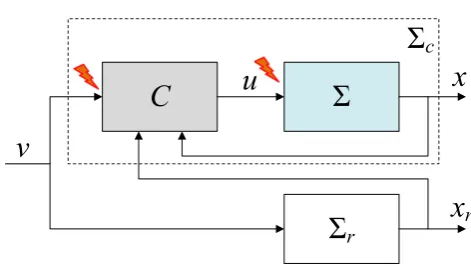
cFig. 1. Corrective control system for tolerating input faults.
Fig. 1 illustrates the structure of the corrective control system accommodating input faults. Σ is the considered asynchronous machine and C is the corrective controller that is implemented also as an asynchronous machine. The closed-loop system consisting ofC andΣis denoted byΣc. Σr, a reference model whose behavior must be matched by Σc, is described as
Σr “ pA,X,x0,srq
wheresris the stable recursion function ofΣr.Creceives the external inputvPAand state feedback values xandxrfrom Σand Σr, respectively, to generate the control inputu P A. The control objective ofCis two folds as follows.
First,Cachieves model matching betweenΣcandΣr. Here, matchingmeans that the stable state input/ouput behavior of Σcequals that ofΣr. IfΣcandΣrstay at the same stable state and if an identical external input enters each machine, they must transfer to the same next stable state. A key aspect is that the control behavior is validated only in terms of the stable states since the transient states are meaningless in asynchronous machines. For this reason, the input and state set and the initial state ofΣr must be the same as those of Σand only the stable recursion function sr of the reference modelΣr is given with no loss of generality.
To prohibit asynchronous machines from falling into un-predictable behaviors, the machines have to be constructed such that they comply with the principle of thefundamental mode operation [22], an operating policy that forbids the simultaneous change of two or more system variables. This policy helps to prevent uncertainties arising from simulta-neous changes in two or more variables in the behavior of asynchronous machines. For Σc to operate in fundamental mode, the following condition must be always valid. Note that this result is taken from the former studies [1], [7].
Condition 1. The closed-loop system Σc of Fig. 1 operates in fundamental mode when all the following conditions are valid:
(i) Among C and Σ, when one machine goes on transient transitions, the other must stay at a stable state. (ii) The external input v changes only while C and Σare
both at stable states.
(iii) The input fault occurs only when both C and Σare at stable states.
Conditions (i) and (ii) are the design specifications that must be satisfied in the construction of the closed-loop system Σc. (iii) imposes a restriction on the occurrences of input faults, which are independent adversarial entities. One must suppose that input faults never happen when Σc are in the middle of transient transitions. Nevertheless, as transient transitions of asynchronous machines occur very quickly, (iii) is not a burdensome requirement. Throughout this paper, we assume thatΣcalways preserves the principle of the fundamental mode operation.
III. ModelMatching
Let us first address the existence condition and design procedure for a corrective controller for model matching between Σc and Σr. We temporarily assume that no input fault occurs in the operation of Σc. In the former results [1]–[3], it is found that the existence condition is described by certain reachability properties of the machine and model. These properties can be characterized in terms of a numerical matrix, called the skeleton matrix, defined as follows.
Definition 2. Given Σ“ pA,X,x0,fq, let X“ tx1, . . . ,xnu. The skeleton matrix KpΣq ofΣ is an nˆn matrix of zeros and ones whosepi,jqentry is
Ki jpΣq “
"
1 DtPA` such that spxi,tq “xj
0 otherwise
where i,jP t1, . . . ,nu.
KpΣq shows in a compact way the stable reachability between any pair of states in Σ. The skeleton matrix KpΣrq
for Σr is similarly defined. The existence condition for a corrective controller that realizes model matching between Σc andΣr is written as [1]–[3]
KpΣrq ďKpΣq
where the inequality is valid entry by entry. The above relation means that the stable reachability of Σ must be greater than or equal to that of Σr for ensuring model matching corrective control.
We outline the process of corrective control for model matching provided thatKpΣrq ďKpΣqis valid. This process
will be also applied to constructing the module of the fault-tolerant controller. Referring to Fig. 1, we formulateCas the following finite state machine; note that Σis the input/state machine whereasCis the input/output machine that provides the output value which differs from the present state.
C“ pXˆXˆA,A,Ξ, ξ0, ϕ, ηq
whereXˆXˆAis the input set, A is the output set,Ξis the state set, and ξ0 PΞis the initial state.ϕ andη are the recursion function and output function, respectively, with the mappings
ϕ:ΞˆXˆXˆAÑΞ
η:ΞÑA.
In the beginning,Cis at the initial stateξ0. Assuming that model matching has been successful so far, suppose that both ΣandΣr reach the same stable statexifor which there exists a non-empty set Dpxi,xjq ĂA such that
Dpxi,xjq:“ taPA|srpxi,aq “xj andsrpxi,aq,spxi,aqu. Any input in Dpxi,xjqwould cause model mismatch in the transition from xi to xj. Upon receiving the state feedback xi,C transfers to ξt, termed the transition state [3]. In the fundamental mode operation, an input change can occur only when the machine stays at a stable combination. Anticipating that an input character in Dpxi,xjqmay enter the system,C prepares the correction behavior atξt. In order to realize the latter functionality, we assignϕandηatξ0andξtas follows.
ϕpξ0,x,x,vq “ξ0 @px,x,vq PXˆXˆAztpxi,xiqu ˆUpxiq
ϕpξ0,xi,xi,vq “ξt @vPUpxiq. (1)
Note that the first character in the input variables of ϕ denotes the state feedback fromΣ. Since no actual control is conducted at eitherξ0 orξt,C relays the external input v to the control inputuwithout modification:
ηpξ0q “v
ηpξtq “v. (2)
If the external inputvchanges to a character that invokes no model mismatch,Cwill go back toξ0. On the other hand, if vchanges to a character a PDpxi,xjq, the next behavior ofΣwould violate the desired input/state specification if not corrected. By Definition 2, srpxi,aq “xj implies Ki jpΣrq “ 1. Since KpΣrq ď KpΣq by assumption, Ki jpΣrq “ 1 leads to Ki jpΣq “ 1 (every entry of the skeleton matrix is either zero or one) and hence there exists an input sequence t :“
u1u2¨ ¨ ¨uk P A` (k ď n´1) such that xj “ spxi,tq. We
denote by z1, . . . ,zk´1 PX all the intermediate stable states Σpasses through witht, that is,
zi“spzi´1,uiq
zi“spzi,uiq, i“1, . . . ,k (3)
z0:“xi
zk:“xj.
Note that between the adjacent stable stateszi andzi`1,Σ may pass through some transient states. Asynchrony and fun-damental mode operations ofΣcmake these stable transitions
termedξ1, . . . , ξkPΞ, into the correction trajectory. As soon asC receives the external inputa, it transfers toξ1, the first auxiliary state, and provides Σ with the first control input characteru1. To this end, setϕ andηas
ϕpξt,xi,xi,aq “ξ1 @aPDpxi,xjq
ϕpξ1,xi,xi,aq “ξ1 @aPDpxi,xjq. (4)
ηpξ1q “u1.
In response to u1, Σ moves from xi to z1 “ spxi,u1q, the first intermediate stable state. Receiving the state feedback z1, C in turn transfers to the second auxiliary state ξ2 and generates the second control input u2. In response to u2, Σ moves to the second intermediate stable state z2“spz1,u2q, and so on. This iterative procedure continues forksteps. The following assignment ofϕ andηrealizes this operation.
ϕpξh,xi,zh,aq “ξh`1
ϕpξh`1,xi,zh,aq “ξh`1 (5)
ηpξhq “uh
h“1, . . . ,k´1.
Finally, at ξk,Σ reaches the desired next stable state xj. To preserve the principle of the fundamental mode operation, we design C so that it receives the state feedback from Σr only after reaching the final state ξk. Receiving xj fromΣr, C returns toξ0.
ϕpξk,xi,xj,aq “ξk
ϕpξk,xj,xj,aq “ξ0 (6)
ηpξkq “uk.
Due to the lack of no global synchronizing clock, all stable transitions and the interactions between C andΣcan be executed very fast. Therefore, the closed-loop system Σc seems to transfer from xi directly to xj in response to any input a P Dpxi,xjq. Note that the foregoing design solves model matching only for the stable transition from xi toxj. The controller modules for other stable transitions can be made in a similar way. The overall model matching controller is accomplished by combining each controller module.
IV. Fault-TolerantCorrectiveControl
A. Faults at the External Input
We now consider the problem of tolerating input faults occurring to the external input v. It is supposed that the reachability condition KpΣrq ď KpΣq is valid so that the model matching corrective controller C is implemented in front ofΣas shown in Fig. 1.
Assume that Σ (and Σr) has been staying at a stable combinationpxi,vqwherevPUpxiqandFpvq,H, i.e.,vis not fault-free, and thatC has been staying at the transition state ξt. Assume further that an input fault happens to v, causing an unauthorized switch to a character v1 P Fpvq.
SinceC is not equipped with any fault detection module, it cannot discriminate between an occurrence of the input fault and the normal transmission of a new input character. In this study, we propose a policy that every change of the external input is first interpreted as the transmission of a new input character. Note that this policy is preferable because the rate of fault occurrences is usually much less than that of the inflow of input characters.
The next behavior ofCis determined byv1. First, assume v1 P Upx
iq. Since model matching between Σc and Σr is supposed to be maintained, the present state ofΣr is alsoxi. In this case, the switched inputv1does not violate the desired
specification. HenceC deliversv1 to the control inputu and
no state transition is induced either inC orΣ.
ϕpξt,xi,xi,v1q “ξt
ηpξtq “v1 @v1PFpvq XUpxiq.
Next, assumev1 PTpxiq. With no knowledge of the fault
occurrence, C must determine the next operation only in terms of whether or notv1 would cause model mismatch. If spxi,v1q “srpxi,v1q,v1<Dpxi,xjqfor all jP t1, . . . ,nu. Thus C does not execute any control action; it just relaysv1 to the control input channel, i.e.,u“v1 as before. WhenΣreaches the next stable statespxi,v1q,spxi,v1qis delivered toCas the state feedback.Cthen compares it with the state feedbackxr coming fromΣr. Sincev1 occurs by fault, the external input
toΣris stillvandΣrstays atxi. When the two state feedback values are found to be different, an occurrence of the input fault is perceived, and C should initiate another correction procedure fromspxi,v1qtoxiimmediately to maintain model
matching. The condition for making a correction trajectory from spxi,v1qto xiis similar to the case of model matching
and is described as follows.
IfvPUpxiq,v1PTpxiqand spxi,v1q “srpxi,v1q,
Dt1PA` such that spspxi,v1q,t1q “xi, (7)
namely, the original state xi must be stably reachable from the deviated state spxi,v1qinΣ.
On the other hand, if spxi,v1q , srpxi,v1q, v1 is an input character that causes model mismatch at the state xi. Let srpxi,v1q:“ xj. Then v1 P Dpxi,xjq andKi jpΣrq “1. Since KpΣrq ďKpΣqby assumption,Ki jpΣrq “1 leads toKi jpΣq “ 1 andC already materializes a correction trajectory from xi to xj using an input sequence t P A` such that spxi,tq “ xj. Upon receiving v1, C initiates the correction procedure that takesΣtoward the goal state srpxi,v1q. WhenΣreaches srpxi,v1q,C compares the two state feedback values fromΣ
andΣr. The rest of the procedure equals the former case.C executes another correction procedure from srpxi,v1q to xi.
The reachability condition needed to realize this control is written as
IfvPUpxiq,v1PTpxiqand spxi,v1q,srpxi,v1q,
Dt1PA` such that spsrpxi,v1q,t1q “xi. (8)
The design procedure is almost identical to (1)–(6). In fact, ifDpxj,xiq,H,Calready has the corresponding correction trajectory from xj to xi. It is efficient to use this trajectory instead of adding another one. To this end, letξ1
1 PΞbe the first auxiliary state ofC that makes the correction trajectory from xj toxi. We assignϕ andη as follows.
ϕpξt,xi,xj,v1q “ξ11
v1PFpvq XTpxiqand xj“srpxi,v1q.
After reaching ξ1
Note that for allv1PFpvq XTpx
iq, conditions (7) and (8) can be combined into
IfvPUpxiq,@v1PFpvq XTpxiq,
Dtpv1q PA` such that spsrpxi,v1q,tpv1qq “xi. (9)
B. Faults at the Control Input
Let us consider the problem of tolerating input faults occurring to the control input u. Unlike the case of input faults occurring to the external input v,C can diagnose the occurrence of this fault since the unauthorized state transition is easily detected by observing the change of the state feedback xwhile the external inputvremains unchanged.
More specifically, assume that both Σ and Σr have been staying at a stable combination pxi,uqwithFpuq,Hwhen the input fault occurs to u, causing an unwanted switch of the control input from u tou1 PFpuq. The fault occurrence
is identified when the state feedback is observed to change from xi to spxi,u1q while the external input and the state
feedback fromΣr remain fixed. Of course, ifu1PUpxiq, the state feedback remains the same. In this case, the fault is latent in that it does not incur any change to the input or state.
Assume now u1 PTpx
iq. The condition for counteracting the unauthorized state transition fromxitospxi,u1qis similar to that used in tolerating the faults to the external input. The original state xi must be stably reachable from the deviated state spxi,u1q. In formal terms, the latter is written as
IfuPUpxiq,@u1PFpuq XTpxiq,
Dtpu1q PA` such that spspxi,u1q,tpu1qq “xi. (10)
Using the results (9) and (10), we now address the condition for the existence of the fault-tolerant controller that achieves model matching with respect to Σ as well as counteracts any input fault in Σ that occurs to either the external inputvor the control inputu. The following theorem is the main result of this paper.
Theorem 1. GivenΣ“ pA,X,x0,fqwith X “ tx1, . . . ,xnu, let Σr “ pA,X,x0,srqbe the reference model, and let KpΣq and KpΣrqbe the skeleton matrix ofΣand Σr, respectively. Suppose that A has at least one character v such that Fpvq, H. Then, there exists a corrective controller C of Fig. 1 that matches the stable state behavior of Σc to that of Σr while invalidating the influence by any input faults if and only if the following conditions are held true.
(a) KpΣrq ďKpΣq.
(b) @xi, i“1, . . . ,n, and@vPA with vPUpxiqand Fpvq, H,
@v1PFpvq XTpxiq,
Dtpv1q PA` such that spsrpxi,v1q,tpv1qq “xi
Dt1pv1q PA` such that spspxi,v1q,t1pv1qq “xi.
The above theorem means that if an input fault occurs to a stable state, fault tolerance against the fault is possible if and only if the original state is stably reachable from the deviated state in both Σ andΣr, as described in (b). If this condition and that of model matching (item (a)) are valid, we can design a corrective controller that materializes both fault tolerance and model matching. Employing the basic
corrective controller module for model matching described in (1)–(6), we can construct a corrective controller that realizes fault tolerance against the fault input occurring to each combinationpxi,vq, namelyCpxi,vq. The overall controllerC is obtained by adding all the controller modulesCpxi,vq’s to C using join operation (refer to [3] for a detailed algorithm for assembling corrective controller modules).
V. Example
Consider an input/state asynchronous sequential machine Σ“ pA,X,x0,fqwhose state flow diagram is shown in Fig. 2. Here, A “ ta,b,c,du, X “ tx1,x2,x3,x4u, and x0 “ x1. An examination of Fig. 2 shows that the corresponding stable state behavior ofΣis given by Fig. 3. Since the next stable state of the pair px3,dq is x1, spx3,dq “ x1 and the corresponding stable transition is marked in Fig. 3. px4,bq
is another transient pair for which the stable transition is different from the transient transition (fpx4,bq “ x1 but spx4,bq “x2). Among the input alphabet A, we assume the following fault scenario.
Fpbq “ ta,du
Fpvq “ H, @v“ ta,c,du,
that is, the inputbmay be switched to one ofaandd by the input faultFpbqand the other input characters are fault-free. The reference modelΣr “ pA,X,x0,srqthat must be matched by the closed-loop systemΣcis shown in Fig. 4.
Let us first investigate the possibility of model matching betweenΣc andΣr. The skeleton matrices KpΣq andKpΣrq
are derived as
KpΣq “ ¨
˚ ˚ ˝
1 1 1 1
1 1 1 1
1 1 1 1
1 1 1 1
˛
‹ ‹ ‚
KpΣrq “ ¨
˚ ˚ ˝
1 1 1 1
1 1 1 1
0 0 1 0
1 1 1 1
˛
‹ ‹ ‚
Refer to the former works on corrective control [1], [3], [5] for the formal steps of computing the skeleton matrix. Since KpΣrq ď KpΣq, a model matching corrective controller C exists in the structure of Fig. 1.
Next, we examine the possibility of fault-tolerant control against Fpbq. In Fig. 3, b makes a stable combination with x2 and x3, that is, b P Upx2q and b P Upx3q. Further, we have
Fpbq XTpx2q “ tau
Fpbq XTpx3q “ tdu.
that invalidates the input faults Fpbq, while realizing model matching betweenΣcandΣr.
x
2x
3x
1a
,
d
a
,
b
,
c
c
b
,
d
x
4c
c
b
a
a
d
[image:6.595.51.248.83.467.2]b
,
d
Fig. 2. State flow diagram ofΣ.
x
2x
3x
1a
,
d
a
,
b
,
c
c
b
,
d
x
4c
c
b
a
a
d
[image:6.595.305.551.214.789.2]d
b
Fig. 3. State flow diagram ofΣin the stable states.
x
2x
3x
1b
,
c
a
,
b
,
c
,
d
a
c
,
d
x
4a
,
d
a
d
b
c
b
Fig. 4. State flow diagram ofΣr.
VI. Summary
We have presented a corrective control scheme for asyn-chronous sequential machines with input faults. We have focused our concern on proposing a fault-tolerant control law for input faults using only state feedback values from the machine and the model. No observer is employed in the proposed control architecture. Necessary and sufficient
conditions for the existence of the controller are presented. It has been found that to tolerate any input fault, both the machine and the model must be able to reach the original state from the deviated state. The design procedure for a controller has been outlined based on the basic corrective controller module. To demonstrate the applicability of the proposed scheme, the procedure of checking the controller existence is addressed in the illustrative example. An appli-cation of the proposed fault-tolerant control scheme to real-world asynchronous sequential machines is under way as a further study.
References
[1] T. E. Murphy, X. Geng, and J. Hammer, “On the control of asyn-chronous machines with races,”IEEE Trans. Autom. Control, vol. 48, no. 6, pp. 1073–1081, 2003.
[2] X. Geng and J. Hammer, “Input/output control of asynchronous sequential machines,” IEEE Trans. Autom. Control, vol. 50, no. 12, pp. 1956–1970, 2005.
[3] N. Venkatraman and J. Hammer, “On the control of asynchronous sequential machines with infinite cycles,”Int. J. Control, vol. 79, no. 7, pp. 764–785, 2006.
[4] J. Sparsø and S. Furber,Principles of Asynchronous Circuit Design —
A Systems Perspective, Kluwer Academic Publishers, 2001.
[5] J. Peng and J. Hammer, “Input/output control of asynchronous sequen-tial machines with races,”Int. J. Control, vol. 83, no. 1, pp. 125–144, 2010.
[6] J. Peng and J. Hammer, “Bursts and output feedback control of non-deterministic asynchronous sequential machines,” Euro. J. Control, vol. 18, no. 3, pp. 286–300, 2012.
[7] J.–M. Yang, “Corrective control of asynchronous sequential machines in the presence of adversarial input,”IET Control Theory Appl., vol. 2, no. 8, pp. 706–716, 2008.
[8] J.–M. Yang, “Corrective control of input/output asynchronous sequen-tial machines with adversarial inputs,”IEEE Trans. Autom. Control, vol. 55, no. 3, pp. 755–761, 2010.
[9] J.–M. Yang and S. W. Kwak, “Output feedback control of asyn-chronous sequential machines with disturbance inputs,” Inf. Sci., vol. 259, pp. 87–99, 2014.
[10] J.–M. Yang and S. W. Kwak, “Fault diagnosis and fault-tolerant con-trol of input/output asynchronous sequential machines,”IET Control
Theory Appl., vol. 6, no. 11, pp. 1682–1689, 2012.
[11] J.–M. Yang, “Fault-tolerant control of a class of asynchronous se-quential machines with permanent faults,”Automatica, vol. 50, no. 3, pp. 989–993, 2014.
[12] J.–M. Yang and S. W. Kwak, “On diagnosing intermittent faults in input/output asynchronous sequential machines,” Latest Trends in
Circuits, Automatic Control and Signal Processing, pp. 110–115, 2012.
[13] J. Hammer, “Automatic defensive control of asynchronous
se-quential machines,” Int. J. Control, vol. 88, 2015, in press,
doi:10.1080/00207179.2015.1064547.
[14] J.–M. Yang, T. Xing, and J. Hammer, “Adaptive control of asyn-chronous sequential machines with state feedback,”Euro. J. Control, vol. 18, no. 6, pp. 503–527, 2012.
[15] X. Xu and Y. Hong, “Matrix approach to model matching of asyn-chronous sequential machines,”IEEE Trans. Autom. Control, vol. 58, no. 11, pp. 2974–2979, 2013.
[16] J.–M. Yang, “Corrective controllers with switching capability for modeling matching of input/state asynchronous machines,” inProc.
Int. MultiConf. Engineers and Computer Scientists, vol. 2, 2015.
[17] Y. Nke and J. Lunze, “A fault modeling approach for input/output automata,” inProc. the 18th IFAC World Congress, pp. 8657–8662, 2011.
[18] L. Sterpone and M. Violante, “Analysis of the robustness of the TMR-architecture in SRAM-based FPGAs,”IEEE Trans. Nucl. Sci., vol. 53, no. 5, pp. 1545–1549, 2005.
[19] C. M. Krishina and K. G. Shin, Real-Time Systems, McGraw-Hill: New York, 1997.
[20] J. Lunze and J. Schr¨oder, “Sensor and actuator fault diagnosis of systems with discrete inputs and outputs,” IEEE Trans. Syst. Man.
Cybern. B, vol. 34, no. 2, pp. 1096–1107, 2004.
[21] A. Paoli, M. Sartini, and S. Lafortune, “Active fault tolerant control of discrete event systems using online diagnostics,”Automatica, vol. 47, no. 4, pp. 639–649, 2011.
[image:6.595.98.240.498.652.2]