Case Report
Primary diffuse large B-cell lymphoma
of the central nervous system harboring
a reciprocal t(3;13)(q27;q14): a case report
Masahiro Manabe1, Ryuta Matsuoka2, Dai Momose1, Yasuyoshi Sugano1, Eiwa Ishida3, Ki-Ryang Koh1
Departments of 1Hematology, 3Pathology, Osaka General Hospital of West Japan Railway Company, 1-2-22
Matsuzaki-cho, Abeno-ku, Osaka 545-0053, Japan; 2Department of Neurosurgery, Osaka General Medical Center,
3-1-56 Bandaihigashi, Sumiyoshi-ku, Osaka 558-8558, Japan
Received March 1, 2016; Accepted May 23, 2016; Epub July 1, 2016; Published July 15, 2016
Abstract: A case of primary diffuse large B-cell lymphoma of the central nervous system involving a t(3;13)(q27;q14) chromosomal abnormality is reported. The disease exhibited an aggressive clinical course. As far as we know, there have only been 8 cases of lymphoma harboring this type of chromosomal translocation, and none of them involved
the central nervous system. This is the first reported case of the primary diffuse large B-cell lymphoma of the central
nervous system involving a reciprocal t(3;13)(q27;q14) translocation.
Keywords: Primary diffuse large B-cell lymphoma of the central nervous system, t(3;13)(q27;q14), BCL6
Introduction
Translocations involving the B-cell lymphoma 6 (BCL6) gene locus (3q27) are seen in approxi-mately 30-40% of diffuse large B-cell lympho-mas of the central nervous system (CNS DLBCL) [1]. A reciprocal translocation containing 3q27 and 13q14 breakpoints, t(3;13)(q27;q14), has been reported in 8 cases of various lymphoid neoplsms as a rare but recurring chromosomal transloction (Table 1) [2-7]. These cases inclu-ded 3 cases of follicular lymphoma, 3 cases of Burkitt’s lymphoma, and 1 case each of nodal marginal zone B-cell lymphoma and systemic DLBCL. However, there have not been any reports about CNS DLBCL involving t(3;13) (q27;q14). Here, we present a case of CNS DLBCL harboring t(3;13)(q27;q14).
Clinical summary
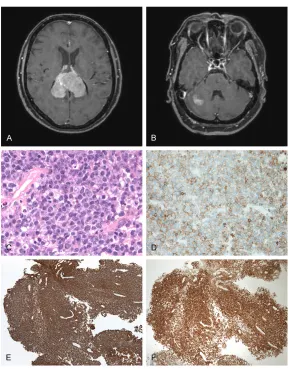
A 66-year-old female developed memory distur-bance over the course of a month. No lympha-denopathy was detected, and the patient did not have a history of night sweats or body weight loss. Mass lesions were found in the splenium of the corpus callosum and the right cerebellum on magnetic resonance imaging
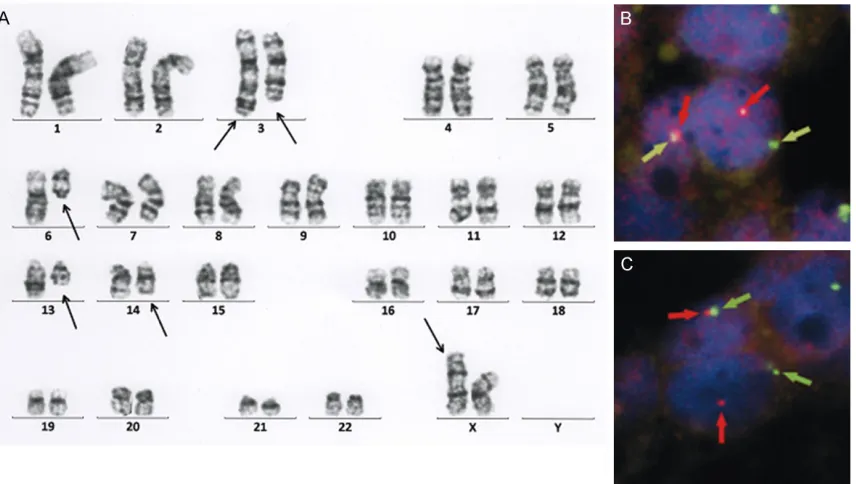
idem,i(15)(q10) [6] (Figure 2A). The formalin-fixed paraf-fin-embedded surgical speci-men was also subjected to interphase fluorescent in situ
hybridization (FISH) analysis.
BCL6, IGH break-apart pro- bes demonstrated signal con-stellations that reflected bre-aks at the BCL6(3q27) and
IGH(14q32) loci in 69% and 61% of the tumor cells, res- pectively (Figure 2B, 2C). On the other hand, no rearran- gement was seen using the
MYC(8q24) probe.
The patient received chemo-therapy involving 375 mg/m2
rituximab on day 1, 3.5 g/m2
methotrexate on day 2, 1.4 mg/m2 vincristine on day 2,
and 100 mg/m2 procarbazine
on days 2 to 8, disease pro-gression was subsequently observed. Due to her poor performance status, the pa- tient was given supportive care alone, and she eventual-ly died 2 months after the ini-tial diagnosis.
Discussion
The BCL6 gene at 3q27 encodes a zinc-finger tran-Table 1. Cytogenetic findings of previously reported cases involving t(3;13)(q27;q14)
Case
no. Age/Sex G-banded Karyotype including t(3;13)(q27;q14) Diagnosis Reference 1 81/M 46,XY,add(19)(q?)/46,idem,t(3;13)(q27;q14),del(6)(q?) FL Temperani et al. (1996) 2 68/F 46,XX,t(3;13)(q27;q14),t(4;18)(q21;q21)/46,idem,del(6)(q16q24) DLBCL Laï et al. (1998) 3 32/F 46,XX,t(3;13)(q27;q14),t(14;18)(q32;q21)/46,XX,t(8;6;13)(q21;q11;p11),t(14;18) FL Laï et al. (1998) 4 67/F 46,XX,t(3;13)(q27;q14),+5,-6,del(6)(q15q23),+7,t(8;14)(q24;q32),+mar BL Laï et al. (1998) 5 44/M 46,XY,t(3;13)(q27;q14),t(8;22)(q24;q11),t(14;18)(q32;q21),+der(18)t(14;18),+mar BL Stamatoullas et al. (2000) 6 NR 48,XX,+X,+del(1)(p21p36),del(6)(q13q21),del(13)(q13q14),t(14;18)(q32;q21)
/46,XX,der(1)t(1;1)(p36;q21),t(3;13)(q27;q14),del(6)(q13q21),t(14;18) FL Sanchez-Izquierdoet al. (2001) 7 NR 46,XY,der(1)t(1;12)(q42;q13),t(3;13)(q27;q14),del(17)(p11),
+der(17)dup(17)(q21q25)t(12;17)(?;q25)t(1;12)(q21;?)
NMZL Itoyama et al. (2002)
8 82/F 47,XX,t(3;13)(q27;q14),del(8)(q22),der(9)t(9;22)(p13;q11),+12,
T(14;18)(q32;q21),der(22)t(9;22)(p13;q11)ins(22;8)(q11;q24q22)
BL Bacher et al. (2011)
9 66/F 46,X,der(X)(Xqter→Xq13::?::Xp11.2→Xqter),der(3)t(1;3)(q12;q11.2),
T(3;13)(q27;q14),del(6)(q12),add(14)(q24)/46,idem,i(15)(q10) CNS DLBCL Present case
[image:2.612.91.522.85.247.2]NR, not reported; FL, follicular lymphoma; DLBCL, diffuse large B-cell lymphoma; BL, Burkitt’s lymphoma; NMZL, nodal marginal zone B-cell lymphoma; CNS DLBCL, primary diffuse large B-cell lymphoma of the central nervous system. Except for that seen in the present case, the karyotypes were described according to the system used in the Mitelman Database of Chromosome Aberrations and Gene Fusions in Cancer [16].
Figure 1. Gadolinium-enhanced T1-weighted magnetic resonance images showing mass lesions in the splenium of the corpus callosum (A) and the right cerebellum (B). Pathological images of the surgical specimen showing
[image:2.612.89.378.291.660.2]scription factor that is expressed in germinal center B cells and functions as a transcriptional repressor [8]. Translocations involving BCL6
are observed in approximately 30-40% of CNS DLBCL [1]. They can include a variety of non-immunoglobulin partner genes as well as the immunoglobulin heavy locus and kappa and lambda loci, and cause deregulated BCL6
expression [8]. In a multicenter study, Laï et al. detected three t(3;13)(q27;q14)-harboring lym-phoma cases (1.5%) among 210 lymphoid tis-sues; however, since Temperani et al. [2] first described the case of a patient with follicular lymphoma harboring t(3;13)(q27;q14) in 1996, only 8 cases of lymphoid malignancies with this translocation have been reported. Hence, it seems that the original estimate of the inci-dence of this translocation (1.5%) might be too high. Furthermore, except for our case there have not been any reports about cases of CNS DLBCL harboring this translocation; therefore, it seems that the present case is the first reported case of CNS DLBCL to involve the t(3;13)(q27;q14) translocation.
In a detailed analysis of two B-cell lympho- ma patients with t(3;13)(q27;q14), Galiègue-Zouitina et al. [9] reported that the translo- cation resulted from the juxtaposition of the
BCL6 sequence on chromosome 3q27 with the L-plastin (LCP1) sequence on chromosome 13q14. Although BCL6 rearrangement was confirmed by FISH in the present case, we could not perform any detailed genetic analysis of the partner gene of BCL6; i.e., LCP1, because of the lack of a tissue specimen. Further accumu-lation of cases will be required to enable the lymphomagenesis mechanism responsible for t(3;13)(q27;q14)-containing lymphoid malig-nancies to be elucidated via molecular and genetic analyses.
[image:3.612.95.523.72.314.2]As for the prognostic significance of t(3;13) (q27;q14), it was reported that BCL6 rearrange-ment is correlated with better outcomes in DLBCL [10], although another study obtained a different result [11]. However, it was suggest- ed that previous cases involving the t(3;13) (q27;q14) translocation tended to also exhibit
another chromosomal abnormality, del (6q), and most of them demonstrated a poor pro- gnosis [3]. In a study of CNS DLBCL based on comparative genomic hybridization technique, Ricket et al. demonstrated that CNS DLBCL dis-plays a mean of 5.5 chromosomal changes per tumor [12]. Among these changes, the loss of 6q was most common (50%), and other studies obtained similar findings (frequency of 6q loss: 45-47%) [13, 14]. Concerning its prognostic impact, several studies have found that the loss of 6q is significantly correlated with short-er survival [12, 14, 15]. In addition, abnormali-ties of chromosome arm 1q have been sug-gested to be correlated with a poor prognosis [6]. In the current case, chromosomal analysis detected both del (6q) and an abnormality of the 1q arm; hence, we selected a high-dose methotrexate-containing regimen for the induc-tion chemotherapy, but tumor progression was subsequently observed. Although it has been established that high-dose methotrexate regi-mens represent the optimal therapy for CNS DLBCL, we suggest that high-risk cases of CNS DLBCL involving poor prognostic factors, such as del (6q) and 1q abnormalities, as were seen in the present study, might require more power-ful treatments, for example, a combination of high-dose methotrexate and cytosine arabino- side.
Disclosure of conflict of Interest
None.
Address correspondence to: Masahiro Manabe, Department of Hematology, Osaka General Hospital of West Japan Railway Company, 1-2-22 Matsuzaki-cho, Abeno-ku, Osaka 545-0053, Japan. Tel: 81-6-6628-2221; Fax: 81-6-6628-4707; E-mail: m115- [email protected]
References
[1] Kluin PM, Deckert M, Ferry JA. Primary diffuse large B-cell lymphoma of the CNS. WHO
Classification of Tumours of Haematopoietic
and Lymphoid Tissues. Edited by Swerdlow SH, Campo E, Harris NL, Jaffe ES, Pileri SA, Stein H, Thiele J, Vardiman JW. Lyon: IARC Press; 2008. pp. 240-241.
[2] Temperani P, Gandini G, Volinia S, Giacobbi F,
Vaccari P, Waterfield MD, Emilia G. YAC clone
H10 discriminates between 3q26.2 and 3q27 chromosome rearrangement in hematological disorders. Leukemia 1996; 10: 225-228.
[3] Laï JL, Daudignon A, Kerckaert JP, Galiègue-Zouitina S, Detourmignies L, Morel P, Bauters F, Fenaux P. Translocation (3;13)(q27;q14): a nonrandom and probably secondary structural change in non-Hodgkin lymphomas. Cancer Genet Cytogenet 1998; 103: 140-143.
[4] Stamatoullas A, Buchonnet G, Lepretre S, Lenain P, Lenormand B, Duval C, Callat MP, Gaulard P, Bastard C, Tilly H. De novo acute B cell leukemia/lymphoma with t(14;18). Leukemia 2000; 14: 1960-1966.
[5] Sanchez-Izquierdo D, Siebert R, Harder L, Marugan I, Gozzetti A, Price HP, Gesk S, Hernandez-Rivas JM, Benet I, Solé F, Sonoki T, Le Beau MM, Schlegelberger B, Dyer MJS, Garcia-Conde J, Martinez-Climent JA. Detection of translocations affecting the BCL6 locus in B cell non-Hodgkin’s lymphoma by interphase
fluorescence in situ hybridization. Leukemia 2001; 15: 1475-1484.
[6] Itoyama T, Nanjungud G, Chen W, Dyomin VG, Teruya-Feldstein J, Jhanwar SC, Zelenetz AD, Chaganti RSK. Molecular cytogenetic analysis of genomic instability at the 1q12-22 chromo-somal site in B-cell non-Hodgkin lymphoma. Genes Chromosomes Cancer 2002; 35: 318-328.
[7] Bacher U, Haferlach T, Alpermann T, Kern W, Schnittger S, Haferlach C. Several
lymphoma-specific genetic events in parallel can be found
in mature B-cell neoplasms. Genes Chromo-somes Cancer 2011; 50: 43-50.
[8] Basso K and Dalla-Favera R. BCL6: master regulator of the germinal center reaction and key oncogene in B cell lymphomagenesis. Adv Immunol 2010; 105: 193-210.
[9] Galiègue-Zouitina S, Quief S, Hildebrand MP, Denis C, Detourmignies L, Laï JL, Kerckaert JP. Nonrandom fusion of L-plastin (LCP1) and LAZ3 (BCL6) genes by t(3;13)(q27;q14) chro-mosome translocation in two cases of B-cell non-Hodgkin lymphoma. Genes Chromosomes Cancer 1999; 26: 97-105.
[10] Offit K, Lo Coco F, Louie DC, Parsa NZ, Leung
D, Portlock C, Ye BH, Lista F, Filippa DA, Rosenbaum A, Ladanyi M, Jhanwar S, Dalla-Favera R, Chaganti RSK. Rearrangement of the bcl-6 gene as a prognostic marker in diffuse large-cell lymphoma. N Engl J Med 1994; 331: 74-80.
[11] Muramatsu M, Akasaka T, Kadowaki N, Ohno H, Yamabe H, Edamura S, Doi S, Mori T, Okuma M, Fukuhara S. Rearrangement of the BCL6 gene in B-cell lymphoid neoplasms: compari-son with lymphomas associated with BCL2 re-arrangement. Br J Haematol 1996; 93: 911-920.
prima-ry lymphomas of the central nervous system. Am J Pathol 1999; 155: 1445-1451.
[13] Weber T, Weber RG, Kaulich K, Actor B, Meyer-Puttlitz B, Lampel S, Büschges R, Weigel R, Deckert-Schlüter M, Schmiedek P, Reifenberger G, Lichter P. Characteristic chromosomal im-balances in primary central nervous system lymphomas of the diffuse large B-cell type. Brain Pathol 2000; 10: 73-84.
[14] Cady FM, O’Neill BP, Law ME, Decker PA, Kurtz DM, Giannini C, Porter AB, Kurtin PJ, Johnston PB, Dogan A, Remstein ED. Del(6)(q22) and BCL6 rearrangements in primary CNS lympho-ma are indicators of an aggressive clinical course. J Clin Oncol 2008; 26: 4814-4819.
[15] Nakamura M, Kishi M, Sakaki T, Hashimoto H, Nakase H, Shimada K, Ishida E, Konishi N. Novel tumor suppressor loci on 6q22-23 in pri-mary central nervous system lymphomas. Cancer Res 2003; 63: 737-741.