21
Performance Improvement in LEACH Protocol based on
Cluster Head Selection in WSN
Aftab Ul Nabi
South China University ofTechnology, China
Li Shan bin
South China University ofTechnology, China
Saifullah Adnan
South China University ofTechnology, China
Asad Raza
University of Sindh, Jamshoro Sindh Pakistan
Muhammad Arsalan
South China University ofTechnology, China
Muhammad Faizan Khan
South China University ofTechnology, China
ABSTRACT
In this paper, in the LEACH (Low Energy Adaptive Clustering Hierarchy) protocol two improvements have been made, firstly in the cluster head selection:- By using the residual energy of the node and distance between the node and the base station, the random number generated by the node is adjusted. The random number of the nodes with more residual energy and the distance from the base station are adjusted to a smaller value, which makes it more likely to be the cluster head. However, this method does not consider the effect of the number of cluster heads on the algorithm. Secondly, the optimal number of cluster heads is proposed:- Which can ensure the balance of network load by controlling the number of cluster heads in the optimal range. Finally simulation results show that the improved algorithm can effectively reduce the energy consumption and prolong the lifetime of nodes and the whole network.
General Terms
Wireless Sensor Network, Routing Protocol
Keywords
Wireless sensor network, routing protocol, LEACH, cluster head, energy consumption, network lifetime.
1.
INTRODUCTION
Our main focus is on topology control, time synchronization, positioning technology and automatic networking.
Regional distribution of WSN is a random sensor node according to the routing algorithm constitutes, and most of the nodes distribution monitoring area people is not likely to arrive at the, so the energy of the node is particularly important. How to make use of their own energy node to achieve maximum effectiveness of our study is the most important purpose of the network and extend the life cycle. For this purpose and routing protocol is not separate, so the main content of this paper is how to reduce energy consumption of the nodes in random distribution, the best effective ways of saving energy, prolong life cycle of the whole network. In this paper, we first introduce the WSN architecture and the technology; secondly, introduces the work characteristics of WSN and its performance index and classification; finally of WSN simulation platform one by one analysis in research, summarizes the simulation platform of WSN research in development to the role. This paper mainly research for the analysis and Research on the LEACH protocol. According to the problems put forward a new improved algorithm, first of all due to the selection of cluster
heads, in the threshold formula added energy factors, so as to get the best cluster head algorithm, by determining the number of cluster head to ensure that the network load balance. At last, the comparison and analysis of the original algorithm and the improved algorithm are carried out by simulation experiment.
[image:1.595.304.554.365.666.2]2.
RESEARCH METHODOLOGY
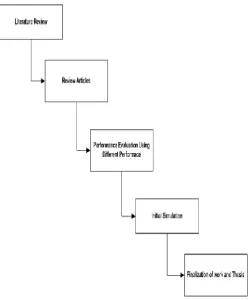
Fig 1: Research Methodology
3.
ROUTING TECHNOLOGY IN
WIRELESS SENSOR NETWORKS
22 forwarding data. The most fundamental is to improve the
quality of the traditional wireless network, the routing protocol should be as far as possible to find the smallest path, but also need to take full use of network resources, as far as possible to reduce the information jam. Compared with the traditional wireless network, the characteristics of the WSN routing protocol are mainly reflected in the following aspects.
3.1
Data Centric
The data centric is one of the characteristics of WSN, a large number of nodes in the network are set randomly, each node has not accurate address information, so that the routing protocol cannot be address of the node as the basis, but according to the demand of sensory data, data communication mode and data flow, data center formation energy optimization of the forwarding path.
3.2
Data Aggregation Technique
In the network adjacent nodes collect data with high similarity, duplication of information increased data traffic in the network with data from different nodes for data aggregation and can effectively reduce the volume of data communication [2]. Data aggregation according to different application environment, the data reorganization and compression, extracts the most characteristic data to send, reduces energy consumption, improve the utilization rate.
3.3
Design Requirements for Routing
Protocols
The routing technology of WSN is designed by the characteristic of the wireless sensor network problems must be considered in the design:
1) A low energy dissipation path. 2) To improve the accuracy of routing.
The design of reliable data forwarding scheme, in order to achieve the purpose of extending the service life of the network. According to the characteristics of the wireless sensor network routing scheme, in the specific application, the following requirements should be satisfied.
3.4
Data Fusion
In order to reduce the energy consumption and the optimization of data transmission in wireless networks, sensor nodes to collect data in often with a lot of repeated data and redundant data, then need to take all kinds of data fusion method to compression, combination of these data.
The above four aspects are the main direction of the wireless sensor network routing protocol design, according to different application conditions, considering the requirements of other designs, such as end to end delay and forwarding between safety performance. For wireless sensor networks, it is necessary to design a meet all application requirements of routing protocol is impossible of, therefore, specific issues specific analysis, the most reasonable design principle is as much as possible of routing protocol is optimized[7].
3.5
Routing Protocols for WSN
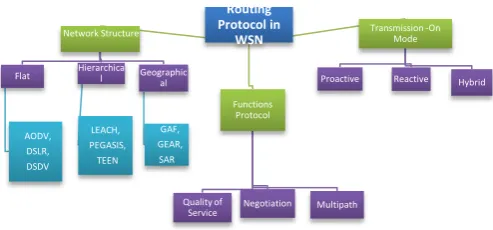
Wireless sensor network routing protocol, aiming at the application background, a variety of different routing protocols have emerged. According to different standards, wireless sensor network routing protocols are divided into different types, as shown in fig 2. According to the logic structure is divided into plane protocol and a layered protocol; according to the service quality divided for QoS protocols and non QoS protocol; divided by the path length for a single path routing protocols and routing protocol; according to the
[image:2.595.318.565.150.265.2]communication mode for the clock driven and query driven and event driven routing protocol; according to the route establishment time can be divided into active protocols and on-demand protocols. According to the destination node a number for unicast and multicast protocol; according to the requirements of data fusion was divided into protocol fusion and non-fusion protocol [3-6].
Fig 2: Classification of WSN Routing Protocol
3.6
Plane Routing
Plane routing refers to each node in the network in the communication function, power and initial energy, and the status of routing algorithm is the same. Network traffic more evenly distributed in the network layer, the routing plane cannot be expanded and is only suitable for small scale network, so the routing design is easy to achieve [8-10].
3.7
Flooding Routing
Flooding routing is one of the earliest and most simple routing technologies in wireless sensor networks. It does not need to maintain the routing table, and it will not consume energy because of complex routing algorithm. It is the way to spread the information to the adjacent nodes the nodes receive the information to be forwarded, until the data reaches the required nodes.
The advantage of flooding routing is simple and easy to implement and it does not need to maintain the network topology information and routing table information, thereby reducing the consumption of energy because of complex routing algorithm. It is suitable for the application of high connectivity, but it also has a lot of disadvantages, such as the same node may be repeatedly received the same data, the occurrence of repeated messages. In addition, the data will be distributed in the whole network, the blind use of network resources the network will have a great waste of energy, and thus affect the performance of the network [11]. Therefore, in real life, it is seldom used in large scale flooding routing. However, due to the strong connectivity of flooding routing, a lot of routing protocols in different degrees of the introduction of flooding routing just like chatting routing protocol. Flooding routing communication mechanism is shown in fig 3.
Routing Protocol in WSN Network Structure Flat AODV, DSLR, DSDV Hierarchica l LEACH, PEGASIS, TEEN Geographic al GAF, GEAR, SAR Functions Protocol Quality of
Service Negotiation Multipath
Transmission -On Mode
23
Fig 3: Flooding Paths
4.
RESEARCH AND IMPROVEMENT
OF LEACH ALGORITHM
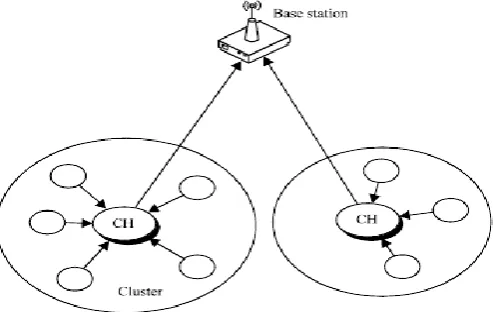
LEACH is an application specific protocol system, which fully considers the unique characteristics of WSN in the design and development of two aspects. In wireless sensor networks, a lot of sensor nodes are distributed in the monitoring area, each node is self-organized into clusters, and each cluster will select a node as the cluster head of the cluster. LEACH uses clustering techniques will be referred to as processing member nodes, the data collected again to the base station (BS). LEACH protocol cluster structure as shown in fig 4.
Fig 4: Clustering Structure of LEACH Protocol
In the model of wireless sensor network, LEACH protocol has some assumptions.
1) A large number of sensor nodes densely distributed in the whole monitoring area, all types of sensor nodes in the network are the same, and their energy is very limited initial energy is the same. At the same time node can adjust the sending and receiving power through the wireless transceiver, adjusting the energy consumption.
2) The base station in the wireless sensor network is usually set at the distance of the wireless sensor network is far away, and the base station node is no longer fixed.
3) sensor nodes can control the transmit power of the size, to adjust the transmission power according to the change of the size of the communication distance, the energy
consumption of radio signals of sensor nodes in each direction are the same.
[image:3.595.317.558.206.279.2]The network node has the ability of data fusion, which can reduce the redundant data information and save the communication energy consumption greatly. At the same time the node has a strong computing power, enough to support a variety of MAC protocols, such as CDMA, TDMA, etc. LEACH protocol in the work process of the entire sensor division cycle of the round, each round consists of two stages: the establishment of the stage and stable stage, as shown in fig 5.
Fig 5: LEACH Operating Cycle
4.1
Establishment Phase
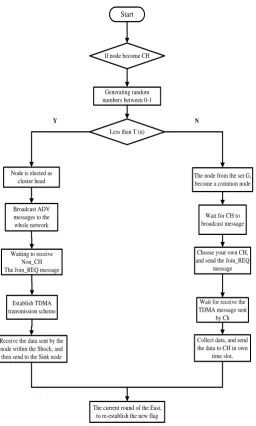
The process of cluster building mainly by three parts: 1) non cluster head node selection to join the cluster 2) non cluster head node to the cluster header to send the join request message 3) cluster head nodes for cluster member nodes TDMA slot assignment. The following is mainly from the three aspects of the formation of clusters.
[image:3.595.48.295.412.568.2]24
If node become CH Start
Node is elected as cluster head
Choose your own CH, and send the Join_REQ
message Waiting to receive
Non_CH The Join_REQ message
Broadcast ADV messages to the whole network
Wait for CH to broadcast message The node from the set G, become a common node
The current round of the East, to re-establish the new flag
Generating random numbers between 0-1
Less than T (n)
Wait for receive the TDMA message sent
by Ch Establish TDMA
transmission scheme
Collect data, and send the data to CH in own
time slot. Receive the data sent by the
node within the Shock, and then send to the Sink node
[image:4.595.37.294.67.494.2]Y N
Fig 6: Leach Work Flow Chart
5.
IMPROVEMENT OF LEACH
PROTOCOL
LEACH protocol in all nodes were the election of cluster head probability, when the network operation after a period of time, namely after several rounds after some node residual energy difference is bigger, but they still follow the election of cluster head probability rules. This is LEACH protocol where the problem deceits no consideration to the node residual energy. Because once elected as cluster head node will have to bear the heavy task of communication, energy consumption has increased, this will lead to carry a lower energy nodes because the energy consumption is too fast and death, the network appeared "hole" and shorten the lifetime of the whole network. Therefore, the residual energy of the node should be considered as the selection of cluster head. An improved cluster head selection formula is proposed:
04.3
1 (1
)
( )
1 [ mod(1/ )]
1 (1
)
Ec
n
E
p
T n
r
p
n
(1)The
E
0
for the representation of the initial energy of nodes, theEc
is the node of the current energy value.
Supposed current node residual energy of the thresholdT n
( )
effect, the experiment was set at 100. This method is the size of the threshold is adjusted by the residual energy of nodes, the high energy nodes compute a threshold is relatively large, so these nodes become cluster head might have a better chance[15]. However, this improved algorithm of defect is: only considers the residual energy of nodes and does not take into account the distance of the node and the base station, if the selection of cluster head away from the base station is far will because of the long distance data transmission have higher energy consumption[16].6.
SIMULATION AND ANALYSIS
Simulation experiments have two advantages: (1) the network model can be established quickly, which makes it more convenient to modify the parameters of the network model, and makes the design of network more reliable; (2) a number of different designs for simulation and comparative analysis, Usually by several parameters, such as: data transmission reliability and robustness of the network topology, network
coverage, etc. to obtain optimum comparative analysis of performance indicators, Thereby to improve the feasibility of
the program comparing different design ideas and provide a basis for preparation.
Fig 7: The total amount of data received by the base station
Fig 7 the energy consumption of the network under different cluster heads. In equation, as a result of n>1, and
when , Node uses multi hop forwarding to
send messages, otherwise the single hop transmission. According to equation when the distance between the cluster
head node and the base station , and
the optimal range for the number of cluster heads is
. From the graph, when the number of cluster heads is K, the energy consumption of network is significantly
2
2
E
elec
ny
fs
75
d
toBS
185
[image:4.595.325.562.424.601.2]25 smaller in 4 and 5.
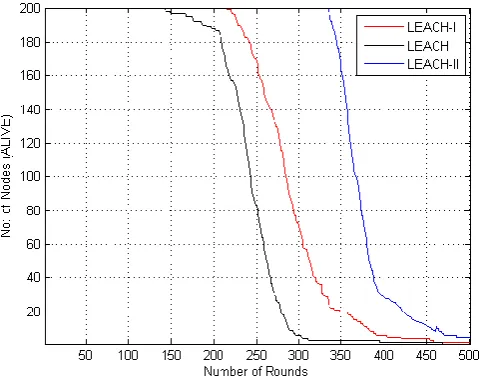
Fig 8: Relation with the Remaining Rounds of Nodes
It can be seen from the fig 8, The time of the first death node appears in the 340 round of LEACH-II, and the LEACH and LEACH-I are obviously late, All nodes in the network run after the number of rounds in the 500 round, And LEACH in the 145 round when all nodes are dead, So it can be seen that LEACH-II effectively prolongs the network lifetime, The improved algorithm LEACH-II optimizes the performance of the network, and achieves the purpose of prolonging the network lifetime.
7.
CONCLUSION
With the rapid development of modern communication technology, wireless sensor networks have a very broad application prospects, people's daily lives and work more and more contact with wireless sensor networks. The great development prospects of wireless sensor networks have also contributed to the development of related technologies, its related technology has become a hot research topic at home and abroad. Among these techniques, such as network topology control technology, node localization, data fusion and network coverage, high efficiency and energy saving routing protocol has become the key technology, due to the limited energy of sensor nodes, the design of energy-efficient routing protocol has become one of the hot issues in the research of routing protocol. The data transmission and receiving in the WSN the energy consumption is main factor and this factor is having importance for the routing protocol. In this study the LEACH is improved to achieve the better performance and after acquiring the results furthermore the results are compared and analyzed with the well-known routing protocols for the validation purpose. The simulations results demonstrated that the proposed routing algorithm is efficient and energy saving.
This paper mainly does the following three aspects:
1)
Provide a brief overview of the wireless sensor network development status at home and abroad, detailing the WSN architecture, protocol architecture and node structure, especially the key technologies of WSN and main characteristics are described in detail.2)
According to the characteristics of the wireless sensor network routing protocol, the design requirements are proposed, and several important routing protocols are analyzed, so as to summarize the advantages of the cluster routing protocol.Design a specific clustering routing LEACH protocol for improvement, combined with some deficiencies of leach, proposed a new improved algorithm and finally the simulation experiments are carried out with MATLAB. The simulation results show that improved new algorithm is better than the original algorithm in saving more energy, effectively balance network load and prolong the lifetime of the whole network.
8.
ACKNOWLEDGMENTS
We are very thankful to teachers who supported and help out whenever we were stuck in any problem during research.
9.
REFERENCES
[1] Xu, Ning, Rangwala, Sumit, Chintalapudi, Krishna Kant, et al. A wireless sensor network For structural monitoring. In Proceedings of the 2nd international conference on Embedded networked sensor systems (pp. 13-24). Acm.
[2] Wang A, Yang D, Sun D. A clustering algorithm based on energy information and cluster heads expectation for wireless sensor networks. Computers & Electrical Engineering, 2012, 38(3):662-671.
[3] Jin K, Zhang Y, Tian D. Based on the Improvement of LEACH Protocol for Wireless Sensor Network Routing Algorithm. International Conference on Intelligent System Design & Engineering Application. IEEE, 2012:1525-1528.
[4] Sutar U S, Bodhe S K. Energy efficient topology control algorithm for multi-hop ad-hoc wireless sensor network .IEEE International Conference on Computer Science and Information Technology. IEEE, 2010:418-421.
[5] Liu J, Tong L. A framework for performance modeling of wireless sensor networks. IEEE International Conference on Communications. IEEE, 2005:1075-1081 Vol. 2.
[6] Gou H, Yoo Y. An Energy Balancing LEACH Algorithm for Wireless Sensor Networks. Seventh International Conference on Information Technology: New Generations. IEEE, 2010:822-827.
[7] He T, Stankovic J A, Lu C, et al. SPEED: A Stateless Protocol for Real-Time Communication in Sensor Networks. International Conference on Distributed Computing Systems. IEEE Computer Society, 2003:46.
[8] Rugin R, Mazzini G. A simple and efficient MAC-routing integrated algorithm for sensor network. IEEE International Conference on Communications. IEEE, 2004:3499-3503 Vol.6.
26 [10] Pottie, G. J, Kaiser, W. J. Wireless integrated network
sensors. Communications of the Acm, 2004, 43(5):51-58.
[11] Sajjanhar U, Mitra P. Distributive Energy Efficient Adaptive Clustering Protocol for Wireless Sensor Networks. International Conference on Mobile Data Management. IEEE, 2007:326-330.
[12] Song L, Hatzinakos D. Cooperative transmission in poisson distributed wireless sensor networks: protocol and outage probability. Wireless Communications IEEE Transactions on, 2006, 5(10):2834-2843.
[13] Akyildiz I F, Su W, Sankarasubramanian Y, et al. Cayirci: "wireless sensor networks: a survey International Symposium on Computer Networks. 2002.
[14] Arici T, Altunbasak Y. Adaptive sensing for environment monitoring using wireless sensor networks .Wireless Communications and Networking Conference, 2004. WCNC. IEEE, 2007:2347-2352 Vol.4.
[15] Polastre J, Szewczyk R, Mainwaring A, et al. Analysis of Wireless Sensor Networks for Habitat Monitoring. Wireless Sensor Networks. Springer US, 2004:399-423.
[16] Muruganathan S D, Ma D C F, Bhasin R I, et al. A centralized energy-efficient routing protocol for wireless sensor networks. IEEE R Commun Mag, 2000, 43(3):S8-13.