Application of micro-foam drilling fluid technology
in Haita area
Qingren Sun1,2, Bo Xu1,2*
1No. 1 Drilling Company of Daqing Drilling and Exploration Engineering Corporation, Daqing, China
2Petroleum Engineering Department, Northeast Petroleum University, Daqing, China; *Corresponding Author: [email protected]
Received 11 April 2012; revised 15 May 2012; accepted 30 May 2012
ABSTRACT
In recent years, a new kind of drilling fluid sys- tem with unique structure micro-foam has been developed. Compared with other drilling fluid systems, it possesses many advantages. And it has been successfully applied in hundreds of wells to drill depleted reservoirs in the world wide. The geological structure is very complex in Haita area, it is difficult to achieve the re- quirement of increasing drilling rate by conven- tional drilling methods, even can’t make footage. The micro-foam drilling fluid can apply to Haita area, and solve the drilling problems commend- ably, which is comprehended by studying the structure and plugging, prevent caving, speed mechanism of the micro-foam drilling fluid. Field practice indicates that micro-foam drilling fluid technology can resolve the drilling problem ef- fectively in Haita basin. It has the extremely vital significance to improve drilling speed, discover and protect reservoir stratum, decrease the risk of circulation loss and save the drilling cost.
Keywords: Micro-Foam Drilling Fluid; Lost
Circulation; Formation Damage Control; Increasing Drilling Rate
1. INTRODUCTION
The upper reservoir of Haita region has some feature, such as strong water-sensitive, the existence of coal seams, loose cement and poor diagenetic nature, so it is easy for the sidewall after the hydration expansion to be unstable. The lower reservoir of Haita region has some more sandstone, conglomerate, mudstone and crack de- velopment, in the difference in pressure affect, the drill- ing fluid filtrate along the cracks flow into the rocks, leading to a sharp decline occurred off the rock strength, collapse and it is easy to make borehole instability. On-site construction have found that it is difficult to con-
trol overcut rate, which requires the drilling fluids have a good rejection capability and sealing characteristics. Therefore, using the usual drilling equipment is difficult to the successful completion of the drilling in the region. Using common drilling fluid, overbalance pressure is likely to result in the loss and differential sticking. Using pneumatic drilling fluid or underbalanced drilling tech- nology, the preparation of expensive equipment and drilling fluids can not be stabilized inflatable upper part of the normal pressure strata, so the effects can not be ensured. According to a large number of laboratory test results and field trials, it is recommended that the mi- cro-bubble drilling fluids system should be used in the construction process.
The micro-foam drilling fluid is a new, reusable, low-cost and low-density drilling fluid; it is a water- based drilling fluid system by the use of surfactants, sta- bilizers, and tackifiers to be supplemented by other treat- ment agent. Compared to the micro-foam drilling fluid with conventional water-based drilling fluid system, it has a low density, low hydrostatic pressure, shielding effect, the filtration rate is small, the ability to bring rock, Lubrication, friction loss, cleanup ability anti-pollution effects, fast drilling speed and therefore it has good leak- proof, oil and gas layer protection and carrying sand, speed and other effects [1].
2. PHOLOGY AND STABILITY OF THE
MICRO-BUBBLE
2.1. The Structure and Morphology of the Micro-Bubble
A
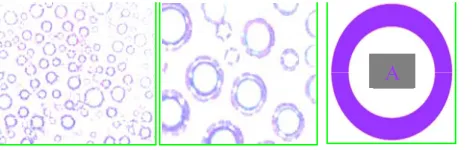
Figure 1. Amplification of different multiples of the micro- bubble morphology.
that outside of the micro-bubble as the surfactant layer structure, the structure to make it wet, which makes mi- cro-bubbles and the continuous aqueous phase have good compatibility. But the outer layer of the surfactant bilayer structure with micro-bubbles in other parts of the con- nection is weak, vulnerable to external environmental effects of flow, due to the outermost surface of the role of the surfactant layer, micro-bubble lipophilicity.
2.2. The Stability of the Micro-Bubble
Factors affecting the stability of the micro-bubble are internal and external causes, including internal foaming agent and foam stabilizer, while the external temperature and time. It can be seen from Figure 1: the shape of the
micro-bubble is round, the air within the nuclear, wrap- ped in a layer of liquid film. Sebba’s theory, the shell folder by the outer and inner layers of surfactant films thickening of the water layer, the radius of the shell is generally up to half of the total radius of the micro-bub- ble, so that the stability of the entire bubble is very diffi- cult to burst. Gravity drainage is the main reason for the micro bubble destruction: liquid film thinning due to their own gravity drop to a certain extent, the bubble will break up; Furthermore, the loss of the liquid makes bub- ble motion and speed, speed up the bubbles merge, thus bubble volume larger, eventually leading to bubble burst [3].
2.3. The Jamin Effects at the Pore Throat
Micro-foam drilling fluids containing a multi-level dis- tributed stable foam sphere, when these bubbles sphere under differential pressure flow within the porous me- dium, or small cracks, wetting because it did not occur with the rocks and occur through the pore throat sphere deformation, the formation of different curvature of the curved surface, shown in Figure 2. According to the
Laplace formula p 2
Pc
R1
[image:2.595.327.524.89.182.2]R2 Air
Figure 2. Micro-bubble Jamin effect diagram.
3. MICRO-FOAM DRILLING FLUIDS
LEAK PROTECTION AND SEALING
MECHANISM
3.1. Decrease Fluid Column Pressure
The micro-foam drilling fluids can decrease the fluid column pressure effectively cause of its low density. Its density varies with the temperature and pressure of dif- ferent well depth. We separate the well depth into many subparagraphs equally to calculate the fluid column pres- sure of the well bottom. We assume that every subpara- graph is very little, so in this subparagraph the micro- foam drilling fluids’ density is a const, and then we can get the fluid column pressure formed by this subpara- graph. By adding all the fluid column pressure of sub- paragraphs, we could get the fluid column pressure of the well bottom. The formula is in Eq.1.
0H
Pg
f h h. (1)In the Eq.1: H—the well depth; f h
h—the func- tion expression of the micro-foam drilling fluids density varies with the well depth; g-acceleration of gravity.3.2. Plugged Pore and Micro Fracture
The air bubble in the drilling fluids is independent and its fluid film is thicker more than the bubble radius. Cause of the protection of strength composite film, the micro-emulsification bubbles can exist under high pres- sure, and with the pressure increase micro-bubble vol- ume decreases quickly, but the particle size decreases more slowly, so multi-level distributed micro-bubble spheres play the role of bridging particles and deforma- tion of filler particles in the drilling fluid, and can effec- tively block the formation of micro cracks.
When the micro-foam drilling fluids circulate to the well, the micro-bubbles within the sealed air is com- pressed. When drilling low-pressure strata, micro-bubble under differential pressure into the low-pressure pores or cracks, the micro-bubbles in a low pressure environment, the internal part of the energy is released, the micro- bubble expansion, Laplace pressure of the external sharp increase in the micro bubble aggregation, thus forms a R
solid phase bridging particles bridging layer.
4. MECHANISM OF ANTI-CAVING OF
MICRO-FOAM DRILLING FLUID
Micro-foam drilling fluid has better function of inhibi- tion of mud shale hydration expansion and preventing the borehole wall sloughing. Its mechanism of anticaving is as follows:
4.1. Reduce Penetration Mechanism
The micro-foam which has the deformable particle diameter has the capability of putting up bridge and for- mation sealing in the pores. Producing physical forma- tion sealing to mud shale can reduce the penetration of water to the mud shale. The micro-foam drilling fluid of low density declines fluid column pressure of drilling fluid and decreases the penetration of water to the mud shale layer. Thus reducing the filtration and the soak ef- fect of filtrate on the wall and effectively decreasing the hydration effect of mud shale [4].
4.2. Film-Forming Anti-Swelling Mechanisms
The microstructure of the micro-foam makes it have the hydrophobic lipophilic property. A large number of surfactant concentrating in the liquid-solid interface re- duces the interfacial tension of water and mud shale, effectively prevent pore pressure penetration of mud shale and inhibit mud shale hydration expansion by ad- sorption film in layer surface.
4.3. Negative Pressure Dehydration Mechanism
The micro-foam drilling fluid has low density and fluid column pressure is less than the layer pore pressure. The activity of micro-foam drilling fluid free liquid can be control below the layer pore fluid activity. Both make the layer fluid flow to the wellbore, producing the nega- tive pressure, thus make the layer mud shale dehydration and prevent the borehole wall sloughing.
5. ACCELERATION MECHANISM OF
MICRO-FOAM DRILLING FLUID
5.1. Reduce Pressure to Assist in Breaking Rock
The micro-foam drilling fluid has low density and good rheological property, bottom hole differential pres- sure is small and drilling cuttings returning in time re- duce the repeated cutting of the drill bit. The low static pressure which the micro-foam produce results in the layer pressure of bottom rock imbalance and releasing
internal stress into the wellbore, thereby helping to break rock [5].
5.2. Reduce the Circulating Pressure
The micro-foam drilling fluid has better lubrication performance and smaller flow resistance than conven- tional water base drilling fluid, reduces the pressure loss of drilling fluid circulation system, especially the annu- lus pressure loss and gives full play to hydrodynamism.
5.3. Improve Ability of Carrying Cuttings
The micro-foam drilling fluid has low density, small circulating pressure loss and quick flow velocity and the micro-foam has a higher low shear viscosity to make its ability of suspension and carry cuttings markedly en- hanced.
5.4. Extend the Drill Bit Life
On the one hand, micro-foam shell is surfactant. It can be absorbed on the surface of drill bit, drill tool and rock, forming lubricating oil film to clean drill bit and prevent drill tool from balling up. On the other hand, because the active agent solution in the micro-foam has good wetting property, it will be immersed in rock fracture to arise burst effect, thereby creating the conditions for efficient drilling. In addition, it has a strong ability of clearing bottom hole cuttings, so the drill bit life can be greatly improved.
6. THE TEST OF MICRO-BUBBLE
DRILLING FLUID IN THE HAITA FIELD
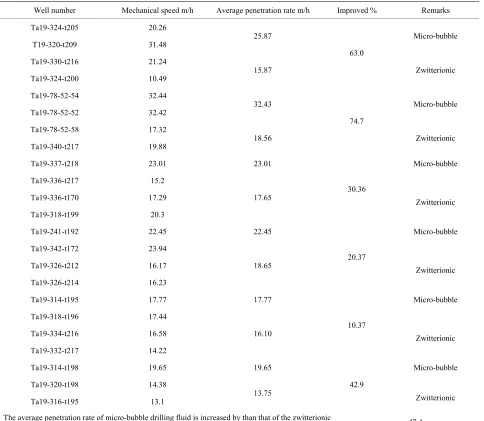
Using Micro Foam Drilling Fluid can make the Circu- lating pressure 2 - 3 Mpa lower than using Zwitterionic drilling fluid system, the Pressure drop of the drilling bit can be improved and the clamping effect of the debris at the bottom of a well can be reduced, avoiding the bit cutting debris again and again. Control the loss of fluid to the following of 4.0 ml. Then the cake formed is thin and tough and the effect of anti-sloughing is good. The solid content reduces significantly and the pressure dif- ferential of the reservoir reduced by 24.02% reaches 4.11. The hole enlargement is 6.96, decreased by 31.93%. Ex- tend the life of drill bit and screw drill while improving the penetration rate. A substantial increase in the return sand effect improves the hole cleaning effect and reduces the number of tripping without any complicated engi- neering accidents.cro-foam drilling fluid was applied, of which 49 wells were mainly used in the Nam Theun group and Tong- bomiao of wells and etc. Realize the purposes of tempo- rary plugging, reservoir protection, reducing the resis- tance, increasing the rate and improving the cementing quality. The technology of micro-bubble drilling fluid has been applied in 26 wells of full-well. Compared with more than 30 wells of Tamu Taga without the application of micro-bubble in 2009, the average drilling speed was 22.88 m/h, increased by 47.4% and the density of drilling fluid was 1.12 g/cm3, reduced by 4.27%. And the reser- voir has been protected effectively and the drilling statis- tics are showed in Table 1.
For the purpose of realizing the large speed of Haita from September to October in 2009, micro-bubble drill-
ing fluid has been applied in the tower 19-342-t220 wells, towers 19-332-t208 wells and towers 19-334-t209 wells. The average mechanical drilling rate has increased by 33.75% and the cementing quality rate has reached 100%. The construction cycle and the cementing quality of the three experimental wells has records the best level of Tamu Taga.
6.1. Time Analyses of the Three Test Wells
[image:4.595.59.543.299.720.2]The three wells which use composite drilling together with micro-bubble drilling fluid to speed up, comparing with the tower 19-335-t213 well that use gender compos- ite ion drilling fluid and pendulum drilling to be applied to the same section, the mechanical drilling rate has a larger substantial increase. The following Table 2 is the
Table 1. Drilling time statistics.
Well number Mechanical speed m/h Average penetration rate m/h Improved % Remarks Ta19-324-t205 20.26
T19-320-t209 31.48 25.87 Micro-bubble
Ta19-330-t216 21.24
Ta19-324-t200 10.49 15.87
63.0
Zwitterionic
Ta19-78-52-54 32.44
Ta19-78-52-52 32.42 32.43 Micro-bubble
Ta19-78-52-58 17.32
Ta19-340-t217 19.88 18.56
74.7
Zwitterionic
Ta19-337-t218 23.01 23.01 Micro-bubble
Ta19-336-t217 15.2 Ta19-336-t170 17.29 Ta19-318-t199 20.3
17.65 30.36 Zwitterionic
Ta19-241-t192 22.45 22.45 Micro-bubble
Ta19-342-t172 23.94 Ta19-326-t212 16.17 Ta19-326-t214 16.23
18.65 20.37 Zwitterionic
Ta19-314-t195 17.77 17.77 Micro-bubble
Ta19-318-t196 17.44 Ta19-334-t216 16.58 Ta19-332-t217 14.22
16.10 10.37 Zwitterionic
Ta19-314-t198 19.65 19.65 Micro-bubble
Ta19-320-t198 14.38
Ta19-316-t195 13.1 13.75
42.9
Zwitterionic
The average penetration rate of micro-bubble drilling fluid is increased by than that of the zwitterionic
polymer drilling fluid (%) 47.4
comparison of the penetration rate of the three wells from two to 2236.2 m (the tower 19-335-t213 wells start to correct oblique from 2236.2 m, so there is no com- parison) [6].
It can be seen from Table 2 that the machinery drilling
rate of combination drive and micro-foam drilling fluids have obtained the increase greatly, with an average in- crease of 10.24 m/h,which have increased 33.75%.
In order to verify the contribution of micro-foam drill- ing fluids on the speed, the statistics of drilling speed comparison that Ta19-328-t204 Well which use pendu- lum drilling rig and Ta19-328-t205 Well using combina- tion drive are as follows shown in Table 3.
From the table we can see that using combination drive have increased 3.46 m/h than pendulum drilling rig in the same well interval. So that the micro-foam drilling fluids contribute to the speed increasing can be approxi- mately considered as 10.24 m/h − 3.46 m/h = 6.78 m/h.
6.2. Average Well Diameter Expansion Rate
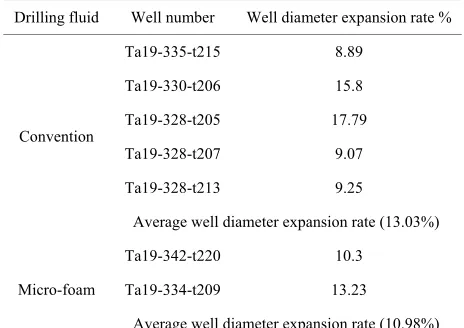
[image:5.595.307.539.103.267.2]Construction of ten micro-foam drilling fluids test wells near nineteen region in the Tamtsag, the average well diameter expansion rate is 13.03%, the average well diameter expansion rate of the three test wells using mi- cro-foam drilling fluids is 10.98%, the average well di- ameter expansion rate has reduced 15.73%. The relevant comparison of the data can be seen in Table 4.
Table 2. Drilling speed comparison of different drill structures and the drilling fluid system of the three wells.
Well number Ta19-335-t213 Ta19-342-t220 Ta19-332-t208
Well section 327 - 2236.2 m 327 - 2236.2 m 327 - 2236.2 m
Drilling time 107 h 5 min 76 h 30 min 70 h 45 min
Drilling rate 17.82 m/h 24.96 m/h 26.99 m/h
Improved 28.60% 33.96%
[image:5.595.57.287.464.583.2]Remarks Zwitterionic Micro-bubble + Compound Micro-bubble+ Compound
Table 3. The contrast of pendulum drilling rig and combi- nation drive.
Well number Ta19-328-t204 Ta19-328-t205
Well section 311 - 2417 m 311 - 2417 m
Pure drilling time 124 h 20 min 103 h 30 min
Machinery drilling rate 16.89 m/h 20.35 m/h
Drilling rate increase +16.99%
Note Pendulum drilling rig Combination drive
Table 4. Well diameter expansion rate comparison table.
Drilling fluid Well number Well diameter expansion rate %
Ta19-335-t215 8.89
Ta19-330-t206 15.8
Ta19-328-t205 17.79
Ta19-328-t207 9.07
Ta19-328-t213 9.25
Convention
Average well diameter expansion rate (13.03%)
Ta19-342-t220 10.3
Ta19-334-t209 13.23 Micro-foam
Average well diameter expansion rate (10.98%)
6.3. Well Cementation Quality
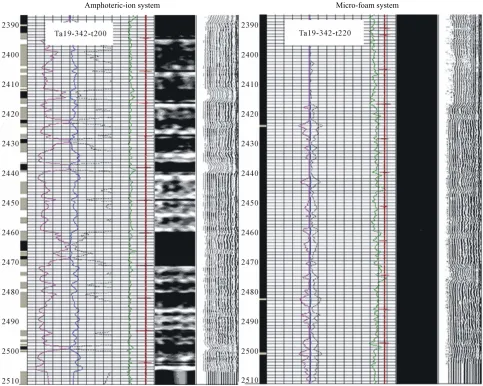
The cementing quality rate of three wells which used micro-foam drilling fluids system is 100%. Figure 3
shows the acoustic amplitude contrast of three micro- foam drilling fluids of wells and an amphoteric-ion drill- ing fluids well in the construction.
Mainly due to the micro-foam drilling fluids to im- prove the cementing quality in three respects: First, mi- cro-foam drilling fluids have the better borehole stability, regular well hole, smaller well diameter expansion rate, which laid the foundation for cementing to improve the displacement efficiency; Second, micro-foam drilling flu- ids have good mud cake quality; the wellbore is clean with the displacement efficiency; Third, shielding effect of micro-foam drilling fluids with the fluid loss in the near sidewall to form less than 1 cm of dense shielding ring can prevent the weightlessness of the cement, the formation fluid into the wellbore, and effectively avoid slurry formation fluid compatibility and quality problem [7].
7. CONCLUSIONS
By the research and application of micro-bubble drill- ing technology in Haita region, the following several conclusions are:
1) Micro-bubble has a special structure, the internal is air nuclear and the external is viscous water between double-layer membranes of surface active agent. Micro- bubble has hydrophobic property because of thick bubble wall. Compared with the ordinary bubble, micro bubble is very stable and its preparation and maintenance is simple. The micro-bubble drilling fluid is not recycled in the area, and it will increase the cost. So must study the circulating micro-bubble drilling fluid system.
[image:5.595.58.285.622.732.2]Amphoteric-ion system Micro-foam system
Figure 3. Acoustic amplitude comparison chart of two kinds of systems.
throat Jamin effect, can achieve a good sealing effect. Reduce the risk of a loss, and reduce the damage to the reservoir.
3) Micro-bubble drilling fluid system has excellent performance and good field application good, so control effectively overcut and collapse accidents. Test wells av- erage ROP increased by 56.7% is 8.71 m/h.
4) Through the air-lock and blockage, around the bore formed less than 1 cm in dense temporary plugging the ring, greatly improving the cementing quality and ensur- ing the needs of the development of the oilfield.
8. ACKNOWLEDGEMENTS
My deepest gratitude goes firstly and foremost to Institute of Petro- leum Engineering; the college gives me great support on funding. Without the funding this thesis could not have reached its present form. Secondly, I would like to express my heartfelt gratitude to Yuxue Sun who have instructed and helped me a lot in the course of the study. I am also greatly indebted to other comrades, for their constant encourage-
ment and guidance; I am able to complete the study smoothly.
REFERENCES
[1] Zhao, F., Wang, P.Q. and Li, X. (2008) Recent advance in Aphron drilling fluids. Drilling & Production Technology,
31, 123-124.
[2] Wang, H.J., Zhen, J., Zheng, X.H., et al. (2007) Research
and application of micro-foam drilling fluid in Daqing Oilfield. Drilling & Production Technology, 29, 88-92. [3] Sun, J.S. (2006) Drilling fluid technology anthology. Pe-
troleum Industry Press, Beijing, 135-150.
[4] Li, G.Q., Wang, H.J., Liu, J.T., et al. (2009) Micro-bubble
drilling fluid technology. Petroleum Geology & Oilfield Development in Daqing, 28, 203-207.
[5] Zhang, Z.H., Yan, J.N. and Fan, S.Z. (2003) Low-density drilling fluid technology. Petroleum University Press, Dongying, 51-54.
foam drilling fluid. Drilling Fluid & Completion Fluid,
27, 7-9.
[7] Wang, W., Jia, L.Y. and Su, Y. (2005) Oil/gas layer pro-