ISSN Online: 2164-5175 ISSN Print: 2164-5167
DOI: 10.4236/ajibm.2018.83050 Mar. 28, 2018 735 American Journal of Industrial and Business Management
Priority Sequence of Generic Technologies
Commercialization: Take Biotechnology
for an Example
Shihui Wang, Rongfang Liu
School of Business Administration, South China University of Technology, Guangzhou, China
Abstract
With the establishing and improving of generic technologies development system in various countries, the obstacles which block the development of ge-neric technologies have been transferred from basic R & D sessions to the downstream sessions, which refer to industrial applications. The research on integrating priority sequence of generic technologies commercialization in the stage of knowledge diffusion is desiderated. Given the limitation of generic technologies classification perspective based on bottom-up tree structure, us-ing social network analysis method, this paper puts forward a method which identifying industrial generic technologies reversely by observing the sharing of proprietary technology to generic technologies from the top of technology tree, in order to pinpoint generic technologies with market conditions and those still need to be studied, moreover, to provide a scientific evaluation me-thod for government intervention in the diffusion of generic technologies. In order to achieve this research, we take biotechnology as an example to con-duct empirical test.
Keywords
Knowledge Diffusion, Generic Technology, Commercialize, Priority Sequence, Biotechnology
1. Introduction
Generic technologies promote China’s strategic emerging industries to catch up with and surpass advanced world levels by providing technical platform support, which has great commercial value [1]. Due to the fundamentality, strategy, risk and externality of generic technologies and the spontaneous market forces,
he-How to cite this paper: Wang, S.H. and Liu, R.F. (2018) Priority Sequence of Generic Technologies Commercialization: Take Bio- technology for an Example. American Jour-nal of Industrial and Business Manage-ment, 8, 735-746.
https://doi.org/10.4236/ajibm.2018.83050
Received: January 30, 2018 Accepted: March 25, 2018 Published: March 28, 2018
Copyright © 2018 by authors and Scientific Research Publishing Inc. This work is licensed under the Creative Commons Attribution International License (CC BY 4.0).
DOI: 10.4236/ajibm.2018.83050 736 American Journal of Industrial and Business Management terogeneous market failures appear in various stages of generic technologies life cycle [2], which depends largely on the participation and supports of the gov-ernment [3]. This paper puts forward a method which identifying industrial ge-neric technologies reversely by observing the sharing of proprietary technology to generic technologies from the top of technology tree, in order to pinpoint ge-neric technologies with market conditions and those still need to be studied, moreover, to provide a scientific evaluation method for government interven-tion in the diffusion of generic technologies.
Through the empirical study, the result shows that due to the market failure, on the one hand, although generic technologies with high centrality are located at core position of technical platform, its weak in technology diffusion. In addition, the diffusion channels of generic technologies are diversified and multi-layered, thus makes spread of generic technologies becoming more complicated. On the other hand, some of generic technologies have low generic-technology centrali-ties but strong proprietary-technology support. Once the property rights and le-gal protection system is not perfect or not implemented, suppliers chose to block the technology in case technology innovations being spread excessively for free.
The main contribution of this paper is to propose a network method for se-lecting priority sequences of generic technologies, therefore provide a theoretical basis for the government to formulate science and technology policy. In addi-tion, the findings from this paper could also be generated to technology spinout of companies. However, this article also has some limitations. The research stu-dies generic technologies from the industry level, but the commercialization of generic technologies ultimately requires companies to practice. Consequently, how to integrate this generic technologies selection method into the enterprise technology spinout is one of the future research directions of generic technolo-gies.
2. Literature
Scholars have done a detailed study on the government’s role in the supply of generic technologies, mainly focused on generic technologies development [4], platform construction [5], innovation systems [6] etc. However, there is still a distance from the supply end to the diffusion end of generic technologies. As the core session for achieving its value, screening and identifying generic technolo-gies, especially forecasting and rating precisely of its commercial potential, have recently become major issues in this field [7] [8] [9] [10].
DOI: 10.4236/ajibm.2018.83050 737 American Journal of Industrial and Business Management difficult for other companies to share the results of generic technologies invest-ment. In this circumstance, generic technologies thus turn out to be a substan-tive proprietary technology [12]. Owing to the tree structure of generic technol-ogies [13], diffusion policy should be chosen based on commercial potential of generic technologies rather than be applied across the board.
Gambardella & McGahan [8] suggest that the technology distance between generic technologies and derived proprietary technology is the key to achieve generic technologies commercialization. Technical boundaries are dynamic and ambiguous, while top of the tree structure is complex and networked [14], the quantitative researches which based on a bottom-up technology evolution pers-pective in the past had many limitations. For example, Delphi method is largely affected by subjective interference, therefore lack of certain objectivity and strong operability.
Given the limitation of generic technologies classification perspective based on bottom-up tree structure, using social network analysis method, this paper puts forward a method which identifying industrial generic technologies re-versely by observing the sharing of proprietary technology to generic technolo-gies from the top of technology tree, in order to pinpoint generic technolotechnolo-gies with market conditions and those still need to be studied. Moreover, to provide a scientific evaluation method for government intervention in the diffusion of ge-neric technologies.
3. Theoretical Background
As a platform for companies to research and develop proprietary technology, generic technologies broadly can be divided into basic generic technologies and applied generic technologies [2] [3] [12]. Basic generic technologies is the basic technology with domain characteristics and public properties, focusing on social supply. Applied generic technologies are the kind of system technology with clear industrial application goals. Because of its direct support for the develop-ment of enterprise proprietary technology, applied generic technologies have both public and private properties and is more embodied as a private property [15].
DOI: 10.4236/ajibm.2018.83050 738 American Journal of Industrial and Business Management shows that economy, institution, legal, behavior and other non-technical ele-ments have restricted the barriers to transform, which led to the diffusion of ge-neric technologies obviously 1) much smaller than expected, such as biotech-nology industry [8]; 2) much slower than expected, such as nanotechbiotech-nology, so-lar thermal utilization technology industry [18] [19] [20].
It has been provided systematic policy implications for researches about technology diffusion related issues based on a bottom-up tree structure of tech-nology evolution perspective. However, technical boundaries are dynamic and ambiguous, while top of the tree structure is complexity and networked [14], thus make the technical nature presents a mixed state during the process of gov-ernment intervention, which is difficult to clarify [21]. For this reason, commer-cialization of generic technologies cannot be evaluated and fed back effectively. Consequently, this paper starts with the proprietary technology at the top of the technology tree structure, then deduces the commercial prioritization of under-lying generic technologies based on reverse innovation logic and network algo-rithm.
4. Methodology
1) IndustryEmerging industries often come from emerging technologies. As an emerging industry, biotechnology industry network is much larger. While being rich in resources, it also means an increase in uncertainty. The development of such industries often depends on technology improvement. Raija et al. suggest that highly cited patents often become an important symbol of emerging industries development. Ahuja, Gregory and Wilfred propose that the difference between highly cited patents and general patents are mainly reflected in technical impact. The cited times of a patent is the most direct indicator of technical impact. As Trajtenberg once suggested in his paper, if a patent is heavily cited, it shows that this patent has been widely used in other technical fields, thus has great value and higher quality. Therefore, this article uses highly cited patents on behalf of major inventions. On the other hand, generic technologies are a kind of tech-nology that has already been or may be universally applied in many fields. Its research results can be shared and have deep impact on the entire industry or across multiple industries and the companies belong to them.
2) Data
DOI: 10.4236/ajibm.2018.83050 739 American Journal of Industrial and Business Management (DII) patent database and three citation index databases (SCI, SSCI & AHCI) is constructed. It is constantly updating at a rate of tens of thousands per week, in-cluding data from 1963 to present. Each of the patent document in the DII data-base cites three different classification codes, i.e. IPC codes, DC codes and MC codes. Besides the codes, DII database also covers patent information of multiple countries. The comprehensive data information has an advantage over observing the development process of emerging technology.
This paper has opted to ground our DII research strategy on the OECD defi-nition of biotechnology, which covers the following IPC classes: A01H1/00, A01H4/00, A61K38/00, A61K39/00, A61K48/00, C02F3/34, C07G11/00, C07G 13/00, C07G15/00, C07K4/00, C07K14/00, C07K16/00, C07K17/00, C07K19/00, C12M, C12N, C12P, C12Q, C12S, G01N27/327, G01N33/53*, G01N33/54*, G01N33/55*, G01N33/57*, G01N33/68, G01N33/74, G01N33/76, G01N33/78, G01N33/88, G01N33/92. Those codes with * also include their sub-codes, e.g. in code G01N33/53*, the sub-codes, i.e. G01N33/532, etc. are also included.
Through the above method, this article has downloaded 47,207 patents in the biotechnology industry for the five years from 2008-2012. The top three cited frequency are 261,183,181 times. We created the basic patents database by choosing highly cited patents (top 5%) which were cited more than 38 times. The basic patents database comprises 212 patents, which includes 14,228 pre-viously cited patents. Apparently biotechnology patents are generally with high technical content, thus those 212 highly cited patents are representative. This ar-ticle tracks the 212 patents and their citations, which can observe the priority sequence of generic technologies commercialization as well as reflect the know-ledge transfer of generic technologies in biotechnology industry.
3) Method
DOI: 10.4236/ajibm.2018.83050 740 American Journal of Industrial and Business Management technology-related degree etc. according to the definition of industrial generic technologies, then conducts the empirical study of the above indices taking solar energy technology as an example. Luan Chunjuan’s methods mainly focus on the quantitative study of patent data. She believes that, in order to guarantee the ac-curacy and validity of generic technologies identification, the combination of quantitative and qualitative analysis is needed for getting a better result of ge-neric technologies choosing.
Co-occurrence analysis is based on the co-word analysis and co-cited theory clustering, comparing and analyzing the literatures that have direct relevance in the content, thus identifying and extracting valuable information from it. Co-occurrence analysis was first proposed by linguists and applied in the analy-sis of semantic closeness. If two terms occur frequently together in a certain or-der unor-der a single context, it means they have high semantic closeness. After that, co-occurrence analysis is widely used in the study of similarity, including co-authored analysis, co-cited analysis, co-word analysis and co-classified analy-sis etc. Co-cited analyanaly-sis is mainly used in the field of research and exploration of emerging technology, while co-word analysis is applied to the forefront of re-search and the detection of leading technology analysis. Although structured methods of integrating patent analysis and text analysis help to reveal the extent and path of knowledge flows within the industry, the existing framework still has some defects, mainly reflected in the respect that the patent citation information system is not complete and low digging. Tapping patents information by mea-suring textual similarity between basic patents and the knowledge they used or spread can effectively capture the degree of knowledge transfer between basic and referenced patents.
Based on a bottom-up tree structure of generic technologies classification perspective, this paper proposed a set of structured methodology that bridges the use of knowledge and the process of knowledge dissemination, which consists of the following five steps:
The first step, creating the basic patents database by choosing highly cited pa-tents which largely represent high quality of papa-tents and intensive flow of know-ledge. For the above-mentioned reasons, highly cited patents are more suitable to detect the knowledge flow of generic technologies. Both the basic patents and cited patents are from DII database. Basic patents are not only the key node that distinguish between cited patents and citing patents, but also the main carrier of knowledge diffusion. Therefore we regard basic patents as research objectives.
The second step, extracting the abstracts of the basic patents and cited patents to build the basic patents and the cited patents co-word network respectively, so that we can tap the inherent characteristics of knowledge flow. The abstract is the condensation of the main contents of the patent application. It provides more comprehensive and richer information compared to its title. Among them, the descriptor list is standardized to delete variants of the same word.
DOI: 10.4236/ajibm.2018.83050 741 American Journal of Industrial and Business Management codes in order to build technology disciplines network. Calculating the centrality of DC codes on the basis of relevant theories and calculation methods of bet-weenness centrality. The technical field or technical theme represented by “bridge” often has functions of integration, driving and radiation, which is able to cultivate new growth points and be regarded as the key technical field or the key technical theme. The degree centrality can be used to measure a single core technological field or core technological theme. Measuring the core technologi-cal group of a complex technologitechnologi-cal network is more appropriate to choose the eigenvector centrality index.
The forth step, based on the key words extracted from the basic patent, the knowledge flow degree of different technical disciplines is measured by the tex-tual similarity which is obtained through the cosine algorithm. DC codes are the technological classification codes quoted by Derwent technical experts as well as implementing the unified classification standard of one letter and two numbers. Whether implementing the unified classification standard or the overall quanti-ty, DC codes are suitable for analysis of technical classification. Extracting key-words from basic patents and cited patents in order to calculate cosine similari-ty—a similarity measurement that can understand and calculate long vectors and sparse vectors easily. The cosine similarity is defined as follows:
(
)
12 2
1 1
,
n k k k
n n
k k
k k
P C Sim P C
P C
=
= =
=
∑
∑
∑
where Pk refers to the frequency of keyword k in basic patents; Ck refers to the frequency of keyword k in citation patents at patent-class level. If keywords do not exist in the corresponding patents, Pk =0, otherwise, Pk =1. Similarly, if keywords do not exist in the corresponding citied/citing patents, Ck =0,
otherwise,, Ck =1. n refers to the quantity of patent-class for basic patents and
cited/citing patents.
The fifth step, calculating the centrality and similarity of each DC code and then obtaining the priority sequence according to the ranking of arithmetic val-ues.
5. Results
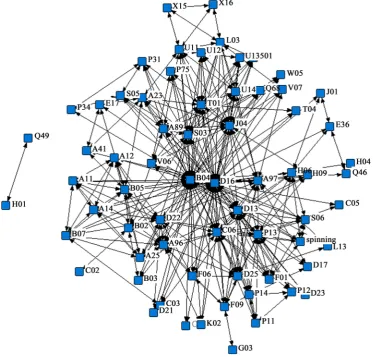
DOI: 10.4236/ajibm.2018.83050 742 American Journal of Industrial and Business Management Eigenvec centrality steps of UCINET. Then selecting the top 13 technical fields with values greater than 3.0 and considering them as generic technological fields in the biotechnology industry (Figure 1).
D16 has the highest eigenvec centrality, which is 100.247. It refers to fermen-tation industry which is a kind of new technique that produces useful products for humans using modern techniques as well as applying microorganism to in-dustry procedures. B04 represent natural products and polymers, testing, com-pounds of unknown structure. It has the second largest number of co-occurrence partners with the eigenvec centrality of 91.76. S03 refers to scientific instrumtation, photometry, calorimetry. In a word, applications of biotechnology in en-gineering. Most of the other generic technologies fields also locates in the center of the technical network and have co-occurrence relationship with many tech-nical fields. For example, C06—biotechnology, plant genetics, veterinary vaccines; A96—medical, dental, veterinary, cosmetic; J04—chemical/physical processes and apparatus including catalysis.
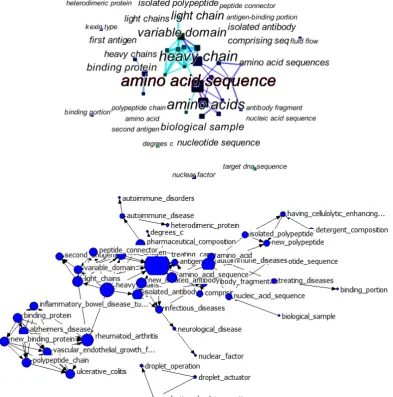
[image:8.595.167.541.353.710.2]When conducting text analysis, this paper used co-words analysis program Citespace. By the means of extracting the keywords from abstracts, 37 keywords were extracted from the basic patent (Figure 2). Because the software unable to
DOI: 10.4236/ajibm.2018.83050 743 American Journal of Industrial and Business Management
Figure 2. Co-occurrence network of keywords.
DOI: 10.4236/ajibm.2018.83050 744 American Journal of Industrial and Business Management
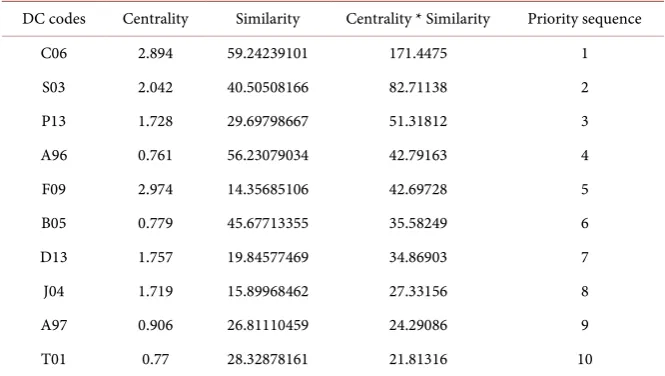
Table 1. Centralities, similarities and products of DC codes in biotechnology industry.
DC codes Centrality Similarity Centrality * Similarity Priority sequence C06 2.894 59.24239101 171.4475 1
S03 2.042 40.50508166 82.71138 2 P13 1.728 29.69798667 51.31812 3 A96 0.761 56.23079034 42.79163 4 F09 2.974 14.35685106 42.69728 5 B05 0.779 45.67713355 35.58249 6 D13 1.757 19.84577469 34.86903 7 J04 1.719 15.89968462 27.33156 8 A97 0.906 26.81110459 24.29086 9 T01 0.77 28.32878161 21.81316 10
J04, A97, T011. The centralities, similarities and products are shown in Table 1.
6. Conclusions and Recommendations
This paper introduces a network analysis that integrated citation analysis and text mining. The paper also puts forward a method which is able to identify in-dustrial generic technologies reversely by observing the sharing of proprietary technology to generic technologies from the top of technology tree, in order to pinpoint generic technologies with market conditions and those still need to be studied, moreover, to provide a scientific evaluation method for government in-tervention in the diffusion of generic technologies.
The empirical results of biotechnology industry show that, although generic technologies with high centrality are located at core position of technical plat-form, it’s weak in technology diffusion. The main reason leading to this pheno-menon is due to the market failure in the process of fundamental generic tech-nologies diffusion. Technical recipient still needs to do a lot of secondary devel-opment work, which lead to the diffusion of technology licensing, technology transfer and others are limited under market mechanisms. In addition, the diffu-sion channels of generic technologies are diversified and multi-layered. Different combinations at all levels will produce diverse effects of proliferation, thus makes spread of generic technologies becoming more complicated. On the other hand, according to the empirical results, some of generic technologies have low generic-technology centralities but strong proprietary-technology support. It is largely results from the market failure in applied generic technology. Once the property rights and legal protection system is not perfect or not implemented,
1C06: biotechnology, plant genetics, veterinary vaccines; S03: scientific instrumentation, photometry,
DOI: 10.4236/ajibm.2018.83050 745 American Journal of Industrial and Business Management suppliers chose to block the technology in case technology innovations being spread excessively for free.
On the basis of the problems we found, this paper provides following sugges-tions:
First of all, China should perfect the technology sharing mechanism. By com-pleting intermediary services, strengthening infrastructure construction and overcoming the drawbacks of information asymmetry in the diffusion mechan-ism, thereby promoting the diffusion and sharing of generic technologies among industries and regions. In addition, R & D supply of generic technologies re-quires input from other resources. Therefore, in accordance with the require-ments of the level of investment in technology in innovative countries, the gov-ernment should increase its financial support and establish a special fund to support China’s plans of action on basic generic technologies.
Secondly, generic-technology platform is a breakthrough for its development. The government should strengthen its leading force in the R & D process of ge-neric technologies in order to build a platform system for innovation as well as to intensify the relationship among institutions, universities and enterprises. Furthermore, the government should actively guide the platform to devote itself to innovation on industrial generic technologies along with providing gener-ic-technology support for the development of proprietary technology, so that to ensure the effective operation of industrial generic-technology innovation system.
References
[1] Slayton, R. and Spinardi, G. (2016) Radical Innovation in Scaling up: Boeing’s Dreamliner and the Challenge of Socio-Technical Transitions. Technovation, 47, 47-58. https://doi.org/10.1016/j.technovation.2015.08.004
[2] Tassey, G. (2004) Underinvestment in Public Good Technologies. Journal of Tech-nology Transfer, 30, 89-113. https://doi.org/10.1007/s10961-004-4360-0
[3] Li, J.Z. (2006) Industrial Generic Technology: Concept, Category and System Supply. Forum on Science and Technology in China, 3, 45-47.
[4] Xu, D. and Xu, F. (2010) Research on the Method of Defining and Selecting Indus-trial Generic Technology: From the View of Management of S & T Programs. China Soft Science, 4, 73-79.
[5] Zhao, H., Li, J. and Wei, H.Z. (2015) The Innovation Mode of Generic Technology in the Industry Cluster: From the Perspective of Enterprise Contribution. Science Research Management, 36, 53-59.
[6] Cao, L.C. and Yang, S.L. (2005) Research on the Construction of Industrial Generic Technology Innovation System. China Soft Science, 11, 77-82.
[7] Ardito, L., Petruzzelli, A.M. and Albino, V. (2015) From Technological Inventions to New Products: A Systematic Review and Research Agenda of the Main Enabling Factors. European Management Review, 12, 113-147.
https://doi.org/10.1111/emre.12047
DOI: 10.4236/ajibm.2018.83050 746 American Journal of Industrial and Business Management [9] Gambardella, A. and Giarratana, M.S. (2013) General Technological Capabilities, Product Market Fragmentation, and Markets for Technology. Research Policy, 42, 315-325. https://doi.org/10.1016/j.respol.2012.08.002
[10] Maine, E. and Garnsey, E. (2006) Commercializing Generic Technology: The Case of Advanced Materials Ventures. Research Policy, 35, 375-393.
https://doi.org/10.1016/j.respol.2005.12.006
[11] Cogez, P., Kokshagina, O., Masson, P.L., et al. (2015) Industry-Wide Technology Road Mapping in Double Unknown—The Case of the Semiconductor Industry. IEEE International Conference on Engineering, Technology and Innovation, Jun 2013, The Hague, 1-13.
[12] Li, J.Z. (2011) Supply and Diffusion Model Selection of Generic Technology. Science of Science and Management of S. & T., 32, 5-12.
[13] Bresnahan, T.F. and Trajtenberg, M. (1995) General Purpose Technologies “Engines of Growth”? Journal of Econometrics, 65, 83-108.
https://doi.org/10.1016/0304-4076(94)01598-T
[14] Baykara, T., Özbek, S. and Ceranoğlu, A.N. (2015) A Generic Transformation of Advanced Materials Technologies: Towards More Integrated Multi-Materials Sys-tems via Customized R & D and Innovation. Journal of High Technology Manage-ment Research, 26, 77-87. https://doi.org/10.1016/j.hitech.2015.04.008
[15] Tassey, G. (2008) Modeling and Measuring the Economic Roles of Technology In-frastructure. Economics of Innovation & New Technology, 17, 615-629.
https://doi.org/10.1080/10438590701785439
[16] Datta, A., Mukherjee, D. and Jessup, L. (2015) Understanding Commercialization of Technological Innovation: Taking Stock and Moving Forward. R & D Management, 45, 215–249. https://doi.org/10.1111/radm.12068
[17] Li, Q., Maggitti, P.G., Smith, K.G., et al. (2013) Top Management Attention to In-novation: The Role of Search Selection and Intensity in New Product Introductions. Academy of Management Journal, 56, 893-916.
https://doi.org/10.5465/amj.2010.0844
[18] Maine, E. (2015) Scientist-Entrepreneurs as the Catalysts of Nanotechnology Com-mercialization. Social Science Electronic Publishing, 2, 301-308.
[19] Capozzi, M.M., Gregg, B. and Howe, A. (2010) Innovation and Commercialization, 2010: McKinsey Global Survey Results. McKinsey Co., New York.
[20] Philibert, C. (2006) Barriers to Technology Diffusion: The Case of Solar Thermal Technologies. IEA, Paris.
[21] Taebi, B., Correljé, A., Cuppen, E., et al. (2014) Responsible Innovation as an En-dorsement of Public Values: The Need for Interdisciplinary Research. Journal of Responsible Innovation, 1, 118-124. https://doi.org/10.1080/23299460.2014.882072 [22] Luan, C.J. (2015) Generic Technology Measurement System and Application.