A Review of Link Layer Protocols for Internet of Things
Raja Abdelmoumen
Higher Institute of Technological Studies of Sousse ISET of Sousse, Tunisia
ABSTRACT
Internet of Things (IoT) consists of smart objects that communicate together, collect and exchange data. IoT has now a wide range of domain applications such as industry, logistics, healthcare, smart environment, as well as personal, social gaming robot, and smart city. The characteristics required by applications, such as coverage area, transmission data rate, and applicability, refer to the link layer designs of protocols. This paper presents a study of proposed link layer protocols that are used in IoT grouped by short and long distance coverage. For short range protocols, this article study the following: Radio Frequency Identification (RFID), Near Field Communication (NFC), Bluetooth Low Energy (BLE), Low-Rate Wireless Personal Area Networks (LR-WPANs), Z-Wave and IEEE 802.11 a/b/g/n/ah. For the long range protocols, Narrow Band IoT (NB-IoT), Long Term Evolution (LTE), Long Range Protocol (LoRa), and SigFox protocols are considered. A comparative study is performed for each group of protocols, considering their characteristics in order to provide a guideline for researchers and application developers to select the right communication protocol for different applications.
General Terms
Internet and Distributed Computer Systems, Computer Networks, Communication Protocols.
Keywords
IoT, communication protocols, short range protocols, long range protocols, RFID, NFC, BLE, LR-WPANs, Z-Wave, IEEE 802.11 ah, NB-IoT, LTE/LTE-A, LoRaWAN, Sigfox.
1.
INTRODUCTION
With an accelerated rate, a large number of physical objects are being connected to the Internet realizing the concept of the Internet of Things (IoT) [1][2]. Physical objects are smart and they can connect, transfer information and make decisions on behalf of the people. This new technology is called connectivity for anything and it can connect anywhere, anytime and anything.
IoT communication technologies connect heterogeneous objects to provide specific smart services. Typically, IoT applications include transport tracking, smart healthcare, industrial automation, smart city and emergency. To provide specific smart services, IoT objects should operate in different environments with many constraints. Processing capability, lossy and noisy communication links and low power are among these constraints. Therefore, the IoT implementation requires communication protocols that can efficiently manage these constraints [3], [4], [5].
This article reviews and compares IoT link layer protocols in order to provide a guideline for researchers and application developers to select the right communication protocol without having to go through RFCs and the standard specifications. Indeed, features such as range, date rate, power consumption, license and security are important issues in the definition or the choice of a certain technology for a particular solution. In
this study, link layer protocols are classified into two groups defined according to their range coverage: short and long range following the work in [6].
The rest of this paper is organized as follows. Section 2 expands a study of short range link layer protocols. A study of long range link layer protocols is presented in Section 3. Section 4 gives a comparison about short and long range IoT link layer protocols arising from their main characteristics. Finally, Section 5 concludes this study.
2.
SHORT RANGE LINK LAYER
PROTOCOLS
2.1
RFID
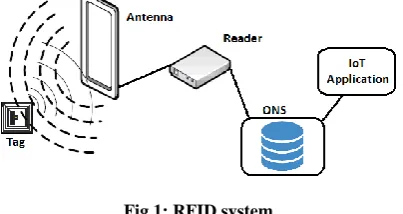
[image:1.595.329.531.449.556.2]RFID (Radio Frequency Identification) is a radio frequency identification technology that allows identifying objects when they pass near a detector (antenna, terminal, smartphone, tablet, etc.). An RFID system is basically composed of two types of devices: the identified devices called RFID tags and the device identifiers or readers. The RFID reader transmits a query signal to the tag and receives a reflected signal which in turn is passed to a specific computer application called the Object-Naming Services (ONS) as is shown in Figure 1. An ONS looks up the tag details from a database to identify objects based on the reflected signals within a 10 cm to 200 m range [7].
Fig 1: RFID system
Different classifications of RFID systems can be made according to the operating frequency, radio interface, communication range or tag autonomy (completely passive, semi-passive, and active).
There are two types of RFID standards: standards that manage communications between tags, readers and information systems and standards that manage the coding of information in the tag memory. There are two international organizations that are working on these standards: the joint ISO / IEC working group and GS1 Global. These independent organizations work together and published standards are fully compatible. The main standards produced are ISO/IEC 15961, ISO/IEC 18000, ISO/IEC22000, etc.
2.2
NFC
NFC (Near Field Communication) is based on the ISO/IEC 18092:2004 standard and this technology is created on the RFID to enable a short-range communication (no more than some centimeters). While NFC uses similar technology principles in RFID, it is not only used for identification but also for more elaborate two-way communication [9].
Each NFC tag has a unique identifier and can contain small amount of data. This tag can be read only (similar to RFID tags for identification purposes) or can be changed later by the device .There are three main operating modes for NFC: card emulation mode (passive mode), reader/writer mode (active mode) and peer-to peer mode. NFC technology is extensively used in mobile phones, industrial applications and contactless payment systems. In the same way, NFC makes it easier to connect, commission, and control IoT devices in different environments like home, factory and the work.
2.3
BLE
BLE (Bluetooth Low-Energy) called also Bluetooth Smart, is a communication technology for short distances using short-wavelength radio with a minimal amount of power. Bluetooth SIG (Special Interest Group) proposed BLE in the Bluetooth 4.0 specification to enable collecting data from devices (sensors) which generate data at a very low rate. Its coverage range (about 100 meters) is ten times that of the classic Bluetooth while its latency is 15 times shorter [10]. Previous studies, such as [11], [12], [13], and [14] have presented some of BLE functionalities with the conclusion of being a good option for some IoT case studies. IETF 6LoWPAN WG developed specification (RFC7668) that enables transmission IPv6 packets over BLE [15] that empowered the IoT capabilities of this technology. New version Bluetooth 5 focuses on improvement of speed, range, security, energy efficiency, location- based functionalities, interoperability and coexistence with other technologies. It brings some major advances in the technology to make it a key enabler of IoT.
2.4
LR-WPANs
LR-WPANs refers to Low-Rate Wireless Personal Area Networks. The IEEE 802.15.4 standard [16] specifies both a physical layer, and a medium access control for LR-WPANs. Due to its specifications such as low power consumption, low data rate, low cost, and high message throughput, it is also utilized by the IoT, M2M, and WSNs. It provides a reliable communication, operability on different platforms, and can handle a large number of nodes (about 65 000). It also provides a high level of security, encryption and authentication services. However, it does not provide QoS guarantees.
Topologies of IEEE 802.15.4 networks are star, peer-to-peer (mesh), and cluster-tree. The star topology contains at least one FFD (Full Function Device) and some RFDs (Reduced Function Device). The FFD who works as a PAN coordinator should be located at the center of topology and aims to manage and control all the other nodes in the network. The peer-to-peer topology contains a PAN coordinator and other nodes communicate with each other in the same network or through intermediate nodes to other networks. A cluster-tree topology is a special case of the peer-to-peer topology and consists of a PAN coordinator, a cluster head and normal nodes.
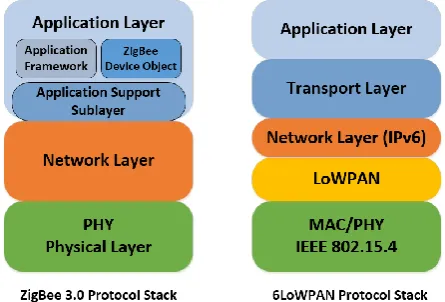
Both ZigBee [17] and 6LoWPAN [18] protocols uses IEEE 802.15.4 as physical and medium access control layers and
[image:2.595.319.542.101.252.2]build a complete network protocol stack for WSNs. Figure 2 shows 6LowPAN and ZigBee protocol stack.
Fig 2: ZigBee and 6LowPAN protocol stack
2.5
Z-Wave
Z-Wave is a low power wireless protocol operating in the ISM (Industrial, Scientific and Medical) bands (around 900 MHz).
Z-Wave is designed for battery or electrically powered devices and widely used for Home Automation Networks (HAN) as well as small-size commercial domains. This protocol is a proprietary standard based on the ITU G.9959 specification [19].
Z-Wave covers about 30 meter point-to-point communication and is specified for applications that need tiny data transmission (about 40 kbps) like light control, household appliance control, smart energy, access control, wearable health care control, and fire detection [20]. This protocol was initially developed by ZenSys (currently Sigma Designs) and later was employed and improved by Z-Wave Alliance [21].
In the architecture of Z-Wave, there are controller and slave nodes. Controllers manage the slaves by sending commands to them. Z-Wave devices are arranged in mesh network topology. They can send and receive messages from any device that is connected to the network [22].
2.6
IEEE 802.11 a/b/g/n/ah
IEEE 802.11 is certainly the most exploited standards for WLAN (Wireless Local Area Network) mostly known as Wi-Fi (Wireless Wi-Fidelity). IEEE 802.11 is set of MAC and PHY specifications.
802.11a standard is published in 1999. It allows a theoretical throughput of 54 Mbps and a real throughput of 27 Mbps within a radius of approximately 10 meters.
The 802.11b standard was the most widespread Wi-Fi standard installed since the early 2000s. It offers a theoretical peak throughput of 11 Mbps (6 Mbps real) with a range of up to 300 meters (in theory) in an open environment.
Published in 2003, the 802.11g standard provides a higher throughput (54 Mbps theoretical and 25 Mbps real). 802.11g is compatible with 802.11b11. This ability allows equipment to offer 802.11g while remaining compatible with existing 802.11b networks.
frequency band, IEEE 802.11b and IEEE 802.11g for the 2.4 GHz frequency band.
IEEE 802.11ah standard [23], ratified in May 2017. 802.11ah also called Low-Power Wi-Fi specifies a throughput up to 4 Mbit/s in the ISM frequency band of 900 MHz. This new standard supports a wide range of IoT applications while being able to provide more energy efficiency, QoS, scalability (a large number of devices) and cost-effective solutions [24] [25].
3.
LONG RANGE LINK LAYER
PROTOCOLS
3.1
Nb-IoT
NB-IoT (Narrow Band Internet of Things) is a cost, low-power, wide-area cellular connectivity for the Internet of Things [26]. NB-IoT is developed by 3GPP (3rd Generation Partnership Project) to enable a wide range of cellular devices and services [27]. The 3GPP Rel-13, published in June 2016, introduces NB-IoT. This system, based on Long Term Evolution (LTE) technology, supports most LTE functionalities, although with essential simplifications to reduce device complexity. Further optimizations to increase coverage, reduce overhead and reduce power consumption while increasing capacity have been introduced as well. The design objectives of NB-IoT include low complexity devices, high coverage, long device battery life, and massive capacity. Latency is relaxed although a delay budget of 10 seconds is the target for exception reports [28].
3.2
LTE/LTE-A
LTE (Long-Term Evolution) is a standard wireless communication for high-speed data transfer between mobile phones based on GSM/UMTS network technologies [29]. It can cover fast travelling devices and provide multicasting and broadcasting services. LTE-A (LTE Advanced) [30] is an improved version of LTE, including bandwidth extension, which supports up to 100 MHz, downlink and uplink spatial multiplexing, extended coverage, higher throughput and lower latencies. LTE-A encompasses a set of cellular communication protocols that fit well for Machine-Type Communications (MTC) and IoT infrastructures, especially for smart cities where long term durability of infrastructure is expected [31]. Moreover, it outperforms other cellular solutions in terms of service cost and scalability. At the physical layer, LTE-A uses orthogonal frequency division multiple access (OFDMA) by which the channel bandwidth is partitioned into smaller bands called physical resource blocks (PRB).
3.3
LoRa/LoRaWAN
LoRa (Long Range) is a long-range wireless communications system, promoted by the LoRa Alliance. This system aims at being used in long-lived battery-powered devices, where the energy consumption is of paramount importance [32]. LoRa refers to two distinct layers:
• A physical layer using the Chirp Spread Spectrum (CSS) [33] radio modulation technique
• A MAC layer protocol LoRaWAN (Long Range Wide-Area Network) [34].
The LoRa physical layer, developed by Semtech, allows for long-range, low-power and low-throughput communications
[35]. It operates on the 433MHz, 868MHz or 915MHz ISM bands, depending on the region in which it is deployed. The payload of each transmission can range from 2–255 octets, and the data rate can reach up to 50 Kbps when channel aggregation is employed. The modulation technique is a proprietary technology from Semtech.
LoRaWAN provides a medium access control mechanism, enabling many end devices to communicate with a gateway using the LoRa modulation. While the LoRa modulation is proprietary, the LoRaWAN is an open standard being developed by the LoRa Alliance.
[image:3.595.318.538.267.361.2]The LoRaWAN specification defines three device types: class A, class B and class C. All LoRaWAN devices must implement Class A, whereas Class B and Class C are extensions to the specification of Class A devices. Figure 3 presents a representation of LoRa and LoRaWAN protocol stacks as given in [6].
Figure 3. LoRa and LoRaWAN protocol stack [6]
3.4
Sigfox
Sigfox is a french telecommunications operator of the Internet of Things created in 2009 [36]. Sigfox operates in the 868-MHz frequency band, with the spectrum divided into 400 channels of 100 Hz. Each end-device can send up to 140 messages per day, with a payload size of 12 octets, at a data rate up to 100 bps. Sigfox claims that each access point can handle up to a million end-devices, with a coverage area of 30–50 km in rural areas and 3–10 km in urban areas.
SigFox protocol stack is composed of three main layers: Frame, MAC and Physical layers. Figure 4 depicts the comparison between SigFox and the OSI reference model.
[image:3.595.324.532.526.677.2]RFID NFC BLE LR-WPANs Z-Wave IEEE 802.11 ah
Standard
ISO/IEC 15961,18000,
22000
ISO/IEC 14443, 18092
IEEE
802.15.1 IEEE 802.15.4
ITU G.9959 IEEE 802.11 ah
Frequency band
LF: 120-150 kHz HF: 13.56 MHz UHF: 433 MHz ISM EU: 865-868
MHz ISM NA: 902
-928 MHz SHF: 2.45 - 5.8
GHz ULB: 3.1-10 GHz
13.56 MHz 2.4 GHz
EU: 868 MHz NA: 915MHz Global : 2.4GHz
EU: 868 MHz
NA: 908 MHz 900 MHz
Data rate 4 Mb/s
106 Kb/s or 212 Kb/s or 424 Kb/s
1 Mb/s 250 kb/s 9 -40 kb/s 4 Mb/s
Range Up to 200m 0-10 cm 100 m
(outdoors) 10-100m
30m (indoors)
100m (outdoors) 100m
Transmission
power 1.5 mW 23 dBm 0-10 dBm 0-20dBm 0 dBm
<10 mW - <1W (local regulations)
Transmission Technique
Proximity Field Modulation Induced Pulse
ASK GFSK FHSS Star
O-QPSK GFSK BPSK
FSK GFSK
BPSK, QPSK, 16-QAM, 64-QAM, 256-QAM, OFDM
Topology
Point to Point Point to Multipoint
Peer-to-Peer Star – Bus
Network Mesh Mesh Star
Packet length 16-64 Kb Variable 8 to 47
bytes 100 bytes 255 bits 100 bytes
Security
Clandestine Tracking and Inventorying EPC
Discovery Service
Encryption Cryptographic, Secure Channel, Key Agreements
AES-128 AES-128 AES-128 WPA
Common Applications
Tracking, Identification,
Human Implantation
Payment, Healthcare,
Smart Environment, Mobile Ticketing
and loyalty
Multimedia data exchange
between nearby
nodes
Home and industry monitoring and
controlling
Automation in residential and light commercial
M2M, V2V applications and smart
[image:5.595.55.542.70.158.2]grids
Fig 5: Comparison of the short range protocols
4.
COMPARISON BETWEEN LINK
LAYER PROTOCOLS FOR IOT
This section presents a comparison of link layer protocols studied in this review considering both groups, defined according to their range coverage: short and long range. This comparison can provide a guideline for researchers and application developers to select the right communication protocol without having to go through RFCs and the standard specifications.
4.1
Short Range Link Protocols
Different criteria are used to compare the studied link layer protocols. Such criteria include standard, frequency band, data rate, range, transmission technique, topology, packet length, power consumption, security, license and common applications. Figure 5 presents a comparison of short range protocols studied in this review.
In terms of security, all the six short range link protocols perform the encryption and authentication mechanisms. BLE, LR-WAN, NFC and Z-Wave use the Advanced Encryption Standard (AES), which is extremely secure. RFID uses RC4 (Rivest Cipher 4) which is very fast compared to AES but not secure enough. IEEE 802.11ah uses the WPA (Wi-Fi Protected Access) which is the common security standard for Wi-Fi protocols. In terms of data rate, NFC, BLE, LR-WPANs and Z-Wave have a data rate less than 1 Mbps. However, RFID and IEEE 802.11 ah have the highest data rate of 4 Mbps. Although the offered date rate of all presented protocols is reduced, but it remains sufficient in the context of the IoT object communication.
In terms of power consumption, since BLE, LR-WPANs, Z-Wave and IEEE 802.11ah are designed for mobile devices and limited battery power, they offer low power consumption. RFID and NFC protocols provide low power consumption.
4.2
Long Range Link Protocols
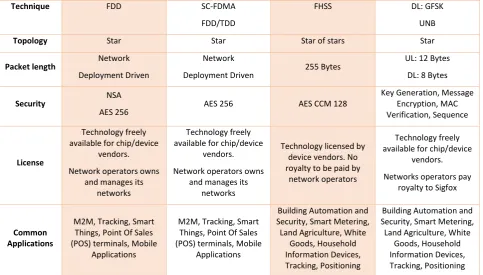
The comparison of long range link protocols involves the same criteria used for short protocols. Figure 6 presents a comparison of long range protocols studied in this review.
In terms of security, all the four long range protocols perform the encryption through AES and authentication mechanisms.
In terms of data rate, all the four studied protocols operate under a data rate of 1 Mbps. This low date rate is sufficient in the context of the IoT object communication.
In terms of power consumption, NB-IoT and LTE-A use a transmission power equal to 23 dBm while the transmission power of LoRaWAN and Sigfox depends on the region. In Europe, LoRaWAN operates at 13 dBm and Sigfox at 14dBm. The power transmission is higher in the United States, where a value of 22 dBm is required for Sigfox and 20dBm for LoRaWAN. All transmission powers of the studied protocols are low and adapted to the IoT devices.
5.
CONCLUSION
Many link layer protocols are proposed for IoT and each one has its specifications, its advantages and its cons. But, it is quite hard to conclude which one is perfect. Hence, the question that someone needs to answer is which protocol is the best one for my application. In this context, this article reviews and compares the common communication protocols proposed in the literature for IoT.
Different criteria are used to make the comparison between link layer protocols such as standard, frequency band, data rate, coverage range, transmission technique, topology, packet length, power consumption, security, license and common applications.
In the future work, this study can be extended to review IoT application protocols and IoT security mechanisms.
NB-IoT LTE/LTE-A LoRaWAN Sigfox
Standard 3GPP 3GPP LoRaWAN Sigfox
Frequency
band Licensed Licensed
EU : 868 MHz
US : 433/915 MHz
AS : 430 MHz
EU : 868 MHz
US : 902 MHz
Data rate DL: 234.7 kb/s
UL: 204.8 kb/s DL /UL : 1 Mb/s 100 kb/s
UL : 100 bps
DL: 600 bps
Range 20 km 5 km 5 km (urban)
15 km LOS
10 Km (Urban)
50 Km (Rural)
Transmission
power 23 dBm 23 dBm
EU: 13 dBm
US: 20 dBm
EU:14 dBm
US: 22 dBm
Technique FDD SC-FDMA
FDD/TDD
FHSS DL: GFSK
UNB
Topology Star Star Star of stars Star
Packet length Network
Deployment Driven
Network
Deployment Driven 255 Bytes
UL: 12 Bytes
DL: 8 Bytes
Security NSA
AES 256 AES 256 AES CCM 128
Key Generation, Message Encryption, MAC Verification, Sequence
License
Technology freely available for chip/device
vendors.
Network operators owns and manages its
networks
Technology freely available for chip/device
vendors.
Network operators owns and manages its
networks
Technology licensed by device vendors. No royalty to be paid by
network operators
Technology freely available for chip/device
vendors.
Networks operators pay royalty to Sigfox
Common Applications
M2M, Tracking, Smart Things, Point Of Sales (POS) terminals, Mobile
Applications
M2M, Tracking, Smart Things, Point Of Sales (POS) terminals, Mobile
Applications
Building Automation and Security, Smart Metering, Land Agriculture, White
Goods, Household Information Devices, Tracking, Positioning
Building Automation and Security, Smart Metering, Land Agriculture, White
[image:6.595.50.534.72.347.2]Goods, Household Information Devices, Tracking, Positioning
Fig 6: Comparison of the long range protocols
6.
REFERENCES
[1] Al-Sarawi, A., Anbar, M., Alieyan, K., Alzubaidi, A., 2017 Internet of Things (IoT) communication protocols: Review. 2017 8th International Conference on Information Technology (ICIT), Amman, 2017, pp. 685-690.
[2] Al-Fuqaha, A.,Guizani, M.,Mohammadi, M.,Aledhari, M., Ayyash, M., 2015 Internet of Things: A Survey on Enabling Technologies, Protocols, and Applications. IEEE Communications Surveys & Tutorials, Volume 17, Issue 4, Fourth Quarter 2015, pp. 2347-2376.
[3] Tan, L., Wang, N., 2010. Future internet: The Internet of Things. 2010 3rd International Conference on Advanced Computer Theory and Engineering (ICACTE), Chengdu, 2010, pp. V5-376-V5-380.
[4] Colakovic, A., Hadzialic, M., 2018. Internet of Things (IoT): A review of enabling technologies, challenges, and open research issues. Computer Networks, Volume 144, 24 October 2018, pp. 17-39.
[5] Haroon, A., Shah, M.A., Asim, Y., Naeem, W., Kamran, M., Javaid, Q., 2016. Constraints in the IoT: the world in 2020 and beyond. (IJACSA) International Journal of Advanced Computer Science and Applications, Vol. 7, No. 11, pp. 252-271.
[6] Oliveira, L., Rodrigues, J.J.P.C., Kozlov, S.A., Rabêlo, R.A.L., Albuquerque, V.H.C., 2019 MAC Layer Protocols for Internet of Things: A Survey. Future Internet 2019, 11, 16.
[7] Want, R., 2006. An introduction to RFID technology. IEEE Pervasive Computing, Volume 5, Issue 1, Jan.-Mar. 2006, pp. 25-33.
[8] Roy, S., Jandhyala, V., Smith, J.R., Wetherall, D.J., Otis, B.P., Chakraborty, R.,Buettner, M.,Yeager, D.J., Ko, Y.C., Sample, A.P., 2010. RFID: From Supply Chains to
Sensor Nets. Proceedings of the IEEE, Volume 98, Issue 9 , Sept. 2010, pp. 1583–1592.
[9] Coskun, V., Ozdenizci, B., and Ok, K., 2013. A Survey on Near Field Communication (NFC) Technology. Wireless Personal Communications, Aug. 2013, Volume 71, Issue 3, pp. 2259–2294.
[10] Frank, R., Bronzi, W., Castignani G.,Engel, T., 2014 Bluetooth low energy: An alternative technology for VANET applications. 2014 11th Annual Conference on Wireless On-demand Network Systems and Services (WONS), Obergurgl, 2014, pp. 104-107.
[11] Raza, S., Misra, P., He, Z., Voigt, T., 2015. Bluetooth smart: an enabling technology for the Internet of Things. 2015 IEEE 11th International Conference on Wireless and Mobile Computing, Networking and Communications (WiMob), Abu Dhabi, Oct. 2015, pp. 155-162.
[12] DeCuir, J., 2014. Introducing Bluetooth Smart: Part 1: A look at both classic and new technologies. IEEE Consumer Electronics Magazine, Volume 3, Issue 1, Jan. 2014, pp. 12-18.
[13] Mackensen, E.,Lai, M.,Wendt, T. M., 2012. Bluetooth Low Energy (BLE) based wire-less sensors. Sensors, 2012 IEEE, Taipei, Oct. 2012, pp. 1–4.
[14] Al Kalaa, M.O.,Balid, W.,Bitar, N.,Refai, H.H., 2016. Evaluating Bluetooth Low Energy in realistic wireless environments. 2016 IEEE Wireless Communications and Networking Conference, Doha, Apr. 2016, pp. 1-6.
[16]IEEE Std 802.15.4, IEEE Standard for Local and metropolitan area networks—Part 15.4: Low-Rate Wireless Personal Area Networks (LR-WPANs). IEEE Standard, Sep. 2011. Available online:
https://standards.ieee.org/content/ieee-standards/en/standard/802_15_4-2011.html (Accessed on 20 February 2019)
[17]ZIGBEE SPECIFICATION, 2012, Available online: https://www.zigbee.org/download/standards-zigbee-specification/ (Accessed on 20 February 2019)
[18]Kushalnagar, N., Montenegro, G.,Schumacher, C, 2007. IPv6 over Low-Power Wireless Personal Area Networks (6LoWPANs): Overview, Assumptions, Problem Statement, and Goals. RFC4919. IETF Aug 2007. Available online: https://tools.ietf.org/html/rfc4919 (Accessed on 20 February 2019)
[19]ITU T-REC-G.9959: Short Range Narrow-Band Digital Radiocommunication Transceivers—PHY, MAC, SAR and LLC Layer Specifications. Available online: http://www.itu.int/rec/T-REC-G.9959-201501-I
(Accessed on 20 February 2019).
[20]Gomez, C., Paradells, J., 2010. Wireless home automation networks: A survey of architectures and technologies. IEEE Communications Magazine, Volume 48, Issue 6, Jun. 2010, pp 92-101.
[21] Z-Wave Alliance—Home Management. Available online: https://z-wavealliance.org/home-management/ (Accessed on 20 February 2019).
[22]Yassein, M.B., Mardini,W., Khalil, A., 2016. Smart homes automation using Z-wave protocol. 2016 International Conference on Engineering & MIS (ICEMIS), Agadir, Morocco, Sept. 2016, pp. 1–6.
[23]IEEE 802.11ah-2016, IEEE Standard for Information technology--Telecommunications and information exchange between systems - Local and metropolitan area networks--Specific requirements - Part 11: Wireless LAN Medium Access Control (MAC) and Physical Layer (PHY) Specifications Amendment 2: Sub 1 GHz License Exempt Operation. IEEE Standard, May 2017. Availableonline:https://standards.ieee.org/standard/802_ 11ah-2016.html (Accessed on 20 February 2019)
[24]Adame, T., Bel, A., Bellalta, B., Barcelo, J. , Oliver, M., 2014. IEEE 802.11AH: the WiFi approach for M2M communications, IEEE Wireless Communications, Volume 21, Issue 6, Dec. 2014, pp. 144-152.
[25]Khorov, E., Krotov A.,Lyakhov, A., 2015. Modelling machine type communication in IEEE 802.11ah networks. 2015 IEEE International Conference on
Communication Workshop (ICCW), London, Jun 2015, pp. 1149-1154.
[26] Ratasuk, R., Vejlgaard, B., Mangalvedhe, N., Ghosh, A., 2016. NB-IoT system for M2M communication. 2016 IEEE Wireless Communications and Networking Conference Workshops (WCNCW), Doha, Apr. 2016, pp. 428-432.
[27] Gozalvez, J., 2016. New 3GPP Standard for IoT [Mobile Radio]. IEEE Vehicular Technology Magazine, Volume 11, Issue 1, , Mar. 2016, pp. 14-20.
[28] Ratasuk, R., Mangalvedhe, N., Zhang, Y., Robert, M., Koskinen, J.P., 2016. Overview of narrowband IoT in LTE Rel-13. 2016 IEEE Conference on Standards for Communications and Networking (CSCN), Berlin, Oct. 2016, pp. 1-7.
[29] Crosby, G. V., Vafa, F., 2013. Wireless sensor networks and LTE-A network convergence. 38th Annual IEEE Conference on Local Computer Networks, Sydney, NSW, 2013, pp. 731-734.
[30] Ghosh, A., Ratasuk, R., Mondal, B., Mangalvedhe, N., Thomas T., 2010. LTE-Advanced: Next-generation wireless broadband technology [Invited Paper]. IEEE Wireless Communications, Volume 17, Issue 3, Jun. 2010, pp. 10-22.
[31] Hasan, M., Hossain, E., Niyato, D., 2013. Random access for machine-to-machine communication in LTE-Advanced networks: Issues and approaches. IEEE Communications Magazine, Volume 51, Issue 6, Jun. 2013, pp. 86-93.
[32] Augustin, A., Yi, J., Clausen, T., Townsley, W. M., 2016. A Study of LoRa: Long Range & Low Power Networks for the Internet of Things. Sensors 2016, 16, 1466.
[33] Reynders, B., S., Pollin, 2016. Chirp spread spectrum as a modulation technique for long range communication. 2016 Symposium on Communications and Vehicular Technologies (SCVT), Mons, Belgium, 2016, pp. 1-5.
[34] LoRaWAN TM Specification , November 2015. Available online: https://lora-alliance.org/about-lorawan (Accessed on 20 February 2019)
[35] Semtech Acquires Wireless Long Range IP Provider Cycleo. 7 March 2012. Available online: https://investors.semtech.com/news-releases/news- release-details/semtech-acquires-wireless-longrange-ip-provider-cycleo (Accessed on 20 February 2019).
![Figure 3. LoRa and LoRaWAN protocol stack [6]](https://thumb-us.123doks.com/thumbv2/123dok_us/9294008.426339/3.595.324.532.526.677/figure-lora-lorawan-protocol-stack.webp)