1
Amazonian Struggles for Recognition
James Angus Fraser,
Lancaster Environment Centre, Lancaster University, Lancaster, United Kingdom, LA1 4YQ
office: 01524 592196, [email protected]
Abstract:
Since the 1988 Constitution, forest peoples of Brazilian Amazonia have been struggling for territorial recognition. Yet studies of recognition in post-colonial contexts, based on cases with clear settler/indigenous distinctions, are highly critical of recognition, seeing it as a form of ‘neoliberal multiculturalism,’ a co-option of subaltern identities with limited emancipatory potential. I question these critiques by examining struggles for legal and intersubjective recognition of subaltern identity categories ‘Índio’ and ‘Agroextractivista’ and corresponding territories of the ‘Terra Indigena’ and ‘Reserva Extractivista’ on the Madeira and Tapajós Rivers in Brazilian Amazonia, where heterogeneous origins of forest peoples belie simple settler/indigenous distinctions. I engage a key question–the relationships of subaltern peoples with state institutions, and highlight a finding – the relevance of the state’s ‘proximity’ - often underestimated in the literature. I build a theory of decolonial recognition combining Axel Honneth’s idea of recognition as love, rights and solidarity with David Scott’s late-Foucauldian reworking of Frantz Fanon. Herein, the Fanonian colonized subjectivity is shaped by the negation of love, rights and solidarity, that is to say,
misrecognition. The subject requires legal and intersubjective recognition in order to
positively incorporate love, rights and solidarity into their ‘practices of techniques of the self.’ On the Tapajos, territorial struggles are more successful owing to a stronger sphere of legal recognition - the presence of state institutions - and a history of Church and union grassroots organisation, both supporting greater intersubjective recognition among forest peoples. On the Madeira, a much weaker sphere of legal recognition has resulted in a situation of intractable conflict around territorial struggles which have correspondingly less intersubjective recognition. I conclude that a theory of decolonial recognition is of considerable utility in elucidating the dynamics of subaltern emancipatory struggles for territory.
2 Introduction
In response to the 1988 Constitution and subsequent laws that formalized their land
rights, many of the heterogeneous forest peoples of Brazilian Amazonia - composed
from Native Amazonian, European and African heritages - are engaging in different
kinds of “forest citizenship” through struggles for the recognition of their territories
(Hecht, 2011 ; Gonçalves, 2001). Yet studies of postcolonial recognition, usually
based on cases where there is a clear settler/indigenous distinction (Coulthard, 2014
; Povinelli, 2002 ; Simpson, 2014), have been highly critical of recognition, often
seeing it as a form of so-called ‘neoliberal multiculturalism’ (Hale, 2002), entailing a
superficial re-valorisation or even co-option of subaltern identities with limited
emancipatory potential. This, I contend, has left the potentialities for a decolonial1
theory of recognition underexplored.
This paper draws on two case-studies - the Middle Madeira and lower
Tapajós Rivers – in a region, Brazilian Amazonia, where, in contrast to the situations
considered by the aforementioned studies, settler/indigenous distinctions are often
blurry (Adams et al., 2009). I examine two distinct legal recognition categories of
Amazonian forest peoples: “Índios” (here I focus on ‘renascent2’ indigenous groups)
and “Povos tradicionais,” (whose rights in this instance come via their livelihoods as
‘Agroextractivistas,’). I trace the relationship of these categories with associated
1 Here I wish to speak to both post-colonial and decolonial geographers, but, following Radcliffe (2017) I emphasize the latter term since it builds on and seeks to go beyond the former.
3
territories of the Terra Indigena (TI) and Extractive Reserve (RESEX)3, respectively,
and with corresponding governmental institutions of the National Indian
Foundation (FUNAI) and the Chico Mendes Institute of Biodiversity Conservation
(ICMBio). I address the question of whether these forms of legal recognition can
serve to advance the goals of emancipatory struggles in spite of ‘neoliberal
multiculturalist’ characteristics of recognition against which various authors caution,
and the various conflicts and overlapping claims surrounding them.
Amazonian forest peoples were historically excluded from property and
territorial rights, making them vulnerable to expulsion from areas they had occupied
for generations. Whilst the 1988 constitution and subsequent laws extended
territorial rights, these are often in practice difficult or impossible to realise. This is
because, as Holston (2008) has argued, a social gradation of rights, differentiated
along intersectional axes of ethnicity, class, gender and region, characterises
Brazilian everyday life. Against this situation, subaltern peoples engage in forms of
“insurgent citizenship” as they struggle to realise their constitutional rights. A
consensus is growing around the need for theories of social justice that are
embedded in, rather than abstracted from, such social struggles and their
moral-ethical dimensions (Sayer, 2011 ; Caillé & Vandenberghe, 2016 ; Barnett, 2017).
Theories of recognition can provide such an approach (Lash & Featherstone, 2002).
The theory of decolonial recognition I advance here distinguishes, both
theoretically and empirically: legal recognition wherein laws and institutions of the
state change to acknowledge the rights to citizenship and territory of particular
4
subaltern identity categories, from intersubjective recognition - the more profound
sense of the quality of moral-ethical relations in society (Emcke, 2000:484). As I will
go on to argue, these two senses of recognition are not always adequately addressed
in the literature. In doing so, I seek to contribute to geographical debates by
engaging with one of the key tensions in both recognition and decolonial theory –
the relationships of subaltern peoples with the state and its institutions. I do this by
highlighting a finding – the relevance of the state’s ‘proximity’ - which is often
underestimated in the literature.
I take my points of departure from Fanon (1967 ; 2007) - the need for the
colonized psychology or subjectivity to overcome (neo-)colonial domination, and the
central importance of self-recognition in this. Following David Scott (1999), however,
I change the model of power through which we read the moves from domination to
liberation of the Fanonian colonized subjectivity, from Fanon’s dated unidirectional
and linear ‘alienation-realization’ model to the late Foucauldian focus on ‘practices
of techniques of the self.’
This leaves the question of recognition as a societal good, for this I turn to the
contrastive approaches of Fraser and Honneth (2003). Nancy Fraser’s (1995) idea of
recognition is a deontological ‘parity of participation’ wherein identity is replaced
with status. Hers is a dual model where recognition is ontologically distinct from
redistribution. I outline Fraser’s model in order to argue that her ‘thin’ narrowly
instrumental and legalistic ‘status’ model is inadequate for a decolonial theory of
recognition because it elides morality and ethics and plural notions of the ‘good’ –
5
Axel Honneth’s (1996) ‘thick’ conceptualization of recognition, embracing
love, rights and solidarity, puts us in a better position to capture both senses of
recognition (love being intersubjective, rights being legal, solidarity being both). For
Honneth, as for Fanon, struggles for recognition and associated conflicts are driven
by moral-ethical outrage at injustice. His approach is monistic, putting recognition
and distribution on the same ontological plane. Yet Honneth’s approach has hitherto
had little engagement outside Europe (Zurn, 2015:210).
My theory of decolonial recognition combines Honneth’s idea of recognition
as love, rights and solidarity and Fanon’s colonized subjectivity via David Scott’s
reworking of Fanon. So, the colonized subjectivity or psychology of Fanon is shaped
by the negation of love, rights and solidarity, that is to say, misrecognition. I argue
that the subject requires legal and intersubjective recognition in order to positively
incorporate love, rights and solidarity into their ‘practices of techniques of the self.’
Power in this late-Foucauldian sense can be both repressive (negation of love, rights
and solidarity) and productive (love, rights and solidarity positively incorporated into
practices of self-formation).
I link these theoretical and empirical dimensions in helping to make sense of
how, what I call the spatio-temporal materialization of differentiated citizenship, is
shaped by varying proximity of the state in contrastive regions of Brazilian
Amazonia. This is expressed as differing configurations of the following variables:
presence or absence of governmental institutions FUNAI and ICMBio and extent of
Church and rural workers union activity - an outcome of the uneven historical
6
Our first case, the middle Madeira River (hereafter Madeira), has a limited
sphere of legal recognition because it lacks local offices of the governmental
institutions which administer TIs and RESEXs - FUNAI and ICMBio respectively. In
addition, there is scant grassroots organising activity by the Church and rural
workers unions to support subaltern struggles for recognition, and correspondingly
less intersubjective recognition from local society. Our second case, the lower
Tapajós River (hereafter Tapajós), has a much stronger sphere of legal recognition,
evidenced in the presence of FUNAI and ICMBio regional offices and decades of
active Church and rural workers union support for subaltern struggles for
recognition, and correspondingly more intersubjective recognition from local
society.
In the following section I outline the contrasting perspectives of Fanon, Fraser
and Honneth in order to build a decolonial theory of recognition. The third section
of the paper outlines the problematic of recognising Índios and Povos tradicionais in
Brazilian Amazonia. The fourth section is a comparative examination of the
spatio-temporal materialization of differentiated citizenship on the Madeira and Tapajós
Rivers. A final fifth section presents the concluding discussion.
Toward a decolonial theory of legal and intersubjective recognition
Legal recognition (by institutions) is not ‘legalistic’ per se, rather it means the
recognition of rights to citizenship and territory by an institution and reciprocal
7 core element of both the right to property and the right to citizenship is recognition.
Citizenship is an apparatus of inclusion and exclusion - it is a key way of extending
the ‘right to have rights’ as Arendt put it. Intersubjective recognition (by other people),
by contrast, is seen scholars such as Taylor (1994) as vital for human flourishing. It is
seen as necessary for self-actualization - individual, group, and peoples’ identities
are contingent upon reciprocal respect vis-a-vis others. Recognition is therefore both
my ability to engage in relations of mutual recognition with people around me
(intersubjective recognition), and my recognition by governmental institutions (legal
recognition).
Frantz Fanon – decolonising recognition
Fanon (1967) argues that the colonial past and present constitute a Manichean world
where a white:black binary produces serious harm in subjects’ relation-to-self. Kercia
Peixoto (2017:1) finds an empirical demonstration of these tendencies in Brazilian
Amazonia - the vernacularization of Fanon’s theory in a narrative by Sister
Emanuela, an elder from the Tapajós (our second case study region) and former
member of the Indigenous Consciousness Group (GCI): ‘Whitening makes the native
want to be white, and reject the native as the ugly, the lazy, the black, the false, the
traitor…. This whitening is the death of ethnic culture. Morte que mata a gente dentro
([The] death which kills us inside). People continue living as slaves.’ The GCI was
heavily influenced by Paulo Freire (2014), who was influenced by Fanon. According
8
Sister Emanuela and the GCI who in 2002 informed them of their right to
self-recognition as indigenous under Brazil’s 1998 Constitution, and about the growing
indigenous movement in the region (Peixoto 2017:1).
In the postcolonial contexts, the terms of recognition are usually determined
by and in the interests of the hegemonic partner – this is the structural problem of
postcolonial recognition. Rather than remaining dependent on their oppressors’
‘recognition’ for freedom and self-worth, the colonized must instead, according to
Fanon, engage in the radical autonomy of self-recognition in order to overcome
alienation/subjection by the objectifying gaze and assimilative lure of colonial
recognition (Coulthard, 2014 ; Fanon, 1967). In Fanon’s view (2007) emancipation
could only come through violent revolution and national independence for subaltern
peoples. David Scott notes that many of the epistemological assumptions about
history, culture, politics, resistance, freedom, have changed since Fanon was writing.
He asks ‘What is the yield and what is the limit of the Fanonian narrative of liberation in the
cognitive-political present?’ (Scott, 1999:203). He observes that a Fanonian politics of
nation liberation is only intelligible when nation state sovereignty is an unattained
aspiration, which is no longer the case for many subaltern peoples.
We can differentiate two tendencies in contemporary subaltern movements’
relationships with the state: simply put, some struggle for increased
self-determination from within the institutional framework of the postcolonial state,
while others struggle for increased self-determination in opposition to the
institutions of the postcolonial state (c.f. Pirsoul, 2017:253/254)). The Amazonian
9 Povos tradicionais – can be read in light of the former tendency. They do not want to
overthrow or take over the institutions of the state - they want a fuller realization of
their constitutional rights from these institutions (Hecht, 2011). The latter tendency
can be observed in the Zapatistas’ attempts to creating their own nation and
institutions in Mexico (Reyes & Kaufman, 2011). The birth of a similar, albeit much
more fragile, process has recently been observed in the Munduruku Ipereğ Ayũ
movement on the Middle Tapajos River (Loures, 2017).
For Scott, the Fanonian story evokes too unreflexive and essentialised a
unitary native identity wherein the colonized are alienated from a harmonious
identity, and this alienation is fostered by colonial institutions that repress the
colonized self and hinder emancipation. Scott problematizes this, asking, in a series
of questions very pertinent to Amazonian forest peoples of heterogeneous origins
who are the subject of this paper: who are the natives? What is their gender? What is
their ethnicity? What is their class? What is their sexual orientation? What are their
modes of self-fashioning? (Scott, 1999:204).
The Fanonian liberation problematic rests on what Scott terms the
‘alienation-realization model’, a unidirectional and linear counter-positioning of
power and freedom. The lid of repressive power must be lifted to free the alienated
self. But for Scott this is insufficient, as he quotes Foucault, the ‘act of liberation is not
sufficient to establish practices of liberty that later on will be necessary for...acceptable forms of … existence or political society.’ (Foucault, 1987:113-4 cited in ; Scott, 1999:205) For
the later Foucault, power is productive in addition to repressive, that is, power is
10
Scott refashions Fanon by shifting the focus onto the practices of
self-formation. He notes that Foucault is sceptical that politics of liberation are adequate
to construct the ethical practices of freedom through which the decolonized community
is to be fashioned. For Foucault (1997:177) ethics is ‘the ancient Greco-Romain sense of a
practice of the self, or normative techniques in self-care for attaining a particular mode of being. An ethical regime can therefore be construed as a style of living guided by given values for constituting oneself in line with particular ethical goal… schemes of virtue are ethical regimes fostering particular forms of self-conduct and visions of the good life.’ Such an
approach is currently seeing significant interest in the social sciences (Laidlaw, 2014 ;
Faubion, 2011 ; Cremonesi et al., 2016 ; Ong, 2006).
Nancy Fraser
For Nancy Fraser, justice should be thought of in terms of right, rather than the good
or self-realisation. For her, achieving a fair distribution in society is not always
compatible with the recognition of marginalised or excluded groups, which justifies
for her a “thinner” conceptualisation of recognition. In Fraser’s deontological status
model of recognition, recognition entails achieving participatory parity for Weberian
status groups (i.e. groupings by ethnicity, race or religion).
Misrecognition is coeval with status subordination and should be overcome
by enabling individual members of a group to participate as peers via acceptance as
full and equal members of wider society. Misrecognition is not psychological
deformation or impairment of self-realization, distorted identity or impaired
11
Honneth or Fanon. For Fraser, misrecognition is social subordination —being
prevented from participating as a peer in social life (Fraser & Honneth, 2003:29).
Participatory parity necessitates economic redistribution to ensure that people can
have autonomy, political representation and their voice heard. So, for Fraser,
distribution is about having the material means to participate, whilst recognition
means having a voice in the national body politic.
Fraser justifies her decoupling of the normativity of recognition claims from
psychology, identity and subjectivity by arguing that only a re-focusing on status (as
a kind of universal right) will allow plural values without privileging any particular
notion of the good. Fraser’s status model is predicated on ‘subjective freedom,’
which people define themselves. What requires recognition, for her, is “the status of
individual group members as full partners in social interaction” (Fraser, 2000:
paragraph 19). The very factor that, for Fanon and Honneth, drives emancipatory
struggles - moral-ethical outrage at historic effects of misrecognition on identity and
psychology - is elided. The reason for this is that if we equate recognition with
identity ‘it encourages both the reification of group identities and the displacement
of redistribution.’ (Fraser, 2000: paragraph 10), because for her recognition and
distribution are separate claims, so can end up being traded off against one another
in zero-sum fashion.
In Brazil, Fraser’s idea that the identity and notions of “the good” of subaltern
peoples need to be excluded from recognition, is problematic in a country whose
subaltern cultures are so marginalised and where the State – in spite of 1988
12
agribusiness elites, clearly antithetical to those of subaltern peoples, particularly
evident in current attempts by Temer government to roll back Amazonian forest
peoples’ rights.
Subaltern identity and notions of “the good” cannot be ignored because these
which drive emancipatory struggles and relations of intersubjective recognition that
underwrite them, as we saw in the example from Sister Emanuela above. The focus
on participatory parity and elision of psychology and identity would appear to
suggest that Fraser’s theory is better suited to grasp only the legal side of the
recognition equation, and only when macro-abstract, ideal-typical model of the State
abstracted from socio-historical contexts is required. On the question of distribution
versus recognition my reading, like Robbins (2009), is that Fraser’s dualist treatment
of the economy (distribution) and culture (recognition) founders against the
constitutive and fundamentally inalienable relationship of indigenous or peasant
identity as being-in-the-world to the territories they inhabit (see following section).
Adopting Fraser’s model, as environmental social scientists including
geographers do, provides a useful way to parse the legalistic dimension of
recognition, wherein recognition comes to stand for peoples’ explicitly articulated
rights claims from institutions (e.g. Wilson & Jackson, 2016 ; Martin, 2017:91-93 ;
Zeitoun et al., 2017 ; Fisher et al., 2018:266). Honneth’s conceptualisation of
recognition in terms of love, rights and solidarity, by contrast, spans both legal and
intersubjective dimensions. It provides a good antidote to the risk of
13 Axel Honneth
For Honneth, human sociality is based on intersubjective relations of mutual
recognition - at once psycho-affective, structural and political. Identity, subjecthood
and the self are all constructed through a dialogic process with others. Even
distributional injustices must be understood as the institutional expression of social
disrespect, or unjustified relations of recognition. His theory is monist because it is
impossible to divide experiences of injustice into two diametrically opposed classes
of recognition and distribution without “introducing a theoretically unbridgeable chasm
between "symbolic" and "material" aspects of social reality” (Fraser & Honneth, 2003:
113-114).
Honneth explicitly links the social causes of widespread feelings of injustice
and the normative objectives of emancipatory movements. According to him,
everyday dimensions of moral-ethical feelings of injustice show that what is called
“injustice” in theoretical language is experienced by those affected as social injury to
well-founded claims to recognition. He argues that social suffering and discontent
possess a normative core: when we examine reports of moral-ethical discontent and
social protest, the same language of feelings of damaged recognition, respect, or
honour quickly emerges – this is clearly evidenced in the example from Sister
Emanuela. For Honneth, women’s, African American and anti-Colonial struggles all
articulate protests in language registering social humiliation and disrespect. The
14
For Honneth (1996), recognition consists in the following tripartite: Firstly,
love, wherein a person’s needs and feelings are recognised, normally in the family
sphere, provided in parent-child relationships and adult relationships of love and
friendship, which fosters self-confidence, corresponding to intersubjective
recognition. Secondly, rights, whereby a person’s autonomy and capacity for moral
dignity is upheld by legal institutions, which foster self-respect, corresponding to
legal recognition. Thirdly, solidarity, where a person’s or social group’s particular,
unique, and special characteristics are valued, fosters self-esteem, which corresponds
to both intersubjective and legal recognition.
Amazonians suffer misrecognition under ‘modernity as coloniality’ (Quijano,
2007). Firstly, love, misrecognition here is physical violence, abuse and rape, common
historically and still suffered by Amazonian subaltern populations at the hands of
colonists. Secondly, rights, misrecognition here is the denial of citizenship and
property rights to subaltern Amazonians. Thirdly, solidarity, in negative form is
denigration and insults, and in Amazonia these are evident in the low social status
and verbal abuse suffered by “Caboclos” and “Índios.” The Fanonian colonized
subjectivity emerges from a negation of love, rights and solidarity, manifest in the
social stigma against “Índios” and “Caboclos” and materialized in oppressive
conditions. Thus, legal and intersubjective recognition for these subaltern categories
is necessary for the positive incorporation of love, rights and solidarity into practices
of techniques of the self.
15
This section outlines how regional differences in the sphere of legal recognition
shape the spatio-temporal materialization of differentiated citizenship. In Brazilian
Amazonia, those legally recognised as ‘Índios,’ by FUNAI are placed in an ethnic
category with “inalienable” territorial rights via the modality of the ‘Terra Indigena’
(TI) (Article 231(1) 1988; Law N° 6.001/1973 Indigenous Peoples Statute).
Neo-Amazonian peasantries, regionally known as ‘Caboclos’ and ‘Riberinhos,’ on the other
hand, of Indigenous, European, and African heritage, forming the majority of
traditional peoples of the region (Adams et al., 2009), were legally recognised as
‘Povos tradicionais’ only in 2007 (Decree 6.040). They have rights to inhabitation and
practice livelihoods as ‘Agroextractivistas’ in different ‘conservation units,’ including
the Extractive Reserve (RESEX) under the National Conservation Units Law, 2000.
The responsible government body is ICMBio. This situation is rendered complex by
the heterogeneity of Amazonian forest peoples, many of whom have indigenous
heritage (but may or may not openly self-identity as Índios) and practice
agro-extractivism, and so could fit either category, and as in other postcolonial contexts,
(Hale 2002; Hall et al. 2011), these essentialised identity categories create territorial
exclusions and overlapping claims (Baletti, 2012).
There is little historical justification for the categorical difference between
renascent ‘Índios,’ legally recognized as an ethnic identity inseparable from ancestral
territories, and ‘Caboclo’ or ‘Riberinho’ peoples, in law recognised as “Povos
tradicionais” but in practice recognized only for their historical livelihoods as
16
farmers, hunters and fisherfolk, with territorial rights but not as strong as those of
Índios. This is related to an ‘invisibility’ of Neo-Amazonian peasantries in both
academic work and popular understandings of what an Amazonian person is like
because they don’t clearly fit into either ‘indigenous’ or ‘settler/colonist’ categories
(Adams et al., 2009).
The essentialised legal recognition categories of neoliberal multiculturalism
are problematic because people’s identities, are arguably not in the mind (as
Descartes would hold) so much as inhering in ways of being-in-the-world (as in
Heidegger’s notion of Dasein) that are particular to them (Ingold, 2000 ; Jones, 2009).
Amazonian forest peoples’ identities and the ‘practices of techniques of the self’
through which they are (re-)produced are then immanent in socio-historical
experiences of inhabiting or dwelling in a particular territory and engaging in
particular livelihood tasks within its landscapes (Harris, 2005 ; Bolaños, 2011). These
dynamic links between identity and territory are captured in the notion of
‘territoriality,’ linking subjectification with the production of territory (Gonçalves,
2001 ; Baletti, 2012). Territorialities clearly exceed the essentialist characteristics of
identity categories under the legal recognition of neoliberal multiculturalism.
A set of economic and cultural traits are characterized by scholars as
composing the lives of both renascent Índios and Povos tradicionais (Slater, 1994 ;
Harris, 2000). Their livelihoods integrate forest extractivism, hunting, fishing and
manioc farming, their cosmologies include belief in enchanted beings (such as
Curupira or Cobra Grande), practices of pajelança (shamanism) embodied in the figure
17
underwritten by gift economies known as Putáua, a Nheengatu (the lingua geral of the
colonial period, derived from Tupi) term, literally “a gift,” wherein families donate,
receive and reciprocate gifts of food (meat, fish, manioc flour, fruits or industrial
products) (Vaz, 2010:31). Farming is organised through the puxirum, (agricultural
work group), which is underwritten by relations of putáua - a gift exchange, of work,
food, and comradeship. The Amazonian struggles for recognition examined in this
paper are struggles to be able to continue such lifeways which also constitute an
identity, practices of care for the self and others, and a definition of freedom (Vaz,
2010:444).
Putáua is, I contend, a materialization of intersubjective recognition among
Amazonian forest peoples. Ricœur (2005: 227) and Robbins (2009) highlight the
similarities between Mauss’ The Gift and recognition. Each follow a similar
three-fold movement: in both, something (the gift/recognition) must be given to and
received by the other (who is then recognised as a subject), and this in return must
be reciprocated by the other (who thereby recognizes the worthiness of the giver as a
subject). Both are based on the idea that social relations of mutuality precede
selfhood and so a fusion of the gift and recognition theory provides a foundational
alternative to utilitarianism in the idea that people are homo donator-reciprocans not
homo-economicus (Caillé & Vandenberghe, 2016).
The spatio-temporal materialization of differentiated citizenship on the Madeira
18
The Madeira and Tapajós regions have had diverging experiences of ‘development’
and incorporation into the state. In the former, comparatively more remote of the
two regions, forest reserves such as the TI and RESEX were and are one of the only
forms of ‘development’ to reach the region and so have been associated with more
conflict over the uneven distribution of, and overlapping claims to, their benefits.
The latter region, meanwhile, is close to the major Amazonian city of Santarém and
to the BR230 Transamazonica highway, and so the industrial agriculture frontier.
Forest reserves were and are being formed in the context of collective resistance to
more traditional forms of ‘development’ such as logging, mining and more recently
soy production.
The Madeira section is drawn from the author’s doctoral fieldwork
(2006-2008), along with an ICMBio report (2013:95-98), while the (much better represented
in the literature) Tapajós, is constructed from secondary material, drawing in
particular on three doctoral theses (Vaz, 2010 ; Ioris, 2005 ; Peixoto, 2017) and was
visited by the author for two months in 2016 and 2017. On the Madeira, struggles for
recognition are more isolated from one another, and so this section examines five
sub-cases (three of conflicts around communities’ renascent self-identification as
indigenous, and two more indepth, the first focusing on PI Pinatuba, the second on
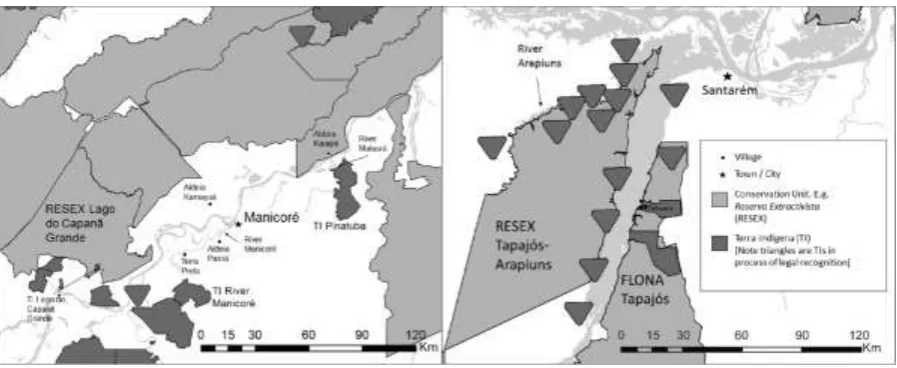
RESEX Capanã Grande) distributed in a wide geographic area of around 200km2
encompassing dozens of communities (Figure 1). In the Tapajós section, owing to the
more integrated nature of struggles for recognition, case material is discussed in a
more generalized fashion, focusing on struggles around the Tapajós National Forest,
self-19
recognising as indigenous. This spans a similar geographic area of around 200km2
also including dozens of communities. I introduce the cases by comparing a vignette
from each region.
Two vignettes
In 2006, at a community named Terra Preta on the Manicoré tributary of the Middle
Madeira River (Figure 1), I asked eighty-five-year-old Maria Magdalena da Silva,
who I had got to know well, “who are Caboclos?” She responded, “Eu sou Cabocla” (I
am [a] cabocla). This was unusual because the term has pejorative connotations, and
is not normally used to self-identify. Maria Magdalena is sister and adoptive mother
to Antonio da Silva, who identified himself to me as “Índio,” and is a leader of an
upriver community located in the 195km2 TI “Rio Manicoré.” One set of Maria
Magdalena’s grandparents were also Índios. So why didn´t she herself identify as
Índio, like several of her ancestors and the brother she raised, especially given that
this could support stronger territorial rights claims?
A likely factor in her identification was that in this region, as with many in
Brazilian Amazonia, “Índio” has even more pejorative connotations than “Caboclo.”
In general, people I met in the Madeira region were loath to recognise indigenous
ancestry, and I often heard people denigrating and insulting “Índios,” at worst
calling them “animals.” Here then, we can infer the damaging effects of Sister
20
techniques of the self, manifest in the negation of love, rights and esteem to “Índios”
and “Caboclos.”
On the lower Tapajós river 800 kilometres away (Figure 1), however, people
similar to Maria Magdalena have become unashamed of openly assuming
indigenous identity. This is related to a much stronger and more unified renascent
indigenous movement in the region. At the community of Pinhel, for example,
Firmina Carvalho dos Santos, who died aged ninety-two in 2008, stated “my father
was born a Mundurukú Índio, my mother was the daughter of Portuguese,” but,
when asked if she was descended from Índios, she replied, “nós somos Índio mesmo” -
we really are Índios (Vaz, 2010:113). She is of a similar age and of similar mixed
origins to Maria Magdalena. The Tapajos case shows the social category “Índio” can
overcome the barriers of whitening to be openly incorporated into practices of
techniques of the self and subaltern political subjectivation if legal and recognition is
strong enough. Or in Honneth’s terms, a strong sphere of right fosters solidarity.
We now move to a detailed examination of our two case study regions
The Madeira
On the Madeira, prior to the 1988 constitution, those now identifying as renascent
“Índios” and their neighbours who do not openly claim indigenous identity (who are
now often in conflict, as we will see) lived relatively harmoniously by many
accounts, with intermarriage cementing social ties into kinship relations in many
21
in order to get legal recognition of a TI normally lack sufficient local intersubjective
recognition, with neighbouring communities often being opposed, claiming that
those self-identifying as indigenous are doing so falsely, their motivation being to
seize control of large areas of land. This is often accompanied by claims that “Índios”
are lazy and reliant on government handouts. The resources a TI receives, according
to certain informants, can lead to Índios giving up manioc cultivation and so having
to buy farinha (manioc flour), and becoming alcoholics.
We now turn to five examples, the first three giving a brief overview of recent
and ongoing conflicts surrounding groups Fanonian renascent self-recognition as
indigenous, whilst the final two present a more in-depth examination of struggles
around the oldest TI and the only RESEX, respectively, in the municipality of
Manicoré.
Our first example is Aldeia Parirá, a community at Lago de Remedios on the
River Manicoré that has self-identified as indigenous (Figure 1). A common
statement I heard at other communities along the River Manicoré was that Aldeia
Parirá was “claiming the entire lower portion of the river, all of the [other] communities of
the river would have been made to leave the river.” Our second example is Aldeia
Kamayuá on access road 464 linking the Manaus-Porto Velho highway BR 319 to
Manicoré. This community, was also, according to neighbouring communities,
laying claim to a large tract of land, provoked the scorn of other local residents who
derided them as “false” Índios. These two examples show how groups
self-identifying as indigenous lack intersubjective recognition, and so suffer the negation
22
indigenous, but are often linked through kinship relations. In these instances, the
trajectory of Fanonian self-recognition stalls.
Our third example is Aldeia Kaiapé, located on the high floodplain that
separates Lake Genipapo from the main channel of the Madeira. This case of
indigenous self-identification occurred in the context of conflict over the land-use
rights of the long-term residents of the land. Historically the locality was dominated
by rubber-era bosses, and their current descendants were demanding rents based on
historic “ownership” of the locale. The community organized itself and asserted
Indigenous identity in 2007. Locals claim that the murder of the head of FUNAI in
Manaus in late 2007 was the response of the “landowning” family. This third
example illustrates how indigenous identification can be asserted to combat unjust
attempts at exploitation by descendants of historic bosses.
Our fourth example, TI Pinatuba, is an area of ca 300km2 surrounding the
mouth and lower reaches of the River Mataurá (Figure 1). An examination of the
history of this river shows the difficulty of separating “Povos Tradicionais” from
“Índios” when creating a TI. Carlos Lindoso Vencedor was one of various army
colonels who settled along the Madeira and set up large extractive operations during
the nineteenth century. He controlled a swathe of extractive locales in the region. He
was not owner of the land in Mataurá as he was elsewhere, but coveted its rich
Brazil nut and rosewood groves. He tried to obtain rights to its historic landholdings
from long-term inhabitants, by falsely promising to help register their properties,
only to do it in his own name, then claiming the land as his. This was the cause,
23
25th of December, 1930, a group of young men assembled and burnt down the three
barracões that were deeper inside the river and brutally killed Vencedor. They then
collectively repelled a gunboat sent from Manaus to avenge Vencedor.
The Mataurá then became, according to my interlocutors, a thriving and free
river until 2001, when TI Pinatuba was established, comprising seven communities.
Many of the river’s long-term inhabitants were forcibly dispossessed, leaving a
population of 458 (GT/Funai 2010). Accounts converge on the actions of one man,
from outside the region, as being instrumental in the setting up of the reserve by
FUNAI. Not an Índio himself, he married a woman from the river, and had the idea
of creating a TI. He got in touch with FUNAI and a “study” was carried out, people
were asked whether they were Índios or not. The implications of the TI were not
explained to the people. Many of indigenous ancestry chose not to identify as Índio.
When TI Pinatuba was created, those who had registered landholdings were
indemnified, but young men who worked seasonally for others received nothing.
Many were taken by the police to an unappealing site in the floodplain close to the
town of Manicoré called Sururu where, according to various informants, they were
living in a “wretched state.” Ironically, according to one interlocutor, many of those
relocated were of entirely indigenous descent, and some of those who self-identified
as Índios of the Mataurá had “blond hair and blue eyes”. The whole lower area of the
river was given to a “small group of people who self-identified as Índios”. What was
once a series of historic communities became “practically deserted.” As one
interlocutor put it: Before, seventy years ago it was just patrões (bosses) and fregueses
24 question in Mataurá, it was just nordestinos (migrants from North-east Brazil) and Índios all working together.” This example shows that even in contexts where historical
emancipatory struggles involving collaboration and intersubjective recognition
among subaltern populations, a weak sphere of legal recognition – of right, that is, a
weak presence of state institution FUNAI, can be exploited by unscrupulous actors,
driving exclusions.
Our fifth example shows that even where all historical residents of a locality
are extended (albeit unequal) territorial rights through legal recognition, that is, as
either “Índios” or “Agroextractivistas,” serious conflict can nevertheless occur when a
weak sphere of legal recognition, in particular the lack of spatial proximity of
FUNAI and ICMBio, means that the overlapping claims which inevitably emerge
cannot be dealt with adequately, leading to a situation of seemingly intractable
conflict.
Lake Capanã Grande is the location of a 3041km2 RESEX of the same name
which was created in 2004 (Figure 1). During the process of creating the RESEX,
some of the regions inhabitants registered as Agroextractivistas with ICMBio while
other residents were registered with FUNAI as Índios. Before this, residents shared a
singular identity, the authors of the RESEX Management Plan observe, and the space
which the RESEX now occupies was a common space for all. According to the
Management Plan: “establishing who is and is not Índio is a very difficult issue on Lake
25
Hence, the division of a previously singular identity into essentialized legal
recognition categories of Índio and Agroextractivista created overlapping claims to the
same area of land and natural resources via two different territorial modalities, the
TI and RESEX. This division was compounded by the lack of coordination between
FUNAI and ICMBio and their overlapping yet contradictory and uncoordinated
modalities of spatial management. Residents were subject to different organisations
which did not communicate and this ended up dividing them.
Currently, six self-identified renascent indigenous communities are
demanding that around two-thirds of the area of the RESEX be recognised as TIs,
refusing to accept that their territories form part of the RESEX – effectively rejecting
it. Two years prior to the RESEX, the comparatively miniscule 63,2km2 TI Lago
Capanã was created, but only one indigenous community is located within it. This
situation, according to those interviewed, also created de facto exclusions among
residents, as one stated, “the Índios are free to walk in the communities of the RESEX,
unlike what happens to some people from the RESEX [when they are refused access to areas
claimed by the Índios]” (ICMBio, 2013:97).
Residents began to accuse one another of registering with either FUNAI or
ICMBio as a way of obtaining “benefits.” The current residents of the RESEX said
that the Índios didn’t want to register as Agroextractivistas “because they thought that
they were going to take over the whole area [of the RESEX].” In 2006 there was a
confrontation where Índios revolted against ICMBio, which had apparently claimed
26
Grande continues to be characterized by this ongoing conflict, ICMBio is “banned”
from entering the two-thirds of the RESEX claimed by Índios as their territory.
These five examples from the Madeira, taken together, show that the potential
for recognition of Fanonian self-identification, for both Índios and Povos tradicionais is
limited by the weak sphere of legal recognition which is a correlate of the weaker
presence of the state in this region – there are no regional FUNAI or ICMBio offices
to mediate claims for legal recognition, and sufficient civil society and church
activity is also lacking, meaning there is a paucity of grassroots organising capacity.
The Tapajós
The struggle for recognition on the Tapajós can be traced back to the Cabanagem
(1835–1840) a popular separatist revolution against poverty and repression (Harris,
2010) - the leaders of the current indigenous movement explicitly link current
struggles to those of the Cabanos (Ioris, 2005). Unlike the Madeira, where as we saw,
current struggles for recognition tend to occur in isolation from one another, on the
Tapajós current struggles emerge from a collective history.
This recent history of struggle begins, according to Ioris (2005), in 1974, when
Brazil’s military government created the 5270km2 FLONA Tapajós (Figure 1). During
this period in Brazil, people were excluded from Conservation Units, and this led
residents of the communities located on the riverside of the FLONA to mobilize for
the right to stay in the area. They were successful in year 2000 with the introduction
27
FLONAS. On the opposite side of the Tapajós, meanwhile, the mobilization of
community residents for the demarcation of their land started in 1996 as a reaction to
intrusions by logging companies and small-scale mining. This cumulated in the
6476km2 RESEX Tapajós-Arapiuns being granted in 1998. This led to timber
companies and mining enterprises being excluded from the area, and residents’
associations took on a role in managing the reserve.
According to Ioris (2005), these struggles for the FLONA and RESEX afforded
greater awareness and valorization of traditional inhabitants’ rights, political
visibility and consciousness along with shared history and culture. During the
process, awareness that indigenous ancestry entitled territorial rights also grew. As
part of the justification for the RESEX, the people of the lower Tapajós began to
speak of their ancestors and their past struggles including the Cabanagem.- and so
fostered intersubjective recognition, and so we can infer, greater love and solidarity,
and a positive incorporation of “Índio” and “Agroextractivista” identities into
practices of techniques of the self, supporting later Fanonian self-recognition.
The beginnings of the renascent indigenous movement along the lower
Tapajós River can be traced to the 1980s, members of the Church began visiting
communities, encouraging residents to revive their cultural traditions and
self-identify as indigenous, which the Church had been against until the mid-twentieth
century. This reversal on the part of the Church is not restricted to Amazonia, and is
also evident in Central America and Mexico, for example.
The recent struggle for recognition on the Tapajós has been heavily
28
especially individuals who would go on to become indigenous leaders - in Paulo
Freire (2014) inspired liberation theology (which was influenced by Fanon). They
began a radical process of politicization that went beyond local issues emphasized
until then by the Church, to highlight class struggles and rights vis-à-vis the
machinations of bosses, private companies and the government (Vaz, 2010:76).
The church set up groups to advocate subaltern rights: in 1993, the Religious
Blacks and Indigenous Reflection Group, to foster greater awareness of identity with a
view of overcoming obstacles to self-respect, in 1997, the Indigenous Consciousness
Group (GCI), mentioned earlier in the example of Sister Emanuela, to promote the
appreciation of indigenous identity and customs. Through such activities, young
people learnt to valorize indigenous culture, and begin to self-identify as indigenous
(Vaz, 2010:79). The term “reconhecimento” (recognition) was incorporated into
speeches given by local leaders. Its use increased sharply by the late 1990s, also in
discourse of the Church and FUNAI (Vaz, 2010:328). This shows how important
Church and rural workers union organising is in fostering both legal and
intersubjective recognition.
The act of self-recognition - “assumir-se Índio” (to assume Índio identity) has
become widespread in the last two decades on the Tapajós, constituting a Fanonian
moment of indigenous renaissance. This began at the end of 1998 at a small
settlement called Takuara (Figure 1). After the death of a leader, curador Laurelino,
families listened to an interview recorded in 1994-1995 where Laurelino stated that
he was an Índio, a son of parents who were Índio puro, and that he was not ashamed
29
FUNAI responded positively and sent anthropologists to confirm the claims. This
shows the importance of the spatial proximity and hence presence of FUNAI – the
presence of the state - for legal recognition or right to be efficacious, and this was the
first of many communities affirming indigenous identity. In a Fanonian decolonial
act, influenced by the CGI, the renascent indigenous movement demanded that
FUNAI stop using anthropologists to conduct studies to confirm or deny their ethnic
identity, instead asserting the principle of ethnic self-identification, following ILO
Convention 169 (Vaz, 2010:327).
The decision for Takuara to assumirse Índio was influenced by struggles for
the right to inhabit the FLONA, which helped people overcome prior reticence to
identify as Índios “the idea of being an Índio was not a pleasing one, an Índio in the woods,
eating raw [food], walking naked, using an arrow. They felt prejudice, and were afraid of being accepted as indigenous, rejected by the whites.” This can be seen as effects of Sister
Emanula’s notion of “whitening,” of the colonized subaltern subjectivity shaped
through the negation of love, rights and solidarity.
After Takuara however, people began to become unashamed of openly
stating indigeneity. During a discussion at a meeting on Arapiuns River in July 2007,
a lady said, "I am Índio because my mother was an Índio, and my grandmother was too."
This shows that given strong enough potential for legal recognition, that is, the
presence of FUNAI, along with Church and rural workers union grassroots
organising, whitening can be overcome by autonomous self-recognition, positively
incorporating indigeneity into practices of techniques of the self. This has been
30
rearticulation of various manifestations of “caboclo culture” as indigenous culture,
principally pajelança (sorcery or witchcraft) and Saint’s Festivals (Vaz, 2010:371).
Another dimension which many informants used to justify assuming indigenous
identity is manioc farming and the ways it is related to practices of ancestors. As one
man noted “we work in the roçado, make farinha, who does this come from? From them [the
Índios], right?... [From our] first fathers….”
That this happened in the face of very similar conflicts to those we observed
on the Madeira, makes it even more remarkable. The major factor motivating people
to assume indigenous identity was the greater security over territory this enabled,
but this generated fear among neighbouring communities that these rights would
lead to them losing land. This had more to do with fear of losing their land to the
Índios than being against resurgent indigenous identity per se. As one noted, “the Índios want a very large area…they want to take strips of land from [other] communities and keep them.”
There is division among rural people between those who were in favour of
Índio identity and the TI, and those who advocated Agroextractivista identity and the
RESEX. In a meeting in 2001, when asked “what happens if a member of an indigenous
community does not wish to assume indigenous identity?” Indigenous leaders replied
that the person would have to conform with community norms, or face being
indemnified and asked to leave (Vaz, 2010:43). The counter-argument by Indigenous
leaders, as to why they believe all residents should assume indigenous identity, is
31
All of this conflict led to polarization of views, renascent Indigenous leaders
began to see the situation in binary terms of ‘you’re with me or you’re my enemy.’ In
many Tapajós communities in the area of RESEX and FLONA, the role of ‘enemy,’
which was before the ‘gaucho’ large scale soy or cattle farmer migrants from south
Brazil, or large timber companies, has been transferred to their own ‘Índio’ or
‘Agroextractivista’ neighbours, belonging to the same social class (Vaz, 2010:368).
Despite this, by early 2002, the number of groups self-recognising increased
rapidly in the region, some 38 renascent indigenous communities are at some stage
of the legal recognition process today. In sum, while similar conflicts around identity
categories and territorial rights are present on the Tapajós and the Madeira, legal
and intersubjective recognition were more fully realized on the former because of
several factors largely absent from the latter.
Concluding Discussion
To what degree do legal recognition categories “Índios” and “Povos tradicionais”
and/or Agroextractivistas”, the territorial forms of the TI and RESEX, and the
institutions FUNAI and ICMBio serve to advance the goals of emancipatory
struggles? The two cases show that the key variables shaping the degrees of
actualization of a sphere of legal recognition, are proximity of the state and its
institutions, along with grassroots organising by the Church and rural workers
32
These variables in turn affect the extent to which the Fanonian colonized
subjectivity is able to reverse the negation of love, rights and solidarity through
positive re-valorization of the abovementioned Amazonian forest peoples’ identity
categories and their incorporation into practices of techniques of the self – forging
new subjectivities and kinds of citizen through struggles for territorial recognition –
exemplified in the figure of Sister Emanuela. This was clearly illustrated by the two
case studies. The Tapajós is much more spatially integrated into the Brazilian state
than the more remote Madeira, not just in terms of government but also civil society,
labour movements and church activity. In particular, four factors shape the
divergences in what I term the spatial materialisation of differentiated citizenship in
these two regions.
On the Tapajós, first, legal recognition in relation to TI and RESEXs is more
efficacious because of the proximity to the state legislative centre of Santarem where
there are ICMBio and FUNAI offices, second, activities of the church fostering
grassroots democratic organization, third, vigorous rural labour movement activity,
fourth, histories of resistance against outside enemies (industrial logging and
mining) has fostered unity among subaltern peoples. Conversely, on the Madeira
each of these four factors is weaker or non-existent, first, there is a more restricted
sphere of legal recognition, there are no regional ICMBio or FUNAI offices, second,
less church activities fostering grassroots activities, third, a weaker labour
movement, fourth, being comparatively far from the frontier until very recently,
there has been less industrial scale logging and mining which serve to bring
33
So paradoxically, given that often subaltern groups see the state as ‘the
enemy,’ the presence of state institutions FUNAI and ICMBio has facilitated greater
recognition on the Tapajos; both ‘legal’ (institutional presence to administer claims
and adjudicate conflicts) and intersubjective (groups more likely to acknowledge
and accept one another’s claims, and less likely to make overlapping claims, at least
when compared to the Madeira, because of these institutions’ presence). On the
Madeira, being further from an administrative centre, more extreme and intractable
overlapping claims are more likely, which was clearly shown in the five sub-cases.
Hence, from the examination of these two regions, the relationship to the state
emerges as complex and Janus faced: it’s institutions can facilitate as well as be an
obstacle to emancipatory struggles. The effects of what can be read as neoliberal
multiculturalism, are evident in the inadequacy of essentialist legal recognition
categories to capture the dynamic nature of Amazonian forest peoples’
territorialities, it is also clear that legal recognition via state institutions has created
considerable emancipatory possibilities.
The Madeira case shows how in the case of a weak sphere of legal
recognition, a situation of intractable conflict is likely, caused by the lack of
institutional presence to mediate inevitable conflicts caused by essentialised identity
categories and overlapping claims. This weakens subaltern struggles by turning
groups within the same socio-economic class against one another. Conversely, on the
Tapajós, where there is a much stronger sphere of legal recognition, the
emancipatory territorial struggles of Amazonian forest peoples have been more
34
effects of “whitening” on the colonized subjectivity - pervasive on the Madeira - are
ameliorated and there are abundant examples of the Fanonian radical autonomy of
self-recognition.
The theorization of decolonial recognition presented in this paper is animated
by the tension between two ‘classic’ concerns in geographical, critical and political
thought, sketching some directions of use for contemporary subaltern struggles.
First, my reading of Fanon through the late Foucault via Scott problematizes
categories often linked to ‘the subaltern,’ such as indigeneity. It does so through an
anti-humanistic and anti-essentialist notion of recognition qua decolonial
self-identification and subjectivation: identities (and indeed other attributes such as
autonomy, subjectivity, and so forth) are constantly becoming, being performed, and
emergent within tangles of power relations, rather than being fixed and unchanging,
or only changing in a unidirectional and punctuated fashion. This is a precondition
for deflecting attempts by states and other powerful actors to ‘co-opt’ categories such
as ‘indigeneity’, excluding subaltern claims based on these self-same categories.
However, in addition to this, it was necessary to establish some positive
grounds for a normative image of recognition as a societal good. If suffering is linked
to misrecognition of subaltern peoples, and their oppression understood as
dehumanising, it becomes a pressing task to establish a provisional grid or horizon
of what it is to be human, against which to judge injustice. Hence, secondly, I
elaborated a normative component of recognition as a societal good, by materially
grounding Honneth’s love, rights and solidarity tripartite in the fundamental
35
opening into humanism could help build a pragmatic and instrumental critique of
bourgeois liberal understandings of rights and justice (i.e. Rawls). The normative
dimension of love, rights and solidarity can also help leverage subaltern struggles in
terms of intersubjective recognition creating collective bonds with other individuals
and groups across society. It can provide a scheme for the critique of actual practices
that is still legible to institutions, states and international law.
References cited
Adams C, Murrieta R, Neves W and Harris M 2009 Amazon Peasant Societies in a Changing Environment: Political Ecology, Invisibility and Modernity in the Rainforest Springer New York
Baletti B 2012 Ordenamento Territorial: Neo-developmentalism and the struggle for territory in the lower Brazilian Amazon The Journal of Peasant Studies 39 573-598
Barnett C 2017 The Priority of Injustice: Locating Democracy in Critical Theory University of Georgia Press
Bolaños O 2011 Redefining identities, redefining landscapes: indigenous identity and land rights struggles in the Brazilian Amazon Journal of Cultural Geography 28 45-72
Caillé A and Vandenberghe F 2016 Neo-classical sociology: The prospects of social theory today European Journal of Social Theory 19 3-20
Coulthard GS 2014 Red Skin, White Masks: Rejecting the Colonial Politics of Recognition University of Minnesota Press Minnesota
Cremonesi L, Irrera O, Tazzioli M and Lorenzini D 2016 Foucault and the Making of Subjects Rowman & Littlefield International London
Emcke C 2000 Between Choice and Coercion: Identities, Injuries, and Different Forms of Recognition Constellations 7 483-495
Fanon F 1967 Black Skin, White Masks Grove Press New York
Fanon F 2007 The Wretched of the Earth Grove/Atlantic, Incorporated New York
Faubion JD 2011 An Anthropology of Ethics Cambridge University Press Cambridge
Fisher JA, Cavanagh CJ, Sikor T and Mwayafu DM 2018 Linking notions of justice and project outcomes in carbon offset forestry projects: Insights from a comparative study in Uganda Land Use Policy 73 259-268
Foucault M 1987 the ethic of care for the self as a practice of freedom:an interview with michel foucault on January 20, 1984 Philosophy & Social Criticism 12 112-131
Foucault M, Rabinow P and Hurley R 1997 Ethics: Subjectivity and Truth New Press
Fraser N 2000 Rethinking Recogntion New Left Review 3
Fraser N and Honneth A 2003 Redistribution Or Recognition?: A Political-philosophical Exchange Verso London and New York
Fraser NF1995 From Redistribution to Recognition? Dilemmas of Justice in a ‘Post-Socialist’ Age New Left Review 212 68-93
36
Gonçalves CWP 2001 Geo-grafías: Movimientos sociales, nuevas territorialidades y sustentabilidad Siglo XXI Mexico City
Hale CR 2002 Does Multiculturalism Menace? Governance, Cultural Rights and the Politics of Identity in Guatemala Journal of Latin American Studies 34 485-524
Harris M 2000 Life on the Amazon: The anthropology of a Brazilian peasant village Oxford University Press Oxford
Harris M 2005 Riding a Wave: Embodied Skills and Colonial History on the Amazon Floodplain Ethnos 70 197-219
Harris M 2010 Rebellion on the Amazon: The Cabanagem, Race, and Popular Culture in the North of Brazil, 1798-1840 Cambridge University Press Cambridge
Hecht SB2011 The new Amazon geographies: insurgent citizenship, “Amazon Nation” and the
politics of environmentalisms Journal of Cultural Geography 28 203-223
Holston J 2008 Insurgent Citizenship: Disjunctions of Democracy and Modernity in Brazil Princeton University Press Princeton, NJ
Honneth A 1996 The Struggle for Recognition: The Moral Grammar of Social Conflicts MIT Press Cambridge, Massachusetts
ICMBio 2013 Plano de Manejo Participativo da Reserva Extrativista do Lago do Capanã Grande Instituto Chico Mendes de Conservação da Biodiversidade
Ingold T 2000 The Perception of the Environment: essays on livelihood, dwelling and skill Routledge London & New York
Ioris EM 2005 A Forest of Disputes: Struggles Over Spaces, Resources and Social Identities in Amazônia. University of Florida, Unpublished PhD Thesis
Jones O 2009 Dwelling in Kitchin R and Thrift N eds International Encyclopedia of Human Geography, Volume 3, Elsevier, Oxford 266-272
Laidlaw J 2014 The Subject of Virtue: An Anthropology of Ethics and Freedom Cambridge University Press Cambridge
Lash S and Featherstone M 2002 Recognition and Difference: Politics, Identity, Multiculture SAGE Thousand Oaks, CA
Loures RSP 2017 Governo Karodaybi: o movimento Ipereğ Ayũ e a resistência Munduruku
Unpublished Masters Thesis Universidade Federal do Oeste do Pará Santarém
Lund C 2016 Rule and Rupture: State Formation through the Production of Property and Citizenship Development and Change 47 1199-1228
Martin A 2017 Just Conservation: Biodiversity, Wellbeing and Sustainability Taylor & Francis Oxford
Ong A 2006 Neoliberalism as Exception: Mutations in Citizenship and Sovereignty Duke University Press Durham, NC
Peixoto KPF2017 “Eu existo”: Afirmação indígena e nomeação do racismo. Os Borari e os Arapium
da Terra Maró, Amazônia. Universidade Federal do Pará, Brazil. Unpublished PhD Thesis
Pirsoul N2017 Identity Between Police and Politics: Rancière’s Political Theory and the Dilemma of Indigenous Politics Critical Horizons 18 248-261
Povinelli EA 2002 The Cunning of Recognition: Indigenous Alterities and the Making of Australian Multiculturalism Duke University Press Durham, NC
Quijano A 2007 Coloniality and modernity/rationality Cultural Studies 21 168-178
Radcliffe SA 2017 Decolonising geographical knowledges Transactions of the Institute of British Geographers 42 329-333
Reyes A and Kaufman M 2011 Sovereignty, Indigeneity, Territory: Zapatista Autonomy and the New Practices of Decolonization South Atlantic Quarterly 110 505-525
Ricœur P 2005 The Course of Recognition Harvard University Press Cambridge, MA
37
Sayer A 2011 Why Things Matter to People: Social Science, Values and Ethical Life Cambridge University Press Cambridge
Scott D 1999 Refashioning Futures: Criticism After Postcoloniality Princeton University Press Princeton, NJ
Simpson A 2014 Mohawk Interruptus: Political Life Across the Borders of Settler States Duke University Press Durham, NC
Slater C 1994 Dance of the Dolphin: Transformation and Disenchantment in the Amazonian Imagination University of Chicago Press Chicago
Taylor C 1994 The Politics of Recognition in Gutmann A ed Multiculturalism: Examining the Politics of Recognition, Princeton University Press, Princeton 25-73
Vaz FA 2010 A emergência étnica de povos indígenas no baixo rio Tapajós, Amazônia. Universidade Federal da Bahia, Brazil. Unpublished PhD Thesis
Wilson M and Jackson P 2016 Fairtrade bananas in the Caribbean: Towards a moral economy of recognition Geoforum 70 11-21
Zeitoun M, Dirar A, El Moghraby A and Hashim MJ2017 A “justice” reading of the trans-national struggle of the people displaced by the Merowe Dam Local Environment 1-17
[image:37.595.74.523.422.606.2]Zurn C 2015 Axel Honneth Polity Press Cambridge, UK and Malden, MA