EFFECT OF OPERATING VARIABLES ON CATALYTIC HYDROTREATING OF HEAVY GAS OIL:
EXPERIMENTAL AND KINETIC STUDIES
Hussien A. Elsayed, *Seham A. Shaban, Hoda
Refining Division, Egyptian Petroleum Research Institute, Nasr City, Cairo 11727, Egypt
ARTICLE INFO ABSTRACT
Experimental study to evaluate the effect of hydrotreating CoMo/γ
heavy gas oil (HGO). Hydrodesulfurization (HDS) and hydrodearomatization (HDA) activities were conducted in a continuous flow micro trickle
space velocity (LHSV) and hydrogen
LL-1 respectively. This work identifies and measures the key parameters in hydrodesulfurization, and at conversion levels
Law model yielded reaction orders of the first order reaction for HDS and HAD, and activation energies of 31.4 and 36.9 kj/Mol respectively.
Copyright © 2014 Hussien A. Elsayed et al. This is an open access article distributed under the Creative Commons Att use, distribution, and reproduction in any medium, provided the original work is properly cited.
INTRODUCTION
Hydrotreating catalysts are playing an important part in the modern refinery to make clean fuel (SK and SK, 2003
and Mmdouh, 2011). Nevertheless, it is a great challenge for the conventional hydrotreating catalyst to create ultra sulfur and low aromatic diesel (Song and Ma, 2003). Therefore, it is imperative to grow more active and more selective hydrotreating catalyst for hydrodesulfurization (HDS)
and hydrodearomatization (HDA) (Ma et al.,
Doheim, 2000). The increasing need for engine fuels has stimulated the oil refinery industry to look for the possibility of processing heavy crude oil. One of the problems related to this possibility is that the aforementioned oil contains a substantial amount of organic sulfur compounds as well as other undesired compounds, which must be ruled out during the procedure. Their elimination is fundamental because they are
both the catalysts used in the oil processing and the
environment (Beškoskia et al., 2008). The reactions such as
hydrodesulfurization (HDS) and (HDA) of refinery streams are carried out with catalysts consisting of Mo promoted with Ni or Co or W, all in the sulfide state (Domínguez
2008). The industrial hydrotreatment of petroleum and is ordinarily achieved by using γ-Al2O3 as support; and although other kinds of supports have been proposed (
2005) to achieve production cost, mechanical resistance and deactivation continue to be better with alumina (
*Corresponding author: Seham A. Shaban
Refining Division, Egyptian Petroleum Research Institute, Nasr City, Cairo 11727, Egypt.
ISSN: 0975-833X
Vol. 6, Issue,
Article History:
Received 21st September, 2014
Received in revised form 14th October, 2014
Accepted 27th November, 2014
Published online 30th December,2014
Key words:
Catalyst, Hydrodesulfurization, Hydrodearomatization, Kinetic Study,
Upgrading Heavy Gas Oil.
RESEARCH ARTICLE
EFFECT OF OPERATING VARIABLES ON CATALYTIC HYDROTREATING OF HEAVY GAS OIL:
EXPERIMENTAL AND KINETIC STUDIES
Hussien A. Elsayed, *Seham A. Shaban, Hoda S. Ahmed and Mohamed F. Menoufy
Refining Division, Egyptian Petroleum Research Institute, Nasr City, Cairo 11727, Egypt
ABSTRACT
Experimental study to evaluate the effect of hydrotreating CoMo/γ
heavy gas oil (HGO). Hydrodesulfurization (HDS) and hydrodearomatization (HDA) activities were conducted in a continuous flow micro trickle-bed reactor at the te
space velocity (LHSV) and hydrogen-to-feed ratio of; 3500-4500C, 40
1 respectively. This work identifies and measures the key parameters in hydrodesulfurization, and at conversion levels above 95 and 90 %, respectively. The experimental results fitted with the Power Law model yielded reaction orders of the first order reaction for HDS and HAD, and activation energies of 31.4 and 36.9 kj/Mol respectively.
is an open access article distributed under the Creative Commons Attribution License, which use, distribution, and reproduction in any medium, provided the original work is properly cited.
Hydrotreating catalysts are playing an important part in the (SK and SK, 2003; Hanafi , 2011). Nevertheless, it is a great challenge for the conventional hydrotreating catalyst to create ultra-low sulfur and low aromatic diesel (Song and Ma, 2003). Therefore, it is imperative to grow more active and more hydrodesulfurization (HDS) ., 2010; Hanafy and The increasing need for engine fuels has stimulated the oil refinery industry to look for the possibility of lems related to this possibility is that the aforementioned oil contains a substantial amount of organic sulfur compounds as well as other undesired compounds, which must be ruled out during the procedure. Their elimination is fundamental because they are toxic for both the catalysts used in the oil processing and the ., 2008). The reactions such as hydrodesulfurization (HDS) and (HDA) of refinery streams are carried out with catalysts consisting of Mo promoted with Ni or
Domínguez-Crespoa et al.,
2008). The industrial hydrotreatment of petroleum and is Al2O3 as support; and although
other kinds of supports have been proposed (Ancheyta et al.,
2005) to achieve production cost, mechanical resistance and deactivation continue to be better with alumina (Song, 2003).
Refining Division, Egyptian Petroleum Research Institute, Nasr City, Cairo
Catalytic hydrotreating (HDT) is one of the most significant stages in the processing of crude oil distillates for fuels and petrochemical feedstock. Depending on their origin, HDT feedstocks contain moderately large concentrations of heteroatoms, which are doled out over the whole boiling range and they generally increase with increasing in their boiling points. In the refining industry, HDT reactions are often classified according to the severity of the operation. Under relatively mild operating conditions, the primary aim is to saturate the feed molecules and/or to remove the undesirable heteroatoms from the oil without significa
the boiling point range or the molecular size distribution. At the other extreme (i.e. Hydrocracking), the primary purpose is to maximize the conversion of a heavy feed to desirable lower boiling-range fractions (Ancheyta
The functions of middle distillates HDT include predominantly the desulfurization of kerosene, diesel fuel and jet fuel, and its application is developed to fit various needs, including the processing of heavier feeds and the production of high performance lubricants (Song, 2003
In addition, hydrogenation of high
has become increasingly important where hydrodesulfurization (HDS) and saturation of aromatic compounds improve product quality. The reacting conditions of the HDS process vary with the case of crude oil; whereas light oils are easy to desulfurize, the asphaltenes and metals which are set up in heavy fractions in large quantities shorten catalyst life and reach of heavy oils very difficult (Gawel
Available online at http://www.journalcra.com
International Journal of Current Research
Vol. 6, Issue, 12, pp.10977-10983, December, 2014
INTERNATIONAL
EFFECT OF OPERATING VARIABLES ON CATALYTIC HYDROTREATING OF HEAVY GAS OIL:
S. Ahmed and Mohamed F. Menoufy
Refining Division, Egyptian Petroleum Research Institute, Nasr City, Cairo 11727, Egypt
Experimental study to evaluate the effect of hydrotreating CoMo/γ-Al2O3 catalyst for upgrading heavy gas oil (HGO). Hydrodesulfurization (HDS) and hydrodearomatization (HDA) activities were bed reactor at the temperatures, pressures, liquid hourly 4500C, 40-75 bar, 0.5-1.0 h-1, and 400 1 respectively. This work identifies and measures the key parameters in hydrodesulfurization, and above 95 and 90 %, respectively. The experimental results fitted with the Power Law model yielded reaction orders of the first order reaction for HDS and HAD, and activation
ribution License, which permits unrestricted
Catalytic hydrotreating (HDT) is one of the most significant stages in the processing of crude oil distillates for fuels and rochemical feedstock. Depending on their origin, HDT feedstocks contain moderately large concentrations of heteroatoms, which are doled out over the whole boiling range and they generally increase with increasing in their boiling dustry, HDT reactions are often classified according to the severity of the operation. Under relatively mild operating conditions, the primary aim is to saturate the feed molecules and/or to remove the undesirable heteroatoms from the oil without significantly changing either the boiling point range or the molecular size distribution. At the other extreme (i.e. Hydrocracking), the primary purpose is to maximize the conversion of a heavy feed to desirable lower
Ancheyta et al., 2005).
The functions of middle distillates HDT include predominantly the desulfurization of kerosene, diesel fuel and jet fuel, and its application is developed to fit various needs, including the processing of heavier feeds and the production of
high-, 2003; Riad and Mikhailhigh-, 2012). In addition, hydrogenation of high-boiling cracking products has become increasingly important where hydrodesulfurization (HDS) and saturation of aromatic compounds improve product ity. The reacting conditions of the HDS process vary with the case of crude oil; whereas light oils are easy to desulfurize, the asphaltenes and metals which are set up in heavy-oil fractions in large quantities shorten catalyst life and reach of
Gawel et al., 2005).
New diesel specifications are being presented around the Earth. The acceptable limits of sulfur content diesel fuel have been slimmed down drastically from 2000 to 500 in many countries due to recent environmental regulations (Europe: from 0.2± 0.3 to 0.05 wt%; Japan: from 0.2 to 0.05 wt%; US from 0.3±0.5 to 0.05 wt%; Mexico from 0.5 to 0.05 wt%) (Ancheyta-JuaÂreza, 1999).
In this work, the hydrotreating activity was evaluated on heavy gas oil under conditions close to those used commercially in the refinery using a micro trickle-reactor operating in down-flow-mode. Several kinetic studies documented in the literature on the hydrotreating reactions using real feadstocks have
mostly utilized the power low model (Boahene et al., 2013; Bej
et al., 2006) to determine significant kinetic parameters. It is
well known that in hydrotreating heavy gas oil adsorption of reactant species, such as sulfur and aromatics on the catalytic active sites is known to be the rate- determining step in the response procedure. The aim of the present study was to
identify and evaluate the key parameters in
hydrodesulfurization and hydrodearomatization at high conversion levels (up to 90 %), and as well to conduct kinetic studies using the Power Law model to find the effects of process variables on the rate of HDS and HDA reactions on the
heterogeneous CoMo/Al2O3 hydrotreating catalyst.
MATERIALS AND METHODS
Feedstock
Heavy gas oil (HGO) obtained from Suez Oil Processing Company was used as a feedstock in our experiments. The feedstock was characterized by 0.9356 g/ml specific density, 21839 ppm sulfur content and 72 wt% total aromatics contents.
Catalyst preparation
Catalyst samples were prepared by impregnation of
commercial -Al2O3 supports with aqueous solutions of
ammonium heptamolybdate through incipient-wetness
impregnation method. After impregnation; the moist paste was preliminary dried in an oven at 120˚C over night and then calcined in a muffle furnace at 450 °C for 4 h. The loadings of MoO3 and CoO for prepared catalyst were kept constant at 12 and 3 wt%, respectively. The prepared hydrotreating catalyst CoMo/γ-Al2O3 (100 ml catalyst volume, surface area 134 m2/g, pore volume 0.21 ml/g, CoO 4.0 wt%, and MoO312 wt%) was used in all experiments. The catalyst was presulfiding in situ prior to starting hydrotreating runs.
Catalyst Reactivity
The hydrotreating experiments were performed in a fixed bed reactor (cata-test unit) in the down-flow mode. Its length, internal and external diameter are 500, 19 and 27 mm respectively. A detailed of schematic diagram of the cata-test
unit is described elsewhere (El Kady et al., 2010). The catalyst
was presulfided by injecting sulfidation solution containing 2 wt% DMDS in straight-run atmospheric gas oil under the
following conditions: 50 bar hydrogen pressure, 350oC
temperature, 400 L/L hydrogen to feed ratio, 1.5 h-1 LHSV for
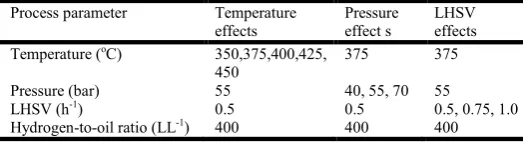
[image:2.595.301.563.120.191.2]12 h before injection the feedstock. The experimental run conditions for the hydrotreatig experiments were indicating in Table (1).
Table 1. Experimental runs operating conditions
Process parameter Temperature
effects
Pressure effect s
LHSV effects
Temperature (oC) 350,375,400,425,
450
375 375
Pressure (bar) 55 40, 55, 70 55
LHSV (h-1) 0.5 0.5 0.5, 0.75, 1.0
Hydrogen-to-oil ratio (LL-1) 400 400 400
Analysis
The liquid products were collected and stripped with nitrogen for removing the dissolved ammonia and hydrogen sulfide. The treated liquid samples were analyzed for total sulfur and aromatic contents according to ASTM 4294 and ASTM D-2549, respectively.
RESULTS AND DISCUSSION
Influence of the Reactor Design on Catalyst Distribution
All the runs were carried out in a dynamic system on a fixed bed reactor. The axial dispersion of a catalyst is minimized, if L / DP is greater than 350, where L is the length of the reactor and DP is the mean diameter of the catalyst particles. In the present study since L / DP (L = 50 cm, DP = 1.2 mm) was 417, which can be taken for granted that there was no significant axial dispersion or back mixing. The wall flow chances of being trifling and a uniform liquid distribution are very honest, if diet / DP is greater than 18 (= the external diameter of reactor tube) (Herskovitz and Smith, 1978). In the present study dt / dp was 23. Hence, it can be assumed that the liquid distribution was very good with no adverse channeling effects (van Klinken and van Dongen, 1980). Under the experimental conditions described above, in the presence of hydrogen, the reaction happens in the vapor phase and the reaction mixture is vaporized completed at the intake of the catalyst bed, which was attributed to passing over the catalyst bed with inert particles in the top and rear of its zone. Also, the catalyst was
diluted with low surface area Al2O3 in a ratio of 1.
Of late, closer attention has been compensated to the deep desulfurization of heavy gas oil and diesel fuel. Since in the near future their sulfur content must be limited to 0.05 wt % to meet the regulation for environmental security.
Effect of reaction temperature
The temperature is commonly regarded as the most comfortable and the most effective parameter to control the
hydrotreating reactions (Ferdous et al., 2006). In parliamentary
classical behavior when the temperature is increased from 350
to 375 oC, that is a continuous increase in sulfur removal. This
may be due to the equilibrium limitation occurs at higher reaction temperatures for the reversible HDS reaction (Steiner
and Blekkan 2002; Stanislaus et al., 2010). The data reveal that
the reaction temperature has the major effect and contributes significantly among the response of HDS activity with respect to the total pressure. The results of Figure (1) also, Discovered that a maximum predicted HDS activity was attained. Indeed, the enhancement of HDS activity up to 99% is reached as the
temperature increased up to 4500C at an operating hydrogen
pressure in the range of 55 bars. This can be attributed to the effect that a certain rise in the reaction temperature favored the desulfurization of non-refractory sulfur compounds and saturate some of aromatic hydrocarbons. However, these sulfur compounds mainly desulfurized via the direct desulfurization (DDS) pathway, for which the CoMo-S catalyst has the highest HDS activity. Therefore, the enhancement of the HDS activity of the catalyst was observed under high reaction temperature. In contrast, the decreasing temperature suppressed the
[image:3.595.311.555.138.347.2]conversion of sulfur compounds to H2S.
Figure 1. Effect of reactor temperature on total sulfur content of hydrotreated HGO and its removal (HDS)
Effect of reaction pressure
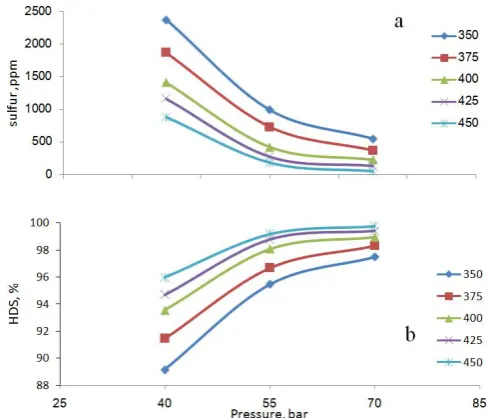
The effect of pressure on product quality was examined between 40 and 70 bar for the feedstock. Figure (2a) shows the effect of the reaction pressure on sulfur content at temperature
ranges of 350o to 450oC with constant LHSV of 0.5 h-1, and
ratio of hydrogen-to-oil ratio = 400 L L-1. The data for the
feedstock show that the growth in reactor pressure, improved product quality (Kim and Choi, 1987). The effect of pressure on HDS for catalyst is applied in Figure (2b). It can be noted from the figure that the rate of HDS reaction is faster during the pressure range from 40 to 55 bars. It implies that the CoMo-S catalyst shows a value of HDS activity as 91.4 wt% at 40 bars, then increases to 96.7 wt% at 55 bars (at 375oC). The figure also revealed that a maximum predicted HDS activity was attained. However, very high pressures reduce the activity of the catalyst, owing to the adhesion of carbon to its surface
(El Kady et al., 2010; Vogelaar et al., 2003). The hydrogen
pressure has a much smaller impact on the effectiveness of HDS activity, even if the increase of pressure as high as 55-70 bars, which will make a moderate decrease from 450 ppm-wt to 130 ppm-wt in residual sulfur. One other potential cause for the phenomenon of data indicated in Fig.2 could be the extra reduction of active Co-Mo-S sites on the catalyst surfaces,
which is responsible for direct desulfurization (DDS). This might give the explanation for the low HDS activity effect at higher hydrogen pressure (Fig.2) in all the temperature ranges and hydrogen pressure (from 55 to 70 bars). Desulfurized via the DDS pathway, for which the Co-Mo-S catalyst has the highest HDS activity.
Figure 2. Effect of hydrogen pressure on total sulfur content (a) and sulfur reduction (HDS) (b) of HGO under variables reaction temperature
Effect of space velocity
The effect of space velocity on product sulfur content was
studied between 0.5 –1.0 h-1 for the HVG feedstock. Figure (3)
shows the effect of LHSV of sulfur at 55 bars and 350-450oC at
a constant ratio of hydrogen-to-oil ratio 400 L L-1. The data
[image:3.595.38.292.310.433.2]show that the decrease in LHSV resulted in improved product quality. The sulfur content of the hydrotreated product is approximately proportional to the LHSV and hence the contact time. Therefore, the heavier the HDT feedstock the lower the LHSV required. The changes in LHSV can have a slight significant effect on the HDS activity.
[image:3.595.314.556.529.719.2]Effect of Operating Conditions on Product Aromatic Content
Most of the environmental legislation in the world has focused on the concentration of aromatic in gas oil. Aromatic saturation in hydrotreating (HDT) process begins with the partial saturation of multiple-ring aromatics. Monoaromatics are significantly more difficult to saturate. With low-severity processing, the monoaromatics content may actually increase as the maturing compounds are saturated. Despite the saturation of aromatic generally increases the cetane index of a
particular feedstock; the relative improvements variable
(Rodríguez and Ancheyta, 2004; Jarullah et al., 2011;
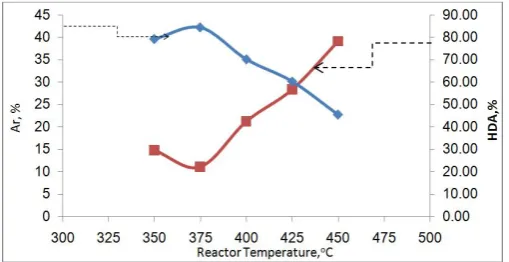
Choudhary, 2007). The data of Figure (4) indicate that the product aromatic contents were decreased as reaction
temperature increased up to 3750C, and then increased as the
temperature rose from 3750C to 4500C, 10 to 40 wt. %,
respectively. The product aromatic content shown the classical behavior when temperature increases in the range of 350- 450 that decrease in total aromatic. It means that the reversibility of the aromatic saturation reaction was observed at higher
temperatures (i.e. 4500C at 55 bars), and reached 40 wt. %. The
best aromatic conversion was obtained by the mild severe
combination of temperatures, 3500 and 3750C and 0.5 h-1
LHSV, and the reduction in aromatic was from 72 to 15 and 10 wt. % of these conditions, respectively. Literature information
(Lylykangas et al., 2002) on kinetic studies of aromatic
hydrogenation in industrial feedstocks such as crude and synthetic middle distillates is relatively scarce, probably due to the complexity of the reactions. The reverse reaction was, nevertheless, not taken into account in this approach. The conversion of aromatic to naphthenes is a reversible reaction and affects a chemical equilibrium which is temperature dependent. Thus, the data shown in Figure (4) show that the aromatic contents of the liquid products decreases with
increasing reaction , up to 3750C , but then increases as the
temperature is further raised from 375oC to 450 oC, that is, the
[image:4.595.306.565.403.728.2]aromatic contents pass through a minimum (Ibrahim and A'reff, 2009).
Figure 4. Effect of reactor temperature on (a) aromatic content of hydrotreated HGO and (b) its removal (HDA) at different
temperature
On the other hand, high aromatic content in gas oil is suspected to contribute to undesired emissions in exhaust gases from
diesel engines (Maiboom et al., 2008). In HDT process the
aromatic saturation requires high severity (Chowdhury et al.,
2002). The growth in reactor pressure at 55 bar, reactor
temperature up to 375oC and a decrease in liquid hourly space
velocity at constant hydrogen to feed ratio at Flow rate, 400 L
L-1 lead to increase the hydrogenation of aromatic as shown in
Figures (4-6).
As exemplified in Figure (4), the consequence of temperature
on the aromatic saturation of the CoMo/Al2O3 catalyst, the
hydrogenation of aromatic gradually increases when the
temperature is raised from 350 to 375 oC, and then starts to
decrease with further increase of temperature. This is because, AHYD is kinetically and thermo-dynamically controlled: in the
kinetically controlled region (up to 375 oC), an increase in
temperature increases the rate of forward reaction
(hydrogenation), resulting in a higher hydrogenation of aromatic. At higher temperatures, thermodynamic effects dominate, hence contributing to a shift in equilibrium in favor of the reverse reaction (dehydrogenation), which results in more aromatic being produced by the hydrotreated products
and AHYD passing through a minimum (Owusu-Boakye et al.,
2005).
The HDA activity strongly depended on the total pressure Figure (5). With increasing the total pressure from 40 to 70 bars, the HDA degree increased from 41.53 to 85.42 using
CoMo/Al2O3 catalyst at different temperature. The effect of
LHSV on HDA is given in Figure (6). From Figure (6), it is observed that HDA degree increased by decreasing LHSV due to increase in reaction time. For example, the HDA degree
increased from 23.47 to 84.58 wt. % for CoMo/Al2O3 with
[image:4.595.307.562.412.566.2]decrease in LHSV from 1.0 to 0.5 h-1 at different temperature.
[image:4.595.38.293.514.645.2]Figure 5. Effect of reactor pressure on hydridearomatization (HDA) of hydrotreated HGO at different temperature
[image:4.595.306.567.584.725.2]Overall Gas Oil HDS and HDA Kinetics
Data available in the literature on kinetic parameters evaluation
and modeling for hydrodesulfurization and
hydrodearomatization reactions are normally derived using the
Power Law and Langmuir-Hinshelwood models (Boahene
et al., 2013; Bej et al., 2006). The kinetics for sulfur removal
from gas oil is complex and depends on the distribution of sulfur compounds and degree of conversion. Although the kinetics of HDS of some model sulfur compounds have been reported in the literature (Rodríguez and Ancheyta, 2004). This is likely referable to the complexity of the reactions caused by the comportment of a great mixture of sulfur compounds with
different reactivates (Mapiour et al. 2010). For industrial
feedstocks, the structural differences between the sulfur containing molecules make it impractical to make a complex rate equation to describe the HDS kinetics, thus, the present work uses conventional power law kinetic expression. Data from both HDS and HDA studies fitted a first order reaction model quite satisfactorily, in accord with the results of others who have used a similar feedstock and the reactor (Shaban
2005; Boahene et al., 2013). And so, the following rate
equations can be applied for calculating rate constants:
ln =
ln =
Where SF; sulfur content in the feedstock, AF; total aromatic
content in the feedstock, Sp; sulfur content in the product, AP;
total aromatic content in the product, LHSV; liquid hourly
space velocity (Mohamed et al., 2013). Values of apparent rate
constants kS and kA were evaluated from experimental data by
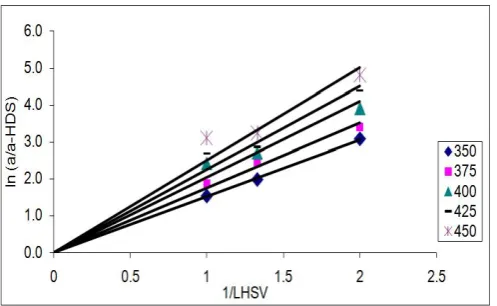
plotting ln Sf /Sp or ln Af /Ap against (LHSV)
-l
[image:5.595.309.558.47.197.2]at five different temperatures for the investigated catalyst (Figures 7,8).
Figure 7. First Order Plot of Hydrodesulfurization (HDS) at different temperature
The figures proved that the observational data are easily fitted to the first order model and the results indicate that the kinetics of desulfurization and dearomatization of gas oil can be
described well with the first-order equation (Deraz et al.,
[image:5.595.308.558.246.398.2]2010). Hence, the rate constants for different temperatures were calculated.
[image:5.595.308.559.446.602.2]Figure 8. First Order Plot of Hydrodearmatization (HDA) at different temperature
Figure 9. Arrhenius Plot of Hydrodesulfurization (HDS) at different temperature
Figure 10. Arrhenius Plot of Hydrodearmatization (HDA) at different temperature
Correlation coefficients larger than 0.96 were obtained, as can be seen in Figures (9,10). These results agree with those
reported in the literature (Mapiour et al., 2010), in contrast to
the close to the first order behavior typically observed in
individual model compound studies (Mapiour et al., 2010). The
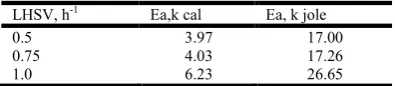
[image:5.595.40.289.483.636.2]HDS, HDA proceeds and the sulfur, aromatic concentration decrease Figure (7,8). The activation energies (EA) for HDS and HDA were calculated by plotting the inverse of absolute temperatures against the logarithm of kinetic constants according to the Arrhenius equation. Activation energies of
31.43 kJ mol-1 for HDS and 36.89 kJ mol-1 for HDA were
obtained over the sulfide CoMo/Al2O3 at best conditions
[image:6.595.64.262.188.231.2]Tables (2,3) (El Kady et al., 2010; Mapiour et al., 2010).
Table 2. The apparent activation energies (EA) for HDS
LHSV, h-1 Ea,k cal Ea, k jole
0.5 3.97 17.00
0.75 4.03 17.26
1.0 6.23 26.65
Table 3. The apparent activation energies (EA) for HDA
LHSV, h-1 Ea,k cal Ea, k jole
0.5 8.62 36.89
0.75 9.89 42.34
1.0 13.07 55.92
Acknowledgements
It is indebted to present our thanks to the Egyptian Petroleum Research Institute (EPRI) who presented finance support of this research and covered the expense of all measurements.
Conclusion
Heavy gas oil hydrotreating overcome/λ-Al2O3 catalyst was
considerably influenced by operating temperatures, pressure, and liquid hourly space velocity. HDT of the feedstock to produce low-sulfur liquid products could be achieved by varying any one of these process parameters studied. The data showed that in general, product quality was improved as the reaction temperature and pressure increased or space velocity decreased. It means that sulfur and aromatic were upgraded. However, aromatic were always greater for HGO. The HDS and HDA activation energies decreased with the quantity of
HGO in the range 26.65 – 17.00 and 55.92 - 36.89
KJ/ Mol, respectively. The desulfurization and the
dearomatization process of gas oil is fitted with different temperature. The results are shown that the orders of the reaction are approximately equal to 1 and the correlation coefficients are above 0.98. The results show that the kinetics of desulfurization of gas oil can be described well with the first-order equation. The importance for studying the impact of HGO product quality when in HDT reaction arises from the need for efficient design and simulation of units and a better understanding of catalyst behavior and the effect of the process conditions. This also allows a better insight into the behavior of an existing reactor.
REFERENCES
Ancheyta J., Sánchez S. and Rodríguez M.A. 2005. Kinetic modeling of hydrocracking of heavy oil fractions, Catalysis Today, 109, 1–4 (30): 76–92.
Ancheyta-JuaÂreza, J. 1999. Enrique Aguilar-RodrõÂgueza,
Daniel Salazar- Soteloa,Gerardo Betancourt-Rivera,
Miguel Leiva-Nuncio, Hydrotreating of straight run gas
oil±light cycle oil blends, Applied Catalysis A: General
180: 195-205.
Bej, S.K., Dalai, A.K. and Adjaye, D., 2006. J. Ind. Eng.
Chem. Research, 45: 544-552.
Beškoskia, V.P., Milića J., Mandićb B., Takićb M. and Vrvićb M.M. 2008. Removal of organically bound sulfur from oil shale by iron(III)-ion generated–regenerated from pyrite by the action of Acidithiobacillus ferrooxidans —
Research on a model system, Hydrometallurgy, 94 (1–4):
8–13.
Boahene, P.E., Soni, K.K., Dalai, A.K. and Adjaye, J. 2013. Hydroprocessing of Heavy Gas Oils Using Fe W/SPA-15 Catalysts: Experimentals, optimization of metal loading,
and kinetic study, J. Catal., Today, 207.
Choudhary T.V., 2007 Structure-reactivity-Mechanistic
Consideration in Heavy Oil Desulfurization, Ind. Eng.
Chem. Res., 46 (25) 8363-8370.
Chowdhury, R., Pedernera, E. and Reimert, R. 2002. Trickle-bed reactor model for desulfurization and dearomatization
of diesel. J AICHE, 48 126–35.
Deraz N.M., Alarifi A. and Shaban S.A. 2010. Removal of sulfur from commercial kerosene using nanocrystalline
NiFe2O4 based sorbents, J. Saudi Chemical Society, 14,
357–362.
Domínguez-Crespoa, M.A., Díaz-Garcíaa L., Arce-Estradac E.M. and Ramírez-Menesesb E. 2008. HDS, HDN and HDA activities of nickel–molybdenum catalysts supported
on alumina, Fuel Processing Technology, 89 (8): 788–796.
El Kady, F.Y.A., Abd El Wahed, M.G., Shaban, S. and Abo El Naga, A.O., 2010. Hydrotreating of heavy gas oil using
CoMo/ʎ-Al2O3 catalyst prepared by equilibrium
deposition filtration, J. Fuel., 89: 3193–3206.
Ferdous, D., Dalai, A.K. and Adjaye, J., 2006. Comparison of product selectivity during hydroprocessing of bitumen derived gas oil in the presence of NiMo/Al2O3 catalyst
containing boron and phosphorus. Fuel, 85: 1286–97.
Gawel I., Bociarska D. and Biskupski P. 2005. Effect of asphaltenes on hydroprocessing of heavy oils and residua, Applied Catalysis A: General, 295 (1): 89–94.
Hanafi, S. A. and Mmdouh S. M., 2011. Recent Trends in the Cleaning of Diesel Fuels via Desulfurization Process", Energy Sources, Part A: Recovery, Utilization, and Environmental Effects, 33(6) 495-511.
Hanafy S.A. and Doheim M.M., 2000. Desulfurization and
Dearomatization of Local Gas Oil, Egypt. J. Petrol., 9: 39.
Herskovitz M. and Smith, J.M. 1978. Liquid distribution in trickle-bed reactors: part II. Tracer studies. J AIChE, 24: 450–4.
Ibrahim M. M. and A'reff H.A. 2009. Kinetic Models Study of Hydrogenation of Aromatic Hydrocarbons in Vacuum Gas
Oil and Basrah Crude Oil Reaction, Tikrit Journal of Eng.
Sciences, 16 (4) 1-11
Ibrahim, M.M., A'reff, H.A. and Jarallah A.T. 2009. Kinetic
Models Study of Hydrogenation of Aromatic
Hydrocarbons in Vacuum Gas Oil and Basrah Crude Oil
Reaction, Tikrit Journal of Eng. Sciences, 16 (4) 1-11.
Jarullah A.T., Mujtaba I.M. and Wood A.S. 2011. Improvement of the Middle Distillate Yield Crude Oil
Hydrotreatment in A Trickle- Bed Reactor, Energy and
[image:6.595.58.267.260.303.2]Kim K.L., Choi K.S., 1987. Int. Chem. Eng., 27: 340-357. Lylykangas M.S., Rautanen P.A. and Krause A. O.I. 2002.
Liquid-Phase Hydrogenation Kinetics of Multicomponent
Aromatic Mixtures on Ni/Al2O3, Ind. Eng. Chem. Res., 41
(23) 5632–5639.
Ma, S.T., Zhao Y. and Han Z.B. 2010. Hydrodesulfurization and hydrodearomatization activities of catalyst containing
Ti-AlPO4-5 on FCC LCO, The 13th Asia Pacific
Confederation of Chemical Engineering Congress, 5-8.
Maiboom, A., Tauzia, X. and Hétet J.F. 2008. Experimental study of various effects of exhaust gas recirculation (EGR) on combustion and emissions of an automotive direct
injection diesel engine, Energy, 33 (1) 22–34.
Mapiour, M., Sundaramurthy, V., Dalai, A.K. and Adjaye, J. 2010. Effects of the operating variables on hydrotreating of heavy gas oil: Experimental, modeling, and kinetic studies, 89(9)1.
Mapiour, M., Sundaramurthy, V., Dalai, A.K. and Adjaye, J., 2010. Effects of the operating variables on hydrotreating of heavy gas oil: Experimental, modeling, and kinetic studies Fuel, 89 (9) 2536-2543.
Mohamed L.K., El Kady F.Y. and Shaban S.A., 2013. The Effect of Boron on the Activity of Hydrotreating
Co-Mo/Al2O3 Catalyst, Energy Sources, Part A, 35, 659–670.
Owusu-Boakye A, Dalai AK, Ferdous D. and Adjaye J. 2005.
Experimental and kinetic studies of aromatic
hydrogenation, hydrodesulfurization, and
hydrodenitrogenation of light gas oils derived from
Athabasca bitumen. Ind. Eng. Chem. Res., 44, 7935–44.
Riad, M. and Mikhail, S. 2012. Oxidative Desulfurization of Light Gas Oil using Zinc Catalysts Prepared Via Different
Techniques, Catalysis Science and Technology, 2,
1437-1446.
Rodríguez, M. A. and Ancheyta, J. 2004. Modeling of
Hydrodesulfurization (HDS), Hydrodenitrogenation
(HDN), and the Hydrogenation of Aromatics (HDA) in a Vacuum Gas Oil Hydrotreater, Energy and Fuels - ENERG FUEL 04, 18(3).
Rodríguez, M. A. and Ancheyta J., 2004. Modeling of
Hydrodesulfurization (HDS), Hydrodenitrogenation
(HDN), and the Hydrogenation of Aromatics (HDA) in a
Vacuum Gas Oil Hydrotreater, Energy Fuels, 18 (3), pp
789–794.
Shaban, S.A. 2005. Physicochemical studies on catalysts used in hydrodesulfurization process prepared by traditional and new methods. PhD dissertation, Ain Shams University. SK B. and SK M., 2003. UT T., 2004. Search for an efficient
4,6-DMDBT hydrodesulfurization catalyst: a review of
recent studies. J. Energy Fuels., 18: 1227-1237.
Song, C. 2003. An overview of new approaches to deep desulfurization for ultra-clean gasoline, diesel fuel and jet fuel, Catalysis Today, 86, 1–4 (1): 211–263.
Song, C. and Ma, X., 2003. New design approaches to ultra-clean diesel fuels by deep desulfurization and deep
dearomatization. J. Appl. Catal., B, 41: 207-238.
Stanislaus A., Marafi A. and Rana M.S. 2010. Recent advances in the science and technology of ultra low sulfur diesel (ULSD) production, Catalysis Today, Volume 153, Issues 1–2, 19: 1–68
Steiner, P. and Blekkan EA., 2002. Catalytic
hydrodesulphurization of light gas oil at over Ni–Mo catalyst. Fuel Process Technol, 79: 1–12.
van Klinken, J. and van Dongen RH. 1980. Catalyst dilution for improved performance of laboratory trickle flow
reactor. Chem. Eng. Sci., 35: 59–66.
Vogelaar B.M., Kagami N., Langeveld A. D.-van, Sonja Eijsbouts and Moulijn J.A. 2003. Active Sites And
Activity IN HDS Catalysis THE Effect of H2and H2S
Partial Pressure, Prepr. Pap.-Am. Chem. Soc., Div. Fuel
Chem, 48 (2), 548