TopicCheck: Interactive Alignment for Assessing Topic Model Stability
Jason Chuang∗Margaret E. Roberts†
Political Science U. California, San Diego
Brandon M. Stewart†
Government Harvard University [email protected]
Rebecca Weiss†
Communication Stanford University [email protected]
Dustin Tingley Government Harvard University [email protected]
Justin Grimmer Political Science Stanford University [email protected]
Jeffrey Heer Computer Science & Eng.
University of Washington [email protected]
Abstract
Content analysis, a widely-applied social sci-ence research method, is increasingly being supplemented by topic modeling. However, while the discourse on content analysis cen-ters heavily on reproducibility, computer sci-entists often focus more on scalability and less on coding reliability, leading to growing skep-ticism on the usefulness of topic models for automated content analysis. In response, we introduce TopicCheck, an interactive tool for assessing topic model stability. Our contri-butions are threefold. First, from established guidelines on reproducible content analysis, we distill a set of design requirements on how to computationally assess the stability of an automated coding process. Second, we devise an interactive alignment algorithm for match-ing latent topics from multiple models, and en-able sensitivity evaluation across a large num-ber of models. Finally, we demonstrate that our tool enables social scientists to gain novel insights into three active research questions.
1 Introduction
Content analysis — the examination and systematic categorization of written texts (Berelson, 1952) — is a fundamental and widely-applied research method in the social sciences and humanities (Krippendorff, 2004a), found in one third of all articles published in major communication journals (Wimmer and Do-minick, 2010). Initial reading and coding, two labor-∗Work completed while at Stanford University and the Uni-versity of Washington, and submitted while at the Allen Insti-tute for Artificial Intelligence.
†These authors contributed equally to this paper.
intensive steps in the analysis process, are increas-ingly replaced by computational approaches such as statistical topic modeling (Grimmer, 2013; McFar-land et al., 2013; Roberts et al., 2014a).
However, while the discourse on content analysis overwhelmingly centers around the reproducibility and generalizability of a coding scheme (Krippen-dorff, 2004b; Lombard et al., 2002), computer sci-entists tend to focus more on increasing the scale of analysis and less on establishing coding reliabil-ity. Machine-generated latent topics are often taken on faith to be a truthful and consistent representa-tion of the underlying corpus, but in practice ex-hibit significant variations among models or mod-eling runs. These unquantified uncertainties fuel growing skepticism (Schmidt, 2012) and hamper the continued adoption (Grimmer and Stewart, 2011) of topic models for automated content analysis.
In response, we introduce TopicCheck, an interac-tive tool for assessing the stability of topic models. Our threefold contributions are as follows.
First, from established guidelines on reproducible content analysis, we distill a set of design require-ments on how to computationally assess the stabil-ity of an automated coding process. We advocate for the use of multiple models for analysis, a user-driven approach to identify acceptable levels of coding un-certainty, and providing users with the capability to inspect model output at all levels of detail.
Second, we devise an interactiveup-to-one align-ment algorithm for assessing topic model stability. Through repeated applications of a topic model to generate multiple outputs, our tool allows users to inspect whether the model consistently uncover the
same set of concepts. We allow users to interactively define groupings of matching topics, and present the aligned topics using an informative tabular lay-out, so that users can quickly identify stable topical groupings as well as any inconsistencies.
Finally, in three case studies, we demonstrate that our tool allows social scientists to gain novel in-sights into active and ongoing research questions. We provide an in-depth look at the multi-modality of topic models. We document how text pre-processing alters topical compositions, causing shifts in defini-tions and the removal of select topics. We report on how TopicCheck supports the validity of newly-proposed communication research methods.
2 Background
Manual approaches to extract information from tex-tual data — reading the source documents and codi-fying notable concepts — do not scale. For example, Pew Research Center produces the News Coverage Index (2014) to measure the quality of news report-ing in the United States. Intended to track 1,450 newspapers nationwide, their purely manual efforts only cover 20 stories per day. Researchers stand to lose rich details in their data when their attention is limited to a minuscule fraction of the available texts. Critical of approaches that “[make] restrictive as-sumptions or [are] prohibitively costly,” Quinn et al. (2010) discuss the use of topic models (Blei et al., 2003) to enable large-scale text analysis by using machine-generated latent topics to approximate pre-viously manually-crafted codes. Automated content analysis has enabled groundbreaking massive stud-ies (Grimmer, 2013; McFarland et al., 2013; Roberts et al., 2014a). While this initial uptake of topic mod-els is encouraging, an over-emphasis on scalability and the use of a single model for analysis invites skepticism and threatens continued adoption.
2.1 Coding Reliability & Growing Skepticism
Coding reliability is critical to content analysis. When social scientists devise a coding scheme, they must clearly articulate the definition of their codes in such a way that any person can consistently apply the given codes to all documents in a corpus.
Despite high labor cost, content analysis is typi-cally conducted with multiple coders in order to
es-tablish coding reliability; the proper application of reliability measures is heavily discussed and debated in the literature (Krippendorff, 2004b; Lombard et al., 2002). In contrast, software packages (McCal-lum, 2013; ˇReh˚uˇrek and Sojka, 2010) and graphical tools (Chaney and Blei, 2014; Chuang et al., 2012b) have made topic models accessible, cheap to com-pute, easy to deploy, but they almost always present users with a single model without any measure of uncertainty; we find few studies on topic model sen-sitivity and no existing tool to support such analyses. Schmidt (2012) summarizes the view among dig-ital humanists, a group of early adopters of topic models, on the experience of working with uncer-tain modeling results: “A poorly supervised ma-chine learning algorithm is like a bad research as-sistant. It might produce some unexpected constel-lations that show flickers of deeper truths; but it will also produce tedious, inexplicable, or misleading re-sults.. . .[Excitement] about the use of topic models for discovery needs to be tempered with skepticism about how often the unexpected juxtapositions. . .
will be helpful, and how often merely surprising.” Researchers increasingly voice skepticism about the validity of using single models for analysis. In a comprehensive survey of automatic content anal-ysis methods, Grimmer et al. (2011) highlight the need to validate models through close reading and model comparison, and advise against the use of software that “simply provide the researcher with output” with no capability to ensure the output is conceptually valid and useful. Chuang et al. (2012a) report that findings from one-off modeling efforts may not sustain under scrutiny. Schmidt (2012) ar-gues that computer-aided text analysis should incor-porate competing models or “humanists are better off applying zero computer programs.”
2.2 Uncertainties in Topic Models
While topic models remove some issues associ-ated with human coding, they also introduce new sources of uncertainties. We review three factors re-lated to our case studies: multi-modality, text pre-processing, and human judgment of topical quality.
demonstrate that the spread of topics can lead to con-tradictory analysis outcomes. The authors note that optimal coding may not necessarily correspond to models that yield the highest value of the objective function, but there is currently a paucity of computa-tional tools to inspect how the various modes differ, help researchers justify why one local mode might be preferred over another on the basis of their do-main knowledge, or for an independent researcher to validate another’s modeling choices.
Fokkens et al. (2013) report widespread repro-ducibility failures in natural language processing when they replicate — and fail to reproduce — the results reported on two standard experiments. The authors find that minor decisions in the modeling process can impact evaluation results, including two factors highly relevant to topic modeling: differ-ences in text pre-processing and corpus vocabulary.
The word intrusion test (Chang et al., 2009; Lau et al., 2014) is considered the current state-of-the-art approach to assess topical quality, and captures human judgment more accurately than other topical coherence measures (Stevens et al., 2012; Wallach et al., 2009). However, in this approach, users inspect only a single latent topic at a time without access to the overall set of topics. As a part of this paper, we investigate whether exposure to multiple competing models affects human judgment, and whether model consistency impacts topical coherence.
2.3 Reproducibility of a Coding Process
While no single definition exists for the process of content analysis, a frequently-cited and wide-applied template is provided by Krippendorff (1989; 2004b) who recommends four steps to safeguard the reproducibility of a coding process. Practitioners must demonstratecoder reliability,a decisive agree-ment coefficient, an acceptable level of agreement, and testindividual variables.
To the best of our knowledge, our paper is the first to convert guidelines on reproducible human coding into software design requirements on validating au-tomated content analysis. Our interactive alignment algorithm is the first implementation of these guide-lines. Our case studies represent the first reports on the impact of computationally quantifying topic model uncertainties, situated within the context of real-world ongoing social science research.
Much of the research on topic modeling focuses on model designs (Blei et al., 2004; Blei and Laf-ferty, 2006; Rosen-Zvi et al., 2004) or inference al-gorithms (Anandkumar et al., 2012). Our tool is complementary to this large body of work, and sup-ports real-world deployment of these techniques. In-teractive topic modeling (Hu et al., 2014) can play a key role to help users not only verify model consis-tency but actively curate high-quality codes; its in-clusion is beyond the scope of a single conference paper. While supervised learning (Settles, 2011) has been applied to content analysis, it represents the ap-plication of a pre-defined coding scheme to a text corpus, which is different from the task of devising a coding scheme and assessing its reliability.
3 Validation Tool Design Requirements
A measure of coding reproducibility is whether a topic model can consistently uncover the same set of latent topics. We assume that users have a large number of topic model outputs, presumed to be iden-tical, and that the users wish to examine unexpected variations among the outputs. To guide tool devel-opment, we first identify software design require-ments, to meet the standards social scientists need to demonstrate producible coding.
3.1 Topical Mapping & Up-to-One Alignment
A key difference exists between measuring inter-coder agreement and assessing topic model varia-tions. In a manual coding process, human coders are provided code identifiers; responses from different coders can be unambiguously mapped onto a com-mon scheme. No such mapping exists acom-mong the output from repeated runs of a topic model. Valida-tion tools must provide users witheffective means to generate topical mapping.
However, the general alignment problem of op-timally mappingmultipletopics from one model to
be grouped together, obscuring critical mismatches. Instead, up-to-one mapping allows for two poten-tial outcomes, both of which correspond directly to the intended user task: recognize consistent pat-terns across the models (when alignment occurs) and identify any deviations (when alignment fails).
3.2 Guidelines Adapted for Topic Models
We synthesize the following four requirements from Krippendorff’s guidelines (2004b).
To calculate the equivalent of coder reliability, we advocate the use of multiple models to deter-mine modeling consistency, which may be deter-mined from the repeated applications of the same topic model, a search through the parameter space of a model, or the use of multiple models.
Selecting an appropriateagreement coefficient de-pends on the underlying data type, such as binary, multivariate, ordered, or continuous codes (Cohen, 1960; Holsti, 1969; Krippendorff, 1970; Osgood, 1959; Scott, 1995). No widely-accepted similarity measure exists for aligning latent topics, which are probability distributions over a large vocabulary. We argue that validation tools must be sufficiently mod-ular, in order to accept any user-defined topical similarity measurefor aligning latent topics.
Acceptable level of agreementdepends on the pur-pose of the analysis, and should account for the costs of drawing incorrect conclusions from a cod-ing scheme. For example, do “human lives hang on the results of a content analysis?” (Krippendorff, 2004b). Validation tools mustallow users to set the appropriate acceptable level of agreement, and help users determine — rather than dictate — when topic models match and what constitutes reasonable variations in the model output.
Finally, Krippendorff points out that aggregated statistics can obscure critical reliability failures, and practitioners must testindividual variables. We in-terpret this recommendation as the need topresent users with not a single overall alignment score but details at all levels: models, topics, and con-stituent words within each latent topic.
4 Interactive Topical Alignment
We introduce TopicCheck, an implementation of our design specifications. At the core of this tool is an interactive topical alignment algorithm.
4.1 Hierarchical Clustering with Constraints
Our algorithm can be considered as hierarchical ag-glomerative clustering with up-to-one mapping con-straints. As input, it takes in three arguments: a list of topic models, a topical similarity measure, and a matching criterion. As output, it generates a list of topical groups, where each group contains a list of topics with at most one topic from each model.
At initialization, we create a topical group for every topic in every model. We then iteratively merge the two most similar groups based on the user-supplied topical similarity measure, provided that the groups satisfy the user-specified matching criterion and the mapping constraints. When no new groups can be formed, the algorithm terminates and returns a sorted list of final topical groups.
During the alignment process, the following two invariants are guaranteed: Every topic is always as-signed to exactly one group; every group contains at most one topic from each model. A topic modelm
consists of a list of latent topics. A latent topictis represented by a probability distribution over words. A topical groupgalso consists of a list of latent top-ics. Let|m|,|t|, and|g|denote the number of mod-els, topics, and groups respectively. We create a total of|g| = |m| × |t|initial topical groups. Although
|g|decreases by 1 after each merge,|g| ≥ |t|at all times. At the end of alignment,|g|=|t|if and only if perfect alignment occurs and every group contains exactly one topic from each model.
Users may supply any topical similarity measure that best suits their analysis needs. We select cosine similarity for our three case studies, though our soft-ware is modular and accepts any input. As a first implementation, we apply single-linkage clustering criteria when comparing the similarity of two topical groups. Single-linkage clustering is computationally efficient (Sibson, 1973), so that users may interact with the algorithm and receive feedback in real-time; our procedure generalizes to other linkage criteria such as complete-linkage or average-linkage.
ex-Figure 1: This chart shows topics uncovered from 13,250 political blogs (Eisenstein and Xing, 2010) by 50 structural topic models (Roberts et al., 2013). Latent topics are represented as rectangles; bar charts within the rectangles represent top terms in a topic. Topics belonging to the same model are arranged in a column; topics assigned to the same group are arranged in a row. This chart is completely filled with topics only if perfect alignment occurs. When topics in a model fail to align with topics in other models, empty cells appear in its column. Similarly, when topics in a group are not consistently uncovered by all models, empty cells appear in its row. Hovering over a term highlights all other occurrences of the same term. Top terms belonging to each topical group are shown on the right; they represent the most frequent words over all topics in the group, by summing their probability distributions.
Figure 2: Continued from Figure 1, users may decrease the similarity threshold to generate additional groupings of topics that are less consistent, uncovered by as few as 3 of the 50 modeling runs.
hausted, at which point the procedure terminates. Users can specify a similarity threshold, below which topical groups are considered to differ too much to be matched. Two groups are allowed to merge only if both of the following conditions are met: their similarity is above the user-defined
sim-ilarity threshold and every topic in the combined group belongs to a different model.
4.2 Tabular Layout and User Interactions
[image:5.612.79.528.486.584.2]and words. Users can interact with the algorithm, redefine matching criteria, and inspect the aligned models interactively in real-time.
We arrange topical groups as rows and topic mod-els as columns as shown in Figure 1. A topic as-signed to group gi and belonging to model mj is placed at the intersection of row i and column j. Our up-to-one mapping ensures at most one topic per each cell. A table of size |g| × |m| will only be completely filled with topics if perfect alignment occurs. When topics in modelmj fail to align with topics in other models, empty cells appear in column
j. Similarly, when topics in groupgi are not consis-tently uncovered by all models, empty cells appear in rowi. Within each topic, we show the probability distribution of its constituent words as a bar chart.
Users define three parameters in our tool. First, they may set the matching criteria, and define how aggressively the topics are merged into groups. Sec-ond, users may alter the number of topical groups to reveal. Rather than displaying numerous sparse groups, the tool shows only the top groups as deter-mined by their topical weight. Topics in all remain-ing groups are placed at the bottom of the table and marked asungrouped. Third, users may adjust the number of top terms to show, as a trade-off between details vs. overview. Increasing the number of terms allows users to inspect the topics more carefully, but the cells take up more screen space, reducing the number of visible groups. Decreasing the number of terms reduces the size of each cell, allowing users to see more groups and observe high-level patterns.
The tabular layout enables rapid visual assess-ment of consistency within a model or a group. We further facilitate comparisons via brushing and linking (Becker and Cleveland, 1987). When users hover over a word on the right hand side or over a bar within the bar charts, we highlight all other occur-rences of the same word. For example, in Figure 1, hovering over the termeconomreveals that the word is common in three topical groups.
5 Deployment and Initial Findings
We implemented our alignment algorithm and user interface in JavaScript, so they are easily accessi-ble within a web browser; topical similarity is com-puted on a Python-backed web server. We report
user responses and initial findings from deploying the tool on three social science research projects. Interactive versions of the projects are available at
http://content-analysis.info/naacl.
5.1 A Look at Multi-Modal Solutions
We deployed TopicCheck on topic models generated by Roberts et al. (2014b) to examine how model out-put clusters into local modes. As the models are pro-duced by 50 runs of an identical algorithm with all pre-processing, parameters, and hyper-parameters held constant, we expect minimal variations.
As shown in Figure 1, we observe that the top two topical groups, about Barack Obama and John Mc-Cain respectively, are consistently uncovered across all runs. The third topical group, about the Iraqi and Afghani wars (defined by a broader set of terms) is also consistently generated by 49 of the 50 runs.
Toward the bottom of the chart, we observe signs of multi-modality. Topical groups #15 to #17 represent variations of topics about the economy. Whereas group #15 is about the broader economy, groups #16 and #17 focus on taxes and the finan-cial crisis, respectively. Half of the runs produced the broader economy topic; the other runs generated only one or two of the specialized subtopics. No sin-gle model uncovered all three, suggesting that the inference algorithm converged to one of two distinct local optimal solutions. In Figure 2, by lowering the matching criteria and revealing additional groups, we find that the model continues to produce inter-esting topics such as those related to global warm-ing (group #24) or women’s rights (group #25), but these topics are not stable across the multiple modes.
5.2 Text Pre-Processing & Replication Issues
We conducted an experiment to investigate the ef-fects of rare word removal using TopicCheck. As a part of our research, we had collected 12,000 news reports from five different international news sources over a period of ten years, to study sys-tematic differences in news coverage on the rise of China, between western and Chinese media.
Figure 3: While rare word removal is generally considered to have limited impact on topic model output, we find evidence to the contrary. By varying the removal threshold, for this corpus of international news reports on the rise of China, we observe that topics such as group #11 on the Beijing Olympics begin to disappear. Topics about Hong Kong appear sporadically. On top of the inconsistency issues, different pre-processing settings lead to drifts in topic definitions. For milder removal thresholds (toward the left), group #13 discusses Hong Kong within the context of Taiwan and Macau. With more aggressive filtering (toward the right), group #14 shifts into discussions about Hong Kong itself such asone country two systemsand thespecial administrative region. Unchecked, these seemingly minor text pre-processing decisions may eventually lead researchers down different paths of analysis.
Second, as latent topics are typically defined through their top words, filtering words that occur only in a small fraction of the documents is generally consid-ered to have limited impact on model output.
We trained structural topic models (Roberts et al., 2013) based on a subset of the corpus with 2,398 documents containing approximately 20,000 unique words. We applied 10 different settings where we progressively removed a greater number of rare terms beyond those already filtered by the default settings while holding all other parameters constant. The number of unique words retained by the models were 1,481 (default), 904, 634, 474, 365,
. . ., down to 124 for the 10 settings. We generated 6 runs of the model at each setting, for a total of 60 runs. Removed words are assigned a value of 0 in the topic vector when computing cosine similarity.
We observe significant changes to the model out-put across the pre-processing settings, as shown in Figure 3. The six models on the far left (columns 1 to 6) represent standard processing; rare word re-moval ranges from the mildest (columns 7 to 12) to the most aggressive (columns 55 to 60) as the columns move from left to right across the chart.
While some topical groups (e.g., #1 on the com-munist party) are stable across all settings, many others fade in and out. Group #11 on the Beijing Olympics is consistent under standard processing and the mildest removal, but disappears completely
afterward. We find two topical groups about Hong Kong that appear sporadically. On top of the in-stability issues, we observe that their content drifts across the settings. With milder thresholds, topical group #13 discusses Hong Kong within the context of Taiwan and Macau. With more aggressive filter-ing, topical group #14 shifts into discussions about Hong Kong itself such asone country two systems
and the special administrative region. Unchecked, these minor text pre-processing decisions may lead researchers down different paths of analysis.
5.3 News Coverage & Topical Coherence
Agenda-setting refers to observations by McCombs et al. (1972) that the media play an important role in dictating issues of importance for voters, and by Iyengar et al. (1993) that news selection bias can determine how the public votes. Studying agenda-setting requires assessing the amount of coverage paid to specific issues. Previous manual coding ef-forts are typically limited to either a single event or subsampled so thinly that they lose the ability to consistently track events over time. Large-scale analysis (e.g., for an entire federal election) remains beyond the reach of most communication scholars.
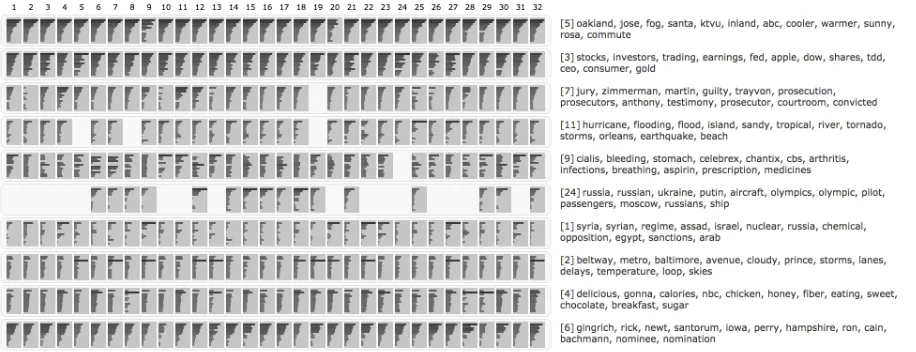
out-Figure 4: To enable large-scale studies of agenda-setting, we applied topic modeling to closed-captioning of over 200,000 hours of broadcasts, to estimate coverage in mainstream news networks. Through TopicCheck, the researchers find consistent topical groups that correspond to known major news categories. Group #9 represents topics about advertisements and valuable data to study the relationships between broadcasters and advertisers.
lets. We conduct word intrusion tests (Chang et al., 2009) on Amazon Mechanical Turk, and obtain over 50,000 user ratings to identify high quality topics. However, to establish topic modeling as a valid re-search method, we must demonstrate the reliability of how we include or exclude topics in our analyses. By applying TopicCheck to 32 runs of the same topic model, as shown in Figure 4, we confirm that the consistent topical groupings capture at least four major known news categories: weather (such as group #5), finance (group #3), major events (group #7 on the Trayvon Martin shooting), and natural dis-asters (group #11 on Hurricane Katrina). We find additional evidence supporting the use of topic mod-els, including the consistent appearance of adver-tising topics (group #9 on the sales of prescription medicine to senior citizens, a major demographic of the broadcast news audience). These topics may en-able studies on the relationship between broadcast-ers and advertisbroadcast-ers, an important but difficult ques-tion to address because few previous studies have the resources to codify advertisement content.
However, event-specific topics tend to appear less consistently (such as group #24 on Russia, its con-flict with Ukraine, and the Sochi Olympics). We note the lack of consistent topics on supreme court cases, an expected but missing news category, which warrants more in-depth investigations.
We compare human judgment of topical quality when examining multiple models and those based
on word intrusion tests. We calculate the aggregated topical coherence scores for each topical grouping. We find that consistent topical groups tend to receive higher coherence scores. However, topics about nat-ural disasters receive low scores with a high variance (avg 0.5371; stdev 0.2497); many of them would have previously been excluded from analysis.
6 Discussions
To many social scientists, statistical models are measurement tools for inspecting social phenom-ena, such as probing recurring language use in a text corpus with topic models. In this light, instru-ments with known performance characteristics — including well-quantified uncertainties and proper coverage — are more valuable than potentially pow-erful but inconsistent modeling approaches.
Our initial findings suggest that a single topic model may not capture all perspectives on a dataset, as evident in the multiple local solutions about the economy, Hong Kong, and natural disasters in the three case studies respectively. By exposing model stability, our tool can help researchers validate mod-eling decisions, and caution against making too gen-eral a claim about any single modeling result.
[image:8.612.78.536.59.235.2]un-folding events may naturally have less stable vocab-ularies. In both cases, detecting and pinpointing re-porting bias is central to the study of agenda-setting. These observations suggest that for certain applica-tions, identifying consistent topics across multiple models may be equally critical as, if not more than, enforcing topical coherence within a single model.
Increasingly, text analysis relies on data-depen-dent modeling decisions. Rare word removal can substantively alter analysis outcomes, but selecting an appropriate threshold requires inspecting the con-tent of a text corpus. TopicCheck can help archive the exact context of analysis, allowing researchers to justify — and readers to verify and challenge — modeling decisions through access to data.
Finally, topic modeling has dramatically lowered the costs associated with content analysis, allowing hundreds of models to be built in parallel. The cur-rent intended user task for TopicCheck is to validate the stability of presumably identical models. We plan to develop additional tools to help social scien-tists design better models, and actively explore the effects of alternative coding schemes.
7 Conclusion
We present TopicCheck for assessing topic model stability. Through its development, we demonstrate that existing research on reproducible manual codi-fication can be transferred and applied to computa-tional approaches such as automated content analy-sis via topic modeling. We hope this work will help computer scientists and social scientists engage in deeper conversations about research reproducibility for large-scale computer-assisted text analysis.
Acknowledgments
This research was supported in part by a grant from the Brown Institute for Media Innovation.
References
Anima Anandkumar, Yi kai Liu, Daniel J. Hsu, Dean P Foster, and Sham M Kakade. 2012. A spectral algo-rithm for latent dirichlet allocation. InNeural Infor-mation Processing Systems (NIPS), pages 917–925. Richard A. Becker and William S. Cleveland. 1987.
Brushing scatterplots. Technometrics, 29(2):127–142. Bernard Berelson. 1952. Content analysis in
communi-cation research. Free Press.
David M. Blei and John D. Lafferty. 2006. Dynamic topic models. InInternational Conference on Machine Learning (ICML), pages 113–120.
David M. Blei, Andrew Y. Ng, and Michael I. Jordan. 2003. Latent Dirichlet allocation. Journal of Machine Learning Research, 3(1):993–1022.
David M. Blei, Thomas L. Griffiths, Michael I. Jordan, and Joshua B. Tenenbaum. 2004. Hierarchical topic models and the nested chinese restaurant process. In
Neural Information Processing Systems (NIPS). Allison June-Barlow Chaney and David M. Blei. 2014.
Visualizing topic models. InInternational Conference on Weblogs and Social Media (ICWSM), pages 419– 422.
Jonathan Chang, Jordan Boyd-Graber, Chong Wang, Sean Gerrish, and David M. Blei. 2009. Reading tea leaves: How humans interpret topic models. In
Neural Information Processing Systems (NIPS), pages 288–296.
Jason Chuang, Christopher D. Manning, and Jeffrey Heer. 2012a. Interpretation and trust: Design-ing model-driven visualizations for text analysis. In
Conference on Human Factors in Computing Systems (CHI), pages 443–452.
Jason Chuang, Christopher D. Manning, and Jeffrey Heer. 2012b. Termite: Visualization techniques for assessing textual topic models. InAdvanced Visual In-terfaces (AVI).
Jacob Cohen. 1960. A coefficient of agreement for nom-inal scales. Educational and Psychological Measure-ment, 20:37–46.
Jacob Eisenstein and Eric Xing. 2010. The CMU 2008 Political Blog Corpus. Carnegie Mellon University. Antske Fokkens, Marieke van Erp, Marten Postma, Ted
Pedersen, Piek Vossen, and Nuno Freire. 2013. Off-spring from reproduction problems: What replication failure teaches us. In Annual Meeting of the Asso-ciation for Computational Linguistics (ACL), pages 1691–1701.
Justin Grimmer and Brandon M. Stewart. 2011. Text as data: The promise and pitfalls of automatic content analysis methods for political texts. Political Analysis, 21(3):267–297.
Justin Grimmer. 2013. Appropriators not position takers: The distorting effects of electoral incentives on con-gressional representation. American Journal of Politi-cal Science, 57(3):624–642.
Ole R. Holsti. 1969. Content analysis for the social sciences and humanities. Addison-Wesley Publishing Company.
Shanto Iyengar and Adam Simon. 1993. News cover-age of the gulf crisis and public opinion: A study of agenda-setting, priming, and framing. Communica-tion Research, 20(3):365–383.
Klaus Krippendorff. 1970. Bivariate agreement coef-ficients for reliability of data. In E. R. Borgatta and G. W. Bohrnstedt, editors,Sociological methodology, pages 139–150. John Wiley & Sons.
Klaus Krippendorff. 1989. Content analysis. In E. Barnouw, G. Gerbner, W. Schramm, T. L. Worth, and L. Gross, editors, International encyclopedia of communication. Oxford University Press.
Klaus Krippendorff. 2004a. Content analysis: An intro-duction to its methodology. Sage, 2nd edition. Klaus Krippendorff. 2004b. Reliability in content
analy-sis: Some common misconceptions and recommenda-tions. Human Communication Research, 30(3):411– 433.
Jey Han Lau, David Newman, and Timothy Baldwin. 2014. Machine reading tea leaves: Automatically evaluating topic coherence and topic model quality. In Conference of the European Chapter of the Asso-ciation for Computational Linguistics (EACL), pages 530–539.
Matthew Lombard, Jennifer Snyder-Duch, and Cheryl Campanella Bracken. 2002. Content analysis in mass communication: Assessment and reporting of intercoder reliability. Human Communication Research, 28(4):587–604.
Andrew McCallum. 2013. MALLET: A machine learning for language toolkit. http://mallet.cs.umass.edu.
Maxwell E. McCombs and Donald L. Shaw. 1972. The agenda-setting function of mass media. Public Opin-ion Quarterly, 36(5):176–187.
Daniel A. McFarland, Daniel Ramage, Jason Chuang, Jeffrey Heer, and Christopher D. Manning. 2013. Dif-ferentiating language usage through topic models. Po-etics: Special Issue on Topic Models and the Cultural Sciences, 41(6):607–625.
C. E. Osgood. 1959. The representational model and relevant research. In I. de Sola Pool, editor,Trends in content analysis, pages 33–88. University of Illinois Press.
Ted Pedersen. 2008. Empiricism is not a matter of faith.
Computational Linguistics, 34(3):465–470.
Pew Research Journalism Project. 2014. News coverage index methodology. http://www.journalism.org/
news index methodology/99/.
Kevin M. Quinn, Burt L. Monroe, Michael Colaresi, Michael H. Crespin, and Dragomir R. Radev. 2010.
How to analyze political attention with minimal as-sumptions and costs. American Journal of Political Science, 54(1):209–228.
Radim ˇReh˚uˇrek and Petr Sojka. 2010. Software frame-work for topic modelling with large corpora. InLREC Workshop on New Challenges for NLP Frameworks, pages 45–50.
Margaret E. Roberts, Brandon M. Stewart, Dustin Tin-gley, and Edoardo M. Airoldi. 2013. The structural topic model and applied social science. InNIPS Work-shop on Topic Models.
Margaret E. Roberts, Brandon Stewart, Dustin Tingley, Chris Lucas, Jetson Leder-Luis, Bethany Albertson, Shana Gadarian, and David Rand. 2014a. Topic mod-els for open-ended survey responses with applications to experiments. American Journal of Political Science. Forthcoming.
Margaret E. Roberts, Brandon M. Stewart, and Dustin Tingley. 2014b. Navigating the local modes of big data: The case of topic models. In R. Michael Alvarez, editor,Data Science for Politics, Policy and Govern-ment. In Press.
Michal Rosen-Zvi, Thomas Griffiths, Mark Steyvers, and Padhraic Smyth. 2004. The author-topic model for authors and documents. InConference on Uncertainty in Artificial Intelligence (UAI), pages 487–494. Benjamin M. Schmidt. 2012. Words alone: Dismantling
topic models in the humanities. Journal of Digital Hu-manities, 2(1).
William A. Scott. 1995. Reliability of content analy-sis:: The case of nominal scale coding. Public Opin-ion Quarterly, 19(3):321–325.
Burr Settles. 2011. Closing the loop: Fast, interactive semi-supervised annotation with queries on features and instances. InEmpirical Methods in Natural Lan-guage Processing (EMNLP), pages 1467–1478. Robin Sibson. 1973. SLINK: an optimally efficient
al-gorithm for the single-link cluster method. The Com-puter Journal, 16:30–34.
Keith Stevens, Philip Kegelmeyer, David Andrzejewski, and David Buttler. 2012. Exploring topic coherence over many models and many topics. In Conference on Empirical Methods on Natural Language Process-ing and Computational Natural Language LearnProcess-ing (EMNLP-CoNLL), pages 952–961.
Hanna M. Wallach, Iain Murray, Ruslan Salakhutdinov, and David Mimno. 2009. Evaluation methods for topic models. InInternational Conference on Machine Learning (ICML), pages 1105–1112.