Original Article
Correlation of platelet function with recurrent
ischemic vascular events in stroke patients
Zhenguang Li*, Jiangshan Zhang*, Jinbiao Zhang, Hairong Sun, Yan Li, Pengfei Wang, Yannan Cong
Department of Neurology, Weihai Municipal Hospital, The Affiliated Hospital of Binzhou Medical College, 70 Hep
-ing Street, Weihai 264200, Shandong Province, China. *Equal contributors.
Received September 18, 2016; Accepted November 26, 2016; Epub April 15, 2017; Published April 30, 2017
Abstract: Platelet activation and aggregation, as well as thrombosis, play an important role in the pathological and physiological processes of recurrent ischemic vascular events in stroke patients. The purpose of this study is to in-vestigate the correlation of platelet function and recurrent ischemic vascular events in the secondary prevention of stroke. A total of 350 stroke patients within 72 h of onset from September 2014 to April 2015 were included in this study. The patients were administered aspirin starting from the day of admission. After 7-10 days, the platelet ag-gregation ratio was detected using method with continuous platelet counting, and the baseline data were recorded. The patients underwent a 6-month follow-up period, and the recurrent ischemic vascular events were observed. Logistic regression analysis was performed to obtain the risk factors for recurrent ischemic vascular events and the receiver operating characteristic (ROC) curve. The predictive value of the platelet aggregation ratio by method with continuous platelet counting detection for ischemic vascular events was analyzed. Among the 350 stroke patients, 52 patients had recurrent ischemic vascular events during the follow-up period. The proportion of the patients with recurrent ischemic events who also had diabetes (48.01% vs. 23.15%, P<0.001), low-density lipoprotein (LDL) cholesterol (3.02±0.74 vs. 2.74±0.72, P=0.016), an arachidonic acid-induced maximum platelet aggregation ratio (MAR-AA) (27.31±9.49 vs. 18.85±6.60, P<0.001), and an epinephrine-induced maximum platelet aggregation ratio (MAR-EPI) (61.26±13.02 vs. 51.41±14.81, P<0.001) was significantly higher than that of the patients in the no ischemic vascular event group. These increased parameters were determined to be the independent risk factors for the occurrence of ischemic vascular events in stroke patients. MAR-AA was most closely related to the occurrence of ischemic vascular events (OR=1.133, 95% CI: 1.080~1.188, P<0.001) and showed a good predictive value for ischemic events with an area under the ROC curve (AUC) of 0.803. The increase in MAR-AA was also an independent risk factor for stroke recurrence (OR=1.090, 95% CI: 1.037~1.145, P=0.001). In the secondary prevention of stroke, platelet function measured with the continuous platelet counting method is closely related to recurrent ischemic vascular events; thus, this parameter has a good predictive value for recurrent ischemic vascular events.
Keywords: Stroke, ischemic event, aspirin, platelet function, risk factor
Introduction
Platelet activation and aggregation, as well as thrombosis, play an important role in the patho-logical and physiopatho-logical processes of recur-rent ischemic vascular events in stroke pati- ents. Aspirin is an effective antiplatelet aggre-gation drug. It can effectively prevent the occur-rence of cardiovascular and cerebrovascular events, and it has been widely used for the sec-ondary prevention of stroke [1]. However, recur-rent ischemic strokes and other vascular events still occurred in 30-40% of stroke patients, even with long-term regular aspirin use [2, 3].
be conducive to the prediction and prevention of recurrent ischemic vascular events; however, the available research in this field is lacking. Light transmittance aggregation (LTA) is cur-rently the most widely used method of plate- let function testing in clinical applications. LTA is considered the “gold standard” of platelet function detection [5, 6]; however, this method requires complicated procedures and shows poor reproducibility [7]. The PL-11 platelet ana-lyzer is a new platelet function testing method with continuous platelet counting based on the Coulter principle. The operation of this analyzer is simple and fast. Studies have confirmed that the evaluation of platelet function using detec-tion methods based on the principle of continu-ous platelet counting, including PL-11, show good reliability and accuracy, and thus a bright future in clinical applications [8-10]. The corre-lation of continuous platelet counting with the recurrence of ischemic vascular events in stroke patients and the predictive value of this method has not been fully elucidated. In this study, platelet function was evaluated using the platelet aggregation ratio calculated by PL-11 detection. The correlation of platelet function with the recurrence of ischemic events in stroke patients during the follow-up period was inves-tigation. In addition, the predictive value of this method was determined. These data provide a new basis for the prediction of recurrent isch-emic events in stroke patients.
Materials and methods
Study subjects
Stroke patients admitted to the Department of Neurology of Weihai Municipal Hospital, an affiliate of Binzhou Medical College within 72 h of onset from September 2014 to April 2015 were continuously selected. Inclusion criteria included (1) a stroke diagnosis confirmed by CT and MRI, (2) a case identified as cerebral infarc-tion with large artery atherosclerosis (LAA) and small artery occlusion (SAO) according to the classification of Trial of ORG 10172 in Acute Stroke Treatment (TOAST) [11], and (3) an informed consent signed by the patients and their families. Exclusion criteria included pati- ents with (1) Alzheimer’s disease; (2) Fever, hypoxia, unconsciousness, or hemodynamic disorder at admission; (3) An allergy to acetyl-salicylic acid; (4) Consumption of any drugs
within one week of the stroke, in addition to aspirin, that would affect platelet aggregation function, such as non-steroidal antiplatelet drugs, low molecular weight heparin, and war-farin; (5) A platelet count >450×109/L or
<100×109/L; (6) Severe liver or renal insuffi-ciency, tumors, or disease of the immune or respiratory systems; and (7) Severe trauma or surgery within one month of the stroke. This study was approved by the ethics committee of our hospital, and all included patients signed the informed consent.
Research methods
Data collection: The general information (inclu- ding age, gender, height, and weight), medical history (including history of hypertension, dia-betes, coronary heart disease, and stroke), per-sonal lifestyle history (such as smoking and drinking), medication history, family history, and the laboratory tests and imaging data (CTorMRI) of the patients were collected.
Treatment: The patients were administered 100 mg/d of aspirin (Aspirin®, BayerCorporation,
Germany) beginning at the day of admission. Patients were also given medication to control blood pressure and blood glucose and lower lipids.
Detection of platelet aggregation ratio: The PL-11 platelet function analyzer was used with arachidonic acid (AA, at a concentration of 2 mg/ml), collagen (COL, at a concentration of 0.2 mg/ml), and epinephrine (EPI, at a concen-tration of 2 mg/ml). The standard sample for quality control was used with the C3 hematolo-gy analyzer (specific for the PL series platelet analyzer). All of the reagents were provided by Nanjing SINNOVA Medical Technology Co., Ltd., China. The platelet aggregation ratio of the patient was detected after the administration of aspirin for 7-10 days.
whole blood sample was completed twice (the baseline value was calculated as the average of the two measurements), 40 µL of AA (the final concentration in the whole blood sample was 0.148 mg/mL), 40 µL of COL (the final con-centration in the whole blood was 0.0148 mg/ mL) or 40 µL of EPI (the final concentration in the whole blood was 0.148 mg/mL) was auto-matically added by the instrument, and the plateletcount for the blood sample was succes-sively conducted with a certain time interval. When the minimum plateletcount was obtained, the result was automatically converted. The maximum aggregate ratio was automatically converted by the instrument based on the fol-lowing equation: maximum platelet aggrega-tion ratio (%) = (the baseline average platelet count-the minimum platelet count)/the base-line average platelet count ×100%. The analy-sis of all blood samples was completed within 2 h of collection, and all operations for the test were performed at room temperature (25°C). Standards for quality control: The standard sample for the quality control of the C3 hema-tology analyzer was placed in an environment above 22°C prior to use and mixed using an automatic mixer for at least 30 minutes. After mixing, the liquid in the quality control tube was observed uniformity with no visible clumps or uneven precipitation on the wall. If the above requirement was not met, the standard sample was continuously mixed. After mixing, 500 µL of this sample was transferred into a detection beaker specific for the platelet analyzer, and the detection by the machine was executed with the correction of various parameters after the sample was mixed again. The sample was only applied in clinical testing after the require-ments of all indexes were fully met. If the plateletcount error for the two samples before the addition of the aggregation-inducing agent exceeded 10%, then a retest was conducted. Follow-up
Follow-up procedures: The patients were asked to continue taking aspirin (100 mg/d, with a meal in the evening) and to control their blood pressure, blood sugar and blood lipids after dis-charge from the hospital. Using the outpatient registration system for stroke screening in our department, the patients were followed up for six months by telephone calls, outpatient ser-vices, and home visits. All endpoint events were recorded.
Follow-up endpoint events: Multiple endpoint events were assessed: (1) the recurrence of stroke; (2) transient ischemic attack (TIA); (3) myocardial infarction; (4) peripheral vascular embolism or thrombus; (5) cerebral, gastroin-testinal tract, eye, or skin hemorrhage; and (6) vascular death. Stroke recurrence was defined as an acute brain or retinal focal infarction accompanied with one of the following circum-stances: (1) acute onset of a new focal neuro-logical deficit with clinical signs or radiographic evidence for ≥24 hours induration, with the exclusion of other non-ischemic causes (e.g., brain infection, brain trauma, brain tumors, epi-lepsy, severe metabolic disorders, or degenera-tive neurological diseases); (2) acute cerebralor retinal ischemic events with focal symptoms or signs with aduration of <24 hours and radio-graphic evidence of a new infarction, with the exclusion of other non-ischemic causes; or (3) progression of the original vasogenic ischemic stroke with a duration ≥24 hours and new isch-emic changes on a head MRI or CT that was significantly different from the original event. Myocardial infarction was defined as the increase in serum cardiac markers (mainly tro-ponin) (at least higher than 99% of the upper limit of the reference value) with at least one of the following clinical indicators: (1) myocardial ischemic symptoms; (2) new onset of ischemic electrocardiographic changes (new ST-T chang-es or blockage at the left bundle branch); (3) formation of pathological Q waves on the elec-trocardiogram; (4) new loss of myocardial activ-ity or new onset of regional wall motion abnor-malities revealed by radiographic evidence; and (5) intracoronary thrombus confirmed by coronary angiography or autopsy. Vascular death was defined as death due to ischemic stroke, myocardial infarction, congestive heart failure, pulmonary embolism, sudden death, or arrhythmia.
Statistical analysis
SPSS13.0 statistical software (SPSS, Chicago, IL) was used for the statistical analysis. The normally distributed measurement data were represented as the mean ± standard deviation (_x±s), and the results of the two groups were compared using a ttest. The counting data were represented as a ratio, and the results of the two groups were compared using a χ2 test.
vascular events and stroke recurrence. The AUC was used to assess the predictive value of the maximum platelet aggregation ratio for ischemic vascular events and stroke recur-rence and determine the boundary values for the prediction of ischemic vascular events and stroke recurrence. Differences with a P<0.05 was considered statistically significant.
Results
Endpoint events
During the study period, 373 patients were identified as candidates. A total of 15 patients did not continue the aspirin antiplatelet therapy
during the follow-up, and 8 patients changed to other antiplatelet drugs during the follow-up. The remaining 350 patients were included in the final analysis. Major ischemic vascular events occurred in 52 patients, including 38 cases of recurrent stroke, 5 cases of new-onset transient ischemic attack, 5 cases of myocar-dial infarction, 3 cases of peripheral vascular thrombosis or occlusion, 1 case of vascular death, 2 cases of cerebral hemorrhage, and 1 case of gastrointestinal hemorrhage with no major hemorrhage event. The included patients were divided into two groups based on whether ischemic vascular events (including stroke recurrence, new TIA, myocardial
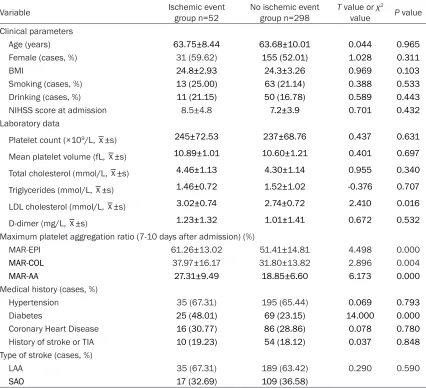
infarc-Table 1. Comparison of the general information and risk factors of the ischemic event group and the no ischemic event group during the follow-upperiod
Variable Ischemic event group n=52 No ischemic event group n=298 T value or value χ2 P value Clinical parameters
Age (years) 63.75±8.44 63.68±10.01 0.044 0.965
Female (cases, %) 31 (59.62) 155 (52.01) 1.028 0.311
BMI 24.8±2.93 24.3±3.26 0.969 0.103
Smoking (cases, %) 13 (25.00) 63 (21.14) 0.388 0.533
Drinking (cases, %) 11 (21.15) 50 (16.78) 0.589 0.443
NIHSS score at admission 8.5±4.8 7.2±3.9 0.701 0.432
Laboratory data
Platelet count (×109/L, _x±s) 245±72.53 237±68.76 0.437 0.631 Mean platelet volume (fL, _x±s) 10.89±1.01 10.60±1.21 0.401 0.697 Total cholesterol (mmol/L, _x±s) 4.46±1.13 4.30±1.14 0.955 0.340
Triglycerides (mmol/L, _x±s) 1.46±0.72 1.52±1.02 -0.376 0.707
LDL cholesterol (mmol/L, _x±s) 3.02±0.74 2.74±0.72 2.410 0.016
D-dimer (mg/L, _x±s) 1.23±1.32 1.01±1.41 0.672 0.532
Maximum platelet aggregation ratio (7-10 days after admission) (%)
MAR-EPI 61.26±13.02 51.41±14.81 4.498 0.000
MAR-COL 37.97±16.17 31.80±13.82 2.896 0.004
MAR-AA 27.31±9.49 18.85±6.60 6.173 0.000
Medical history (cases, %)
Hypertension 35 (67.31) 195 (65.44) 0.069 0.793
Diabetes 25 (48.01) 69 (23.15) 14.000 0.000
Coronary Heart Disease 16 (30.77) 86 (28.86) 0.078 0.780
History of stroke or TIA 10 (19.23) 54 (18.12) 0.037 0.848
Type of stroke (cases, %)
LAA 35 (67.31) 189 (63.42) 0.290 0.590
SAO 17 (32.69) 109 (36.58)
[image:4.612.93.519.96.484.2]tion, peripheral vascular thrombosis or occlu-sion, and vascular death) occurred during the period of aspirin administration. A total of 52 patients were assigned to the ischemic vascu-lar event group (ischemic event group), and 298 patients were assigned to the no ischemic vascular event group (noischemic event group). Univariate analysis for the occurrence of isch-emic vascular events
The general information and risk factors for the 2 groups are compared in Table 1. A u ni-variate analysis showed that age, gender, body mass index, smoking, and total cholesterol level were not significantly different between the 2 groups (P>0.05). The differences in the level of low-density lipoprotein (LDL) cholester-ol, diabetes, arachidonic acid-induced
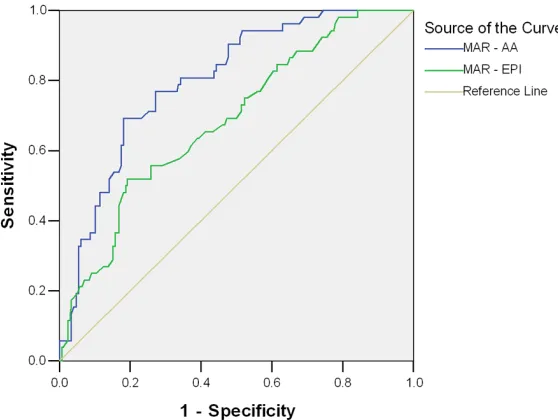
maxi-The AUC was used to evaluate the predictive value of the MAR-AA and MAR-EPI detected by PL-11 for vascular events (Figure 1). The AUC for MAR-AA was 0.803 (95% CI: 0.744-0.861, P<0.001). The AUC for MAR-EPI was 0.683 (95% CI: 0.606-0.759, P<0.001). The best cut-off value for the diagnosis of ischemic vascular events based on the maximum Youden index calculated by the ROC curve was 21.05% for the MAR-AA and 60.85% for the MAR-EPI. Multivariate analysis of stroke recurrence The general information and risk factors of the patients in the stroke recurrence group and the nostroke recurrence group during the follow-up are compared in Table 3. A multivari-ate logistic regression analysis was carried out with the occurrence of stroke during the
follow-Table 2. Multivariate logistic regression analysis for ischemic vascular events
Independent
variable coefficient Regression B error Standard S.E. valueP valueOR 95% CI
Diabetes 0.863 0.365 0.018 2.370 1.158~4.850
LDL cholesterol 0.426 0.228 0.062 1.531 0.979~2.394
MAR-AA 0.125 0.024 0.000 1.133 1.080~1.188
MAR-EPI 0.038 0.012 0.002 1.039 1.014~1.042
MAR-COL 0.017 0.012 0.186 1.017 0.992~1.046
[image:5.612.90.378.97.188.2]LDL, low-density lipoprotein; MAR-AA, arachidonic acid-induced maximum platelet aggregation ratio; MAR-EPI, epinephrine-induced maximum platelet aggregation ratio; MAR-COL, collagen-induced maximum platelet aggregation ratio.
Figure 1. Comparison of the ROC curves for MAR-AA and MAR-EPI detected by continuous platelet counting method in the prediction of ischemic vascu-lar events.
mum platelet aggregation ra- tio (MAR-AA), collagen-indu- ced maximum platelet aggre-gation ratio (MAR-COL), and epinephrine-induced maxim- um platelet aggregation ratio (MAR-EPI) between the two groups were statistically sig-nificant (P<0.05).
Multivariate analysis for the occurrence of ischemic vas-cular events
A multivariate logistic regres-sion analysis was carried out with the ischemic vascular events as the dependent va- riable. The variables of dia- betes, LDL cholesterol, MAR-AA, MAR-COL, and MAR-EPI were used as the independ- ent variables. The results sh- owed that diabetes (OR= 2.370, 95% CI: 1.158~4.850, P=0.018), MAR-AA (OR=1.133 95% CI: 1.080~1.188, P< 0.001), and MAR-EPI (OR= 1.039, 95% CI: 1.014~1.042, P=0.002) were the risk fac-tors for ischemic vascular events (Table 2).
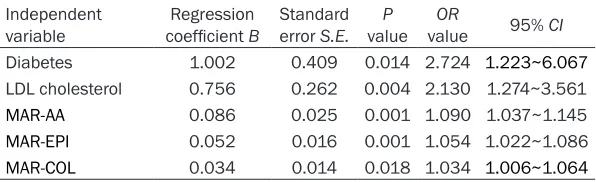
[image:5.612.93.372.241.451.2]up period as the dependent variable. The vari-ables of diabetes, LDL cholesterol, MAR-AA, MAR-COL, and MAR-EPI were used as the inde-pendent variables. The results showed that dia-betes (OR=2.724, 95% CI: 1.223~6.067, P= 0.014), LDLcholesterol (OR=2.130, 95% CI: 1.274~3.561, P=0.004), MAR-AA (OR=1.090, 95% CI: 1.037~1.145, P=0.001), MAR-COL (OR=1.034, 95% CI: 1.006~1.064, P=0.018), and MAR-EPI (OR=1.054, 95% CI: 1.022~1.086, P=0.001) were the risk factors for stroke recur-rence (Table 4).
The predictive value of the platelet aggrega-tion ratio determined by the ROC curve for
stroke recurrence
The AUC was used to evaluate the predictive value of the MAR-AA and MAR-EPI detected by
induced maximum platelet aggregation ratio (MAR-EPI) in stroke patients with recurrent ischemic events was significantly higher than that of the patients in the no ischemic vascu- lar event group. These increased parameters were determined to be the independent risk factors for the occurrence of ischemic vascu- lar events in stroke patients. Furthermore, MAR-AA showed a good predictive value for ischemic events with an area under the ROC curve of 0.803.
Stroke recurrence is related to multiple risk factors. High LDL cholesterol and diabetes are currently recognized in China and other coun-tries as the risk factors for stroke and recurrent stroke [14, 15]. Consistent with previous stud-ies [14, 15], our study found that the proportion of patients with diabetes and high LDL
choles-Table 3. Comparison of the general information and risk factors of the strokerecurrence group and the nostroke recurrence group during the follow-upperiod
Variable recurrence Stroke group n=38
No stroke recurrence group n=312
T value or χ2 value
P
value
Age (years) 64.26±8.01 63.6±10.05 0.377 0.706
Female (cases, %) 24 (63.16) 162 (51.92) 1.717 0.190 Hypertension (cases, %) 26 (68.42) 204 (65.38) 0.139 0.710 Diabetes (cases, %) 21 (55.26) 73 (23.40) 17.510 0.000 Smoking (cases, %) 10 (26.32) 63 (20.19) 0.769 0.380 LDL cholesterol (mmol/L, _x±s) 3.17±0.68 2.74±0.74 3.363 0.001 Total cholesterol (mmol/L, _x±s) 4.57±0.99 4.29±1.16 1.459 0.146
MAR-AA (%) 26.99±8.28 19.27±7.20 6.135 0.000
MAR-EPI (%) 63.52±13.38 51.58±14.64 4.789 0.000 MAR-COL (%) 41.08±16.71 31.70±13.71 3.883 0.002
[image:6.612.91.387.110.283.2]LDL, low-density lipoprotein; MAR-AA, arachidonic acid-induced maximum platelet aggregation ratio; MAR-EPI, epinephrine-induced maximum platelet aggregation ratio; MAR-COL, collagen-induced maximum platelet aggregation ratio.
Table 4. Multivariate logistic regression analysis for stroke recurrence Independent
variable coefficient Regression B Standard error S.E. valueP valueOR 95% CI
Diabetes 1.002 0.409 0.014 2.724 1.223~6.067
LDL cholesterol 0.756 0.262 0.004 2.130 1.274~3.561
MAR-AA 0.086 0.025 0.001 1.090 1.037~1.145
MAR-EPI 0.052 0.016 0.001 1.054 1.022~1.086
MAR-COL 0.034 0.014 0.018 1.034 1.006~1.064
LDL, low-density lipoprotein; MAR-AA, arachidonic acid-induced maximum platelet aggregation ratio; MAR-EPI, epinephrine-induced maximum platelet aggregation ratio; MAR-COL, collagen-induced maximum platelet aggregation ratio.
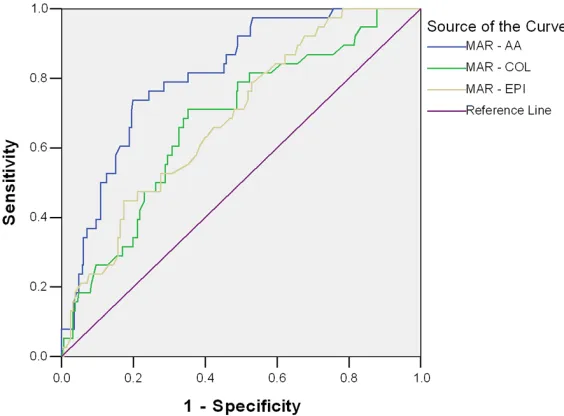
PL-11 for stroke recurrence (Figure 2). The AUC for MAR-AA was 0.810 (95% CI: 0.746-0.875, P<0.001). The AUC for MAR-EPI was 0.684 (95% CI: 0.602-0.766, P<0.001). The AUC for MAR-COL was 0.677 (95% CI: 0.589~0.765, P< 0.001). The best cutoff va- lue for the diagnosis of stroke recurrence based on the maximum Youden index calculated by the ROC curve was 23.05% for the MAR-AA, 62.95% for the MAR-EPI, and 30.55% for the MAR-COL.
Discussion
[image:6.612.90.388.350.441.2]epinephrine-terol levels was significantly increased in the stroke recurrence group when compared with the no stroke recurrence group. These incre- ased parameters were independent risk fac-tors for recurrent stroke. To date, studies on the risk factors for predicting the recurrence of stroke are mainly focused on the history of stroke, hypertension, diabetes, high homocys-teine levels, high-sensitivity C-reactive protein (hsCRP) levels, symptom aticintracranialarteri-alstenosis, and the type of stroke [14, 16, 17]. However, use of these risk factors is relatively indirect for predicting the recurrence of stroke, and their predictive values are very limited. Current research suggests the aforementioned risk factors lead to vascular intimal injury. Specifically, the exposure of basal collagen and microfibers under the intima causes platelet activation and enhanced platelet reactivity, which leads to the occurrence of platelet adhe-sion, aggregation, release, and thrombosis. Therefore, the direct assessment of platelet reactivity by detecting platelet aggregation is useful for the prediction of stroke recurrence. Recent studies suggest that the detection of platelet aggregation and recurrent ischemic vascular events in stroke patients are closely related [18, 19]. In a study of 105 ischemic stroke patients by Schwammenthal et al. [18], all patients received aspirin therapy after admittance to the hospital, and platelet
[image:7.612.91.373.73.281.2]aggre-let aggregation ratio ≥70% was significantly increased (P<0.001). This study also found that the risk of vascular events in patients with a maximum platelet aggregation ratio ≥70% was significantly increased (81.55% vs. 13.28%; RR 3.223, 95% CI: 1.155-7.256, P<0.001) [19]. Currently, the majority of worldwide correlation studies on platelet function detection and the poor prognosis of stroke patients were based on the pre-screening of aspirin resistance (AR) patients. After this screening, the impact of AR on the recurrence of ischemic vascular events and its predictive value were evaluated. However, the AR diagnostic criteria with differ-ent detection methods were not standardized, and the AR diagnostic cutoffs were mainly determined using cross-sectional and case-control studies [4]. Our study is the first pro-spective study to detect the platelet aggrega-tion ratio by PL-11 and directly evaluate the correlation of platelet function with the recur-rence of ischemic vascular events. We also showed the important clinical significance for the prediction and prevention of the recurrent ischemic events in stroke patients using plate-let function. Our study found that the MAR-AA was significantly higher in the ischemic event group during the follow-up period, and this increase was a relatively independent risk fac-tor for the occurrence of ischemic vascular events in stroke patients. The MAR-AA showed Figure 2. Comparison of the ROC curves for MAR-AA, MAR-COL, and MAR-EPI
detected by continuous platelet counting method in the prediction of stroke recurrence.
plate-a good predictive vplate-alue for ischemic events with an AUC of 0.803. Our study also found that an increased MAR-AA was an independent risk factor for stroke recurrence. The MAR-AA showed a good predictive value for the recur-rence of stroke with an AUC of 0.810.
EPI is a weak inducer of platelets. EPI effects depend on the secretion of platelets after aggregation and activation; thus, EPI induces the aggregation process without causing the deformation of platelets. EPI can bind to the EPIα2 receptor to activate phospholipase C and generate inositol triphosphate (IP3) and diacylglycerol (DG). Using the IP3 and DG path-ways, protein kinases can be activated to in- hibit adenylate cyclase, promote the release of calciumions in the endoplasmic reticulum, and activate phospholipase A2, which eventu-ally induces platelet aggregation by the AA pathway [20]. The increased MAR-EP suggests that aspirin does not effectively inhibit the metabolism of AA. AA may still generate prosta-gland in H2 and promote vasoconstriction and platelet aggregation through the cyclooxygen-ase-2 (COX-2) alternative pathway with a low inhibition rate of aspirin and the non-enzymatic lipid oxidation pathway. This alternative mecha-nism may explain the occurrence of adverse ischemic events. Our results showed that the MAR-EPI of the ischemic event group was sig-nificantly increased when compared with the no ischemic event group. This increase was closely related to the number of ischemic vas-cular events. In addition, the increased MAR-EPI was an independent risk factor for the recurrence of stroke. The prediction accuracy of ischemic stroke recurrence for MAR-EPI was evidenced by an AUC of 0.684. Therefore, the results of our study suggest that the detection of the platelet aggregation ratio using PL-11 in the secondary prevention of stroke can effec-tively predict the risk of ischemic vascular events.
Limitations
First, the follow-up period was relatively short. This study investigated the recurrent ischemic vascular events within six months of the origi-nal stroke. The correlation of platelet function with ischemic vascular events and its predic-tive value remains to be verified by studies with a long-term follow-up. Second, the sample size was small. Multi-center and large-scale clinical
studies are needed to clarify the impact of platelet aggregation on recurrent ischemic vas-cular events in stroke patients. Third, the cur-rent detection of platelet aggregation function was based on the PL-11 in China and other countries. The prediction standards for recur-rent ischemic vascular events in stroke patients are not yet developed, and larger, more in-depth studies are needed to establish these criteria and guide the treatment.
Conclusion
In the secondary prevention of stroke, platelet function measured with the continuous platelet counting method is closely related to recurrent ischemic vascular events; thus, this parameter has a good predictive value for recurrent isch-emic vascular events.
Acknowledgements
The present study was supported by the De- velopment Plan of Medical and Health Scien- ces of Shandong Province (No. 2015WS0089), Development Plan of Sciences of Weihai City (2014GNS040-1).
Disclosure of conflict of interest
None.
Address correspondence to: Dr. Jinbiao Zhang, De- partment of Neurology, Weihai Municipal Hospital,
The Affiliated Hospital of Binzhou Medical College,
70 Heping Street, Weihai 264200, Shandong Province, China. E-mail: [email protected]
References
[1] Bornstein NM, Karepov VG, Aronovich BD, Gor
-bulev AY, Treves TA, Korczyn AD. Failure of aspi -rin treatment after stroke. Stroke 1994; 25: 275-277.
[2] Grundmann K, Jaschonek K, Kleine B, Dich -gans J, Topka H. Aspirin non-responder status in patients with recurrent cerebral ischemic at-tacks. J Neurol 2003; 250: 63-66.
[3] Gorelick PB, Farooq MU. Advances in our un -derstanding of “resistance” to antiplatelet agents for prevention of ischemic stroke. Stroke Res Treat 2013; 2013: 727-842. [4] Lim ST, Coughlan CA, Murphy SJ,
[5] Choi JL, Li S, Han JY. Platelet function tests: a review of progresses in clinical application.
Biomed Res Int 2014; 2014: 456569.
[6] Hochholzer W, Trenk D, Bestehorn HP, Fischer B, Valina CM, Ferenc M, Gick M, Caputo A, Büt -tner HJ, Neumann FJ. Impact of the degree of peri-interventional platelet inhibition after loading with clopidogrel on early clinical out-come of elective coronary stent placement. J Am Coll Cardiol 2006; 48: 1742-1750. [7] Karathanos A, Geisler T. Monitoring aspirin
and clopidogrel response: testing controver-sies and recommendations. Mol Diagn Ther 2013; 17: 123-137.
[8] Guan J, Cong Y, Ren J, Zhu Y, Li L, Deng X,
Bai J. Comparison between a new platelet count drop method PL-11, light transmission aggregometry, verify now aspirin system and thromboelastography for monitoring short-term aspirin effects in healthy individuals. Platelets 2015; 26: 25-30.
[9] Paniccia R, Priora R, Liotta AA, Abbate R. Plate-let function tests: a comparative review. Vasc Health Risk Manag 2015; 11: 133-48.
[10] Darling CE, Sala Mercado JA, Quiroga-Castro W, Tecco GF, Zelaya FR, Conci EC. Point-of-care assessment of platelet reactivity in the emer-gency department may facilitate rapid rule-out of acute coronary syndromes: a prospective
cohort pilot feasibility study. BMJ Open 2014;
4: e003883.
[11] Han SW, Kim SH, Lee JY, Chu CK, Yang JH, Shin HY. A new subtype classification of ischemic
stroke based on treatment and etiologic mech-anism. Eur Neural 2007; 57: 96-102.
[12] Rafferty M, Walters MR, Dawson J. Antiplatelet therapy and aspirin resistance-clinically and chemically relevant? Curr Med Chem 2010; 17: 4578-4586.
[13] Valles J, Santos MT, Fuset MP, Moscardo A,
Ruano M, Perez F, Piñon M, Breña S, Aznar J.
Partial inhibition of platelet thromboxane A(2) synthesis by aspirin is associated with myone-crosis in patients with ST-segment elevation myocardial infarction. Am J Cardiol 2007; 99: 19-25.
[14] Serena J, Segura T, Roquer J, García-Gil M,
Castillo J. The ARTICO study: identification of
patients at high risk of vascular recurrence
af-ter a first non-cardioembolic stroke. BMC Neu -rol 2015; 15: 28.
[15] Kaplan RC, Tirschwell DL, Longstreth WT Jr,
Manolio TA, Heckbert SR, Lefkowitz D. Vascu-lar events, mortality, and preventive therapy following ischemic stroke in the elderly. Neurol-ogy 2005; 65: 835-842.
[16] Hart RG, Pearce LA, Bakheet MF, Benavente
OR, Conwit RA, McClure LA, Talbert RL, Ander-son DC. Predictors of stroke recurrence in pa-tients with recent lacunar stroke and respon- se to interventions according to risk status: secondary prevention of small subcortical strokes trial. J Stroke Cerebrovasc Dis 2014; 23: 618-624.
[17] Elkind MS, Luna JM, McClure LA, Zhang Y,
Coffey CS, Roldan A, Del Brutto OH, Pretell EJ, Pettigrew LC, Meyer BC, Tapia J, White C, Bena -vente OR; LIMITS Investigators. C-reactive protein as a prognostic marker after lacunar
stroke: levels of inflammatory markersin the
treatment of stroke study. Stroke 2014; 45: 707-716.
[18] Schwammenthal Y, Tsabari R, Shenkman B,
Schwartz R, Matetzky S, Lubetsky A, Orion D,
Israeli-Korn S, Chapman J, Savion N, Varon D,
Tanne D. Aspirin responsiveness in acute brain ischaemia: association with stroke severity and clinical outcome. Cerebrovasc Dis 2008; 25: 355-361.
[19] Yi X, Zhou Q, Lin J, Chi L. Aspirin resistance in Chinese stroke patients increased the rate of recurrent stroke and other vascular events. Int J Stroke 2013; 8: 535-539.
[20] Xiang YZ, Xia Y, Gao XM, Shang HC, Kang LY, Zhang BL. Platelet activation, and antiplatelet