Model Invertibility Regularization:
Sequence Alignment With or Without Parallel Data
Tomer Levinboim∗
[email protected] Ashish Vaswani
†
[email protected] David Chiang
∗Dept. of Computer Science and Engineering
University of Notre Dame
†Information Sciences Institute
University of Southern California
Abstract
We present Model Invertibility Regularization (MIR), a method that jointly trains two direc-tional sequence alignment models, one in each direction, and takes into account the invertibil-ity of the alignment task. By coupling the two models through their parameters (as opposed to through their inferences, as in Liang et al.’s Alignment by Agreement (ABA), and Ganchev et al.’s Posterior Regularization (PostCAT)), our method seamlessly extends to all IBM-style word alignment models as well as to alignmentwithoutparallel data. Our proposed algorithm is mathematically sound and inher-its convergence guarantees from EM. We
eval-uate MIR on two tasks: (1) On word
align-ment, applying MIR on fertility based mod-els we attain higher F-scores than ABA and
PostCAT. (2) On Japanese-to-English back-transliteration without parallel data, applied to the decipherment model of Ravi and Knight,
MIRlearns sparser models that close the gap in whole-name error rate by 33% relative to a model trained on parallel data, and further, beats a previous approach by Mylonakis et al.
1 Introduction
The transfer of information between languages is a common natural language phenomenon that is in-tuitively invertible. For example, in transliteration, a source-language word is mapped to a target lan-guage’s writing system under a sound preserving mapping (for example, “computer” to Japanese Ro-maji, “konpyutaa”). The original word should then be recoverable from its transliterated version. Simi-larly, in translation, the back-translation of the trans-lation of a word is likely to be that same word itself.
In NLP, however, commonly-used generative models describing such phenomena are directional, only concerned with the transfer of source-language symbols to target-language symbols or vice versa, but not both directions. Left unchecked, indepen-dently training two such directional models (source-to-target and target-to-source) often yields two mod-els that diverge from this invertibility intuition.
In word alignment, this can lead to disagreements between alignments inferred by a model trained in one direction and those inferred by a model trained in the reverse direction. To remedy this disparity (and other shortcomings), it is common to turn to alignment symmetrization techniques such as grow-diag-final-and (Koehn et al., 2003) which heuristi-cally combines alignments from both directions.
Liang et al. (2006) suggest a more fundamental approach they call Alignment by Agreement (ABA), which jointly trains two word alignment models by maximizing their data-likelihoods along with a reg-ularizer that rewards agreement between their align-ment posteriors (computed over each parallel sen-tence pair). Although their EM-like optimization procedure is heuristic, it proves effective at jointly training bidirectional models. Ganchev et al. (2008) propose another approach for agreement between the directed models by adding constraints on the alignment posteriors. UnlikeABA, their optimization is exact, but it can be computationally expensive, requiring multiple forward-backward inferences in each E-step.
In this paper we develop a different approach for jointly training general bidirectional sequence align-ment models called Model Invertibility Regulariza-tion, or MIR (Section 3). Our approach has two key benefits overABAandPostCAT: First, MIRcan
be applied to sequence alignment without parallel data. Second, a single implementation seamlessly extends to all IBM models, including the fertility based models. Furthermore, since MIRfollows the MAP-EM framework, it inherits its desirable con-vergence guarantees.
The key idea facilitating the easy extension to complex models and to non-parallel data settings is in our regularizer, which operates on the model pa-rameters as opposed to their inferences. Specifically,
MIR was designed to reward model pairs whose translation tables respect the invertibility intuition.
We tested MIR against competitive baselines on two sequence alignment tasks: word alignment (with parallel data) and back-transliteration deci-pherment (without parallel data).
On Czech-English and Chinese-English word alignment (Section 5), restricted to the HMM model,
MIRattains F- and Bleuscore improvements that are comparable to those ofABAandPostCAT. We fur-ther applyMIRbeyond HMM, on the fertility-based IBM Models, showing further gains in F-score com-pared to the baseline, ABAandPostCAT. Interest-ingly, the HMM alignments obtained by ABA and
MIRare qualitatively different, so that combining the two yields additive gains over each method by itself. On English-Japanese back-transliteration deci-pherment (Section 6), we applyMIRto the cascade of wFSTs approach proposed by Ravi and Knight (2009). UsingMIR, we are able to reduce the whole-name error-rate relative to a model trained on paral-lel data by 33%, as well as significantly outperform the joint model proposed by Mylonakis et al. (2007).
2 Background
We are concerned with learning generative models that describe transformations of a source-language sequence e = (e1, . . . ,eI) to a target-language se-quence f = (f1, . . . , fJ). We consider two different data scenarios.
In the parallel data setting, each sample in the ob-served data consists of a pair (e,f). The generative story assigns the following probability to the event thatfarises frome:
p(f |e;Θ)=X
a
p(a, f |e;Θ) (1)
where Θ denotes the model parameters and a de-notes a hidden variable that corresponds to unknown choices taken in the generative process.
In the non-parallel data setting, only the target se-quence f is observed and the source sequence e is hidden. The model assigns the following probabil-ity to the observed data:
p(f;Θ)=X
e
p(e)X
a
p(a, f|e). (2)
That is, the sequencefcan arise from any sequence
eby first selectinge∼ p(e) and then proceeding ac-cording to the parallel-data generative story (Eq. 1). Unsupervised training of such models entails maximizing the data log-likelihoodL(Θ):
arg max
Θ L(Θ)=arg maxΘ
X
x∈X
logp(x;Θ)
whereX = {(en,fn)}
nin the parallel data setting and
X={(fn)}nin the non-parallel data setting.
Although the structure of Θ is unspecified, in practice, most models that follow these generative stories contain a word translation table (t-table) de-notedt, with each parametert(f |e) representing the conditional probability of mapping a given source symboleto a target symbol f.
3 Model Invertibility Regularization In this section we propose a method for jointly train-ing two word alignment models, a source-to-target modelΘ1and a target-to-source model Θ2, by reg-ularizing their parameters to respect the invertibil-ity of the alignment task. We therefore name our methodModel Invertibility Regularization(MIR).
3.1 Regularizer
Our regularizer operates on the t-table parameters
t1,t2 of the two models, as follows: Let matrices
In particular, each diagonal entry Tii holds the probability of mapping a source symbol back onto itself, a quantity we intuitively believe should be high. We therefore (initially) consider maximizing the trace ofT:
Tr[T]=X i
Tii= X
e X
f
t1(f |e)t2(e| f).
We further note that Tr[T] = Tr[T1T2] = Tr[T2T1], so that the trace captures equally well how much the target symbols map onto themselves.
SinceT is stochastic, setting it to the identity ma-trixI maximizes its trace. In other words, the more
T1andT2behave as (pseudo-)inverses of each other, the higher the trace is. This exactly fits with our in-tuition regarding invertibility.
Unfortunately, the trace is not concave in bothT1 andT2, a property which will become desirable in optimization. We therefore modify the trace regular-izer by applying the entrywise square root operator onT1,T2and denote the new termR:
R(t1,t2)=Trh pT1 p
T2 i
=X e
X
f p
t1(f |e)t2(e| f). (3)
Note thatRis maximized when √T1√T2=I. Concavity of R in both t1,t2 (or equivalently
T1,T2) follows by observing that it is a sum of con-cave functions – each term in the summation is a geometric mean, which is concave in its parameters.
3.2 Joint Objective Function
We applyMIRin two data scenarios: In the parallel data setting, we observe N sequence pairs {xn
1}n = {(en,fn)}nor, equivalently,{xn
2}n ={(fn,en)}n. In the non-parallel setting, two monolingual datasets are observed: N1source sequences{xn1}n = {en}nandN2target sequences{xn
2}n={fn}n.
The probability of the nth sample under the kth model Θk (for k ∈ {1,2}) is denoted pk(xnk;Θk). Specifically, in the parallel data setting, the proba-bility ofxn
kunder its model is:1
p1(xn1;Θ1)= p(fn|en;Θ1)
p2(xn2;Θ2)= p(en|fn;Θ2)
1This slight notational abuse helps represent both data
sce-narios succinctly.
whereas in the non-parallel data setting, the proba-bility is defined as:
p1(xn1;Θ1)= p(fn;Θ1)
p2(xn2;Θ2)= p(en;Θ2).
Using the above definitions and the MIR regular-izerR (Eq. 3), we formulate an optimization pro-gram for maximizing the regularized log-likelihoods of the observed data:
max
Θ1,Θ2 λR(t1,t2)+
X
k∈{1,2}
Nk
X
n=1
logpk(xnk;Θk) (4)
whereλ≥ 0 is a tunable hyperparameter (note that, in the parallel case,N=N1 =N2).
We defer discussion on the relationship and mer-its of our approach with respect toABA(Liang et al., 2006) andPostCAT (Ganchev et al., 2008) to Sec-tion 4.
3.3 Optimization Procedure
Using our concave regularizer, MIR optimization (Eq. 4) neatly falls under the MAP-EM framework (Dempster et al., 1977) and inherits the convergence properties of the underlying algorithms. MAP-EM follows the same structure as standard MAP-EM: The E-step remains identical to the standard E-step, while the M-step maximizes the complete-data log-likelihood plus the regularization term. In the case ofMIR, the E-step can be carried out independently for each model. The only extra work is in the M-step, which optimizes a single (concave) objective function.
Specifically, letzndenote the missing data, where, in the parallel data setting, only the alignment is missing (zn
k = ank) and in the non-parallel data set-ting, both alignment and source symbol are missing (zn
1=(an1,en),zn2 =(an2,fn)).
In the E-step, each model Θk (for k ∈ {1,2}) is held fixed and its posterior distribution over the missing data zn
k is computed per each observa-tion,xn
k:
qk(znk,xnk) := pk(znk |xnk;Θk).
max-imizes the regularized sum of expected complete-data log-likelihoods:
max
Θ1,Θ2λR(t1,t2)+
X
k∈{1,2}
Nk
X
n=1
qk(znk,xnk) logpk(xnk,znk)
wherenranges over the appropriate sample set. Operationally, for modelsΘkthat can be encoded as wFSTs (such as the IBM1, IBM2 and HMM word alignment models), the E-step can be carried out efficiently and exactly using dynamic program-ming (Eisner, 2002). Other models resort to ap-proximation techniques – for example, the fertility-based word alignment models apply hill-climbing and sampling heuristics in order to efficiently esti-mate the posteriors (Brown et al., 1993)
From the computed posteriors qk we collect ex-pected counts for each event, used to construct the M-step optimization objective. Since theMIR regu-larizer couples only the t-table parameters, the up-date rule for any remaining parameter is left un-changed (that is, one can use the usual closed-form count-and-divide solution).
Now, letCe1,f andCe2,f denote the expected counts for the t-table parameters. That is,Cek,f denotes the expected number of times a source-symbol typeeis seen aligned to a target-symbol type f according to the posterior qk. In the M-step, we maximize the following objective with respect tot1andt2:
arg max t1,t2
X
e,f
Ce1,f logt1(f |e)+ X
e,f
Ce2,f logt2(e| f)+λR(t1,t2) (5)
which can be efficiently solved using convex pro-gramming techniques due to the concavity ofRand the complete-data log-likelihoods in botht1andt2.
In our implementation, we applied Projected Gradient Descent (Bertsekas, 1999; Schoenemann, 2011), where at each step, the parameters are up-dated in the direction of the M-step objective gradi-ent at (t1,t2) and then projected back onto the prob-ability simplex. We used simple stopping conditions based on objective function value convergence and a bounded number of iterations.
4 Baselines
4.1 Parallel Data Baseline:ABAandPostCAT
Our approach is most similar to Alignment by Agreement (Liang et al., 2006) which uses a single joint objective for two word alignment models. The difference between our objective (Eq. 4) and theirs lies in their proposed regularizer, which rewards the per-sample agreement of the two models’ alignment posteriors:
X
n
logX
z
p1(z|xn)·p2(z|xn)
wherexn=(en,fn) and wherezranges over the pos-sible alignments betweenenandfn(practically, only over 1-to-1 alignments, since each model is only ca-pable of producing one-to-many alignments).
Liang et al. (2006) note that proper EM opti-mization of their regularized joint objective leads to an intractable E-step. Unable to exactly and effi -ciently compute alignment posteriors, they resort to a product-of-marginals heuristic which breaks EM’s convergence guarantees, but has a closed-form solu-tion and works well in practice.
MIRregularization has both theoretical and prac-tical advantages compared toABA, which make our method more convenient and broadly applicable: 1. By regularizing for posterior agreement, ABA is
restricted to a parallel data setting, whereasMIR
can be applied even without parallel data. 2. The posteriors of more advanced word
align-ment models (such as fertility-based models) do not correspond to alignments, and furthermore, are already estimated with approximation tech-niques. Thus, even if we somehow adapt ABA’s product-of-marginals heuristic to such models, we run the risk of estimating highly inaccurate posteriors (specifically, zero-valued posteriors). In contrast, MIR extends to all IBM-style word alignment models and does not add heuristics. The M-step computation can be done exactly and efficiently with convex optimization.
3. MIR provides the same theoretical convergence guarantees as the underlying algorithms.
to enforce posterior agreement between the two models. Specifically, they add a KL-projection step after the E-step of the EM algorithm which returns the posterior q(z | x) closest in KL-Divergence to an E-step posterior, but which also upholds certain constraints. The particular constraints they suggest encode alignment agreementin expectationbetween the two models’ posteriors. For details, the reader can refer to (Ganchev et al., 2008).
Similarly toABA, with their suggested alignment agreement constraints PostCAT cannot be applied without parallel data and it is unclear how to extend it to fertility based models (however, it does seems possible to apply other constraints using the general posterior regularization framework).
We compare MIR against ABA and PostCAT in Section 5.
4.2 Non-Parallel Data Baseline:bi-EM
Mylonakis et al. (2007) cast the two directional models as a single joint model by reparameterization and normalization. That is, both directional models, consisting of a t-table only, are reparameterized as:
t1(f |e)= Pβe,f
fβe,f t2(e| f)=
βe,f P
eβe,f (6)
They then maximize the likelihood of observed
monolingualsequences from both languages:
max β L1({f
n};β)+L
2({en};β) (7)
where, for example:
L1({fn};β)=log Y
n
p(fn)
=logY n
X
e
p(fn|e)p(e)
=logY n
X
e
p(e)Y m
t1(fmn |e)
Here, p(e) denotes the probability ofeaccording to a fixed source language model.
Once training of β is complete, we can decode an observed target sequencef, by castingβback in terms oft1and apply the Viterbi decoding algorithm. To solve forβ in Eq. 7, Mylonakis et al. (2007) proposebi-EM, an iterative EM-style algorithm. The objective function in their M-step is not concave,
hinting that a closed-form solution for the maxi-mizer is unlikely. The probability estimate that they use in the M-step appears to maximize an approx-imation of their M-step objective which omits the normalization factors in Eq. 7.
Nevertheless, bi-EM attains improved results compared to standard EM on both POS-tagging and monotone noun sequence translation without paral-lel data. We compareMIRagainstbi-EMin Sec. 6.
5 Experiments with Parallel Data
In this section, we compare MIR against stan-dard EM training and ABA on Czech-English and Chinese-English word alignment and translation.
5.1 Implementation and Code
For ABA2 and PostCAT3 training we used the au-thors’ implementation, which supports the HMM model. Vanilla EM training was done using GIZA++,4 which supports all IBM models as well as HMM. Our methodMIRwas implemented on top of GIZA++.5
5.2 Data
We used the following parallel data to train the word alignment models:
Chinese-English: 287K sentence pairs from the NIST 2009 Open MT Evaluation constrained task consisting of 5.3M and 6.6M tokens, respectively.
Czech-English: 85K sentence pairs from the News Commentary corpus, consisting of 1.6M and 1.8M tokens, respectively.
Sentence length was restricted to at most 40 tokens.
5.3 Word Alignment Experiments
We obtained HMM alignments by running either 5 or 10 iterations (optimized on a held-out validation set) of both IBM Model 1 and HMM. We obtained IBM Model 4 alignments by continuing with 5 it-erations of IBM Model 3 and 10 itit-erations of IBM
2http://cs.stanford.edu/˜pliang/software/ cross-em-aligner-1.3.zip
3http://www.seas.upenn.edu/˜strctlrn/CAT/CAT. html
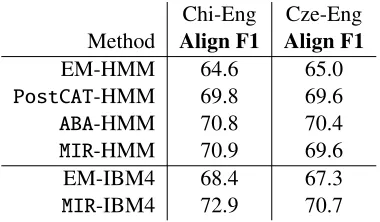
Chi-Eng Cze-Eng Method Align F1 Align F1
EM-HMM 64.6 65.0
PostCAT-HMM 69.8 69.6
ABA-HMM 70.8 70.4
MIR-HMM 70.9 69.6
EM-IBM4 68.4 67.3
[image:6.612.91.281.54.165.2]MIR-IBM4 72.9 70.7
Table 1: Word alignment F1 scores.
Model 4. We then extracted symmetrized align-ments in the following manner: For all HMM mod-els, we used the posterior decoding technique de-scribed in Liang et al. (2006) as implemented by each package. For IBM Model 4, we used the standard grow-diag-final-and (gdfa) symmetrization heuristic (Koehn et al., 2003).
We tuned MIR’s λparameter to maximize align-ment F-score on a validation set of 460 hand-aligned Czech-English and 1102 Chinese-English sentences. Alignment F-scores are reported in Table 1. In particular, the best results were obtained by MIR, when applied to the fertility based IBM4 model -we obtained gains of+2.1% (Chinese-English) and +0.3% (Czech-English) compared to the best com-petitor.
5.4 MT Experiments
We ran MT experiments using the Moses (Koehn et al., 2007) phrase-based translation system.6 The feature weights were trained discriminatively using MIRA (Chiang et al., 2008), and we used a 5-gram language model trained on the Xinhua portion of En-glish Gigaword (LDC2007T07). All other parame-ters remained with their default settings. The devel-opment data used for discriminative training were: for Chinese-English, data from the NIST 2004 and NIST 2006 test sets; for Czech-English, 2051 sen-tences from the WMT 2010 shared task. We used case-insensitive IBM Bleu(closest reference length) as our metric.
On both language pairs, ABA, PostCAT andMIR
outperform their respective EM baseline with com-parable gains overall. However, we noticed that
ABAandMIRare not producing the same alignments.
6http://www.statmt.org/moses/
Chi-Eng Cze-Eng
Method NIST08 WMT09 WMT10
EM-HMM 23.6 16.7 17.1
PostCAT-HMM 24.6 16.9 17.4
MIR-HMM 24.0 17.1 17.6
ABA-HMM 24.4 17.1 17.7
EM-IBM4 24.2 16.8 17.2
MIR-IBM4 24.6 17.2 17.5
ABA+MIR-HMM 25.1 17.4 17.9
Table 2: Bleu scores. CombiningABAand MIRHMM
alignments improves Bleu score significantly over all other methods.
For example, by combining their HMM alignments (simply concatenating aligned bitexts) the total im-provement reaches +1.5 Bleu on the Chinese-to-English task, a statistically significant improvement (p < 0.05) according to a bootstrap resampling sig-nificance test (Koehn, 2004)). Table 5.4 summarizes our MT results.
6 Experiments without Parallel Data
Ravi and Knight (2009) consider the challeng-ing task of learnchalleng-ing a Japanese-English back-transliteration model without parallel data. The goal is to correctly decode a list of 100 US senator names written in katakana script, without having access to parallel data. In this section, we reproduce their de-cipherment experiment and show that applyingMIR
to their baseline model significantly outperforms both the baseline and thebi-EMmethod.
6.1 Phonetic-Based Japanese Decipherment
Ravi and Knight (2009) construct a English-to-Japanese transliteration model as a cascade of wF-STs (depicted in Figure 1, top). According to their generative story, any word in katakana is gen-erated by re-writing an English word in its En-glish phonetic representation, which is then trans-formed to a Japanese phonetic representation and finally re-written in katakana script. For example, the word “computer” is mapped to a sequence of 8 English phonemes (k,ah,m,p,y,uw,t,er), which is mapped to a sequence of 9 Japanese phonemes (K,O,N,P,Y,U,T,A,A) and finally to Katakana.
[image:6.612.315.540.54.158.2]whole-name error-rate (WNER)7of 40% with paral-lel data (trained over 3.3k word pairs), compared to 73% WNER without parallel data (trained over 9.5k Japanese words only), demonstrating the weakness of methods that do not use parallel data.
6.2 Forward Pipeline
We reproduced the English-to-Japanese translitera-tion pipeline of Ravi and Knight (2009) by con-structing each of the cascade wFSTs as follows:
1. A unigram language model (LM) of English terms, estimated over the top 40K most frequent capitalized words found in the Gigaword corpus (without smoothing).
2. An English pronunciation wFST from the CMU pronunciation dictionary.8
3. An English-to-Japanese phoneme mapping wFST that encodes a phoneme t-tablet1 which was designed according to the best setting re-ported by Ravi and Knight (2009). Specifically,
t1is restricted to either 1-to-1 or 1-to-2 phoneme mappings and maintains consonant parity. See further details in their paper.
4. A hand-built Japanese pronunciation to Katakana wFST (Ravi and Knight, 2009).
6.3 Backward Pipeline
MIR requires a pipeline in the reverse direction, transliteration of Japanese to English. We con-structed a unigram LM of Katakana terms over the top 25K most frequent Katakana words found in the Japanese2005-2008-newsdictionary from the Leipzig corpora.9
The remaining required wFSTs were obtained by inverting the forward model wFSTs (that is, wFSTs 2,3,4 above), and the cascade was composed in the reverse direction. In particular, by inverting t1, we obtained the Japanese-to-English t-table t2 that al-lows only 2-to-1 or 1-to-1 phoneme mappings.
7The percentage of names where any error occurs anywhere
in either the first or last name.
8http://www.speech.cs.cmu.edu/cgi-bin/cmudict 9http://corpora.uni-leipzig.de/
6.4 Training Data
For training data, we used the top 50% most frequent terms from the monolingual data over which we con-structed the LM wFSTs. This resulted in a set of 20K English terms (denotedENG) and a set of 13K Japanese terms in Katakana (denotedKTKN).
Taking the entire set of monolingual terms led to poor baseline results, probably since uncommon En-glish terms are not transliterated, and uncommon Katakana terms may be borrowed from languages other than English.
In any case, it is important to note that ENGand
KTKN are unrelated, since both were collected over non-parallel corpora.
6.5 Training and Tuning
We train and tune 4 models:
baseline: the model proposed by Ravi and Knight (2009), which maximizes the likelihood (Eq. 2) of the observed Japanese termsKTKN.
MIR: Our bidirectional, regularized model, which maximizes the regularized likelihoods (Eq. 4) of both monolingual corporaENG,KTKN.
bi-EM: The joint model proposed by Mylonakis et al. (2007), which maximizes the likelihoods (Eq. 7) of both monolingual corporaENG,KTKN.
Oracle: As an upper bound, we train the model of Ravi and Knight (2009) as if it was given the correct English origin for each Japanese term. (over 4.2K
parallelEnglish-Japanese phoneme sequences). We train each method for 15 EM iterations, while keeping the LM and pronunciation wFSTs fixed.
Training was done using the Carmel finite-state toolkit.10 Specifically, baseline andoraclerely on Carmel exclusively, while forMIRandbi-EM, we manipulated Carmel to output the E-step posteriors, which we then used to construct and solve the M-step objective using our own implementation.
The different models were tuned over a develop-ment set consisting of 50 frequent Japanese terms and their English origin. For each method, we chose the so-called stretch-factorα ∈ {1,2,3}used to ex-ponentiate the model parameters before decoding
Figure 1: The transliteration generative story as a cascade of wFSTs. Each box represents a transducer.Top: transliter-ation of the word “computer” to Japanese Katakana.Bottom:the reverse process.MIRjointly trains the two cascades by maximizing the regularized data log-likelihood with respect to the two (shaded) phoneme mapping modelst1,t2.
A B CH D E G H I J K M N O P R S SH T TS U W Y Z aa
ah aw b d eh ey g ih jh l n ow p s t uh v y
zh 0.00
0.08 0.16 0.24 0.32 0.40 0.48 0.56 0.64
A B CH D E G H I J K M N O P R S SH T TS U W Y Z aa
ah aw b d eh ey g ih jh l n ow p s t uh v y
zh 0.00
[image:8.612.120.496.215.362.2]0.08 0.16 0.24 0.32 0.40 0.48 0.56 0.64
Figure 2: The 1-to-1 mapping submatrix of thet1transliteration table for independent training (left) andMIR(right).
MIRlearns sparser, peaked models compared to those learned by independent training.
(see Ravi and Knight (2009)), our model’s hyper-parameter λ ∈ {1,2,3,4}, and the number of itera-tions (up to 15) to minimize WNER on the develop-ment set.
We decoded Japanese terms using the Viterbi al-gorithm, applied on the selected t1 model (using Eq. 6 to convert the bi-EM model β back to tot1). Finally, note that ABA training and symmetrization decoding heuristics are inapplicable, since they rely on parallel data.
6.6 Senator Name Decoding Results
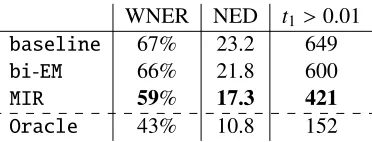
We compiled our own test set, consisting of 100 US senator names (first and last), and compared the per-formance of the four algorithms. Table 3 reports WNER, average normalized edit distance (NED) and the number of model parameters (t1) with value greater than 0.01 as an indication of sparsity. Figure 2 further compares the 1-to-1 portions of the best model learned by the baseline method with the
best model learned byMIR, showing the difference in parameter sparsity.
WNER NED t1>0.01
baseline 67% 23.2 649
bi-EM 66% 21.8 600
MIR 59% 17.3 421
[image:8.612.334.520.474.545.2]Oracle 43% 10.8 152
Table 3: MIR reduces error rates (WNER, NED) and
learns sparser models (number of t1 parameters greater
than 0.01) compared to the other models.
Using MIR, we obtained significant reduction in error rates, closing the gap between thebaseline
7 Conclusion
We presented Model Invertibility Regularization (MIR), an unsupervised method for jointly train-ing bidirectional sequence alignment models with or without parallel data. Our formulation is based on the simple observation that the alignment tasks at hand are inherently invertible and encourages the translation tables in both models to behave like pseudo-inverses of each other.
We derived an efficient MAP-EM algorithm and demonstrated our method’s effectiveness on two dif-ferent alignment tasks. On word alignment, apply-ing MIRon the IBM4 model yielded the highest F scores and the resulting Bleuscores were compara-ble to that of Alignment by Agreement (Liang et al., 2006) andPostCAT(Ganchev et al., 2008). Our best MT results (up to +1.5 Bleu improvement) were obtained by combining alignments from both MIR
andABA, indicating that the two methods learn com-plementary alignments. On Japanese-English back-transliteration with no parallel data, we obtained a significant error reduction over two baseline meth-ods (Ravi and Knight, 2009; Mylonakis et al., 2007). As future work, we plan to apply MIRon large-scale MT decipherment (Ravi and Knight, 2011; Dou and Knight, 2013), where, so far, only a single directional model has been used. Another promis-ing direction is to encourage invertibility not only between words, but between their senses and syn-onyms.
Acknowledgements
We would like to thank Markos Mylonakis and Khalil Sima’an for their help in understanding the derivation of their bi-EM method. This work was partially supported by DARPA grants DOI/NBC D12AP00225 and HR0011-12-C-0014 and a Google Faculty Research Award to Chiang.
References
Dimitri P. Bertsekas. 1999. Nonlinear Programming.
Athena Scientific.
Peter F. Brown, Stephen A. Della Pietra, Vincent J. Della Pietra, and Robert L. Mercer. 1993. The mathematics of statistical machine translation: Parameter estima-tion. Computational Linguistics, 19:263–311.
David Chiang, Yuval Marton, and Philip Resnik. 2008. Online large-margin training of syntactic and struc-tural translation features. InProceedings of EMNLP. A. P. Dempster, N. M. Laird, and D. B. Rubin. 1977.
Maximum likelihood from incomplete data via the EM algorithm.Computational Linguistics, 39(4):1–38. Qing Dou and Kevin Knight. 2013. Dependency-based
decipherment for resource-limited machine
transla-tion. InEMNLP, pages 1668–1676. ACL.
Jason Eisner. 2002. Parameter estimation for proba-bilistic finite-state transducers. InProceedings of the 40th Annual Meeting on Association for Computa-tional Linguistics, ACL ’02, pages 1–8, Stroudsburg, PA, USA. Association for Computational Linguistics. Kuzman Ganchev, Jo˜ao V. Grac¸a, and Ben Taskar. 2008.
Better alignments=better translations? In Proceed-ings of ACL-08: HLT, pages 986–993, Columbus, Ohio, June. Association for Computational Linguis-tics.
Kuzman Ganchev, Joao Grac¸a, Jennifer Gillenwater, and Ben Taskar. 2010. Posterior regularization for struc-tured latent variable models. The Journal of Machine Learning Research, 11:2001–2049.
Philipp Koehn, Franz Joseph Och, and Daniel Marcu. 2003. Statistical phrase-based translation. In Proceed-ings of NAACL.
Philipp Koehn, Hieu Hoang, Alexandra Birch, Chris Callison-Burch, Marcello Federico, Nicola Bertoldi, Brooke Cowan, Wade Shen, Christine Moran, Richard Zens, et al. 2007. Moses: Open source toolkit for sta-tistical machine translation. InProceedings of the 45th Annual Meeting of the ACL on Interactive Poster and Demonstration Sessions, pages 177–180. Association for Computational Linguistics.
Philipp Koehn. 2004. Statistical significance tests for
machine translation evaluation. In Proceedings of
EMNLP.
Percy Liang, Ben Taskar, and Dan Klein. 2006.
Align-ment by agreeAlign-ment. InProceedings of HLT-NAACL.
Markos Mylonakis, Khalil Sima’an, and Rebecca Hwa.
2007. Unsupervised estimation for noisy-channel
models. InProceedings of the 24th International Con-ference on Machine Learning, ICML ’07, pages 665– 672, New York, NY, USA. ACM.
Sujith Ravi and Kevin Knight. 2009. Learning phoneme mappings for transliteration without parallel data. In
Proceedings of Human Language Technologies: The 2009 Annual Conference of the North American Chap-ter of the Association for Computational Linguistics, NAACL ’09, pages 37–45, Stroudsburg, PA, USA. As-sociation for Computational Linguistics.
Sujith Ravi and Kevin Knight. 2011. Deciphering
Meeting of the Association for Computational Linguis-tics: Human Language Technologies - Volume 1, HLT ’11, pages 12–21, Stroudsburg, PA, USA. Association for Computational Linguistics.