Cross-Entropy and Estimation of
Probabilistic Context-Free Grammars
Anna Corazza
Department of Physics University “Federico II”
via Cinthia I-80126 Napoli, Italy
Giorgio Satta
Department of Information Engineering University of Padua
via Gradenigo, 6/A I-35131 Padova, Italy
Abstract
We investigate the problem of training probabilistic context-free grammars on the basis of a distribution defined over an infinite set of trees, by minimizing the cross-entropy. This problem can be seen as a generalization of the well-known maximum likelihood estimator on (finite) tree banks. We prove an unexpected the-oretical property of grammars that are trained in this way, namely, we show that the derivational entropy of the gram-mar takes the same value as the cross-entropy between the input distribution and the grammar itself. We show that the re-sult also holds for the widely applied max-imum likelihood estimator on tree banks.
1 Introduction
Probabilistic context-free grammars are able to de-scribe hierarchical, tree-shaped structures underly-ing sentences, and are widely used in statistical nat-ural language processing; see for instance (Collins, 2003) and references therein. Probabilistic context-free grammars seem also more suitable than finite-state devices for language modeling, and several language models based on these grammars have been recently proposed in the literature; see for in-stance (Chelba and Jelinek, 1998), (Charniak, 2001) and (Roark, 2001).
Empirical estimation of probabilistic context-free grammars is usually carried out on tree banks, that
is, finite samples of parse trees, through the max-imization of the likelihood of the sample itself. It is well-known that this method also minimizes the cross-entropy between the probability distribution induced by the tree bank, also called the empirical distribution, and the tree probability distribution in-duced by the estimated grammar.
In this paper we generalize the maximum like-lihood method, proposing an estimation technique that works on any unrestricted tree distribution de-fined over an infinite set of trees. This generalization is theoretically appealing, and allows us to prove un-expected properties of the already mentioned maxi-mum likelihood estimator for tree banks, that were not previously known in the literature on statistical natural language parsing. More specifically, we in-vestigate the following information theoretic quanti-ties
• the cross-entropy between the unrestricted tree distribution given as input and the tree distri-bution induced by the estimated probabilistic context-free grammar; and
• the derivational entropy of the estimated prob-abilistic context-free grammar.
These two quantities are usually unrelated. We show that these two quantities take the same value when the probabilistic context-free grammar is trained us-ing the minimal cross-entropy criterion. We then translate back this property to the method of max-imum likelihood estimation. Our general estima-tion method also has practical applicaestima-tions in cases one uses a probabilistic context-free grammar to ap-proximate strictly more powerful rewriting systems,
as for instance probabilistic tree adjoining gram-mars (Schabes, 1992).
Not much is found in the literature about the estimation of probabilistic grammars from infinite distributions. This line of research was started in (Nederhof, 2005), investigating the problem of training an input probabilistic finite automaton from an infinite tree distribution specified by means of an input probabilistic context-free grammar. The prob-lem we consider in this paper can then be seen as a generalization of the above problem, where the in-put model to be trained is a probabilistic context-free grammar and the input distribution is an unrestricted tree distribution. In (Chi, 1999) an estimator that maximizes the likelihood of a probability distribu-tion defined over a finite set of trees is introduced, as a generalization of the maximum likelihood es-timator. Again, the problems we consider here can be thought of as generalizations of such estimator to the case of distributions over infinite sets of trees or sentences.
The remainder of this paper is structured as fol-lows. Section 2 introduces the basic notation and definitions and Section 3 discusses our new esti-mation method. Section 4 presents our main re-sult, which is transferred in Section 5 to the method of maximum likelihood estimation. Section 6 dis-cusses some simple examples, and Section 7 closes with some further discussion.
2 Preliminaries
Throughout this paper we use standard notation and definitions from the literature on formal languages and probabilistic grammars, which we briefly sum-marize below. We refer the reader to (Hopcroft and Ullman, 1979) and (Booth and Thompson, 1973) for a more precise presentation.
Acontext-free grammar(CFG) is a tuple G = (N, Σ, R, S), whereN is a finite set of nonterminal symbols, Σ is a finite set of terminal symbols dis-joint fromN,S ∈N is the start symbol andRis a finite set of rules. Each rule has the form A → α, whereA ∈ N andα ∈ (Σ∪N)∗. We denote by
L(G) and T(G) the set of all strings, resp., trees, generated by G. For t ∈ T(G), the yield of t is denoted byy(t).
For a nonterminal A and a string α, we write
f(A, α) to denote the number of occurrences of A
inα. For a rule(A→ α)∈Rand a treet∈T(G),
f(A → α, t)denotes the number of occurrences of
A→αint. We letf(A, t) =Pαf(A→α, t). Aprobabilisticcontext-free grammar (PCFG) is a pairG = (G, pG), with Ga CFG andpGa
func-tion fromRto the real numbers in the interval[0,1]. A PCFG is proper if for every A ∈ N we have
P
αpG(A → α) = 1. The probability oft∈ T(G)
is the product of the probabilities of all rules in t, counted with their multiplicity, that is,
pG(t) =
Y
A→α
pG(A→α)f(A→α,t). (1)
The probability ofw∈L(G)is the sum of the prob-abilities of all the trees that generatew, that is,
pG(w) =
X
y(t)=w
pG(t). (2)
A PCFG isconsistentifPt∈T(G)pG(t) = 1.
In this paper we writelogfor logarithms in base 2 andlnfor logarithms in the natural basee. We also assume 0·log 0 = 0. We write Ep to denote the
expectation operator under distributionp. In caseG is proper and consistent, we can define the deriva-tional entropyofGas the expectation of the infor-mation of parse trees inT(G), computed under dis-tributionpG, that is,
Hd(pG) = EpG log 1
pG(t)
= − X
t∈T(G)
pG(t)·logpG(t). (3)
Similarly, for eachA ∈ N we also define the non-terminal entropyofAas
HA(pG) =
= EpG log 1
pG(A→α)
= −X
α
pG(A→α)·logpG(A→α). (4)
3 Estimation based on cross-entropy
inΣ. We assume that the set of rules that are ob-served in the trees inTis drawn from some finite set
R. LetpT be a probability distribution defined over
T, that is, a function from T to set [0,1]such that
P
t∈TpT(t) = 1.
The skeleton CFG underlying T is defined as
G = (N, Σ, R, S). Note that we have T ⊆ T(G)
and, in the general case, there might be trees inT(G)
that do not appear inT. We wish anyway to approx-imate distribution pT the best we can, by turning
G into some proper PCFG G = (G, pG) and
set-ting parameterspG(A → α)appropriately, for each
(A→α)∈R.
One possible criterion is to choose pG in such a
way that the cross-entropy between pT and pG is
minimized, where we now viewpGas a probability
distribution defined overT(G). Thecross-entropy
betweenpT andpGis defined as the expectation
un-der distributionpT of the information, computed
un-der distributionpG, of the trees inT(G)
H(pT ||pG) = EpT log 1
pG(t)
= −X
t∈T
pT(t)·logpG(t). (5)
SinceGshould be proper, the minimization of (5) is subject to the constraintsPα pG(A →α) = 1, for
eachA∈N.
To solve the minimization problem above, we use Lagrange multipliersλAfor eachA∈N and define
the form
∇ = X
A∈N
λA·(
X
α
pG(A→α)−1) +
−X
t∈T
pT(t)·logpG(t). (6)
We now view∇as a function of all theλAand the
pG(A → α), and consider all the partial derivatives
of∇. For eachA∈N we have
∂∇
∂λA
= X
α
pG(A→α)−1.
For each(A→α)∈Rwe have
∂∇
∂pG(A→α)
=
= λA−
∂ ∂pG(A→α)
X
t∈T
pT(t)·logpG(t)
= λA−
X
t∈T
pT(t)·
∂ ∂pG(A→α)
logpG(t)
= λA−
X
t∈T
pT(t)·
∂ ∂pG(A→α)
log Y (B→β)∈R
pG(B →β)f(B→β,t)
= λA−
X
t∈T
pT(t)·
∂ ∂pG(A→α)
X
(B→β)∈R
f(B →β, t)·logpG(B →β)
= λA−
X
t∈T
pT(t)·
X
(B→β)∈R
f(B→β, t)·
∂ ∂pG(A→α)
logpG(B →β)
= λA−
X
t∈T
pT(t)·f(A→α, t)·
· 1
ln(2)· 1
pG(A→α)
= λA−
1 ln(2)·
1
pG(A→α)
·
·X
t∈T
pT(t)·f(A→α, t)
= λA−
1 ln(2)·
1
pG(A→α)
·
·EpT f(A→α, t).
We now need to solve a system of|N|+|R| equa-tions obtained by setting to zero all of the above par-tial derivatives. From each equation ∂pG(∂A∇→α) = 0
we obtain
λA·ln(2)·pG(A→α) =
= EpT f(A→α, t). (7)
We sum over all stringsαsuch that(A→α)∈R
λA·ln(2)·
X
α
pG(A→α) =
= X
α
EpT f(A→α, t)
= X
α
X
t∈T
pT(t)·f(A→α, t)
= X
t∈T
pT(t)·
X
α
f(A→α, t)
= X
t∈T
pT(t)·f(A, t)
From each equation ∂λ∂∇
A = 0 we obtain
P
αpG(A → α) = 1for eachA ∈ N (our
origi-nal constraints). Combining with (8) we obtain
λA·ln(2) = EpT f(A, t). (9)
Replacing (9) into (7) we obtain, for every rule
(A→α)∈R,
pG(A→α) =
EpT f(A→α, t)
EpT f(A, t)
. (10)
The equations in (10) define the desired estimator for our PCFG, assigning to each ruleA→αa prob-ability specified as the ratio between the expected number ofA → α and the expected number of A, under the distributionpT. We remark here that the
minimization of the cross-entropy above is equiva-lent to the minimization of the Kullback-Leibler dis-tance between pT and pG, viewed as tree
distribu-tions. Also, note that the likelihood of an infinite set of derivations would always be zero and therefore cannot be considered here.
To be used in the next section, we now show that the PCFG G obtained as above is consistent. The line of our argument below follows a proof provided in (Chi and Geman, 1998) for the maximum like-lihood estimator based on finite tree distributions. Without loss of generality, we assume that inGthe start symbolS is never used in the right-hand side of a rule.
For each A ∈ N, letqA be the probability that a
derivation in G rooted in A fails to terminate. We can then write
qA ≤
X
B∈N
qB·
X
α
pG(A→α)f(B, α).(11)
The inequality follows from the fact that the events considered in the right-hand side of (11) are not mu-tually exclusive. Combining (10) and (11) we obtain
qA·EpT f(A, t)≤
≤ X
B∈N
qB·
X
α
EpTf(A→α, t)f(B, α).
Summing over all nonterminals we have
X
A∈N
qA·EpT f(A, t)≤
≤ X
B∈N
qB·
X
A∈N
X
α
EpT f(A→α, t)f(B, α)
= X
B∈N
qB·EpT fc(B, t), (12)
wherefc(B, t)indicates the number of times a node
labeled by nonterminalB appears in the derivation treetas a child of some other node.
From our assumptions on the start symbolS, we have that S only appears at the root of the trees in T(G). Then it is easy to see that, for every
A 6=S, we haveEpTfc(A, t) =EpTf(A, t), while
EpTfc(S, t) = 0andEpTf(S, t) = 1. Using these relations in (12) we obtain
qS·EpT f(S, T) ≤ qS·EpT fc(S, T),
from which we concludeqS = 0, thus implying the
consistency ofG.
4 Cross-entropy and derivational entropy
In this section we present the main result of the pa-per. We show that, whenG = (G, pG) is estimated
by minimizing the cross-entropy in (5), then such cross-entropy takes the same value as the deriva-tional entropy ofG, defined in (3).
In (Nederhof and Satta, 2004) relations are de-rived for the exact computation ofHd(pG). For later
use, we report these relations below, under the as-sumption that G is consistent (see Section 3). We have
Hd(pG) =
X
A∈N
outG(A)·HA(pG). (13)
Quantities HA(pG), A ∈ N, have been defined
in (4). For eachA∈N, quantityoutG(A)is the sum
of the probabilities of all trees generated byG, hav-ing root labeled byS and having a yield composed of terminal symbols with an unexpanded occurrence of nonterminalA. Again, we assume that symbol
S does not appear in any of the right-hand sides of the rules in R. This means that S only appears at the root of the trees in T(G). Under this condi-tion, quantities outG(A) can be exactly computed
by solving the following system of linear equations (see also (Nederhof, 2005))
outG(S) = 1; (14)
for eachA6=S
outG(A) = = X
B→β
We can now prove the equality
Hd(pG) = H(pT ||pG), (16)
whereG is the PCFG estimated by minimizing the cross-entropy in (5), as described in Section 3.
We start from the definition of cross-entropy
H(pT ||pG) =
= −X
t∈T
pT(t)·logpG(t)
= −X
t∈T
pT(t)·log
Y
A→α
pG(A→α)f(A→α,t)
= −X
t∈T
pT(t)·
· X
A→α
f(A→α, t)·logpG(A→α)
= − X
A→α
logpG(A→α)·
·X
t∈T
pT(t)·f(A→α, t)
= − X
A→α
logpG(A→α)·
·EpT f(A→α, t). (17)
From our estimator in (10) we can write
EpT f(A→α, t) =
= pG(A→α)·EpT f(A, t). (18)
Replacing (18) into (17) gives
H(pT ||pG) =
= − X
A→α
logpG(A→α)·
·pG(A→α)·EpT f(A, t)
= − X
A∈N
EpT f(A, t)·
·X
α
pG(A→α)·logpG(A→α)
= X
A∈N
EpT f(A, t)·H(pG, A). (19)
Comparing (19) with (13) we see that, in order to prove the equality in (16), we need to show relations
EpT f(A, t) = outG(A), (20)
for everyA∈N. We have already observed in Sec-tion 3 that, under our assumpSec-tion on the start symbol
S, we have
EpT f(S, t) = 1. (21)
We now observe that, for anyA ∈ N withA 6= S
and anyt∈T(G), we have
f(A, t) = = X
B→β
f(B →β, t)·f(A, β). (22)
For eachA∈N withA6=Swe can then write
EpT f(A, t) =
= X
t∈T
pT(t)·f(A, t)
= X
t∈T
pT(t)·
X
B→β
f(B →β, t)·f(A, β)
= X
B→β
X
t∈T
pT(t)·f(B →β, t)·f(A, β)
= X
B→β
EpT f(B→β, t)·f(A, β). (23)
Once more we use relation (18), which replaced in (23) provides
EpT f(A, t) =
= X
B→β
EpT f(B, t)·
·f(A, β)·pG(B →β). (24)
Notice that the linear system in (14) and (15) and the linear system in (21) and (24) are the same. Thus we conclude that quantities EpT f(A, t) andoutG(A) are the same for eachA ∈ N. This completes our proof of the equality in (16). Some examples will be discussed in Section 6.
Besides its theoretical significance, the equality in (16) can also be exploited in the computation of the cross-entropy in practical applications. In fact, cross-entropy is used as a measure of tightness in comparing different models. In case of estimation from an infinite distributionpT, the definition of the
cross-entropyH(pT||pG)contains an infinite
sum-mation, which is problematic for the computation of such quantity. In standard practice, this problem is overcome by generating a finite sampleT(n)of large sizen, through the distributionpT, and then
comput-ing the approximation (Manncomput-ing and Sch¨utze, 1999)
H(pT||pG) ∼ −
1
n X
t∈T
where f(t, T(n)) indicates the multiplicity, that is, the number of occurrences, oftinT(n). However, in practical applicationsnmust be very large in order to have a small error. Based on the results in this section, we can instead compute the exact value of
H(pT||pG) by computing the derivational entropy
Hd(pG), using relation (13) and solving the linear
system in (14) and (15), which takes cubic time in the number of nonterminals of the grammar.
5 Estimation based on likelihood
In natural language processing applications, the es-timation of a PCFG is usually carried out on the ba-sis of a finite sample of trees, called tree bank. The so-called maximum likelihood estimation (MLE) method is exploited, which maximizes the likeli-hood of the observed data. In this section we show that the MLE method is a special case of the esti-mation method presented in Section 3, and that the results of Section 4 also hold for the MLE method.
Let T be a tree sample, and let T be the under-lying set of trees. Fort ∈ T, we letf(t,T) be the multiplicity oftinT. We define
f(A→α,T) = = X
t∈T
f(t,T)·f(A→α, t), (25)
and let f(A,T) = Pαf(A → α,T). We can in-duce from T a probability distribution pT, defined
overT, by letting for eacht∈T
pT(t) =
f(t,T)
|T | . (26)
Note thatPt∈T pT(t) = 1. DistributionpT is called theempirical distributionofT.
Assume that the trees in T have internal nodes labeled by symbols in N, root nodes labeled by
S and leaf nodes labeled by symbols in Σ. Let also R be the finite set of rules that are observed inT. We define the skeleton CFG underlyingT as
G = (N, Σ, R, S). In the MLE method we proba-bilistically extend the skeleton CFGGby means of a function pG that maximizes the likelihood of T,
defined as
pG(T) =
Y
t∈T
pG(t)f(t,T), (27)
subject to the usual properness conditions on pG.
Such maximization provides the estimator (see for instance (Chi and Geman, 1998))
pG(A→α) =
f(A→α,T)
f(A,T) . (28)
Let us consider the estimator in (10). If we replace distribution pT with our empirical distribution pT,
we derive
pG(A→α) =
= EpT f(A→α, t)
EpT f(A, t)
=
P
t∈T f(t,T)
|T | ·f(A→α, t) P
t∈T f(t,T)
|T | ·f(A, t)
=
P
tP∈T f(t,T)·f(A→α, t)
t∈T f(t,T)·f(A, t)
= f(A→α,T)
f(A,T) . (29)
This is precisely the estimator in (28).
From relation (29) we conclude that the MLE method can be seen as a special case of the general estimator in Section 3, with the input distribution de-fined over a finite set of trees. We can also derive the well-known fact that, in the finite case, the maxi-mization of the likelihoodpG(T)corresponds to the
minimization of the cross-entropyH(pT ||pG).
Let nowG= (G, pG)be a PCFG trained onT
us-ing the MLE method. Again from relation (29) and Section 3 we have thatG is consistent. This result has been firstly shown in (Chaudhuri et al., 1983) and later, with a different proof technique, in (Chi and Geman, 1998). We can then transfer the results of Section 4 to the supervised MLE method, show-ing the equality
Hd(pG) = H(pT ||pG). (30)
This result was not previously known in the litera-ture on statistical parsing of natural language. Some examples will be discussed in Section 6.
6 Some examples
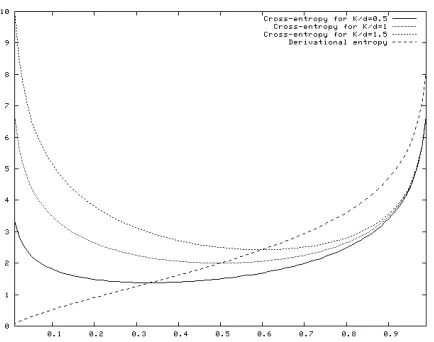
Figure 1: Derivational entropy of Gq and
cross-entropies for three different corpora.
consider the CFGGdefined by the two rulesS →
aSandS→a, and letGq= (G, pG,q)be the
proba-bilistic extension ofGwithpG,q(S →aS) =q and
pG,q(S →a) = 1−q. This grammar is
unambigu-ous and consistent, and each treetgenerated byG
has probabilitypG,q(t) =qi·(1−q), wherei≥0
is the number of occurrences of ruleS →aSint. We use below the following well-known relations (0< r <1)
+∞
X
i=0
ri = 1
1−r, (31)
+∞
X
i=1
i·ri−1 = 1
(1−r)2. (32)
The derivational entropy of Gq can be directly
computed from its definition as
Hd(pG,q) = −
+∞
X
i=0
qi·(1−q)·logqi·(1−q)
= −(1−q) +∞
X
i=0
qilogqi+
−(1−q)·log(1−q)· +∞
X
i=0
qi
= −(1−q)·logq· +∞
X
i=0
i·qi−log(1−q)
= − q
1−q ·logq−log(1−q). (33)
See Figure 1 for a plot of Hd(pG,q) as a function
ofq.
If a tree bank is given, composed of occurrences of trees generated by G, the value ofq can be es-timated by applying the MLE or, equivalently, by minimizing the cross-entropy. We consider here sev-eral tree banks, to exemplify the behaviour of the cross-entropy depending on the structure of the sam-ple of trees. The first tree bankT contains a single treetwith a single occurrence of ruleS → aSand a single occurrence of rule S → a. We then have
pT(t) = 1 andpG,q(t) = q ·(1−q). The
cross-entropy between distributionspT andpG,qis then
H(pT, pG,q) = −logq·(1−q)
= −logq−log(1−q). (34)
The cross-entropy H(pT, pG,q), viewed as a
func-tion of q, is a convex-∪ function and is plotted in Figure 1 (line indicated by Kd = 1, see below). We can obtain its minimum by finding a zero for the first derivative
d
dqH(pT, pG,q) = −
1
q +
1 1−q
= 2q−1
q·(1−q) = 0, (35)
which gives q = 0.5. Note from Figure 1 that the minimum of H(pT, pG,q) crosses the line
cor-responding to the derivational entropy, as should be expected from the result in Section 4.
More in general, for integersd > 0andK > 0, consider a tree sampleTd,K consisting ofdtreesti,
1 ≤ i ≤ d. Eachti containski ≥ 0 occurrences
of ruleS →aSand one occurrence of ruleS →a. Thus we have pTd,K(ti) =
1
d andpG,q(ti) = q ki ·
(1−q). We letPdi=1 ki=K. The cross-entropy is
H(pTd,K, pG,q) =
= −
d X
i=0 1
d·logq
ki−log(1−q)
= −K
d logq−log(1−q). (36)
In Figure 1 we plotH(pTd,K, pG,q)in the case
K d =
0.5and in the case Kd = 1.5. Again, we have that these curves intersect with the curve corresponding to the derivational entropy Hd(pG,q) at the points
7 Conclusions
We have shown in this paper that, when a PCFG is estimated from some tree distribution by minimiz-ing the cross-entropy, then the cross-entropy takes the same value as the derivational entropy of the PCFG itself. As a special case, this result holds for the maximum likelihood estimator, widely applied in statistical natural language parsing. The result also holds for the relative weighted frequency esti-mator introduced in (Chi, 1999) as a generalization of the maximum likelihood estimator, and for the es-timator introduced in (Nederhof, 2005) already dis-cussed in the introduction. In a journal version of the present paper, which is under submission, we have also extended the results of Section 4 to the unsuper-vised estimation of a PCFG from a distribution de-fined over an infinite set of (unannotated) sentences and, as a particular case, to the well-knonw inside-outside algorithm (Manning and Sch¨utze, 1999).
In practical applications, the results of Section 4 can be exploited in the computation of model tight-ness. In fact, cross-entropy indicates how much the estimated model fits the observed data, and is com-monly exploited in comparison of different models on the same data set. We can then use the given relation between cross-entropy and derivational en-tropy to compute one of these two quantities from the other. For instance, in the case of the MLE method we can choose between the computation of the derivational entropy and the cross-entropy, de-pending basically on the instance of the problem at hand. As already mentioned, the computation of the derivational entropy requires cubic time in the ber of nonterminals of the grammar. If this num-ber is large, direct computation of (5) on the corpus might be more efficient. On the other hand, if the corpus at hand is very large, one might opt for direct computation of (3).
Acknowledgements
Helpful comments from Zhiyi Chi, Alberto lavelli, Mark-Jan Nederhof and Khalil Simaan are grate-fully acknowledged.
References
T.L. Booth and R.A. Thompson. 1973. Applying prob-abilistic measures to abstract languages. IEEE Trans-actions on Computers, C-22(5):442–450, May.
E. Charniak. 2001. Immediate-head parsing for language models. In39th Annual Meeting and 10th Conference of the European Chapter of the Association for Com-putational Linguistics, Proceedings of the Conference, pages 116–123, Toulouse, France, July.
R. Chaudhuri, S. Pham, and O. N. Garcia. 1983. Solution of an open problem on probabilistic grammars. IEEE Transactions on Computers, 32(8):748–750.
C. Chelba and F. Jelinek. 1998. Exploiting syntactic structure for language modeling. In36th Annual Meet-ing of the Association for Computational LMeet-inguistics and 17th International Conference on Computational Linguistics, volume 1, pages 225–231, Montreal, Que-bec, Canada, August.
Z. Chi and S. Geman. 1998. Estimation of probabilis-tic context-free grammars. Computational Linguistics, 24(2):299–305.
Z. Chi. 1999. Statistical properties of probabilistic context-free grammars. Computational Linguistics, 25(1):131–160.
M. Collins. 2003. Head-driven statistical models for natural language parsing. Computational Linguistics, pages 589–638.
J.E. Hopcroft and J.D. Ullman. 1979. Introduction to Automata Theory, Languages, and Computation. Addison-Wesley.
C.D. Manning and H. Sch¨utze. 1999. Foundations of Statistical Natural Language Processing. Mas-sachusetts Institute of Technology.
M.-J. Nederhof and G. Satta. 2004. Kullback-Leibler distance between probabilistic context-free grammars and probabilistic finite automata. InProc. of the 20th COLING, volume 1, pages 71–77, Geneva, Switzer-land.
M.-J. Nederhof. 2005. A general technique to train lan-guage models on lanlan-guage models. Computational Linguistics, 31(2):173–185.
B. Roark. 2001. Probabilistic top-down parsing and language modeling. Computational Linguistics, 27(2):249–276.