Computation of Infix Probabilities
for Probabilistic Context-Free Grammars
Mark-Jan Nederhof School of Computer Science
University of St Andrews United Kingdom
Giorgio Satta
Dept. of Information Engineering University of Padua
Italy
Abstract
The notion of infix probability has been intro-duced in the literature as a generalization of the notion of prefix (or initial substring) prob-ability, motivated by applications in speech recognition and word error correction. For the case where a probabilistic context-free gram-mar is used as language model, methods for the computation of infix probabilities have been presented in the literature, based on vari-ous simplifying assumptions. Here we present a solution that applies to the problem in its full generality.
1 Introduction
Probabilistic context-free grammars (PCFGs for short) are a statistical model widely used in natural language processing. Several computational prob-lems related to PCFGs have been investigated in the literature, motivated by applications in model-ing of natural language syntax. One such problem is the computation ofprefix probabilitiesfor PCFGs, where we are given as input a PCFGG and a string w, and we are asked to compute the probability that a sentence generated byG starts withw, that is, has was a prefix. This quantity is defined as the possi-bly infinite sum of the probabilities of all strings of the formwx, for any stringxover the alphabet ofG. The problem of computation of prefix probabili-ties for PCFGs was first formulated by Persoon and Fu (1975). Efficient algorithms for its solution have been proposed by Jelinek and Lafferty (1991) and Stolcke (1995). Prefix probabilities can be used to compute probability distributions for the next word
or part-of-speech, when a prefix of the input has al-ready been processed, as discussed by Jelinek and Lafferty (1991). Such distributions are useful for speech recognition, where the result of the acous-tic processor is represented as a latacous-tice, and local choices must be made for a next transition. In ad-dition, distributions for the next word are also useful for applications of word error correction, when one is processing ‘noisy’ text and the parser recognizes an error that must be recovered by operations of in-sertion, replacement or deletion.
Motivated by the above applications, the problem of the computation ofinfix probabilitiesfor PCFGs has been introduced in the literature as a generaliza-tion of the prefix probability problem. We are now given a PCFGG and a stringw, and we are asked to compute the probability that a sentence generated byG hasw as an infix. This probability is defined as the possibly infinite sum of the probabilities of all strings of the formxwy, for any pair of stringsx andy over the alphabet ofG. Besides applications in computation of the probability distribution for the next word token and in word error correction, in-fix probabilities can also be exploited in speech un-derstanding systems to score partial hypotheses in algorithms based on beam search, as discussed by Corazza et al. (1991).
the distance of the infix from the sentence bound-aries, which is a simplifying assumption. The prob-lem is also considered by Fred (2000), which pro-vides algorithms for the case where the language model is a probabilistic regular grammar. However, the algorithm in (Fred, 2000) does not apply to cases with multiple occurrences of the given infix within a string in the language, which is what was pointed out to be the problematic case.
In this paper we adopt a novel approach to the problem of computation of infix probabilities, by re-moving the ambiguity that would be caused by mul-tiple occurrences of the given infix. Although our result is obtained by a combination of well-known techniques from the literature on PCFG parsing and pattern matching, as far as we know this is the first algorithm for the computation of infix probabilities that works for general PCFG models without any re-strictive assumption.
The remainder of this paper is structured as fol-lows. In Section 2 we explain how the sum of the probabilities of all trees generated by a PCFG can be computed as the least fixed-point solution of a non-linear system of equations. In Section 3 we re-call the construction of a new PCFG out of a given PCFG and a given finite automaton, such that the language generated by the new grammar is the in-tersection of the languages generated by the given PCFG and the automaton, and the probabilities of the generated strings are preserved. In Section 4 we show how one can efficiently construct an un-ambiguous finite automaton that accepts all strings with a given infix. The material from these three sections is combined into a new algorithm in Sec-tion 5, which allows computaSec-tion of the infix prob-ability for PCFGs. This is the main result of this paper. Several extensions of the basic technique are discussed in Section 6. Section 7 discusses imple-mentation and some experiments.
2 Sum of probabilities of all derivations
Assume a probabilistic context-free grammarG, rep-resented by a 5-tuple(Σ, N, S, R, p), whereΣand N are two finite disjoint sets ofterminalsand non-terminals, respectively,S ∈N is thestart symbol, Ris a finite set of rules, each of the form A → α, whereA∈Nandα∈(Σ∪N)∗, andpis a function
from rules inRto real numbers in the interval[0,1]. The concept ofleft-most derivationin one step is represented by the notationα ⇒πG β, which means that the left-most occurrence of any nonterminal in α ∈ (Σ∪N)∗ is rewritten by means of some rule π ∈ R. If the rewritten nonterminal is A, then π must be of the form(A → γ) and β is the result of replacing the occurrence ofAinαbyγ. A left-most derivation with any number of steps, using a sequencedof rules, is denoted asα⇒dG β. We omit the subscriptG when the PCFG is understood. We also write α ⇒∗ β when the involved sequence of rules is of no relevance. Henceforth, all derivations we discuss are implicitly left-most.
A complete derivation is either the empty se-quence of rules, or a sese-quenced=π1· · ·πm,m ≥ 1, of rules such thatA ⇒d w for someA ∈ N and w ∈ Σ∗. In the latter case, we say the complete derivation starts withA, and in the former case, with dan empty sequence of rules, we assume the com-plete derivation starts and ends with a single termi-nal, which is left unspecified. It is well-known that there exists a bijective correspondence between left-most complete derivations starting with nonterminal Aand parse trees derived by the grammar with root Aand a yield composed of terminal symbols only.
Thedepthof a complete derivationdis the length of the longest path from the root to a leaf in the parse tree associated withd. The length of a path is de-fined as the number of nodes it visits. Thus ifd=π for some ruleπ = (A→w)withw∈Σ∗, then the depth ofdis 2.
The probabilityp(d)of a complete derivationd=
π1· · ·πm,m≥1, is:
p(d) = m
Y
i=1
p(πi).
We also assume thatp(d) = 1whendis an empty sequence of rules. The probabilityp(w)of a string wis the sum of all complete derivations deriving that string from the start symbol:
p(w) = X
d:S⇒dw
p(d).
de-fined as the condition:
X
d,w:S⇒dw
p(d) = 1.
In other words, a PCFG is consistent if the sum of probabilities of all complete derivations starting withSis 1. An equivalent definition of consistency considers the sum of probabilities of all strings:
X
w
p(w) = 1.
See (Booth and Thompson, 1973) for further discus-sion.
In practice, PCFGs are often required to satisfy the additional condition:
X
π=(A→α)
p(π) = 1,
for each A ∈ N. This condition is called proper-ness. PCFGs that naturally arise by parameter es-timation from corpora are generally consistent; see (S´anchez and Bened´ı, 1997; Chi and Geman, 1998). However, in what follows, neither properness nor consistency is guaranteed.
We define thepartition functionofGas the func-tionZthat assigns to eachA∈N the value
Z(A) = X d,w
p(A⇒d w). (1)
Note that Z(S) = 1 means that G is consistent. More generally, in later sections we will need to compute the partition function for non-consistent PCFGs.
We can characterize the partition function of a PCFG as a solution of a specific system of equa-tions. Following the approach in (Harris, 1963; Chi, 1999), we introduce generating functions associated with the nonterminals of the grammar. ForA ∈ N andα ∈(N∪Σ)∗, we writef(A, α)to denote the number of occurrences of symbolAwithin stringα. LetN ={A1, A2, . . . , A|N|}. For eachAk ∈N, let
mk be the number of rules inRwith left-hand side
Ak, and assume some fixed order for these rules. For
eachiwith1 ≤i ≤mk, letAk → αk,i be thei-th
rule with left-hand sideAk.
For each k with 1 ≤ k ≤ |N|, the generating functionassociated withAkis defined as
gAk(z1, z2, . . . , z|N|) =
mk
X
i=1
p(Ak→αk,i)·
|N| Y
j=1
zf(Aj,αk,i) j
. (2)
Furthermore, for each i ≥ 1 we recursively define functionsg(Aki)(z1, z2, . . . , z|N|)by
gAk(1)(z1, z2, . . . , z|N|) =gAk(z1, z2, . . . , z|N|), (3)
and, fori≥2, by
g(Aki)(z1, z2, . . . , z|N|) = (4)
gAk( g(i
−1)
A1 (z1, z2, . . . , z|N|),
g(Ai−1)
2 (z1, z2, . . . , z|N|), . . . ,
g(Ai−1)
|N| (z1, z2, . . . , z|N|) ).
Using induction it is not difficult to show that, for eachkandias above,gAk(i)(0,0, . . . ,0)is the sum of the probabilities of all complete derivations fromAk
having depth not exceedingi. This implies that, for i= 0,1,2, . . ., the sequence of thegA(i)
k(0,0, . . . ,0)
monotonically converges toZ(Ak).
For eachkwith1≤k≤ |N|we can now write
Z(Ak) =
= lim i→∞ g
(i)
Ak(0, . . . ,0)
= lim
i→∞ gAk( g
(i−1)
A1 (0,0, . . . ,0), . . . ,
gA(i−1)
|N| (0,0, . . . ,0) )
=gAk( limi→∞ g
(i−1)
A1 (0,0, . . . ,0), . . . ,
limi→∞ gA(i−1)
|N| (0,0, . . . ,0) )
=gAk(Z(A1), . . . , Z(A|N|)).
The above shows that the values of the partition function provide a solution to the system of the fol-lowing equations, for1≤k≤ |N|:
zk = gAk(z1, z2, . . . , z|N|). (5)
are called monotone systems of polynomial equa-tions and have been investigated by Etessami and Yannakakis (2009) and Kiefer et al. (2007). The sought solution, that is, the partition function, is the least fixed point solution ofX=g(X).
For practical reasons, the set of nonterminals of a grammar is usually divided into maximal subsets of mutually recursive nonterminals, that is, for each A and B in such a subset, we have A ⇒∗ uBα and B ⇒∗ vAβ, for some u, v, α, β. This corre-sponds to a strongly connected component if we see the connection between the left-hand side of a rule and a nonterminal member in its right-hand side as an edge in a directed graph. For each strongly connected component, there is a separate system of equations of the formX=g(X). Such systems can be solved one by one, in a bottom-up order. That is, if one strongly connected component contains nonterminalA, and another contains nonterminalB, whereA⇒∗ uBαfor someu, α, then the system for the latter component must be solved first.
The solution for a system of equations such as those described above can be irrational and non-expressible by radicals, even if we assume that all the probabilities of the rules in the input PCFG are rational numbers, as observed by Etessami and Yan-nakakis (2009). Nonetheless, the partition function can still be approximated to any degree of preci-sion by iterative computation of the relation in (4), as done for instance by Stolcke (1995) and by Ab-ney et al. (1999). This corresponds to the so-called fixed-point iteration method, which is well-known in the numerical calculus literature and is frequently applied to systems of non-linear equations because it can be easily implemented.
When a number of standard conditions are met, each iteration of (4) adds a fixed number of bits to the precision of the solution; see Kelley (1995, Chapter 4). Since each iteration can easily be im-plemented to run in polynomial time, this means that we can approximate the partition function of a PCFG in polynomial time in the size of the PCFG itself and in the number of bits of the desired preci-sion.
In practical applications where large PCFGs are empirically estimated from data sets, the standard conditions mentioned above for the polynomial time approximation of the partition function are usually
met. However, there are some degenerate cases for which these standard conditions do not hold, result-ing in exponential time behaviour of the fixed-point iteration method. This has been firstly observed in (Etessami and Yannakakis, 2005).
An alternative iterative algorithm for the approx-imation of the partition function has been proposed by Etessami and Yannakakis (2009), based on New-ton’s method for the solution of non-linear systems of equations. From a theoretical perspective, Kiefer et al. (2007) have shown that, after a certain number of initial iterations, Newton’s method adds a fixed number of bits to the precision of the approximated solution, even in the above mentioned cases in which the fixed-point iteration method shows exponential time behaviour. However, these authors also show that, in some degenerate cases, the number of itera-tions needed to compute the first bit of the solution can be at least exponential in the size of the system. Experiments with Newton’s method for the ap-proximation of the partition functions of PCFGs have been carried out in several application-oriented settings, by Wojtczak and Etessami (2007) and by Nederhof and Satta (2008), showing considerable improvements over the fixed-point iteration method.
3 Intersection of PCFG and FA
It was shown by Bar-Hillel et al. (1964) that context-free languages are closed under intersection with regular languages. Their proof relied on the con-struction of a new CFG out of an input CFG and an input finite automaton. Here we extend that con-struction by letting the input grammar be a proba-bilistic CFG. We refer the reader to (Nederhof and Satta, 2003) for more details.
To avoid a number of technical complications, we assume the finite automaton has no epsilon transi-tions, and has only one final state. In the context of our use of this construction in the following sec-tions, these restrictions are without loss of general-ity. Thus, a finite automaton (FA)Mis represented by a 5-tuple(Σ, Q, q0, qf, ∆), whereΣandQare
two finite sets ofterminalsandstates, respectively, q0 is theinitialstate,qf is thefinalstate, and∆is
a finite set oftransitions, each of the forms 7→a t, wheres, t∈Qanda∈Σ.
w = a1· · ·an is a sequencec = τ1· · ·τn of
tran-sitions such thatτi = (si−1
ai
7→ si)for each i(1 ≤
i ≤ n), for somes0, s1, . . . , sn withs0 = q0 and
sn=qf. The language of all strings accepted byM
is denoted by L(M). A FA is unambiguousif at most one complete computation exists for each ac-cepted string. A FA is deterministicif there is at most one transitions7→a tfor eachsanda.
For a FAMas above and a PCFGG= (Σ, N, S, R, p) with the same set of terminals, we construct a new PCFGG0 = (Σ, N0, S0, R0, p0), whereN0 = Q×(Σ∪N)×Q,S0= (q0, S, qf),andR0is the set
of rules that is obtained as follows.
• For each A → X1· · ·Xm in R and each
se-quences0, . . . , sm withsi ∈ Q,0 ≤ i ≤ m,
andm ≥0, let(s0, A, sm)→(s0, X1, s1)· · ·
(sm−1, Xm, sm) be inR0; if m = 0, the new
rule is of the form(s0, A, s0)→. Functionp0
assigns the same probability to the new rule as passigned to the original rule.
• For eachs7→a tin∆, let(s, a, t)→abe inR0. Functionp0 assigns probability 1 to this rule.
Intuitively, a rule ofG0is either constructed out of a rule ofGor out of a transition ofM. On the basis of this correspondence between rules and transitions ofG0, G andM, it is not difficult to see that each derivationd0inG0deriving stringwcorresponds to a unique derivationdinGderiving the same string and a unique computation c in M accepting the same string. Conversely, if there is a derivation d in G
deriving string w, and some computation c in M
accepting the same string, then the pair of dandc corresponds to a unique derivationd0inG0 deriving the same stringw. Furthermore, the probabilities of dandd0are equal, by definition ofp0.
Let us now assume that each stringwis accepted by at most one computation, i.e. Mis unambigu-ous. If a stringwis accepted by M, then there are as many derivations derivingwinG0as there are in
G. Ifw is not accepted byM, then there are zero derivations derivingwinG0. Consequently:
X
d0,w:
S0⇒d0 G0w
p0(d0) = X
d,w:
S⇒dGw∧w∈L(M) p(d),
or more succinctly:
X
w
p0(w) = X w∈L(M)
p(w).
Note that the above construction ofG0is exponen-tial in the largest value ofmin any rule fromG. For this reason,Gis usually brought in binary form be-fore the intersection, i.e. the input grammar is trans-formed to let each right-hand side have at most two members. Such a transformation can be realized in linear time in the size of the grammar. We will return to this issue in Section 7.
4 Obtaining unambiguous FAs
In the previous section, we explained that unambigu-ous finite automata have special properties with re-spect to the grammarG0 that we may construct out of a FAMand a PCFG G. In this section we dis-cuss how unambiguity can be obtained for the spe-cial case of finite automata accepting the language of all strings with given infixw∈Σ∗:
Linfix(w) = {xwy | x, y∈Σ∗}.
Any deterministic automaton is also unambigu-ous. Furthermore, there seem to be no practical al-gorithms that turn FAs into equivalent unambiguous FAs other than the algorithms that also determinize them. Therefore, we will henceforth concentrate on deterministic rather than unambiguous automata.
Given a stringw = a1· · ·an, a finite automaton
accepting Linfix(w) can be straightforwardly
con-structed. This automaton has statess0, . . . , sn,
tran-sitionss0
a
7→ s0 andsn a
7→ sn for eacha ∈ Σ, and
transitionsi−1
ai
7→ si for each i(1 ≤ i ≤ n). The
initial state iss0 and the final state is sn. Clearly,
there is nondeterminism in states0.
way that the time complexity of constructing the au-tomaton is linear in|w|.
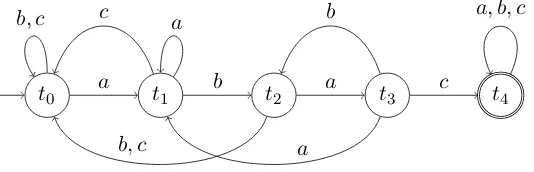
The automatonIwis described as follows. There are n+ 1 states t0, . . . , tn, where as before n is
the length ofw. The initial state ist0 and the final
state is tn. The intuition is that Iw reads a string
x = b1· · ·bm from left to right, and when it has
read the prefixb1· · ·bj (0 ≤ j ≤ m), it is in state
ti (0 ≤i < n) if and only ifa1· · ·ai is the longest
prefix of w that is also a suffix of b1· · ·bj. If the
automaton is in statetn, then this means thatwis an
infix ofb1· · ·bj.
In more detail, for eachi(1 ≤ i ≤ n) and each a ∈ Σ, there is a transitionti−1 7→a tj, wherej is
the length of the longest string that is both a prefix ofw and a suffix of a1· · ·ai−1a. Ifa = ai, then
clearlyj=i, and otherwisej < i. To ensure that we remain in the final state once an occurrence of infix whas been found, we also add transitionstn
a 7→ tn
for each a ∈ Σ. This construction is illustrated in Figure 1.
5 Infix probability
With the material developed in the previous sections, the problem of computing the infix probabilities can be effectively solved. Our goal is to compute for given infixw ∈ Σ∗ and PCFGG = (Σ, N, S, R, p):
σinfix(w,G) =
X
z∈Linfix(w) p(z).
In Section 4 we have shown the construction of finite automatonIwacceptingLinfix(w), by which we
ob-tain:
σinfix(w,G) =
X
z∈L(Iw)
p(z).
AsIw is deterministic and therefore unambiguous,
the results from Section 3 apply and ifG0= (Σ, N0, S0, R0, p0)is the PCFG constructed out ofGandIw
then:
σinfix(w,G) =
X
z
p0(z).
Finally, we can compute the above sum by applying the iterative method discussed in Section 2.
6 Extensions
The approach discussed above allows for a number of generalizations. First, we can replace the infixw by asequenceof infixesw1,. . . ,wm, which have to
occur in the given order, one strictly after the other, with arbitrary infixes in between:
σisland(w1, . . . , wm,G) =
X
x0,...,xm∈Σ∗
p(x0w1x1· · ·wmxm).
This problem was discussed before by (Corazza et al., 1991), who mentioned applications in speech recognition. Further applications are found in com-putational biology, but their discussion is beyond the scope of this paper; see for instance (Apostolico et al., 2005) and references therein. In order to solve the problem, we only need a small addition to the procedures we discussed before. First we construct separate automataIwj (1 ≤j ≤m) as explained in
Section 4. These automata are then composed into a single automatonI(w1,...,wm). In this composition, the outgoing transitions of the final state ofIwj, for
eachj(1≤j < m), are removed and that final state is merged with the initial state of the next automaton
Iwj+1. The initial state of the composed automaton
is the initial state of Iw1, and the final state is the final state ofIwm. The time costs of constructing I(w1,...,wm)are linear in the sum of the lengths of the stringswj.
Another way to generalize the problem is to re-placewby a finite setL={w1, . . . , wm}. The
ob-jective is to compute:
σinfix(L,G) =
X
w∈L,x,y∈Σ∗
p(xwy)
Again, this can be solved by first constructing a de-terministic FA, which is then intersected with G. This FA can be obtained by determinizing a straight-forward nondeterministic FA acceptingL, or by di-rectly constructing a deterministic FA along the lines of the Aho-Corasick algorithm (Aho and Corasick, 1975). Construction of the automaton with the latter approach takes linear time.
t0 a t1 b t2 a t3 c t4
b, c c a a, b, c
b, c a
[image:7.612.175.442.76.162.2]b
Figure 1: Deterministic automaton that accepts all strings over alphabet{a, b, c}with infixabac.
as the construction from Bar-Hillel et al. (1964) car-ries over from context-free grammars to tree ad-joining grammars, and more generally to the linear context-free rewriting systems of Vijay-Shanker et al. (1987).
7 Implementation
We have conducted experiments with the computa-tion of infix probabilities. The objective was to iden-tify parts of the computation that have a high time or space demand, and that might be improved. The experiments were run on a desktop with a 3.0 GHz Pentium 4 processor. The implementation language is C++.
The set-up of the experiments is similar to that in (Nederhof and Satta, 2008). A probabilistic context-free grammar was extracted from sections 2-21 of the Penn Treebank version II. Subtrees that gener-ated the empty string were systematically removed. The result was a CFG with 10,035 rules, 28 nonter-minals and 36 parts-of-speech. The rule probabili-ties were determined by maximum likelihood esti-mation. The grammar was subsequently binarized, to avoid exponential behaviour, as explained in Sec-tion 3.
We have considered 10 strings of length 7, ran-domly generated, assuming each of the parts-of-speech has the same probability. For all prefixes of those strings from length 2 to length 7, we then com-puted the infix probability. The duration of the full computation, averaged over the 10 strings of length 7, is given in the first row of Table 1.
In order to solve the non-linear systems of equa-tions, we used Broyden’s method. It can be seen as an approximation of Newton’s method. It re-quires more iterations, but seems to be faster over-all, and more scalable to large problem sizes, due to
the avoidance of matrix inversion, which sometimes makes Newton’s method prohibitively expensive. In our experiments, Broyden’s method was generally faster than Newton’s method and much faster than the simple iteration method by the relation in (4). For further details on Broyden’s method, we refer the reader to (Kelley, 1995).
The main obstacle to computation for infixes sub-stantially longer than 7 symbols is the memory con-sumption rather than the running time. This is due to the required square matrices, the dimension of which is the number of nonterminals. The number of nonterminals (of the intersection grammar) natu-rally grows as the infix becomes longer.
As explained in Section 2, the problem is divided into smaller problems by isolating disjoint sets of mutually recursive nonterminals, or strongly con-nected components. We found that for the applica-tion to the automata discussed in Secapplica-tion 4, there were exactly three strongly connected components that contained more than one element, throughout the experiments. For an infix of lengthn, these com-ponents are:
• C1, which consists of nonterminals of the form
(ti, A, tj), wherei < nandj < n,
• C2, which consists of nonterminals of the form
(ti, A, tj), wherei=j=n, and
• C3, which consists of nonterminals of the form
(ti, A, tj), wherei < j=n.
This can be easily explained by looking at the struc-ture of our automata. See for example Figure 1, with cycles running through statest0, . . . , tn−1, and
cy-cles through statetn. Furthermore, the grammar
infix length 2 3 4 5 6 7 total running time 1.07 1.95 5.84 11.38 23.93 45.91 Broyden’s method forC1 0.46 0.90 3.42 6.63 12.91 24.38
Broyden’s method forC2 0.08 0.04 0.07 0.04 0.03 0.09
[image:8.612.147.468.72.139.2]Broyden’s method forC3 0.20 0.36 0.81 1.74 5.30 9.02
Table 1: Running time for infixes from length 2 to length 7. The infixes are prefixes of 10 random strings of length 7, and reported CPU times (in seconds) are averaged over the 10 strings.
so that almost every nonterminal can directly or in-directly call any other.
The strongly connected componentC2 is always
the same, consisting of 2402 nonterminals, for each infix of any length. (Note that binarization of the grammar introduced artificial nonterminals.) The last three rows of Table 1 present the time costs of Broyden’s method, for the three strongly connected components.
The strongly connected componentC3happens to
correspond to alinear system of equations. This is because a rule in the intersection grammar with a left-hand side (ti, A, tj), where i < j = n, must
have a right-hand side of the form(ti, A0, tj), or of
the form(ti, A1, tk) (tk, A2, tj), withk≤n. Ifk <
n, then only the second member can be in C3. If
k = n, only first member can be in C3. Hence,
such a rule corresponds to a linear equation within the system of equations for the entire grammar.
A linear system of equations can be solved an-alytically, for example by Gaussian elimination, rather than approximated through Newton’s method or Broyden’s method. This means that the running times in the last row of Table 1 can be reduced by treatingC3 differently from the other strongly
con-nected components. However, the running time for C1dominates the total time consumption.
The above investigations were motivated by two questions, namely whether any part of the computa-tion can be precomputed, and second, whether infix probabilities can be computed incrementally, for in-fixes that are extended to the left or to the right. The first question can be answered affirmatively forC2,
as it is always the same. However, as we can see in Table 1, the computation ofC2 amounts to a small
portion of the total time consumption.
The second question can be rephrased more pre-cisely as follows. Suppose we have computed the
infix probability of a stringw and have kept inter-mediate results in memory. Can the computation of the infix probability of a string of the formaworwa, a ∈ Σ, be computed by relying on the existing re-sults, so that the computation is substantially faster than if the computation were done from scratch?
Our investigations so far have not found a posi-tive answer to this second question. In particular, the systems of equations forC1andC3change
fun-damentally if the infix is extended by one more sym-bol, which seems to at least make incremental com-putation very difficult, if not impossible. Note that the algorithms for the computation of prefix prob-abilities by Jelinek and Lafferty (1991) and Stolcke (1995) do allow incrementality, which contributes to their practical usefulness for speech recognition.
8 Conclusions
We have shown that the problem of infix probabili-ties for PCFGs can be solved by a construction that intersects a context-free language with a regular lan-guage. An important constraint is that the finite automaton that is input to this construction be un-ambiguous. We have shown that such an automa-ton can be efficiently constructed. Once the input probabilistic PCFG and the FA have been combined into a new probabilistic CFG, the infix probability can be straightforwardly solved by iterative algo-rithms. Such algorithms include Newton’s method, and Broyden’s method, which was used in our exper-iments. Our discussion ended with an open question about the possibility of incremental computation of infix probabilities.
References
Meeting of the Association for Computational
Linguis-tics, Proceedings of the Conference, pages 542–549,
Maryland, USA, June.
A.V. Aho and M.J. Corasick. 1975. Efficient string matching: an aid to bibliographic search. Communi-cations of the ACM, 18(6):333–340, June.
A.V. Aho and J.D. Ullman. 1972. Parsing, volume 1 ofThe Theory of Parsing, Translation and Compiling. Prentice-Hall, Englewood Cliffs, N.J.
A. Apostolico, M. Comin, and L. Parida. 2005. Con-servative extraction of overrepresented extensible mo-tifs. InProceedings of Intelligent Systems for Molecu-lar Biology (ISMB05).
Y. Bar-Hillel, M. Perles, and E. Shamir. 1964. On formal properties of simple phrase structure grammars. In Y. Bar-Hillel, editor,Language and Information: Se-lected Essays on their Theory and Application, chap-ter 9, pages 116–150. Addison-Wesley, Reading, Mas-sachusetts.
T.L. Booth and R.A. Thompson. 1973. Applying prob-abilistic measures to abstract languages. IEEE
Trans-actions on Computers, C-22:442–450.
Z. Chi and S. Geman. 1998. Estimation of probabilis-tic context-free grammars. Computational Linguistics, 24(2):299–305.
Z. Chi. 1999. Statistical properties of probabilistic context-free grammars. Computational Linguistics, 25(1):131–160.
A. Corazza, R. De Mori, R. Gretter, and G. Satta. 1991. Computation of probabilities for an island-driven parser. IEEE Transactions on Pattern Analysis and Machine Intelligence, 13(9):936–950.
K. Etessami and M. Yannakakis. 2005. Recursive Markov chains, stochastic grammars, and monotone systems of nonlinear equations. In22nd International Symposium on Theoretical Aspects of Computer Sci-ence, volume 3404 ofLecture Notes in Computer Sci-ence, pages 340–352, Stuttgart, Germany. Springer-Verlag.
K. Etessami and M. Yannakakis. 2009. Recursive Markov chains, stochastic grammars, and monotone systems of nonlinear equations. Journal of the ACM, 56(1):1–66.
A.L.N. Fred. 2000. Computation of substring proba-bilities in stochastic grammars. In A. Oliveira,
edi-tor,Grammatical Inference: Algorithms and
Applica-tions, volume 1891 ofLecture Notes in Artificial Intel-ligence, pages 103–114. Springer-Verlag.
D. Gusfield. 1997. Algorithms on Strings, Trees, and
Sequences. Cambridge University Press, Cambridge.
T.E. Harris. 1963. The Theory of Branching Processes. Springer-Verlag, Berlin, Germany.
F. Jelinek and J.D. Lafferty. 1991. Computation of the probability of initial substring generation by stochas-tic context-free grammars. Computational Linguistics, 17(3):315–323.
C.T. Kelley. 1995. Iterative Methods for Linear and
Nonlinear Equations. Society for Industrial and
Ap-plied Mathematics, Philadelphia, PA.
S. Kiefer, M. Luttenberger, and J. Esparza. 2007. On the convergence of Newton’s method for monotone sys-tems of polynomial equations. InProceedings of the
39th ACM Symposium on Theory of Computing, pages
217–266.
D.E. Knuth, J.H. Morris, Jr., and V.R. Pratt. 1977. Fast pattern matching in strings.SIAM Journal on Comput-ing, 6:323–350.
M.-J. Nederhof and G. Satta. 2003. Probabilistic pars-ing as intersection. In8th International Workshop on
Parsing Technologies, pages 137–148, LORIA, Nancy,
France, April.
M.-J. Nederhof and G. Satta. 2008. Computing parti-tion funcparti-tions of PCFGs. Research on Language and
Computation, 6(2):139–162.
E. Persoon and K.S. Fu. 1975. Sequential classification of strings generated by SCFG’s. International Journal
of Computer and Information Sciences, 4(3):205–217.
P. Resnik. 1992. Probabilistic tree-adjoining grammar as a framework for statistical natural language process-ing. InProc. of the fifteenth International Conference
on Computational Linguistics, Nantes, August, pages
418–424.
J.-A. S´anchez and J.-M. Bened´ı. 1997. Consistency of stochastic context-free grammars from probabilis-tic estimation based on growth transformations. IEEE Transactions on Pattern Analysis and Machine
Intelli-gence, 19(9):1052–1055, September.
Y. Schabes. 1992. Stochastic lexicalized tree-adjoining grammars. InProc. of the fifteenth International
Con-ference on Computational Linguistics, Nantes,
Au-gust, pages 426–432.
A. Stolcke. 1995. An efficient probabilistic context-free parsing algorithm that computes prefix probabilities.
Computational Linguistics, 21(2):167–201.
K. Vijay-Shanker, D.J. Weir, and A.K. Joshi. 1987. Characterizing structural descriptions produced by various grammatical formalisms. In 25th Annual Meeting of the Association for Computational
Linguis-tics, Proceedings of the Conference, pages 104–111,
Stanford, California, USA, July.
D. Wojtczak and K. Etessami. 2007. PReMo: an an-alyzer for Probabilistic Recursive Models. In Tools and Algorithms for the Construction and Analysis of
Systems, 13th International Conference, volume 4424
of Lecture Notes in Computer Science, pages 66–71,