200
EmoDet at SemEval-2019 Task 3: Emotion Detection in Text using Deep
Learning
Hani Al-Omari Malak Abdullah Nabeel Bassam
[email protected] [email protected] [email protected] Department of Computer Science
Jordan University of Science and Technology Irbid, Jordan
Abstract
Task 3, EmoContext, in the International Workshop SemEval 2019 provides training and testing datasets for the participant teams to detect emotion classes (Happy, Sad, Angry, or Others). This paper proposes a participat-ing system (EmoDet) to detect emotions us-ing deep learnus-ing architecture. The main input to the system is a combination of Word2Vec word embeddings and a set of semantic fea-tures (e.g. from AffectiveTweets Weka-package). The proposed system (EmoDet) en-sembles a fully connected neural network ar-chitecture and LSTM neural network to ob-tain performance results that show substantial improvements (F1-Score 0.67) over the base-line model provided by Task 3 organizers (F1-score 0.58).
1 Introduction
The past decades have seen an explosive growth of user-generated content through social media platforms. People are expressing online their feelings and opinions on a variety of topics on a daily basis. Tracking and analyzing public opin-ions from social media can help to predict certain political events or predicting people’s attitude towards certain products. Therefore, detecting sentiments and emotions in text have gained a considerable amount of attention(Mohammad et al., 2018). Researchers and scientists in different fields considered this a promising topic (Abdullah et al.,2018;Liu,2012). Many machine learning approaches have been used to detect and predict emotions and sentiments. Recently, the deep neural network (DNN) is attracting more researchers as they have been benefited from the high-performance graphics processing unit (GPU) power (Abdullah et al., 2018; Dos Santos and Gatti,2014).
The shared task (Task 3: ”EmoContext”) in SemEval-2019 workshop has been designed for understanding emotions in textual conversations (Chatterjee et al., 2019). In this task, the partic-ipants are given a textual dialogue i.e. a user ut-terance along with three turns of context. The par-ticipant teams have to classify the emotion of user utterance as one of the emotion classes: Happy, Sad, Angry or Others. Further details about Task 3 and the datasets appear in Section 3.
This paper describes our team approach to de-tect and classify emotions. The input has been rep-resented as word vectors (Mikolov et al., 2013b) and a set of different features which are applied to different neural network architecture to obtain the results. The performance of the system shows sub-stantial improvements F1-Score over the baseline model provided by Task 3 organizers.
The remainder of this research paper is orga-nized as follows: Section 2 gives a brief overview of existing work on social media emotion and sen-timent analyses. Section 3 presents the require-ments of SemEval Task3 and examines our pro-posed system to determine the presence of emo-tion in conversaemo-tional text. Secemo-tion 4 summarizes the key findings of the study and the evaluations and concludes with future directions for this re-search.
2 Related Work
emo-tion felt by the speaker of a tweet (Mohammad et al., 2018; Strapparava and Mihalcea, 2007). A group of researchers (Mohammad and Bravo-Marquez, 2017) introduced the WASSA- 2017 shared task of detecting the intensity of emotion felt by the speaker of a tweet. The previous Se-meval Task1 (Mohammad et al.,2018) also intro-duced a dataset (annotated tweets) for emotion de-tection. The state-of- the-art systems in the pre-vious competitions used different approaches of ensembling different deep neural network-based models, representing tweets as word2vec/doc2vec embedding vectors and extracting semantic fea-tures. Our system is using word2vec embed-ding vectors (Mikolov et al.,2013a) and extracted features using a Weka package, AffectiveTweet, (Bravo-Marquez et al.,2014), also extracting em-bedding from the text using deeMoji model (Felbo et al.,2017).
3 Our Approach
Our system has the ability to determine the emo-tion (Happy, Sad, Angry and Other) in English tex-tual dialogue with F1-Score over 0.67. Figure 1
shows the general structure of the system. More details for the systems components are shown in the following subsections: Section 3.1 describes the systems input and preprocessing step. Section 3.2 lists the extracted feature vectors, and Section 3.3 details the system’s architecture of neural net-works. Section 3.4 discusses the output details.
3.1 Input and Preprocessing
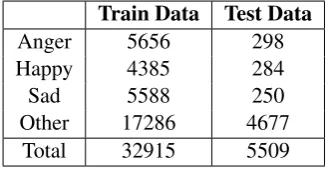
The shared task (Task 3: EmoContext) provides training and testing datasets to be used by all participants. The number of training and testing datasets for each emotion can be shown in Table1.
Train Data Test Data
Anger 5656 298
Happy 4385 284
Sad 5588 250
[image:2.595.99.264.600.685.2]Other 17286 4677 Total 32915 5509
Table 1: Training and Testing Datasets
The training dataset contains 5 columns: ID - Contains a unique number to identify each training sample.
Turn 1 - Contains the first turn in the three turn conversation, written by User 1.
Turn 2 - Contains the second turn, which is a reply to the first turn in conversation and is written by User 2.
Turn 3 - Contains the third turn, which is a reply to the second turn in the conversation, which is written by User 1.
Label - Contains the human-judged label of Emotion of Turn 3 based on the conversation for the given training sample. It is always one of the four values - ’happy’, ’sad, ’angry’ and ’others’.
For testing dataset, the 5th column - ’Label’ is absent. See Table2for more clarification.
The prepossessing methods applied for the data include converting the text into lower case, stem-ming the words and removing of extraneous white spaces. Punctuation has been treated as individual words (”.,?!:;()[]#@’). It’s worth mentioning that removing stop-words dissolved the meaning of the sentence, therefore we didn’t remove them.
3.2 Feature Vector
We have explored different features to represent each turn and the concatenated turns. Our ap-proach extracts feature vectors from texts with a total of 2753 dimensions (Check Table 3). We have applied the same methods for each turn and the concatenated turns.
Figure 1: The architecture of our approach
id Turn1 Turn2 Turn3 label
156 You are funny LOL I konw that. :) happy 187 Yeah exactly Like you said, like brother like sister ;) Not in the least others
Table 2: Examples of datasets format
vector to represent Anger, fear, sadness, and joy (Mohammad,2018).
Dimension Word2Vec 300 AffectiveTweets 145 DeepMoji 2302
NRC 4
Total 2753
Table 3: Feature vectors
3.3 Network Architecture
Knowing that Deep Neural Networks (DNN) is showing significant improvements over traditional Machine Learning (ML) based approaches on classification tasks(LeCun et al., 2015). This derives more researchers to apply it recently for detecting sentiments and emotions. The standard Recurrent Neural Network (RNN) is distinguished from Feed-forward network with a memory. A special kind of RNNs are Long Short-Term Memory Network (LSTM) (Hochreiter and Schmidhuber, 1997), which is composed of a memory cell, an input gate, an output gate and a forget gate.
The architecture of our system consists of two sub-models that use both: feed-forward (Dense) and LSTM. For our first sub-Model, the Input
2753-dimensional vector feeds a fully connected neural network with three dense hidden layers of 500, 200 and 80 neurons for each layer. The activation function for each layer is ReLU ( Good-fellow et al., 2013). Two dropouts have been added to this sub-model, which are 0.3 and 0.2 after the first and the second layers. The output layer consists of 4 sigmoid neurons to predict the class of emotion in each conversation. For optimization, we use Stochastic Gradient Descent (SGD) optimizer (lr=.001, decay=1×10⁻⁶, and momentum = 0.9) augmenting for MSE loss function and ACCURACY metrics. We have also saved the output predictions weights to predict the testing data sets. The fit function uses number of epochs = 60, batch size=32, validation split= 33%.
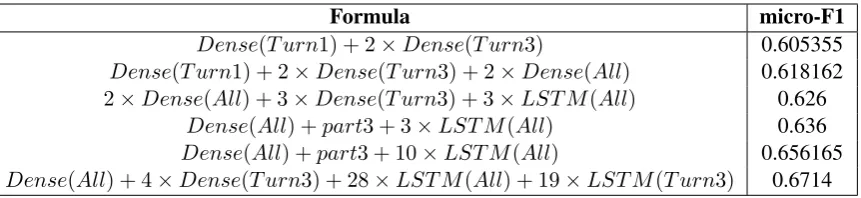
[image:3.595.107.256.385.470.2]Formula micro-F1
Dense(T urn1) + 2×Dense(T urn3) 0.605355
Dense(T urn1) + 2×Dense(T urn3) + 2×Dense(All) 0.618162
2×Dense(All) + 3×Dense(T urn3) + 3×LST M(All) 0.626
Dense(All) +part3 + 3×LST M(All) 0.636
Dense(All) +part3 + 10×LST M(All) 0.656165
[image:4.595.86.517.61.160.2]Dense(All) + 4×Dense(T urn3) + 28×LST M(All) + 19×LST M(T urn3) 0.6714
Table 4: Weight Ensembling
Conversation Turn 1 Turn 2 Turn 3 micro-F1 0.26379 0.08435 0.58920
Table 5: Using Sub-model 1 - Dense Layer
Conversation Turn 1 Turn 2 Turn 3 micro-F1 0.20734 0.13543 0.44364
Table 6: Using Sub-model 1 - Dense Layer plus re-moving 70% of others randomly
System Epoch micro-F1
LSTM (All Conversation) 40 0.5376 LSTM (All Conversation) 80 0.6094 LSTM (All Conversation) 114 0.5096 Dense (All Conversation) 60 4677
Table 7: Best Epoch for both LSTM and Dense
3.4 Output and result
In the beginning, we have analyzed all the con-versation (turn1 + turn2 + turn3) using both sub-model systems. We have noticed that the third turn of the conversation provides better predictions of emotion’s class, see in Table 5. Removing 70% of the others randomly in the training data set led to bad predictions so we didn’t apply this method, see Table6. One of the key findings is noticing that LSTM gives better prediction than the feed-forward system for the whole conversation, see the result in Table7. For the final stage, we have com-bined both sub-models results to produce a real value number between 0 and 1. It has shown that the second sub-model gives higher accuracy than the first sub-model. Applying different amount of weights for four prediction led us to find out that the correct formula for our system using turn3 alone as a sub-model and All-Conversation pre-diction and from the second sub-Model turn3 and
All-Conversation and combining them together in a formula, It showed a higher F1-Score equal to 0.67. Also, it’s worth mentioning that we used Grid Search to find the best parameters for the for-mula (Check Table4).
4 Conclusion
In this paper, we have presented our system EmoDet that uses deep learning architectures for detecting the existence of emotions in a text. The performance of the system surpasses the perfor-mance of the baselines model indicating that our approach is promising. In this system, we uses word embedding models with feature vectors ex-tracted using the AffectiveTweets package and Deepmoji model. These vectors feed different deep neural network architectures, feed-forward and LSTM, to obtain the predictions. We use the SemEval-2019 Task 3s datasets as input for our system and show that EmoDet has a high profi-ciency in detecting emotions in a conversational text and surpasses the F1-score Baseline models performance, which is provided by the SemEval-Task 3 organizers.
References
Malak Abdullah, Mirsad Hadzikadicy, and Samira Shaikhz. 2018. Sedat: Sentiment and emotion de-tection in arabic text using cnn-lstm deep learning. In2018 17th IEEE International Conference on Ma-chine Learning and Applications (ICMLA), pages 835–840. IEEE.
Felipe Bravo-Marquez, Marcelo Mendoza, and Bar-bara Poblete. 2014. Meta-level sentiment models for big social data analysis. Knowledge-Based Systems, 69:86–99.
Cicero Dos Santos and Maira Gatti. 2014. Deep con-volutional neural networks for sentiment analysis of short texts. In Proceedings of COLING 2014, the 25th International Conference on Computational Linguistics: Technical Papers, pages 69–78.
Paul Ekman and Dacher Keltner. 1997. Universal fa-cial expressions of emotion. Segerstrale U, P. Mol-nar P, eds. Nonverbal communication: Where nature meets culture, pages 27–46.
Bjarke Felbo, Alan Mislove, Anders Søgaard, Iyad Rahwan, and Sune Lehmann. 2017. Using millions of emoji occurrences to learn any-domain represen-tations for detecting sentiment, emotion and sar-casm. arXiv preprint arXiv:1708.00524.
Ian J Goodfellow, David Warde-Farley, Mehdi Mirza, Aaron Courville, and Yoshua Bengio. 2013. Maxout networks. arXiv preprint arXiv:1302.4389.
Sepp Hochreiter and J¨urgen Schmidhuber. 1997. Long short-term memory. Neural computation, 9(8):1735–1780.
Yann LeCun, Yoshua Bengio, and Geoffrey Hinton. 2015. Deep learning. nature, 521(7553):436.
Bing Liu. 2012. Sentiment analysis and opinion min-ing. Synthesis lectures on human language tech-nologies, 5(1):1–167.
Tomas Mikolov, Kai Chen, Greg Corrado, and Jef-frey Dean. 2013a. Efficient estimation of word representations in vector space. arXiv preprint arXiv:1301.3781.
Tomas Mikolov, Ilya Sutskever, Kai Chen, Greg S Cor-rado, and Jeff Dean. 2013b. Distributed representa-tions of words and phrases and their compositional-ity. InAdvances in neural information processing systems, pages 3111–3119.
Saif Mohammad, Felipe Bravo-Marquez, Mohammad Salameh, and Svetlana Kiritchenko. 2018. Semeval-2018 task 1: Affect in tweets. In Proceedings of The 12th International Workshop on Semantic Eval-uation, pages 1–17.
Saif M. Mohammad. 2018. Word affect intensities. In
Proceedings of the 11th Edition of the Language Re-sources and Evaluation Conference (LREC-2018), Miyazaki, Japan.
Saif M Mohammad and Felipe Bravo-Marquez. 2017. Wassa-2017 shared task on emotion intensity. arXiv preprint arXiv:1708.03700.
Robert Plutchik. 1990. Emotions and psychotherapy: A psychoevolutionary perspective. InEmotion, psy-chopathology, and psychotherapy, pages 3–41. Else-vier.