Annotating Spelling Errors in German Texts
Produced by Primary School Children
Ronja Laarmann-Quante, Lukas Knichel, Stefanie Dipper and Carina Betken Ruhr-University Bochum
[email protected], [email protected], [email protected], [email protected]
Abstract
We present a new multi-layered annotation scheme for orthographic errors in freely written German texts produced by primary school children. The scheme is closely linked to the German graphematic sys-tem and defines categories for both gen-eral structural word properties and error-related properties. Furthermore, it features multiple layers of information which can be used to evaluate an error. The cate-gories can also be used to investigate prop-erties of correctly-spelled words, and to compare them to the erroneous spellings. For data representation, we propose the XML-format LearnerXML.
1 Introduction
Orthographic competence is one of the key skills to be acquired in primary school. In many cases, the systematicity and logic behind the German writing system seems not to play a sufficiently large role in school teaching yet. One area where this becomes apparent is the interpretation of or-thographic errors. Well-established instruments of assessing spelling abilities such as the HSP (May, 2013), OLFA (Thom´e and Thom´e, 2004) or AFRA (Hern´e and Naumann, 2002) only partly classify errors along graphematic dimensions, as has been criticized before (Eisenberg and Fuhrhop, 2007; R¨ober, 2011). However, we believe that the Ger-man graphematic system and children’s orthogra-phy acquisition are closely related in that orthog-raphy acquisition involves the detection of regu-larities in the writing system, be it by implicit or explicit learning.1
1Graphemics is about describing properties of the
writ-ing system, orthography is about standardizwrit-ing it (D¨urscheid, 2006, p. 126). That means that orthographically correct
We developed a new annotation scheme which closely follows the graphematic theory by Eisen-berg (2006). Its main novelty is that it features multiple layers of annotation to keep apart infor-mation that gets mixed up, or is not even available, in other available schemes for German spelling error annotation. Besides error categories, it in-cludes general linguistic information, such as the syllabic and morphological structure of a word.
We further propose LearnerXML, an XML-scheme for the representation of our annota-tions, and the use of EXMARaLDA2(Schmidt and W¨orner, 2009; Schmidt et al., 2011) as a suitable annotation tool.
Our aim is twofold: Firstly, we want to provide a means for constructing detailed and graphemati-cally valid error profiles for individual learners and groups of learners to study the development of or-thographic competence. Our annotations allow us to pursue new research questions with regard to the relation of graphemics and orthography acqui-sition, e.g. whether errors are more frequently re-lated to the prosodical or morphological structure of a word. Secondly, our scheme can also serve as a tool for analyzing the orthographic properties of German words in general. This way we can in-vestigate what kind of spelling phenomena occur in texts children are confronted with (e.g. in chil-dren’s books or in schoolbooks) and how this re-lates to the kinds of spelling errors they produce (see also Berkling et al. (2015)).
The paper is organized as follows. Section 2 introduces Eisenberg’s (2006) theory of the Ger-man graphematic system, section 3 discusses re-lated work. Section 4 presents our annotation scheme, which comprises both annotations of gen-eral structural properties of words as well as
spe-spellings are determined by convention and form a subset of graphematically possible spellings.
2www.exmaralda.org
cific grapheme-related features. Section 5 deals with the data representation in LearnerXML and in EXMARaLDA, followed by figures on inter-annotator agreement in Section 6.3
2 Theoretical Background
Our annotation scheme is largely based on the graphematic theory by Eisenberg (2006). He takes grapheme-phoneme correspondences (GPCs) as the basic component of the German writing sys-tem. For instance, the word<bunt>‘colorful’ can be spelled purely phonographically, by following the basic GPC rules set up by Eisenberg (2006). (1) shows the relevant rules.
(1) /b/ → <b> /n/ → <n> /U/ → <u> /t/ → <t>
Simple GPC rules can be overwritten by syl-labic principles. For instance, Ruhe ‘quietness’ is pronounced [öu:@] and according to GPC rules it would be spelled as *<Rue>4. The principle of syllable-separating “h” inserts <h> to indicate the syllable boundary: <Ru.he>. Other syllabic principles are consonant doubling (<Kanne> ‘pot’), vowel-lengthening<h>(<Kohle>‘coal’) and vowel doubling (<Saal> ‘hall’). Phono-graphic and syllabic spellings taken together are called phonological spellings by Eisenberg. They make reference to the word’s prosodic struc-ture and help determining its pronunciation and prosody given its spelling.
Finally, phonological spelling principles can be overwritten by morphological principles, which help recognizing a word’s morphological struc-ture. The main principle is that of morpheme con-stancy (MC), which means that a morpheme is al-ways spelled in the same way regardless of its syl-labic context. The “reference spelling” of a mor-pheme usually follows GPC and syllabic princi-ples and is derived from so-called explicit forms. These are word forms with a trochaic stress pat-tern (stressed-unstressed as in ‘under’) or dactylic stress pattern (stressed-unstressed-unstressed as in ‘memorize’.
For instance, for a monosyllabic word like singular Hund [hUnt] ‘dog’, the explicit form would be the disyllabic plural form Hunde
3
The annotation scheme and the data of the pilot study reported here are available at https://www. linguistics.ruhr-uni-bochum.de/litkey/ Scientific/Corpusanalysis/Resources.html.
4Asterisks mark an orthographically incorrect spelling.
[hUnd@] ‘dogs’. For these forms, GPC and
syl-labic rules would predict the spellings *<Hunt> (due to final devoicing) and <Hunde>, respec-tively. Morpheme constancy states that<Hund> is the correct singular spelling, inheriting the grapheme for the voiced plosive from the explicit form. MC becomes also visible e.g. in spellings of g-spirantization (GPC: *<K¨onich>; MC: <K¨onig> because of <K¨onige> ‘king/kings’) and morphologically-determined <¨a>-spellings (GPC: *<Reuber>; MC:<R¨auber>‘robber’ be-cause of <rauben> ‘(to) rob’). Another exam-ple are inhereted syllabic spellings where there is no actual structural need (<kommst>because of <kommen>‘(you/to) come’).
From the learner’s perspective, Eisenberg’s tax-onomy is a suitable background to interpret er-rors against: Firstly, it takes GPCs as a basis, which is in accordance both with typical models of orthography acquisition (Siekmann and Thom´e, 2012) as well as predominant teaching methods at school such as “Lesen durch Schreiben” (‘reading through writing’) (Reichen, 2008). Furthermore, the taxonomy clearly groups orthographic phe-nomena by form and function (e.g. principles that facilitate pronunciation or identification of mor-phemes), hence errors can be assessed in a graphe-matically systematical way.
3 Related Work
Error analysis has recently been of particular in-terest in the area of second language learner data. Here, spelling errors are often only one type of er-rors analyzed (besides grammatical erer-rors) and not further subclassified (e.g. Rozovskaya and Roth (2010) and Dahlmeier et al. (2013) for English, Reznicek et al. (2012) for German). In contrast, work that is specifically directed at spelling er-rors often models and annotates causes of erer-rors (e.g. Deorowicz and Ciura (2005), Hovermale and Martin (2008)), or describes the deviations from a rather technical point of view (e.g. edit-distance or single vs. multi-token (Bestgen and Granger, 2011; Flor, 2012)). This is largely language-independent, and a sample application for this kind of annotations is automatic spelling correc-tion.
spelled. For English, such annotations have been applied for comparing L1 and L2 learners (Be-bout, 1985) and to derive implications for spelling instructions for L1 learners (Arndt and Foorman, 2010). Since annotations which reflect the ortho-graphic properties of the words to be spelled are highly language specific, we focus on the litera-ture on German spelling error annotation in the re-mainder of this section.
For German, quite a large number of ortho-graphic annotation schemes exist already, many of which are part of well-established tests to as-sess children’s spelling competence. However, their connection to the German graphematic sys-tem is often only loose. Some of them, for instance Hamburger Schreib-Probe (HSP) (May, 2013) and Oldenburger Fehleranalyse (OLFA) (Thom´e and Thom´e, 2004), are based on orthographic acquisi-tion models and assign errors to phases of acqui-sition rather than graphematically well-founded categories. Hence, it can often not be assessed how an error relates to the systematics of the Ger-man writing system. OLFA, for example, has four designated error categories for s-spellings, namely s for ß, ß for s, ss for ß and ß for ss. These categories confound different cases, though. For instance, ß for s would apply to *<leßen> for <lesen> ‘(to) read’. This error violates ba-sic GPCs: <lesen> is pronounced [le:z@n] and,
hence, spelled with <s>. ß for s also applies to *<Hauß>for<Haus>‘house’, without violating GPCs this time but morpheme constancy instead.
Similarly, HSP considers<ß>for the phoneme /s/ in <Gießkanne> ‘watering can’ an element that has to be memorized because the same phoneme can be represented by <s> elsewhere, for example in<Gras>‘grass’ (May, 2013, p. 35). This disregards that the morphologically-related verb forms (gießen ‘(to) water’ and grasen ‘(to) graze’, respectively) make the correct spelling de-ducible (see also R¨ober (2011) and Eisenberg and Fuhrhop (2007) for further criticism on the HSP).
Aachener F¨orderdiagnostische Rechtschreib-analyse (AFRA) (Hern´e and Naumann, 2002) is a largely graphematically-based scheme but still the categorization of misspelled words is not fully transparent with regard to the German writing system. For instance, *<faren> for <fahren> ‘(to) drive’ and *<Stull> for <Stuhl> ‘chair’ both fall under “misspelling of a long vowel which is marked by lengthening-h or doubled
vowel”. Grouping *<faren> and *<Stull> to-gether misses the fact that *<faren>is a graphe-matically possible spelling for <fahren>, while *<Stull>for<Stuhl>is not, marking the vowel incorrectly as a short vowel.
Thelen (2010) designed an annotation scheme that reflects the graphematic system to a high de-gree. It takes the syllable as its central unit and codes whether syllable onset, nucleus or coda as well as certain orthographic phenomena (like con-sonant doubling, marked vowel duration) were spelled correctly. This scheme strictly distin-guishes between phonological and morphological spellings. Moreover, the scheme grades whether a misspelling was phonologically plausible. There are also some downsides to this scheme, though. Firstly, overgeneralizations and random uses of phenomena are not differentiated. So for in-stance, there is no way to mark that *<Buss> for<Bus>‘bus’ is a plausible overgeneralization (hypercorrection) of consonant doubling whereas *<Brrot>for<Brot>‘bread’ is graphematically not legitimate at all. Secondly, as also Fay (2010) notes, the annotation scheme focuses on marking whether a phenomenon was spelled correctly or not, but many details are not recorded. Fay gives *<Gahbel> and *<Garbel> as misspellings of <Gabel>‘fork’ as an example: Both would fall under “false spelling of syllable nucleus”, miss-ing the fact that they represent overgeneralizations of two different orthographic phenomena (namely vowel-lengthening<h>and vocalized<r>).
Fay’s (2010) aim was also to create a scheme that was both graphematically systematic and learner-oriented (p. 57). However, as its main drawback, this scheme does again not differ-entiate between structurally-determined phenom-ena (such as doubled <m> in<kommen>) and morphologically-inherited phenomena (such as doubled<m>in<kommst>).
Except for Thelen’s (2010) scheme, which also codes the phonological plausibility of a spelling, the existing schemes are all single-layered and an-notate misspellings only with (possibly multiple) error categories.
ortho-graphic phenomenon is present. This allows for a comprehensive view on the different factors that impact on the interpretation of a spelling error.
4 Annotation Scheme
Our annotation scheme distinguishes between two types of words, the original words produced by the children, and a target word generated by the annotator, which is the word form that the child most probably had in mind.5 If the original word is correctly spelled, the original and target forms are identical. Otherwise, the target form is the correctly-spelled version of the original form. In our annotations, original and target words are aligned in a way to state exactly which characters correspond to which. Errors are then annotated at the affected character alignments. This allows us to pin down the exact location of an error, and makes it possible to determine its context in terms of surrounding characters, syllables, morphemes, etc.
The annotation scheme consists of two parts. Part I defines general linguistic properties of words, such as syllables and morphemes. Most of them are annotated at the target word. Part II de-fines error-related categories, which are annotated at the original word.
4.1 Annotation Layers I: General Properties
As we have seen, written words are not single-layered constructs but have structural properties on various levels such as syllables and mor-phemes, which in turn influence a word’s spelling. We believe that in order to fully understand the na-ture of an orthographic error, one needs access to multiple pieces of information that a spelling car-ries.
Most of the information relates to the target words, i.e. the correctly-spelled forms of the orig-inal words. This is because in the misspelled words, some information can only be extracted clearly with reference to the target word, e.g. *<Schle>appears to be monosyllabic but know-ing the target word <Schule>‘school’ makes it
5
[image:4.595.308.521.62.254.2]There is exactly one target hypothesis for each origi-nal word. Note that our annotation scheme only deals with spelling errors, i.e. grammatical errors such as incorrect in-flectional endings are ignored. The target word is there-fore usually rather easy to determine (see section 6 for inter-annotator-agreement), in contrast to syntactic target hypothe-ses (see e.g. Hirschmann et al. (2007)). It is further facilitated by the fact that the texts in our corpus are all descriptions of picture stories, which provide a contextual frame.
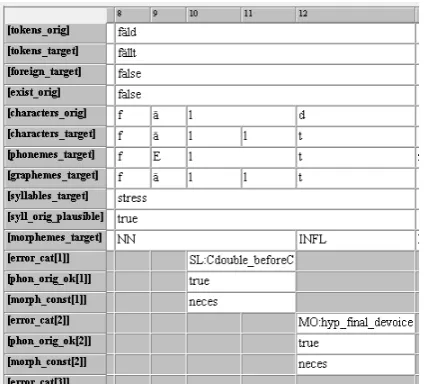
Figure 1: Annotations of the spelling *<f¨ald> (screenshot of EXMARaLDA)
more probable that the nucleus of the first sylla-ble was simply forgotten. Hence, we evaluate its structures on the basis of the target word.
The layers that our annotation scheme com-prises are given in the following (for each layer, it is specified whether the information relates to the original or the target form). An example anno-tation for the spelling *<f¨ald>for <f¨allt>‘(he) falls’ is given in figure 1, visualized in EXMAR-aLDA (see sec. 5.2). The text is presented hori-zontally and each annotation layer corresponds to one tier, arranged vertically.6
phonemes (target) Each character (or character sequence) is mapped to a phoneme.
graphemes (target) Each character (or character sequence) is mapped to a grapheme, following Eisenberg’s (2006) grapheme definition.
syllables (target) All syllables are classified as stressed, unstressed, or reduced. Knowing in which type of syllable an error occurred can be helpful for its interpretation. For instance, vowels can more easily be misheard in an unstressed lable than in a stressed syllable, and reduced syl-lables are often spelled very differently from how
6
In our project, phonemes (represented in SAMPA), graphemes, syllables and morpheme types are determined automatically by means of the web service G2P of the Bavar-ian Archive of Speech Signals (BAS)https://webapp. phonetik.uni-muenchen.de/BASWebServices/ #/services/Grapheme2Phoneme (Reichel, 2012; Reichel and Kisler, 2014), followed by some heuris-tic mappings. For aligning phonemes with characters, Levenshtein-based scripts by Marcel Bollmann were used
they are pronounced (see also Fay (2010)).
morphemes (target) All morphemes are differ-entiated with regard to their morpheme type: for bound morphemes, if it is a derivational or inflec-tional affix; for free morphemes, its part of speech. The morpheme type can for instance give informa-tion about a learner’s grammatical skills in relainforma-tion to orthography by separately assessing the spelling of grammatical morphemes (see also Fay (2010)).
foreign target (target) For each erroneous word, we indicate whether the target word is a foreign word, because many spelling regularities only ap-ply to the German core vocabulary.
exist orig (original) For each erroneous spelling, it is determined whether it (by chance or con-fusion) resulted in an existing word form, a so-called real-word error (e.g. *<feld> ‘field’ for <f¨allt> ‘(she) falls’). Knowing that the learn-ers constructed or retrieved a plausible word form which they might have encountered before can be valuable information to assess their spelling com-petence.
plausible orig (original) This feature codes for each syllable whether it is a possible syllable in German. This refers to graphotactics, i.e. permitted character sequences. For example, *<trraurig> (for <traurig> ‘sad’) is graphotac-tically not permitted as doubled consonants never occur in a syllable onset. A hypothesis one can test with this feature is that good spellers rarely commit errors which violate graphotactics.
4.2 Annotation Layers II: Error Categories
Our annotation scheme focuses on orthographic errors in single word spelling. As it is designed to be used for freely-written coherent texts, a few phenomena on the textual level are included as well.
We distinguish four classes of error categories: phoneme-grapheme correspondence (PG), sylla-ble (SL), morphology (MO), and phenomena beyond word spelling (e.g. syntax-based) (SN), which is in accordance with Eisenberg’s taxonomy and has also been similarly applied by Fay (2010). There are 69 error tags in total; class PG: 19 tags (with 3 subclasses), SL: 32 tags, MO: 6 tags, SN: 8 tags, and 4 tags for ‘other systematic errors’. Each error is assigned exactly one tag, i.e. the scheme is designed in a way that only one cate-gory is the best fit for a given error. Here are some examples of the phenomena we cover:
PG:repl unmarked marked: learner used the ordinary, unmarked GPC-compliant spelling, in-stead of the marked target grapheme (*<Fogel> for<Vogel>‘bird’)7
PG:literal: learner used GPC-compliant spelling, ignoring the exceptional spelling of a partic-ular phoneme combination (*<schpielen> for *<spielen>‘(to) play’)
SL:Cdouble beforeC: learner ignored consonant doubling before other consonants (*<komt>for <kommt>‘(he) comes’)
SL:separating h: learner ignored a syllable-separating <h> (*<Rue> for <Ruhe> ‘quiet-ness’)
SL:rem Vlong short: learner marked a long vowel for a phonetically short vowel (*<Sahnd> for<Sand>‘sand’)
MO:final devoice: learner ignored that final de-voicing is not reflected in the spelling (*<Hunt> for<Hund>‘dog’)
MO:hyp final devoice: learner incorrectly as-sumed final devoicing (*<r¨ad> for <r¨at> ‘(he) guesses’)
SN:low up: learner ignored capitalization (*<hund>for<Hund>‘dog’)
SN:merge, SN:split: learner incorrectly spelled words separately (*<zu frieden> for <zufrieden> ‘satisfied’) or in one word (*<unddann>for<und dann>‘and then’)
The categories show that some phenomena get a more detailed analysis than in any other annota-tion scheme. For instance, with regard to missed consonant doubling, different contexts are explic-itly distinguished: (i) between vowels, (ii) be-tween vowel and another consonant (see above: SL:Cdouble beforeC), and (iii) at the end of a word. The different contexts are motivated by different challenges for the learner: (i) conso-nant doubling between vowels (e.g.<kommen>, ‘(to) come’) is a pattern that requires knowledge of the word’s syllabic structure; a single con-sonant would result in a different pronunciation of the word (the preceding vowel would be pro-nounced long). (ii) A doubled consonant be-fore another consonant, however, cannot be mo-tivated by means of the syllable structure and vowel duration alone: The spellings *<komst>
7The category label reads as follows: “replace the original
and<kommst>‘(you) come’ can be pronounced the same way and do not differ in syllable struc-ture. Instead, morpheme constancy is decisive. (iii) Consonant doubling at the end of the word is not regulated in a completely consistent way in the German writing system (compare <Bus/Busse> ‘bus/busses’ and <Fluss/Fl¨usse> ‘river/rivers’). Such cases must be memorized. Although missed consonant doubling is a very frequent error (see for example Fay (2010)), their appearance in dif-ferent graphematic contexts has not been studied yet. Having explicit categories for them facilitates the analysis.
Hypercorrection and overuse also play a cen-tral role in our scheme. In order to decide, e.g., whether superfluous consonant doubling is a hy-percorrection (i.e. graphematically plausible) or just overused, we refer to the pronunciation, i.e. to vowel quality (tense/long vs. lax/short). For in-stance, *<Buss>for<Bus>‘bus’ is regarded a hypercorrection because the fact that there is no doubled consonant in the target can be seen as an exception in the writing system (see above). Similarly, *<k¨ammpfen> for <k¨ampfen> ‘(to) fight’ is categorized as a hypercorrection because the doubled consonant was applied after a lax vowel, which is a legitimate location (not af-fecting pronunciation). In contrast, *<gebben> for <geben> ‘(to) give’ is an overuse of conso-nant doubling because it was applied after a tense vowel, where it never occurs as it would change the pronunciation (from [ge:b@n] to [gEb@n]).
There are two further properties stored for each error:
phon orig ok (original) This feature assesses for each error whether the incorrect spelling is pho-netically sensible (cf. Bebout (1985) for English data). The feature encodes whether the pronunci-ation is similar in standard German (e.g. *<ier> for<ihr>‘her’), or in some dialect or colloquial register (e.g. *<Kina> for <China> ‘China’ in Southern German dialects), or not similar (e.g. *<Schle> for <Schule> ‘school’). It shows to what extent a learner considers the relation be-tween a word’s spelling and its pronunciation.
morph const (target) Morpheme constancy is, in some way, orthogonal to the other principles. There are clear cases which can only be ex-plained by inheritance via morpheme constancy, such as consonant doubling in<kommst>) ‘(you) come’, from <kommen> ‘(to) come’. In other
cases, however, consonant doubling could be both prosodically determined (<kommend>‘coming’) and motivated by morpheme constancy. Finally, in some exceptional cases, morpheme constancy is even violated, as in<Bus/Busse>‘bus/busses’. The layer codes, for each error, whether refer-ence to morpheme constancy is necessary in order to arrive at the correct spelling, whether it is re-dundant, whether is violated (i.e. a case of hyper-correction), or irrelevant.
A hypothesis to test is that orthographic phe-nomena that are determined by morpheme con-stancy alone are more difficult for learners than those which conform to different principles si-multaneously. Another hypothesis would be that cases of hypercorrection occur more frequently with good spellers than bad spellers.
4.3 Using Error Categories for
Characterizing Correctly-Spelled Words
Switching the perspective, our error categories can also be used to describe orthographic properties of a target word. For instance, a category label like SL:Cdouble interV can be read as an instruc-tion “apply consonant doubling between vowels to achieve the correct target form”. At the same time, it can also be interpreted as “the target form shows consonant doubling”. In the second read-ing, it can be annotated to a correct word form like <kommen>‘(to) come’.
In contrast, the category SL:Vlong single h states “change a single long vowel to one with a vowel-lengthening <h>”, or, reformulated for correct words: “the word contains a vowel-lengthening <h>”. This category cannot be ap-plied to the word <kommen> as there is no vowel-lengthening<h>in this word.
The set of categories that can be applied to a given correctly-spelled word encodes its ortho-graphic properties and allows us to estimate its orthograpic complexity. We can thus analyze the level of difficulty of children’s schoolbooks. Moreover, when applied to a child’s text, the cat-egories show which phenomena a child already masters and which of the possible errors it did not commit. This knowledge is important if one wants to make statements about a child’s spelling com-petence (see also Fay (2010)).
(category PG:repl marked unmarked) and by a double consonant before other consonants (SL:Cdouble beforeC).
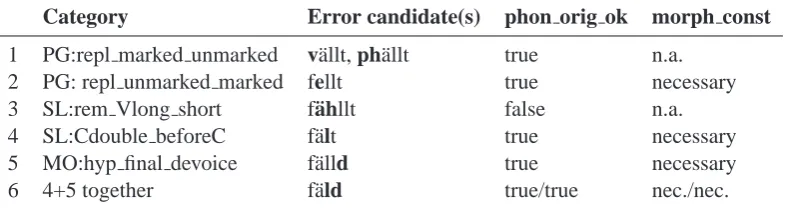
We can now apply each category to the word and construct ‘error candidates’, i.e. incorrectly-spelled words that result from violating the respec-tive error category, showing what the word would look like if this error in fact had occurred. One cat-egory may give raise to different error candidates, and several categories could be applied simultane-ously. Table 1 lists some examples, also specifying the features phon orig ok and morph const.8
5 Data Representation
5.1 LearnerXML
To represent the annotations, we developed an XML-based representation format called Learn-erXML. Its main features are that the smallest units are characters, and errors are annotated to align-ments between original and target characters. This section describes the format in detail.
Figure 2 shows an example fragment, featuring the misspelling *<f¨ald> for <f¨allt> ‘(he) falls’ (see Table 1).
The root elementtokenscontains the individ-ual tokens (words), with attributes orig (the original token as written by the child), target (the corrected version of the original token), and foreign target and exists orig as ex-plained in section 4.1.
token elements embed further elements that encode various relevant word properties:
characters orig, characters target with sub-elementschar o, char t, representing the in-dividual characters in the child’s original word and in the target word, respectively. These elements duplicate the information already contained in the token’s attributesorig andtarget, to provide the basis for character-based alignment of both forms.
characters aligned with sub-elements char a for individual alignments between original and target character(s). By means of the attributes o range and t range, an alignment element can refer to: (i) one char o and one char t; (ii) a range of char o (e.g. o3..o5) and one
8In case 5, morpheme constancy applies to the inflectional
ending *<-d>for<-t>. If the learners realize that the end-ing is the markend-ing for 3rd person send-ingular present tense, they can deduce the correct form from analogous forms like< sag-t>‘(he) says,<lach-t>‘(he) laughs’, etc.
char t(if several original characters correspond to one target character); (iii) or onechar oand a range ofchar t.
It is also possible that there is no correspond-ing character that can be aligned. In these cases, char arefers to (iv) only onechar o(an erro-neous insertion in the child’s form) or (v) only one char t(i.e. an erroneous deletion). In cases (iv) and (v), the attributest rangeando range, re-spectively, are absent.
Ranges are of the formx1..x3, indicating the first and last element of the range. Note that no n-to-mcorrespondences, wheren, m ≥2, are al-lowed, neither are0-to-ncorrespondences, where n ≥ 2 (see annotation in EXMARaLDA in the next section).
phonemes target with sub-elements phon for phonemes that are related to the correspond-ing characters or character sequences in the tar-get word, as indicated by the range attribute. These are given in SAMPA notation as speci-fied underhttp://www.phon.ucl.ac.uk/ home/sampa/german.htm.
graphemes target with sub-elementsgrafor in-dividual graphemes of the target word. Multi-character graphemes have an attribute type which explicitly names the grapheme (e.g."ch").
syllables target, morphemes target with sub-elements syll, mor for individual syllables and morphemes of the target word, respectively, as described in section 4.1.9
errors with sub-elements err, each correspond-ing to one orthographic error in the original word. Errors are defined with regard to the alignment units, which connect original and target word frag-ments. An error annotation can point to one or more aligned characters (e.g. a1 or a1..a3). The other attributes encode the information de-scribed in section 4.10
5.2 Annotation in EXMARaLDA
In order to visualize LearnerXML and to carry out manual annotations, we import the data into the Partitur-Editor of the tool EXMARaLDA (Schmidt and W¨orner, 2009; Schmidt et al., 2011),
9
Morpheme boundaries and types are determined auto-matically, see section 4.1. We currently do not correct these annotations, hence the incorrect part-of-speech assignment “NN” (noun) to the verbal stem in the example in figure 1.
10Right now, we only analyze orthographic errors but if
Category Error candidate(s) phon orig ok morph const
1 PG:repl marked unmarked v¨allt, ph¨allt true n.a.
2 PG: repl unmarked marked fellt true necessary
3 SL:rem Vlong short f¨ahllt false n.a.
4 SL:Cdouble beforeC f¨alt true necessary
5 MO:hyp final devoice f¨alld true necessary
[image:8.595.104.498.66.170.2]6 4+5 together f¨ald true/true nec./nec.
Table 1: Examples of characterizing categories and corresponding error candidates of the word<f¨allt> ‘(he) falls’
<?xml version="1.0" ?> <tokens id="test">
<token id="tok1" orig="f¨ald" target="f¨allt" foreign_target="false" exist_orig="false"> <characters_orig>
<char_o id="o1">f</char_o> <char_o id="o2">¨a</char_o> <char_o id="o3">l</char_o> <char_o id="o4">d</char_o> </characters_orig>
<characters_target>
<char_t id="t1">f</char_t> <char_t id="t2">¨a</char_t> <char_t id="t3">l</char_t> <char_t id="t4">l</char_t> <char_t id="t5">t</char_t> </characters_target>
<characters_aligned>
<char_a id="a1" o_range="o1" t_range="t1"/> <char_a id="a2" o_range="o2" t_range="t2"/> <char_a id="a3" o_range="o3" t_range="t3..t4"/> <char_a id="a4" o_range="o4" t_range="t5"/> </characters_aligned>
<phonemes_target>
<phon_t id="p1" t_range="t1">f</phon_t> <phon_t id="p2" t_range="t2">E</phon_t> <phon_t id="p3" t_range="t3..t4">l</phon_t> <phon_t id="p4" t_range="t5">t</phon_t> </phonemes_target>
<graphemes_target>
<gra id="g1" range="t1"/> <gra id="g2" range="t2"/> <gra id="g3" range="t3"/> <gra id="g4" range="t4"/> <gra id="g5" range="t5"/> </graphemes_target>
<syllables_target>
<syll id="s1" range="t1..t5" type="stress" plausible_orig ="true"/> </syllables_target>
<morphemes_target>
<mor id="m1" range="t1..t4" type="NN"/> <mor id="m2" range="t5..t5" type="INFL"/> </morphemes_target>
<errors>
<err range="a3" cat="SL:Cdouble_beforeC" phon_orig_ok="true" morph_const="neces"/>
<err range="a4" cat="MO:hyp_final_devoice" phon_orig_ok="true" morph_const="neces"/>
</errors> </token> </tokens>
as shown in figure 1. EXMARaLDA allows for character-wise annotation of texts. The small-est units that can be annotated are called timeline items, which correspond to characters in our ap-plication. On the annotation tiers, timeline items can be merged, and the alignments and the range of each annotation (i.e. the characters an annota-tion refers to) can be made visible. In figure 1 for instance, “l” at level “characters orig” (5th row) is aligned with “ll” at level “characters target (6th row). Similarly, all error-related annotations (rows 12–14 and 15–17) refer to such ranges.
6 Inter-Annotator Agreement
Children’s texts are typically handwritten, so be-fore orthographic errors in a child’s text can be annotated, those texts have to be transcribed. Fur-thermore, the intended target words have to be recovered. We conducted a small pilot study to judge how manageable these tasks are.
Four students transcribed 12 freely-written texts produced by German primary school children of grades 2–4. The texts were taken from the corpus by Frieg (2014), for which children had to write down a story that was shown in a sequence of six pictures. The texts of our pilot study contained 951 tokens with 3640 characters in total. We com-puted pairwise inter-transcriber percent agreement for characters. Average agreement was 98.67% (SD: 0.15).
We then constructed a gold transcription for each text, and the same annotators annotated the target forms. They achieved a word-based average agreement of 96.44% (SD: 1.93).
Finally, we constructed a gold normalization for each text, and three of the annotators annotated the orthographic errors using EXMARaLDA as annotation tool. In this pilot study, only the er-ror category was annotated, the other layers were left aside. We only evaluated annotated misspelled characters or character sequences (possibly over-lapping; 295 annotations of 49 different categories in total; ). Chance-corrected agreement according to Fleiss’κwas .80.11
The evaluation shows that transcribing and con-structing target forms was done with high reliabil-ity. Error categorization also resulted in an agree-ment that is commonly considered “substantial”.
11For computing agreement, we used the software tool R
and the package “irr”, https://cran.r-project. org/web/packages/irr/.
The disagreements do not reveal major system-atic difficulties with the annotation scheme, rather individual inattentiveness. For instance, some-times a category for an underspecified insertion was chosen although a specific category would ex-ist (PG:ins C vs. SL:Vlong single h), or ignoring a principle and its hypercorrection would be mixed up or an error was completely overlooked.
7 Conclusion
We presented a new multi-layered annotation scheme for orthographic errors in freely written German texts produced by primary school chil-dren. Compared to most existing schemes, it is much more closely linked to the German graphe-matic system. Furthermore, it features multiple layers of information which can be used to evalu-ate an error. To represent these data, we proposed LearnerXML, an XML-format which can be also be transferred to other formats, e.g. to visualize the data in EXMARaLDA.
Our first aim is to get new insights into the inter-relation of orthographic errors and the graphemic system. Furthermore, we want to use the anno-tation scheme to investigate what kind of spelling phenomena occur in texts that children are con-fronted with, and how this relates to the kinds of spelling errors they produce. For instance, we plan to enrich childLex, the German Children’s Book Corpus (Schroeder et al., 2014), with information about the orthographic properties of the words.
Hence, our future work is dedicated to a large-scale annotation of errors to pursue research ques-tions such as whether spellings which relate to morpheme constancy are more error prone than spellings which can be derived from a word’s pro-nunciation and prosody. The full corpus that we want to annotate, from which the data of the pilot study is a small extract, consists of around 2000 texts written by primary school children. We are also working on an automation of the categoriza-tion process.
Acknowledgments
References
Elissa J. Arndt and Barbara R. Foorman. 2010. Sec-ond graders as spellers: What types of errors are they making? Assessment for Effective Intervention, 36(1):57–67.
Linda Bebout. 1985. An error analysis of misspellings made by learners of English as a first and as a second language. Journal of Psycholinguistic Research, 14(6):569–593.
Kay Berkling, R´emi Lavalley, and Uwe Reichel. 2015. Systematic acquisition of reading and writing: An exploration of structure in didactic elementary texts for German. In Proceedings of the Int. Conference of the German Society for Computational Linguis-tics and Language Technology, pages 67–76, Duis-burg/Essen, Germany.
Yves Bestgen and Sylviane Granger. 2011. Categoris-ing spellCategoris-ing errors to assess L2 writCategoris-ing. Interna-tional Journal of Continuing Engineering Education and Life Long Learning, 21(2-3):235–252.
Daniel Dahlmeier, Hwee Tou Ng, and Siew Mei Wu. 2013. Building a large annotated corpus of learner English: The NUS corpus of learner English. In Proceedings of the Eighth Workshop on Innovative Use of NLP for Building Educational Applications, pages 22–31.
Sebastian Deorowicz and Marcin G. Ciura. 2005. Cor-recting spelling errors by modelling their causes. International Journal of Applied Mathematics and Computer Science, 15(2):275.
Christa D¨urscheid. 2006. Einf¨uhrung in die Schriftlin-guistik. Vandenhoeck & Ruprecht, G¨ottingen, 3rd edition.
Peter Eisenberg and Nanna Fuhrhop. 2007. Schul-orthographie und Graphematik. Zeitschrift f¨ur Sprachwissenschaft, 26:15–41.
Peter Eisenberg. 2006. Grundriss der deutschen Grammatik Band 1: Das Wort. J.B. Metzler, Stuttgart, 3rd edition.
Johanna Fay. 2010. Die Entwicklung der
Rechtschreibkompetenz beim Textschreiben: Eine empirische Untersuchung in Klasse 1 bis 4. Peter Lang, Frankfurt a. M.
Michael Flor. 2012. Four types of context for auto-matic spelling correction. TAL, 53(3):61–99.
Hendrike Frieg. 2014. Sprachf¨orderung im Regelun-terricht der Grundschule: Eine Evaluation der Generativen Textproduktion. Ph.D. thesis, Ruhr-Universit¨at Bochum.
Karl-Ludwig Hern´e and Carl Ludwig Naumann. 2002. Aachener F¨orderdiagnostische Rechtschreibfehler-Analyse. Alfa Zentaurus, Aachen, 4th edition.
Hagen Hirschmann, Seanna Doolittle, and Anke L¨udeling. 2007. Syntactic annotation of non-canonical linguistic structures. In Proceedings of Corpus Linguistics 2007, Birmingham.
DJ Hovermale and Scott Martin. 2008. Developing an annotation scheme for ELL spelling errors. In Pro-ceedings of MCLC-5 (Midwest Computational Lin-guistics Colloquium). East Lansing, MI.
Peter May. 2013. Hamburger Schreib-Probe zur Er-fassung der grundlegenden Rechtschreibstrategien: Manual/Handbuch Diagnose orthografischer Kom-petenz. vpm, Stuttgart.
Uwe D. Reichel and Thomas Kisler. 2014. Language-independent grapheme-phoneme conversion and word stress assignment as a web service. In R¨udiger Hoffmann, editor, Elektronische Sprachver-arbeitung: Studientexte zur Sprachkommunikation 71, pages 42–49. TUDpress.
Uwe D. Reichel. 2012. PermA and Balloon: Tools for string alignment and text processing. In Proceed-ings of Interspeech, Portland, Oregon.
J¨urgen Reichen. 2008. Lesen durch Schreiben: Lesen-lernen ohne Leseunterricht. Grundschulunterricht Deutsch, 2:4–8.
Marc Reznicek, Anke Ludeling, Cedric Krummes, Franziska Schwantuschke, Maik Walter, Karin Schmidt, Hagen Hirschmann, and Torsten Andreas. 2012. Das Falko-Handbuch. Korpusaufbau und An-notationen Version 2.01. Technical report, Depart-ment of German Studies and Linguistics, Humboldt University, Berlin, Germany.
Christa R¨ober. 2011. Zur Ermittlung rechtschreib-licher Kompetenz. In Ursula Bredel and Tilo Reißig, editors, Weiterf¨uhrender Orthographieerwerb. Schneider-Verlag Hohengehren, Baltmannsweiler.
Alla Rozovskaya and Dan Roth. 2010. Annotating ESL errors: Challenges and rewards. In Proceed-ings of the NAACL HLT 2010 Fifth Workshop on In-novative Use of NLP for Building Educational Ap-plications, pages 28–36. Association for Computa-tional Linguistics.
Thomas Schmidt and Kai W¨orner. 2009. EXMAR-aLDA: Creating, analysing and sharing spoken lan-guage corpora for pragmatic research. Pragmatics, 19(4):565–582.
Thomas Schmidt, Kai W¨orner, Hanna Hedeland, and Timm Lehmberg. 2011. New and future develop-ments in EXMARaLDA. In Thomas Schmidt and Kai W¨orner, editors, Multilingual Resources and Multilingual Applications. Proceedings of GSCL Conference 2011 Hamburg.
Katja Siekmann and G¨unther Thom´e. 2012. Der or-thographische Fehler: Grundz¨uge der orthographi-schen Fehlerforschung und aktuelle Entwicklungen. isb-Verlag, Oldenburg.
Tobias Thelen. 2010. Automatische Analyse or-thographischer Leistungen von Schreibanf¨angern. Ph.D. thesis, Universit¨at Osnabr¨uck.