Learning exceptionality and variation with lexically scaled MaxEnt
⇤Coral Hughto, Andrew Lamont, Brandon Prickett, and Gaja Jarosz University of Massachusetts Amherst
{coralwilliam, alamont, bprickett, jarosz}@linguist.umass.edu
Abstract
A growing body of research in phonology addresses the representation and learning of variable processes and exceptional, lexically conditioned processes. Linzen et al. (2013) present a MaxEnt model with additive lexical scales to account for data exhibiting both vari-ation and exceptionality. In this paper, we im-plement a learning model for lexically scaled MaxEnt grammars which we show to be suc-cessful across a range of data containing pat-terns of variation and exceptionality. We also explore how the model’s parameters and the rate of exceptionality in the data influence its performance and predictions for novel forms.
1 Introduction
While phonological research often focuses on cate-gorical generalizations, a growing body of research addresses the representation and learning of vari-able processes and exceptional processes, where ap-plication is lexically conditioned (see Coetzee and Pater (2011) and Pater (2010) for overviews). A few recent studies have modeled processes that ex-hibit both variation and exceptionality (Hayes and Londe, 2006; Pater et al., 2012; Linzen et al., 2013; Nazarov, 2018; Shih, 2018; Zymet, 2018).
Linzen et al. (2013) model co-existing exception-ality and variation in Russian using a Maximum En-⇤We wish to thank the SCiL 2019 anonymous reviewers, the UMass Linguistics Sound Workshop, Brendan O’Connor, and Joe Pater for valuable comments.
tropy (MaxEnt) grammar (Goldwater and Johnson, 2003) with additive, lexically specified scales. Rus-sian contains a vowel alternation process that ex-hibits both variation and idiosyncratic lexical con-ditioning (exceptionality). Linzen et al. show that speakers apply this process variably and that its vari-ation differs across lexical items. In their lexical scaling framework, each lexical item is associated with a vector of scales that are added to the gen-eral weights of the grammar’s constraints. These summed weights are used to calculate the probabil-ity of the input’s surface realization. This allows the likelihood of a phonological process to differ across morphemes, since the scales can modulate how con-straints are weighted for different lexemes. While Linzen et al. (2013) show that a lexically scaled MaxEnt grammar can successfully represent Rus-sian speakers’ knowledge of a pattern that is both variable and exceptional, they do not show how such a grammar would be learned.
In this paper, we introduce a model for learn-ing lexically scaled MaxEnt grammars from data exhibiting both variation and exceptionality.1 The
primary challenge for formalizing learning in this framework is generalizing appropriately beyond the learning data and limiting the learner’s reliance on lexical scales. Since every morpheme can poten-tially scale the weight of every constraint, there is potential for massively over-fitting the learning data
1Our code is publicly available at https://github.
com/chughto/Lexically-Scaled-MaxEnt
and failing to generalize. We approach this chal-lenge as a problem of feature selection and seek a learner that utilizes scales (i.e., assigning them non-zero weights) only when needed to account for lex-ical conditioning. We propose an objective function relying on an L1 (linear) prior (§2), rather than the more commonly used L2 (quadratic) prior (§4.1), to formalize these criteria.
Our approach differs in a number of ways from previous models for learning exceptionality and variation. We assume the learner must induce a weighting for general phonological constraints and make lexical conditioning choices without prior knowledge of which lexical items behave exception-ally (Allen and Becker, 2015; Becker and Gouskova, 2016). Rather than splitting the learning of gen-eral phonological patterns and the learning of excep-tions/classes into distinct learning phases (Nazarov, 2018; Shih, 2018), or treating the learning of lex-ical conditioning as emergent from repeated expo-sure to the lexicon (Zuraw, 2000; Zuraw, 2010), we seek to formally characterize the criteria that favor the desired balance of lexical sensitivity and gener-alization in a model that optimizes general weights and lexical conditioning in parallel. Our approach is most similar to Moore-Cantwell and Pater (2016); however, we argue for an L1 prior rather than an L2 prior (§4.1). We demonstrate the capacity of our model to learn variation and exceptionality using a variety of toy languages based on the Russian pro-cess mentioned above (§3).
We also explore the model’s predictions for novel data, examining how the learner decides which pat-terns to treat as exceptional and which to generalize (§4). Previous behavioral investigations of speak-ers’ productive knowledge of lexically conditioned (morpho-)phonological alternations have found that speakers extend statistical tendencies in the lexicon to novel forms (Zuraw, 2000; Ernestus and Baayen, 2003; Hayes and Londe, 2006; Hayes et al., 2009; Linzen et al., 2013; Becker and Gouskova, 2016). In some cases, the absolute rates of application of a process in nonce forms closely follow rates ob-served in the lexicon, yielding so-called “frequency-matching” behavior (Hayes and Londe, 2006; Hayes et al., 2009; Zymet, 2018). In other cases, however, rates of application of exceptional processes are sys-tematically skewed lower as compared to the
lexi-cal rates (Zuraw, 2000; Albright and Hayes, 2003; Ernestus and Baayen, 2003). Under a variety of learning assumptions, frequency-matching behavior is not automatic. To better understand some of the factors that may play a role in these divergent find-ings, we examine the properties of the data dis-tribution and parameters of the model that affect frequency-matching behavior on nonce forms.
2 Lexically scaled MaxEnt
Linzen et al.’s (2013) scaled weights framework uses weighted constraints to represent probabilis-tic phonological patterns, and adds scales on those weights to represent lexicalized behavior for in-dividual morphemes. In MaxEnt (Goldwater and Johnson, 2003), the probability of some surface rep-resentation (SR), given a grammar and an underly-ing representation (UR), is calculated as in (1):
p(i) = e
Hi P
k2Kie
Hk (1)
HereHiis the harmony of a given (UR, SR) pair
i, andKiis the set of candidates that share the same
UR asi (including iitself). Typically, harmony is
the weighted sum of a candidate’s constraint vio-lations (Goldwater and Johnson, 2003), however in Linzen et al.’s (2013) framework, harmony is a func-tion of a candidate’s violafunc-tions, the general weights, and the relevant scales, as shown formally in (2):
Hi=
X
2
(w + X
m2µi
s m)(v i) (2)
Here is the set of constraints,w is the general
weight of constraint ,µi is the set of morphemes
in the (UR, SR) pairi, s m is the scale that
mor-phememhas for constraint , andv iis the number
of violations assigned to candidate i by constraint
et al.’s framework, scaling is not restricted to faith-fulness constraints or systematic factors (e.g., regis-ter, frequency): all constraints are available for lexi-cal slexi-caling by all morphemes. Using both weights and scales enables the model to represent lexical-ized exceptions by employing the scales to modulate the effect of some constraints. We leave exploring the relationship between this approach and indexed constraints (Kraska-Szlenk, 1995; Pater, 1996), a closely related framework, to future work.
We formalized learning as minimizing the objec-tive function in (3), the sum of the negaobjec-tive log like-lihood and an L1 prior on weights and scales.
X
i
logp(i)+CX
2
|w |+CX
2
X
m2M
|s m| (3)
Here, M is the set of morphemes in the
lan-guage, andC is a parameter that controls the over-all strength of the prior. Our goal was to de-termine whether learning of phonological general-izations could occur without formally distinguish-ing between weights and scales. Accorddistinguish-ingly, this prior penalizes both weights and scales with a single strength parameterC. In simulations reported here, both weights and scales are restricted to nonnegative values, but this is not a inherent restriction of the model. For optimization, we used a form of gradient descent adapted for L1 priors – the “L1 (Clipping)” method described by Tsuruoka et al. (2009).
3 Learning variation and exceptionality To explore the capacity of this model to learn a range of variable and exceptional patterns, it was trained on four toy languages based on the Russian vowel alternation described by Linzen et al. (2013).
In Russian, underlyingly CV prepositions surface as C before words beginning with vowels or single consonants; we follow Linzen et al. (2013,§5.1) in treating this alternation as deletion. Before words beginning with consonant clusters, vowel deletion is variable and lexically conditioned. For example, the vowel in /sa/ “from, with” variably surfaces with cer-tain cluster-initial words (4a), categorically deletes with certain others (4b), and categorically surfaces with others (4c) (Linzen et al., 2013, 455).
(4) a. [s⇠sa]mn´oü@stv@m“with a large amount, (mathematical) set”
b. [s⇠*s@]prik´az@m“with the order” c. [*s⇠s@]st@rik´om“with the old man”
The factors influencing vowel deletion in Rus-sian span multiple phonological dimensions such as stress and sonority profile. For the purposes of testing our learning model, we focused on whether words began with one or two consonants. The four toy languages consisted of 3 prefixes /ape-/, /ate-/, and /ake-/ concatenated with 420 stems, giving 1260 forms in total. Stems were all consonant-initial, be-ginning either with a single consonant (“C-stems”), or a biconsonantal cluster (“CC-stems”). Six conso-nants were used{v, r, l, n, s, t}, giving 6 unique C-stem types, and 36 CC-C-stem types. Each C-stem type was replicated 10 times, yielding 420 stems in total. In all four languages, prefix vowels categorically deleted with C-stems, e.g., /ape-naba/! [apnaba]. Vowel deletion was conditioned with CC-stems, ei-ther categorically failing to apply (§3.1) or with its application subject to free variation (§3.2), lexical specification (§3.3), or both (§3.4).
We used three categorically evaluated constraints (see Linzen et al. (2013, 489-490)): ALIGN, MAX, and *CCC. ALIGN prefers vowel deletion, and is violated by candidates containing the final prefix vowel. MAX disprefers vowel deletion, and is vi-olated by candidates lacking the final prefix vowel. *CCC is violated by candidates with triconsonantal clusters, and so disprefers deletion with CC-stems.
After training, the model was tested by evaluating its performance on the learning data and its predic-tions on a set of nonce forms comprising 3 novel pre-fixes concatenated with 42 novel stems. Following previous work, we assume that predictions for novel forms are generated using only the general weights. Learning was evaluated according to quantitative and qualitative criteria. Quantitatively, learning was considered successful if the KL-Divergence (Kull-back and Leibler, 1951) between the likelihood as-signed by the model and the observed probabil-ity in the training data was close to zero, indicat-ing that the model succeeded in accountindicat-ing for the learning data.2 Qualitatively, learning was
consid-ered successful only if the model appropriately di-vided weight between the general constraints and
*CCC MAX ALIG
N
/ape-taba/ 11.5 0.0 4.5 O E
a. apetaba 0 0 -1 0.00 0.00 b. aptaba 0 -1 0 1.00 1.00 /ape-tnaba/ 11.5 0.0 4.5 O E
a. apetnaba 0 0 -1 1.00 1.00 b. aptnaba -1 -1 0 0.00 0.00
Tableau 1:Categorical language
the scales, only using scales when presented with lexically conditioned data. Finally, we required that the model generalizes the observed pattern to nonce forms, deleting (nearly) categorically for novel C-stems while predicting variation for CC-C-stems in languages with variation and/or lexical conditioning. For all experiments in this section, the model was run with weights and scales initialized at 0.0, for 20,000 epochs, with a learning rate of .001, and prior termCset to 1.0, unless otherwise noted.
Overall, the model performed well, successfully learning the four toy languages and using the scales appropriately. In all runs, ALIGNreceived non-zero weight, reflecting (near) categorical vowel deletion with C-stems. In languages with variable or ex-ceptional deletion, *CCC was weighted closer to ALIGN, predicting variation in nonce forms.
3.1 Categorical language
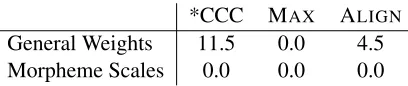
In the Categorical language, prefix vowels always delete with C-stems and never with CC-stems. The solution learned by the model captures this pattern using the general weights only, putting no weight on the scales, as summarized in Table (1). The weight on *CCC is much higher than the weight on ALIGN so that tri-consonantal clusters block vowel deletion, and the weight of ALIGNis above that of MAX, so that prefix vowels always delete with C-stems.
*CCC MAX ALIGN General Weights 11.5 0.0 4.5 Morpheme Scales 0.0 0.0 0.0
Table 1:Categorical weights and mean scales
The model’s performance on forms in the train-ing data is illustrated in Tableau (1) with a C-stem, /taba/, and a CC-stem, /tnaba/. Candidate
probabil-ities observed in the training data are given in col-umn O. Column E gives the expected candidate
probabilities generated by the model, rounded to two decimal places. The model fits the training data ex-tremely well (KL divergence⇡0.002) and, because
only the general weights are used, the model predicts that the trained pattern should generalize, yielding the same predicted probabilities for nonce forms.
3.2 Variable language
In the Variable language, prefix vowels always delete with C-stems and variably delete 33% of the time with CC-stems. As desired, the model captures this pattern using the general weights only, putting no weight on the scales, as shown in Table (2).
[image:4.612.83.287.611.654.2]*CCC MAX ALIGN General Weights 5.2 0.0 4.5 Morpheme Scales 0.0 0.0 0.0
Table 2:Variable weights and mean scales
The model’s performance on trained forms is il-lustrated in Tableau (2) below with a C-stem and a CC-stem. The weight of *CCC is above that of ALIGN, but by a smaller margin than in the Cate-gorical language, yielding variable rather than cate-gorical deletion with CC-stems. MAX is weighted below ALIGN, so that deletion occurs (nearly) cat-egorically for C-stems. The probabilities generated by the model (E) fit the training data (O) extremely
well (KL divergence⇡0.002) and, because only the general constraints are used, the model predicts that the trained pattern should generalize, yielding the same predicted probabilities for nonce forms.
*CCC MAX ALI
G
N
/ape-taba/ 5.2 0.0 4.5 O E
a. apetaba 0 0 -1 0.00 0.01 b. aptaba 0 -1 0 1.00 0.99 /ape-tnaba/ 5.2 0.0 4.5 O E
a. apetnaba 0 0 -1 0.67 0.67 b. aptnaba -1 -1 0 0.33 0.33
3.3 Lexical language
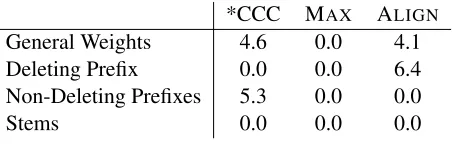
The Lexical language is identical to the Categori-cal language, except that one prefix, /ape-/, is excep-tional: its vowel always deletes with CC-stems. Av-eraged across the lexicon, the rate of deletion with CC-stems is therefore 33%, but this pattern cannot be captured using the general weights alone. The scales must be used to distinguish the behavior of the exceptionally deleting prefix from the other two prefixes. As Table (3) shows, the model’s solution weights the general constraints in the same order as in the Categorical language: *CCC>ALIGN>
MAX. The model additionally scales up the weight of ALIGN for the deleting prefix /ape-/, yielding (near) categorical deletion for it, and scales up the weight of *CCC for each of the non-deleting pre-fixes, preventing deletion for those prefixes.
*CCC MAX ALIGN General Weights 4.6 0.0 4.1 Deleting Prefix 0.0 0.0 6.4 Non-Deleting Prefixes 5.3 0.0 0.0
[image:5.612.75.301.317.389.2]Stems 0.0 0.0 0.0
Table 3:Lexical weights and mean scales
The model’s performance on forms in the train-ing data is illustrated in Tableau (3) with a CC-stem /tnaba/ paired with a non-deleting prefix /ake-/, and the deleting prefix /ape-/. The weights shown for each input are the sums of the general weights and scales associated with the input morphemes for each constraint. The model’s solution fits the train-ing data well (KL divergence⇡ 0.004), predicting
deletion for the deleting prefix and no deletion for each non-deleting prefix. These weights addition-ally yield deletion of all prefix vowels before C-stems (not shown) in the learning data, as expected. Since this is captured by general constraint weights, the same prediction is made for novel C-stems.
Because the general weight of ALIGN is some-what lower but still close to the general weight of *CCC, variable deletion (37%) is predicted for novel prefixes attached to novel CC-stems. Tableau (4) il-lustrates with the nonce prefix /aPe-/ and the nonce stem /pmaba/. Because this form was not present in the training data, only the expected probabilities are reported. As discussed above, predicting vari-able deletion is desirvari-able given experimental
find-*CCC MAX ALIG
N
/ake-tnaba/ 10.0 0.0 4.1 O E
a. aketnaba 0 0 -1 1.00 1.00 b. aktnaba -1 -1 0 0.00 0.00 /ape-tnaba/ 4.6 0.0 10.5 O E
a. apetnaba 0 0 -1 0.00 0.00 b. aptnaba -1 -1 0 1.00 1.00
Tableau 3:Lexical language – known prefixes and stems; /ape-/ exceptionally undergoes vowel deletion with CC-stems
ings that speakers extend lexical trends to nonce forms (Hayes et al., 2009). Deletion is the disferred outcome in both the training data and the pre-dictions for novel forms, but the predicted rate of deletion for novel forms (37%) is a little higher than that observed in the training data (33%).
Interestingly, by using scales for each prefix, the model did not single out any prefix as qualitatively exceptional, despite the fact that such a solution is available. Removing the weight from the scales of the non-deleting prefixes and dividing it between the weight of general *CCC and the deleting prefix’s scale of ALIGNproduces a solution that is identical in terms of fit to the training data and the total sum of weights across all constraints and scales. That solution identifies only the deleting prefix as excep-tional, and produces different predictions for nonce forms. The proposed objective function does not al-ways differentiate among distinct al-ways of encoding exceptionality. The solution selected by the model in this experiment is arbitrarily influenced by starting the weights at zero. In experiments with weights ini-tialized to random values between 0 and 10, the solu-tions selected by the model all have equivalent fit to the training data and total weight but vary somewhat in terms of how exceptionality is encoded and the deletion rate predicted for nonce forms. The avail-ability of such varied solutions depends on the rate
*CCC MAX ALI
G
N
/aPe-pmaba/ 4.6 0.0 4.1 E
a. aPepmaba 0 0 -1 0.63 b. aPpmaba -1 -1 0 0.37
of exceptionality in the training data and the prior. These factors are further explored in§4.
3.4 Variable-Lexical language
The Variable-Lexical language is largely identical to the Variable language, except that 20% of CC-stems are exceptional triggers of categorical vowel deletion. The model’s solution is summarized in Ta-ble (4). TaTa-bleau (5) illustrates the learned weights with a triggering stem /vraba/ and a non-triggering stem /tnaba/. The model learned a set of gen-eral weights which closely, but not exactly, repro-duces the trained general pattern of variable dele-tion, and weights the scale of ALIGNhigher for trig-gering CC-stems, though not enough to yield (near) categorical deletion. Again, ALIGN is weighted sufficiently above MAX to motivate (near) cate-gorical deletion with C-stems. The model’s fit to the training data for the Variable-Lexical language, while worse than the other languages, is still good (KL divergence ⇡ 0.08). Examining the general weights, the model generalizes appropriately, pre-dicting (near) categorical deletion for novel C-stems, and variable deletion for novel CC-stems.
*CCC MAX ALIGN General Weights 4.8 0.0 4.5
Prefixes 0.0 0.0 0.0
[image:6.612.319.533.357.567.2]Exceptional Stems 0.0 0.0 1.0 Regular Stems 0.0 0.0 0.0
Table 4:Variable-Lexical weights and mean scales
*CCC MAX ALI
G
N
/ape-vraba/ 4.8 0.0 5.5 O E
a. apevraba 0 0 -1 0.00 0.33 b. apvraba -1 -1 0 1.00 0.67 /ape-tnaba/ 4.8 0.0 4.5 O E
a. apetnaba 0 0 -1 0.67 0.58 b. aptnaba -1 -1 0 0.33 0.42
Tableau 5: Variable-Lexical language – known prefixes and stems; /vraba/ exceptionally triggers prefix vowel deletion
Fit with the training data is not as close as with the other languages due to pervasive exceptional-ity: 20% of the stems (84 morphemes) must utilize
scales to capture their behavior, which conflicts with the prior’s pressure to keep the total weights and scales low. The effect of the prior is explored sys-tematically in the next section, but it is worth not-ing here that a closer fit with the trainnot-ing data for this language is straightforwardly achieved with a weaker prior; for example, settingC = 0.1 yields a
deletion rate of 97% for /ape-vraba/.
4 Generalizing from exceptional data This section examines the model’s predictions for nonce data, focusing on how the choice of the prior and the rate of exceptionality in the training data af-fect generalization.
4.1 Effect of the prior
Recall that the previous section reported on exper-iments with the prior termC set to 1.0. Here, we
varyC and examine its effects on the model’s
pre-dictions, using the Lexical language as a test case.
● ●
●
● ●
0.0 0.1 0.2 0.3 0.4 0.5 0.6 0.7 0.8 0.9 1.0
0.5 1.0 5.0 15.0 30.0
Prior
Probability of Deleting in CC
−
Initial Stems
Form Type
[image:6.612.80.294.510.642.2]●Trained Deleting Trained Non−Deleting Nonce
Figure 1:Probability of deletion with CC-stems byCvalues
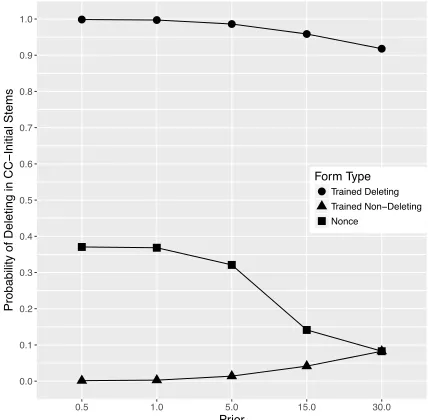
Unsurprisingly, the model’s fit to the training data decreases as the strength of the prior increases, as there is more pressure to keep all weights and scales close to zero. The model’s predictions for novel forms also vary with C, as shown in Figure (1),
which plots the probability of deletion for CC-stems by values ofC. AsCincreases, there is a poorer fit
known forms which should not undergo vowel dele-tion are slightly more likely to.
The most striking trend is the convergence of nonce form behavior with the behavior of non-deleting forms. In the Lexical language, two pre-fixes, and thus two-thirds of the data, categorically do not undergo deletion with CC-stems. As dis-cussed in §3.3, these proportions make multiple ways of encoding exceptionality available to the model. When the prior is weak, the model encodes exceptionality in a distributed way, and its predicted deletion rate for novel forms is intermediate between the deleting and non-deleting forms in the training data. When the prior is strong, however, the learner is forced to set more weights to zero, and the non-deleting forms in the learning data are more easily accommodated by the general constraint weights. This leads the learner to designate one of the pre-fixes as exceptional and to generalize to novel forms on the basis of the non-deleting prefixes. Thus, with a stronger prior, there is more pressure on the learner to over-extend the more general pattern in the data.
This pattern is clear when we examine the learned weights. Table (5) reports the weights learned with
Cset to 0.5 and 30. WithC set low, the learner
as-signs weight to the exceptionally deleting prefix as well as the non-deleting prefixes. WithC set high,
the learner only assigns weight to the exceptional prefix, picking it out as exceptional.
C= 0.5 C = 30
*CCC MAX ALIG
N
*CCC MAX ALI
G
N
[image:7.612.319.534.179.391.2]General Wts 5.3 0.0 4.8 2.4 0.0 0.01 Except. Prefix 0.0 0.0 7.1 0.0 0.0 4.8 Reg. Prefixes 6.0 0.0 0.0 0.0 0.0 0.0 Stems 0.0 0.0 0.0 0.0 0.0 0.0
Table 5:Lexical weights and mean scales,C= 0.5and30
4.2 Effect of exceptionality
Following Moore-Cantwell and Pater (2016), this section reports the effect of varying the proportion of exceptional forms in the training data on nonce form predictions. To test this, we started with the Categorical language, in which prefix vowels always delete with C-stems but never delete with CC-stems, and then created data sets which increased the
per-centage of CC-stems that trigger deletion of the pre-fix vowel by 10% increments, forming a total of 11 data sets (with deletion rates of 0%, 10%, . . . , 90%, 100%). In these simulations, epochs were increased up to 80000 (we found this to be necessary to guar-antee convergence for languages with pervasive ex-ceptionality and weaker priors).
● ● ● ● ● ● ● ● ● ● ● ● ● ● ● ● ● ● ● ● ● ● ● ● ● ● ● ● ● ● 0.0 0.1 0.2 0.3 0.4 0.5 0.6 0.7 0.8 0.9 1.0
0 10 20 30 40 50 60 70 80 90 100
Percent CC−Initial Stem Deleters in Training
Probability of Deleting in CC
− Initial Stems Prior ● ● ● 0.1 0.5 1.0 Form Type
●Trained Deleting
Trained Non−Deleting
Nonce
Figure 2:Probability of deletion with CC-stems by percentage of deletion-triggering CC-stems in the training data
Figure (2) plots the probability of deletion as a function of the percentage of triggering CC-stems in the training data. To show how the strength of the prior interacts with the rate of exceptionality in the data, we show curves for three settings of the prior parameter (C = 0.1,0.5,1.0). The patterns are
qualitatively similar for all three settings, with closer fit to the data for weaker priors. As the percentage of triggering CC-stems in the training data increases, the probability of deleting the prefix vowel before any CC-stem increases. For trained stems, the prob-ability of deleting with a non-triggering stem is al-ways much lower than the probability of deleting with a triggering stem, with rates closer to categor-ical for lowerC values. The rate of exceptionality
affects learning of both the majority and minority patterns: the more extreme the imbalance, the more poorly the minority pattern is learned and the more categorically the majority pattern is learned.
[image:7.612.75.299.472.586.2]ma-jority of the training data (0%-30%), and mirros the behavior of triggering stems when they form a majority in the training data (60%-100%), with the probability of deleting in nonce forms rising sharply across those data sets where there is not a clear ma-jority (40%-50%). This indicates that, when there is a clear majority pattern, the model more strongly trends towards using the general weights to capture the majority pattern and the scales to capture the be-havior of exceptional forms. When there is no clear majority pattern, the model will trend towards learn-ing general weights which more closely reflect the lexical statistics in the training data, using scales to account for the idiosyncratic behavior of each stem. Also noteworthy are the non-linear shape and the displacement of the nonce form curves. As Moore-Cantwell and Pater (2016) found for indexed constraints, we show here that the lexically scaled model also predicts nonce form rates that exagger-ate the proportions in the training data. For exam-ple, when 70% of the stems trigger deletion in the training data, the model with C = 1.0
exagger-ates this to over 85% in novel forms, and when 30% of stems trigger deletion in training, the model pre-dicts fewer than 15% deletion in novel forms. Our results demonstrate two further influences. First, the exaggeration effect is greater for weaker priors since the curves are overall steeper. Second, the curve is shifted leftward: when 50% of the CC-stems are triggers, the predicted rate of deletion for nonce forms is above 50%, regardless ofC. The
pre-dicted deletion rate is generally higher than might be expected on the basis of the trained deletion rate in CC-stems alone. The presence of categorically deleting C-stems in the data exerts an independent pressure to weight ALIGNmore heavily than MAX, favoring deletion overall. When theC = 1.0model
is trained without C-stems (not shown), no skew is predicted: 50% deletion is predicted for nonce forms in the 50% training condition. These results indicate that predictions for nonce forms in one context can be influenced by other processes in the language.
5 Discussion
5.1 Why not L2 regularization?
Existing MaxEnt models of phonology over-whelmingly utilize L2 priors rather than L1 priors
(Goldwater and Johnson, 2003; Wilson, 2006; Pater et al., 2012). For our purposes, however, we found that the choice of an L1 prior was crucial. While both L1 and L2 priors penalize higher weights, L1 priors are more effective for learning sparse vec-tors of weights, with as many zeroes as possible (Yan, 2016). The primary challenge for learning in the lexically scaled MaxEnt framework is to use scales sparingly. This requires a strong pressure to set weights exactly to zero, which an L1 prior pro-vides. L2 priors favor solutions with small weights distributed across many parameters; setting weights to zero is not generally the optimal solution.
X
i
logp(i) + 1
2 2(
X
2
w2+X
2
X
m2M
s2m) (5)
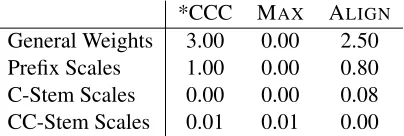
In experiments with an L2 prior, we found there was no weighting of the prior that simultaneously eliminated weights from the scales in languages without exceptionality while satisfactorily account-ing for the trainaccount-ing data. An example of the weights learned for the Variable language with a weak L2 prior is shown in Table (6). These weights were learned using the standard L-BFGS-B optimizer (Byrd et al., 1995) and the objective function in (5).
[image:8.612.327.529.426.494.2]*CCC MAX ALIGN General Weights 3.00 0.00 2.50 Prefix Scales 1.00 0.00 0.80 C-Stem Scales 0.00 0.00 0.08 CC-Stem Scales 0.01 0.01 0.00
Table 6:Variable weights and mean scales, L2 prior, 2= 1
predicting skews not only for lexically-conditioned variation (as predicted by the L1 prior) but also for patterns without lexical conditioning.
As discussed earlier, we characterized successful learning in terms of feature selection, using scales only when needed to capture lexical conditioning, and we have shown that the L2 prior does not suc-ceed on this criterion, affecting generalization of cat-egorical, lexicalized, and freely variable processes. However, the extent to which language users encode predictable properties of lexical items is not known, and further behavioral research is needed to under-stand whether and how generalization of variable and exceptional processes is skewed.
*CCC MAX ALI
G
N
/ape-taba/ 4.00 0.00 3.38 O E
a. apetaba 0 0 -1 0.00 0.03 b. aptaba 0 -1 0 1.00 0.97 /ape-tnaba/ 4.01 0.01 3.30 O E
a. apetnaba 0 0 -1 0.67 0.66 b. aptnaba -1 -1 0 0.33 0.34
Tableau 6:Variable language tableau – L2 prior, 2= 1
5.2 No extra penalty for scales
We found that a general L1 prior was sufficient for keeping the model from overusing scales and generalizing beyond the data. The objective func-tion penalizes weights and scales equally, but scales are more costly when many morphemes require the same scaling. Thus, the pressure against scales fol-lows automatically from their limited utility in the grammar. This contrasts with other approaches to MaxEnt learning of exceptionality, which require ei-ther additional priors on some constraints to ensure that the model generalizes (Pater et al., 2012) or dis-tinct phases of learning for general and lexical gen-eralizations (Nazarov, 2018; Shih, 2018).
5.3 Multiple correct solutions
We also found that, when lexical exceptionality is present, there are multiple correct solutions for a given problem with different predictions about gen-eralization. Any model that is tasked with learning both general and exceptional patterns must decide
which items in the lexicon are the exceptions and which represent the generalizable pattern. We found that the objective function for our model favors over-extending clear majority patterns, but is more am-bivalent about what to treat as exceptional given bal-anced data (§3.3). This ambivalence was modulated by the strength of the prior (§4.1) and the presence of related processes in the data (§4.2).
5.4 Future work
A number of avenues for future work remain. As mentioned in §2, the differences between this approach and lexically indexed constraints (Pater, 2010) remain to be explored, as do differences from alternative models for learning variability and ex-ceptionality (Nazarov, 2018; Shih, 2018). Another natural continuation of this research is to apply the learning paradigm described here to more realis-tic datasets. Following Pater (2007), Linzen et al. (2013, 489) limit scales to only penalizing ex-ponents of the morphemes they are associated with. This locality condition will be important to incorpo-rate before exploring more complex datasets.
Further investigations of the effect of the prior on generalization are needed. While we investigated the consequences of varyingC, our focus was lim-ited to the Lexical language. We found that the data distribution, the strength of the prior, and the exis-tence of related processes in the language already introduce strong pressures on the learner’s encoding of exceptionality. In some cases, however, we found the proposed prior did not uniquely favor a single solution. Ultimately, these and other modeling deci-sions require an understanding of how humans per-form under similar learning conditions. Connections with experimental work on how humans generalize variable and exceptional patterns is crucial to defin-ing desirable behavior for any learndefin-ing model. 6 Conclusion
References
Adam Albright and Bruce Hayes. 2003. Rules vs. analogy in English past tenses: A computa-tional/experimental study. Cognition, 90(2):119–161. Blake Allen and Michael Becker. 2015. Learning
al-ternations from surface forms with sublexical phonol-ogy. Unpublished manuscript, University of British Columbia and Stony Brook University. Available as lingbuzz/002503.
Michael Becker and Maria Gouskova. 2016. Source-oriented generalizations as grammar inference in Rus-sian vowel deletion. Linguistic Inquiry, 47(3):391– 425.
Paul Boersma and Bruce Hayes. 2001. Empirical tests of the Gradual Learning Algorithm. Linguistic Inquiry, 32(1):45–86.
Richard H. Byrd, Peihuang Lu, Jorge Nocedal, and Ciyou Zhu. 1995. A limited memory algorithm for bound constrained optimization. SIAM Journal on Scientific
Computing, 16(5):1190–1208.
Andries W. Coetzee and Shigeto Kawahara. 2013. Fre-quency biases in phonological variation. Natural
Lan-guage and Linguistic Theory, 31(1):47–89.
Andries W. Coetzee and Joe Pater. 2011. The place of variation in phonological theory. In John A. Gold-smith, Jason Riggle, and Alan C. L. Yu, editors, The
Handbook of Phonological Theory, pages 401–434.
Wiley, 2nd edition.
Mirjam Ernestus and R. Harald Baayen. 2003. Pre-dicting the unpredictable: Interpreting neutralized seg-ments in Dutch. Language, pages 5–38.
Sharon Goldwater and Mark Johnson. 2003. Learn-ing OT constraint rankLearn-ings usLearn-ing a Maximum Entropy model. InProceedings of the Stockholm Workshop on
Variation within Optimality Theory, pages 111–120.
Bruce Hayes and Zsuzsa Czir´aky Londe. 2006. Stochas-tic phonological knowledge: The case of Hungarian vowel harmony. Phonology, 23(1):59–104.
Bruce Hayes, P´eter Sipt´ar, Kie Zuraw, and Zsuzsa Londe. 2009. Natural and unnatural constraints in Hungarian vowel harmony. Language, 85(4):822–863.
Brian Hsu and Karen Jesney. 2016. Scalar positional markedness and faithfulness in Harmonic Grammar.
InProceedings of the Annual Meeting of the Chicago
Linguistic Society, volume 51, pages 241–255.
Wendell Kimper. 2011. Competing Triggers:
Trans-parency and Opacity in Vowel Harmony. Ph.D. thesis,
University of Massachusetts Amherst.
Iwona Kraska-Szlenk. 1995. The phonology of stress in
Polish. Ph.D. thesis, University of Illinois at
Urbana-Champaign.
Solomon Kullback and Richard A. Leibler. 1951. On information and sufficiency. The Annals of Mathemat-ical Statistics, 22(1):79–86, 03.
Tal Linzen, Sofya Kasyanenko, and Maria Gouskova. 2013. Lexical and phonological variation in Russian prepositions.Phonology, 30(3):453–515.
Claire Moore-Cantwell and Joe Pater. 2016. Gradi-ent exceptionality in Maximum Entropy grammar with lexically specific constraints. Catalan Journal of
Lin-guistics, 15:53–66.
Aleksei Nazarov. 2018. Learning within- and between-word variation in probabilistic OT grammars. In Gillian Gallagher, Maria Gouskova, and Sora Yin, ed-itors, Supplemental Proceedings of the 2017 Annual
Meeting on Phonology, Washington, DC. Linguistic
Society of America.
Joe Pater, Karen Jesney, Robert Staubs, and Brian Smith. 2012. Learning probabilities over underlying repre-sentations. In Proceedings of the Twelfth Meeting of the Special Interest Group on Computational
Mor-phology and Phonology, pages 62–71. Association for
Computational Linguistics.
Joe Pater. 1996. Consequences of Constraint Ranking. Ph.D. thesis, McGill University.
Joe Pater. 2007. The locus of exceptionality: Morpheme-specific phonology as constraint indexation. In Leah Bateman, Michael O’Keefe, Ehren Reilly, and Adam Werle, editors, University of Massachusetts Occa-sional Papers in Linguistics 32: Papers in Optimality
Theory III, pages 259–296. GLSA, Amherst, MA.
Joe Pater. 2010. Morpheme-specific phonology: Con-straint indexation and inconsistency resolution. In Steve Parker, editor,Phonological argumentation:
Es-says on evidence and motivation, pages 123–154.
Equinox, London.
Stephanie S. Shih. 2018. Learning lexical classes from variable phonology. In Yuki Seo and Haruya Ogawa, editors, Selected Papers from Asian Junior Linguists
Conference 2, pages 1–15. ICUWPL.
Yoshimasa Tsuruoka, Jun’ichi Tsujii, and Sophia Ana-niadou. 2009. Stochastic gradient descent training for L1-regularized log-linear models with cumulative penalty. InProceedings of the Joint Conference of the 47th Annual Meeting of the ACL and the 4th Interna-tional Joint Conference on Natural Language
Process-ing of the AFNLP: Volume 1, pages 477–485.
Associ-ation for ComputAssoci-ational Linguistics.
Colin Wilson. 2006. Learning phonology with substan-tive bias: An experimental and computational study of velar palatalization.Cognitive Science, 30:945–982. Shi Yan. 2016. L1 norm regularization and sparsity
mlreview/l1-norm-regularization- and-sparsity-explained-for-dummies-5b0e4be3938a.
Kie Zuraw. 2000. Patterned Exceptions in Phonology. Ph.D. thesis, University of California, Los Angeles. Kie Zuraw. 2010. A model of lexical variation and
the grammar with application to Tagalog nasal sub-stitution. Natural Language & Linguistic Theory, 28(2):417–472.
Jesse Zymet. 2018. Lexical propensities in phonol-ogy: corpus and experimental evidence, grammar, and
learning. Ph.D. thesis, University of California, Los