Normalization in Context: Inter-Annotator Agreement for
Meaning-Based Target Hypothesis Annotation
Adriane Boyd Department of Linguistics
University of T¨ubingen
Abstract
We explore the contribution of explicit task contexts in the annotation of word-level and sentence-level normalizations for learner lan-guage. We present the annotation schemes and tools used to annotate both word- and sentence-level target hypotheses given an ex-plicit task context for the Corpus of Reading Exercises in German (Ott et al.,2012) and dis-cuss a range of inter-annotator agreement mea-sures appropriate for evaluating target hypoth-esis and error annotation.
For learner answers to reading comprehension questions, we find that both the amount of task context and the correctness of the learner an-swer influence the inter-annotator agreement for word-level normalizations. For sentence-level normalizations, the teachers’ detailed as-sessments of the learner answer meaning pro-vided in the corpus give indications of the difficulty of the target hypothesis annotation task. We provide a thorough evaluation of inter-annotator agreement for multiple aspects of meaning-based target hypothesis annotation in context and explore measures beyond inter-annotator agreement that can potentially be used to evaluate the quality of normalization annotation.
1 Introduction
Learner language frequently contains non-canonical orthography and morphosyntactic constructions that present difficulties for natural language processing tools developed for standard language. Since manually annotated learner corpora are often small and the high degree of variation in learner productions leads to data sparsity issues even for larger learner corpora, it is useful to consider methods that normalize
This work is licensed under a Creative Commons Attri-bution 4.0 International Licence. Licence details:
http://creativecommons.org/licenses/by/4.0/.
non-standard aspects of learner language. While normalization and applying standard language categories to learner language does not address the full spectrum of learner language analysis and fundamental concerns about analyzing learner language (cf. Meurers and Dickinson, 2017), it can facilitate access to learner language in applications such as corpus search tools and computer-aided language learning systems.
Normalizations such as the minimal target hy-pothesis from the Falko German learner corpus (Reznicek et al., 2012) have been developed in order to provide a version of a learner produc-tion that can be systematically searched and that is more appropriate for further manual or automatic analysis. The minimal target hypothesis contains a minimal number of modifications that convert the learner sentence into a locally grammatical sen-tence. As it may not be possible to determine ex-actly what the learner intended to say in an open-ended task such as an essay task, what constitutes a minimal change is based on grammatical prop-erties, e.g., preserving a verb and modifying its ar-guments rather modifying the verb itself.
In terms of the difficulties an annotator may face while interpreting a learner utterance, consider the following learner utterance from the Hiroshima English Learners’ Corpus (Miura,1998):
(1) I don’t know he live were.
It is possible to speculate about the intended mean-ing of this utterance, proposmean-ing multiple interpre-tations such as:
(2) a. I don’t know if he was alive.
b. I don’t know where he lives.
lives. This task context makes it extremely likely that the intended meaning is that of (2b).
Without annotation guidelines based on detailed grammatical properties such as for Falko, target hypothesis annotation and likewise error annota-tion for learner language in open-ended tasks has been shown to be difficult to perform reliably (e.g., Fitzpatrick and Seegmiller,2004;L¨udeling,2008; Tetreault and Chodorow, 2008; Lee et al., 2009; Rosen et al.,2013;Dahlmeier et al.,2013). As an example,Dahlmeier et al.(2013) report Cohen’sκ
of 0.39 for the task of identifying which tokens should be edited in the NUCLE corpus of English student essays.
In contrast to open-ended tasks, a more ex-plicit task context can provide more information about the potential meaning of a learner produc-tion (Meurers, 2015), thereby facilitating a more reliable interpretation of the form and meaning and thus more reliable annotation of target hy-potheses, which preserve the intended meaning in-stead of prioritizing particular grammatical fea-tures. For the ComiGS corpus, which contains explicit task contexts in the form of comic strips used in picture description tasks,K¨ohn and K¨ohn (2018) reportκ = 0.86for the same task of iden-tifying which tokens should be normalized.
In this paper, we systematically explore the de-pendence of normalization on task context through manual annotation studies, focusing on L2 learner responses in a reading comprehension task con-text. We explore inter-annotator agreement mea-sures for normalization and error annotation, con-sidering the use of related evaluation metrics be-yond inter-annotator agreement for the direct eval-uation of normalization annotation.
2 Background
Numerous manual annotation studies have shown that target hypothesis annotation is difficult to perform reliably, and since error annotation de-pends on the formulation of target hypotheses (cf. Hirschmann et al., 2007), inter-annotator agreement for error annotation has likewise had lower levels of reliability (e.g., Fitzpatrick and Seegmiller, 2004; L¨udeling, 2008; Tetreault and Chodorow, 2008; Lee et al., 2009; Rosen et al., 2013;Dahlmeier et al.,2013). For example, a de-tailed annotation study for the CzeSL corpus of L2 Czech shows a wide range of inter-annotator agreement results for the presence of different
types of error tags (Rosen et al., 2013), from
κ >0.6 for incorrect stem, incorrect inflection, and incorrect word boundary to κ <0.2 for ill-formed complex verb formsandincorrect pronom-inal references. The authors perform a detailed in-spection of theagreement errors (κ = 0.54) that reveals that half of the disagreements correspond to differing target hypotheses, where the annota-tors provided the correct error tags for their re-spective target hypotheses, but since these differ, the error annotation is inconsistent.
2.1 Task Context
For the contribution of available task context with respect to inter-annotator reliability, several stud-ies on normalization annotation for in both L1 and L2 task contexts report promising results. In a native language setting, Lee et al. (2009) inves-tigate annotators’ judgments of article/number se-lections for English nouns in a sentence containing noun phrase gap. Annotators choose which noun article (a/an, the, no article) and number combi-nations (singular,plural) are possible in this con-text. For the five possible categories, Cohen’sκ in-creases fromκ= 0.55toκ= 0.60when the avail-able context increases from the current sentence with the gap to include five preceding sentences. In addition,κincreases when the noun has already been mentioned in the context and for those arti-cle/number combinations that are much more fre-quent overall, e.g., the article/number combination
the sunis much more frequent than all other arti-cle/number combinations involvingsun, so anno-tators are more consistent about their decisions for
the sunthan less frequent combinations.
hypotheses κ= 0.74 (cf. κ= 0.39 for NUCLE (Dahlmeier et al., 2013), although clearly many differences between the annotation studies make a direct comparison difficult).
2.2 Inter-Annotator Agreement for Normalization Annotation
Evaluations of inter-annotator agreement for nor-malization annotation are typically performed for several perspectives on the manual annotation. As an example of some possible evaluations, the NU-CLE corpus (Dahlmeier et al.,2013), which con-tains both normalizations and associated errors tags, presents inter-annotator agreement results for three aspects:
• Normalization identification: Do annota-tors agree on which tokens are normalized?
• Error tag given norm. identification: For those tokens where both annotators agree that a modification is needed, do they agree on the error tag assigned?
• Error+norm. given norm. identification: For those tokens where both annotators agree that a modification is needed, do they agree on both the error tag and the normalization?
As an alternative to examining only those cases where both annotators agree that a modification is necessary, which excludes many potentially in-teresting cases where annotators disagree about whether to make a modification in the first place, the CzeSL inter-annotator agreement evaluation (Rosen et al.,2013) considers each error tag sepa-rately as a binary annotation task:
• Error tag identification: For a given error category, do annotators agree on which to-kens are annotated with this category?
Both Dahlmeier et al. (2013) and Rosen et al. (2013) report the agreement coefficient Cohen’sκ
(Cohen, 1960), which measures agreement for categorical annotation tasks for two annotators. Cohen’s κ (Cohen, 1960) and Krippendorff’s α
(Krippendorff, 1980) are frequently used inter-annotator agreement measures for evaluating bi-nary or categorical annotation decisions, e.g.,Is a token modified?orIs a token annotated with cate-gory X?. Inter-annotator agreement measures esti-mate how likely it is that annotators agreed (forκ)
or disagreed (forα) by chance and calculate the degree of agreement beyond the level expected by chance alone.
The values for both Cohen’s κ and Krippen-dorff’sαrange from -1 (perfect disagreement) to 1 (perfect agreement) with 0 as chance agreement only. Cohen’s κ is limited to nominal categories (all disagreements are counted equally) and only two annotators, while Krippendorff’sαhas the ad-vantages that three or more annotators can be in-cluded and that not only nominal categories but also annotations on ordinal or interval scales or with sets of categorical tags can be compared more precisely. See Artstein and Poesio (2009) for a detailed overview of inter-annotator agreement for linguistic annotation.
As explored in Bollmann et al. (2016), Co-hen’s κ, Krippendorff’sα, and other related mea-sures of agreement are not appropriate for use with normalization annotation itself, as in the NUCLE evaluation of error+norm. given norm. identi-fication. The difficulties lie in the fact that the possible values for normalizations are not a small, finite set of categories but the set of all possible tokens in the target language. Given a relatively small annotated corpus, it is not possible to esti-mate how likely a given token might be in order to estimate chance agreement and even if it were possible, it would still not take into account the fact that a target hypothesis is frequently a form closely related to the original token. Addition-ally,κandαgive a higher weight to less frequent annotations, which means that normalizations for infrequent words play a larger role in the agree-ment coefficient even though an annotator’s per-formance typically does not depend directly on the frequency of the word to be normalized. In fact, the opposite is often true: a misspelled rare name provided in the task context may be simple to nor-malize while a frequent determiner may be more challenging.
As there is no consensus on suitable agreement measures for normalization or target hypothesis annotation, we will primarily report percentage agreement in the following studies. We return to the issue of inter-annotator agreement measures for full target hypotheses in section4.2.4.
3 Data
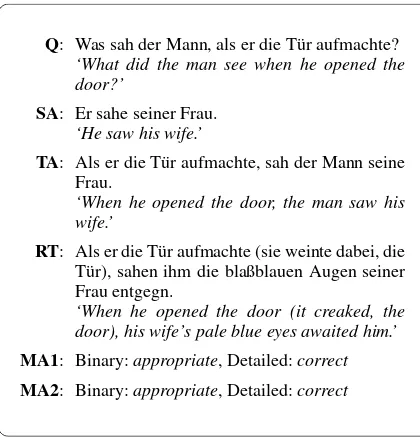
Q: Was sah der Mann, als er die T¨ur aufmachte?
‘What did the man see when he opened the door?’
SA: Er sahe seiner Frau.
‘He saw his wife.’
TA: Als er die T¨ur aufmachte, sah der Mann seine Frau.
‘When he opened the door, the man saw his wife.’
RT: Als er die T¨ur aufmachte (sie weinte dabei, die T¨ur), sahen ihm die blaßblauen Augen seiner Frau entgegn.
‘When he opened the door (it creaked, the door), his wife’s pale blue eyes awaited him.’
MA1: Binary:appropriate, Detailed:correct
[image:4.595.73.283.41.260.2]MA2: Binary:appropriate, Detailed:correct
Figure 1: CREG Example
Corpus of Reading Exercises in German (CREG, Ott et al., 2012), a German L2 learner corpus containing learner answers to reading compre-hension exercises, which was collected in to en-able research into learner language in a task-based context. The learners are students in German classes at two American universities who com-pleted reading comprehension exercises as part of their coursework. The corpus contains: 1) read-ing texts, 2) comprehension questions, 3) teacher-provided target answer(s), 4) student answers to the questions, and 5) teacher assessments of the student answer meaning.
An example student answer (SA) to a compre-hension question (Q) is shown in Figure1 along with the target answer (TA) provided by a teacher and an excerpt from the reading text (RT). The meaning of each student answer is assessed by two teachers (MA1/2), who provide a binary as-sessment of the meaning (appropriateor inappro-priate as an answer to the question) without tak-ing spelltak-ing or grammar into account and a de-tailed classification of how the student answer dif-fers from the provided target answer using the categories: correct, missing concept, extra con-cept, blend, and non-answer. Student answers marked as appropriate in the binary assessment are most frequentlycorrectin the detailed assess-ment, but appropriate answers may also contain missing concepts, extra concepts, or blends.
Our experiments will primarily use data from CREG-5K, a subcorpus of CREG that contains
Binary Approp. Inapprop.
Detailed (%) (%)
Correct 76.9 0.0
Missing Concept 14.5 43.7
Extra Concept 6.2 3.2
Blend 2.4 50.2
[image:4.595.322.513.43.139.2]Non-Answer 0.0 2.9
Table 1: Meaning Assessments in CREG-5K
~5000 student answers with a balanced number of appropriate and inappropriate answers. In to-tal, CREG-5K contains 5138 student answers to 877 questions for 98 reading texts. The reading texts vary greatly in length, with an average of 961 tokens and a standard deviation of 1271 to-kens. The student answers have been selected to contain a minimum of four tokens and have an av-erage length of 11.75 tokens with a standard de-viation of 7.13 tokens. The distribution of binary and detailed meaning assessments for CREG-5K is shown in Figure1.
4 Experiments
On the basis of the CREG corpus, we explore the extent to whichcontextandappropriatenessplay a role in the normalization of learner language. We first perform two normalization annotation studies on non-words in CREG-5K. Our goal is to inves-tigate whether the amount of task context plays a role in inter-annotator agreement and whether appropriate answers can be more reliably normal-ized than inappropriate ones. Next, in section4.2 we will describe the annotation of full meaning-based target hypotheses for the appropriate an-swers in CREG-5K and explore the evaluation of inter-annotator agreement for full normalizations and error tags.
4.1 Non-Word Normalization
DEREWO list of the 100,000 most frequent in-flected words in a large German reference corpus (Institut f¨ur Deutsche Sprache,2009).1
In two related experiments, we investigate the roles of task context and answer appropriateness in non-word normalization. We hypothesize that it is easier to perform non-word normalization reli-ably given more task context and that appropriate answers are easier to normalize than inappropriate ones, since annotators know the intended mean-ing of an appropriate answer from the task context. We first describe the annotation scheme and anno-tation tool used in both experiments, then present the experimental results.
4.1.1 Non-Word: Annotation Scheme
Non-words are annotated with a normalization that would be part of a form-meaning target hy-pothesis (a target hyhy-pothesis that preserves the in-tended meaning of the student answer while tak-ing the task context into account, see section4.2) for the student’s answer given the available task context. Each non-word is additionally annotated with the amount of context required for the anno-tator to be confident that the provided normaliza-tion is the intended token in this context. If the annotator cannot be confident of a single normal-ization, multiple normalizations can be provided along with the context categoryHard. The anno-tators are instructed to consider each context cate-gory in order:
• Real Word: non-word is a real word
• No Context: umlaut spellings withe,ssvs.ß
• Answer: the student answer alone
• Question + Answer: the answer along with the question
• Reading Text + Question + Answer: the full task context
• Hard (ambiguous, English): a single normal-ization cannot be chosen with confidence
When the full context is not available (only in some conditions in Experiment 1), only the con-text categories for the provided concon-text should be annotated.
1This process misses some non-words and misspellings
[image:5.595.316.520.45.163.2]in the corpus because the DEREWOword list contains both old and new German spellings and also some proper names such asFisherthat cause our automatic selection process to miss some tokens in CREG that require a word-level nor-malization. All non-word normalizations are reviewed and additional non-word annotations are added in the full form-meaning target hypotheses in section4.2.
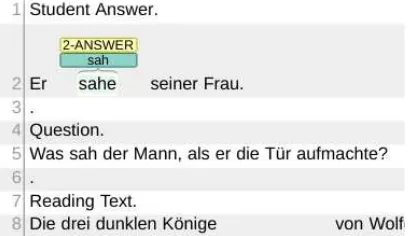
Figure 2: Non-Word Annotation in WebAnno
4.1.2 Non-Word: Annotation Tool
The non-words were annotated using custom lay-ers in the tool WebAnno (Yimam et al.,2014). The student answers were preprocessed using a UIMA pipeline in order to tokenize them, identify non-words, and insert empty annotation spans to be filled in by the annotators. A screenshot of the We-bAnno annotation environment is shown in Fig-ure2for the student answerEr sahe seiner Frau.
‘He saw his wife.’ in response to the questionWas sah der Mann, als er die T¨ur aufmachte? ‘What did the man see as he opened the door?’ The an-notator has annotated the non-wordsahewith the normalizationsah‘saw’ and specified the required context as the student answer alone.
4.1.3 Non-Word Experiment 1: Context To evaluate the role of context in non-word nor-malization, the correct answers from CREG-5K (binary assessment: appropriate) were annotated. There were 1152 potential non-words in 2574 an-swers to 877 questions about 98 reading texts. The non-words were divided into four conditions by reading text, so that a reading text and its asso-ciated questions/answer are only included in one condition:
• training (10%)
• answer context only (15%) • answer + question (15%)
• answer + question + reading text (60%)
Since we intend to annotate all non-words given the full context for the full form-meaning target hypotheses (see section 4.2), the non-words are not distributed equally between the conditions in order to reduce the reannotation burden in the next stage.
re-Norm. Context
% # Cats α
Answer 74.8 4 0.696
[image:6.595.317.516.40.152.2]A + Question 79.0 5 0.689 A + Q + Text 83.8 6 0.602
Table 2: IAA for Non-Words: Context
fine the annotation guidelines, then annotated the remaining instances (90%) independently. The re-sults are shown in Table 2. As discussed in sec-tion 2.2, the agreement for the normalizations is presented as percentage agreement on the exact form provided and the agreement for the context category using Krippendorff’sα.
As a result of the fact that the number of cate-gories is not identical across conditions, theα val-ues cannot be compared directly, however indicate moderate to substantial agreement on the context tags. When only the student answer is available, annotators agree 74.8% of the time on the nor-malization. This increases to 79.0% if the ques-tion is also available and to 83.8% if the quesques-tion and reading text2 are provided, showing that the presence of an explicit task context does enable a higher degree of reliability in normalization anno-tation.
For the annotations with the full context (60%, all six context tags are included), the confusion matrix for the context tags is shown in Figure3. Some frequent sources of disagreement are rare in-flections such as second person plural subjunctive forms (e.g.,stehet ‘would stand’), where one an-notator annotated them asReal Wordand the other normalized them to more frequent third person singular indicative forms (steht ‘stand’) with the category Answer, and instances where there are multiple, acceptable alternatives for prepositions in a particular context and one annotator consis-tently provided more alternatives, annotating such cases asHard(vs.Answerfor the other annotator).
4.1.4 Non-Word Experiment 2: Appropriateness
In the second non-word normalization experi-ment, the role of appropriateness is considered. The non-words consist of 529 non-words in 365 answers, presented to the annotator with the
2As the students answering the reading comprehension
questions do not have access to the teacher target answers while responding, the target answers are not presented to the annotations as part of this experiment.
W N A Q R H Σ
W 41 0 26 1 2 2 72
N 0 71 4 0 1 3 79
A 5 8 321 4 7 18 363
Q 0 0 13 11 0 0 24
R 0 0 26 1 9 1 37
H 0 0 6 0 1 6 13
[image:6.595.85.280.42.112.2]Σ 46 79 396 17 20 30 588
Table 3: Confusion Matrix: Non-Word with Full Con-text
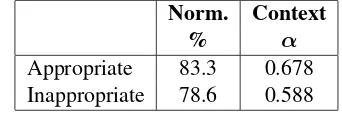
Norm. Context
% α
Appropriate 83.3 0.678 Inappropriate 78.6 0.588
Table 4: IAA for Non-Words: Appropriateness
full reading text context. Since the appropri-ate answers from CREG-5K were annotappropri-ated in the previous experiment, the appropriate answers come from CREG-1032 and other CREG subcor-pora, while the inappropriate answers come from CREG-1032 and CREG-5K.
The two annotators from the previous exper-iment completed the annotation independently without any further training. The results are shown in Table4. When the answer meaning has been as-sessed asappropriate, annotators agree on a sin-gle normalization in 83.3% of instances, nearly 5% higher than when the answer is inappropri-ate. Krippendorff’s α, which is now compara-ble across both conditions since all six categories were used, is 0.678 for appropriate answers and drops to 0.588 for inappropriate answers, showing that annotators are more reliable in terms of the contribution of the task context for appropriate an-swers. This may be due to the fact that incorrect answers may include additional information that is not present in any part of the task context, so it may be more difficult to choose a context annota-tion.
4.2 Form-Meaning Target Hypothesis Annotation
Moving from non-word annotation to full target hypothesis annotation for the complete student an-swers, we present pilot results for the annotation of
[image:6.595.328.499.203.260.2]CREG annotated in Experiment 1 (section 4.1.3) containing 2574 student answers.
A form-meaning target hypothesis (FMTH) is defined as a target hypothesis that provides a grammatical version of the student answer that:
• preserves as much of the meaning of the an-swer as possible
• respects the task context
If normalizations are necessary, these modifica-tions should be as minimal as possible and align as closely as possible with material from the tar-get answer, the question, and the reading text, e.g., if there is a missing concept, the inserted tokens should come directly from the task context.
After completing the non-word annotation ex-periments, one annotator reannotated the subset of non-words from Experiment 1 not presented in the full task context (30%) and the data was converted to Prague Markup Language3 in preparation for use with the tool feat (see section 4.2.2). This annotator and a new second annotator performed the full target hypothesis and error annotation pre-sented in the following sections.
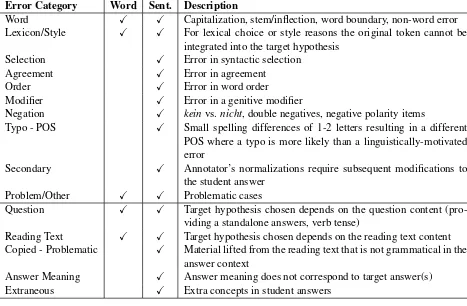
4.2.1 FMTH: Error Annotation Scheme The focus of the form-meaning target hypothesis annotation is on the normalization itself, however error annotation is also included to encourage a careful, reliable analysis of the student answers during the annotation process. The error tion scheme attempts to parallel the CzeSL annota-tion scheme where possible, with non-words nor-malized in the first layer of annotation (word) and the full sentence normalized in the second layer of annotation (sentence). The top-level categories of the annotation scheme are presented in Table5. For each error category, the table specifies whether a tag is possible on the word or sentence layers.
The top half of the table shows error tags simi-lar to CzeSL, which are typical types of error tags seen in error-annotated learner corpora, and the bottom half of the table introduces new tags spe-cific to the annotation of target hypotheses within a provided task context. In some instances, nor-malizations are necessary because of the question or reading text content, e.g., the tense of a stu-dent answer needs to be adjusted (tag: Question) or a proper name from the reading text is mis-spelled (tag: Reading Text). Students may have
3
[image:7.595.313.521.51.161.2]https://ufal.mff.cuni.cz/pml
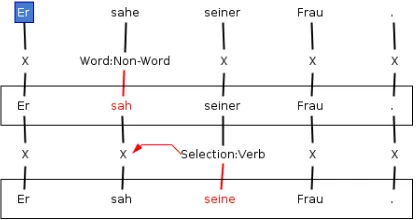
Figure 3: feat Annotation Tool
copied material from the reading text in a problem-atic way (e.g., copied ‘not only’ without the cor-responding ‘but also’,Copied - Problematic), pro-vided an answer that has a slightly incorrect mean-ing (Answer Meaning), or provided extra concepts that the annotators cannot normalize as consis-tently as material based on the task context ( Extra-neous). Problematic cases are discussed in further detail in section4.2.3.
4.2.2 FMTH: Annotation Tool
The form-meaning target hypothesis annotation is performed using the toolfeat(Flexible Error An-notation Tool), which was developed as part of the CzeSL project (Hana et al.,2012). We extendfeat
to support the CREG FMTH error scheme and to enable annotators to search for strings within long reading texts in order to make it easier to find the relevant sections and copied material.4
A screenshot of thefeatannotation for the ex-ample from Figure 1 is shown in Figure 3. The top layer of tokens shows the original tokenized text, the middle layer shows the non-word nor-malizations, and the bottom layer shows the full form-meaning target hypothesis. In this example, the verbsah‘saw’ selects the accusative case, so
seiner‘his (DAT/GEN)’ is normalized toseine‘his (NOM/ACC)’ and the corresponding error tag Se-lection:Verb is chosen with a pointer identifying the head that selects this token.
4.2.3 Difficult Cases
Annotators encountered a range of difficult cases while annotating form-meaning target hypotheses, which relate to the nature of certain types of read-ing comprehension questions and aspects of anno-tating given a context provided by a written text.
4
Error Category Word Sent. Description
Word X X Capitalization, stem/inflection, word boundary, non-word error Lexicon/Style X X For lexical choice or style reasons the original token cannot be
integrated into the target hypothesis Selection X Error in syntactic selection
Agreement X Error in agreement
Order X Error in word order
Modifier X Error in a genitive modifier
Negation X keinvs.nicht, double negatives, negative polarity items
Typo - POS X Small spelling differences of 1-2 letters resulting in a different
POS where a typo is more likely than a linguistically-motivated error
Secondary X Annotator’s normalizations require subsequent modifications to
the student answer Problem/Other X X Problematic cases
Question X X Target hypothesis chosen depends on the question content (pro-viding a standalone answers, verb tense)
Reading Text X X Target hypothesis chosen depends on the reading text content
Copied - Problematic X Material lifted from the reading text that is not grammatical in the answer context
Answer Meaning X Answer meaning does not correspond to target answer(s)
[image:8.595.73.540.44.350.2]Extraneous X Extra concepts in student answers
Table 5: Top-Level Categories in CREG FMTH Error Annotation Scheme
Q: Nennen Sie zwei Zimmer im Erdgeschoss.
‘Name two rooms on the ground floor.’
SA: ein Wohnzimmer und ein Badzimmer
‘a living room and a bathroom’
TA: Im Erdgeschoss gibt es ein Bad, G¨aste WC, eine K¨uche und ein Wohn/Esszimmer.
‘On the ground floor there is a bathroom, a guest bathroom, a kitchen, and a living/dining room.’
Figure 4: Difficult Cases: Enumerated Answers
Enumerated answers Enumerated answers present a particular problem for the reading comprehension task scenario. An example of a question with an enumerated answer is shown in Figure 4. When creating the CREG corpus, Ott et al. (2012) noticed a larger degree of dis-agreement in meaning assessment for enumerated answers, which appears to be due to the fact that is unclear how complete an enumeration needs to be to consider a student answerappropriate.
The target answers typically provide an exhaus-tive list of all items while an appropriate student answer provides only the number requested in the
question. For form-meaning target hypothesis an-notation, the annotators cannot rely on the target answers when evaluting the meaning of the stu-dent answer and when concepts are missing, there is also not a clear choice for which concept to in-sert into the student answer.
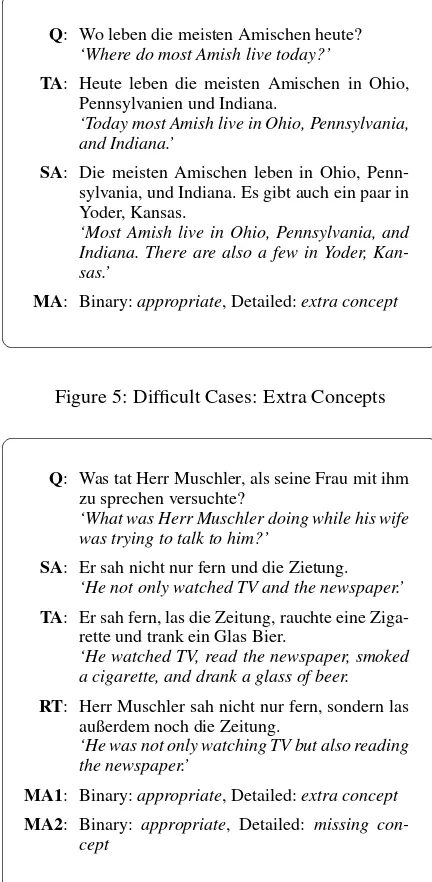
Extra concepts Students occasionally provide material in their responses that comes from their own world knowledge rather than the reading text. Figure 5 shows one instance where the student provides additional facts in an answer, which an annotator cannot evaluate within the task context.
Q: Wo leben die meisten Amischen heute?
‘Where do most Amish live today?’
TA: Heute leben die meisten Amischen in Ohio, Pennsylvanien und Indiana.
‘Today most Amish live in Ohio, Pennsylvania, and Indiana.’
SA: Die meisten Amischen leben in Ohio, Penn-sylvania, und Indiana. Es gibt auch ein paar in Yoder, Kansas.
‘Most Amish live in Ohio, Pennsylvania, and Indiana. There are also a few in Yoder, Kan-sas.’
[image:9.595.71.287.46.487.2]MA: Binary:appropriate, Detailed:extra concept
Figure 5: Difficult Cases: Extra Concepts
Q: Was tat Herr Muschler, als seine Frau mit ihm zu sprechen versuchte?
‘What was Herr Muschler doing while his wife was trying to talk to him?’
SA: Er sah nicht nur fern und die Zietung.
‘He not only watched TV and the newspaper.’
TA: Er sah fern, las die Zeitung, rauchte eine Ziga-rette und trank ein Glas Bier.
‘He watched TV, read the newspaper, smoked a cigarette, and drank a glass of beer.
RT: Herr Muschler sah nicht nur fern, sondern las außerdem noch die Zeitung.
‘He was not only watching TV but also reading the newspaper.’
MA1: Binary:appropriate, Detailed:extra concept
[image:9.595.75.282.263.488.2]MA2: Binary: appropriate, Detailed: missing con-cept
Figure 6: Difficult Cases: Problematic Copied Material
assessment for the response.
Reading text interpretation The least resolv-able issues arise when two annotators disagree on the interpretation of the reading text itself. In Fig-ure7, the subject of an interview in a reading text states that he was unsure how many people might come to a demonstration and the student answer mentions ‘force against not too many people’, which potentially needs to be normalized under
Answer Meaningto align with the target answer. One annotator interpreted the text to mean that the organizer was worried that not enough people would come and the other annotator thought that he was worried that too many people would come.
Q: Warum hatte Schorlemmer zu Beginn Angst?
‘Why was Schorlemmer afraid at the begin-ning?’
TA: Er wusste nicht, wie viele Menschen kommen w¨urden und ob die Polizei mit Gewalt gegen die Demonstration vorgeht.
‘He did not know how many people would co-me and if the police would respond to the de-monstration with force.’
SA: dass die Polizei mit Gewalt gegen nicht zu vie-le Menschen kommen
‘that the police would come with force against not too many people’
RT: Ich hatte noch große Angst. Zum einen, weil ich nicht wusste, wie viele Menschen kom-men w¨urden. Zum anderen, weil ich Angst hatte, dass die Polizei mit Gewalt gegen die Demonstration vorgehen w¨urde.
‘I was still very scared. On the one hand, be-cause I didn’t know how many people would come. On the other hand, because I was scared that the police would respond to the demons-tration with force.’
MA1: Binary:appropriate, Detailed:correct
MA2: Binary: appropriate, Detailed: missing con-cept
Figure 7: Difficult Cases: Reading Text Interpretation
With differing interpretations of the reading text, there is little hope for similar target hypotheses. Despite the explicit task context, such ambiguous statements may still be present in a reading text and lead to inter-annotator disagreement.
4.2.4 IAA for Meaning-Based Target Hypotheses
the preceding token. In case there are multiple er-ror tags on a single token or in merged annotations, these are treated as a set of error tags on the origi-nal token.
Cohen’s κ5 for normalization identification (see section2.2for detailed descriptions) is 0.68, which shows substantial agreement and falls in be-tween results reported for NUCLE (κ= 0.39) and for ComiGS (κ= 0.86). Forerror tag given nor-malization,κis0.47, which is slightly lower than NUCLE (κ = 0.55) for a relatively similar set of error tags. However, our annotation allows anno-tators to annotate multiple error tags on a single word, resulting in 57 combinations of error tags (for 15 individual tags) which are treated as sepa-rate tags inκ’s comparisons. Using the more ap-propriate MASI distance metric for set annotations (Passonneau,2006), we obtainαM ASI = 0.50for
15 error tags, again given that both annotators nor-malized the token.
We find only small differences between error tag given normalization (κ = 0.47), which ig-nores cases where only one annotator annotated an error, and simplyerror tagfor all tokens, with
κ = 0.45. Although ~86% of the tokens are not annotated with error tags, chance-corrected agree-ment measures account for the high probability that an original token remains unmodified in a tar-get hypothesis and that most tokens in the corpus are not annotated with error tags.
As with non-word normalizations, we calculate only the percentage agreement for the normaliza-tions themselves. For cases where both annotators agreed that a token should be normalized, the same normalization is provided in 70% of instances. Given the fact that target hypothesis annotation can involve complicated edits and reordering, it is not surprising that the agreement is slightly lower than in the non-word experiments reported Table2 and Table4.
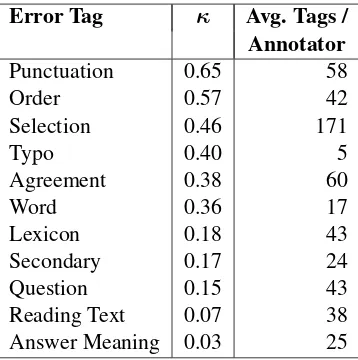
We perform a similar analysis of error tag identificationto compare our results to those re-ported for CzeSL inRosen et al.(2013). For the top-level error tags that appear at least ten times in our subcorpus, we evaluate whether annotators agreed about which tokens are annotated with a particular tag. These results are shown in Table6. As in CzeSL, there is a wide range of agreement
5All inter-annotator agreement measures are calculated
using the scripts by Thomas Lippincott and Rebecca Passon-neau: https://cswww.essex.ac.uk/Research/ nle/arrau/Lippincott/agreement.tgz
Error Tag κ Avg. Tags / Annotator
Punctuation 0.65 58
Order 0.57 42
Selection 0.46 171
Typo 0.40 5
Agreement 0.38 60
Word 0.36 17
Lexicon 0.18 43
Secondary 0.17 24
Question 0.15 43
Reading Text 0.07 38
[image:10.595.327.506.41.221.2]Answer Meaning 0.03 25
Table 6: IAA for Error Tag Identification
with some error tags being annotated fairly reli-ably (Punctuation, Order) and others with little agreement beyond chance (Reading Text, Answer Meaning).
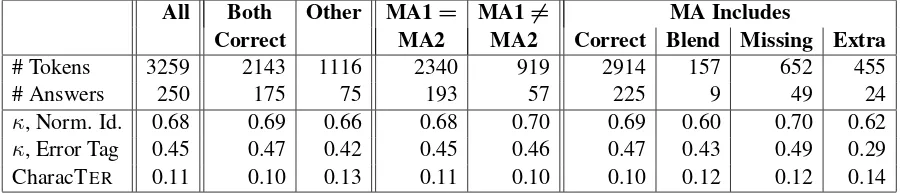
A common thread in the inspection of diffi-cult cases throughout the annotation process is that difficulties frequently occur when the detailed meaning assessment is notcorrectfor one or both teacher assessments. Since an answer with a miss-ing concept, extra concept, or blend either does not supply the correct answer meaning or may in-clude material from outside the task context, this is not surprising. To explore the relationship be-tween difficulty as perceived by the annotators and inter-annotator agreement, we consider three par-titions of the data: 1) both detailed meaning as-sessment are correct vs. all other combinations of assessments, 2) the two detailed meaning assess-ments are identical vs. different, and 3) the cases where at least one detailed assessment includes a particular detailed tag.
We calculate κ for normalization identifica-tion, κ for error tagfor all error tags as shown in Table 7. Agreement measures for both drop slightly forcorrectvs. otherbut surprisingly in-crease slightly for answers where the teachers did not agree on the detailed assessment. Larger dif-ferences are seen for the individual detailed cat-egories, with blend and extra concept instances showing much lower agreement, in particular for error tags related to extra concepts. In general,
All Both Other MA1= MA16= MA Includes
Correct MA2 MA2 Correct Blend Missing Extra
# Tokens 3259 2143 1116 2340 919 2914 157 652 455
# Answers 250 175 75 193 57 225 9 49 24
κ, Norm. Id. 0.68 0.69 0.66 0.68 0.70 0.69 0.60 0.70 0.62
κ, Error Tag 0.45 0.47 0.42 0.45 0.46 0.47 0.43 0.49 0.29
[image:11.595.74.526.43.140.2]CharacTER 0.11 0.10 0.13 0.11 0.10 0.10 0.12 0.12 0.14
Table 7: IAA by Detailed Meaning Assessment
small part of the annotation task.
Since none of the inter-annotator agreement measures are suitable for comparing agreement between the normalization annotation, we turn to alternate metrics that have been proposed for the related tasks of machine translation evaluation and paraphrase detection. These metrics should ide-ally provide a more holistic evaluation of whether two target hypotheses are similar to each other on the sentence level rather than focusing on anno-tations for individual tokens. One recent metric from machine translation evaluation, CharacTER, seems particularly promising since it has been shown to correlate highly with human judgments for languages with richer morphology such as Ger-man and Russian (Wang et al.,2016).
CharacTERis adapted from thetranslation edit ratemetric (TER,Olive, 2005), which calculates the number of edits required to convert one trans-lation to a reference transtrans-lation on the word level. CharacTERextends this to consider bothshiftson the word level to align two sentences (counted as the average number of characters in the words shifted) and then furthercharacter edits required to transform the shifted sentence into the reference translation. This combination allows for variations in word order and small differences in morpholog-ical endings to be counted in a more fine-grained way than word-only edits. CharacTERis formally defined as:
CharacTER= shift cost + edit distance
# characters in the hypothesis sentence
The CharacTER score is lower when two sen-tences are more similar, with a score of 0 for iden-tical sentences. Since it is intended to compare a system translation to a reference translation, we extend CharacTER6 to calculate scores with each annotator providing the reference translation once and average these scores on the sentence level. Al-though a translation metric does not account for
6
https://github.com/rwth-i6/CharacTER/
the overlap between the original student answer and the target hypothesis (thus such low overall scores when compared to machine translation), the types of cases that teachers found difficult to assess and that annotators found difficult to nor-malize are reflected more accurately (with higher CharacTERscores) than with other measures.
5 Conclusion / Outlook
In experiments on word-level and sentence-level normalization for an L2 German reading com-prehension corpus, we show that inter-annotator agreement for normalization annotation increases when more of the task context is provided to the annotators and that appropriate answers can be normalized more reliably than inappropriate an-swers. In the evaluation of inter-annotator agree-ment for full form-meaning target hypotheses, which preserve the intended meaning while tak-ing the task context into account, we explore a range of inter-annotator agreement metrics and how the CharacTER machine translation metric shows promise for the comparison of normaliza-tion annotanormaliza-tions on the sentence level.
In future work on evaluating inter-annotator agreement for normalization annotation, we would like to explore the use of additional machine trans-lation metrics and related metrics from paraphrase detection and plagiarism detection, since these could potentially capture many of the similarities in form and meaning while accounting for the fact that annotators’ normalizations should come from the provided context as much as possible.
Acknowledgments
References
Ron Artstein and Massimo Poesio. 2009. Survey ar-ticle: Inter-coder agreement for computational lin-guistics.Computational Linguistics, 34(4):1–42.
Marcel Bollmann, Stefanie Dipper, and Florian Petran. 2016. Evaluating inter-annotator agreement on his-torical spelling normalization. Proceedings of LAW X – The 10th Linguistic Annotation Workshop, pages 89–98.
Jacob Cohen. 1960. A coefficient of agreement for nominal scales. Educational and Psychological Measurement, 20(1):37–46.
Daniel Dahlmeier, Hwee Tou Ng, and Siew Mei Wu. 2013. Building a large annotated corpus of learner English: The NUS corpus of learner English. In Proceedings of the Eighth Workshop on Innovative Use of NLP for Building Educational Applications, pages 22–31. Association for Computational Lin-guistics.
Eileen Fitzpatrick and M. S. Seegmiller. 2004. The Montclair electronic language database project. In U. Connor and T.A. Upton, editors, Applied Cor-pus Linguistics: A Multidimensional Perspective. Rodopi, Amsterdam.
Jirka Hana, Alexandr Rosen, Barbora ˇStindlov´a, and Petr J¨ager. 2012. Building a learner corpus. In Pro-ceedings of the Eight International Conference on Language Resources and Evaluation (LREC’12), Is-tanbul, Turkey. European Language Resources As-sociation (ELRA).
Hagen Hirschmann, Seanna Doolittle, and Anke L¨udel-ing. 2007. Syntactic annotation of non-canonical linguistic structures. InProceedings of Corpus Lin-guistics 2007, Birmingham.
Institut f¨ur Deutsche Sprache. 2009. Korpusbasierte Wortformenliste DEREWO, v-100000t-2009-04-30-0.1, mit Benutzerdokumentation. Technical Report IDS-KL-2009-02, Institut f¨ur Deutsche Sprache, Programmbereich Korpuslinguistik.
Christine K¨ohn and Arne K¨ohn. 2018. An annotated corpus of picture stories retold by language learners. InProceedings of the Joint Workshop on Linguistic Annotation, Multiword Expressions and Construc-tions (LAW-MWE-CxG-2018), pages 121–132. As-sociation for Computational Linguistics.
Klaus Krippendorff. 1980. Content Analysis: An In-troduction to its Methodology. Sage Publications, Beverly Hills, CA.
John Lee, Joel Tetreault, and Martin Chodorow. 2009.
Human evaluation of article and noun number usage: Influences of context and construction variability. InACL 2009 Proceedings of the Linguistic Annota-tion Workshop III (LAW3). Association for Compu-tational Linguistics.
Anke L¨udeling. 2008. Mehrdeutigkeiten und Kate-gorisierung: Probleme bei der Annotation von Lern-erkorpora. In Maik Walter and Patrick Grommes, editors, Fortgeschrittene Lernervariet¨aten: Ko-rpuslinguistik und Zweispracherwerbsforschung, pages 119–140. Max Niemeyer Verlag, T¨ubingen.
Detmar Meurers. 2015. Learner corpora and nat-ural language processing. In Sylviane Granger, Ga¨etanelle Gilquin, and Fanny Meunier, editors,The Cambridge Handbook of Learner Corpus Research, pages 537–566. Cambridge University Press.
Detmar Meurers and Markus Dickinson. 2017. Ev-idence and interpretation in language learning re-search: Opportunities for collaboration with com-putational linguistics. Language Learning, Special Issue on Language learning research at the inter-section of experimental, corpus-based and compu-tational methods: Evidence and interpretation. To appear.
Shogo Miura. 1998. Hiroshima English Learners’ Corpus: English learner No. 2 (English I & En-glish II). Department of EnEn-glish Language Educa-tion, Hiroshima University.http://purl.org/ icall/helc.
Joseph Olive. 2005. Global autonomous language ex-ploitation (gale). Technical report, DARPA/IPTO Proposer Information Pamphlet.
Niels Ott, Ramon Ziai, and Detmar Meurers. 2012. Creation and analysis of a reading comprehension exercise corpus: Towards evaluating meaning in context. In Thomas Schmidt and Kai W¨orner, ed-itors, Multilingual Corpora and Multilingual Cor-pus Analysis, Hamburg Studies in Multilingualism (HSM), pages 47–69. Benjamins, Amsterdam.
Rebecca Passonneau. 2006. Measuring agreement on set-valued items (MASI) for semantic and pragmatic annotation. InProceedings of the Fifth International Conference on Language Resources and Evauation (LREC-06).
Marc Reznicek, Anke L¨udeling, Cedric Krummes, and Franziska Schwantuschke. 2012. Das Falko-Handbuch. Korpusaufbau und Annotationen Version
2.0.
Alexandr Rosen, Jirka Hana, Barbora ˇStindlov´a, and Anna Feldman. 2013. Evaluating and automating the annotation of a learner corpus. Language Re-sources and Evaluation, pages 1–28.
Heike Telljohann, Erhard Hinrichs, and Sandra K¨ubler. 2004. The T¨uBa-D/Z treebank: Annotating German with a context-free backbone. InProceedings of the Fourth International Conference on Language Re-sources and Evaluation (LREC 2004), Lissabon.
Linguistics at COLING-08, pages 24–32, Manch-ester, UK. Association for Computational Linguis-tics.
Weiyue Wang, Jan-Thorsten Peter, Hendrik Rosendahl, and Hermann Ney. 2016. CharacTer: Translation edit rate on character level. In Proceedings of the First Conference on Machine Translation, pages 505–510, Berlin, Germany. Association for Compu-tational Linguistics.