Proceedings of NAACL-HLT 2018, pages 107–112
Annotation Artifacts in Natural Language Inference Data
Suchin GururanganF♦ Swabha SwayamdiptaF♥Omer Levy♣ Roy Schwartz♣♠ Samuel R. Bowman† Noah A. Smith♣
♦Department of Linguistics, University of Washington, Seattle, WA, USA ♥Language Technologies Institute, Carnegie Mellon University, Pittsburgh, PA, USA
♣Paul G. Allen School of Computer Science & Engineering, University of Washington, Seattle, WA, USA ♠Allen Institute for Artificial Intelligence, Seattle, WA, USA
†Center for Data Science and Department of Linguistics, New York University, New York, NY, USA {sg01,swabha,omerlevy,roysch,nasmith}@cs.washington.edu [email protected]
Abstract
Large-scale datasets for natural language in-ference are created by presenting crowd work-ers with a sentence (premise), and asking them to generate three new sentences (hypotheses) that it entails, contradicts, or is logically neu-tral with respect to. We show that, in a signif-icant portion of such data, this protocol leaves clues that make it possible to identify the label by looking only at the hypothesis, without ob-serving the premise. Specifically, we show that a simple text categorization model can cor-rectly classify the hypothesis alone in about 67% of SNLI (Bowman et al.,2015) and 53% of MultiNLI (Williams et al.,2018). Our anal-ysis reveals that specific linguistic phenom-ena such as negation and vagueness are highly correlated with certain inference classes. Our findings suggest that the success of natural lan-guage inference models to date has been over-estimated, and that the task remains a hard open problem.
1 Introduction
Natural language inference (NLI; also known as recognizing textual entailment, or RTE) is a widely-studied task in natural language process-ing, to which many complex semantic tasks, such as question answering and text summarization, can be reduced (Dagan et al.,2006). Given a pair of sentences, a premisepand a hypothesish, the goal
is to determine whether or notpsemantically
en-tailsh.
The problem of acquiring large amounts of la-beled inference data was addressed by Bowman et al. (2015), who devised a method for crowd-sourcing high-agreement entailment annotations en masse, creating the SNLI and later the genre-diverse MultiNLI (Williams et al.,2018) datasets. In this process, crowd workers are presented with
FThese authors contributed equally to this work.
a premisepdrawn from some corpus (e.g., image
captions), and are required to generate three new sentences (hypotheses) based on p, according to
one of the following criteria:
Entailment his definitely true givenp
Neutral hmight be true givenp
Contradiction his definitelynottrue givenp
In this paper, we observe that hypotheses gener-ated by this crowdsourcing process contain arti-facts that can help a classifier detect the correct class without ever observing the premise (Sec-tion2).
A closer look suggests that the observed arti-facts are a product of specific annotation strategies and heuristics that crowd workers adopt. We find, for example, that entailed hypotheses tend to con-tain gender-neutral references to people, purpose clauses are a sign of neutral hypotheses, and nega-tion is correlated with contradicnega-tion (Secnega-tion 3). Table1shows a single set of instances from SNLI that demonstrates all three phenomena.
We re-evaluate high-performing NLI models on the subset of examples on which our hypothesis-only classifier failed, which we consider to be “hard” (Section4). Our results show that the per-formance of these models on the “hard” subset is dramatically lower than their performance on the rest of the instances. This suggests that, despite recently reported progress, natural language infer-ence remains an open problem.
2 Annotation Artifacts are Common
We conjecture that the framing of the annotation task has a significant effect on the language gener-ation choices that crowd workers make when au-thoring hypotheses, producing certain patterns in the data. We call these patternsannotation arti-facts.
Premise A woman selling bamboo sticks talking to two men on a loading dock.
Entailment There areat leastthreepeopleon a loading dock.
Neutral A woman is selling bamboo sticksto help provide for her family. Contradiction A woman isnottaking money for any of her sticks.
Table 1: An instance from SNLI that illustrates the artifacts that arise from the annotation protocol. A common strategy for generating entailed hypotheses is to remove gender or number information. Neutral hypotheses are often constructed by adding a purpose clause. Negations are often introduced to generate contradictions.
Model SNLI Matched MismatchedMultiNLI
majority class 34.3 35.4 35.2
fastText 67.0 53.9 52.3
Table 2: Performance of a premise-oblivious text classifier on NLI. The MultiNLI benchmark con-tains two test sets: matched (in-domain exam-ples) and mismatched (out-of-domain examexam-ples). A majority baseline is presented for reference.
To determine the degree to which such arti-facts exist, we train a model to predict the label of a given hypothesiswithout seeing the premise. Specifically, we use fastText (Joulin et al.,
2017), an off-the-shelf text classifier that models text as a bag of words and bigrams, to predict the entailment label of the hypothesis.1 This classifier
is completely oblivious to the premise.
Table2shows that a significant portion of each test set can be correctly classified without look-ing at the premise, well beyond the most-frequent-class baseline.2
Our finding demonstrates that it is possible to perform well on these datasets without modeling natural language inference.
3 Characteristics of Annotation Artifacts
In the previous section we showed that more than half (MultiNLI) or even two thirds (SNLI) of the data can be classified correctly using annotation artifacts. A possible explanation for the formation and relative consistency of these artifacts is that
1For MultiNLI, we additionally enabled two
hyperparam-eters: character 4-grams, and filtering words that appeared less than 10 times in the training data.
2Experiments with two other text classifiers, a logistic
re-gression classifier with word and charactern-gram features and a premise-oblivious version of the decomposable atten-tion model (Parikh et al.,2016), yielded similar results.
crowd workers adopt heuristics in order to gener-ate hypotheses quickly and efficiently. We identify some of these heuristics by conducting a shallow statistical analysis of the data, focusing on lexi-cal choice (Section3.1) and sentence length (Sec-tion3.2).
3.1 Lexical Choice
To see whether the use of certain words is indica-tive of the inference class, we compute the point-wise mutual information (PMI) between each word and class in the training set:
PMI(word,class) = log p(word,class) p(word,·)p(·,class)
We apply add-100 smoothing to the raw statistics; the aggressive smoothing emphasizes word-class correlations that are highly discriminative. Table4
shows the top words affiliated with each class by PMI, along with the proportion of training sen-tences in each class containing each word.
Below, we elaborate on the most discriminat-ing words for each NLI class, and suggest possible annotation heuristics that gave rise to these par-ticular artifacts. However, it is important to note that even the most discriminative words are not very frequent, indicating that the annotation arti-facts are diverse, and that crowd workers tend to adopt multiple heuristics for generating new text.
Entailment. Entailed hypotheses have generic words such asanimal, instrument, andoutdoors, which were probably chosen to generalize over more specific premise words such asdog,guitar, and beach. Other heuristics seem to replace ex-act numbers with approximates (some, at least,
various), and to remove explicit gender (human
Premise Two dogs are running through a field.
Entailment There areanimals outdoors.
Neutral Some puppies are runningto catch a stick.
Contradiction The pets aresitting on a couch.
Table 3: The example provided in the annotation guidelines for SNLI. Some of the observed artifacts (bold) can be potentially traced back to phenomena in this specific example.
Entailment Neutral Contradiction
SNLI
outdoors 2.8% tall 0.7% nobody 0.1% least 0.2% first 0.6% sleeping 3.2% instrument 0.5% competition 0.7% no 1.2% outside 8.0% sad 0.5% tv 0.4% animal 0.7% favorite 0.4% cat 1.3%
MNLI
some 1.6% also 1.4% never 5.0% yes 0.1% because 4.1% no 7.6% something 0.9% popular 0.7% nothing 1.4% sometimes 0.2% many 2.2% any 4.1% various 0.1% most 1.8% none 0.1%
Table 4: Top 5 words by PMI(word,class), along with the proportion ofclasstraining samples con-tainingword. MultiNLI is abbreviated to MNLI.
Interestingly, the example from the SNLI anno-tation guidelines (Table3) contains both animals
andoutdoors, and also removes the number. This example likely primed the annotators, inducing the specific heuristics of replacing dog with animal
and mentions of scenery withoutdoors.
Neutral. Modifiers (tall, sad, popular) and su-perlatives (first,favorite, most) are affiliated with the neutral class. These modifiers are perhaps a product of a simple strategy for introducing in-formation that is not obviously entailed by the premise, yet plausible. Another formulation of neutral hypotheses seems to be through cause and purpose clauses, which increase the prevalence of discourse markers such as because. Once again, we observe that the example from the SNLI an-notation guidelines does just that, by adding the purpose clauseto catch a stick(Table3).
Contradiction. Negation words such asnobody,
no,neverandnothingare strong indicators of con-tradiction.3 Other (non-negative) words appear to
be part of heuristics for contradicting whatever in-formation is displayed in the premise; sleeping
contradicts any activity, and naked(further down the list) contradicts any description of clothing.
3Similar findings were observed in the ROC story cloze
[image:3.595.308.525.192.333.2]annotation (Schwartz et al.,2017).
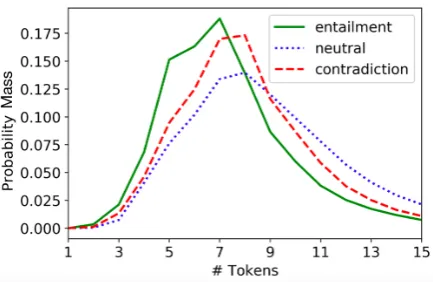
Figure 1: The probability mass function of the hy-pothesis length in SNLI, by class.
The high frequency ofcatprobably stems from the many dog images in the original dataset.
3.2 Sentence Length
We observe that the number of tokens in generated hypotheses is not distributed equally among the different inference classes. Figure 1 shows that, in SNLI, neutral hypotheses tend to be long, while entailed ones are generally shorter. The median length of a neutral hypothesis is 9, whereas 60% of entailments have 7 tokens or less. We also observe that half of hypotheses with at least 12 tokens are neutral, while a similar portion of hypotheses of length 5 and under are entailments, making hy-pothesis length an effective feature. Length is also a discriminatory feature in MultiNLI, but is less significant, possibly due to the introduction of di-verse genres.
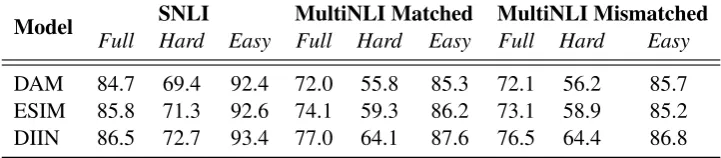
Model Full Hard Easy Full HardSNLI MultiNLI Matched MultiNLI MismatchedEasy Full Hard Easy
[image:4.595.118.479.66.145.2]DAM 84.7 69.4 92.4 72.0 55.8 85.3 72.1 56.2 85.7 ESIM 85.8 71.3 92.6 74.1 59.3 86.2 73.1 58.9 85.2 DIIN 86.5 72.7 93.4 77.0 64.1 87.6 76.5 64.4 86.8
Table 5: Performance of high-performing NLI models on the full,Hard, andEasyNLI test sets.
4 Re-evaluating NLI Models
In Section2, we showed that a model with no ac-cess to the premise can correctly classify many ex-amples in both SNLI and MultiNLI, performing well above the most-frequent-class baseline. This raises an important question about state-of-the-art NLI models: to what extent are they “gaming” the task by learning to detect annotation artifacts?
To answer this question, we partition each NLI test set into two subsets: examples that the premise-oblivious model classified accurately are labeledEasy, and those it could not areHard.
We then train an NLI model on the original training sets (from either SNLI or MultiNLI),4and
evaluate on the full test set, the Hard test set, and the Easy test set. We ran this experiment on three high-performing NLI models: the De-composable Attention Model (DAM;Parikh et al.,
2016),5the Enhanced Sequential Inference Model
(ESIM; Chen et al., 2017),6 and the Densely
In-teractive Inference Network (DIIN; Gong et al.,
2018).7 All models were retrained out of the box.
Table 5 shows the performance of each model on the different splits. While the models correctly classify some Hard examples, the bulk of their success is attributed to the Easyexamples. This result implies that the ability of NLI models to rec-ognize textual entailment is lower than previously perceived, and that such models rely heavily on annotation artifacts in the hypothesis to make their predictions.
A natural question to ask is whether it is pos-sible to select a set of NLI training and test sam-ples which do not contain easy-to-exploit artifacts. One solution might be to filterEasyexamples from the training set, retaining only Hard examples. However, initial experiments suggest that it might
4The MultiNLI models were trained on MultiNLI data
alone (as opposed to a blend of MultiNLI and SNLI data).
5github.com/allenai/allennlp 6github.com/nyu-mll/multiNLI 7goo.gl/kCeZXm
not be as straightforward to eliminate annotation artifacts once the dataset has been collected.
First, after removing the Easyexamples,Hard
examples might not necessarily be artifact-free. For instance, removing all contradicting samples containing the word “no” (a strong indicator for contradiction, see Section 3), leaves the Hard
dataset with this word mostly appearing in the neu-tral and entailing classes, thus creating a new ar-tifact. Secondly, Easy examples contain impor-tant inference phenomena (e.g. the word “animal” is indeed a hypernym of “dog”), and removing these examples may hinder the model from learn-ing such phenomena. Importantly, artifacts do not render any particular exampleincorrect; they are a problem with the sample distribution, which is skewed toward certain kinds of entailment, con-tradiction, and neutral hypotheses. Therefore, a better solution might not eliminate the artifacts altogether, but rather balance them across labels. Future strategies for reducing annotation artifacts might involve experimenting with the prompts or training given to crowd workers, e.g., to encourage a wide range of strategies, or incorporating base-line or adversarial systems that flag examples that appear to use over-represented heuristics. We de-fer research on hard-to-exploit NLI datasets to fu-ture work.
5 Discussion
We reflect on our results and relate them to other work that also analyzes annotation artifacts in NLP datasets, drawing three main conclusions.
Many datasets contain annotation artifacts.
apply-ing automatic tools for annotation. Levy and Da-gan(2016) showed that a relation inference bench-mark (Zeichner et al., 2012) is severely biased towards distributional methods, since it was cre-ated using DIRT (Lin and Pantel,2001).Schwartz et al. (2017) and Cai et al. (2017) showed that certain biases are prevalent in the ROC stories cloze task (Mostafazadeh et al., 2016), which al-low models trained on the endings alone, and not the story prefix, to yield state-of-the-art results.
Rudinger et al. (2017) revealed that elicited hy-potheses in SNLI contain evidence of various gen-der, racial, religious, and aged-based stereotypes. In parallel to this work, Poliak et al. (2018) un-covered similar annotation biases across multiple NLI datasets. Indeed, annotation artifacts are not unique to the NLI datasets, and the danger of such biases should be carefully considered when anno-tating new datasets.
Supervised models leverage annotation arti-facts. Levy et al. (2015) demonstrated that su-pervised lexical inference models rely heavily on artifacts in the datasets, particularly the tendency of some words to serve as prototypical hypernyms.
Agrawal et al. (2016); Jabri et al.(2016); Goyal et al.(2017) all showed that state-of-the-art visual question answering (Antol et al., 2015) systems leverage annotation biases in the dataset. Cirik et al.(2018) find that complex models for referring expression recognition achieve high performance without any text input. In parallel to this work,
Dasgupta et al. (2018) found that the InferSent model (Conneau et al.,2017) relies on word-level heuristics to achieve state-of-the-art performance on SNLI. These findings coincide with ours, and strongly suggest that supervised models will ex-ploit shortcuts in the data for gaming the bench-mark, if such exist.
Annotation artifacts inflate model perfor-mance. This is a corollary of the above, since large portions of the test set can be solved by rely-ing on annotation artifacts alone. A similar findrely-ing by Jia and Liang (2017) showed that the perfor-mance of top question-answering models trained on SQuAD (Rajpurkar et al., 2016) drops drasti-cally by introducing simple adversarial sentences in the evidence. We release the Hard SNLI and MultiNLI test sets,8and encourage the community
8SNLI: goo.gl/5rQKb5, MultiNLI matched: goo. gl/abdSbi, MultiNLI mismatched:goo.gl/Cu9Gp6
to use them for evaluating NLI models (in addition to the original benchmarks). We also encourage the development of additional challenging bench-marks that expose the true performance levels of state-of-the-art NLI models.
Acknowledgments
This research was supported in part by the DARPA CwC program through ARO (W911NF-15-1-0543) and a hardware gift from NVIDIA Corporation. SB acknowledges gift support from Google and Tencent Holdings and support from Samsung Research.
References
Aishwarya Agrawal, Dhruv Batra, and Devi Parikh. 2016. Analyzing the behavior of visual question answering models. InProc. of EMNLP. https: //aclweb.org/anthology/D16-1203. Stanislaw Antol, Aishwarya Agrawal, Jiasen Lu,
Mar-garet Mitchell, Dhruv Batra, C Lawrence Zitnick, and Devi Parikh. 2015. VQA: Visual question an-swering. In Proc. of ICCV. https://arxiv. org/abs/1506.00278.
Samuel R. Bowman, Gabor Angeli, Christopher Potts, and Christopher D. Manning. 2015. A large anno-tated corpus for learning natural language inference. In Proc. of EMNLP. https://doi.org/10. 18653/v1/D15-1075.
Zheng Cai, Lifu Tu, and Kevin Gimpel. 2017. Pay at-tention to the ending:strong neural baselines for the ROC Story Cloze task. InProc. of ACL. https: //doi.org/10.18653/v1/P17-2097. Danqi Chen, Jason Bolton, and Christopher D.
Man-ning. 2016. A thorough examination of the CNN/Daily Mail reading comprehension task. In Proc. of ACL.https://doi.org/10.18653/ v1/P16-1223.
Qian Chen, Xiaodan Zhu, Zhen-Hua Ling, and Di-ana Inkpen. 2017. Natural language inference with external knowledge. arXiv:1711.04289. https: //arxiv.org/abs/1711.04289.
Volkan Cirik, Louis-Philippe Morency, and Taylor Berg-Kirkpatrick. 2018. Visual referring expression recognition: What do our systems actually learn? In Proc. of NAACL.
Ido Dagan, Oren Glickman, and Bernardo Magnini. 2006. The PASCAL recognising textual en-tailment challenge. Machine Learning Chal-lengespages 177–190.https://doi.org/10. 1007/11736790_9.
Ishita Dasgupta, Demi Guo, Andreas Stuhlm¨uller, Samuel J Gershman, and Noah D Goodman. 2018. Evaluating compositionality in sentence em-beddings. https://arxiv.org/abs/1802. 04302.
Yichen Gong, Heng Luo, and Jian Zhang. 2018. Nat-ural language inference over interaction space. In Proc. of ICLR. https://arxiv.org/abs/ 1709.04348.
Yash Goyal, Tejas Khot, Douglas Summers-Stay, Dhruv Batra, and Devi Parikh. 2017. Making the V in VQA matter: Elevating the role of image un-derstanding in visual question answering. InProc. of CVPR. https://arxiv.org/abs/1612. 00837.
Karl Moritz Hermann, Tom´aˇs Koˇcisk´y, Edward Grefenstette, Lasse Espeholt, Will Kay, Mustafa Suleyman, and Phil Blunsom. 2015. Teaching machines to read and comprehend. In Proc. of NIPS. http://dl.acm.org/citation. cfm?id=2969239.2969428.
Allan Jabri, Armand Joulin, and Laurens van der Maaten. 2016. Revisiting visual question answer-ing baselines. InProc. of ECCV. https://doi. org/10.1007/978-3-319-46484-8_44.
Robin Jia and Percy Liang. 2017. Adversarial exam-ples for evaluating reading comprehension systems. In Proc. of EMNLP. https://www.aclweb. org/anthology/D17-1215.
Armand Joulin, Edouard Grave, Piotr Bojanowski, and Tomas Mikolov. 2017. Bag of tricks for efficient text classification. InProc. of EACL. https://doi. org/10.18653/v1/E17-2068.
Alice Lai and Julia Hockenmaier. 2014. Illinois-LH: A denotational and distributional approach to seman-tics. InProc. of SemEval. https://doi.org/ 10.3115/v1/S14-2055.
Omer Levy and Ido Dagan. 2016. Annotating rela-tion inference in context via quesrela-tion answering. In Proc. of ACL.https://doi.org/10.18653/ v1/P16-2041.
Omer Levy, Steffen Remus, Chris Biemann, and Ido Dagan. 2015. Do supervised distributional methods really learn lexical inference relations? InProc. of NAACL. https://doi.org/10.3115/v1/ N15-1098.
Dekang Lin and Patrick Pantel. 2001. Discovery of inference rules for question-answering. Natural Language Engineering7(4):343–360. https:// doi.org/10.1017/S1351324901002765.
Marco Marelli, Stefano Menini, Marco Baroni, Luisa Bentivogli, Raffaella Bernardi, and Roberto Zam-parelli. 2014. A SICK cure for the evaluation of compositional distributional semantic models. In Proc. of LREC. pages 216–223. https://doi. org/10.3115/v1/S14-2001.
Nasrin Mostafazadeh, Nathanael Chambers, Xiaodong He, Devi Parikh, Dhruv Batra, Lucy Vanderwende, Pushmeet Kohli, and James Allen. 2016. A corpus and Cloze evaluation for deeper understanding of commonsense stories. InProc. of NAACL. https: //doi.org/10.18653/v1/N16-1098.
Ankur Parikh, Oscar T¨ackstr¨om, Dipanjan Das, and Jakob Uszkoreit. 2016. A decomposable attention model for natural language inference. InProc. of EMNLP. https://doi.org/10.18653/v1/ D16-1244.
Adam Poliak, Jason Naradowsky, Aparajita Haldar, Rachel Rudinger, and Benjamin Van Durme. 2018. Hypothesis only baselines for natural language in-ference. InProc of *SEM.
Pranav Rajpurkar, Jian Zhang, Konstantin Lopyrev, and Percy Liang. 2016. SQuAD: 100,000+ questions for machine comprehension of text. In Proc. of EMNLP. https://doi.org/10.18653/v1/ D16-1264.
Rachel Rudinger, Chandler May, and Benjamin Van Durme. 2017. Social bias in elicited natural lan-guage inferences. InProc. of EthNLP. http:// www.aclweb.org/anthology/W17-1609.
Roy Schwartz, Maarten Sap, Ioannis Konstas, Li Zilles, Yejin Choi, and Noah A. Smith. 2017. The effect of different writing tasks on linguistic style: A case study of the ROC Story Cloze task. In Proc. of CoNLL. https://doi.org/10.18653/v1/ K17-1004.
Adina Williams, Nikita Nangia, and Samuel R. Bow-man. 2018. A broad-coverage challenge corpus for sentence understanding through inference. InProc. of NAACL.