Visualizing Deep-Syntactic Parser Output
Juan Soler-Company1 Miguel Ballesteros1 Bernd Bohnet2 Simon Mille1 Leo Wanner1,3
1Natural Language Processing Group, Pompeu Fabra University, Barcelona, Spain
2Google Inc.
3Catalan Institute for Research and Advanced Studies (ICREA)
1,3{name.lastname}@upf.edu 2[email protected]
Abstract
“Deep-syntactic” dependency structures bridge the gap between the surface-syntactic structures as produced by state-of-the-art dependency parsers and semantic logical forms in that they abstract away from surface-syntactic idiosyncrasies, but still keep the linguistic structure of a sentence. They have thus a great potential for such downstream applications as machine translation and sum-marization. In this demo paper, we propose an online version of a deep-syntactic parser that outputs deep-syntactic structures from plain sentences and visualizes them using the Brat tool. Along with the deep-syntactic structures, the user can also inspect the visual presen-tation of the surface-syntactic structures that serve as input to the deep-syntactic parser and that are produced by the joint tagger and syntactic transition-based parser ran in the pipeline before deep-syntactic parsing takes place.
1 Introduction
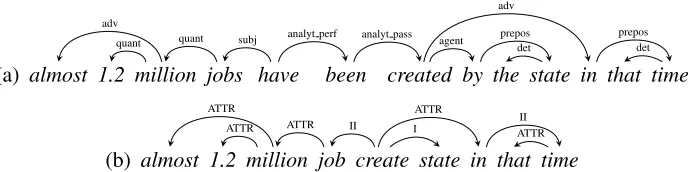
“Deep-syntactic” dependency structures bridge the gap between surface-syntactic structures as pro-duced by state-of-the-art dependency parsers and se-mantic logical forms in that they abstract away from surface-syntactic idiosyncrasies, but still keep the linguistic structure of a sentence. More precisely, a deep-syntactic structure (DSyntS) is a dependency tree that captures the argumentative, attributive and coordinative relations between full (i.e., meaning-ful) words of a sentence. For illustration, Figure 1 shows a surface-syntactic structure (above) and deep-syntactic structure (below) for the sentence:
almost 1.2 million jobs have been created by the state in that time.
DSyntSs have a great potential for such down-stream applications as deep machine translation,
summarization or information extraction. In deep machine translation as discussed, e.g., by Jones et al. (2012), DSyntSs simplify the alignment between the source and target language structures consider-ably. In extractive summarization, sentence fusion (Filippova and Strube, 2008) becomes much more straightforward at the level of DSyntSs. A stochas-tic sentence realizer that takes as input DSyntSs can then be used to generate surface sentences (Balles-teros et al., 2015). In information extraction (Attardi and Simi, 2014) the procedures for the distillation of the information to fill the slots of the corresponding patterns are also simpler at the DSyntS level.
However, it is only recently that deep-syntactic parsing has been introduced as a new parsing paradigm; see, e.g., (Ballesteros et al., 2014).1 No
visualization interfaces are available as yet to con-trol the output of deep-syntactic parsers. In this pa-per, we propose such a visualization interface. The interface can be used for both a pipeline consisting of a syntactic parser and a deep parser and a joint syntactic+deep parser. In the first configuration, it facilitates the visualization of the output of the syn-tactic parser and of the output of the deep parser. In the second configuration, it visualizes directly the output of the joint parser.
In what follows, we present its use for the first configuration applied to English. As surface-syntactic parser, we use Bohnet and Nivre (2012)’s joint tagger+lemmatizer+parser. As deep parser, we use Ballesteros et al. (2014)’s implementation. Both have been trained on the dependency Penn Tree-bank (Johansson and Nugues, 2007), which has been extended by the DSyntS-annotation. The interface can be inspected online; cf. http://dparse. 1The source code of Ballesteros et al.’s deep parser
and a short manual on how to use it can be down-loaded from https://github.com/talnsoftware/ deepsyntacticparsing/wiki.
(a) almost 1.2 million jobs have been created by the state in that time
adv
quant quant subj analyt perf analyt pass agent adv
prepos det
prepos det
(b) almost 1.2 million job create state in that time
ATTR
ATTR ATTR II I
ATTR II
[image:2.612.135.482.63.149.2]ATTR
Figure 1: Sample equivalent (a) SSynt- and (b) DSynt-structures. A SSyntS contains all tokens of the sentence, while in the corresponding DSyntS the grammatical tokens that are void of lexical meaning are omitted.
multisensor.taln.upf.edu/main. It ac-cepts as input an English sentence and delivers as output the surface- and deep-syntactic structures of this sentence.
Section 2 shows how the online model of the deep parser is trained and displays its performance for the English model. Section 3 describes the visualization interface and its use online. In Section 4, a number of other existing visualizers of the output of depen-dency parsers are briefly listed. Section 5, finally, concludes and makes some suggestions for future work.
2 Deep-Syntactic Parser
As already mentioned above, we use the joint PoS-tagger+lemmatizer+parser of Bohnet and Nivre (2012)2 as surface parser, setting up a pipeline
with the deep-syntactic parser of Ballesteros et al. (2014).3The output of the first serves as input to the
latter.
The online versions of the joint PoS-tagger+lemmatizer+parser and the deep-syntactic parser have been trained on the dependency Penn Treebank (Johansson and Nugues, 2007) in CoNLL09 format. To have an English training dataset for the deep-syntactic parser, we derived DSyntSs from the syntactic structures of the de-pendency Penn Treebank, extending thus the Penn Treebank by a new layer of annotation, as described in Section 2.1. The performance figures obtained using this dataset are shown in Section 2.2.
2The joint PoS-tagger+Lemmatizer+parser is available for
downloading at https://code.google.com/p/mate-tools/.
3The deep-syntactic parser is availabe for download at
https://code.google.com/p/deepsyntacticparsing/.
2.1 Training Dataset for the Deep-Syntactic Parser
The English deep-syntactic dataset has been ob-tained using a rule-based graph transducer that con-verts the syntactic annotation of the dependency Penn Treebank into a DSyntS annotation in the CoNLL09 format. The conversion removes definite and indefinite determiners, auxiliaries, THAT com-plementizers, TO infinitive markers, and all func-tional (or lexically-bound) prepositions which we were able to recover in PropBank and NomBank. In these two resources, 11,781 disambiguated pred-icates are described and their semantic roles are listed. We use two fields of their XML files to gather prepositions: the last word of the field “descr” in “roles”, and the first word of the field of the corre-sponding role in “example”. In this way, we retrieve, for instance, for the lexical unit beg.01 the prepo-sition from for the second semantic role (as inbeg from someone), and the prepositionforfor the third role (as inbeg someone for something). The corre-spondence between prepositions and semantic roles is also used for the mapping of dependency relations (Mille and Wanner, 2015).
depen-POS LEMMA LAS UAS English 98.50 99.46 89.70 92.21
Table 1: Performance of Bohnet and Nivre’s joint PoS-tagger+dependency parser trained on the PTB Treebank for English.
Hypernode Detection (English)
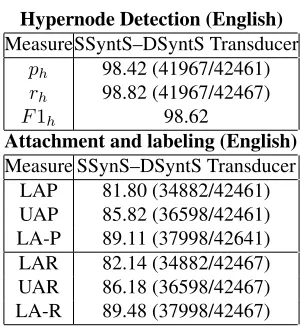
MeasureSSyntS–DSyntS Transducer ph 98.42 (41967/42461)
rh 98.82 (41967/42467)
F1h 98.62
Attachment and labeling (English)
Measure SSynS–DSyntS Transducer LAP 81.80 (34882/42461) UAP 85.82 (36598/42461) LA-P 89.11 (37998/42641) LAR 82.14 (34882/42467) UAR 86.18 (36598/42467) LA-R 89.48 (37998/42467)
Table 2: Performance of the Ballesteros et al. deep-syntactic parser trained on the adapted version of the PTB Treebank for English.
dent of plan with the surface dependency NMOD.
NMOD is by default mapped to the deep relation
ATTR, but in the dictionary entry ofplanit is stated that a dependent introduced by to is mapped toII, such that in the case ofplan, the default will be over-written in thatNMODwill be mapped toII.
2.2 Parser Results
Our models offer state-of-the-art performance for part-of-speech tagging, lemmatization, syntactic de-pendency parsing and deep-syntactic parsing.4
Ta-bles 15and 26show the results of both parsers.
4This is the first attempt to build English deep-syntactic
structures; Ballesteros et al. (2014) report results for Spanish only.
5‘POS’ stands for part-of-speech accuracy, ‘LEMMA’ for
lemma accuracy, ‘LAS’ for labeled attachment score, and ‘UAS’ for unlabeled attachment score
6‘ph’ stands for hypernode detection precision, ‘rh’ for
hy-pernode detection recall, ‘F1h’ for hypernode detection F1 measure, ‘LAP’ for labeled attachment precision, ‘UAP’ for un-labeled attachment precision, ‘LA-P’ for label accuracy preci-sion, ‘LAR’ for labeled attachment recall, ‘UAR’ for unlabeled attachment recall, and ‘LA-R’ for label accuracy recall.
3 Tree Visualization
Our visualization interface is built with a Java HTTPServer, which is bound to an IP address and port number that listens to incoming connections from users. The HTTPServer Java class connects with both the joint tagger+lemmatizer+parser and the deep-syntactic parser and provides the output of plain text input sentences in real time. To ensure real time performance, a model of both parsers is already loaded, and the interface waits for new input given by the users.
The main page (see http://dparse. multisensor.taln.upf.edu/main) lets the user introduce a text and select what kind of parsing she wants to see in the output, the surface-syntactic, deep-syntactic or both at the same time. Depending on the choice of the user, after parsing the CoNLL outputs (surface- and/or deep-syntactic) are shown. If desired, they can be also downloaded. A click on the corresponding link takes the user to the graphic representation of the parse tree.
The visualization of the output is performed by the annotation tool Brat (Stenetorp et al., 2012). Brat takes an annotation file, which is produced by trans-forming the CoNLL files that the parsers output into Brat’s native format, and generates the graphical in-terface for the dependency trees.
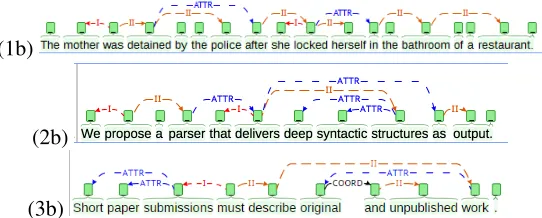
Figure 2 shows three sample surface syntactic structures in Brat. In Figure 3, their equivalent deep-syntactic structures are displayed. As already Fig-ure 1, the figFig-ures illustrate the difference of both types of structures with respect to the abstraction of linguistic phenomena. The DSyntSs are clearly much closer to semantics. As a matter of fact, they are equivalent to PropBank structures (Palmer et al., 2005). However, this does not mean that they must per se be “simpler” than their corresponding surface-syntactic structures—compare, for instance, the structures (3a) and (3b) in Figures 2 and 3, where both SSyntS and DSyntS contain the same number of nodes, i.e., are isomorphic.
(1a)
(2a)
[image:4.612.160.452.62.182.2](3a)
Figure 2: Visualization of surface syntactic structures with Brat
(1b)
(2b)
(3b)
Figure 3: Visualization of deep-syntactic structures with Brat
4 Related Work
Visualization interfaces normally offer a universal and simple way to access the output of NLP tools, among them parsers. This leads to better compre-hension of their outputs and a better usability for downstream applications. Therefore, it is not sur-prising that visualization interfaces have been a rel-evant topic during the last years in the NLP com-munity; see, e.g., (Collins et al., 2008; Collins et al., 2009; Feng and Lapata, 2010). In the pars-ing area, tools such as MaltEval (Nilsson and Nivre, 2008), the Mate Tools (Bohnet and Wanner, 2010), XLDD (Culy et al., 2011), TreeExplorer (Thiele et al., 2013), ViZPar (Ortiz et al., 2014), MaltDiver (Ballesteros and Carlini, 2013), or XLike Services (Carreras et al., 2014) have been proposed for the vi-sualization of parse trees and their subsequent eval-uation. The interface described in this paper serves a similar purpose. To the best of our knowledge, it is the first interface that uses the flexible off-the-shelf tool Brat and that serves for the visualization of deep-syntactic structures.
5 Conclusions and Future Work
We have presented an operational interface for the visualization of the output of a deep-syntactic parser and of surface-syntactic structures that serve it as in-put. The interface is flexible in that it allows for the display of any additional structural information pro-vided by an extended parsing pipeline. For instance, if the obtained deep-syntactic structure is projected onto a frame-like structure (Chen et al., 2010) with semantic roles as arc labels, this frame structure can be displayed as well. We are currently working on such an extension. Furthermore, we aim to expand our visualization interface to facilitate active explo-ration of linguistic structures with Brat and thus add to the static display of structures the dimension of
Visual Analytics(Keim et al., 2008).
Acknowledgments
[image:4.612.171.442.225.334.2]References
G. Attardi and M. Simi. 2014. Dependency parsing tech-niques for information extraction. InProceedings of Evalita 2014.
M. Ballesteros and R. Carlini. 2013. Maltdiver: A transition-based parser visualizer. InDemonstrations of the Sixth International Joint Conference on Natural Language Processing, page 25. IJCNLP.
M. Ballesteros, B. Bohnet, S. Mille, and L. Wanner. 2014. Deep-syntactic parsing. InProceedings of the 25th International Conference on Computational Lin-guistics (COLING).
M. Ballesteros, B. Bohnet, S. Mille, and L. Wanner. 2015. Data-driven sentence generation with non-isomorphic trees. In Proceedings of the 2015 Con-ference of the North American Chapter of the Asso-ciation for Computational Linguistics – Human Lan-guage Technologies (NAACL HLT 2015).
B. Bohnet and J. Nivre. 2012. A transition-based sys-tem for joint part-of-speech tagging and labeled non-projective dependency parsing. InEMNLP-CoNLL. B. Bohnet and L. Wanner. 2010. Open Source Graph
Transducer Interpreter and Grammar Development Environment. In Proceedings of the International Conference on Linguistic Resources and Evaluation (LREC).
X. Carreras, L. Padr´o, L. Zhang, Z. Rettinger, A.and Li, E. Garcıa-Cuesta, Z. Agic, B. Bekavec, B. Fortuna, and T. ˇStajner. 2014. Xlike project language analysis services. Proceedings of the Demonstrations Session at EACL, pages 9–12.
D. Chen, N. Schneider, D. Das, and N.A. Smith. 2010. Semafor: Frame argument resolution with log-linear models. InProceedings of the 5th international work-shop on semantic evaluation, pages 264–267. Associ-ation for ComputAssoci-ational Linguistics.
C. Collins, G. Penn, and S. Carpendale. 2008. Inter-active visualization for computational linguistics. In Proceedings of the 46th Annual Meeting of the Asso-ciation for Computational Linguistics on Human Lan-guage Technologies, Stroudsburg, PA, USA. Associa-tion for ComputaAssocia-tional Linguistics.
C. Collins, S. Carpendale, and G. Penn. 2009. DocuBurst: Visualizing Document Content Us-ing Language Structure. In Proceedings of the Eurographics/IEEE-VGTC Symposium on Visualiza-tion (EuroVis ’09), pages 1039–1046. Eurographics Association.
C. Culy, V. Lyding, and H. Dittmann. 2011. xLDD: Extended Linguistic Dependency Diagrams. In Pro-ceedings of the 2011 15th International Conference on Information Visualisation, IV ’11, pages 164–169, Washington, DC, USA. IEEE Computer Society.
Y. Feng and M. Lapata. 2010. Visual Information in Semantic Representation. In Proceedings of the 2010 Conference of the North American Chapter of the Association for Computational Linguistics – Human Language Technologies (NAACL HLT 2010), pages 91–99, Stroudsburg, PA, USA. Association for Com-putational Linguistics.
K. Filippova and M. Strube. 2008. Sentence fusion via dependency graph compression. In Proceedings of the International Conference on Empirical Methods in Natural Language Processing (EMNLP).
R. Johansson and P. Nugues. 2007. Extended constituent-to-dependency conversion for English. In Proceedings of the 16th Nordic Conference of Com-putational Linguistics (NODALIDA), pages 105–112, Tartu, Estonia, May 25-26.
B. Jones, J. Andreas, D. Bauer, K.-M. Hermann, and K. Knight. 2012. Semantics-based machine transla-tion with hyperedge replacement grammars. In Pro-ceedings of the International Conference on Computa-tional Linguistics (COLING).
D.A. Keim, F. Mansmann, J. Schneidewind, J. Thomas, and H. Ziegler. 2008. Visual Analytics: Scope and Challenges. In S. Simoff, editor,Visual Data Mining, LNCS 4404, pages 76–90. Springer Verlag, Berlin. S. Mille and L. Wanner. 2015. Towards large-coverage
detailed lexical resources for data-to-text generation. InProceedings of the First International Workshop on Data-to-Text Generation, Edinburgh, Scotland. Jens Nilsson and Joakim Nivre. 2008. Malteval: an
eval-uation and visualization tool for dependency parsing. In Proceedings of the Sixth International Conference on Language Resources and Evaluation (LREC’08), Marrakech, Morocco, may. European Language Re-sources Association (ELRA).
I. Ortiz, M. Ballesteros, and Y. Zhang. 2014. ViZPar: A GUI for ZPar with Manual Feature Selection. Proce-samiento del lenguaje natural, 53.
Martha Palmer, Paul Kingsbury, and Daniel Gildea. 2005. The Proposition Bank: An annotated corpus of semantic roles.Computational Linguistics, 31. P. Stenetorp, S. Pyysalo, G. Topi´c, T. Ohta, S. Ananiadou,
and J. Tsujii. 2012. BRAT: A Web-based Tool for NLP-Assisted Text Annotation. In13th Conference of the European Chapter of the Association for Compu-tational Linguistics, pages 102–107. Association for Computational Linguistics.