Reward-Balancing for Statistical Spoken Dialogue Systems using
Multi-objective Reinforcement Learning
Stefan Ultes, Paweł Budzianowski, I˜nigo Casanueva, Nikola Mrkˇsi´c,
Lina Rojas-Barahona, Pei-Hao Su, Tsung-Hsien Wen, Milica Gaˇsi´c and Steve Young Engineering Department, University of Cambridge, Cambridge, United Kingdom
{su259,pfb30,ic340,nm480,lmr46,phs26,thw28,mg436,sjy11}@cam.ac.uk
Abstract
Reinforcement learning is widely used for dialogue policy optimization where the re-ward function often consists of more than one component, e.g., the dialogue success and the dialogue length. In this work, we propose a structured method for finding a good balance between these components by searching for the optimal reward com-ponent weighting. To render this search feasible, we use multi-objective reinforce-ment learning to significantly reduce the number of training dialogues required. We apply our proposed method to find opti-mized component weights for six domains and compare them to a default baseline.
1 Introduction
In a Spoken Dialogue System (SDS), one of the main problems is to find appropriate system be-haviour for any given situation. This problem is often modelled using reinforcement learning (RL) where the task is to find an optimal policyπ(b) =
awhich maps the current belief state b—an esti-mate of the user goal— to the next system action a. To do this, RL algorithms seek to optimize an objective function, the rewardr, using sample di-alogues. In contrast to other RL tasks (like Al-phaGo (Silver et al., 2016)), the reward used in goal-oriented dialogue systems usually consists of more than one objective (e.g., task success and di-alogue length (Levin et al., 1998; Lemon et al., 2006;Young et al.,2013)).
However, balancing these rewards is rarely con-sidered and the goal of this paper is to propose a structured method for finding the optimal weights for a multiple objective reward function. Finding a good balance between multiple objectives is usu-ally domain-specific and not straight-forward. For
example, in the case of task success and dialogue length, if the reward for success is too high, the learning algorithm is insensitive to potentially ir-ritating actions such asrepeatprovided that the dialogue is ultimately successful. Conversely, if the reward for success is too small, the resulting policy may irritate users by offering inappropriate solutions before fully illiciting the user’s require-ments.
In this paper, we propose to find a suitable ward balance by searching through the space of re-ward component weights. Doing this with conven-tional RL techniques is infeasible as a policy must be trained for each candidate balance and this re-quires an enormous number of training dialogues. To alleviate this, we propose to use multi-objective RL (MORL) which is specifically designed for this task (among others (Roijers et al.,2013)). Then, only one policy needs to be trained which may be evaluated with several candidate balances. To the best of our knowledge, this is the first time MORL has been applied to dialogue policy optimization.
In contrast to previous work which explicitly selects component weights to maximize user sat-isfaction (Walker, 2000) explicitly, the proposed method enables optimisation of an implicit goal by allowing the interplay each reward component to be explored at low computational cost.
Several different algorithms have previously been used for MORL (Castelletti et al., 2013; Van Moffaert et al., 2015; Pirotta et al., 2015; Mossalam et al., 2016). In this work, we pro-pose a novel MORL algorithm based on Gaussian processes. This is described in Section 2 along with a brief introduction to MORL. In Section3, the proposed method for finding a good reward balance with MORL is presented. Section4 de-scribes the application and evaluation of the bal-ancing method on six different domains. Finally conclusions are drawn in Section5.
2 Multi-objective Reinforcement Learning with Gaussian Processes
In this Section we present our proposed exten-sion of the GPSARSA algorithm for MORL af-ter giving a brief introduction to single- and multi-objective RL and the GPSARSA algorithm itself.
Reinforcement Learning Reinforcement
learn-ing (RL) is used in a sequential decision-maklearn-ing process where a decision-model (the policy π) is trained based on sample data and a potentially de-layed objective signal (the rewardr) (Sutton and Barto,1998). Implementing the Markov assump-tion, the policy selects the next actiona∈Abased on the current system belief statebto optimise the accumulated future rewardRtat timet:
Rt= ∞ X
k=0
γkrt+k+1. (1)
Here, k denotes the number of future steps, γ a discount factor andrτ the reward at timeτ.
The Q-function models the expected accumu-lated future rewardRtwhen taking actionain
be-lief stateband then following policyπ: Qπ(b, a) =E
π[Rt|bt=b, at=a]. (2)
GPSARSA For most real-world problems,
find-ing the exact optimalQ-values is not feasible. In-stead,Engel et al. (2005) have proposed the GP-SARSA algorithm which uses Gaussian processes (GP) to approximate the Q-function. Gaˇsi´c and Young (2014) have shown that this works well when applied to the problem of spoken dialogue policy optimisation. GPSARSA is a Bayesian on-line learning algorithm which models the Q -function as a zero-mean GP which is fully defined by a mean and a kernel functionk:
Qπ(b, a)∼ GP(0, k(b, a),(b, a))), (3)
where the kernel models the correlation between data points. Based on sample data, the GP is trained to approximate Q such that the variance derived from the kernel represents the uncertainty of the approximation.
In dialogue management, the following kernel has been successfully used:
k((b, a),(b0, a0)) =δ(a, a0)·k
lin(b, b0). (4)
It consists of a linear kernel for the continuous be-lief representation band the δ-kernel for the dis-crete system actiona.
Multi-objective Reinforcement Learning In
multi-objective reinforcement learning (MORL), the objective function does not consist of only one but of many dimensions. Thus, the rewardrt
be-comes a vectorrt= (rt1, r2t, . . . , rmt ), wheremis
the number of objectives.
To define the contribution of each objective, a scalarization function f is introduced which uses weightswfor the different objectives to map the vector representation to a scalar value. The solu-tion to a MORL problem is a set of optimal poli-cies containing an optimal policy for any given weight configuration.
In MORL, theQ-function may either be mod-elled as a vector of Q-functions or directly as the expectation of the scalarized vector of
(R1
t. . . Rmt ):
Qπw(b) =E[f(Rt,w)|π, b, a]. (5)
In practice, the scalarization function is often modelled as a linear function (the weighted sum):
f(rt,w) = X
m
wmrmt . (6)
Multi-objective GPSARSA The proposed
multi-objective (MO) GPSARSA is based on Equation 5. By approximating the scalarized Q-function directly using a GP, the GPSARSA algorithm may be applied for MORL. The GP (and thus the Q-function) is extended by one parameter—the weight vectorw:Q(b, a,w).
Approximating theQ-function with a GP relies on the fact that the accumulated future rewardRt
(Eq.1) may be decomposed as
Rt=rt+1+γRt+1 . (7)
Accordingly, for using a GP to directly esti-mate the scalarized reward in MO-GPSARSA, the equation
f(Rt,w) =f(rt+1+γRt+1,w) !
=f(rt+1,w) +γf(Rt+1,w) (8)
must hold. This is true in case of using a linear scalarization functionf (Eq.6).
To alter the kernel accordingly, a linear kernel forwis added to the state kernel1resulting in
k((b, a,w),(b0, a0,w0))
=δ(a, a0)· klin(b, b0) +klin(w,w0) . (9) 1A similar type of kernel extension has been proposed
previously in a different context, e.g., (Casanueva et al.,
Algorithm1: Training of the MO-GPSARSA.
Input: dialogue success rewardrs, dialogue length
penaltyrl
1 foreachtraining dialoguedo
2 selectws, wlrandomly
3 execute dialogue and record(bt, at,w)inDfor
each turnt
// dialogue length penalty
4 r←wl· |D| ·rl
// dialogue success reward
5 ifdialogue successfulthen 6 r←r+wr·rs 7 update GP usingDandr 8 resetD
Since a linear scalarization function is applied, the correlations with other data points are also as-sumed to be linear.
To train a policy using multi-objective GP-SARSA, a new weight configuration is sampled randomly for each training dialogue. An example of the training process being applied to dialogue policy optimization with the two objectives task success and dialogue length is depicted in Algo-rithm1.
3 Reward Balancing using MORL
The main contribution of this paper is to provide a structured method for finding a good balance be-tween multiple rewards for learning dialogue poli-cies. For the two-objective problem of having a task success reward rs and a dialogue length
re-wardrl,r= (rs, rl), the scalarized reward is
r=f(r,w) =1T S·wsrs+T ·wsrl
=1T S·rsw+T·rwl , (10)
whereT is the number of turns and 1T S = 1iff
the dialogue is successful, zero otherwise.
To find a good reward balance, we adopt the fol-lowing procedure:
1. Set initial reward values rw
s and rwl along
with the initial weight configuration.
2. Apply MORL to train a policy for a given number of training dialogues and evaluate with different weight configurations.
3. Select an appropriate balance based on success-weight and length-weight curves to optimise the individual implicit goal.
The method may be refined by applying it re-cursively with different grid sizes. After selecting
a suitable weight configuration, a single-objective policy may be trained.
4 Experiments and Results
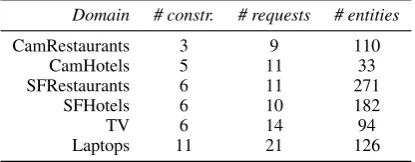
[image:3.595.307.515.236.317.2]The reward balancing method described in the pre-vious section is applied to six domains: finding TVs, laptops, restaurants or hotels (the latter two in Cambridge and San Francisco). The following table depicts the domain statistics with the number of search constraints, the number of informational items the user can request, and the number of data-base entities:
Domain # constr. # requests # entities
CamRestaurants 3 9 110
CamHotels 5 11 33
SFRestaurants 6 11 271
SFHotels 6 10 182
TV 6 14 94
Laptops 11 21 126
For consistency with previous work (Gaˇsi´c and Young,2014;Young et al.,2013;Su et al.,2016) the rewardsrw
s = 20andrwl =−1are used
repre-senting the weight configuration w = (0.5,0.5). This results inrs= 40andrl=−2.
For the evaluation, simulated dialogues were created using the statistical spoken dialogue toolkit PyDial (Ultes et al., 2017). It contains an agenda-based user simulator (Schatzmann and Young,2009) with an error model to simulate the semantic error rate (SER) encountered in real sys-tems due to the noisy speech channel.
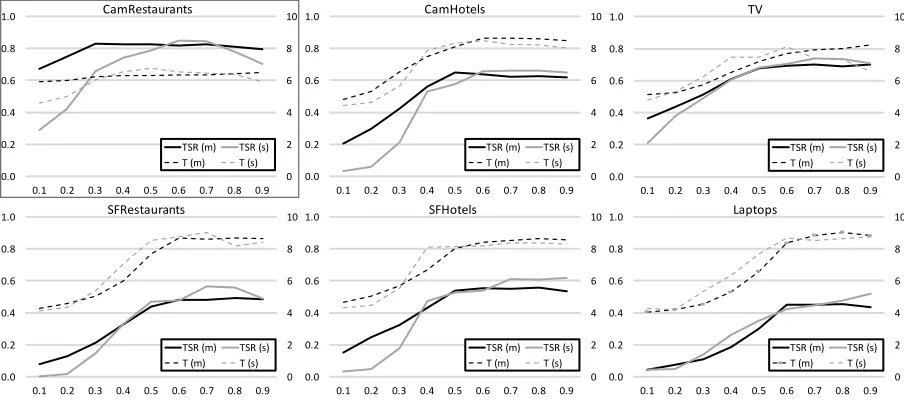
A policy has been trained for each domain using multi-objective GPSARSA with 3,000 dialogues and an SER of 15%. Each policy was evaluated with 300 dialogues for each weight configuration in{(0.1,0.9),(0.2,0.8), . . . ,(0.9,0.1)}. The re-sults in Figure 1 are the averages of five trained policies with different random seeds. All curves follow a similar pattern: at some point, the success curve reaches a plateau where the performance does not increase any further with higherws.
The following weights were selected: Cam-Restaurants ws = 0.4; CamHotels ws = 0.6;
SFRestaurantsws = 0.6; SFHotelsws = 0.7; TV
ws= 0.6; Laptopsws = 0.7. These weights were
selected by hand according to the success rate2as
well as the average dialogue length.
The selected weights were scaled to keep the
2Taking into account the overall performance and the
0 2 4 6 8 10
0.0 0.2 0.4 0.6 0.8 1.0
0.1 0.2 0.3 0.4 0.5 0.6 0.7 0.8 0.9 CamRestaurants
TSR (m) TSR (s) T (m) T (s)
0 2 4 6 8 10
0.0 0.2 0.4 0.6 0.8 1.0
0.1 0.2 0.3 0.4 0.5 0.6 0.7 0.8 0.9
CamHotels
TSR (m) TSR (s) T (m) T (s)
0 2 4 6 8 10
0.0 0.2 0.4 0.6 0.8 1.0
0.1 0.2 0.3 0.4 0.5 0.6 0.7 0.8 0.9 TV
TSR (m) TSR (s) T (m) T (s)
0 2 4 6 8 10
0.0 0.2 0.4 0.6 0.8 1.0
0.1 0.2 0.3 0.4 0.5 0.6 0.7 0.8 0.9 SFRestaurants
TSR (m) TSR (s) T (m) T (s)
0 2 4 6 8 10
0.0 0.2 0.4 0.6 0.8 1.0
0.1 0.2 0.3 0.4 0.5 0.6 0.7 0.8 0.9
SFHotels
TSR (m) TSR (s) T (m) T (s)
0 2 4 6 8 10
0.0 0.2 0.4 0.6 0.8 1.0
0.1 0.2 0.3 0.4 0.5 0.6 0.7 0.8 0.9 Laptops
TSR (m) TSR (s) T (m) T (s)
Figure 1: The MORL success-weight and length-weight curves (m, task success rate (TSR) on left, number of turns T on right vertical axes; success weightsws on horizontal axes) after 3,000 training
dialogues. Each data point is the average over five policies with different seeds where each policy/weight configuration is evaluated with 300 dialogues. As a comparison, the same curves using single-objective RL (s, separate policies trained for each balance) have been createdafterselecting the weights.
rw
s TSR # Turns
base. opt. base. opt. CamRestaurants 14 88.8% 86.2% 6.4 6.3 CamHotels 30 75.1% 79.8% 8.1 8.2 SFRestaurants 47 62.4% 65.7% 8.5 9.1 SFHotels 30 66.7% 69.4% 8.0 8.0
TV 30 75.7% 80.5% 7.4 7.4
[image:4.595.72.524.63.263.2]Laptops 47 44.6% 54.6% 7.5 8.7
Table 1: Task success rates (TSRs) and number of turns after 4,000 training dialogues using a success reward of 20 (baseline) compared to the optimised success rewardrw
s. All TSR differences are
statis-tically significant (t-test,p <0.05).
turn penalty ww
l constant at−1. Using these
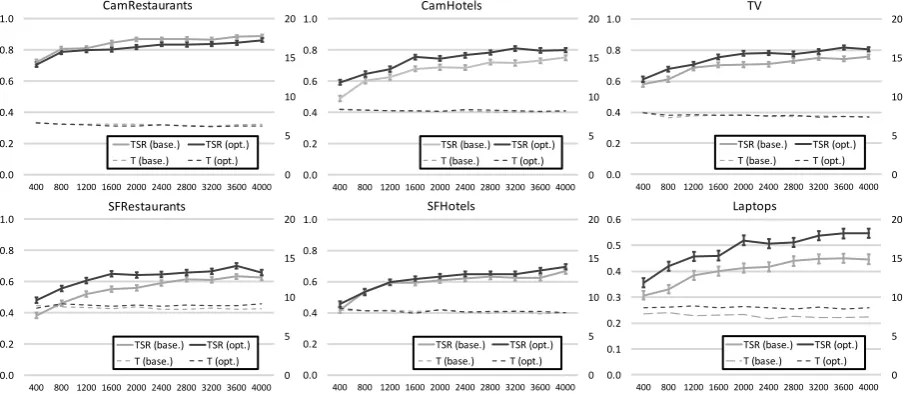
re-ward settings, each domain was evaluated with 4,000 dialogues in 10 batches. After each batch, the policies were evaluated with 300 dialogues. The final results shown in Table 1 (selection of learning curves in Figure 2) are compared to the baseline of w = (0.5,0.5)(i.e. standard unopti-mised reward component weight balance). Evi-dently, optimising the balance has a significant im-pact on the performance of the trained polices.
To analyse the performance of multi-objective GPSARSA, policies were trained and evaluated for each reward balance with single-objective (SO) GPSARSA (see Figure 1) after the weights had been selected. Each SO policy was trained with
1,000 dialogues and evaluated with 300 dialogues, all averaged over five runs. The success-weight curves for SORL clearly resemble the MORL curves for almost all domains except for Cam-Restaurants where it leads to an incorrect selection of weights. This may be attributed to the kernel used for multi-objective GPSARSA.
It is worth noting that for the presented full MORL analysis, 3,000 training dialogues were necessary for each domain to find a good balance. This is significantly less than the 9,000 dialogues needed for the SORL analysis and this difference would increase further for a finer grain search grid.
5 Conclusion
In this work, we have addressed the problem of finding a good balance between multiple rewards for learning dialogue policies. We have shown the relevance of the problem and demonstrated the usefulness of multi-objective reinforcement learn-ing to facilitate the search for a suitable balance. Using the proposed procedure, only one policy needs to be trained which can then be evaluated for an arbitrary number of reward balances thus drastically reducing the total amount of training dialogues needed.
ex-0 5 10 15 20
0.0 0.2 0.4 0.6 0.8 1.0
400 800 1200 1600 2000 2400 2800 3200 3600 4000 CamRestaurants
TSR (base.) TSR (opt.) T (base.) T (opt.)
0 5 10 15 20
0.0 0.2 0.4 0.6 0.8 1.0
400 800 1200 1600 2000 2400 2800 3200 3600 4000 CamHotels
TSR (base.) TSR (opt.) T (base.) T (opt.)
0 5 10 15 20
0.0 0.2 0.4 0.6 0.8 1.0
400 800 1200 1600 2000 2400 2800 3200 3600 4000 TV
TSR (base.) TSR (opt.) T (base.) T (opt.)
0 5 10 15 20
0.0 0.2 0.4 0.6 0.8 1.0
400 800 1200 1600 2000 2400 2800 3200 3600 4000 SFRestaurants
TSR (base.) TSR (opt.) T (base.) T (opt.)
0 5 10 15 20
0.0 0.2 0.4 0.6 0.8 1.0
400 800 1200 1600 2000 2400 2800 3200 3600 4000 SFHotels
TSR (base.) TSR (opt.) T (base.) T (opt.)
0 5 10 15 20
0.0 0.1 0.2 0.3 0.4 0.5 0.6
400 800 1200 1600 2000 2400 2800 3200 3600 4000
Laptops
[image:5.595.73.525.65.262.2]TSR (base.) TSR (opt.) T (base.) T (opt.)
Figure 2: The task success rates (TSR, left axes) and dialogue length in number of turns (T, right axes) for all six domains comparing the baseline (rw
s = 20,w= (0.5,0.5)) with the optimised balance. The
horizontal axes show the number of training dialogues. Each data point is the average over five policies with different seeds where each policy is evaluated with 300 dialogues.
periments show the successful application of our method: the optimal balance improved task suc-cess without unduly impacting on dialogue length in all domains except CamRestaurants, where it is clear that the weight selection criteria failed. In practice, this could have been easily trapped by applying a minimum weight to the success crite-ria. Furthermore, the domain-dependence of the reward balance has been confirmed.
For future work, the accuracy of the proposed multi-objective GPSARSA will be further im-proved with the ultimate goal of using the pro-posed method to directly learn a multi-objective policy through interaction with real users. To achieve this, alternative weight kernels will be ex-plored. The resulting multi-objective policy may then directly be applied (without the need of re-training a single-objective policy) and the weights may even be adjusted according to a specific situ-ation or user preferences.
Future work will also include an automatic method to find the optimal balance as well as in-vestigating the relationship between the optimal success reward value and the domain characteris-tics (similar toPapangelis et al.(2017)).
Acknowledgments
Tsung-Hsien Wen, Paweł Budzianowski and Ste-fan Ultes are supported by Toshiba Research Eu-rope Ltd, Cambridge Research Laboratory. This
research was partly funded by the EPSRC grant EP/M018946/1 Open Domain Statistical Spoken Dialogue Systems.
Data
All experiments were run in simulation. The cor-responding source code is included in the PyDial toolkit which can be found on www.pydial.org.
References
Inigo Casanueva, Thomas Hain, Heidi Christensen, Ri-card Marxer, and Phil Green. 2015. Knowledge transfer between speakers for personalised dialogue management. In16th Annual Meeting of the Special Interest Group on Discourse and Dialogue. page 12.
A Castelletti, F Pianesi, and M Restelli. 2013. A mul-tiobjective reinforcement learning approach to water resources systems operation: Pareto frontier approx-imation in a single run. Water Resources Research
49(6):3476–3486.
Yaakov Engel, Shie Mannor, and Ron Meir. 2005. Re-inforcement learning with gaussian processes. In
Proceedings of the 22nd international conference on Machine learning. ACM, pages 201–208.
Milica Gaˇsi´c and Steve J. Young. 2014. Gaussian processes for POMDP-based dialogue manager op-timization. IEEE/ACM Transactions on Audio, Speech, and Language Processing22(1):28–40. Oliver Lemon, Kallirroi Georgila, James Henderson,
exhibiting reinforcement learning of dialogue poli-cies: generic slot-filling in the talk in-car system. In
Proceedings of the Eleventh Conference of the Euro-pean Chapter of the Association for Computational Linguistics: Posters & Demonstrations. Association for Computational Linguistics, pages 119–122. Esther Levin, Roberto Pieraccini, and Wieland Eckert.
1998. Using markov decision process for learning dialogue strategies. InAcoustics, Speech and Signal Processing, 1998. Proceedings of the 1998 IEEE In-ternational Conference on. IEEE, volume 1, pages 201–204.
Hossam Mossalam, Yannis M. Assael, Diederik M Roijers, and Shimon Whiteson. 2016. Multi-objective deep reinforcement learning. CoRR
abs/1610.02707. http://arxiv.org/abs/1610.02707. Alexandros Papangelis, Stefan Ultes, and Yannis
Stylianou. 2017. Domain complexity and policy learning in task-oriented dialogue systems. In Pro-ceedings of the 8th International Workshop On Spo-ken Dialogue Systems (IWSDS).
Matteo Pirotta, Simone Parisi, and Marcello Restelli. 2015. Multi-objective reinforcement learning with continuous pareto frontier approximation. In Pro-ceedings of the Twenty-Ninth AAAI Conference on Artificial Intelligence. pages 2928–2934.
Diederik M Roijers, Peter Vamplew, Shimon White-son, and Richard Dazeley. 2013. A survey of multi-objective sequential decision-making. Journal of Artificial Intelligence Research (JAIR)48:67–113. Jost Schatzmann and Steve J. Young. 2009. The
hid-den agenda user simulation model. Audio, Speech, and Language Processing, IEEE Transactions on
17(4):733–747.
David Silver, Aja Huang, Chris J Maddison, Arthur Guez, Laurent Sifre, George Van Den Driessche, Ju-lian Schrittwieser, Ioannis Antonoglou, Veda Pan-neershelvam, Marc Lanctot, et al. 2016. Mastering the game of go with deep neural networks and tree search. Nature529(7587):484–489.
Pei-Hao Su, M. Gaˇsi´c, N. Mrkˇsi´c, L. Rojas-Barahona, Stefan Ultes, D. Vandyke, T. H. Wen, and S. Young. 2016. On-line active reward learning for policy op-timisation in spoken dialogue systems. In Proceed-ings of the 54th Annual Meeting of the Associa-tion for ComputaAssocia-tional Linguistics. Association for Computational Linguistics, pages 2431–2441. Richard S. Sutton and Andrew G. Barto. 1998.
Reinforcement Learning: An Introduction. MIT Press, Cambridge, MA, USA, 1st edition.
http://portal.acm.org/citation.cfm?id=551283. Stefan Ultes, Lina M. Rojas-Barahona, Pei-Hao Su,
David Vandyke, Dongho Kim, I˜nigo Casanueva, Paweł Budzianowski, Nikola Mrkˇsi´c, Tsung-Hsien Wen, Milica Gaˇsi´c, and Steve J. Young. 2017. Py-dial: A multi-domain statistical dialogue system
toolkit. In ACL Demo. Association of Computa-tional Linguistics.
Kristof Van Moffaert, Tim Brys, and Ann Now´e. 2015. Risk-sensitivity through multi-objective reinforce-ment learning. InEvolutionary Computation (CEC), 2015 IEEE Congress on. IEEE, pages 1746–1753. Marilyn Walker. 2000. An application of
reinforce-ment learning to dialogue strategy selection in a spo-ken dialogue system for email. Journal of Artificial Intelligence Research12:387–416.