The Thirty-Third AAAI Conference on Artificial Intelligence (AAAI-19)
Multi-Task Deep Reinforcement Learning with PopArt
Matteo Hessel
DeepMindHubert Soyer
DeepMindLasse Espeholt
DeepMindWojciech Czarnecki
DeepMindSimon Schmitt
DeepMindHado van Hasselt
DeepMindAbstract
The reinforcement learning (RL) community has made great strides in designing algorithms capable of exceeding human performance on specific tasks. These algorithms are mostly trained one task at the time, each new task requiring to train a brand new agent instance. This means the learning algo-rithm is general, but each solution is not; each agent can only solve the one task it was trained on. In this work, we study the problem of learning to master not one but multiple sequential-decision tasks at once. A general issue in multi-task learning is that a balance must be found between the needs of multiple tasks competing for the limited resources of a single learn-ing system. Many learnlearn-ing algorithms can get distracted by certain tasks in the set of tasks to solve. Such tasks appear more salient to the learning process, for instance because of the density or magnitude of the in-task rewards. This causes the algorithm to focus on those salient tasks at the expense of generality. We propose to automatically adapt the contribu-tion of each task to the agent’s updates, so that all tasks have a similar impact on the learning dynamics. This resulted in state of the art performance on learning to play all games in a set of 57 diverse Atari games. Excitingly, our method learned a single trained policy - with a single set of weights - that exceeds median human performance. To our knowledge, this was the first time a single agent surpassed human-level per-formance on this multi-task domain. The same approach also demonstrated state of the art performance on a set of 30 tasks in the 3D reinforcement learning platform DeepMind Lab.
Introduction
In recent years, the field of deep reinforcement learning (RL) has enjoyed many successes. Deep RL agents have been ap-plied to board games such as Go (Silver et al. 2016) and chess (Silver et al. 2017), continuous control tasks (Lillicrap et al. 2016; Duan et al. 2016), classic video-games such as Atari (Mnih et al. 2015; Hessel et al. 2018; Gruslys et al. 2018; Schulman et al. 2015; 2017; Bacon, Harb, and Precup 2017), and 3D first person environments (Mnih et al. 2016; Jaderberg et al. 2016). While the results are impressive, they were achieved on one task at the time, each new task requir-ing to train a brand new agent instance from scratch.
Multi-task and transfer learning remain important open problems in deep RL. There are at least four different strains
Copyright c2019, Association for the Advancement of Artificial Intelligence (www.aaai.org). All rights reserved.
of multi-task reinforcement learning that have been explored in the literature: off-policy learning of many predictions about the same stream of experience (Schmidhuber 1990; Sutton et al. 2011; Jaderberg et al. 2016), continual learn-ing in a sequence of tasks (Rlearn-ing 1994; Thrun 1996; 2012; Rusu et al. 2016), distillation of task-specific experts into a single shared model (Parisotto, Ba, and Salakhutdinov 2015; Rusu et al. 2015; Schmitt et al. 2018; Teh et al. 2017), and parallel learning of multiple tasks at once (Sharma and Ravindran 2017; Caruana 1998). We will focus on the latter. Parallel multi-task learning has recently achieved remark-able success in enabling a single system to learn a large number of diverse tasks. The Importance Weighted Actor-Learner Architecture, henceforth IMPALA (Espeholt et al. 2018), achieved a 59.7% median human normalised score across 57 Atari games, and a 49.4% mean human normalised score across 30 DeepMind Lab levels. These results are state of the art for multi-task RL, but they are far from the human-level performance demonstrated by deep RL agents on the same domains, when trained on each task individually.
Part of why multi-task learning is much harder than sin-gle task learning is that a balance must be found between the needs of multiple tasks, that compete for the limited resources of a single learning system (for instance, for its limited representation capacity). We observed that the naive transposition of common RL algorithms to the multi-task setting may not perform well in this respect. More specif-ically, the saliency of a task for the agent increases with the scale of thereturnsobserved in that task, and these may differ arbitrarily across tasks. This affects value-based algo-rithms such as Q-learning (Watkins 1989), as well as policy-based algorithms such as REINFORCE (Williams 1992).
Note that both the sparsity and the magnitude of rewards collected in an environment are inherentlynon-stationary, because the agent is learning to actively maximise the total amount of rewards it can collect. These non-stationary learn-ing dynamics make it impossible to normalise the learnlearn-ing updates a priori, even if we would be willing to pour signif-icant domain knowledge into the design of the algorithm.
To summarise, in IMPALA the magnitude of updates re-sulting from experience gathered in each environment de-pends on: 1) thescaleof rewards, 2) thesparsityof rewards, 3) thecompetenceof the agent. In this paper we use PopArt normalisation (van Hasselt et al. 2016) to derive an actor-critic update invariant to these factors, enabling large per-formance improvements in parallel multi-task agents. We demonstrated this on the Atari-57 benchmark, where a sin-gle agent achieved a median normalised score of 110% and on DmLab-30, where it achieved a mean score of 72.8%.
Background
Reinforcement learning (RL) is a framework for learning and decision-making under uncertainty (Sutton and Barto 2018). A learning system - theagent - must learn to inter-act with theenvironment it is embedded in, so as to max-imise a scalarrewardsignal. The RL problem is often for-malised as a Markov decision process (Bellman 1957): a tuple(S,A, p, γ), whereS,A are finite sets of statesand actions,pdenotes the dynamics, such thatp(r, s0 | s, a)is the probability of observing rewardrand states0when ex-ecuting actionain states, andγ ∈ [0,1]discounts future rewards. Thepolicymaps statess ∈ S to probability dis-tributions over actionsπ(A|S =s), thus specifying the be-haviour of the agent. ThereturnGt=Rt+1+γRt+2+. . .is theγ-discounted sum of rewards collected by an agent from stateStonward under policyπ. We defineaction valuesand
state values asqπ(s, a) = E
π[Gt | St = s, At = a]and
vπ(s) =Eπ[Gt| St=s], respectively. The agent’s
objec-tive is to find a policy to maximise such values.
In multi-task reinforcement learning, a single agent must learn to master N different environments T = {Di =
(Si,Ai, pi, γ)}Ni=1, each with its own distinct dynamics (Brunskill and Li 2013). Particularly interesting is the case in which the action space and transition dynamics are at least partially shared. For instance, the environments might follow the same physical rules, while the set of intercon-nected states and obtainable rewards differ. We may for-malise this as a single larger MDP, whose state space is S = {{(sj, i)}sj∈Si}
N
i=1. The task indeximay be latent, or may be exposed to the agent’s policy. In this paper, we use the task index at training time, for the value estimates used to compute the policy updates, but not at testing time: our algorithm will return a single general policy π(A|S) which is only function of the individual environment’s state S and not conditioned directly on task index i. This is more challenging than the standard multi-task learning setup, which typically allows conditioning the model on the task index even at evaluation (Romera-Paredes et al. 2013; Collobert and Weston 2008), because our agents will need to infer what task to solve purely from the stream of raw observations and/or early rewards in the episode.
Actor-critic
In our experiments, we use an actor-critic algorithm to learn a policy πη(A|S)and a value estimate vθ(s), which
are both outputs of a deep neural network. We update the agent’s policy by using REINFORCE-style stochastic gradi-ent(Gt−vθ(St))∇ηlogπ(At|St)(Williams 1992), where
vθ(St)is used as a baseline to reduce variance. In addition
we use a multi-step returnGv
t that bootstraps on the value
estimates after a limited number of transitions, both to re-duce variance further and to allow us to update the policy beforeGtfully resolves at the end of an episode. The value
functionvθ(S)is instead updated to minimise the squared
loss with respect to the (truncated and bootstrapped) return:
∆θ∝ −∇θ(Gvt−vθ(St))2= (Gvt−vθ(St))∇θvθ(St) (1)
∆η∝(Gπt −vθ(St))∇ηlog(πη(At|St)), (2)
where Gv
t and Gπt are stochastic estimates of vπ(St)and
qπ(S
t, At), respectively. Note how both updates depend
lin-early on the scale of returns, which, as previously argued, de-pend on scale/sparsity of rewards, and agent’s competence.
Efficient multi-task learning in simulation
We use the IMPALA agent architecture (Espeholt et al. 2018), proposed for reinforcement learning in simulated en-vironments. In IMPALA the agent is distributed across mul-tiple threads, processes or machines. Several actors run on CPU generating rollouts of experience, consisting of a fixed number of interactions (100 in our experiments) with their own copy of the environment, and then enqueue the roll-outs in a shared queue. Actors receive the latest copy of the network’s parameters from the learner before each rollout. A single GPU learner processes rollouts from all actors, in batches, and updates a deep network. The network is a deep convolutional ResNet (He et al. 2015), followed by a LSTM recurrent layer (Hochreiter and Schmidhuber 1997). Policy and values are all linear functions of the LSTM’s output.
Despite the large network used for estimating policyπη
and values vθ, the decoupled nature of the agent enables
to process data very efficiently: in the order of hundreds of thousands frames per second (Espeholt et al. 2018). The setup easily supports the multi-task setting by simply assign-ing different environments to each of the actors and then run-ning the single policyπ(S|A)on each of them. The data in the queue can also be easily labelled with the taskid, if use-ful at training time. Note that an efficient implementation of IMPALA is available open-source1, and that, while we use
this agent for our experiments, our approach can be applied to other data parallel multi-task agents (e.g. A3C).
Off-policy corrections
Because we use a distributed queue-based learning setup, the data consumed by the learning algorithm might be slightly off-policy, as the policy parameters change between acting and learning. We can use importance sampling corrections
ρt = π(At|St)/µ(At|St)to compensate for this (Precup,
1
Sutton, and Singh 2000). In particular, we can write then -step return asGt= Rt+1+γRt+2+. . .+γnv(St+n) =
v(St) +P
t+n−1
k=t γ
k−tδ
k,whereδt=Rt+1+γv(St+1)−
v(St), and then apply appropriate importance sampling
cor-rections to each error term (Sutton et al. 2014) to getGt=
v(St)+P
t+n−1
k=t γk−t(
Qk
i=tρi)δk.This is unbiased, but has
high variance. To reduce variance, we can further clip most of the importance-sampling ratios, e.g., asct= min(1, ρt).
This leads to thev-trace return (Espeholt et al. 2018)
Gvt−trace=v(St) +
t+n−1
X
k=t
γk−t
k
Y
i=t
ci
!
δk (3)
A very similar target was proposed for the ABQ(ζ) algo-rithm (Mahmood 2017), where the productρtλtwas
consid-ered and then the trace parameterλtwas chosen to be
adap-tive to lead to exactly the same behaviour thatct=ρtλt=
min(1, ρt). This shows that this form of clipping does not
impair the validity of the off-policy corrections, in the same sense that bootstrapping in general does not change the se-mantics of a return. The returns used by the value and policy updates defined in Equation 1 and 2 are then
Gvt =Gvt−trace and Gπt =Rt+1+γGvt+1−trace. (4)
This is the same algorithm as used by Espeholt et al. (2018) in the experiments on the IMPALA architecture.
Adaptive normalisation
In this section we use PopArt normalisation (van Hasselt et al. 2016), which was introduced for value-based RL, to de-rive a scale invariant algorithm for actor-critic agents. For simplicity, we first consider the single-task setting, then we extend it to the multi-task setting (the focus of this work).
Scale invariant updates
In order to normalise both baseline and policy gradient up-dates, we first parameterise the value estimatevµ,σ,θ(S)as
the linear transformation of a suitablynormalisedvalue pre-dictionnθ(S). We further assume that the normalised value
prediction is itself the output of a linear function, for in-stance the last fully connected layer of a deep neural net:
vµ,σ,θ(s) =σ·nθ(s) +µ=σ·(w>fθ\{w,b}(s) +b
| {z }
=nθ(s)
) +µ .
(5) As proposed by van Hasselt et al.,µandσcan be updated so as to track mean and standard deviation of the values. First and second moments of can be estimated online as
µt= (1−β)µt−1+βGvt, νt= (1−β)νt−1+β(Gvt)
2, (6) and then used to derive the estimated standard deviation as
σt=
p
νt−µ2t. Note that the fixeddecayrateβdetermines
the horizon used to compute the statistics. We can then use the normalised value estimatenθ(S)and the statisticsµand
σto normalise the actor-critic loss, both in its value and pol-icy component; this results in the scale-invariant updates:
∆θ∝
Gv
t −µ
σ −nθ(St)
∇θnθ(St), (7)
∆η∝
Gπ
t −µ
σ −nθ(St)
∇ηlogπη(At|St). (8)
If we optimise the new objective naively, we are at risk of making the problem harder: the normalised targets for val-ues are non-stationary, since they depend on statisticsµand
σ. The PopArt normalisation algorithm prevents this, by up-dating the last layer of the normalised value network to pre-serve unnormalised value estimatesvµ,σ,θ, under any change
in the statisticsµ→µ0andσ→σ0:
w0= σ
σ0w, b
0= σb+µ−µ0
σ0 . (9)
This extends PopArt’s scale-invariant updates to the actor-critic setting, and can help to make tuning hyperparameters easier, but it is not sufficient to tackle the challenging multi-task RL setting that we are interested in this paper. For this, a single pair of normalisation statistics is not sufficient.
Scale invariant updates for multi-task learning
LetDibe an environment in some finite setT ={Di}Ni=1, and let π(S|A)be a task-agnostic policy, that takes a state
Sfrom any of the environmentsDi, and maps it to a
proba-bility distribution onto the shared action spaceA. Consider now a multi-task value functionv(S)with N outputs, one for each task. We can use forvthe same parametrisation as in Equation 5, but with vectors of statisticsµ,σ∈RN, and
a vector-valued functionnθ(s) = (n1θ(s), . . . , n N
θ (s))
>
vµ,σ,θ(S) =σnθ(S)+µ=σ(Wfθ\{W,b}(S)+b)+µ
(10) whereWandbdenote the parameters of the last fully con-nected layer innθ(s). Given a rollout{Si,k, Ak, Ri,k}tk+=nt,
generated under task-agnostic policy πη(A|S)in
environ-mentDi, we can adapt the updates in Equation 7 and 8 to
provide scale invariant updates also in the multi-task setting:
∆θ∝ G
v,i
t −µi
σi
−niθ(St)
!
∇θniθ(St), (11)
∆η∝ G
π,i
t −µi
σi
−niθ(St)
!
∇ηlogπη(At|St), (12)
where the targetsG·t,i use the value estimates for environ-ment Di for bootstrapping. For each rollout, only the ith
head in the value net is updated, while the same policy net-work is updated irrespectively of the task, using the appro-priate rescaling for updates to parametersη. As in the single-task case, when updating the statisticsµandσwe also need to updateW andbto preserve unnormalised outputs,
wi0= σi
σ0 i
wi, b0i=
σibi+µi−µ0i
σ0 i
, (13)
wherewi is theithrow of matrixW, andµi, σi, biare the
ith elements of the corresponding parameter vectors. Note
Figure 1: Summary of results: aggregate scores for IMPALA and PopArt-IMPALA. We report median human normalised score for Atari-57, and mean capped human normalised score for DmLab-30. In Atari, Random and Human refer to whether the trained agent is evaluated with random or human starts. In DmLab-30, test score includes evaluation on the held-out levels.
Atari-57 Atari-57 (unclipped) DmLab-30
Agent Random Human Random Human Train Test
IMPALA 59.7% 28.5% 0.3% 1.0% 60.6% 58.4%
PopArt-IMPALA 110.7% 101.5% 107.0% 93.7% 73.5% 72.8%
Experiments
We evaluated our approach in two challenging multi-task benchmarks, Atari-57 and DmLab-30, based on Atari and DeepMind Lab respectively, and introduced by Espeholt et al. We also consider a new benchmark, consisting of the same 57 Atari games as Atari-57, but with the original un-clipped reward scheme. We demonstrate state of the art per-formance on all three benchmarks. In all cases, to meaning-fully aggregate scores across many diverse tasks, we nor-malise scores based on the scores achieved by a human player and by a random agent on that same task, as common in literature (van Hasselt, Guez, and Silver 2016). All exper-iments use population-based training (PBT) to adapt hyper-parameters as training progresses (Jaderberg et al. 2017).
Domains
Atari-57 is a collection of 57 classic Atari 2600 games. The ALE (Bellemare et al. 2013), exposes them as RL envi-ronments. Most prior work has focused on training agents for individual games (Mnih et al. 2015; Hessel et al. 2018; Gruslys et al. 2018; Schulman et al. 2015; 2017; Bacon, Harb, and Precup 2017). Multi-task learning on this plat-form has not been as successful due to large number of envi-ronments, inconsistent dynamics and very different reward structure. Prior work on multi-task RL in the ALE has there-fore focused on smaller subsets of games (Rusu et al. 2015; Sharma and Ravindran 2017). Atari has a particularly di-verse reward structure. Consequently, it is a perfect domain to fully assess how well can our agents deal with extreme differences in the scale of returns. Thus, we train all agents both with and without reward clipping, to compare perfor-mance degradation as returns get more diverse in the un-clipped version of the environment. In both cases, at the end of training, we test agents both withrandom-starts (Mnih et al. 2015) andhuman-starts(Nair et al. 2015); aggregate results are reported in Table 1 accordingly.
DmLab-30 is a benchmark consisting of 30 different vi-sually rich, partially observable RL environments (Beattie et al. 2016). This benchmark has strong internal consis-tency (all levels are played with a first person camera in a 3D environment with consistent dynamics). However, the tasks themselves are quite diverse, and were designed to test distinct skills in RL agents: among these navigation, memory, planning, laser-tagging, and language grounding. The levels can also differ visually in non-trivial ways, as they include both natural environments and maze-like lev-els. Two levels (rooms collect good objects and
rooms exploit deferred effects) have held out
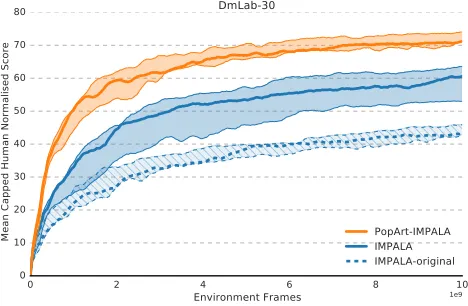
testversions, therefore Table 1 reports both train and test ag-gregate scores. We observed that the original IMPALA agent suffers from an artificial bottleneck in performance, due to the fact that some of the tasks cannot be solved with the ac-tion set available to the agent. As first step, we thus fix this issue by equipping it with a larger action set, resulting in a stronger IMPALA baseline than reported in the original pa-per. We also run multiple independent PBT experiments, to assess the variability of results across multiple replications.
Atari-57 results
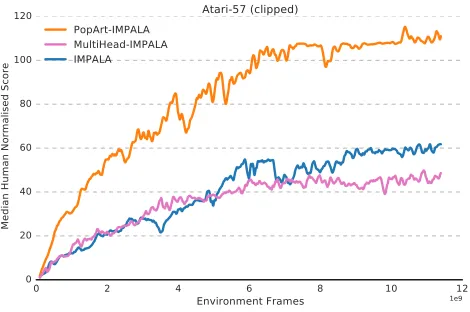
Figures 1 and 2 show the median human normalised perfor-mance across the entire set of 57 Atari games in the ALE, when training agent with and without reward clipping, re-spectively. The curves are plotted as function of the total number of frames seen by each agent.
PopArt-IMPALA (orange line) achieved a median mance of 110% with reward clipping and a median perfor-mance of 101% in the unclipped version of Atari-57. Re-call that here we are measuring the median performance of a single trained agent across all games, rather than the me-dian over the performance of a set of individually trained agents as it has been more common in the Atari domain. To our knowledge, both agents are the first to surpass median human performance across the entire set of 57 Atari games. The IMPALA agent (blue line) performed much worse. The baseline barely reached60%with reward clipping, and the median performance is close to 0% in the unclipped setup. The large decrease in the performance of the base-line IMPALA agent once clipping was removed is in stark contrast with what we observed for PopArt-IMPALA, that achieved almost the same performance in the two training regimes.
Since the level-specific value predictions used by multi-task PopArt effectively increase the capacity of the network, we also ran an additional experiment to disentangle the con-tribution of the increased network capacity from the contri-bution of the adaptive normalisation. For this purpose, we trained a second baseline, that used level specific value pre-dictions, but did not use PopArt to adaptively normalise the learning updates. Experiments showed that such MultiHead-IMPALA agent (pink line) actually performed slightly worse than the original IMPALA, both with and without clipping, confirming that the performance boost of PopArt-IMPALA is indeed due to the adaptive rescaling.
0 2 4 6 8 10 12
Environment Frames 1e9
0 20 40 60 80 100 120
Median Human Normalised Score
Atari-57 (clipped)
PopArt-IMPALA MultiHead-IMPALA IMPALA
Figure 1: Atari-57 (reward clipping): Median human nor-malised score across all Atari levels, as function of the total number of frames seen by the agents across all levels. We compare PopArt-IMPALA to IMPALA and to an additional baseline, MultiHead-IMPALA, that uses task-specific value predictions but no adaptive normalisation. All three agent are trained with the clipped reward scheme.
of frames as a collection of 57 expert DQN agents (57× 200M = 1.14×10¹⁰), while achieving better performance. Despite the large CPU requirements, on a cloud service, training multi-task PopArt-IMPALA can also be competi-tive in terms of costs, since it exceeds the performance of a vanilla-DQN in just 2.5 days, with a smaller GPU footprint.
Normalisation statistics
It is insightful to observe the different normalisation statis-tics across games, and how they adapt during the course of training. Figure 3 (top row) plots theshiftµfor a selection of Atari games, in the unclipped training regime. Thescale σis visualised within the same figure by shading the area in the range[µ−σ, µ+σ]. We observed that the statistics differed by orders of magnitude across the different games:
in crazy climber the shift exceeded 2500, while in
bowlingit never went above 15. The adaptivity of the pro-posed normalisation emerged clearly incrazy climber and qbert, where the statistics spanned multiple orders of magnitude during training. The bottom row in Figure 3 shows the corresponding agent’s undiscounted episode re-turn: it followed the same patterns as the statistics (with differences in magnitude due to discounting). Note how the statistics even tracked the instabilities in the agent’s perfor-mance, as inqbert, ensuring that appropriate scaling was preserved throughout the experiment.
DmLab-30 results
Figure 4 shows, as a function of the total number of frames processed by each agent, the mean human normalised per-formance across all 30 DeepMind Lab levels, where each level’s score is capped at 100% . For all agents, we ran three independent PBT experiments. In Figure 4 we plot the learn-ing curves for each experiment and, for each agent, fill in the area between the best and worse of these three experiment.
0 2 4 6 8 10 12
Environment Frames 1e9
−20 0 20 40 60 80 100 120
Median Human Normalised Score
Atari-57 (unclipped)
PopArt-IMPALA MultiHead-IMPALA IMPALA
Figure 2: Atari-57 (unclipped): Median human normalised score across all Atari levels, as a function of the total num-ber of frames seen by the agents across all levels. We here compare the same set of agents as in Figure 1, but now all agents are trained without using reward clipping. The ap-proximately flat lines corresponding to the baselines mean no learning at all on at least 50% of the games.
breakout crazy_climber qbert seaquest
Undiscounted Return
[μ-σ, μ+σ]
Environment Frames Environment Frames Environment Frames Environment Frames
Figure 3: Normalisation statistics: Top: learned statistics, without reward clipping, for four distinct Atari games. The shaded region is[µ−σ, µ+σ]. Bottom: undiscounted re-turns.
0 2 4 6 8 10
Environment Frames 1e9
0 10 20 30 40 50 60 70 80
Mean Capped Human Normalised Score
DmLab-30
PopArt-IMPALA IMPALA IMPALA-original
Figure 4: DmLab-30: Mean capped human normalised score of IMPALA (blue) and PopArt-IMPALA (orange), across the DmLab-30 benchmark as function of the number of frames (summed across all levels). Shaded region is bounded by best and worse run among 3 PBT experiments. For ref-erence, we also plot the performance of IMPALA with the limited action set from the original paper (dashed).
Extensions
In this section, we explore the combination of the proposed PopArt-IMPALA agent with pixel control (Jaderberg et al. 2016), to further improve data efficiency, and make train-ing IMPALA-like agents on large multi-task benchmarks cheaper and more practical. Pixel control is an unsuper-vised auxiliary task introduced to help learning good state representations. As shown in Figure 5, the combination of PopArt-IMPALA with pixel control (red line) matched the final performance of the vanilla PopArt-IMPALA (orange line) within a fraction of the data (∼ 2B frames). This was on top of the large improvement in data efficiency al-ready provided by PopArt, meaning that the pixel control augmented PopArt-IMPALA required less than 1/10-th of the data to match our own IMPALA baseline’s performance (and1/30-th of the frames to match the original published IMPALA). Importantly, since both PopArt and Pixel Control only add a very small computational cost, this improvement in data efficiency directly translated in a large reduction of the cost of training IMPALA agents on large multi-task benchmarks. Note, finally, that other orthogonal advances in deep RL could also be combined to further improve perfor-mance, similarly to what was done by Rainbow (Hessel et al. 2018), in the context of value-based reinforcement learning.
Implementation notes
We implemented all agents in TensorFlow. For each batch of rollouts processed by the learner, we averaged the Gv t
targets within a rollout, and for each rollout in the batch we performed one online update of PopArt’s normalisation statistics withdecayβ = 3×10⁻⁴. Note thatβ didn’t re-quire any tuning. To prevent numerical issues, we clipped the scale σ in the range [0.0001,1e6]. We did not back-propagate gradients into µ and σ, exclusively updated as
0 2 4 6 8 10
Environment Frames 1e9
0 10 20 30 40 50 60 70 80
Mean Capped Human Normalised Score
0.1
IMPALA-original@10B IMPALA@10B
PopArt-IMPALA@10B
DmLab-30
PopArt-IMPALA Pixel-PopArt-IMPALA
Figure 5: DmLab-30 (with pixel control): Mean capped hu-man normalised score of PopArt-IMPALA with pixel con-trol (red), across the DmLab-30 benchmark as function of the total number of frames across all tasks. Shaded region is bounded by best and worse run among 3 PBT experiments. Dotted lines mark the point where Pixel-PopArt-IMPALA matches PopArt-IMPALA and the two IMPALA baselines.
in Equation 6. The weights W of the last layer of the value function were updated according to Equation 13 and 11. Note that we first applied the actor-critic updates (11), then updated the statistics (6), finally applied output pre-serving updates (13). For more just-in-time rescaling of updates we can invert this order, but this wasn’t neces-sary. In all experiments we used population-based training (PBT) to adapt hyperparameters during the course of train-ing (Jaderberg et al. 2017). As in the IMPALA paper, we used PBT to tunelearning rate,entropy cost, the optimiser’sepsilon, and—in the Atari experiments—the max gradient norm. In Atari-57 we used populations of 24 instances, in DmLab-30 just 8 instances. For other hyper-parameters we used the values from (Espeholt et al. 2018).
Discussion
In this paper we propose a scale-invariant actor-critic al-gorithm that enables significantly improved performance in multi-task reinforcement learning settings. Being able to ac-quire knowledge about a wide range of facts and skills has been long considered an essential feature for an RL agent to demonstrate flexible intelligent behaviour (Sutton et al. 2011; Degris and Modayil 2012; Legg and Hutter 2007; Schmidhuber 2013). To ask our algorithms to be capable of mastering multiple tasks is therefore a natural step as we progress towards increasingly powerful agents.
et al. 2016) demonstrated this by improving performance on a single external task by learning off-policy about auxiliary tasks defined on the same stream of experience (e.g. pixel control, immediate reward prediction or auto-encoding).
Multi-task learning, as considered in this paper, where we get to execute, in parallel, the policies learned for each task, has potential additional benefits, including deep exploration (Osband et al. 2016), and policy composition (Mankowitz et al. 2018; Todorov 2009; Fern´andez and Veloso 2006). By learning on-policy about tasks, it may also be easier to scale to much more diverse tasks: if we only learn about some task off-policy from experience generated pursuing a very differ-ent one, we might never observe any reward. A limitation of our approach is that it can be complicated, and expensive, to implement parallel learning outside of simulation. How-ever, recent work on parallel training of real world robots (Levine et al. 2016) suggests that this is not necessarily an insurmountable obstacle if sufficient resources are available. Adoption of parallel multi-task RL has up to now been fairly limited. That the scaling issues considered in this pa-per, may have been a factor in the limited adoption is in-dicated by the wider use of this kind of learning in su-pervised settings (Johnson et al. 2017; Lu et al. 2016; Misra et al. 2016; Hashimoto et al. 2016), where loss func-tions are naturally well scaled (e.g. cross entropy), or can be easily scaled thanks to the stationarity of the training dis-tribution. We therefore hope and believe that the work pre-sented here can enable more research on multi-task RL.
We also believe that PopArt’s adaptive normalisation can be combined with other research in multi-task RL, that pre-viously did not scale as effectively to large numbers of di-verse tasks. Among the ideas that may be fruitfully com-bined we highlight policy distillation (Parisotto, Ba, and Salakhutdinov 2015; Rusu et al. 2015; Schmitt et al. 2018; Teh et al. 2017) and active sampling of the task distribu-tion the agent trains on (Sharma and Ravindran 2017). The combination of PopArt-IMPALA with forms of active sam-pling might be particularly promising since it may allow to make more efficient use of the parallel data generation, focusing it on the task most amenable for learning. Elas-tic weight consolidation (Kirkpatrick et al. 2017) and other work from the continual learning literature (Ring 1994; Mcclelland, Mcnaughton, and O’Reilly 1995) might also be adapted to parallel learning setups to reduce interference (Mccloskey and Cohen 1989; French 1999) among tasks.
References
Bacon, P.; Harb, J.; and Precup, D. 2017. The option-critic archi-tecture.AAAI Conference on Artificial Intelligence.
Beattie, C.; Leibo, J. Z.; Teplyashin, D.; Ward, T.; Wainwright, M.; K¨uttler, H.; Lefrancq, A.; Green, S.; Vald´es, V.; Sadik, A.; Schrit-twieser, J.; Anderson, K.; York, S.; Cant, M.; Cain, A.; Bolton, A.; Gaffney, S.; King, H.; Hassabis, D.; Legg, S.; and Petersen, S. 2016. Deepmind lab.CoRRabs/1612.03801.
Bellemare, M. G.; Naddaf, Y.; Veness, J.; and Bowling, M. 2013. The arcade learning environment: An evaluation platform for gen-eral agents.JAIR.
Bellman, R. 1957. A markovian decision process. Journal of Mathematics and Mechanics.
Brunskill, E., and Li, L. 2013. Sample complexity of multi-task reinforcement learning.CoRRabs/1309.6821.
Caruana, R. 1998. Multitask learning. InLearning to learn. Kluwer Academic Publishers.
Collobert, R., and Weston, J. 2008. A unified architecture for natural language processing: Deep neural networks with multitask learning. InICML.
Degris, T., and Modayil, J. 2012. Scaling-up knowledge for a cognizant robot. InAAAI Spring Symposium: Designing Intelligent Robots.
Duan, Y.; Chen, X.; Houthooft, R.; Schulman, J.; and Abbeel, P. 2016. Benchmarking deep reinforcement learning for continuous control. InICML.
Espeholt, L.; Soyer, H.; Munos, R.; Simonyan, K.; Mnih, V.; Ward, T.; Doron, Y.; Firoiu, V.; Harley, T.; Dunning, I.; Legg, S.; and Kavukcuoglu, K. 2018. Impala: Scalable distributed deep-rl with importance weighted actor-learner architectures. InICML. Fern´andez, F., and Veloso, M. 2006. Probabilistic policy reuse in a reinforcement learning agent. InAAMAS.
French, R. M. 1999. Catastrophic forgetting in connectionist net-works.Trends in cognitive sciences.
Gruslys, A.; Azar, M. G.; Bellemare, M. G.; and Munos, R. 2018. The reactor: A sample-efficient actor-critic architecture.ICLR. Hashimoto, K.; Xiong, C.; Tsuruoka, Y.; and Socher, R. 2016. A joint many-task model: Growing a neural network for multiple NLP tasks.CoRRabs/1611.01587.
He, K.; Zhang, X.; Ren, S.; and Sun, J. 2015. Deep residual learn-ing for image recognition. arXiv preprint arXiv:1512.03385. Hessel, M.; Modayil, J.; van Hasselt, H.; Schaul, T.; Ostrovski, G.; Dabney, W.; Horgan, D.; Piot, B.; Azar, M. G.; and Silver, D. 2018. Rainbow: Combining improvements in deep reinforcement learn-ing.AAAI Conference on Artificial Intelligence.
Hochreiter, S., and Schmidhuber, J. 1997. Long short-term mem-ory. Neural computation.
Jaderberg, M.; Mnih, V.; Czarnecki, W. M.; Schaul, T.; Leibo, J. Z.; Silver, D.; and Kavukcuoglu, K. 2016. Reinforcement learning with unsupervised auxiliary tasks.CoRRabs/1611.05397. Jaderberg, M.; Dalibard, V.; Osindero, S.; Czarnecki, W. M.; Don-ahue, J.; Razavi, A.; Vinyals, O.; Green, T.; Dunning, I.; Simonyan, K.; Fernando, C.; and Kavukcuoglu, K. 2017. Population based training of neural networks.CoRRabs/1711.09846.
Johnson, M.; Schuster, M.; Le, Q. V.; Krikun, M.; Wu, Y.; Chen, Z.; Thorat, N.; Vi´egas, F. B.; Wattenberg, M.; Corrado, G.; Hughes, M.; and Dean, J. 2017. Google’s multilingual neural machine trans-lation system: Enabling zero-shot transtrans-lation. Transactions of the Association for Computational Linguistics5.
Kirkpatrick, J.; Pascanu, R.; Rabinowitz, N.; Veness, J.; Desjardins, G.; Rusu, A. A.; Milan, K.; Quan, J.; Ramalho, T.; Grabska-Barwinska, A.; Hassabis, D.; Clopath, C.; Kumaran, D.; and Had-sell, R. 2017. Overcoming catastrophic forgetting in neural net-works.PNAS.
Lample, G., and Chaplot, D. S. 2016. Playing FPS games with deep reinforcement learning.CoRRabs/1609.05521.
Legg, S., and Hutter, M. 2007. Universal intelligence: A definition of machine intelligence.Minds Mach.
Lillicrap, T.; Hunt, J.; Pritzel, A.; Heess, N.; Erez, T.; Tassa, Y.; Silver, D.; and Wierstra, D. 2016. Continuous control with deep reinforcement learning. InICLR.
Lu, Y.; Kumar, A.; Zhai, S.; Cheng, Y.; Javidi, T.; and Feris, R. S. 2016. Fully-adaptive feature sharing in multi-task net-works with applications in person attribute classification. CoRR
abs/1611.05377.
Mahmood, A. 2017. Incremental off-policy reinforcement learning algorithms.Ph.D. UAlberta.
Mankowitz, D. J.; Z´ıdek, A.; Barreto, A.; Horgan, D.; Hessel, M.; Quan, J.; Oh, J.; van Hasselt, H.; Silver, D.; and Schaul, T. 2018. Unicorn: Continual learning with a universal, off-policy agent.
CoRRabs/1802.08294.
Mcclelland, J. L.; Mcnaughton, B. L.; and O’Reilly, R. C. 1995. Why there are complementary learning systems in the hippocam-pus and neocortex: Insights from the successes and failures of con-nectionist models of learning and memory.Psychological Review.
Mccloskey, M., and Cohen, N. J. 1989. Catastrophic interference in connectionist networks: The sequential learning problem. The Psychology of Learning and Motivation.
Mirowski, P.; Pascanu, R.; Viola, F.; Soyer, H.; Ballard, A. J.; Ban-ino, A.; Denil, M.; Goroshin, R.; Sifre, L.; Kavukcuoglu, K.; Ku-maran, D.; and Hadsell, R. 2016. Learning to navigate in complex environments.CoRRabs/1611.03673.
Misra, I.; Shrivastava, A.; Gupta, A.; and Hebert, M. 2016. Cross-stitch networks for multi-task learning.CoRRabs/1604.03539.
Mnih, V.; Kavukcuoglu, K.; Silver, D.; Rusu, A. A.; Veness, J.; Bellemare, M. G.; Graves, A.; Riedmiller, M.; Fidjeland, A. K.; Ostrovski, G.; Petersen, S.; Beattie, C.; Sadik, A.; Antonoglou, I.; King, H.; Kumaran, D.; Wierstra, D.; Legg, S.; and Hassabis, D. 2015. Human-level control through deep reinforcement learning.
Nature.
Mnih, V.; Badia, A. P.; Mirza, M.; Graves, A.; Lillicrap, T.; Harley, T.; Silver, D.; and Kavukcuoglu, K. 2016. Asynchronous methods for deep reinforcement learning. InICML.
Nair, A.; Srinivasan, P.; Blackwell, S.; Alcicek, C.; Fearon, R.; De Maria, A.; Panneershelvam, V.; Suleyman, M.; Beattie, C.; Pe-tersen, S.; Legg, S.; Mnih, V.; Kavukcuoglu, K.; and Silver, D. 2015. Massively parallel methods for deep reinforcement learning.
arXiv preprint arXiv:1507.04296.
Osband, I.; Blundell, C.; Pritzel, A.; and Van Roy, B. 2016. Deep exploration via bootstrapped DQN. InNIPS.
Parisotto, E.; Ba, L. J.; and Salakhutdinov, R. 2015. Actor-mimic: Deep multitask and transfer reinforcement learning.CoRR
abs/1511.06342.
Precup, D.; Sutton, R. S.; and Singh, S. P. 2000. Eligibility traces for off-policy policy evaluation. InICML.
Ring, M. 1994. Continual learning in reinforcement environments.
Romera-Paredes, B.; Aung, H.; Bianchi-Berthouze, N.; and Pontil, M. 2013. Multilinear multitask learning. InICML.
Rusu, A. A.; Colmenarejo, S. G.; G¨ulc¸ehre, C¸ .; Desjardins, G.; Kirkpatrick, J.; Pascanu, R.; Mnih, V.; Kavukcuoglu, K.; and Had-sell, R. 2015. Policy distillation.CoRRabs/1511.06295.
Rusu, A. A.; Rabinowitz, N. C.; Desjardins, G.; Soyer, H.; Kirk-patrick, J.; Kavukcuoglu, K.; Pascanu, R.; and Hadsell, R. 2016. Progressive neural networks.CoRRabs/1606.04671.
Schmidhuber, J. 1990. An on-line algorithm for dynamic reinforce-ment learning and planning in reactive environreinforce-ments. InIJCNN.
Schmidhuber, J. 2013. Powerplay: Training an increasingly gen-eral problem solver by continually searching for the simplest still unsolvable problem. InFrontiers in Psychology.
Schmitt, S.; Hudson, J. J.; Z´ıdek, A.; Osindero, S.; Doersch, C.; Czarnecki, W. M.; Leibo, J. Z.; K¨uttler, H.; Zisserman, A.; Si-monyan, K.; and Eslami, S. M. A. 2018. Kickstarting deep re-inforcement learning.CoRRabs/1803.03835.
Schulman, J.; Levine, S.; Moritz, P.; Jordan, M. I.; and Abbeel, P. 2015. Trust region policy optimization.CoRRabs/1502.05477. Schulman, J.; Wolski, F.; Dhariwal, P.; Radford, A.; and Klimov, O. 2017. Proximal policy optimization algorithms. CoRR
abs/1707.06347.
Sharma, S., and Ravindran, B. 2017. Online multi-task learning using active sampling.CoRRabs/1702.06053.
Shelhamer, E.; Mahmoudieh, P.; Argus, M.; and Darrell, T. 2016. Loss is its own reward: Self-supervision for reinforcement learning.
CoRRabs/1612.07307.
Silver, D.; Huang, A.; Maddison, C. J.; Guez, A.; Sifre, L.; van den Driessche, G.; Schrittwieser, J.; Antonoglou, I.; Panneershelvam, V.; Lanctot, M.; Dieleman, S.; Grewe, D.; Nham, J.; Kalchbrenner, N.; Sutskever, I.; Lillicrap, T.; Leach, M.; Kavukcuoglu, K.; Grae-pel, T.; and Hassabis, D. 2016. Mastering the game of Go with deep neural networks and tree search.Nature.
Silver, D.; Hubert, T.; Schrittwieser, J.; Antonoglou, I.; Lai, M.; Guez, A.; Lanctot, M.; Sifre, L.; Kumaran, D.; Graepel, T.; Lilli-crap, T. P.; Simonyan, K.; and Hassabis, D. 2017. Mastering chess and shogi by self-play with a general reinforcement learning algo-rithm.CoRRabs/1712.01815.
Sutton, R. S., and Barto, A. G. 2018. Reinforcement Learning: An Introduction. MIT press.
Sutton, R. S.; Modayil, J.; Delp, M.; Degris, T.; Pilarski, P. M.; White, A.; and Precup, D. 2011. Horde: A scalable real-time ar-chitecture for learning knowledge from unsupervised sensorimotor interaction. InAAMAS.
Sutton, R. S.; Mahmood, A. R.; Precup, D.; and van Hasselt, H. 2014. A new q(λ) with interim forward view and Monte Carlo equivalence. InICML.
Teh, Y. W.; Bapst, V.; Czarnecki, W. M.; Quan, J.; Kirkpatrick, J.; Hadsell, R.; Heess, N.; and Pascanu, R. 2017. Distral: Robust multitask reinforcement learning.CoRRabs/1707.04175. Thrun, S. 1996. Is learning the n-th thing any easier than learning the first? InNIPS.
Thrun, S. 2012. Explanation-based neural network learning: A lifelong learning approach. Springer.
Todorov, E. 2009. Compositionality of optimal control laws. In
NIPS. Curran Associates, Inc.
van Hasselt, H.; Guez, A.; Hessel, M.; Mnih, V.; and Silver, D. 2016. Learning values across many orders of magnitude. InNIPS. van Hasselt, H.; Guez, A.; and Silver, D. 2016. Deep reinforcement learning with double Q-learning. InAAAI Conference on Artificial Intelligence.
Watkins, C. J. C. H. 1989.Learning from Delayed Rewards. Ph.D. Dissertation, King’s College, Cambridge, England.