Automatic Diacritization as Prerequisite Towards the Automatic
Generation of Arabic Lexical Recognition Tests
Osama Hamed Language Technology Lab University of Duisburg-Essen [email protected]
Torsten Zesch Language Technology Lab University of Duisburg-Essen [email protected]
Abstract
The automatic generation of Arabic lexical recognition tests entails several NLP chal-lenges, including corpus linguistics, auto-matic diacritization, lemmatization and lan-guage modeling. Here, we only address the problem of automatic diacritization, a step that paves the road for the automatic generation of Arabic LRTs. We conduct a comparative study between the available tools for diacritization (Farasa and Madamira) and a strong baseline. We evaluate the error rates for these systems using a set of publicly available (almost) fully diacritized corpora, but in a relaxed evaluation mode to ensure fair comparison. Farasa out-performs Madamira and the baseline under all conditions.
1 Introduction
Lexical recognition tests are widely used to as-sess vocabulary knowledge. LRTs are based on the assumption that recognizing a word is suffi-cient for ‘knowing’ the word (Cameron,2002). In such tests, the participants are being shown a list of items, containing words and nonwords. Their task is based on word recognition approach, i.e. they have to say ‘Yes’ when the item is word and ‘No’ otherwise – see Figure1.
In the past LRTs were manually generated, as in LexTALE1 and other LexTALE-like tests (Lemh¨ofer and Broersma,2012). However, for the repetitive testing as used in formative assessment (Wang,2007), LRT’s test stimuli need to be gen-erated automatically using natural language pro-cessing (NLP) techniques. The automatic gener-ation of LRTs involves two NLP tasks: (i) a sim-ple task: words selection from a corpus, and (ii) a complex task: nonwords generation. Some re-searchers have recently proposed an approach to
1The Lexical Test for Advanced Learners of English
generate nonwords automatically using character n-gram language models as obtained from Brown corpus (Hamed and Zesch). They applied their ap-proach to English, and considered word selection using frequency per million word.
We want to generalize their approach to other languages, and more specifically Arabic, which is both interesting and challenging language. Cre-ating Arabic lexical recognition tests is a task that entails a lot of NLP challenges regarding au-tomatic diacritization, corpus linguistic, morpho-logical analysis e.g. lemmatization and language modeling.
While there exist well-established lexical recog-nition tests for English, and other European lan-guages like German and Dutch (Lemh¨ofer and Broersma, 2012), French and Spanish, for many under-resourced languages, like Arabic, a lot of challenges still remain. We are aware of very few studies for Arabic, like (Ricks, 2015; Baharudin et al., 2014). Both studies were conducted with-out any diacritical marks, which means that the respondent claims to know the most frequent di-acritized form of a word. Although some re-searchers have recently shown that the diacritical marks play a vital role in improving the difficulty of Arabic LRTs (Hamed and Zesch, 2017), they did not automate the whole process.
Figure 1: Example of a lexical recognition test as Yes/No question.
Figure 2: Example of a lexical recognition test in checklist format.
2 Related Work
The lexical recognition tests are typically used to measure the size of vocabulary, i.e. they only mea-sure the breadth of vocabulary knowledge, but not the depth or quality (Schmitt,2014). As described by Read (2004), breadth is used to “refer to any vocabulary measure that requires just a single re-sponse to each target word, by indicating whether the word is known or not”. LRTs have two presen-tation formats: Yes/No question format, or check-list format – as show in Figures1,2.
2.1 Arabic LRTs
We are aware of a limited set of studies on Arabic lexical recognition tests.
– Test of Arabic Vocabulary (TAV) Baharudin
et al.(2014) developed the Test of Arabic Vocab-ularythat uses 40 words selected from a book by panel of experts, but no nonwords. Thus, the test is vulnerable to test-wiseness or overconfidence (just answering ‘yes’ for each item).
– Test of Arabic Checklist Ricks(2015)
devel-oped a checklist-format test with 40 words and 20 nonwords (following the format introduced with LexTALE). Words were randomly selected from the Buckwalter/Parkinson frequency dictio-nary (Buckwalter and Parkinson, 2014), but ex-cluding dialectal words. Nonwords were manually created using letters substitution approach.
Importance of Diacritics for LRTs In a recent
studies (Hamed and Zesch, 2017, 2018), the re-searchers added a new parameter to Ricks’s test. They constructed a diacritized test, where they partially diacritized the test stimuli (words and nonwords) and applied a form of relaxation that
drops some diacritics. It was shown that diacritics play a vital role in words recognition, especially for beginner and intermediate learners. Hamed and Zesch(2018) demonstrated the impact of di-acritization on increasing the difficulty of Arabic LRTs.
3 NLP Challenges
Three Arabic NLP challenges are entailed in the automatic generation of Arabic LRTs.
3.1 Diacritized Text Availability
LRT is a corpus-based assessment. To obtain a re-liable frequency count, we typically need a large set of diacritized text. However, the currently available diacritized corpora are limited to religion related texts (Classical Arabic) such as the Holy Quran2, RDI3 and Tashkeela (Zerrouki and Balla, 2017) or newswire genres available in Penn Arabic Treebanks (PATB) from the Linguistic Data Con-sortium (LDC). Below we shed the light on the limitations of available corpora.
• Religious TextAs we are trying to build
edu-cation appliedu-cation that measure language pro-ficiency. We need text that cover a variety of themes like: politics, economics, health, sci-ence and technology, sports, arts, culture and religion.
• ATBWhich is limited in terms of size with less than 570k tokens and in terms of di-versity with 87,160 unique surface forms (excluding numerals). In comparison, the AFP news corpus has approximately 765,890 unique tokens (Cole et al.,2001). Moreover, ATB often uses inconsistent diacritizations (Darwish et al.,2017).
Such a huge corpus can be crawled from the in-ternet, lemmatized and diacritized accordingly.
3.2 Lemmatization
Lemmatization is the process of grouping together the different inflected forms of a word, so they can be analyzed as a single item (a.k.a the lemma). The lemma (aka the dictionary citation form) is a conventionalized choice using one of the word forms to stand for the set (Habash, 2010). Typ-ically, the lemmas are written without any clitics
2
http://tanzil.net/download/
and without any sense (meaning indices). For ex-ample, the lemma of a verb is the third person mas-culine singular perfective form e.g.
O
/AtSl/; while the lemma for a noun is the masculine sin-gular form e.g.y
/bayt/.4Lemmas are usually presented in the LRTs for English and other European languages . Follow-ing standard practice for frequency lists in English and other languages, Buckwalter and Parkinson (2014) adopt the lemma as the organizing princi-ple in their frequency dictionary. Lemmatization is difficult because Arabic is a morphology rich language and its words are highly inflected and derived (Aqel et al., 2015). We are aware of a well-established research that compares the avail-able lemmatization tools. For example, Darwish and Mubarak(2016) have shown that Farasa out-performs or equalizes state-of-the-art Arabic seg-menters like Madamira (Pasha et al.,2014). Next, we investigate the performance of Arabic diacriti-zation tools.
3.3 Diacritization
The Arabic script contains two classes of symbols for writing words: letters and diacritics (Habash, 2010). Diab et al. (2007) grouped the diacrit-iccal marks into three categories: vowels (Fatha /a/, Damma /u/, Kasra /i/ and Sukun to indi-cate the no presence of any vowel), nunations or Tanween (Fathatan, Dammatan, Kasratan) and Shadda (gemination or a consonant doubling). The following examples show the appearance of all diacritics on the Arabic letter “ ” /d/ grouped by categories: short vowels (Á /da/, Damma
Â
/du/, KasraÃ
/di/ and Sukun /do/), Tanween (¾ /daN/,¿
/duN/ andX
/diN/) and Shadda ( /dd/) respec-tively. Diacritization is the task of restoring miss-ing diacritics automatically in languages that are usually written without diacritics like Arabic and Hebrew. We are not going to reinvent the wheel, instead we are going to evaluate the existing and freely available diacritization tools and report the best performing one. We are aware of two tools: MADAMIRA and Farasa. Next, we provide some4If no masculine is possible, then the feminine singular.
Corpus Description Availability # of words
Quran Religious Free 78 K RDI Religious Free 20 M Tashkeela Religious Free 60 M PATB News Commercial 1 M
Table 1: Summary of diacritized corpora.
background on Arabic automatic diacritization.
4 State of the Art Overview
We shortly describe the diacritized datasets, and give an overview of the results that have so far been obtained on different corpora using the stan-dard evaluation metrics.
4.1 Datasets
Table 1 summarizes the existing diacritized pora, we conduct our experiments using Free cor-pora.
4.2 Evaluation Metrics
Two standard evaluation metrics are used almost exclusively to measure the system performance, in terms of error rates on the character and word lev-els. Namely, diacritization error rate (DER) and word error rate (WER). The smaller the error rates, the better the performance.
Case Endings In the diacritized version of the
LRTs, the test stimuli are typically shown with lexical diacritics and without syntactic diacritics (a.k.a. case endings). Thus, we are going to re-port a variant of the above two mentioned metrics that ignore the word’s last letter, denoted as
DER-1andWER-1.
4.3 Results Overview
The existing diacritization approaches can be grouped into four main categories: statistical, se-quence labeling, morphological analysis, and hy-brid approaches (Metwally et al.,2016). Although there are several models within each approach, we only shed the light on one tool (not necessarily the the best performing one). A detailed review can be found in (Azmi and Almajed,2015).
Statistical For example, the approach byHifny
(2012) is using an n-gram language model.
Sequence Labeling Some researchers have
tagged with any of the possible diacritics. For ex-ample, recurrent neural networks model (Abandah et al.,2015).
Morphological Analysis For example, the
sys-tem by Habash et al.(2009) is based on MADA, the tool for the morphological analysis and disam-biguation of Arabic.
Hybrid Usually, the hybrid approach combines
multiple-layers, each is utilizing one single ap-proach. For example, the Rashwan et al. (2011) combines the unfactorized system (dictionary-based system) and a morphological analyzer.
Table2gives an overview of the reported results from the literature. The results are grouped by the corpus that was used for testing in order to allow for a fair comparison. Most numbers are still not directly comparable as they were obtained using different test sets. As most of the systems from the literature are not freely available, we have no way of directly comparing them. In this paper, we establish a comparative study that only includes the systems that are freely available along with the freely available corpora under a controlled set-tings.
5 Experimental Setup
The experiments are carried out using DKPro TC, the open-source UIMA-based framework for su-pervised text classification (Daxenberger et al., 2014). All the experiments were conducted as ten-fold (1 part testing, 9 parts training) cross valida-tion reporting the average over the ten folds.
5.1 Used Data
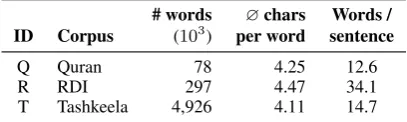
Because of the commercial availability of LDC’s PATB datasets, our experimental data are drawn from the Quran, Tashkeela (CA) and RDI (con-temporary writing). Table 3 shows the statistics for these three sub-datasets (punctuation marks are not counted).
Data Preprocessing The files from Tashkeela
and RDI contain Quranic symbols or English al-phabets and numerics respectively. In order to pre-pare them for training and testing purposes, the following preprocessing steps are performed: (i) convert them from HTML to plain text files that have one sentence per line. (ii) clean the files by removing the Quranic symbols and words written in non Arabic letters. (iii) normalize the Arabic
text by removing the extra white spaces and the Tatweel.
5.2 Sequence Labeling Baseline
This treats diacritization as a sequence labeling (multi-class text classification) problem and pro-posed a baseline solution using conditional ran-dom fields (Lafferty et al.,2001).
Given a sentence (set of non-diacritized words) separated using white-space delimiter, each word in the sentence is a sequence of characters, and we want to label each letter with its corresponding labels from the diacritics set D = (d1, ...,dN). We
represent each word as input sequence X = (x1,
..., xN), where we need to label each consonant
in X with the diacritics that follow this consonant. Thus, the diacritization of X sequence is to find its labeling sequence Y, of word length and derived from D. A word might have more than one valid labeling. For the word “ktAb” (At) X = (k, t, A, b), Y1 = (i, a, o, u) and Y2 = (i, a, o, a) are
examples of two possible labeling.
Our features are character n-grams language model (LM) in sequence labeling approach. The features extractor selects the character-level fea-tures relevant to diacritics from annotated corpora. It collects the diacritics on previous, current and following character and up to the 6th character.
5.3 Diacritization Tools
We are aware of a few tools that can be tested with thousands of words, enhanced or integrated with Java Frameworks.
MADAMIRA A fast, comprehensive tool for
morphological analysis and disambiguation of Arabic (Pasha et al.,2014). It is the successor of MADA (Habash et al.,2009).
Our experiments are carried out using the SAMA enabled version of Madamira v2.1. Madamira reported the accuracy of 86.3 and 95.3 for full and partial diacritization using an MSA blind test set. Madamira was used to diacritize the test sequences from the three corpora: Quran, Tashkeela (CA) and RDI. As the resulting dia-critized text is encoded using Buckwalter translit-eration, it is necessary to decode it into Arabic text. We compare the mapped Arabic text with gold sequence and calculating the different evalu-ation metrics.
Farasa A fast and accurate text processing
All Diacritics Ignore Last
Corpus Test Size Approach DER WER DER-1 WER-1
(103)
ATB (Parts 1–3)
52 Morphological (Habash et al.,2009) 4.8 14.9 2.2 5.5 52 Hybrid (Rashwan et al.,2011) 3.8 12.5 1.2 3.1
37 RNN (Abandah et al.,2015) 2.7 9.1 1.4 4.3
Quran 76 RNN (Abandah et al.,2015) 3.0 8.7 2.0 5.8
Tashkeela 1902 Statistical (Hifny,2012) - 8.9 - 3.4 272 RNN (Abandah et al.,2015) 2.1 5.8 1.3 3.5
[image:5.595.79.283.265.326.2]Tashkeela+RDI 199 Hybrid (Bebah et al.,2014) 7.4 21.1 3.8 7.4
Table 2: List of Arabic Diacritization Systems.
# words ∅chars Words / ID Corpus (103
) per word sentence
Q Quran 78 4.25 12.6 R RDI 297 4.47 34.1 T Tashkeela 4,926 4.11 14.7
Table 3: Statistics of corpora sub-datasets used in this study.
2016).
We did not find any reported published results for Farasa diacritizer. We use Farasa to diacritize test sequence from the three corpora. We compare the resulting diacritized text with gold sequence and calculate the different metrics.
5.4 Evaluation Metrics
The evaluation was conducted across the charac-ter and word levels. For the Arabic LRTs, the test stimuli are not fully diacritized, instead they con-form to specific diacritization (no default diacrit-ics, no case-endings) settings. Thus, the differ-ent error rates are reported in relaxed mode, not in strict mode:
Strict Mode Whenever a letter has a set of
dia-critics in the gold standard, the tools are expected to predict exactly this set. This means that we pun-ish tools that only provide a partial diacritization, e.g. by not returning some default diacritics. For example (A) /qAl/ instead of (Aa) /qaAl/.
Relaxed Mode Whenever a letter has a set of
di-acritics in the gold standard, we do not expect the tool to predict exactly this set. Which means that we do not punish the tools on a letter that does not hold a diacritic. Instead, we only count for the let-ters that holds diacritic. This assumption remains
valid only for words that are labeled with at least one diacritic by the diacritization tool (i.e. the tool is punished if no-diacritics are provided).
The following pre/post-processing steps are ap-plied on the text to do the comparison in relaxed mode.
• Comply to Default DiacriticsIt is important
to note that both Madamira and Farasa ignore the default diacritics, so that we normalize the gold sequence in such a way that also ig-nores the default diacritics to ensure fair com-parison.
• Sukun RemovalSome writing styles use the
Sukun diacritic to mark un-diacritized letters and some styles leave such letters without any diacritic. To overcome these differences when computing the error rates, we discard the Sukun to neglect it in our evaluation.
5.5 Making Results Comparable
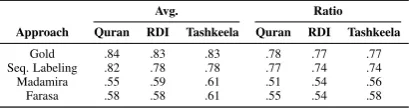
In Table 4, we show the average number and ra-tio of diacritics per letter for the gold standard and all systems used in our experiments. It shows that Madamira and Farasa both assign about the same amount of diacritics on average, but substantially fewer than the gold standard. This means that both tools are especially punished by the strict evalua-tion. These findings motivate us to do the evalu-ation using therelaxed mode. This requires us to normalize the ratio of letters with diacritics in the gold standard, training and output texts.
Avg. Ratio Approach Quran RDI Tashkeela Quran RDI Tashkeela
Gold .84 .83 .83 .78 .77 .77
Seq. Labeling .82 .78 .78 .77 .74 .74
Madamira .55 .59 .61 .51 .54 .56
[image:6.595.79.284.63.117.2]Farasa .58 .58 .61 .55 .54 .58
Table 4: Average number of diacritics per letter (Avg.), and the ratio of letters with diacritics (Ra-tio).
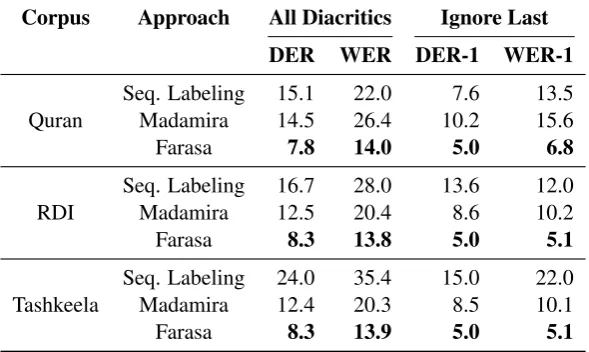
Tashkeela, and it outperforms the baseline with RDI and Tashkeela under all conditions. Farasa gets its best WER with RDI corpus, and outper-forms almost at the same levels with Quran and Tashkeela. Madamira also performs almost on the same level with RDI and Tashkeela.
As most of the systems from the literature are not freely available, we have no way of directly comparing our results with those approaches un-less they have the same settings. Only Farasa comes closer to the DER and DER-1 numbers by (Abandah et al., 2015) in Table 2 when text is drawn from the Quran. If we ignore the sam-ple size, it can be clearly seen that the results of Farasa in relaxed mode are on the same level under (DER and DER-1) and outperforms the results ap-proached byBebah et al.(2014) under (WER and WER-1). The error rates are relatively high, we expect a certain level of overfitting on the domain (due to free words order) to play a role and that our results are closer to the actual performance that can be expected from existing tools.
Recall that Madamira reported an accuracy of 86.3% when evaluated using a blind MSA test set from the PATB. Madamira performs better in the relaxed mode (there is a slight difference). For in-stance, on average it shows a 74%, 80% and 80% WERs with the Quran, RDI and Tashkeela respec-tively. On the other hand, Farasa reported an accu-racy of 86% with the three corpora.
6 Conclusion and Future Work
Arabic LRTs are corpus-based assessments that make use of diacritized words counts in a huge corpus. The lack of diacritized Arabic resources is one of the main challenges entailed in the auto-matic generation of Arabic LRTs. This paper ap-proached the lack of diacritized Arabic resources via automatic diacritization. We presented a com-parative study between the publicly available tools for diacritization. The evaluation experiments are conducted using diacritized text from the Quran,
Tashkeela and RDI corpora, but in a relaxed eval-uation mode to ensure fair comparison and suit the design of Arabic LRTs. Farasa outperforms Madamira under all conditions. In future work, we want to investigate the creation of dialectal Arabic lexical recognition tests automatically.
References
Gheith Abandah, Alex Graves, Balkees Al-Shagoor, Alaa Arabiyat, Fuad Jamour, and Majid Al-Taee. 2015. Automatic diacritization of arabic text us-ing recurrent neural networks.International Journal on Document Analysis and Recognition (IJDAR), 18(2):183–197.
Afnan Aqel, Sahar Alwadei, and Mohammad Da-hab. 2015. Building an Arabic Words Genera-tor. International Journal of Computer Applica-tions, 112(14).
Aqil Azmi and Reham Almajed. 2015. A survey of automatic arabic diacritization techniques. Natural Language Engineering, 21(03):477–495.
Harun Baharudin, Zawawi Ismail, Adelina Asmawi, and Normala Baharuddin. 2014. TAV of Arabic lan-guage measurement. Mediterranean Journal of So-cial Sciences, 5(20):2402.
Mohamed Bebah, Chennoufi Amine, Mazroui Azzed-dine, and Lakhouaja Abdelhak. 2014. Hybrid ap-proaches for automatic vowelization of arabic texts.
arXiv preprint arXiv:1410.2646.
Tim Buckwalter and Dilworth Parkinson. 2014. A fre-quency dictionary of Arabic: Core vocabulary for learners. Routledge.
Lynne Cameron. 2002. Measuring vocabulary size in English as an additional language. Language Teach-ing Research, 6(2):145–173.
Andy Cole, David Graff, and Kevin Walker. 2001. Ara-bic newswire part 1 corpus (1-58563-190-6). Lin-guistic Data Consortium (LDC).
Kareem Darwish and Hamdy Mubarak. 2016. Farasa: A New Fast and Accurate Arabic Word Segmenter. In Proceedings of the Tenth International Confer-ence on Language Resources and Evaluation (LREC 2016), Paris, France. European Language Resources Association (ELRA).
Kareem Darwish, Hamdy Mubarak, and Ahmed Abde-lali. 2017. Arabic diacritization: Stats, rules, and hacks. InProceedings of the Third Arabic Natural Language Processing Workshop, pages 9–17.
Corpus Approach All Diacritics Ignore Last
DER WER DER-1 WER-1
Quran
Seq. Labeling 15.1 22.0 7.6 13.5
Madamira 14.5 26.4 10.2 15.6
Farasa 7.8 14.0 5.0 6.8
RDI
Seq. Labeling 16.7 28.0 13.6 12.0
Madamira 12.5 20.4 8.6 10.2
Farasa 8.3 13.8 5.0 5.1
Tashkeela
Seq. Labeling 24.0 35.4 15.0 22.0
Madamira 12.4 20.3 8.5 10.1
[image:7.595.152.447.64.240.2]Farasa 8.3 13.9 5.0 5.1
Table 5: Error rates in relaxed evaluation mode.
Mona Diab, Mahmoud Ghoneim, and Nizar Habash. 2007. Arabic diacritization in the context of sta-tistical machine translation. InProceedings of MT-Summit.
Nizar Habash. 2010. Introduction to Arabic natural language processing. Synthesis Lectures on Human Language Technologies, 3(1):1–187.
Nizar Habash, Owen Rambow, and Ryan Roth. 2009. MADA + TOKAN: A toolkit for Arabic tokeniza-tion, diacritizatokeniza-tion, morphological disambiguatokeniza-tion, POS tagging, stemming and lemmatization. In Pro-ceedings of the 2nd international conference on Ara-bic language resources and tools (MEDAR), Cairo, Egypt, pages 102–109.
Osama Hamed and Torsten Zesch. Generating Non-words for Vocabulary Proficiency Testing.
Osama Hamed and Torsten Zesch. 2017. The Role of Diacritics in Designing Lexical Recognition Tests for Arabic. In 3rd International Conference on Arabic Computational Linguistics (ACLing 2017), Dubai, UAE. Elsevier.
Osama Hamed and Torsten Zesch. 2018. The role of diacritics in increasing the difficulty of Arabic lexical recognition tests. In Proceedings of the 7th workshop on NLP for Computer Assisted Lan-guage Learning, Stockholm, Sweden. LiU Elec-tronic Press.
Yasser Hifny. 2012. Smoothing techniques for arabic diacritics restoration. In 12th Conference on Lan-guage Engineering, pages 6–12.
John Lafferty, Andrew McCallum, and Fernando Pereira. 2001. Conditional random fields: Prob-abilistic models for segmenting and labeling se-quence data.
Kristin Lemh¨ofer and Mirjam Broersma. 2012. Intro-ducing LexTALE: A quick and valid lexical test for advanced learners of English. Behavior Research Methods, 44(2):325–343.
Aya S Metwally, Mohsen A Rashwan, and Amir F Atiya. 2016. A multi-layered approach for ara-bic text diacritization. In Cloud Computing and Big Data Analysis (ICCCBDA), 2016 IEEE Interna-tional Conference on, pages 389–393. IEEE.
Arfath Pasha, Mohamed Al-Badrashiny, Mona Diab, Ahmed El Kholy, Ramy Eskander, Nizar Habash, Manoj Pooleery, Owen Rambow, and Ryan Roth. 2014. Madamira: A fast, comprehensive tool for morphological analysis and disambiguation of ara-bic. InLREC, pages 1094–1101.
Mohsen Rashwan, Mohamed Al-Badrashiny, Mo-hamed Attia, Sherif Abdou, and Ahmed Rafea. 2011. A stochastic arabic diacritizer based on a hybrid of factorized and unfactorized textual fea-tures. Audio, Speech, and Language Processing, IEEE Transactions on, 19(1):166–175.
John Read. 2004. Plumbing the depths: How should the construct of vocabulary knowledge be defined.
Vocabulary in a second language, pages 209–227.
Robert Ricks. 2015. The Development of Frequency-Based Assessments of Vocabulary Breadth and Depth for L2 Arabic.
Norbert Schmitt. 2014. Size and depth of vocabulary knowledge: What the research shows. Language Learning, 64(4):913–951.
Tzu-Hua Wang. 2007. What strategies are effective for formative assessment in an e-learning environment?
Journal of Computer Assisted Learning, 23(3):171– 186.