AnonyMate: A Toolkit for Anonymizing Unstructured Chat Data
Allison Adams, Eric Aili, Daniel Aioanei, Rebecca Jonsson, Lina Mickelsson, Dagmar Mikmekova, Fred Roberts, Javier Fernandez Valencia, Roger Wechsler
Artificial Solutions Stureplan 15, Stockholm 111 45 r&[email protected]
Abstract
Most existing research on the automatic anonymization of text data has been lim-ited to the de-identification of medical records. This is beginning to change following the passage of GDPR privacy laws, which have made the task of au-tomatic text anonymization more relevant than ever. We present our privacy pro-tection toolkit, AnonyMate, which is built to anonymize both personal identifying information (PII) as well as corporate identifying information (CII) in human-computer dialogue text data.
1 Introduction
Many NLP systems require vast amounts of text data to develop. This poses a considerable chal-lenge to companies who want to prioritize the data integrity and privacy of their clients while build-ing state of the art tools. The General Data Pro-tection Regulation (GDPR) 1 sets restrictions on the usage and storage of personal identifying in-formation (PII), which is often present in human-computer dialog data. As such, steps to remove sensitive information through anonymization are essential if the data are to be collected and stored for research and development purposes. To ad-dress this need, we developed our anonymization tool, AnonyMate, with two main objectives in mind:
• To ensure that historical data stored for R&D purposes do not contain any PII data.
• To enable our platform to produce anonymized data.
In light of these objectives, our goal was to build a tool that can identify and classify types of
1https://eur-lex.europa.eu/eli/reg/2016/679/oj
PII data and apply different anonymization and pseudonymization strategies on the detected PII types. We further sought to detect and annotate named entities beyond the scope of anonymization purposes.
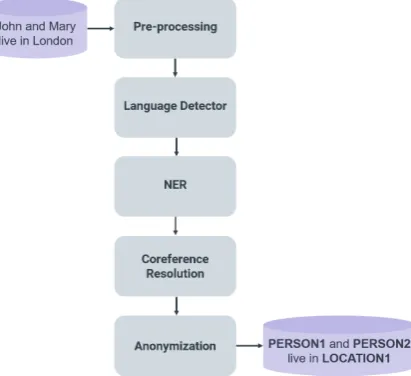
The development of this system encompassed a diverse range of tasks including: establishing a tag set of PII and named entity types with guide-lines for annotation, the creation of an annota-tion tool, a large-scale annotaannota-tion effort in mul-tiple languages, and the testing and implemen-tation of Named Entity Recognition (NER) and language identification systems. The resulting anonymization pipeline comprises five modules: a pre-processing step, a language detector, an NER component, coreference resolution and, finally, an anonymization step, in which identified entities are removed or replaced. In this paper we present an overview of this project and our anonymization pipeline architecture.
2 Tag set and annotation
2.1 Tag set
In the first phase of this project, we established a set of entity types we wanted our system to be able to identify. As our data, sampled from historical chat logs, belong to a diverse set of domains, we identified 24 named entity types we expected to be present in our data. We classified them into three categories:
i. Personal Identifying Information (PII), or named entities that could link the data to a specific individual.
ii. Corporate Identifying Information (CII), or named entities that could link the data to a specific organization or client.
PII CII Other
Person Organization Nationality Address Product Geographical Zip Code Facility Event
Location URL Work of Art
Email Language
UID Unit
IP Address Misc
(Date) Med/Chem
Sports Team Known Group Known Figure Fictional Figure
[image:2.595.75.289.62.259.2]Date
Table 1: Categorization of entity types in our tag set
Table 1 lists these entity types and their respec-tive groupings. The first group, PII, comprises en-tities relating to an identifiable person. This cat-egory includes person names, addresses (includ-ing e-mail and IP addresses), zip codes, locations, unique identifiers (UID), which includes entities such as phone numbers or social security num-bers, and in some cases birth dates. We further aimed to protect not only the privacy of individ-uals present in our data, but that of our corporate clients as well. The list of entity types pertaining to CII includes organizations, products, facilities and URLs. Finally, we established a list of named entities we expect to occur frequently in our data that fall outside the scope of this anonymization task. This list includes named entities useful to identify within our platform, for example for slot-filling purposes, such as nationalities, languages, units (when in the context of an amount, e.g. 5 kilometers), medical/chemical entities, known fig-ures, etc. We also reserved a placeholder Miscella-neoustag to annotate things that are clearly named entities but that do not fit in any other category, such as What is the 50th digit ofPiorWhen did theTitanicsink?.
2.2 Data selection and pre-annotation
We expected named entities to be somewhat sparsely represented in our data and, as such, to speed up the annotation process, we sought to develop a method of pre-selecting sentences for our training set that had a higher likelihood of containing a named entity. Lingren et al.,
2013 have demonstrated dictionary-based anno-tation methods to save time on NER annoanno-tation tasks without introducing bias to the annotation process. Following these findings, we used our in-house lexical resources to develop a rule-based and dictionary-based method for identifying in-puts likely to contain an entity. This system further acts as a simplistic NER tagger that pre-annotates the data.
2.3 Annotation guidelines and training
More than 15 annotators contributed to the devel-opment of our annotated NER data set, working in 6 languages (English, German, Swedish, Spanish, Italian and French). To coordinate this annotation effort we established a set of guidelines for each language, designed to be as synchronized as pos-sible across all development languages. As a part of these guidelines, we instructed annotators to:
• Tag according to context, selecting the most obvious and probable meaning or tag in cases of ambiguous inputs (e.g. I paid with my visa PRODUCT vs. Visa ORGANIZATION is a credit card company.).
• Follow word boundaries in the case of compounds. This means that in En-glish, for example, we only annotate the named entity part of the compound in visa PRODUCT card X while for Swedish visakort PRODUCT, the whole compound is annotated.
• Generally, determiners are not to be included in the scope of an entity. Only annotate deter-miners (or other function words) if they are part of the official name of an entity, e.g. I read the PRODUCT times PRODUCT.
Training Set Test Set
Entities Tokens Sentences Entities Tokens Sentences
English 62231 586637 61081 5217 51078 5097
French 33075 382099 28033 5889 60646 4914
German 73052 570527 78261 4083 30768 3949
Italian 42494 404078 39609 5565 50730 4589
Spanish 35583 357045 34684 4495 34451 4437
[image:3.595.129.471.62.173.2]Swedish 53218 524703 60830 2862 24006 2763
Table 2: Training and test data set size by language
After establishing our tag set and annotation guidelines, we held training sessions with our an-notators, who we in turn tasked with annotating a 300 sentence subset of the training data. We then collectively discussed the sentences for which our annotators had produced different annotations, re-visiting problematic tags and reviewing the guide-lines. As an additional step to improve inter-annotator agreement, we encouraged inter-annotators to work collaboratively to reach joint decisions about difficult or ambiguous tags.
To evaluate inter-annotator agreement, we mea-sured agreement separately for every pair of an-notators on the 300 double-annotated sentences of the training set using Cohen’s kappa (Cohen, 1960) and report the average score. These results are shown in Table 3.
Averageκ Annotators
English .89 9
French .89 3
German .84 6
Italian .89 2
Spanish .75 4
[image:3.595.311.520.217.304.2]Swedish .90 5
Table 3: Average Cohen’s kappa for inter-annotator agreement
2.4 Annotation tool
In addition to receiving training in our annotation guidelines, our annotators were also instructed on how to use our web-based tool developed in-house to facilitate the process of annotating written lan-guage data. In the annotation tool user inter-face, the annotator chooses the appropriate label for each word in a sentence from a drop-down menu. The tool also allows the annotator to navi-gate through examples, giving them the option to skip tricky examples and revisit them later.
Figure 1: Annotation tool user interface
In order to ensure consistent annotation, the tool displays statistics for how a given word has been annotated previously. For instance, in the hypo-thetical example shown in Figure 1, the annotator can see that the ambiguous token, Mercedes, has been marked as a product, organization, and as a person. A regex search function then allows the user to review previous examples to see the con-text in which these tags were assigned.
[image:3.595.95.270.453.553.2]2.5 Data sets composition
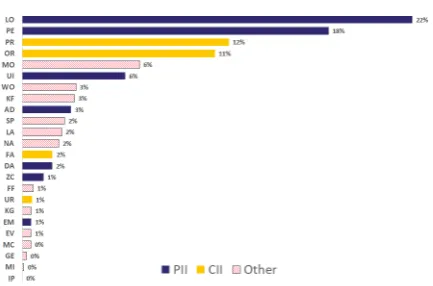
Figure 2: Distribution of named entity tags in the English training set
[image:3.595.309.526.518.661.2]size from 28,033 sentences for French, to 78,261 for German. We did not necessarily expect a cor-relation between training data set size and NER model performance, as our larger data sets tend to contain a broader range of domains, which we ex-pected to make them more difficult to predict.
[image:4.595.324.512.167.254.2]Our English training data set contains 61,081 sentences, 585,773 tokens and 62,231 annotated entities. Figure 2 shows the distribution of named entity tag types in the English training data set. We generally observed very similar distribution pat-tern across all languages we developed. We opted to maintain the natural distribution of entity types in our data set, rather than artificially inflate the training set for underrepresented tag types. As Figure 2 shows, PII and CII tags occur most fre-quently in the data, with the exception of URLs, IP addresses and E-mail addresses. Given the pre-dictability of these entity forms, however, we did not expect their lack of frequency in the training data to be problematic.
3 Named entity recognition for anonymization
Named entity recognition (NER), the identifica-tion of named entities in unstructured text, is a standard component of anonymization and de-identification systems. Most prior research in au-tomatic text anonymization has focused on the de-identification of medical records, and has em-ployed either rule-based (Ruch et al., 2000; Nea-matullah et al., 2008) or machine learning (Guo et al., 2006; Yang and Garibaldi, 2015) NER tech-niques. For the purposes of our system, we opted for the latter and explored two different NER system architectures: one based on conditional random fields (CRFs) and the other using deep-learning techniques based on the model proposed by Lample et al., 2016, which is a BiLSTM with a CRF decoding layer. We developed the CRF model using CRFSuite (Okazaki, 2007). The neu-ral network model was implemented in Tensorflow (Abadi et al., 2015).
In addition to using word, basic prefix and suf-fix, as well as regex features to help detect e-mail addresses and series of digits, one CRFSuite model makes use of embeddings clusters, which we derived by performing K-means clustering on word embeddings, which we trained on our own in-house data using Word2Vec (Mikolov et al., 2013). In doing so, our aim was to group together
words which are distributionally similar in order to imbue our model with some degree of seman-tic understanding, while maintaining the model size small relative to using the full emebeddings model.
3.1 NER performance
SYSTEM TYPE F1
Baseline (unamb) 45.0
Baseline (freq) 57.5
CRFSuite 74.1
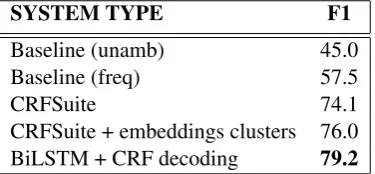
CRFSuite + embeddings clusters 76.0 BiLSTM + CRF decoding 79.2
Table 4: NER system performance for English
Table 4 shows the results of an evaluation of our English NER models on a separate test set. We performed our evaluation following the same methods used in the CoNLL-2003 shared task on named entity recognition (Sang and De Meul-der, 2003). The test set contains 5,217 entities, and comprises 51,078 tokens and 5,097 sentences, making it slightly less than 10 percent the size of the training set. We evaluated our models against two baseline metrics; an unambiguous baseline (unamb), in which entities that appear in the train-ing set with only one annotation are assigned that label in the test set, and a frequency-based baseline (freq), in which entities that appear in the training set are assigned the most frequent annotation that the entity was given in the training set. All three models we investigated performed well over these baselines, with the highest performing model be-ing our neural network based system. We further see that the use of embeddings clusters in the CRF-Suite model results in a modest improvement in F1 compared to not using the embeddings clus-ters. We used default parameters when training and testing these models, so it is possible that tun-ing could lead to further improvements over the baseline.
PII CII
LANGUAGE P R F1 P R F1
[image:5.595.168.430.60.176.2]English 86.4 82.7 84.6 87.0 73.5 79.5 French 89.4 89.4 89.3 85.3 78.0 81.0 German 92.7 89.6 91.1 86.5 65.5 73.5 Italian 88.7 86.0 87.1 87.5 73.0 77.8 Swedish 89.1 83.7 86.1 84.5 71.5 77.0 Spanish 89.1 86.9 87.7 89.3 80.5 84.5
Table 5: Average PII and CII performance: English CRFSuite with embeddings clusters
Figure 3: Performance of English CRFSuite with embeddings clusters, by named entity type
and CII for each language. As the table shows, both PII and CII types perform well above the av-erage model F1. Our evaluations are carried out on the chunk level, rather than on token level, and we observe that scores are generally lower for tags likely to contain multi-token entities (e.g. personal names, addresses, facilities, organizations, etc.). A point of further investigation is to perform an er-ror analysis on these entity types, as even partial recognition of an entity chunk is likely to be suffi-cient for anonymization purposes. We further ob-serve a correlation between entity tag frequency in the data set and performance, suggesting that the performance of some tags could be improved through the addition of training data for these en-tity types. As IP addresses were generally lacking from our data set, we opted to remove this tag from our NER training set and use regular expressions instead of relying on NER.
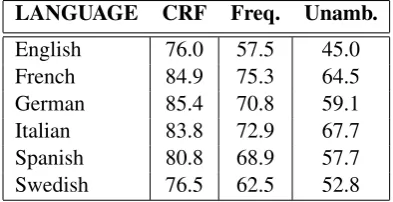
Finally, Table 6 shows the performance of the CRFSuite model with embeddings clusters for each language as compared to the two baseline evaluation metrics. As the table shows, the models for all languages performed well over both
base-LANGUAGE CRF Freq. Unamb.
[image:5.595.75.290.214.368.2]English 76.0 57.5 45.0 French 84.9 75.3 64.5 German 85.4 70.8 59.1 Italian 83.8 72.9 67.7 Spanish 80.8 68.9 57.7 Swedish 76.5 62.5 52.8
Table 6: NER performance by language: CRF-Suite with embeddings clusters
lines. We do, however, see that performance gains over the baseline are more modest for the lan-guages for which we have less training data.
4 Language detector
Given that our anonymization pipelines are language-specific, in order to ensure we anonymize our data effectively, we developed an automatic language identification system to confirm that inputs are being sent into the correct NER pipeline. Our data are organized according to project, which are typically monolingual, however we expect a certain amount of noise in the data, and want to be sure that we do not fail to anonymize PII based on this factor.
Our language detector is currently capable of predicting 45 languages and was trained using OpenNLP’s (Apache Software Foundation, 2014) language detector model (a Na¨ıve Bayes Classi-fier) on a training set of 182,087 sentences. We sourced the training data from a combination of in-house project data as well as external corpora, namely, the OpenSubtitles (Tiedemann, 2016) and Europarl (Koehn, 2005) corpora. We cleaned our in-house data in the following ways:
[image:5.595.318.515.215.316.2]• Analyzing a preliminary model’s output on the data set using cross-validation to identify sentences incorrectly classified as false posi-tives.
These adjustments to our training data resulted in a final F1 of 93.01% tested on separate test set of 19,828 sentences.
5 Coreference resolution
The last stage in our pipeline before anonymiza-tion handles basic coreference resoluanonymiza-tion. This system keeps track of multiple occurrences of en-tities on a user chat session level. For example, if a user refers to the same person name multi-ple times throughout a chat session, the name is anonymized toPerson 1. If a user then mentions a second name during the course of a session, that name is then anonymized toPerson 2. This allows us to maintain the distinction between different in-dividuals while protecting the privacy of those dis-cussed over the course of a full dialogue.
[image:6.595.80.286.416.604.2]6 Anonymization pipeline
Figure 4: Anonymization pipeline architecture
Figure 4 shows the AnonyMate pipeline archi-tecture. An input is first sent to a pre-processing module which deunicodes, removes non-printable characters, and strips HTML tags before tokeniz-ing the input. The input is then sent to the lan-guage detector. Inputs identified as foreign are deleted from our logs rather than being sent to the NER module. Depending on the settings selected, the input can be sent either to be processed by a
BiLSTM+CRF NER module or a CRF NER mod-ule. Finally, after the input has been analyzed for entities, coreference resolution is applied to the in-put.
The anonymization strategy applied is config-urable by the user, where the user can select which entity types to anonymize. Moreover, the tool al-lows the option to suppress certain entity types, whereby entities are simply removed from the in-put (e.g. I live in London. →I live in *** .); tag entities, in which entities are replaced with their named entity tag (e.g. I live in London. →I live in LOCATION.); or substitute entities, in which a specific entity is replaced by a predetermined string (e.g. I live in London. → I live in EN-GLISH CITY.)
7 Conclusion
In this paper we have presented an overview of our anonymization toolkit, AnonyMate, and de-tailed the stages of the project. We have de-scribed the creation of a tag set and data set used to train and test a named entity recognition system that can be applied to the tasks of anonymization and slot-filling, as well as given an evaluation of the NER systems we developed. We further re-ported on the implementation of a language detec-tion system used to filter foreign inputs that our language-specific anonymization pipeline would fail to successfully de-identify. Finally, we pro-vided a description of the anonymization pipeline architecture, and discussed the various strategies employed to remove personal and corporate iden-tifying information from our data. AnonyMate has given us the ability to both remove PII and CII data from our historical data, so that they can be stored for future use in research and development, as well as enabled our platform to generate anonymized data.
Acknowledgments
We would like to thank our annotators for their hard work and dedication in creating our data sets, as well as the three reviewers for their valuable comments.
References
Geoffrey Irving, Michael Isard, Yangqing Jia, Rafal Jozefowicz, Lukasz Kaiser, Manjunath Kudlur, Josh Levenberg, Dan Man´e, Rajat Monga, Sherry Moore, Derek Murray, Chris Olah, Mike Schuster, Jonathon Shlens, Benoit Steiner, Ilya Sutskever, Kunal Tal-war, Paul Tucker, Vincent Vanhoucke, Vijay Vasude-van, Fernanda Vi´egas, Oriol Vinyals, Pete Warden, Martin Wattenberg, Martin Wicke, Yuan Yu, and Xiaoqiang Zheng. 2015. http://tensorflow.org/ Ten-sorFlow: Large-scale machine learning on hetero-geneous systems. Software available from tensor-flow.org.
Apache Software Foundation. 2014.
http://opennlp.apache.org/ openNLP
Nat-ural Language Processing Library.
Http://opennlp.apache.org/.
Jacob Cohen. 1960. A coefficient of agreement for nominal scales. Educational and psychological measurement, 20(1):37–46.
Yikun Guo, Robert Gaizauskas, Ian Roberts, George Demetriou, Mark Hepple, et al. 2006. Identify-ing personal health information usIdentify-ing support vec-tor machines. In i2b2 workshop on challenges in natural language processing for clinical data, pages 10–11. Citeseer.
Philipp Koehn. 2005. Europarl: A parallel corpus for statistical machine translation. InMT summit, vol-ume 5, pages 79–86.
Guillaume Lample, Miguel Ballesteros, Sandeep Sub-ramanian, Kazuya Kawakami, and Chris Dyer. 2016. Neural architectures for named entity recognition. arXiv preprint arXiv:1603.01360.
Todd Lingren, Louise Deleger, Katalin Molnar, Hai-jun Zhai, Jareen Meinzen-Derr, Megan Kaiser, Laura Stoutenborough, Qi Li, and Imre Solti. 2013. https://doi.org/10.1136/amiajnl-2013-001837 Eval-uating the impact of pre-annotation on annotation speed and potential bias: Natural language process-ing gold standard development for clinical named entity recognition in clinical trial announcements. Journal of the American Medical Informatics Asso-ciation : JAMIA, 21.
Tomas Mikolov, Ilya Sutskever, Kai Chen, Greg S Corrado, and Jeff Dean. 2013. http://papers.nips.cc/paper/5021-distributed- representations-of-words-and-phrases-and-their-compositionality.pdf Distributed representations of words and phrases and their compositionality. In C. J. C. Burges, L. Bottou, M. Welling, Z. Ghahra-mani, and K. Q. Weinberger, editors, Advances in Neural Information Processing Systems 26, pages 3111–3119. Curran Associates, Inc.
Ishna Neamatullah, Margaret M Douglass, H Lehman Li-wei, Andrew Reisner, Mauricio Villarroel, William J Long, Peter Szolovits, George B Moody, Roger G Mark, and Gari D Clifford. 2008. Auto-mated de-identification of free-text medical records.
BMC medical informatics and decision making, 8(1):32.
Naoaki Okazaki. 2007.
http://www.chokkan.org/software/crfsuite/ Crf-suite: a fast implementation of conditional random fields (crfs).
Lance A Ramshaw and Mitchell P Marcus. 1999. Text chunking using transformation-based learning. In Natural language processing using very large cor-pora, pages 157–176. Springer.
Patrick Ruch, Robert H Baud, Anne-Marie Rassinoux, Pierrette Bouillon, and Gilbert Robert. 2000. Med-ical document anonymization with a semantic lexi-con. InProceedings of the AMIA Symposium, page 729. American Medical Informatics Association.
Erik F Sang and Fien De Meulder. 2003. Intro-duction to the conll-2003 shared task: Language-independent named entity recognition. arXiv preprint cs/0306050.
J¨org Tiedemann. 2016. Finding alternative translations in a large corpus of movie subtitle. InLREC.