A data-driven approach to verbal multiword expression detection.
PARSEME Shared Task system description paper
Tiberiu Boros,, Sonia Pipa, Verginica Barbu Mititelu, Dan Tufis, Research Institute for Artificial Intelligence ”Mihai Dr˘ag˘anescu”,
Romanian Academy, Bucharest, Romania
{tibi,sonia,vergi,tufis}@racai.ro
Abstract
Multiword expressions are groups of words acting as a morphologic, syntac-tic and semansyntac-tic unit in linguissyntac-tic analy-sis. Verbal multiword expressions repre-sent a subgroup of multiword expressions, namely that in which a verb is the syn-tactic head of the group considered in its canonical (or dictionary) form. All mul-tiword expressions are a great challenge for natural language processing, but the verbal ones are particularly interesting for tasks such as parsing, as the verb is the central element in the syntactic organiza-tion of a sentence. In this paper we in-troduce our data-driven approach to verbal multiword expressions, which was objecti-vely validated during the PARSEME sha-red task on verbal multiword expressions identification. We tested our approach on 12 languages, and we provide detailed in-formation about corpora composition, fe-ature selection process, validation proce-dure and performance on all languages.
1 Introduction
The term “multiword expressions” (MWEs) de-notes a group of words that act as a morpholo-gic, syntactic and semantic unit in linguistic analy-sis: their linguistic behavior (inflection, combina-tion with other words, meaning) cannot be infer-red from the characteristics of their components. As the name suggests, verbal MWEs (VMWEs) require the presence of a verb head in the prototy-pical form of the MWE. The importance of iden-tifying MWEs in natural language processing, as well as the appropriate techniques to deal with this linguistic phenomenon were discussed by (Sag et al., 2002), among others. VMWEs are particularly
important for parsing, mainly because the verb is the central element in the syntactic organization of a sentence.
For the present task we focused on both detec-tion and type-labeling of VMWEs. Though simi-lar in nature, detection and type-labeling require different training strategies, at least in the fine-tunning stage of the system. In our case, this meant that the two tasks might require different context windows and feature sets (see Section 3 for more details). Moreover, though we applied our system on twelve languages, we performed fine-tunning of the parameter set only for the Romanian corpus (due to time constraints) and we used the same parameter set for all langua-ges. However, the proposed fine-tunning strategy can be applied on any dataset and, in the future, we plan to make language-dependent optimization and re-run the MWE detection and labeling pro-cess for each language with its own parameters.
2 Corpora composition
During the system preparation for the PARSEME shared task on VMWEs identification (Savary et al., 2017) we were granted access to training data in the form of annotated text for 18 languages. The annotation was provided using a custom designed format called parsemetsv1(one-token per line with
tokenization and VMWEs information, stored as tab-separated values). For some languages, lem-matization and tagging information was provided in CONLL format2.
From the 18 languages we focused on a sub-set of 12 languages, because both parsemetsv in-formation and morphosyntactic analysis were
pro-1
http://typo.uni-konstanz.de/parseme/index.php/2- general/184-parseme-shared-task-format-of-the-final-annotation (last accessed 2017-01-29)
2http://universaldependencies.org/format.html (last
ac-cessed 2017-01-29)
vided for them: RO, FR, CS, DE, EL, ES, HU, IT, MT, SL, SV and TR. The Farsi and and Polish corpora were also provided with all the necessary information, but due to technical difficulties, we were unable to cope with the file encodings be-fore the submission deadline and we were unable to provide an accurate evaluation on these langua-ges.
Regarding granularity, 5 VMWE classes are used in the annotation process:
• Ligth Verb Constructions (LVC): they are made up of a verb and a noun: the former has little if any semantic content, while the latter contributes the semantics of the VMWE;
• Idioms (ID): these are expressions in which the verb can combine with various other words and their key-characteristic is the lack of compositional meaning;
• Inherently reflexive verbs (IReflV): they are made up of a verb and a reflexive cli-tic and their meaning is different from those occurrences of the verb without the clitic (in case this is possible); the passive, reciprocal, possessive and impersonal constructions are excluded from annotation;
• Verb-Particle Constructions (VPC): they contain a verb and a particle and have a non-compositional meaning;
• Other (OTH): any VMWE that does not fit any of the above mentioned classes.
The LVC and ID categories are considered uni-versal, in the sense that they apply to all langua-ges involved in the shared task3, whereas IReflV
applies to all Romance languages, to all Germanic languages in the shared task and almost all Balto-Slavic ones (the exception is Lithuanian). VPC applies to all Germanic languages, to Italian, Slo-vene, Greek, Hebrew and Hungarian. Except for Lithuanian, OTH can occur in any language in the task, although not necessarily present in the data.
The distribution of these categories over the training sets for the languages considered here is given in Table 1 below.
3Although considered applicable, the LVC category did
not occur in the Farsi data, while ID did not occur in the Farsi or Hungarian data.
3 Sequence labeling for verbal multiword expression detection
When it comes to automatic identification of VMWEs, aside from rule-based approaches such as tree substitution grammars (Green et al., 2011) and dependency lexicons (Bejcek et al., 2013), se-veral research have addressed statistical methods. These statistical methods refer to n-gram based approaches (Pedersen et al., 2011), Latent Seman-tic Analysis (LSA) (Katz and Giesbrecht, 2006), word association measures (Pecina, 2008) and many classification-based approaches.
In our approach, which is also a statistical me-thod, we treat VMWEs identification as a sequ-ence labeling approach, in which we employ a Conditional Random Fields (CRF) classifier (La-fferty et al., 2001) trained to predict transitions between labels rather than the labels themselves. For every word inside a sentence we trained the classifier to predict a label using lemma and part-of-speech based features for a window of words centered on the current position. A naive method would use the VMWE type as labels and employ a dummy label for words that do not belong to any unit. However, a more principled approach is to perform VMWE identification in two steps:
• Head labeling: in this step we identify words that introduce VMWEs, a good choice for these words being the verb, in head-initial languages.
• Tail labeling: in this step we identify the words that link to the head word and contri-bute to the unit.
pro-VMWE type CS DE EL ES FR HU IT MT RO SL SV TR
IReflV 8851 111 0 336 1313 0 580 0 2496 945 3 0
LVC 2580 178 955 214 1362 584 395 434 1019 186 13 2624
ID 1419 1005 515 196 1786 0 913 261 524 283 9 2911
VPC 0 1143 32 0 0 2415 62 0 0 371 31 0
[image:3.595.71.516.61.148.2]OTH 2 10 16 2 1 0 4 77 15 2 0 634
Table 1: VMWE distribution in the training corpora for the 12 languages
ved to be inefficient for head labeling, but provi-ded better results in the second step4.
The training data contained several overlapped VMWEs. In theory, our proposed labeling scheme should be able to handle such cases (i.e., if a head token is also linked as a tail, then that token and its tail should be embedded in the higher VMWE). However, because of their sparseness in the trai-ning data, our system did not spot such cases.
4 Validation and feature selection procedure
All our results are reported for a 10-fold valida-tion procedure, which takes into account the dis-tribution of VMWE types in the training corpora. This means that when we split our data into 90% training and 10% validation we strived to preserve the relative distribution of labels in order to report results as close as possible to real-life data.
4.1 Head labeling
After a shallow investigation of different feature sets we established that lemma, part-of-speech (POS) (with attributes) and a combined feature from lemma+POS are the best candidates for fine-tuning. This first feature set is denoted as L+P. We tried to extend this setup by adding 4 new features (whenever possible): gender, person, number and a special flag for reflexive pronouns (L+P+E). In Table 2 we show the detailed results obtained on the Romanian training corpus using the two fea-ture sets (L+P and L+P+E) and varying the feafea-ture window size, in the 10-fold validation procedure.
As can easily be seen, the overall F-score of the system decreases for feature windows higher than 2, which indicates over-fitting of the training data. Also, for the window size of 2 the extended feature 4In the feature selection process, described in the next
section, we found that the best results are obtained using a feature-window of two (totally, 5 words included) for head labeling and a window of 4 (totally, 9 words included) for tail labeling
W Feat-set P R F
2 L+PL+P+E 0.8957 0.89520.9012 0.8769 0.88890.8914
3 L+PL+P+E 0.8912 0.8842 0.88770.8778 0.8868 0.8823
[image:3.595.318.517.191.289.2]4 L+PL+P+E 0.8656 0.8869 0.87610.8378 0.8845 0.8605
Table 2: Results on the training set
set provides a better precision but decreases the recall, yielding in a lower F-score. Thus, our final choice was a window size of two with the L+P feature set.
4.2 Tail labeling
Tail labeling is carried out on an extended fea-ture set in which we added additional information about labels previously assigned during head la-beling. Our experiments showed that varying the feature window has little impact on the system’s performance and we decided to use a feature win-dow of 4 (totally, 9 words).
In Table 6, for head labeling, the first column represents the words lemmas, the second column contains the part-of-speech with its associated at-tributes and the third column is used for the label itself. Note that during head labeling we ignore any linked words. Next, for tail labeling we extend the feature-set and we add one column, which is used for head labels. In the training phase we use the head-labels extracted from the training corpus and at runtime we use the classifier to predict these labels in the first phase of the two-step approach.
In the template file5 (Table 8), each line starts
with a string that uniquely identifies the feature (i.e., “U01”, “U02”, etc.). Next to the identifier we can add any feature (%x) and any combina-tion of features (’/’ is used for combining multi-ple features). Features in the training data are ex-5standard CRF++ (https://taku910.github.io/crfpp/)
Label P Stdev R Stdev F-score Stdev ID 0.8760 0.0434 0.6421 0.0727 0.7398 0.0612
IReflV 0.8830 0.0207 0.9611 0.0129 0.9202 0.0113
LVC 0.9363 0.0219 0.8590 0.0322 0.8955 0.0202
[image:4.595.149.451.62.132.2]PREV 0.9837 0.0087 0.9655 0.0105 0.9745 0.0068
Table 3: Detailed results for Romanian reported for every VMWE type using 10- fold validation. The ’PREV’ label is used for tail linking
CM IReflV ID LVC
- 8 13 15
IReflV 38 239 0 0
ID 2 0 37 3
[image:4.595.306.535.186.396.2]LVC 3 1 0 84
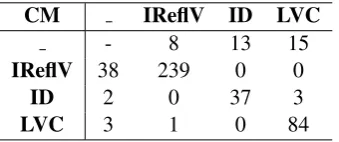
Table 4: Confusion matrix computed for the first fold of the RO corpus. Symbol ’ ’ is used to de-note dummy tokens - token does not belong to any VMWE
Strict
Lang P R F Rank
CS 0.7009 0.5918 0.6418 2/4
DE 0.3652 0.13 0.1917 4/4
EL 0.4286 0.252 0.3174 2/4
ES 0.6447 0.196 0.3006 4/4
FR 0.7415 0.35 0.4755 3/5
HU 0.8029 0.5471 0.6508 3/4
IT 0.6125 0.098 0.169 3/3
MT 0.2333 0.028 0.05 3/3
RO 0.8652 0.706 0.7775 1/4
SL 0.5503 0.208 0.3019 4/4
SV 0.5758 0.161 0.2517 3/3
TR 0.6304 0.4391 0.5176 2/4
Fuzzy
Lang P R F
CS 0.819 0.6228 0.7076 3/4
DE 0.6716 0.1793 0.283 4/4
EL 0.5616 0.2953 0.3871 4/4
ES 0.7233 0.1967 0.3093 4/4
FR 0.7872 0.3673 0.5009 3/4
HU 0.8208 0.5015 0.6226 4/4
IT 0.6837 0.1053 0.1824 3/3
MT 0.2481 0.0259 0.0469 3/3
RO 0.8773 0.7019 0.7799 4/4
SL 0.7339 0.2145 0.332 4/4
SV 0.6538 0.1677 0.2669 3/3
[image:4.595.98.268.194.265.2]TR 0.634 0.4348 0.5159 3/4
Table 5: Evaluation campaign results
Head labeling
Portugalia Np
s Ncmprn IReflV
- DASH
avea Vaip3s
confrunta Vmp
cu Sp
acelas,i Dd3fsr
situat,ie Ncfsrn
: COLON
Tail labeling
Portugalia Np
s Ncmprn IReflv
- DASH
avea Vaip3s
confrunta Vmp PREV
cu Sp
acelas,i Dd3fsr
situat,ie Ncfsrn
: COLON
Table 6: Excerpt from the training data - Roma-nian version of the training corpus
tracted using a “relative coordinate systems”. The first coordinate is the relative row index, and the second one is the 0-indexed absolute column posi-tion of the feature. For instance, x[-1,1] signifies the lemma (1 - second column) of the previous to-ken (-1 - the above row).
Head labeling template file
U01:%x[0,0] U02:%x[0,1]
U03:%x[0,0]/%x[0,1] U04:%x[-1,0]
U05:%x[-1,1]
U06:%x[-1,0]/%x[0,1] ...
3 more similar feature sets
Tail labeling template file
U01:%x[0,0] U02:%x[0,1] U03:%x[0,2]
U04:%x[0,0]/%x[0,1] ...
[image:4.595.81.283.350.735.2]8 more similar feature sets
[image:4.595.302.536.549.723.2]Language Type P R F Language P R F
CS
LVC 0.7460 0.2741 0.4009
DE
0.0000 0.0000 0.0000
IReflV 0.7109 0.7554 0.7325 0.4000 0.1000 0.1600
VPC N/A N/A N/A 0.6667 0.1593 0.2571
ID 0.5909 0.1354 0.2203 0.3433 0.1075 0.1637
EL
LVC 0.4096 0.2798 0.3316
ES
0.6111 0.2018 0.3034
IReflV N/A N/A N/A 0.6559 0.2735 0.3861
VPC 0.6667 0.2500 0.3636 N/A N/A N/A
ID 0.2321 0.1024 0.1421 0.0000 0.0000 0.0000
FR
LVC 0.7255 0.1365 0.2298
HU
0.6383 0.2055 0.3109
IReflV 0.7000 0.6667 0.6829 N/A N/A N/A
VPC N/A N/A N/A 0.8294 0.6864 0.7512
ID 0.7294 0.5210 0.6078 N/A N/A N/A
IT
LVC 0.7000 0.0805 0.1443
MT
0.1837 0.0347 0.0584
IReflV 0.3636 0.0533 0.0930 N/A N/A N/A
VPC 0.3333 0.0909 0.1429 N/A N/A N/A
ID 0.6667 0.1200 0.2034 0.2000 0.0108 0.0205
RO
LVC 0.9167 0.8148 0.8627
SL
0.6667 0.0444 0.0833
IReflV 0.8197 0.6897 0.7491 0.5390 0.3004 0.3858
VPC N/A N/A N/A 0.6757 0.2315 0.3448
ID 0.8864 0.5200 0.6555 0.5000 0.0109 0.0213
SV
LVC 0.4000 0.1429 0.2105
TR
0.6797 0.5226 0.5909
IReflV 0.0000 0.0000 0.0000 N/A N/A N/A
VPC 0.5614 0.2065 0.3019 N/A N/A N/A
[image:5.595.119.486.60.315.2]ID 0.5000 0.0196 0.0377 0.5921 0.3614 0.4489
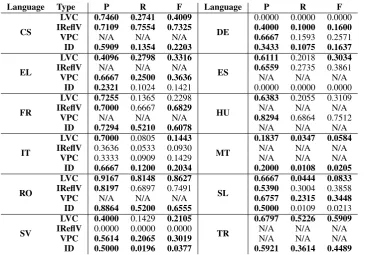
Table 7: Strict evaluation results for VMWE type identification. Best results in the challenge are BOLD
4.3 Further discussion of the results
The values reported in Table 2 refer to the ove-rall performance of the system, regardless of the VMWE class. In order to offer a better view on the system performance we provide accuracy figu-res for every VMWE class (Table 3), as well as the confusion matrix for head labeling computed on the first training fold of the validation (Table 4).
As shown in the confusion matrix, the system rarely confuses one VMWE for another, most er-rors being omissions - head VMWE tokens being labeled with “ ” (dummy) labels. While IReflVs are both numerous and easy to spot, IDs are rare and extremely difficult to label because their iden-tification involves semantics as well as syntactic knowledge. The IDs correctly spotted by the sys-tem in this fold may have been “over-fitted” during the training. However, it is highly possible that, with another corpus, ID identification fail mainly because of the ambiguities that arise when trying to determine if the “sum” of the words senses is different from the VMWE sense (a task which is barely handled by the CRF and feature set combi-nation).
5 Results and conclusions
The final evaluation results that we report in this paper are the results obtained during the
PAR-SEME shared task on VMWE identification. As previously mentioned, we trained and submitted runs for 12 languages (table 5 summarizes the results)6. We must mention that for the shared
task, VMWE type identification was not manda-tory. However, we as well as three other teams included this information in their submissions. As such, we show detailed results for each VMWE class in Table 7, where we give the results for the strict evaluation.
For Romanian, there is a notable difference in the F-score reported during 10-fold validation and PARSEME evaluation, which is caused mainly by the skewed distribution of VMWE types in the test data. However, the F-score reported for individual VMWE classes are well within the standard devi-ation computed in table 3. Similar conditions may apply to the other languages. Also, as previously stated, our fine-tunning process was only perfor-med on the Romanian dataset, where we obtained the highest score in the strict evaluation of the sys-tem. An identical process can be carried out on any dataset and for best results, one would have to perform this tunning in order to obtain language-dependent optimizations.
The system is freely available and can be ob-tained by contacting the authors.
6
References
Eduard Bejcek, Pavel Stran´ak, and Pavel Pecina. 2013. Syntactic identification of occurrences of multiword expressions in text using a lexicon with dependency structures. InProc. of the 9th Workshop on Multi-word Expressions, pages 106–115.
Spence Green, Marie-Catherine De Marneffe, John Bauer, and Christopher D Manning. 2011. Mul-tiword expression identification with tree substitu-tion grammars: A parsing tour de force with french. InProceedings of the Conference on Empirical Me-thods in Natural Language Processing, pages 725– 735. Association for Computational Linguistics. Graham Katz and Eugenie Giesbrecht. 2006.
Automa-tic identification of non-compositional multi-word expressions using latent semantic analysis. In Pro-ceedings of the Workshop on Multiword Expres-sions: Identifying and Exploiting Underlying Pro-perties, pages 12–19. Association for Computational Linguistics.
John Lafferty, Andrew McCallum, Fernando Pereira, et al. 2001. Conditional random fields: Probabi-listic models for segmenting and labeling sequence data. InProceedings of the eighteenth international conference on machine learning, ICML, volume 1, pages 282–289.
Pavel Pecina. 2008. A machine learning approach to multiword expression extraction. InProceedings of the LREC Workshop Towards a Shared Task for Mul-tiword Expressions (MWE 2008), volume 2008, pa-ges 54–61. Citeseer.
Ted Pedersen, Satanjeev Banerjee, Bridget T McInnes, Saiyam Kohli, Mahesh Joshi, and Ying Liu. 2011. The ngram statistics package (text:: nsp): A flexible tool for identifying ngrams, collocations, and word associations. In Proceedings of the Workshop on Multiword Expressions: from Parsing and Genera-tion to the Real World, pages 131–133. Association for Computational Linguistics.
Ivan A. Sag, Timothy Baldwin, Francis Bond, Ann Co-pestake, and Dan Flickinger, 2002. Multiword Ex-pressions: A Pain in the Neck for NLP, pages 1–15. Springer Berlin Heidelberg, Berlin, Heidelberg.