Science teachers' perceptions of expertise in practice : An
exploratory study.
BEVINS, Stuart Carl.
Available from Sheffield Hallam University Research Archive (SHURA) at:
http://shura.shu.ac.uk/19352/
This document is the author deposited version. You are advised to consult the publisher's version if you wish to cite from it.
Published version
BEVINS, Stuart Carl. (2002). Science teachers' perceptions of expertise in practice : An exploratory study. Doctoral, Sheffield Hallam University (United Kingdom)..
Copyright and re-use policy
Sheffield Hallam University Learning and IT Services Adsetts Centre City Campus
Sheffield S1 1WB
Fines are charged at 50p per hour
ProQuest Number: 10694233
All rights reserved
INFORMATION TO ALL USERS
The quality of this reproduction is dependent upon the quality of the copy submitted.
In the unlikely event that the author did not send a com plete manuscript and there are missing pages, these will be noted. Also, if material had to be removed,
a note will indicate the deletion.
uest
ProQuest 10694233
Published by ProQuest LLC(2017). Copyright of the Dissertation is held by the Author.
All rights reserved.
This work is protected against unauthorized copying under Title 17, United States C ode Microform Edition © ProQuest LLC.
ProQuest LLC.
789 East Eisenhower Parkway P.O. Box 1346
Science Teachers’ Perceptions of Expertise in Practice: An Exploratory Study
Stuart Carl Bevins
Submitted in accordance with the requirements for the degree of PhD
Sheffield Hallam University
Abstract
This thesis reports on an exploration of the nature and characteristics of science teaching expertise as exhibited by six identified expert science teachers. An action research methodology was adopted with data gathered through: semi-structured interviews; classroom observations, and reflective discussions. A culture of
collaboration between the researcher and teachers was encouraged by the researcher in an attempt to create a ‘bottom-up’ approach to the study. The teachers acted as research collaborators by continuously reflecting on, and analysing their knowledge and practice within the context of the study.
The reported study emphasises a need for identifying characteristics of science teacher expertise from the insights of teachers themselves. The study considers the reflections and perceptions of the science teachers involved to be an important part of their continuing professional development, which leads to a greater self-awareness and understanding of their teaching expertise.
Findings show that these six science teachers demonstrate: subject master; deep pedagogical understanding; considerable pedagogical content knowledge, and a desire to continue learning for an entire professional life, in an attempt to keep abreast of changes and developments in science and education. Within these characteristics, the teachers exhibit, for example, organisational skills, empathy, flexibility, intuition, enthusiasm and professionalism. Most of all, they demonstrate an ability to operate and communicate at the level of their pupils.
Table of Contents
Tables Figures
Acknowledgements
1 Introduction 1
1.1 Context and origins of the study 1
1.2 Why study expert science teachers? 4
1.3 Aims of the study 5
1.4 Problems in studying science teacher expertise 7
1.5 Approach 8
1.6 Outline of thesis 9
2 Literature Review 12
2.1 Introduction 12
2.2 The novice-expert comparison 13
2.3 Knowledge frameworks and cognitive model representations 19
2.4 The reflective practitioner 28
2.5 Teacher effectiveness 31
2.6 Summary 36
3 Methodology 39
3.1 Introduction 39
3.2 Choosing and action research approach 40
3.3 Action research theory 45
3.4 Pilot group 47
3.5 Six expert teachers 49
3.6 Observations 50
3.7 Interviews 51
3.8 Participants responses 54
3.9 A culture of collaboration 56
3.10 Reflective discussions 58
3.11 Matrix creation 60
3.12 Strengths and weaknesses of the chosen approach 62
3.13 Summary 65
4 Data Analysis 67
4.1 Introduction 67
4.2 NUD*IST 68
4.3 Grounded theory: an approach to data analysis 69
4.4 Interview data 70
J
4.5 Categories and themes 71
4.6 Coding 75
4.7 Observational data 80
4.8 Reflective discussions 81
4.9 Triangulation 82
4.10 Data integration 84
4.11 School data 86
4.12 Summary 86
5 Teacher Profiles 88
5.1 Introduction 88
5.2 Profile 1: Simon 89
5.3 Profile 2: Debbie 91
5.6 Profile 5: Janet 96
5.7 Profile 6: Ian 98
5.8 Summary 100
6 Findings 101
6.1 Introduction 101
6.2 Perceptions of learning 102
6.2.1 Analogies 103
6.2.2 Teacher-pupil relationships 104
6.2.3 Pupil achievement 107
6.3 Perceptions of teaching 110
6.3.1 Flexibility 113
6.3.2 Risk takers 115
6.3.3 Utilising experience 118
6.3.4 Mentoring and expertise 119
6.3.5 Autopilot 121
6.3.6 Classroom management 122
6.4 Perceptions of science 124
6.5 Perceptions of reflection 128
6.6 Reflection: a process of change 133
6.7 Summary 135
7 Conclusions 136
7.1 Introduction 136
7.2 Towards a unified understanding 137
7.3 Teachers reflecting on teaching 147
7.5 Aims and original contribution to knowledge 155
7.6 Summary 158
8 Implications and final remarks 160
8.1 Introduction 160
8.2 Ownership, empowerment and structure: CPD for the future 161
8.3 Process skills 169
8.4 Initial Teacher Training 171
8.5 Further study 175
8.6 Final remarks 176
Bibliography 179
Appendices
Appendix 1 Standards for Advanced Skills Teachers 188
Appendix 2 Sample interviews from the pilot group 190
Appendix 3 List of emergent issues from the pilot group 206
Appendix 4 Observation schedule 207
Appendix 5 Interview schedule 209
Appendix 6 Interview schedule (2) 210
Appendix 7 Sample interview transcripts 211
Appendix 8 Sample reflective summaries 228
Appendix 9 Time table of events 234
Tables
Table 2.2 Characteristics of professional expertise 24
Table 2.3 Three differences between experts and non-experts 27
Table 2.4 Quantity and pacing of instruction 32
Table 2.5 Hay McBer characteristics of effective teaching 34
Table 4.1 Process of qualitative data analysis 72
Table 4.2 List of emergent themes 73
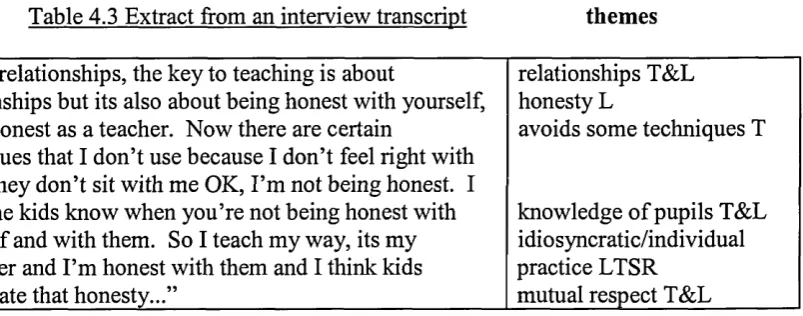
Table 4.3 Extract from an interview transcript 76
Table 4.4 Initial matrix construction from interview transcript 77
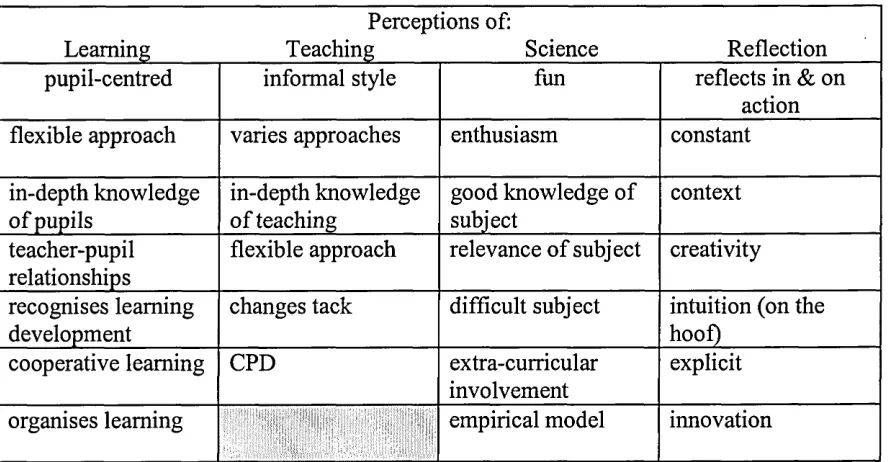
Table 4.5 Second stage matrix 78
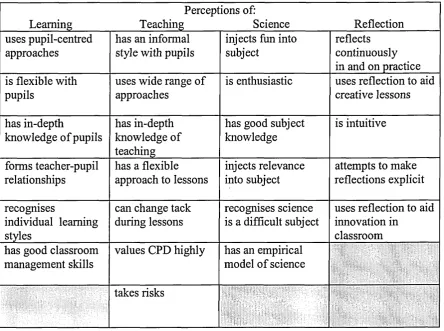
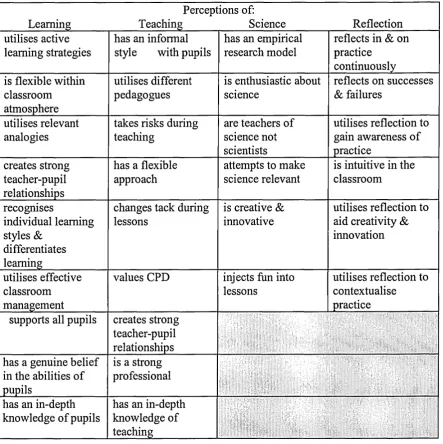
Table 4.6 Emerging characteristics of an expert science teacher 79
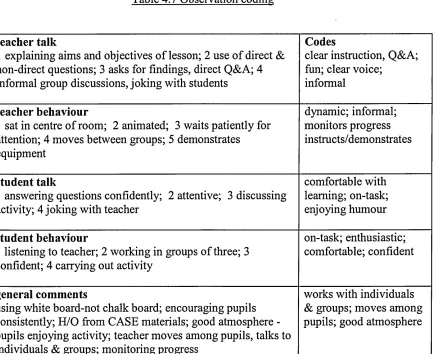
Table 4.7 Observation coding 80
Table 4.8 Researcher notes from a reflective discussion 81
Table 4.9 Paragraph from a teachers’ reflective summary 81
Table 4.10 Six types of triangulation used in research 83
Table 7.1 Model of teacher development 149
Table 7.2 Shared characteristics of six expert science teachers 151
Table 8.1 GRASP 168
Table 8.2 Process skills 171
Figures
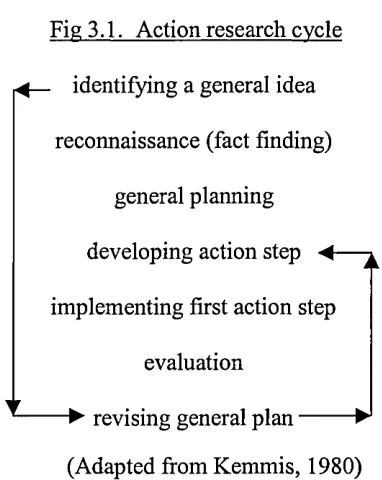
Figure 3.1 Action research cycle 46
Figure 4.1 Process of qualitative data analysis 72
Figure 6.1 Process of risk taking and development 116
Figure 7.1 Model of teacher development 149
Acknowledgements
This study set out to explore science teachers’ perceptions of their expertise and could
not have been achieved without the assistance of the following people.
My ‘expert supervisor’ was Professor Dick West. It is difficult to imagine anyone
who could have been better qualified for the task. He made available to me his acute
understanding not only of science education and teaching, but also of research
processes. His patience with my concise writing style has been exceptional. Dick has
made a major and valuable contribution to this study.
My ‘outstanding and committed’ Director of Studies was Professor Bill Harrison. His
enthusiasm and motivation served as a great source of inspiration throughout the
study. Bill’s creative talent and vision helped me to explore possibilities during the
study which only he could have imagined.
My ‘expert advisor’ was Professor Peter Ashworth. Peter offered me his in-depth
knowledge of research methodology and process, while highlighting issues that I
could not have foreseen. His advise and guidance has been excellent. The quality
and quantity of supervision given to me by this expert team has been of the highest
standard.
My ‘reflective partners’ and ‘support mechanism’ have been my family. Jane, Jamie,
Darcey and Madison have all given me great support and demonstrated exceptional
patience. Their ability to inspire me has no limits. It is an honour to share this study
The ‘expert science teachers’ were Andy, Debbie, Simon, Steve, Janet and Ian. It has
been a privilege to observe and listen to such professionals. My respect and
admiration for these teachers is far too complex to articulate.
Finally, my ‘reflective colleagues’ from the Centre for Science Education and the
School of Education have provided advise and support, especially during low periods.
I would like to offer my thanks to Robin and Marilyn who have endured my written
1 Introduction
1.1 Context and origins of the study
Central to government policy today, is the aim to modernise the teaching profession.
This is backed by an overall commitment to raising standards and achievement. In a
recent Green Paper ‘Teachers Meeting the Challenge of Change’ (DfEE, December
1998) it is stated that the eventual goal is to produce a world-class education system
where every school is excellent or improving or both (p.l). So, teachers are now
faced with the challenge of improving their knowledge and practice to very high
standards.
Changes to Initial Teacher Training (ITT) include national testing in an attempt to
secure high skill levels in literacy, numeracy and Information and Communication
Technology (ICT) and a review of procedures for Qualified Teacher Status (QTS).
These are coupled with an attempt to attract high quality graduates into a profession
which currently appears to be an unattractive option for future professionals. The
Green paper states that in-service teachers can expect a strong commitment from
government to the provision of professional development activities, while outstanding
classroom teachers will be rewarded through a new pay scheme that aims to
encourage the best teachers to stay in the classroom rather than seeking promotion
through management roles.
The publication of the DfEE’s proposed framework for professional development-
2000); and the intended introduction of the Performance Threshold, represent a major
challenge to teachers. The Threshold Standards, as currently outlined (DfEE, March
2000), place the onus on teachers to provide clear evidence to show that they meet the
standards set out. An important element of this is the requirement for teachers to
demonstrate their continuing professional development (CPD). To respond to the
challenge of meeting the Threshold Standards teachers will be required to take
ownership and responsibility for their professional development, and provide explicit
evidence of their involvement in CPD activity. The implications for teachers seeking
career advancement are clear. They will have to make their own case to their head
teacher (and an independent external assessor) and provide evidence in support of it.
This will require teachers to identify their strengths and to develop their
weaknesses—to know their own practice characteristics and skills.
Those teachers who are recognised as outstanding will be encouraged to stay in the
classroom and seek promotion to Advanced Skills Teacher (AST) status. This
initiative provides expert teachers with the opportunity to be nominated by their
schools and assessed by external consultants, in order to achieve the designated status.
The post entitles the teachers to a higher pay range while staying in the classroom.
There are however, other commitments that ASTs may have to fulfil, such as:
• participation in supporting Initial Teacher Training
• mentoring Newly Qualified Teachers (NQTs)
• provision of advice on classroom management and teaching methods
to other teachers
• provision of advice on in-service training
• provision of guidance and support for teachers who are experiencing
difficulties
• participation in teacher appraisal
The standards laid down for candidates seeking to gain AST status (see appendix 1)
are systematic but do not provide a detailed account of the key characteristics of
expert knowledge and practice. However, it is acknowledged that this is not the aim
of the process. Even so, a rich understanding of expert teachers’ skills and knowledge
may provide a better framework from which to identify prospective AST candidates
and also define the statutory duties that individual ASTs may be best suited to become
involved in. The criteria laid out for becoming an AST are relatively standard and
could be applied to most ‘good’ teachers. The intention of this present study is to
reveal a much richer understanding of the nature and elements of expert science
teachers’ practice and knowledge.
Through the Office for Standards in Education (OFSTED) and the Teacher Training
Agency (TTA), government policy has led to the formulation of a professional
development framework for teachers. The National Professional Qualification for
Headship (NPQH) and National Professional Qualification for Subject Leaders
(NPQSL) are major elements within this framework. The government bodies have
used a working party of perceived experts from Local Education Authorities (LEAs),
Higher Education Institutions (HEIs), professional associations, head teachers and
others both inside and outside the profession. While acknowledging the value of this
thesis, the approach taken for this present study is fundamentally different. To reveal
the implicit notions that teachers have of their practice requires a close relationship
between the researcher and those teachers participating in the research. The close
relationship induced by the researcher during the study, demonstrates an active
partnership between researcher and practitioners. As this study reports, a spirit of
trust, responsibility and collaboration was developed with the participants fully
collaborating as a group to produce a detailed picture of the nature of science teacher
expertise as exhibited by the six teachers involved with the present study.
1.2 Why study expert science teachers?
This study promotes thinking about the nature of science teacher expertise and a range
of teaching methods and approaches to choose from (see chapter 6). Also, by making
explicit the characteristics and skills exhibited by expert science teachers a
pedagogical framework can be constructed which beginning and established teachers
may build on to inform their own practice. Furthermore, the constructed framework
may be strengthened if experts can provide clear insights into their teaching and
learning approaches and underpinning reasoning.
Teachers’ knowledge is reflected in their actions and they are rarely called upon to
articulate the underpinning features of their expertise and skills (Olson, 1992). Many
of their actions are routinised and, although they may reflect constantly in and on their
practice, they have little opportunity or need to define specifically what it is they do
best (Apple project, 1999). This present study has enabled the science teachers
suitably technical and clear language. Thus, the value of the study is its potential to
promote and develop the growth of other (non-expert) teachers, particularly beginning
teachers. Through a model of science teacher expertise, formulated from the
perceptions of science teachers, non-expert science teachers may be enabled or even
trained to think and practice as experts do.
1.3 Aims of the study
The study is built around three main aims which are:
1 To explore the nature of expertise within teaching with specific
reference to science teaching.
This is the primary aim of the study. Studies of expertise that concentrate on science
teaching are few (Kagan and Tippins, 1992; Barba and Rubba, 1993). Therefore an
exploration of its character and how this is manifested is overdue. This point has been
achieved by looking at similar and differing perceptions of expert practice from two
fields: those of social scientists and educationists, which are contained in the existing
literature, and those of the science teachers who participated in the study.
2 To highlight key characteristics of expert science teacher practice and
thinking and the nature of the interaction between them.
The second aim focuses on the things which expert science teachers do that other
descriptive accounts of classroom observations and interviews with identified expert
science teachers. Emergent themes are compared to the findings contained within the
existing body of knowledge to show tensions and relationships. From these
comparisons a detailed model of science teacher expertise has been teased out.
3 To inform the structure and content of teacher education programmes
and Continuing Professional Development (CPD).
In the light of recent government proposals to designate Advanced Skills Teachers
there is a need to identify how teacher education programmes may benefit from the
findings of this current study. By talking to practising teachers (all of whom are
regarded by their peers as experts and have been or are involved in teacher education
as mentors, and two who are ASTs) about their perceptions of expert practice, the
study highlights how we are able to incorporate aspects of expertise into teacher
education. Thus, enabling student teachers and NQTs to clarify their experiences and
provide a way for them to access expert science teachers’ professional knowledge.
Established teachers can identify a way of looking at their own practice in an attempt
to meet the Threshold Standards and beyond.
The aims have been carefully designed to structure the research and to provide a
significant and much needed contribution to the existing body of knowledge in the
areas of teacher education and teacher development. Therefore, the study makes a
valuable contribution to existing literature in this field. This, together with present
governmental policy aimed at highlighting the expert teacher through the AST
Standards, means that the research is very relevant and is potentially of significant
value.
1.4 Problems in studying science teacher expertise
Science teaching is a very complex area and presents a number of problems for
researchers studying this field. There were three main problems that this present
study encountered. Much of what an expert science teacher does is tacit and practised
through routines. The main difficulty is in the way that the teachers examine and
understand their knowledge and practice, and more importantly, articulate perceptions
of their knowledge and practice. As already stated earlier in this chapter (section 1.2)
teachers are rarely called upon to articulate their knowledge and therefore, may not
have an understanding of the methodological tools available for analysing and
articulating their knowledge. So, developing a collaborative approach where teachers
and researcher work together is very important.
It was also important that the science teachers involved with the present study
remained focused on the aims of the research. With increasing pressures being placed
on teachers (i.e. large class sizes, growing administrative duties) a danger of the
teachers becoming deflected from the study’s focus existed.
Another problem in studying expert science teachers’ concerns selection criteria of
participating teachers. Although many previous studies provide detailed descriptions
of what expert teachers do, there are few which attempt to provide a broad model of
problem solving. This presents a problem when identifying ‘expert’ teachers for
research involvement. Without an existing holistic model of teacher expertise to work
from it is difficult to describe and select ‘expert’ science teachers. The large majority
of studies seem to rely on experience as a valid indication of expertise. Experience in
itself cannot be used as a valid measure of expertise and must be used alongside other
criteria, such as peer review (Zeichner and Gore, 1990). The present study combines
years of career experience with peer review for selection of the six participant science
teachers who took part in the main phase of the research (see chapter three, 3.4).
Finally, in a study of this nature, time is a major issue. Freeing up time to take part in
interviews and reflective discussions is difficult for teachers who have a full teaching
timetable as well as other duties. Because of this issue dialogue between the
researcher and teachers was not confined to face-to-face meetings and utilised email
and telephone media to continue dialogue. Email and telephone discussions also
helped to overcome the problem of travel, as geographical location of the teachers
was also a time problem for the researcher in travelling to and from schools.
1.5 Approach
The approach of the study attempts to explore science teachers’ perceptions of their
classroom practice and how their knowledge and beliefs of science and pedagogy are
manifested within the classroom. Implicit in this context is a notion of teacher as
reflective practitioner. Schon’s (1983) theory of the reflective practitioner provides a
useful perspective for this particular study. His theory asserts that professionals
range of professionals. Very often, the reflective process is so tacit in nature that it is
difficult for professionals to articulate their reflections and for researchers to analyse
their perceptions of practice and knowledge.
Through the collaborative nature of the study developed by the researcher, the science
teachers’ tacit understanding of their knowledge and practice is made clear as
indicated in the findings (chapter 6). Each teacher was motivated to focus on their
reflections and share these with the researcher and the other science teachers
involved.
An action research methodology was adapted and used in an attempt to enable the
teachers to combine their day-to-day practice with the study. They were able to focus
more on their reflections during and after classroom practice by their participation in
the study. As they were involved in every stage of data analysis, reflections in and on
practice became more detailed and were articulated clearly through expressing
perceptions about their own practice and thinking. The six teachers were also able to
construct clearer perceptions through collaborating in a group reflective discussion
with the other science teachers involved in the study. As the study is firmly based
within a qualitative paradigm, semi-structured interviews, classroom observations and
reflective discussions were developed and used as appropriate tools for gathering data.
1.6 Outline of the thesis
The thesis is organised through this introductory chapter that attempts to highlight the
existing literature, methodology, data analysis, teacher profiles, findings from the
study, conclusions, and implications.
Chapter two is the literature review and provides a comprehensive range of existing
studies that are relevant to this present study. The review presents an overview of
findings from existing studies and demonstrates a gap in the research, which focuses
specifically on science teacher expertise. The chapter is organised under four
subheadings: the novice-expert comparison; knowledge frameworks and cognitive
model representations; the reflective practitioner, and teacher effectiveness. The
reported literature presents a framework for thinking about science teacher expertise
and sets the scene for a comparison of findings in chapter six.
The discussion of methodology in chapter three concentrates on the approach taken
for the study and the justification for choosing a modified action research
methodology. It details the collaborative process which was key to the success of the
study and considers the tools used to gather data for the study. Strengths and
weaknesses of the approach are discussed.
Data analysis techniques are reported in chapter four. Techniques used to analyse
data are organised through a discussion that focuses on category identification,
interpretation of emergent themes, coding and triangulation of data. The strengths
and weaknesses of the techniques are summarised.
Chapter five presents the findings from the study, using the categories identified for
headings. Emergent characteristics are discussed under subheadings, and are
supported by relevant quotes and accounts from the data.
Conclusions are drawn in chapter six by discussing the findings and offering
supporting and contradictory evidence for a framework of science teacher expertise
derived from a comparison of the findings from the present study with those of
existing studies. The chapter also summarises the study, highlighting strengths and
weaknesses.
Chapter seven discusses implications arising from the study for ITT in science and
2 Literature Review
2.1 Introduction
The existing research literature that concentrates on expert or effective teaching is
large and detailed. There is however, by comparison, only a limited range of studies
that have specifically investigated science teacher expertise. Despite this there
appears to be a high level of consensus about the generic elements of expert teaching.
In exploring how the best teachers manipulate techniques, approaches, styles and
resources, how they evaluate their practice and that of others and how they think
about teaching, researchers hope to disseminate a clear picture of a very complex
profession. This chapter concentrates on research which has previously attempted to
uncover the complexities of expert thinking and practice in order to provide a
framework for this present study.
The literature review is organised into four categories: the novice-expert comparison;
knowledge frameworks and cognitive model representations; the reflective
practitioner; and teacher effectiveness. These categories were chosen as they
represent the great majority of existing literature in this field. They also organise the
review and offer a way of analysing the literature concerned with teacher and
professional expertise. The categories identify how studies into expertise vary in
approach and focus. Each category provides an insight into characteristics and
aspects that are deemed to be fundamental to expert practice. While these categories
detail research with diverse aims and approaches, there are many overlapping issues
of findings and implications for this current study is presented at the end of the
chapter. The chapter will provide a framework for thinking about science teacher
expertise and highlight elements of expert thinking and practice. It will also set the
scene for contrasting and comparing findings from the present study with those
highlighted within this chapter.
2.2 The novice-expert comparison
A good deal of research within the field of teacher expertise has concentrated on
comparisons between expert and novice thinking and practice (Borko & Livingston,
1989,1987; Barba & Rubba, 1993; Berliner, 1985; Leinhardt & Greeno, 1986).
Data produced from these studies indicate that there is a vast difference in an expert’s
practice and thought processes from that of the novice.
Borko and Livingston (1989) interviewed and observed experienced and newly
qualified, high school teachers of mathematics. Their findings suggest that novices
have cognitive schemata which are less well developed than that of an expert and that
their pedagogical reasoning has not matured to its full potential. This supports
Norman’s (1982) theory of learning. His belief is that novices work harder and at the
accretion level, while experts perform with ease at the tuning level. Accretion is
defined as the gradual accumulation and assimilation of knowledge while tuning is the
process whereby experts put a ‘fine edge’ on their knowledge. This is consistent with
Barba and Rubba’s (1993) explanation of ‘chunking’. Barba and Rubba (ibid) studied
six expert and six novice teachers of earth and space science by comparing their
problem-solving abilities on a five item problem-solving test. They describe experts
of procedural knowledge to aid smoothness and automaticity (routines) during
practice.
They also state that expert teachers recognise non-productive solution paths early
when problem solving, in contrast to novices who enter into a solution immediately
only to find at a later stage that the chosen solution path is inadequate. The
formulation of cognitive schemata and constant tuning and refining of knowledge of
teaching, planning, problem solving and decision making all seem to add to the
process of developing expertise. However, Barba and Rubba (ibid) do not explain
clearly how expert science teachers operationalise their chunking ability.
Leinhardt and Greeno (1986) compared student mathematics teachers’ practice to that
of more experienced teachers who were acting as the students’ mentors. The
researchers suggest that by developing complex schemata for pedagogical knowledge,
expert teachers (in this case teacher-mentors) are able to plan lessons better and are
quicker at making decisions during their classroom practice than novice teachers.
Novices may have a well developed content knowledge through their subject learning,
but lack the ability to plan and implement a smooth lesson and are far slower in
making decisions during interactive teaching.
Berliner (1985) compares the performance of three groups of teachers. One of these
groups he designates as experienced/expert teachers of secondary mathematics and
science who were nominated as excellent by their school principals. Other groups
were established and novice teachers. The teachers were compared on standardised
describing what was seen. Berliner suggests that expert teachers have a lower
variance than novices when identifying salient issues of a particular topic. What is
being said here is that experts can focus on the main issues of a topic through
experience of a wide variety of cases. They immediately recognise similar issues
from other cases and treat them in a similar manner. This expert similarity he claims
is; “..what people hope for when they visit an expert opthamologist or automobile
mechanic” (p. 602). Chi et al. (1982) and de Groot (1966) also found that experts
were able to identify underpinning principles and select an appropriate solution from a
number of alternatives. In a later paper Berliner (1987) describes a repertoire of
expertise being developed over numerous hours of classroom interaction and
instruction which the novice has not yet gained. As the expert teacher continues to
reflect, plan and interact he/she develops the ability to recognise patterns for action as,
for example, an expert chess player would.
Barba and Rubba (ibid) cite Gagne et al (1988) classification of knowledge as
declarative, procedural and structural knowledge. Declarative knowledge is
knowledge which we are able to state. This includes subject content knowledge
together with general cognitive knowledge. By performing an action or a skill
procedural knowledge is engaged. Procedural knowledge is a plan for carrying out
the stages of an activity: tying shoe laces or driving a car are actions within the
domain of procedural knowledge. Structural knowledge brings together declarative
and procedural knowledge and organises the information. Barba and Rubba’s study
compared expert and novice teachers of earth and space science engaged in problem
solving of typical science problems using the three knowledge domains of Gagne.
generated more alternative solutions and subroutines while shifting between
declarative and procedural knowledge less than novices. Their accuracy in solving
problems is also greater than the novice teachers. The work of Chi et al. (1982) and
Chase and Simon (1973) supports this notion.
A number of methods can be and have been used to explore teachers’ conceptions of
teaching and the nature of their thinking. Kagan (1990) identified various methods of
investigation, for example self-report forms that use a similar format to a Likert-style
scale. Others are methods of analysis which concentrate on teachers’ descriptive
language. Analyses of reflective statements were also contained in her review
together with concept mapping. In a later study Kagan (1992) argued that the
conceptions held by science teachers of teaching science are dominated by the way
they themselves learned their subject. This claim was based on a study of novice
teachers’ self images as teachers. Huibregtse et al (1994) supported this argument
and suggested further that this may be increased to include experienced teachers.
Kagan and Tippins (1992) studied pre-service teachers’ observations of classroom
teaching. The researchers analysed notes made by pre-service and in-service teachers
who viewed video taped lessons. They found that pre-service teachers tended to
comment more on the delivery of the lesson, how boring it was or how many times
the teacher had contact with different pupils. In-service teachers however, often
ignored the specifics of the classroom behaviour and concentrated on underlying
purposes such as whether or not the objectives had been met and the pace and style of
the lesson. The researchers concluded that this demonstrated a deeper understanding
of teacher performance by the in-service teachers than that of the pre-service teachers.
fundamentals of teaching, which they tend to ignore, and concentrate on the finer
points of teaching. Whether or not the researchers are right to view the comments of
the pre-service teachers as not demonstrating a deeper understanding of teacher
performance is an issue for debate. New teachers may bring differing views and
attentional foci to the profession that cannot be dismissed as superficial to a deeper
understanding.
Using Berliner's (1988) theory as a framework for comparison, Schempp et al (1998)
identified teachers’ conceptions of knowledge and reflective practice. The study
identified five novice and five competent teachers who were interviewed three
separate times. They found that experienced teachers were more accepting of their
knowledge deficiencies and more willing to learn than novice teachers. In subject
areas that they are required to teach but felt that they had insufficient knowledge of,
experienced teachers were motivated to research the area in order to identify the main
elements of a concept and then to stage their teaching, highlighting important
components. This, they felt, would ensure effective coverage of the concept. An
interesting point here is that the experienced teachers had no hesitation in using
knowledgeable students to help with explanations or discussions. Novice teachers, on
the other hand, showed greater concern for the development of teacher-led activity.
The researchers conclude that the novice teachers were more apt to shy away from
language based interaction and keen to develop a teacher-led lesson. Schempp states
that novices differ from experienced teachers in
Eisenhardt et al (1991) from a case study of one ITT course in the US recognise an
advanced level of teacher expertise. They suggest that this level is reached when
teachers begin to make their own decisions, take responsibility for their classes and
invest emotionally in their practice. They go on to state that teachers who reach this
level of expertise act out of an intuitive sense rather than a conscious sense of ‘what to
do.’ They do not make clear at what stage this may be reached but merely state that it
is only after the ‘first few years’ of teaching. Novices, they say, are unable to assume
these roles as they are concentrating on identifying, labelling and following the rules
of teaching. A great deal of a teacher’s practice and thinking is idiosyncratic, so
expertise may be reached after varying years of experience dependent on the
individual teacher and not just after the first few years of teaching. It is highly likely
that the accumulation of at least a basic amount of quality experience is needed from
which to learn.
The studies highlighted above show a number of consistent issues. Rapid decision
making abilities, qualitative problem solving skills and an insightful understanding of
teaching practice to mention just three, show the development of a knowledge-rich
and well organised framework for expert teaching.
The next section of this chapter will show how researchers have collated information
about teachers’ expertise and attempted to produce models or representations which
convey a clear view of the stages and elements consistent with expert thinking and
2.3 Knowledge frameworks and cognitive model representations
Considerable thought and method have been applied to researching expertise over
recent years, most of which has overlapped or reinforced central issues relating to the
field of expertise. Many detailed views have been offered about model representations
of an expert’s knowledge. For example, Dreyfus and Dreyfus (1986) use exemplars
from the fields of mathematical modelling and computer systems as well as chess, car
driving, senior management and plane flying. They explain their model as five stages
of skill acquisition, which is rooted in perception and decision making as opposed to
routine activity. From this they see skill integrating both routines and the decisions to
employ them. Benner (1984) provides a detailed account of the application of the
Dreyfus model. She analysed data from interviews based on critical incidents with a
sample of nurses. Not only did she justify the model through her research but also
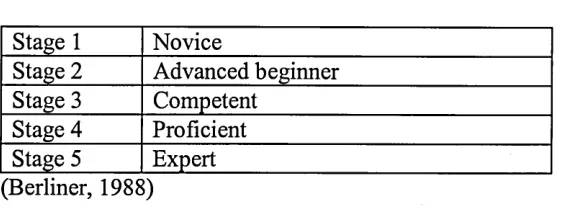
presented a detailed explanation of nursing expertise based on it. Berliner’s (1988)
five stage model of teacher development (table 2.1) not only shares the same five
stages of the Dreyfus model but also has very similar underpinning explanations of
each stage. Berliner’s emphasis is on the cognitive processes fundamental to teacher
behaviour.
Table 2.1 Stages of expertise development
Stage 1 Novice
Stage 2 Advanced beginner Stage 3 Competent
Stage 4 Proficient Stage 5 Expert (Berliner, 1988)
[image:31.612.138.421.555.659.2]means they are unable to change tack at will and will carry on an activity even if it is
fruitless. Ability to prioritise is also limited, incidents and issues within the
classroom, such as monitoring pupils’ understanding and distributing equipment, are
given equal importance. Once Stage 2 has been reached the teacher has built up a
number of guidelines for activities based on prior experience. However, situational
perception is still limited as is prioritising. At Stage 3 teachers have developed
standard, routine procedures. Teachers are organised and their actions are the result
of conscious, deliberate planning. They have also begun to see their actions as part of
long term goals and less of a ‘one off situation. By Stage 4 prioritising situations has
become part of the routinised actions. The teacher can now separate important events
and issues from those that are less so. The teacher has developed an ability to see the
‘bigger picture’ and plan their lessons accordingly toward annual aims rather than
daily aims. Also in Stage 4, teachers begin to perceive deviations from normal
patterns and react accordingly. This is to say that they are now developing the ability
to change tack when activities are not producing the desired effect. Decision making
is less laboured and quicker. At Stage 5, rules and guidelines are no longer relied
upon. An intuitive notion of the classroom environment is embedded in a deep tacit
knowledge. Analysis of events and actions only occur when problems arise,
otherwise routines are kept fluid. Creativity is linked to a wider vision of what may
be achieved and non-adherence to novice rules.
It is worth noting here that the above explanations of each stage are stated in terms of
teachers as professionals. The Dreyfus model details professional practice and so is
general in terminology. Their theory explains expertise as ongoing and non-reflective
although they do not discount Schon’s (1983) reflection-on-action which they say
on changing no longer adequate practices, rather than breaking-down the performance
into smaller elements for analysis. Dreyfus and Dreyfus do not describe the processes
involved in learning from experience, the only indication given of how learning is
realised is that of an accumulation of knowledge of cases. How this knowledge is
selected, stored and retrieved is not explained. Berliner’s model is grounded in
cognitive theory and identifies the gradual acquisition of problem solving skills, fluid
and flexible performance and standardised automated routines. But here too, an exact
account of the process of learning from experience is not given. Human
interpretations are susceptible to fallibility and therefore cases may become invalid.
Attention must be paid to the quality of the experience and therefore the case, before
generalisations can be made.
In a four year longitudinal study Shulman et al (1986,1987; Shulman & Grossman,
1988; Wilson, Shulman & Richert, 1987) identified three main components of teacher
knowledge: pedagogical knowledge, content knowledge, and pedagogical content
knowledge. Pedagogical knowledge is knowledge of theories and principles of
learning, teaching, classroom behaviour and management. Content knowledge is
defined as knowledge specific to the teacher’s specialist subject and Pedagogical
Content Knowledge allows the teacher to transform content knowledge into a
teachable form and it initiates an understanding of how topics are related and most
effectively presented to the learner. These components are described as being part of a
framework that organises these and other components such as: curriculum knowledge;
other content knowledge; and general pedagogical knowledge, into an effective
database or ‘personal landscape’ from which the teacher may draw upon or move
develop cyclically with the teacher transforming, reflecting and gaining new
comprehension before transforming again.
In a study of three secondary science teachers who were identified as good teachers
by school colleagues, Sanders et al (1993) found that the teachers they observed and
interviewed appeared to be expert in many ways, either when teaching their specialist
or non-specialist subject. The teachers had a deep insight of how to pace lessons to
ensure a smooth flow. The researchers related this to the development of complex
schemata for teaching similar to that stated by Leinhardt and Greeno (1986). Two of
the more specific conclusions which they drew focused on pedagogical knowledge.
They state that the teachers have a strong base of pedagogical knowledge which
seems to have the most influence when teaching out of their specialist area. It is also
very evident when teaching within their specialism. They also claim that pedagogical
knowledge:
...provided a framework for teaching that was filled in by content knowledge and pedagogical content knowledge” (p.733).
Salmon (1995) likened expert knowledge to: “..an intricate personal landscape
through which to move at will from one interesting vista to another” (p. 32). It would
be fair to say that this notion of constructed knowledge assumes a more personal
knowledge base which is uniquely derived from social and situational interaction.
This is reinforced by Schmidt et al (1990). In their study of medical expertise they
found that exposure to a large and varied number of cases may be an important
element in the development of expertise.
This appears to be a similar notion to that of Berliner (1987) and designates
experience as important to achieving expertise. While few would disagree with this it
should also be stated that the mere accumulation of hours of practice or exposure to a
large number of cases does not in itself constitute nor guarantee expertise. Zeichner
and Gore (1990) have argued for the need to consider the quality of the experience
rather than the quantity. They emphasise that “one should not assume, as has often
been the case in the past, that experience equals educative experience and that the
more experience the better” (p. 107).
Jones et al (1997) and Bevins (1998) suggest that student-teacher mentoring is a two-
way process where established teacher-mentors can learn from student teachers while
offering their expertise and knowledge to students. The researchers interviewed
twenty mentors covering a range of subjects and they claim that student teachers bring
new ideas and ways of teaching to the classroom that an established teacher-mentor
can use and adapt for their own practice. This indicates that pre-service teachers can
offer a range of differing perspectives on teacher performance that established and
expert teachers may learn from.
Experience then, is not just building a reserve of experiences from which to draw. It
is actively seeking specific experiences from which to learn and then assimilating the
learning from those experiences (Johnston, 1994). Ey (1978) states:
To be conscious is to live the uniqueness o f ones ’ experience while transforming it into the universality o f ones' knowledge, (p.3)
This is an interesting point and has direct relevance to the findings presented in this
activities that are initially executed with much effort can, after repeated experience,
become managed more efficiently and quickly.
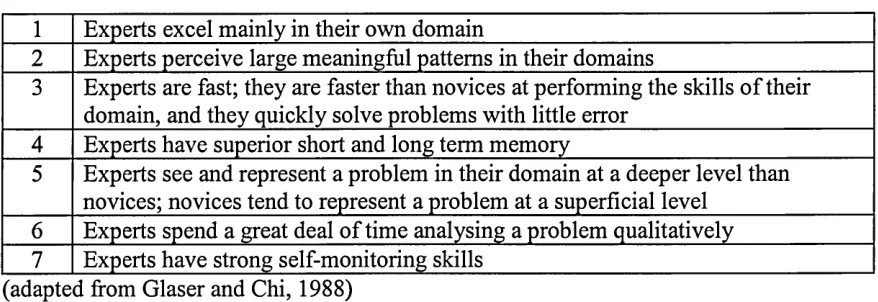
Glaser and Chi (1988) provide an overview of expertise and highlight seven
characteristics presented in table 2.2 which they generalise across professional
[image:36.612.58.497.231.382.2]domains and not just education.
Table 2.2 Characteristics of professional expertise
1 Experts excel mainly in their own domain
2 Experts perceive large meaningful patterns in their domains
3 Experts are fast; they are faster than novices at performing the skills of their domain, and they quickly solve problems with little error
4 Experts have superior short and long term memory
5 Experts see and represent a problem in their domain at a deeper level than novices; novices tend to represent a problem at a superficial level
6 Experts spend a great deal of time analysing a problem qualitatively 7 Experts have strong self-monitoring skills
(adapted from Glaser and Chi, 1988)
Their first characteristic, experts excel mainly in their own domainsa is based on a lack
of evidence of expert skill transfer from one domain to another. They cite Minsky
and Papert (1974)
A very intelligent person might be that way because o f specific local features o f his knowledge-organising rather than because o f global
qualities o f his thinking (p. 17).
What they are saying here is that an expert is so in his/her subject and that there is
evidence to show that they may act like novices out of their specific subject area and
there is little evidence to prove that expertise is transferable across subject areas. As
stated earlier, Sanders et al (ibid) found that expert science teachers teaching out of
their specialist area sometimes performed like novices although they were able to
draw on their pedagogical knowledge to assist them in such circumstances. This
pedagogical knowledge which they rely on while teaching out of their specialism.
This is to say that while teaching is highly context dependent an expert teacher may
be able to excel outside of their specialism because of a well developed pedagogical
knowledge base.
The second characteristic, experts perceive large meaningful patterns in their domain,
is supported by the work of Newell and Simon (1972). They show that chess masters
excel in their ability to recall patterns and clusters of pieces which they see during
play. Glaser and Chi point out that this ability does not, in itself, reflect a superior
perceptual capacity. Rather, it shows an effective organisation of the knowledge base.
The speed with which experts solve problems or perform a skill is indicative of the
third characteristic, experts are fast. Two possible explanations are given for this: the
first is put down to accumulated hours of experience of task performance such as a
typist. Many hours of practice enable the skill to be executed quickly and more
automatically, which in turn frees up memory to process other task related activity
and unrelated tasks. The second is based around the assumption that experts arrive at
solutions to problems quickly and accurately. Glaser and Chi use the example of a
cab driver that will recognise the shortest and most economical route while travelling
to a destination.
This also has implications for their fourth characteristic, experts have superior short
term and long-term memory. They explain that this is not because experts have a
greater memory capacity than others, rather that the automaticity of their performance
declarative knowledge and were able to retrieve more facts relevant to a problem
situation.
This finding supports the fifth characteristic, experts see and represent a problem in
their domain at a deeper level than novices. Chi et al. (1981) discovered that experts
solving physics problems employed principles of mechanics to organise information,
while novices used literal objects within the problem description. Thus, experts have
concepts which are semantic or principle based, while novices’ concepts are more
syntactic or surface based.
Barba and Rubba’s (ibid) study also supports the sixth characteristic of Glaser and
Chi, experts spend a great deal o f time analysing a problem qualitatively. In
recognising possible alternative solutions and underlying principles expert science
teachers analysed problems qualitatively, whereas novices moved immediately into a
solution only to find the path they had chosen was incorrect. Glaser and Chi explain
this expert behaviour by stating that:
Basically they build a mental representation from which they can infer relations that can define the situation and they add constraints to the problem (p. 14).
Finally, the seventh characteristic highlights the reflection process, experts have
strong self-monitoring skills. They state that experts seem to recognise their failures
and errors in a more proficient and qualitative manner:
Experts ask more questions, particularly when the texts from which they have to learn are difficult. Novice learners, on the other hand, ask more questions on the easier materials (p. 20).
They also argue that the superior self-monitoring skills of an expert reflect the
In a position paper Sternberg and Horvarth (1995) define a model that is based on
psychological research across a variety of professional domains, but is specific to
teaching, and raises very similar issues. They present a prototype view of expert
teaching and their model seeks to provide a way of thinking about teaching expertise
rather than claiming definitive status. Their aim was to distinguish expert teachers
from teachers who are merely experienced at teaching. In table 2.3 the researchers
suggest three ways in which expert teachers may differ from non-experts.
Table 2.3 Three differences between experts and non-experts
1 Experts bring knowledge to bear more effectively on problems 2 Experts solve problems more efficiently and in less time
3 Experts are more likely to arrive at novel and appropriate solutions to problems (adapted from Sternberg and Horvarth, 1995)
From these statements they build their model around three core characteristics,
knowledge, efficiency and insight. They go on to describe knowledge using
Shulman's (1986; 1987) notion of pedagogical knowledge, pedagogical content
knowledge and content knowledge. They also state that the expert possesses
knowledge which is better organised than that of the non expert. This is in the form
of mental scripts and schemata. Most of their claims support previous research
findings (Shulman, 1986; 1987; Leinhardt & Greeno, 1986; Glaser & Chi, 1988).
However, they do make an interesting argument for knowledge of the social context
for teaching. They claim that an expert teacher has a tacit knowledge which enables
them to cut through, for instance, administrative barriers which may impede the
acquisition of resources. Sternberg and Horvarth see this as an important practical
skill or ‘savvy’ which an expert teacher has.
implications of the term expertise. Glaser and Chi’s first characteristic—experts excel
mainly in their own domain, is a good example. However, the purpose of presenting
these studies is to draw attention to the types of characteristics which experts exhibit;
to unpack expertise, and not to attempt to discover new insights into expertise.
As the literature presented so far has concentrated on teachers’ thought processes it is
pertinent to include in this chapter an overview of the notion of reflection. Whether
depicted as a form of metacognition or self-evaluation it appears that reflection is an
important process for reaching and maintaining expert practice.
2.4 The reflective practitioner
Schon’s (1983; 1987) theory of the reflective practitioner is probably the most
referred to in studies of professional performance. His critique of positivist
epistemology is based on his belief that the technical rationality model does not
articulate how professional’s work in practice and that it is inadequate as a descriptor
of professional practice. Schon’s epistemology highlights creativity and artistry of
performance as the way in which some professionals “...make sense of complexity
and reduce uncertainty to manageable risk” (p. 18) within professional activity. This
he calls ‘reflection-in-action.’ His emphasis on intuition and the ability to reffame or
reconceptualise a situation demonstrates his reduced concern with the unproblematic,
general issues of professional practice (Eraut, 1994). Therefore, he concentrates less
on expert practice when a situation is running smoothly and has centred on critical
incidents or problem situations which give rise to reconceptualisation of the situation
that when a dilemma occurs the practitioner can, through reflection, draw from a
repertoire of understandings and actions to solve the problem.
He indicates that this is a kind of “...thinking on your feet” (p.54). His statements of
reflection-in-action and reflection-on-action are observations of engaged activity and
of post activity. However, the two statements have been the cause of considerable
debate centred on his theory. As Munby and Russell (1989) noted:
..his work is not sufficiently analytical and articulated to enable us to follow the connections that must be made between elements o f experience and elementsof cognition so that we may see how reflection-in-action might be understood to occur (p.74).
Eraut (1994) shares this difficulty:
Many o f his long examples fail to provide any evidence that reflection-in-action is occurring; and in several examples, including all those from science, engineering and management, reflection-on-action appears to have been at least as likely a cause o f reframing as reflection-in-action
(p. 148).
Eraut uses the term ‘reframing’ here to denote the monitoring process involved in
metacognition. Indeed he prefers to remove the term ‘reflection’ from Schon’s theory
and sees it as a useful theory of metacognition. Olson (1992) believes that reflection
is “..part o f the skilful process, not a parallel process which gives the action its
intelligence” (p. 17). Olson also states that reflecting and acting are not a dual
process but one reflective action.
What Schon does make clear is that he holds little faith in the model of ‘technical
rationality’ that he believes assumes that professional action is embedded in theory
which precedes practice and that expertise lies in the theory and not the practice. He
suggests that the challenge for understanding, developing and improving practice is to
important implication for this present study as it implies that practitioners have a tacit
knowledge of their practice, which only they may fully articulate.
Silcock (1994) believes that assuming two different types of reflective process (in
action and on-action) may be problematic in the use of reflective techniques today.
By identifying core generic principles of reflective practices, contradictions may be
reduced and a theory of reflection which does not distinguish between two types may
be more useful. Therefore, he states that reflection may be defined as a:
Ubiquitous, cognitive process, not only reworking tacit knowledge into skill but providing, through symbolic transformations, a means for linking social and knowledge contexts, and for translating one sort o f experience
(e.g. academic) into another (e.g. practical) (p.974).
Silcock suggests this to be a way of justifying competing models of reflective
teaching. He does, however go on to warn against claiming too much for professional
development programmes from a process which seems to be endemic to every
element of teaching practice. This is to say that Silcock believes reflection to be as
much a part of teaching as knowing one’s subject area. Therefore, he feels that CPD
programmes that claim reflection to be an innovative way of developing practice are,
perhaps, just another way of understanding the process of reflection.
Reflective processes may enable practitioners to exploit and articulate professional
knowledge which in turn enables knowledge and skill development. Reflective
practitioners utilise a repertoire of techniques, including metaphors, cooperative
discourse and analogies to enhance the process of reflection (Clift, et al, 1990; Yinger,
1987). Schon’s account of reflection and subsequent analysis of other accounts
(Olson, 1992; Eraut, 1994; Silcock, 1994) has shown that reflection is an important
error and are prone to weaknesses common to human thought processes and it is
possible for an expert to allow features of their expertise to stagnate or decay (Eraut,
1994). Thus reflection can be seen as an integral part of the process of achieving and
more importantly maintaining expertise.
2.5 Teacher effectiveness
A yardstick frequently used to measure teacher effectiveness is pupil achievement.
Although this approach was not used in the present study, there are characteristics
contained in some of the reported literature which are pertinent to this study.
Stallings et al (1978) research (targeted at reading instruction) indicated that the
pupils they studied, who worked independently under teacher supervision or took
direct instruction from their teacher, had a much higher achievement ratio than those
who were expected to learn on their own, and that more frequent instruction was
needed for lower ability pupils. This suggests that the effective teacher intervenes
regularly to give guidance and instruction, while allowing pupils to work
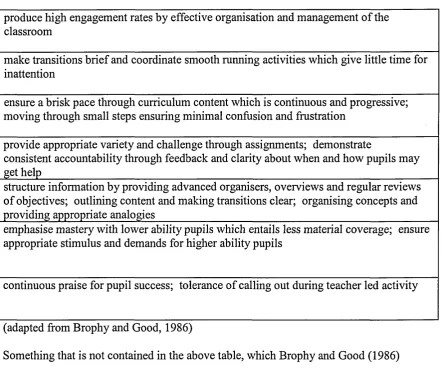
independently. A major review by Brophy and Good (1986) concluded that the
quantity and pacing of instruction is essential to pupil achievement. This is consistent
with many other research findings centred on this theme. They explain this through a
Table 2.4 Quantity and pacing of instruction
produce high engagement rates by effective organisation and management of the classroom
make transitions brief and coordinate smooth running activities which give little time for inattention
ensure a brisk pace through curriculum content which is continuous and progressive; moving through small steps ensuring minimal confusion and frustration
provide appropriate variety and challenge through assignments; demonstrate
consistent accountability through feedback and clarity about when and how pupils may get help___________________________________________________________________ structure information by providing advanced organisers, overviews and regular reviews of objectives; outlining content and making transitions clear; organising concepts and providing appropriate analogies________________________________________________ emphasise mastery with lower ability pupils which entails less material coverage; ensure appropriate stimulus and demands for higher ability pupils
continuous praise for pupil success; tolerance of calling out during teacher led activity
(adapted from Brophy and Good, 1986)
Something that is not contained in the above table, which Brophy and Good (1986)
found, is that pupils learn more when their teachers cover more subject content.
Brophy and Good do not stipulate whether they mean adequate coverage of
curriculum content or coverage of a vast amount of subject specific material. If they
mean the former then surely this is an obvious conclusion.
However, the abilities stated in the above table would be widely accepted as important
factors for effective teaching and thus, successful learning. Implicit in table 2.4 is a
strong belief in pupils’ ability to leam. Fullan (1985) believes that there is a need for
teachers to have high expectations of their pupils. The ‘Fifteen Thousand Hours’
[image:44.613.54.500.48.416.2]were higher where teachers had positive attitudes toward and high expectations of
their pupils’ capabilities.
A matter for discussion here is whether or not positive attitudes and high expectations
of pupils are characteristics of teaching expertise or merely of a teacher ‘doing the
job’. The literature detailing novice practice concedes that less experienced teachers
are rule bound and do not develop flexible working practices and a deeper
understanding of classroom dynamics until later in their development. In view of this
it may be possible to conclude that because novices are concentrating on the rules of
teaching they do not exhibit positive attitudes towards high expectations and
understanding of pupils until later in their development.
Opie (1995) interviewed and observed five successful teachers of reading and found
that they too exhibit high expectations of their pupils and demanded a lot from them.
Opie also found that the teachers valued the construction and maintenance of positive
relationships with their pupils and that they felt that this was essential to effective
teaching. While exploring pupils’ perceptions of a good teacher Younger and
Warrington (1999) used focus group interviews with year eleven pupils and found that
both boys and girls believed that treating pupils with respect, fairness and equality
was a necessary attribute of an effective teacher and that pupils from a wide range of
schools “...preferred teachers to be approachable, helpful and friendly. ” The pupils
were also critical of teachers who demonstrated moodiness in the classroom.
The recent enquiry carried out by the management consultancy group Hay McBer
(2000) into teacher effectiveness, collected data by questionnaire to teachers and
The data was analysed in terms of value-added data throughout one year of
performance in classroom tests and school examinations. Over one thousand teachers
from primary and secondary schools with pupils from a wide range of social
backgrounds were used. Teacher effectiveness was ‘measured’ against knowledge
and skills acquired by pupils as measured by tests and examinations. The research
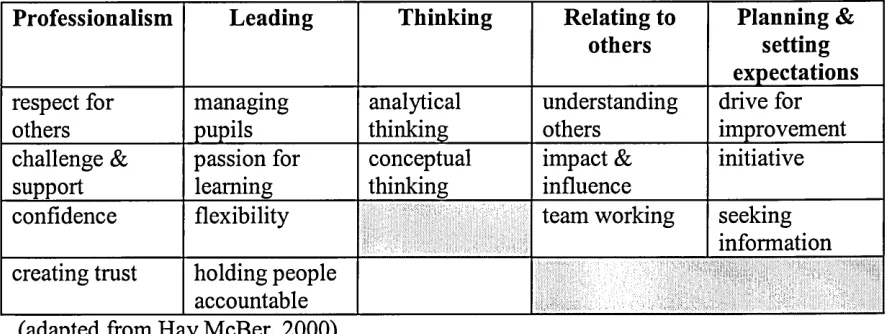
produced sixteen characteristics of effective teaching organised by five categories
[image:46.612.49.496.264.431.2]shown in Table 2.5.
Table 2.5 Hay McBer characteristics of effective teaching
Professionalism Leading Thinking Relating to
others Planning &setting expectations
respect for
others managingpupils thinkinganalytical understandingothers drive for improvement challenge &
support passion for learning thinkingconceptual impact & influence initiative
confidence flexibility team working seeking
information creating trust holding people
accountable (adapted from Hay McBer, 2000)
Hay McBer claim that there are “clear links between the characteristics for effective
teaching and the teaching skills proposed in the DfEE’s Threshold Standards” (Hay
McBer, 2000, p.l). They also suggest that their research adds an extra dimension to
the standards by describing, in detail, the behaviours that underpin effective teaching
at the Threshold level. The suggestion that they ‘describe in detail’ cannot be
substantiated as the research is only partly in the public domain—the interim report is
not sufficiently detailed and lacks some of the data, while the DfEE website report is a