DAY, Liza.
Available from Sheffield Hallam University Research Archive (SHURA) at:
http://shura.shu.ac.uk/20657/
This document is the author deposited version. You are advised to consult the publisher's version if you wish to cite from it.
Published version
DAY, Liza. (2002). A theory of commitment to belief and its positive effects on well being. Doctoral, Sheffield Hallam University (United Kingdom)..
Copyright and re-use policy
All rights reserved INFORMATION TO ALL USERS
The quality of this reproduction is dependent upon the quality of the copy submitted. In the unlikely event that the author did not send a com plete manuscript and there are missing pages, these will be noted. Also, if material had to be removed,
a note will indicate the deletion.
uest
ProQuest 10701304
Published by ProQuest LLC(2017). Copyright of the Dissertation is held by the Author.
All rights reserved.
This work is protected against unauthorized copying under Title 17, United States C ode Microform Edition © ProQuest LLC.
ProQuest LLC.
789 East Eisenhower Parkway P.O. Box 1346
Positive Effects on Well Being
Liza Day
A thesis submitted in partial fulfilment of the requirements of
Sheffield Hallam University for the Degree of Doctor of Philosophy
measurement context to the notion that a commitment to belief leads to a positive outcome, particularly in terms of mental health. The present work seeks to test a number of hypotheses derived from a Jungian theoretical framework, but seeks to draw on modem personality, individual difference, cognitive and social
psychological theory to critically examine findings.
A total of 14 studies (10 which use original data) are carried out that (1) develop a measure of commitment to belief (Chapter 2), (2) examine the reliability and validity of the commitment to belief measure (Chapters 2 and 3), (3) examine psychological correlates of the commitment to belief measure against measures thought to reflect Jungian descriptions (Chapters 4, 5 and 6), and (4) examine the relationship between commitment to belief and mental health within the context of modem theories of stress appraisal and coping style (Chapter 7 and 8).
The present findings suggest it may be possible to measure commitment to belief, and that a person scoring high on the commitment to belief scale tends to report: fewer depressive symptoms, less anxiety, less social dysfunction, fewer somatic symptoms, liking words that suggest completeness or wholeness, sometimes higher levels of extraversion, higher levels of optimism, using challenging primary appraisals, using a positive reinterpretation and growth coping style, and using their beliefs to deal with major life events.
First and foremost, I would like to thank Dr John Maltby for all his help and advice in the completion of this research. Above all, I would like to thank him for his incredible patience and seemingly limitless enthusiasm and inspiration. I would also like to thank Dr Ann Macaskill for some constructive advice.
Preface... ... 1
Chapter One: A theoretical context for findings supporting commitment to belief and positive outcomes from belief... 3
Introduction... 4
Belief definition... 6
A general theoretical context for belief... 7
A commitment to belief: Jung’s theoretical support... 16
Commitment to belief and positive mental-health outcomes... 19
Main statement relating to the programme of research... 21
Implications in considering a commitment to belief... 22
Aims of the following studies... 24
Chapter Two: The Commitment to Belief Scale: Exploratory factor analysis and some initial consideration of construct validity... 25
Summary... 26
Introduction... 27
Underlying principles measuring commitment to belief... 27
Eliciting core beliefs using Personal Construct Theory... 28
Considering dimensions to belief, borrowing Attribution theory 29
Initial consideration of construct validity... 30
Aim of the study... 32
Method... 32
Results... 43
Discussion... 52
Chapter Three: The Commitment to Belief Scale: Further consideration and exploration of reliability and validity... 56
Summary... 57
Study One: Are the constructs, generated by the Commitment to
Belief Scale, central to the person... 60
Study Two: Are the constructs generated by the Commitment to Belief Scale related to general attitude sets... 63
Study Three: The Commitment to Belief Scale should be related to general statements regarding individual’s commitment to belief. 71
PART TWO: Further examination of the internal structure of the Commitment to Belief Scale... 74
Study Four: Does the Commitment to Belief Scale measure a one factor or three factor model... 74
Study Five: Test - re-test reliability: Commitment to Belief should be stable over time... 79
PART THREE: Research questions related to the commitment of belief scale to other constructs... 82
Study Six: Discriminant Validity: The relationship between commitment to belief, irrational belief, and just world beliefs... 82
General discussion and final comments... 87
Chapter Four: Commitment to belief and Jungian theory (Part I): Jung’s typology and concepts surrounding individuation... 90
Summary... 91
Introduction... 92
Commitment to belief and individuation... 92
Issues of measurement... 94
Others measures of self-fulfillment... 99
Aims of the study... 100
Study one: Method... 101
Study one: Results... 107
Study one: Discussion... 114
Study two: Method... 116
Study two: Results... 117
Summary... 124
Introduction... 125
Jungian personality types and commitment to belief... 125
Commitment to belief and optimism... 128
Aims of the study... 124
Study one: Method... 130
Study one: Results... 132
Study one: Discussion... 135
Study two: Method... 136
Study two: Results... 137
Study two: Discussion... 138
Final Comments... 139
Chapter Six: Commitment to belief, spirituality, and religiosity 141
Summary... 142
Introduction... 143
Jungian theory surround religiosity and spirituality... 143
Modem theories of spirituality... 147
Modem theories of religion... 149
Aims of the study... 152
Method... 153
Results... 157
Discussion... 162
Chapter Seven: Commitment to belief and stressful life events... 164
Summary... 165
Introduction... 166
Conceptualising commitment to belief and its positive effects on mental health... 167
Ellis: providing a basis for understanding the relationship of belief
processes... 169
Considering stressful life events... 173
Using life events with Ellis’ ABC format... 174
Method... 175
Results... 177
Discussion... 182
Chapter Eight: Commitment to belief, primary appraisals and coping.. 185
Summary... 186
Introduction... 187
Primary stress appraisals... 188
Coping... 192
Optimism... 196
Rationale and Aims of the study... 198
Method... 199
Results... 203
Discussion... 212
Chapter Nine: Discussion... 215
Summary... 216
Overview of findings... 217
Contributions to the psychology literature... 233
Future research and implications... 236
Final summary and comments... 245
References... 247
Appendix One: Commitment to Belief Scale... 275
Appendix Two: Rating scale for constructs... 281
Appendix Three: Tarot Cards... 283
Chapter 2
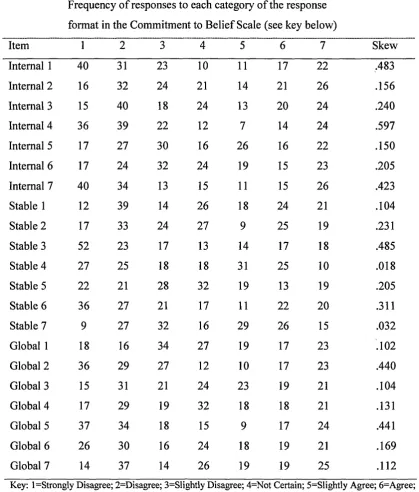
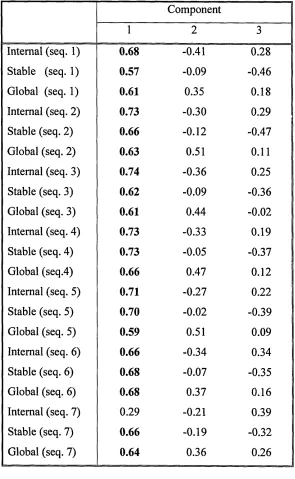
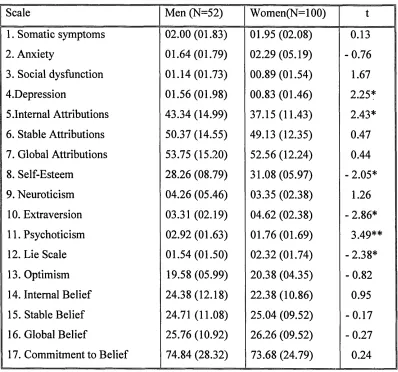
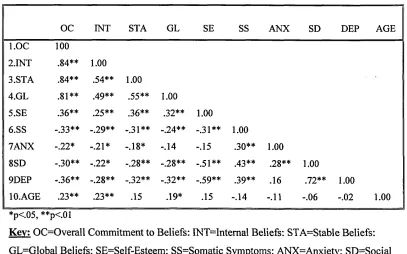
Table 2.1: Frequency of responses to each category of the response format for each item in the Commitment to Belief Scale, and skewness statistics for each item... 44 Table 2.2: Alpha coefficients for all items on the Commitment to Belief scale... 45 Table 2.3: Principal components analysis with unrotated solution 46 Table 2.4: Eigenvalues for all items above 1.00 for the Commitment to Belief scale... 47 Table 2.5: Extracted method of Principal component analysis with oblomin rotation (extraction method) for the three factors... 48 Table 2.6: Mean scores (Standard Deviations) by sex, and Independent Samples t-test for total sample, for all the scales... 50 Table 2.7: Pearson product-moment correlation coefficients between internal, stable, and global beliefs, overall commitment to beliefs, age and psychological well-being measures... 51 Table 2.8: Pearson product-moment correlation coefficients between structure of beliefs, commitment, age and attribution and personality 52
Chapter 3
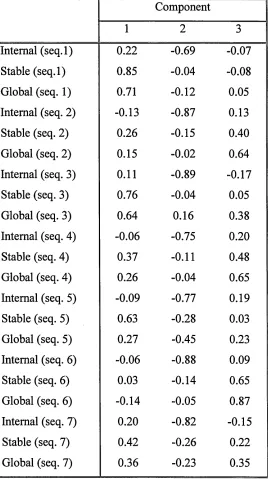
Belief scale... 75 Table 3.7: Principal components analysis with unrotated solution 76 Table 3.8: Extracted method of Principal component analysis with oblomin rotation (extraction method) for the three factors... 77 Table 3.9: Good fit statistics for 1 and 3 factor models of the Commitment to Belief Scale... 78 Table 3.10: Test - Re-test Reliability for the three aspects to belief, of internal, stable, and global dimensions, of the Commitment to Belief scale over a 4-month interval... 81 Table 3.11: Mean scores for Internal, Stable, Global beliefs, and overall commitment to belief, irrational belief, just and unjust belief by sex 85 Table 3.12: Pearson Product moment correlations computed between internal, stable, and global beliefs, overall commitment to belief, irrational belief, and just and unjust belief... 85
Chapter 4
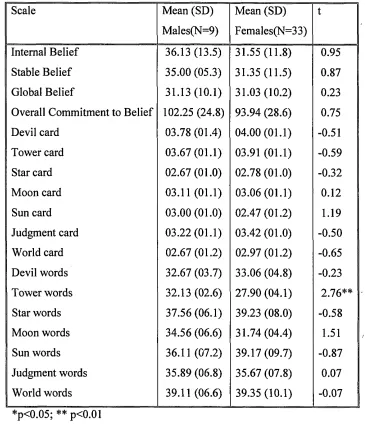
Table 4.1: Mean Scores by sex for internal, stable, global, and overall commitment to belief; the seven Tarot pictures; and the total word
scores each of the seven Tarot cards... I l l Table 4.2: Pearson Product moment correlation coefficient matrix for all the variables, and internal, stable, global and overall commitment to beliefs... 113 Table 4.3: Alpha coefficients for all the scales and mean scores for all the variables by sex... 118 Table 4.4: Pearson Product moment correlation coefficient matrix for all the variables of the measure of actualization potential, and internal, stable, global, and overall commitment to belief... 119
Chapter 5
the variables by sex... 137 Table 5.4: Pearson Product moment correlations computed between internal, stable, and global beliefs, overall commitment to belief, and the Life Orientation Test... 138
Chapter 6
Table 6.1: Alpha coefficients for all the scales and mean scores for all the variables by sex... 158
Table 6.2: Pearson Product moment correlation coefficient matrix for all the variables, and internal, stable, global and overall commitment to beliefs... 161
Chapter 7
Table 7.1: Alpha coefficients for all scales and mean scores for all variables by sex... 178 Table 7.2: Frequency table showing number of beliefs used to help with stressful Life Event... 179 Table 7.3: Pearson Product moment correlation coefficient matrix for all the variables, and overall scores of beliefs used... 180 Table 7.4: Regression analysis for social dysfunction using overall commitment to belief in its original format and overall scores of beliefs used... 181
Chapter 8
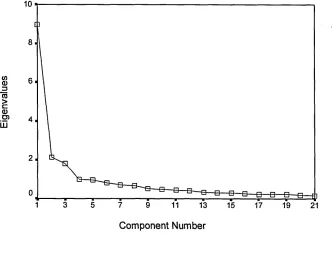
Figure 2.1: Scree Test showing the performance of Eigenvalues 47 Figure 8.1a: Model 1. Mediated path model suggesting commitment to beliefs relationship with somatic symptoms is mediated by optimism and challenge appraisals... 209 Figure 8.1b:Model 2. Mediated path model suggesting commitment to belief s relationship with anxiety is mediated by optimism... 210 Figure 8.1c: Model 3. Mediated path model suggesting commitment to beliefs relationship with depression is mediated by optimism and denial... 210 Figure 8.Id: Model 4. Mediated path model suggesting commitment to beliefs relationship with social dysfunction is mediated by optimism and challenge appraisals... 211 Figure 9.1: A model showing the mechanisms affected by a
PREFACE: A Context for the Thesis
It may be necessaiy to provide some context for the following thesis. There seems to be two forms of PhD submission in present UK institutions; the first is through a studentship, whereby (under present guidelines), the student presents unpublished work, and the PhD is partly viewed as comprising research training leading to a researcher capable of publication. The second is submission of a PhD through publication, for established researchers, where a collection of articles is presented within an introduction/discussion context for consideration.
The present submission presents a mixture of both, as the submission comprises research that is entirely new, but is based firmly within the context of work that has already been published by the author. It is, therefore, important to note that the ideas for presenting an original contribution to the literature grew out of existing and published research work.
This impacts on the presentation of the PhD in two ways;
1. The work does not necessarily start from an outline of theory, review of relevant research, leading to an examination of several research ideas. Rather, the work re-interprets/examines some present research (some of which is led by the author), then tries to provide a theoretical context for the present work, and then seeks to test and develop this context through the examination of research questions.1
2. The work does not represent a growth in research training around developing a range of methods; rather, there is a use of traditional quantitative and experimental methods to develop a research idea. As such, a quantitative methodology and outlook are already defined and expected within much of
research.2
Aside from these aspects, all the usual features of a PhD are present, with the work pulling from a range of literature across disciplines within the subject to provide an interpretation of recent research, a modem context to some very old ideas, an impetus for future research, and an original contribution to the psychological literature.
CHAPTER ONE
and greatly increased over recent years. The shift in emphasis from philosophical theory (such as Foucault’s writings on belief systems [1970; 1980], and William James’s first links of belief to psychology [1902/1985]) towards the scientific study of belief has led to substantial and exciting progress in the understanding of belief and its effects on psychological well-being, and as a consequence, in some cases, the development of therapy techniques for relieving symptoms (cognitive therapy). In spite of the progress made, however, there are still very many inconsistencies in the research to date, and there is a lot more scope for improving our understanding. This is particularly the case with the research examining the relationship between belief as a function and positive effects on health. There appears to be very little research directly investigating the actual construct of belief (the energy, or dynamic of belief, behind the observable belief), and its relationship to psychological well-being, as opposed to specific belief and well-being (i.e. the direction of belief - how the belief manifests itself), as well as little theoretical guidance as to the why and how belief affects health. As a step towards filling this apparent research void, this thesis seeks to systematically examine the relationship between commitment to a belief and its positive effects on well-being, whilst providing a theoretical context.
As a result of the research activity in the field of belief, several theories of how specific beliefs effect health have been proposed, and extensively tested. Belief, as with attitudes, has been considered as possessing a function, that is, that a person’s beliefs, and consequently their behaviours derived from these beliefs, serve the needs of the individual (e.g. Allport, 1960; Frankl, 1978; Jung, 1958; Maltby, Lewis, & Day, 1999; Maslow, 1971; Seligman, 1990; Thoreson, 1999; Scheier & Carver,
1995). Belief has been reported to have both beneficial and detrimental effects on a person’s well-being. These research areas are fully established, and are interesting because they demonstrate how particular beliefs have both positive and negative effects on the mental health of the individual, and suggest that certain individuals have a vulnerability to become anxious, depressed, or lower in self-esteem due to believing in certain ‘detrimental’, or ‘irrational’ beliefs (e.g. Ellis, 1962; 1995). However, alongside these supposed ‘negative’ effects on mental health, researchers have also shown that specific beliefs, such as religion and belief in good luck, also have ‘positive’ effects on the individual. If this is the case, as authors such as Darke and Freedman (1997), Maltby and Day (2000), Pargament (1997) have demonstrated, further research into the dynamic of the actual construct of belief is called for.
Belief, then, is a phenomenon that has many and varied consequences. Because of this, it is of great interest to psychologists, with emphasis around consequent behaviour, effects on general health, and psychological well-being. However, major considerations and overviews of belief tend towards considering them as specific, independent beliefs; not as how and why belief, as a construct, functions as it does, but how specific beliefs (such as religion, irrational beliefs, e.g. luck, etc.) are structured, formed or changed, and what psychological purpose these specific beliefs serve. The research reported in this thesis attempts to address recent findings that belief has a positive effect on mental health, and seeks to establish a theoretical context to why belief performs/functions in this way. Firstly, however, a discussion of the relevant literature will be presented, in order to further explain the need for this research.
The present chapter, then, is designed to look at two areas of belief (religion and luck) more closely, in order to present arguments for a programme of research. Though both areas of research, in religion and luck, are somewhat disparate and fragmented, certain elements emerge from these areas that (i) highlight the
importance of belief to the well-being of the individual; (ii) demonstrate similarities in how they are presently conceptualised; and (iii) suggest how an overall
traditional theories of Jung. Finally, problems and concerns of the type of methodology needed to explore the programme of research will be addressed. Firstly, however, various definitions of belief will be presented in order to outline how the word/construct of ‘belief will be used within this thesis, as well as a general theoretical context for how belief will be perceived and conceptualised.
Belief Definition
As with any research process, it is very useful to have a relatively clear
conceptualisation of the phenomenon of interest. It would, therefore, be very useful to outline what belief might be, and how it will be conceived within this thesis.
The word ‘Belief is generally used in the standard dictionary sense for an emotional acceptance, or confidence, of some proposition, statement or doctrine (Reber, 1985). However, the term ‘Belief has many and varied conceptualisations within psychology, and the research literature concerning belief often uses the term ‘belief in conjunction, or as well as, terms such as ‘opinion’ or ‘attitude’.
Opinion is generally a tentatively held and expressible point of view, and the term is usually used with the connotations of being intellectually held and based on at least some facts or data. These aspects can help, somewhat, to differentiate opinion from belief (where an emotional component is entailed), and from attitude (which has a much broader range of semantic implication).
entails several components, namely; cognitive (consciously held belief or opinion);
affective (emotional tone or feeling); evaluative (positive or negative); and conative
(disposition for action). Reber (1985) suggests that there is considerable dispute as to which of these components should be regarded as more, or less, important. Cognitive theorists usually maintain that the underlying belief is fundamental,
behaviourally oriented theorists focus in the conative, and most other researchers feel that a combination of the affective and evaluative components are the critical ones. Exactly how the term is used in modem psychological literature will, thus, depend largely on the theoretical tilt on the writer. Finally, other authors, by attempting to rescue the term from its frizziness of usage, consider attitude as a response tendency, i.e. regard attitudes as things, which can only be inferred from observed behaviours (Reber, 1985).
Within the literature on belief, then, these three terms, particularly belief and attitude, consistently overlap, and it is impossible to review the literature without encountering both terms. Therefore, this thesis will also use both terms
interchangeably, considering attitude within a more cognitive and affective domain, i.e. as having emotional tone or feeling, and maintaining the underlying belief as fundamental. However, this thesis will attempt to use the term attitude, instead of belief, when discussing a suggested observable behaviour, in other words, when
measuring belief.
A general theoretical context for belief
If there were a general theoretical context in which to understand this thesis, under which it will be argued that Jungian ideas can be used as a basis to test research questions relating to positive outcomes of belief, it would be placed generally within a functional theory of attitude.
1. Utilitarian function (Katz, 196), also known as Instrumental and Adaptive (Eagly & Chaiken, 1993), in which people are motivated by securing positive outcomes and resisting negative outcomes,
2. Knowledge function with which attitudes are used to supply a standard frame of reference for organising and simplifying information from the world.
3. Ego defensive function, which emphasises the psychoanalytic principle of the use of defence mechanisms to preserve self-concept against internal and external threats.
4. Value expressive function, which emphasises the importance of attitudes as a need for self-expression and self-actualisation.
There is relatively little theorising that seeks to add to these functions (Eagly & Chaiken, 1993), and very little available empirical evidence (Shavitt, 1989). Originally, Katz (1960) saw these aspects as distinct functions, however, there has been some attempt to integrate or combine the four functions (Eagly & Chaiken,
1993). For example, there is thought to be the Object-appraisal function, sometimes thought to be an integrated version of the Utilitarian and Knowledge functions (Herek, 1986; Kiesler, Collins & Miller, 1969; Tesser & Shaffer, 1990) which is thought to provide individuals with schemas for assessing objects and events in terms of the interests of the individual. Other authors, Abelson and Prentice (1989), Herek (1986), and Shavitt (1989; 1990), have also sought to integrate and elaborate on Katz’s model, yet have always placed the integration within Katz’s original distinctions (Eagly & Chaiken, 1993).
emphasis is on attitudes3 serving as a function. That is, in this and the following chapters, ideas in relation to the ways that attitudes secure positive outcomes and resist negative outcomes, supply a standard frame of reference for organising and understanding the world, emphasise psychoanalytic principles (albeit in this work Jungian principles rather than traditional Freudian ego-defensive theory are
important), and stressing the importance of attitudes as a need for self-expression and self-actualisation are explored.
Thus, using this context, two areas of belief (religion and luck) will be presented, in order to forward arguments for this thesis. As mentioned earlier, certain elements emerge from the research of both religion and luck that:
1. Stress the importance of belief to psychological well-being and how the importance of belief may have positive outcome in terms of mental health 2. Examine how researchers within certain areas have tried to explain
positive outcomes of a specific belief and, finding problems in explaining this, have suggested how an overall interpretation (how the underlying construct of belief is functioning in itself) may be required, and be applied to understand these explanations, and
3. Because of this, suggest the need for a provision of an overall theory that centres on a commitment to belief
Each of these points will now be considered individually, where research on religion and luck can be used as an argument/proposal for the direction of this thesis.
(1) The importance of belief to psychological well-being: positive outcomes in terms of mental health.
As previously mentioned, the literature suggests that beliefs can be related to an individual’s mental health, though often, within sets of the literature, a distinction can be made as to whether the belief has a positive effect or a negative effect on
luck.
The first example is religiosity. Many authors debate the issue of whether religion has beneficial or detrimental effect on the mental well-being of individuals (Beit-Hallahmi & Argyle, 1997; Gorsuch, 1988; Wulff, 1997). However, one area of research has suggested that distinctions can be made between individuals’ orientation toward religion, and it is these religious orientations that are useful in predicting whether religiosity has a positive or negative effect on mental health (Gorsuch, 1988). Three main religious orientations have been identified that are thought to have varying effects on psychological well-being (Allport & Ross, 1967; Beit- Hallahmi & Argyle, 1997; Gorsuch, 1988; Leong & Zachar, 1990; Maltby, 1999a; Wulff, 1997). The first is an intrinsic orientation, where a person lives their religious beliefs, the influence of which religion is evident in every aspect of their life (Allport,
1966; Allport & Ross, 1967). The second is an extrinsic orientation, which is split into (ii) extrinsic-personal, where individuals look to religion for comfort, relief, and protection, and use religious practices for peace and happiness (Kahoe & Meadow,
1981) and (iii) extrinsic-social, where individuals look to church for making friends, creating social status, and being part of an in-group (Allport & Ross, 1967; Fleck,
1981; Genia& Shaw, 1991).
Overall, an intrinsic orientation has been found to be related to mental health in finding that it is related to lower anxiety and depression, and higher self-esteem; while both extrinsic orientations are related to poorer psychological well-being through reports of higher extrinsic religiosity being related to higher neuroticism, anxiety, depression and lower self-esteem (Allport, 1996; Allport & Ross, 1967; Baker & Gorsuch, 1982; Batson, 1976; Batson & Gray, 1981; Batson & Ventis,
1982; Bergin, 1983; Fleck, 1981; Genia, 1991; 1996; Genia & Shaw, 1991; Kahoe & Meadow, 1981; Kirkpatrick, 1989; Koenig, 1995; Maltby, 1999a; Maltby, Lewis & Day, 1999; Nelson, 1989; 1990; Park, Cohen & Herb, 1990; Sturgeon, 1979;
Watson, Morris & Hood, 1989).
1997). Irrational themes of belief traditionally centre on a cognitive theory to explain the development of maladaptive emotion (Ellis, 1962). Ellis’ Rational Emotive Therapy (RET; Bernard & DiGuiseppe, 1989; Ellis, 1985), or more recently renamed Rational Emotive Behaviour Therapy (REBT; see Ellis, 1995) is based on an ABC model of psychological disturbance and therapy, where 4 A’ is some activating stressful life event (e.g. frustration, failure, rejection), 4B’ refers to irrational beliefs, and 4C’ refers to the psychological and behavioural consequences of these irrational beliefs, i.e. psychological disturbance and maladaptive behaviours. One of the major assumptions of this model is that a positive relationship exists between the separate constructs of irrational beliefs (B) and psychological
disturbance (C), particularly with regards to depression. Empirical support for this assumption has been reported in numerous correlational studies relating irrational belief to mental health (Malouff, Schutte, & McCellend, 1992; Muran, Kassinove, Ross, & Muran, 1989; Muran & Motta, 1993; Nottingham, Rosen, & Parks, 1992). However, due to recent findings (Darke & Freedman, 1997a; Day, Maltby & Macaskill, 1999; Day & Maltby, in press), it is unclear whether an irrational belief such as luck is detrimental to mental health. Researchers have begun to re-evaluate the notion that luck is maladaptive, and instead, their findings show that it is adaptive (has a positive effect) when considering the positive illusions around good luck; leading to feelings of confidence, control and optimism, increasing self-esteem, and reducing levels of depression and anxiety (Darke & Freedman, 1997a; Day, Maltby & Macaskill, 1999; Day & Maltby, in press; Taylor & Brown, 1988). These
findings, then, are contrary to what would be predicted by the usual theory relating to luck and suggest further conceptualisations are needed to understand the positive relationship between belief in an irrational belief (good luck) and mental health (Day, et al., 1999; Day & Maltby, in press).
(2) An explanation of positive outcomes: Something more than ‘somehow just coping’
As mentioned above, present findings suggest that religiosity and belief in luck can sometimes be associated with better psychological well-being, particularly when concentrating on certain aspects of these beliefs (i.e. intrinsic orientation towards religion, e.g. Genia, 1991; 1996; Genia & Shaw, 1991; Maltby, 1999a; 2000; Maltby, Lewis & Day, 1999; belief in good luck, Darke & Freedman, 1997a; Day, Maltby & MacAskill, 1999; Day & Maltby, in press; Taylor & Brown, 1988). However, within this research there is little overarching theoretical guidance that suggests the reasons for these positive outcomes. Usually researchers, reflecting on such findings, often conclude that individuals demonstrating these set beliefs are able to ‘cope better’ than those other individuals that do not show these aspects of belief (Day & Maltby,
1999; Pargament, 1990,1997).
At best, some researchers have tried to expand this idea of coping in more detail, though often this is descriptive, or philosophical, more than theoretically, or empirically, led. For example, Pargament (1990,1996,1997) makes the distinction between positive religious coping and negative religious coping. This theoretical perspective views religion as a coping process (Pargament, 1990; 1996; 1997; Pargament, Olsen, Reilly, Falgout, Ensing, & Vanhaitsma, 1992; Pargament & Park,
religious coping is associated with higher levels of depression and reporting of psychological symptoms. Such theorising, regarding the influence of religious coping in the relationship between religious orientation and psychological well being, is useful. However, this consideration cannot, at present, be expanded into a wider theoretical context, i.e. religious coping cannot be used to explain the positive and negative distinction in, for example, the belief of luck etc, and rather, like religious orientation, theory is led by findings from analysis of scales rather than any driving rationale.
Similarly, there is a relationship between belief in ‘good’ luck and
psychological well-being, though theorising does extend beyond a simple coping hypothesis. At best, authors conclude good luck may provide an important means of coping with the very real influences that chance sometimes has on everyday life (Darke & Freedman, 1997; Day etal., 1999). However, despite some findings suggesting that optimism may sometimes play an important role in the relationship between belief in good luck and mental well-being (Day & Maltby, in press), again there is little overarching theoretical guidance for this relationship.
However, the literature on the positive effects of religion and belief in good luck do share some similarities, not only in terms of the relationship between some aspects of these beliefs and better mental-health outcomes, but also in the reliance on a simple coping hypothesis to understand these relationships. Not only can this reliance be discussed in its failure to provide a comprehensive theory, but, even when presented with detailed coping theory (as with positive and negative religious
Therefore, there seems a need to begin to conceptualise these findings. With authors coming to such conclusions in these areas, further theorising is limited. At best, authors have only been able to suggest that there may be some integral aspect in the belief itself, that is important to the belief, and that this is a neglected sole
emphasis within the psychology of religion, whereby positive outlook and outcomes are central to the research questions (Day & Maltby, 1999; in press; Maltby & Day, 2000; in press). Part of the reason for such an explanation may be due to these aspects being traditionally seen, then, as single personality variables or traits, which are the means to better psychological well-being. However, if this is so, then this personality characteristic or belief trait needs to be examined more closely. This closer examination, and the clues to which psychological processes may be integral to the beliefs that result in better psychological well-being, may already be present in authors’ descriptions and speculations regarding the present findings relating to intrinsic religiosity and belief in good luck.
(3) Providing an overall theoretical perspective: The central role of commitment to/ strength of belief.
One aspect to the present literature findings, on occasions when distinctions can be made between different types of belief, is that, certain dimensions may reflect a commitment. That is, where the individual has somehow internalised their belief, i.e. that a person has become committed to that belief, and thus it has become an
underlying principle in their life.
positive effect on a person’s psychological well-being. Other evidence in the psychology of religion supports this. Maltby, et al (1999) show that, with frequency of prayer, it is those persons, who show a commitment to prayer (i.e. once a day or more) that show better mental-health, through lower depression, anxiety and higher self-esteem. Here, then, commitment is reflected in the attention and importance placed on religious worship, in that it is a daily activity.
Similar ideas around the importance and commitment/strength of beliefs are echoed in the belief in good luck literature, where this concept of a committed set of ideas being lived, can also be found. Within this literature, belief in good luck is seen as an attempt to understand the world, particularly in response to events in our lives that are largely beyond any direct attempts to control (Darke & Freedman, 1999). The uncertainty associated with the possibility that such events may occur can be quite disconcerting, especially when the consequences are substantial. Rothbaum, Weisz and Snyder (1982) suggest that irrational beliefs about luck may allow individuals to remain optimistic even when it is objectively impossible to exercise direct control over one’s circumstances. As such, it is this belief that gives meaning to life and events, and adherence to this belief set helps the person interpret, understand and deal with the world.
Alongside these, there are many other theories of belief that propose that specific beliefs give purpose in life (e.g. Carson, Soeken & Grimm, 1988; Klein, Kupfer & Shea, 1993; Richards, Owen & Stein, 1993; Seligman, 1990). For example, Wright (1993) found that lower depression scores among adolescents are significantly positively correlated to those individuals who found meaning in life. Also, Carson, Soeken and Grimm (1988) found that a sense of life purpose and satisfaction related both to trait hope (hope as a personality characteristic; how one generally feels) and state hope (hope based on specific situations and times; how one feels at the moment).
being, as well as, or in place of, a negative effect.
To summarise, then, it has been argued, so far, that there are 3 main areas in how the research literature can support the need for an overall theory of positive belief, instead of considering individual theories. First, there is some evidence in the literature, which stresses the importance of belief to psychological well-being, and emphasises positive effects on mental health. Second, there is the need to consider these positive effects in more than ‘coping better’ theoretical terms. Third, that it is a commitment/strength of belief that may be important. However, although a strong argument for an overall theory of commitment to belief has been presented, and common variables/constructs put forward to warrant examination of an overall theory, as yet, little theoretical guidance has been identified. Nevertheless, whilst reviewing the aforementioned literature, one traditionalist theorist has proposed similar principles on the nature of belief. This theorist is Jung, who, across his lifetime, outlined theoretical underpinnings that can lend themselves to the strength and commitment shown by individuals to a set of beliefs, rather than to the type of belief. Again, this literature is somewhat fragmented, nevertheless there are definite theoretical constructs that can be drawn upon to support and enhance a theory considering these dimensions to overall belief. These focus on two areas; (i) conceptualising a commitment to belief, and (ii) using commitment to belief to explain positive mental health effects.
A commitment to belief: Jung’s theoretical support
Jung demonstrates throughout his work that commitment is a fundamental part of belief. He indeed sees this commitment as intrinsic to human nature, and thus a person both lives, and is part of their “religious” beliefs, the influence of which, belief is evident in every aspect of their life. Jung provides theoretical guidance for the importance of a commitment to belief in three main ways.
argued that this religious function was as powerful as the Freudian instinct for sex and aggression, and that every spiritual feeling, every mystical insight, every creative experience, comes from the collective unconscious. This religious experience Jung called a Numinosum (a word coined by the theologian Rudolph Otto, 1917). Indeed, Corbett (1999) has suggested that certain situations can also be summed up as numinous, filling the person with awe and wonder, being irresistibly attractive, allowing the person to effortlessly lose all track of time, providing joy, or removing all sense of self in a felt oneness with the world. These experiences, he argues, may occur in innumerable ways; listening to music, dancing, painting, weaving, watching children play, being in the wilderness, writing or cooking are only a few of them. When these experiences are numinous, Corbett argues that they are legitimate channels for spiritual experience, and regular participation in such an activity can be considered devotional or meditative. Yet he argues that such experiences are often ignored by Western religious culture, so that often they are not carried out with conscious reverence, in other words, people are unaware of the importance of these experiences/activities, considering only orthodox religious activities as religious in nature. Indeed, this criticism is also true of Jung, throughout his later works, as Jung began to believe that religious belief, however unorthodox, represented a supreme value, and became less able to conceive of this process in any other than religious terms (Storr, 1973). Nevertheless, Jung believed that every individual possesses an a priori 'religious instinct', an impulse for religion that is a psychic function, and that it is this instinct, which provides the occasion and the pattern for all his subsequent religious imagery and activities.
Secondly, Jung shows commitment to belief through an internal process via
the self, and that of individuation, the final arbiter being the discovery of meaning. Another way of expressing this would be to say that the religious attitude, however it may be personally or socially realized, and irrespective of time or place, proceeds from the fact that deep within our unconscious lies an archetypal form of God which is deeply, and indelibly, engraved upon our psyche. Jung argues that this religious disposition functions as an internal activity of the psyche, which generates an energy unique to itself, which then comes forth from the collective unconscious, and
the process by which the individual integrates the conscious and unconscious parts of the personality the process of individuation. The concept of individuation (Jung,
1957; 1971; 1956) denotes not a state but a living and dynamic process by which a person becomes an "individual", i.e. a separate, indivisible unity or "whole."
For Jung, individuation is a ‘coming to selfhood,' and thus the goal of individuation is the realization of the Self. The Self, in other words, must be
conceived not just as the goal of individuation but also as its originating impulse, it is both result and agent. Individuation is thus innate to individuals, a natural law of the psyche, and is considered the component, and process, to which all human beings must devote themselves, albeit with differing degrees of success. Individuation seeks the union of opposites, which means assimilating or integrating into consciousness the various unconscious parts of the psyche. It is not just that the desire for
individuation is archetypal, then, but that the archetypes themselves provide specific psychological information about how individuation is to be contained. This, Jung argues, is why philosophical and spiritual questions are asked about the meaning of life, and the purpose of existence. Individuation may be defined as religious because it is an archetypal process, and because any such orientation towards archetypes is religious. This conclusion follows directly from Jung’s account of religious experience, where religious experience is named the ’numinous’ experience by the individual of that aspect of his own psyche that is primordial, archetypal and collective. In this case, the archetypal desire for wholeness. It may also be
construed that a religious and numinous process derives its religious quality solely from being a collective experience; it requires, in other words, a ‘religious outlook on life’ by demanding of the individuating self insight into their own psychic nature. Thus, a person perceives that his conscious ego is grounded on something that is deeper than, prior to, and more fundamental than his own distinct personality, and that his desire to become an integrated human being is at the same time an
experience of the eternal and archetypal foundation of his own psychic being (Jung, 1921).
own philosophical commitment. Jung argues that in order for a person to live happily, they need faith, hope, love and insight, and that these four highest achievements of human effort only come through experiences that require us to commit ourselves with our whole being, to resolve our doubts into a 'conformed belief,' and the energic movement of the libido towards the deepest layer of the psyche, in which reside the universal and primordial images of the collective unconscious.
When Jung speaks of the act of ascribing meaning to something as a dynamic and psychically intense act, he is recalling his earlier theory of psychic energy. The relatively closed system of the psyche is characterized by the constant and dynamic movement of the libido. Although the libido itself is not observable, its course can be charted in terms of the 'value' being attributed in any given case. Values are 'quantitative estimates of energy,' so that for a person to place a high value on, say, a work of art is the same as saying that this art-object has been invested by him or her with a large amount of psychic energy. What has happened here is that psychical energy has been 'transformed' or 'canalized’ into a particular cultural phenomenon, the value being attributed to it being directly calculable in terms of the intensity of its libidinal effect.
These symbolic images, whatever form they take, are thus the manifestation and expression of the libido, and the intensity of their effect derives directly from the energic movement of the psyche, of the infusion of these images with libidinal power.
In summary, then, a religious experience is a numinous experience, and a numinous experience carries with it certain necessary psychic processes, and thus, supports the need for commitment within belief.
Commitment to Belief and positive mental-health outcomes: Jung’s theoretical support
meaning, which gives our life purpose and a reason for existence, thus allowing our selves, and the Self, to grow and develop toward individuation, which in turn, allows for a mentally healthy outlook on life. Jung's recognition and delineation of the inner world of the psyche did not include a statement as to why a person was so constituted that what went on inside him was so often at variance with the external world that he could not find all his satisfactions therein. And it is this fact, which makes a person restlessly creative, searching for ‘ideal' solutions, whether these are in the shape of scientific world-views, philosophies, religions or the integrative patterns of art, rather than a loss of the sense that there is any meaning in existence. Jung conceived that this mythological material had a positive function in giving meaning and significance to a person’s existence.
However, if, according to Jung, we cannot find a strong enough belief, in which meaning is established, then this may be extremely damaging to our mental health. Indeed, meaning was fundamental to Jung's concept of the aetiology of neurosis since the recognition of meaning appears to have a curative power. 'A psychoneurosis must be understood, ultimately, as the suffering of a soul, which has not discovered its meaning,' he wrote (Jung, 1958, para. 497). The clinical picture of neurosis often contains the feeling of meaninglessness. This led Jung to refer
metaphorically to a typical neurosis as a religious problem (1958), and states that, in the majority of cases the root cause of neurosis is connected with a loss of meaning
Thus, because religion is a psychic function, as inseparable from the individual as any other instinct, any attempt to deny its significance will result in a loss of psychic equilibrium and thus a descent into neurosis. The religious experience is a numinous experience of the archetypal and eternal foundations of humanity itself, and to that extent it enables the individual to lift himself above his personal problems and to relate instead to the indestructible and primordial dimension of his own psychic being. It is not, therefore, the acceptance of belief that is
psychologically damaging but its rejection. Therefore, Jung saw the embracing of beliefs as a positive outcome that could have positive effects on mental-health.
Therefore, it is suggested, in this thesis, that Jungian theory on belief can be used to inform modem psychology on the processes of underlying belief.
Particularly whilst focussing on two areas of; (i) conceptualising a commitment to belief, and (ii) using commitment to belief to explain positive mental health effects. Therefore, whilst investigating positive effects and commitment of belief, Jungian theory will also be investigated in order to achieve theoretical guidance for the findings.
Main Statement relating to the Programme of Research
It has been proposed, so far, that major considerations and overviews of belief tend towards viewing them as specific, independent beliefs; not as how and why belief, as a whole, functions as it does, but how specific beliefs are structured, formed or changed, and what psychological purpose these specific beliefs serve. Given this, it has been argued that there are 3 main reasons to think that the construct of belief would benefit from considering it as an overall theory of belief, instead of individual theories. Firstly, there is a lack of theoretical guidance within each specific theory on belief; secondly, all theories show common threads; and thirdly, a number of variables can be extracted, and examined more closely, in order to enable the investigation of an overall theory of belief. It has also been highlighted that
establish whether such a psychological construct can be measured, and that commitment to belief can be of psychological benefit. Chapters 2 and 3 will concentrate on the construction of a reliable and valid instrument of measurement and establishes the relationship between commitment to belief and better mental health. Chapters 4 and 5 will consider the measurement of commitment to belief within the context of Jungian theory. Chapter 6 will consider commitment to belief with measures of religiosity and spirituality by way of homage to Jungian writing on commitment to belief in religiosity and spirituality. Chapters 7 and 8 try to
conceptualise and test many of the findings from Chapters 2-8 within a modem context using the more recent theoretical explanation of ‘coping’. Finally, chapter 9 will present an overall discussion.
Implications in considering a commitment to belief: issues of measurement
A further issue that needs to be considered within this research programme is that of measurement, in other words, how do we measure an underlying concept of belief? Within psychology there are generally two main streams of measuring constructs; qualitative methods and quantitative methods, which can lead to a multitude of research strategies seeking to separate out, or to integrate both, these aspects.
Qualitative research recognises a complex and dynamic social world. It involves researcher’s active engagement with participants and acknowledges that understanding is constructed, and multiple realities exist (Bannister, Burman, Parker, Taylor, & Tindall, 1996). It is argued that qualitative methods are theory generating, inductive, aiming to gain valid knowledge and understanding by representing and illuminating the nature and quality of people’s experiences. Here, participants are encouraged to speak for themselves, personal accounts are valued, and emergent issues within the accounts are attended to. The developing theory is, thus, firmly and richly grounded in personal experiences rather than a reflection of the researcher’s a priori frameworks. In this way insight is gained to the meanings people attach to
However, it was felt, by the researcher, to be an inappropriate methodology for two main reasons;
(i) Because of the nature of research, i.e. considering an underlying construct of belief, in which to explain the positive effects on well-being within areas such as religion and luck, it was deemed necessary to fall in line
with the generally accepted methodology within these areas, in other words quantitative.
(ii) Because of point 1, and from what has been established so far in this thesis, that the research on beliefs is extensive, and in order to present an immediate valuable contribution to the literature, the research here needs to be able to be extrapolated easily to a number of populations using a number of theoretical perspectives. It was felt that qualitative research, tends to afford smaller samples, and seeking larger samples would be time-consuming (particularly within the time constraints of the present considerations) and would not enable such a contribution
Therefore, a quantitative programme of research was followed.
Within quantitative methodologies, psychometric measures of belief are substantial; however, these measures are designed to assess specific beliefs such as religion and luck, and cannot be used to measure an underlying commitment to belief. Therefore, it is necessary, within this thesis, to create a new psychometric measure in which to assess, and quantify the construct of belief. Thus, chapters 2 and 3 mainly focus on the creation and validation of this new scale.
must also consider this ambiguous connotation within its construction, allowing participants to reveal all their concepts of belief. Thirdly, it must be considered that, when measuring the commitment of a belief, in other words, if these beliefs are underlying or central to a person, i.e. internal, used in all situations, and have become part of the self, as well as their everyday life, then it may be difficult for individual’s to even consider them as actual beliefs. They may in fact be considered, for
example, as part of their personality. Again, this issue needs to be addressed within the scale’s construction. These issues, then, will be considered and addressed more fully within chapters 2 and 3.
Aims of the following studies
Notwithstanding the outline of the methodological stance; the main aim of the following studies was to examine a functional role of overall commitment to belief which argues (i) that a commitment to belief is important; (ii) that overall belief will be related to mental health and well-being4; and (iii) that it is the strength of belief in itself that is important and not the type of belief. Such consideration would include the development of an overall commitment to belief measure, and hypotheses derived from both Jungian theory and the research literature concerning belief. It was also a major aim of the studies to account for any alternative explanations of results found in support of an overall commitment to belief
4 It is of importance to highlight the point that this thesis will concentrate on an attempt to explain positive contributions to mental health, and will not address the issue of negative
CHAPTER TWO
Building on the theory of Jung, it was proposed, in chapter one, that three basic
dimensions underlie the importance of belief; (i) that a commitment to belief is important (i.e. that it is internalised, and used within all situations within one’s life, and is present across time); (ii) that the belief will be related to mental health, or well being; and (iii) that the strength of the belief in itself is important and not necessarily the type of belief.
To begin to explore these ideas, a measure of commitment to belief is developed and compared to measures of psychological well-being, personality and attribution style among 154 undergraduate students (52 men, 100 women). The measure was developed by adapting aspects of attribution style theory (Peterson, Semmel, von Baeyer,
Abramson, Metalsky, & Seligman, 1982), to measure internal, stable, and global aspects of belief; and Kelly’s Construct theory (Kelly, 1955), to enable the issues of belief, mentioned in chapter one, to be addressed (i.e. to reduce ambiguous meanings of belief to individuals).
Reliability and validity is found for a measure that adapts personal construct theory and attribution style as a basis for measuring individuals’ commitment to a set of beliefs. Exploratory factor analysis suggests both a one factor (overall commitment to belief) and a three factor model of commitment to belief (internal, global, and stable aspects of belief), in which both models are related to better psychological well-being, and largely fall outside personality space, and attribution style.
Introduction
The previous chapter has presented the view that belief is important to the well-being of the individual. In summary, the reviewed literature suggests the possibility of an overall theory of belief, where three basic dimensions underlie beliefs functional role; (i) that a
commitment to belief is important (i.e. that it is internalised, stable across time, and used within all situations within one’s life); (ii) that the belief will be related to mental health, or well-being; and (iii) that the strength of the belief in itself is important and not
necessarily the type of belief.
Thus, the concept of commitment to belief will concentrate on a theory applicable to understanding different types of belief and will be used to encompass a variety of belief, or possible outcomes. However, the research literature has, so far, tended to focus on the function of specific beliefs, such as religion, spirituality,
conservatism, irrationality, rather than aspects of overall belief, and thus, at present, no psychometric test is available in which to measure this commitment to overall belief. Therefore, the psychometric development of a measure is needed in order to measure and take forward this presented theory of an overall commitment to belief.
Underlying principles measuring commitment to belief
There are two main aspects to measuring commitment to belief. First, this measure must reflect core belief (beliefs that are highly important/central to the person), and must not be reliant upon one type of belief. Second, the measure must be able to measure the size of commitment within that belief (i.e. its strength of belief, whether it is evident within all aspects of one’s life).
In addition to the above criteria, three further aspects should be considered.
personal, and not easily revealed.
• The word ‘belief can have numerous constructed definitions for different people; for example, some individuals may consider belief to be only religious or spiritual. Thus, the scale must consider this ambiguous connotation within its construction.
• It must be considered that, if these beliefs are indeed central to the person, i.e. internal, used in all situations, and have become part of the self, as well as their everyday life, that it may be difficult for individual’s to even consider them as actual beliefs. They may in fact be considered, for example, as part of their personality. Again, this issue needs to be addressed within the scale’s construction.
Eliciting core beliefs using Personal Construct Theory
A commitment to belief measure needs to be able to generate people’s beliefs, and, indeed, to elicit that said individual’s core beliefs (those central to the person), as well as taking into account their sensitive nature. However, beliefs can have numerous
similarity-difference dimensions or bipolar constructs. Individuals uniquely, yet systematically, hierarchically network their constructs. Core or super-ordinate constructs are those that are central to our being, those that we use to impose personal order on our lives (Kelly, 1955). Each core construct subsumes a number of subordinate constructs, which in turn subsume more subordinate constructs, and so on. This theory, then, immediately suggests a way in which we can consider belief structures, and measure the core belief. Thus, this technique should allow direct access to the belief itself, by eliciting the individual’s own belief system and not relying on numerous or insubstantial definitions for the word ‘belief.
Considering dimensions to belief, borrowing Attribution Theory
To measure the individual’s actual commitment to their beliefs, the different dimensions to belief needs to be considered (i.e. whether the belief is internalised, used within all situations within one’s life, and is present across time), and can be facilitated by using aspects of Attribution Style Theory (outlined below) (Rotter, 1966; Peterson, Semmel, von Baeyer, Abramson, Metalsky, & Seligman, 1982; Kinderman, & Bentall, 1996). Indeed, authors, such as Jung (1933), and Allport (1966) have presented commitment as intrinsic to human nature, in other words, a person lives, and is part of, their beliefs, the influence of which, is evident in every aspect of their life, and throughout their life. This view is relevant to the present considerations as it emphasizes the importance that any measure must take account of, when measuring underlying belief. However, although authors within the literature agree upon this idea of commitment within certain contexts; e.g. intrinsic or internal religiosity (e.g. Allport, 1966; Jung, 1933), there is as yet no such scale with which to measure degrees of commitment to belief regardless of the type of beliefs respondents may have.
To begin the measurement of commitment to belief; it is worth noting the similarities between the dimensions of commitment to belief, as previously
interpret good and bad events (Abramson, Seligman, & Teasdale, 1978; Peterson, et al., 1982). In essence, interpretations of good and bad events reflect the use of internal (‘cause of events due to the individual’) versus external (‘cause of events due to other people or circumstances’) attributions, stable (‘cause of events persistent over time’) versus unstable (‘cause of events not persistent over time) attributions, and global (‘cause of events persistent over time evidence in a variety of situations’) versus specific (‘cause of events specific to one situation) attributions (Peterson et al., 1982).
Attribution style has been used in a number of research contexts, however, its largest application has been in using a reformulated learned helplessness model to explain attribution style depression (Abramson et al., 1978).
Although Attribution Style is not the target of measurement, the essence of the theory easily lends itself, for the purpose of measurement, to commitment of belief. To illustrate, an individual with a strong commitment to religious beliefs may believe that their religiosity is very personal to them (internal versus external), see religion playing a part in many, or all, areas of their life (global versus specific), and see their religiosity occurring over a long period of time (stable versus unstable).
Therefore, both Personal Construct theory and Attribution Style Theory can be utilised to operationalise the hypotheses regarding measuring core beliefs and a commitment to them. Using Personal Construct theory will also allow beliefs to be considered with sensitivity, to allow individuals to use their own frame of reference, and be used as a tool to reveal individual beliefs.
Initial consideration of construct validity
(Baker & Gorsuch, 1982; Bergin, 1983; Genia, 1996; Genia & Shaw, 1991; Koenig, 1995; Maltby & Day, 2000; Maltby, Lewis, & Day, 1999; Park, Cohen, & Herb, 1990), spirituality (Carson, Soekin, & Grimm, 1988; Klein, Kupfer, & Shea, 1993; Seligman,
1990; Thoreson, 1999), and belief in good luck (Darke & Freedman, 1997; Day, Maltby, & MacAskill, 1999; Taylor & Brown, 1988). However, these research findings are related only to a specific belief, and cannot be generalised to all beliefs. This, again, highlights the important need to develop a reliable and valid measure of core beliefs (regardless of the specifics of the belief) that will; (i) measure all underlying core belief (beliefs that are central to the person), and must not be reliant upon one type of belief; (ii) be able to measure the size of commitment within that belief (i.e. its strength of belief, whether it is evident within all aspects of one’s life); and (iii) be considered alongside measures of health and well-being. Therefore, to be certain that the
Commitment to Belief scale is in fact measuring all these things (e.g. for the purposes of construct validity), it would be expected, that there would be significant negative
correlations between the Commitment to Belief scale and anxiety and depression and a positive significant correlation between the Commitment to Belief scale and self-esteem.
When considering construct validity, another issue to be considered here is that, if beliefs are indeed central to the person, i.e. internal, used in all situations, and have become part of the self, as well as their everyday life, it may indeed be difficult for individual’s to even consider them as actual beliefs. Researchers may argue, in fact, that it could be merely considered as part of their personality. It is important, then, to
demonstrate that a measure of core beliefs is not simply assessing personality, but that it is indeed measuring an underlying principle of commitment. Therefore, for the purposes of construct validity only, personality factors will be explored using the simple measure of Eysenck’s 3-factor model (extraversion, neuroticism, psychoticism). It is expected that the Commitment to Belief scale will have no significant correlation with these personality variables.
provide further evidence of discriminant, and therefore, construct validity for the new commitment to belief measure. It is, therefore, expected that the Commitment to Belief scale will not be congruent to aspects of attribution.
Aim of the Study
The aim of the present study was to develop a Commitment to Belief scale. It is expected that; higher scores on the scale should be positively related to better
psychological well-being, should not be related to personality factor, and, given the use of attribution style concepts to develop the scale, should not be related to attribution style.
Method
Participants
154 undergraduate students (52 men, 100 women) of ages 18 to 51 years (Mean=23.12; SD=7.04) were administered the Commitment to Belief scale and a number of other questionnaires.
Questionnaires
The Commitment to Belief Scale
1. Elicitation o f the beliefs - construct theory
(i) In order to perform Kelly’s Repertory Grid technique (Kelly, 1955), a number of initial elements are required (elements are anything that give rise to construing, so as to enable the generation of constructs, e.g. the elements o f‘car’ will generate such
constructs as ‘ability to get from a to b’, ‘financial stability’, ‘status symbol’, trustworthy’ etc). In creating the Commitment to Belief scale, these elements were achieved by extracting attitudinal words or statements, that pertained to attitude theory formation and research, (attitudes: as a tendency; as evaluative; as cognitive, affective and behavioural; as objects; as representations; as functional; as self-perceiving; as self- identifying; as attitude strength) derived from a number of theoretical books (Eagle & Chaiken, 1993; Ajzen, 1996). These elements were designed to trigger belief like constructs. 34 attitudinal words or statements were believed to be appropriate for use. Raters (N=5) then sought to condense the list to a workable level by checking for duplications and inappropriate questions. Finally, a list of 18 attitudinal statements was agreed upon, and written into full instructional sentences.
A full list of the 18 attitudinal sentences are shown below (attitudinal statements are shown in bold):
1. Write down a belief, or attitude that you have that you feel strongly about. 2. Write down a belief, or attitude that you have that you are very closed about, i.e.
something that is very private to you, that you are secretive about.
3. Write down a strong belief, or attitude that you have about, or within, your profession.
4. Write down a belief, or attitude that you have that you are proud of.
5. Write down a belief, or attitude that you have that you feel is personally useful or beneficial to you.
6. Write down a belief, or attitude that you have that motivates you in your life. 7. Write down a belief, or attitude that you care about deeply.
way.
10. Write down something that you feel that you need in your life. 11. Write down something that you desire in your life.
12. Write down something that you feel is important in relationships.
13. Write down a belief, or attitude that you have that you are guided by in your life. 14. Write down a belief, or attitude that you aspire to.
15. Write down a belief, or attitude that you have that you would like to enhance. 16. Write down a belief, or attitude that you have that you would like to improve. 17. Write down a belief, or attitude that you have that could be considered as
harmful to your personal growth.
18. Write down a belief, or attitude that you feel is particularly healthy or good for you.
(ii) The aim of the questionnaire was to elicit as many beliefs as possible from the respondents. The generating of seven beliefs was decided upon, this number was arbitrary; however, from pilot studies (N=5) using the questionnaire, it was suggested that these were as many beliefs as respondents could generate within an appropriate timeframe (approximately 45-60 minutes).
order with which they should be administered to each participant was decided, by using a random number programme.
(iv) Within repertory grid techniques, the task is for participants to identify certain constructs, in this case, to identify their belief constructs. This is done by giving them three elements (attitude statements) and asking them in what way two of the three are similar to each other and different from the third. Here, the three elements were chosen randomly via random numbers. This procedure was then repeated seven times, in order to achieve 7 beliefs. As previously mentioned, carrying out this task seven times was arbitrary, but it was decided that this would be ample in which to create enough belief constructs for the purpose.
(v) The purpose of the Commitment to Belief scale is to gain access to people’s individual beliefs, thus it is important to make sure that the constructs that were generated in step (iv) above are indeed endorsed by the respondents, and that they are committed to these beliefs. To ensure this, then, as with Kelly’s repertory technique, respondents were asked to take each construct that had been generated and to write down its opposite. They were then asked to identify which of the two alternatives they believe was desirable to them. Kelly (1955) believes that the desirable construct signifies the direction of the construct, i.e. it is the desired element that is measured, for the example with ‘car’, a desired construct would be that the car presents the correct status symbol, as opposed to not. Hence, with the Commitment to Belief scale, the desirable construct is considered to be a core belief generated by the participant, and it is these 7 desirable constructs that are used in the remainder of the scale, which is
concerned with the level of commitment to these said beliefs.
2. Assessing the level of commitment - adapting Attribution Style.